The most common sourcing mistake we see with mantel mirrors isn't the frame finish or the glass grade — it's the dimensions. A buyer submits a PO for 500 units at 36 × 48 inches, the mirrors arrive, and their retail customers or hotel project managers reject them because the proportions look wrong above a standard 60-inch mantel. Returns, reorders, and a damaged supplier relationship — all from a number that could have been confirmed in five minutes.
This reference covers the proportion rules, standard dimension ranges, glass thickness requirements, and packaging implications that matter when you're sourcing Mantel Decor Mirrors at volume. The tables here are designed to be forwarded directly to your procurement team or project manager.

The Proportion Rule: Mirror Width as a Percentage of Mantel Width
Get this wrong and nothing else matters. A mirror that's too narrow looks lost; one that's too wide crowds the wall and creates visual tension that end users notice immediately — which means your buyers hear about it.
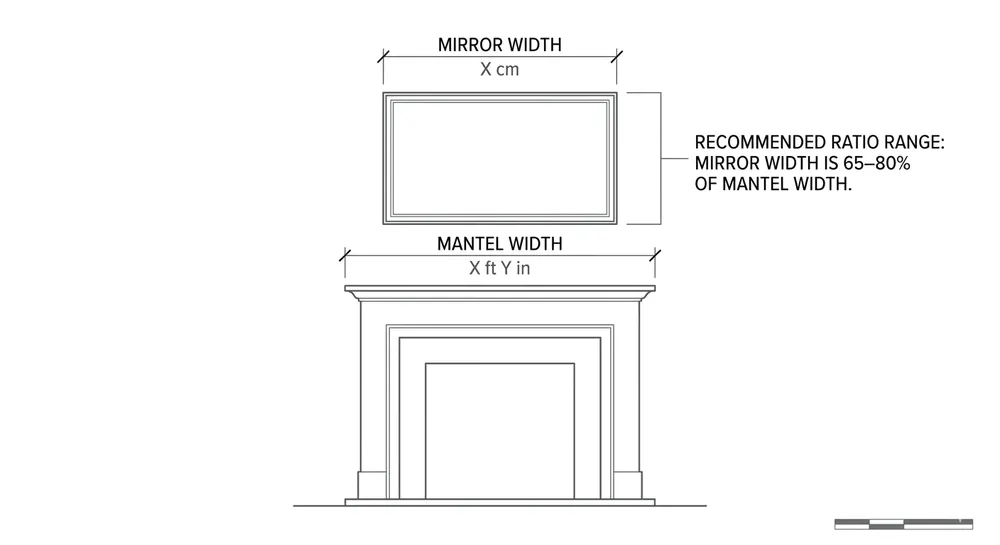
The working rule across North American and European retail programs we've supplied: mirror width should fall between 65% and 80% of the mantel shelf width. That range holds for both residential retail and hospitality projects. Below 65%, the mirror reads as undersized regardless of height. Above 85%, you start competing with the mantel's own visual weight, and in hospitality installs, it can conflict with sconce placement on either side.
(We've had hotel procurement teams send back spec sheets asking us to reduce mirror width by 4 inches for exactly this reason — the original spec was technically fine but created a sconce clearance problem in their standard room layout.)
Here's how that ratio translates to actual dimensions across the most common mantel widths:
| Mantel Width | Recommended Mirror Width (65–80%) | Typical Mirror Height | Common Frame Profile |
|---|---|---|---|
| 36 in (91 cm) | 24–29 in (61–74 cm) | 30–36 in (76–91 cm) | Narrow to mid (1.5–2.5 in) |
| 48 in (122 cm) | 31–38 in (79–97 cm) | 36–42 in (91–107 cm) | Mid (2–3 in) |
| 60 in (152 cm) | 39–48 in (99–122 cm) | 42–54 in (107–137 cm) | Mid to wide (2.5–4 in) |
| 72 in (183 cm) | 47–58 in (119–147 cm) | 48–60 in (122–152 cm) | Wide (3–5 in) |
Height is secondary to width in proportion terms, but the aspect ratio of the mirror itself matters. For mantel applications, portrait orientation (taller than wide) is standard in residential retail. Landscape or near-square formats appear in some hospitality and commercial lobby specs, but they're a smaller segment of the market and typically require custom tooling on our end.
Standard Dimension Ranges for Wholesale and Hospitality Channels
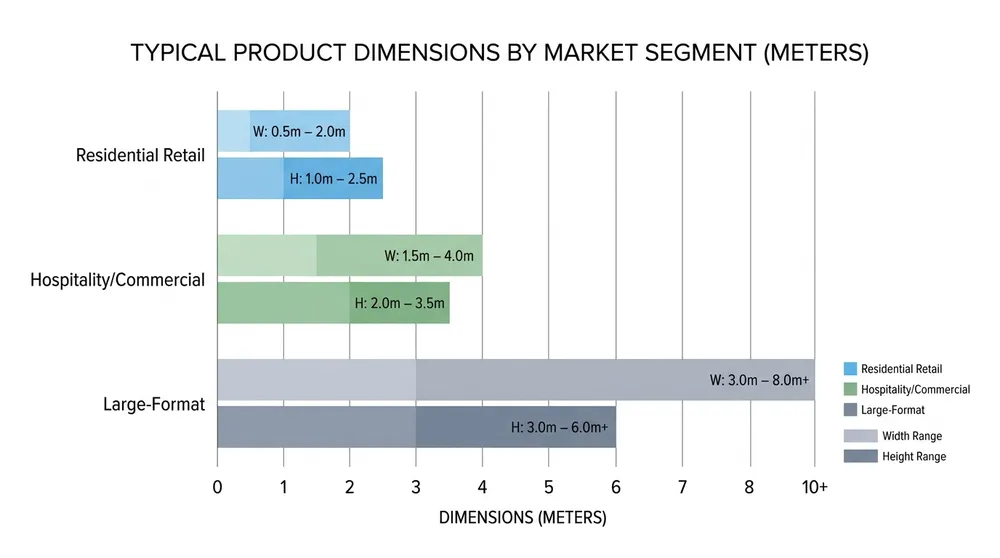
Across the programs we run for North American and European distributors, mantel mirror orders cluster around a few proven size brackets. These aren't arbitrary — they reflect what moves at retail and what fits standard hospitality room specs.
Residential retail sweet spot: 30–40 in wide × 36–48 in tall. This covers the 48-inch and 60-inch mantel market, which represents the majority of residential fireplace installations in North American housing stock. If you're building a starter SKU assortment for a home décor distributor, two sizes in this range — say 32 × 40 in and 38 × 48 in — will cover most of your sell-through without overcomplicating your inventory.
Hospitality and commercial projects: 40–54 in wide × 48–60 in tall. Hotel lobbies, restaurant feature walls, and boutique property renovations typically spec larger formats. These orders usually come with tighter dimensional tolerances (±3 mm on glass, ±2 mm on overall frame) and often require specific frame profiles to match existing millwork. We handle these as OEM runs with engineering sign-off on the spec sheet before production starts.
Large-format over-mantel: 54–72 in wide. These are less common in standard wholesale programs but appear regularly in high-end residential and commercial projects. Glass cutting yield drops at these sizes (more on that below), which affects per-unit cost. If your buyers are asking for this range, it's worth discussing in the RFQ rather than assuming standard pricing applies.
Glass Thickness Requirements as Mirror Size Increases
This is where buyers sometimes get surprised by cost or weight differences between their sample and their bulk order spec.
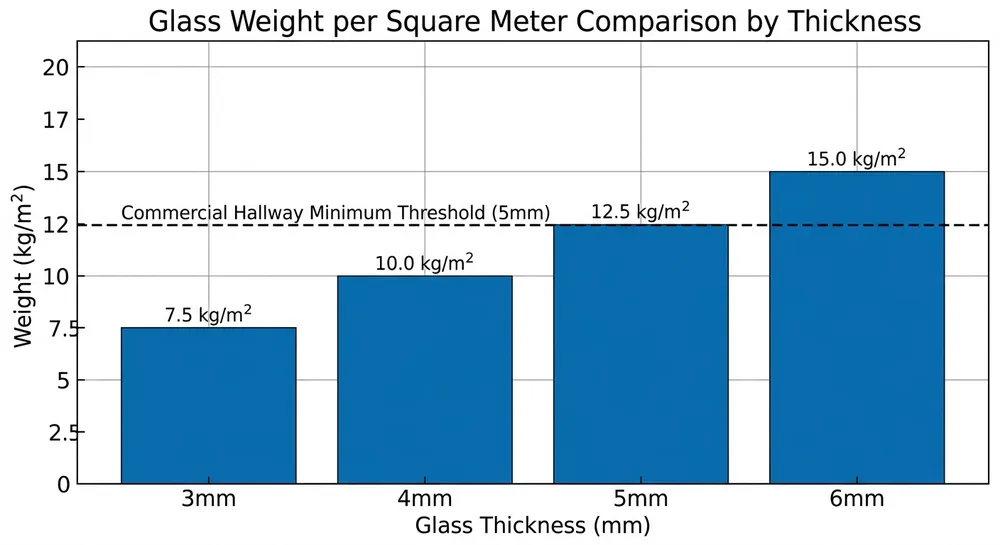
For mirrors up to roughly 24 × 36 in, 3 mm float glass is standard and sufficient. The glass is light, the cutting yield is good, and the silvering process is straightforward. Above that threshold, the calculus changes.
3 mm glass works up to approximately 24 × 36 in (61 × 91 cm). Beyond this size, 3 mm glass carries meaningful flex risk during handling and installation — not a structural failure, but enough movement to stress the silver coating at the edges over time, which shows up as edge darkening within 12–18 months. Your buyers' customers notice that.
5 mm glass is our standard specification for mirrors from 24 × 36 in up to approximately 48 × 60 in (122 × 152 cm). The added thickness eliminates flex, protects the silver layer, and gives the mirror a perceptibly more substantial feel — which matters for retail price positioning. The weight increase is real: a 38 × 48 in mirror in 5 mm glass runs approximately 18–20 kg before frame, versus 11–12 kg in 3 mm. That affects both packaging design and freight cost per unit.
6 mm glass applies to large-format pieces above 48 × 60 in. At this size, 5 mm still carries some flex risk during container loading and unloading, particularly if the carton takes side impact. We spec 6 mm on anything over 48 inches wide as a standard practice, not an upgrade. The weight and freight cost implications are significant — factor this into your landed cost calculation before quoting your buyers.
| Mirror Size Range | Recommended Glass Thickness | Approx. Weight (glass only) | Key Risk if Under-Specified |
|---|---|---|---|
| Up to 24 × 36 in | 3 mm | 5–7 kg | Minimal |
| 24 × 36 in to 48 × 60 in | 5 mm | 12–22 kg | Edge silver degradation, flex stress |
| Above 48 × 60 in | 6 mm | 25–40 kg | Flex fracture risk in transit, silver delamination |
(One thing we tell buyers sourcing large-format mirrors for the first time: the freight cost difference between 5 mm and 6 mm glass at 48 × 60 in is smaller than the cost of one RMA claim on a cracked mirror. Spec it right the first time.)
Frame Profile Depth and Wall Projection
Frame depth is the dimension buyers most often forget to specify — and it's the one that causes the most installation complaints in hospitality projects.
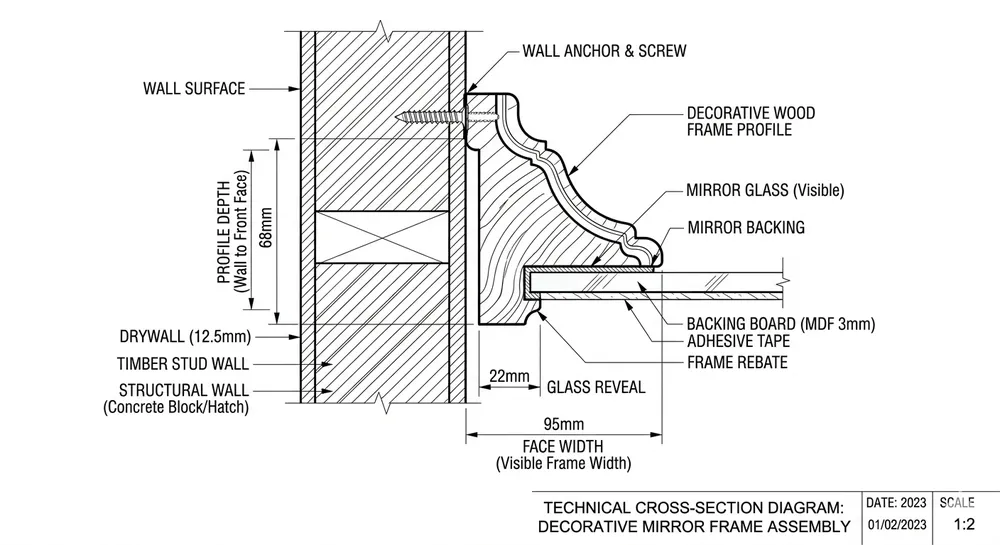
Frame profile depth (the measurement from the wall surface to the front face of the frame) typically runs 1.5–2.5 in (38–64 mm) for standard residential mantel mirrors. That projection is invisible in a product photo but very visible on a wall, particularly in rooms with recessed lighting or sconces positioned close to the mirror.
For retail programs, standard depth is fine and buyers rarely need to specify it. For hospitality and commercial projects, it's worth confirming. We've had projects where the original spec called for a 2.5-inch deep frame, and the hotel's interior designer came back after installation asking why the mirror "stuck out so far." The answer was in the spec sheet they approved — but nobody had flagged it as a decision point.
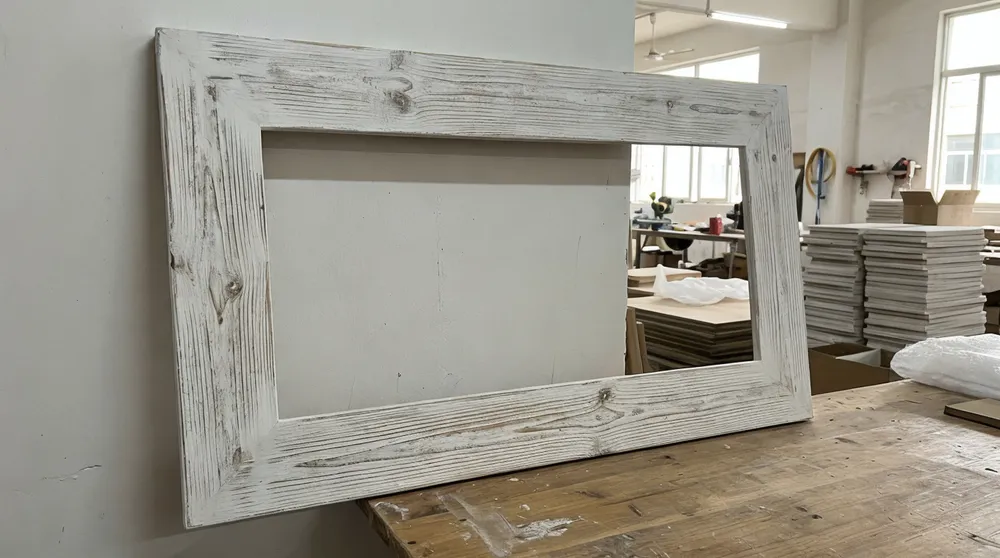
Frame profile width (the visible face width of the frame) has a more direct effect on the mirror's visual proportion. Narrow profiles (1–1.5 in / 25–38 mm) work well on smaller mirrors where the glass area should dominate. Wider profiles (3–5 in / 76–127 mm) are appropriate for larger formats and add visual weight that suits formal or traditional aesthetics common in hospitality lobbies and high-end residential.
| Frame Profile Width | Suitable Mirror Size | Typical Application |
|---|---|---|
| 1–1.5 in (25–38 mm) | Up to 32 × 40 in | Residential retail, contemporary style |
| 2–3 in (51–76 mm) | 32–48 in wide | Mid-range retail, transitional style |
| 3–5 in (76–127 mm) | 48 in wide and above | Hospitality, traditional/formal residential |
We run frame molds in-house, so profile changes don't require sourcing from an external supplier. Custom profiles are available on runs of 200 units or more — below that, the mold amortization doesn't work for either side.
How Dimension Choices Affect Production Cost and Container Efficiency
This section is for buyers who want to understand why two mirrors that look similar in a catalog can have meaningfully different per-unit costs — and why that difference isn't always about the frame finish.
Glass cutting yield is the first factor. Our glass cutting line works from standard float glass sheets. Certain mirror dimensions nest efficiently on those sheets; others generate significant offcut waste. A 30 × 40 in mirror cuts very efficiently from standard sheet sizes. A 31 × 41 in mirror — one inch larger in each direction — can drop yield by 8–12% depending on sheet dimensions, which flows directly into per-unit glass cost. When you're specifying custom dimensions, it's worth asking us to check yield before locking the spec. We do this as part of the RFQ process and will flag it if a small dimension adjustment saves meaningful cost.
Frame mold requirements are the second factor. Standard frame profiles we already run require no tooling cost. Custom profiles require a mold, which we amortize across the order. On a 500-unit run, mold cost is negligible. On a 100-unit trial order, it can add $3–6 per unit depending on profile complexity. We're transparent about this in our quotes — it's not a hidden charge, but buyers sometimes don't ask about it until after they've committed to a custom profile.
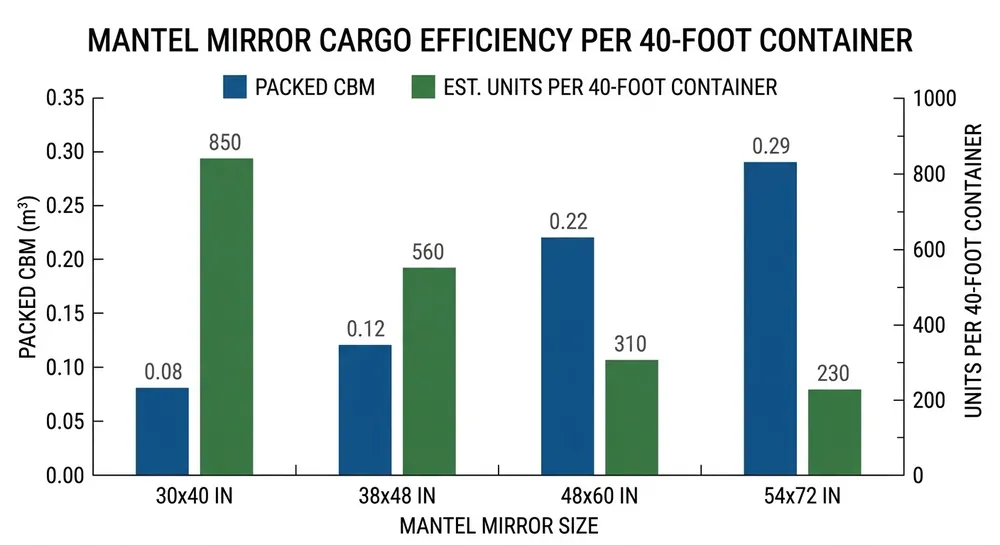
Carton sizing and container loading are where dimension decisions have the most direct impact on your landed cost. Mantel mirrors are large, fragile, and require substantial protective packaging. A 38 × 48 in mirror in a properly packed export carton typically occupies 0.25–0.30 CBM. A 48 × 60 in mirror in 6 mm glass can run 0.45–0.55 CBM per unit. The difference between a 40-unit container load and a 28-unit container load on the same 20-foot container is a freight cost difference your buyers will feel.
We've had buyers come to us after their first large-format order with a freight bill that surprised them. The mirror cost was fine; the shipping cost per unit was 40% higher than they'd budgeted because nobody had modeled the CBM at the spec stage. We now include a container loading estimate in every quote for mirrors above 40 inches wide.
| Mirror Size | Approx. Packed CBM | Est. Units per 20' Container | Est. Units per 40' Container |
|---|---|---|---|
| 30 × 40 in | 0.18–0.22 CBM | 90–110 units | 190–220 units |
| 38 × 48 in | 0.25–0.30 CBM | 65–80 units | 135–160 units |
| 48 × 60 in | 0.45–0.55 CBM | 35–45 units | 75–90 units |
| 54 × 72 in | 0.65–0.80 CBM | 25–30 units | 50–60 units |
(These are working estimates based on standard export carton specs with foam corner protection and corrugated inner wrap. Actual CBM varies with frame profile depth and packaging spec. We provide exact figures in the shipping plan attached to every confirmed order.)
Sourcing Traps: Where Dimension Specs Go Wrong
Most dimension problems we see aren't caused by bad suppliers — they're caused by incomplete spec sheets that leave too much to interpretation.
"Standard size" means different things in different markets. A 36 × 48 in mirror is standard in North American residential retail. In European markets, 90 × 120 cm (roughly 35.4 × 47.2 in) is the equivalent, but the difference matters when you're specifying frame miter cuts and glass cutting programs. If your buyer is in Europe and you submit a spec in inches without confirming the exact millimeter dimensions, you'll get a mirror that's close but not right. We work in both unit systems and confirm exact dimensions in millimeters on every order confirmation.
Overall dimensions vs. glass dimensions. A mirror listed as 38 × 48 in is almost always the overall frame dimension, not the glass size. The glass is smaller by twice the frame rabbet depth on each side — typically 10–15 mm per side for standard profiles. If your buyer's project manager is specifying the mirror based on the visible glass area (common in hospitality installs where the mirror needs to align with tile or millwork), you need to confirm which dimension they're working from. We include both overall and glass dimensions on every spec sheet.
Tolerance stacking in large orders. On a 500-unit order, a ±5 mm tolerance on overall dimensions is standard and acceptable. But if your buyer is installing mirrors in a grid pattern — a common hospitality application — that tolerance stacks across units and can create visible misalignment. For grid installations, we recommend specifying ±2 mm on overall dimensions and confirming this in the PO. It requires tighter QC on our end (we do 100% dimensional inspection on these orders rather than sampling), but it eliminates the installation problem entirely.
For buyers building a sourcing program around mantel mirrors, the companion article on sourcing mantel decor mirrors with consistent frame quality covers frame construction and QC documentation in more detail.
Dimension Reference for Common Project Types
Rather than abstract rules, here's how these specifications land in real sourcing scenarios.
Mid-range residential retail (e.g., Wayfair-tier distribution): Two to three SKUs covering 32 × 40 in and 38 × 48 in in 5 mm glass, mid-profile frame (2–2.5 in face width), standard portrait orientation. These fit 48-inch and 60-inch mantels respectively and cover the majority of the residential market. MOQ 200 units per SKU at standard pricing; 100 units per SKU is workable on established frame profiles.
Boutique hotel and resort projects: Typically 42–54 in wide × 48–60 in tall, 5–6 mm glass depending on size, wider frame profiles (3–4 in) in finishes that match existing millwork. These are OEM runs with engineering review. Lead time is longer than standard wholesale because we're confirming frame profile, finish, and dimensional tolerances before cutting glass. Budget 45–60 days from approved spec to shipment for first-time project orders.
High-end residential and interior design trade: Large-format mirrors (48–72 in wide) with custom frame profiles, often in antique or specialty finishes. These buyers care about the frame profile detail as much as the glass. We've supplied programs for interior design trade accounts where the frame profile was the primary differentiator — the glass spec was standard, but the mold was custom. Minimum run 200 units for custom profiles; standard profiles available from 100 units.
The full Decor Mirrors by Room category covers the broader mirror assortment context if you're building a multi-room program alongside your mantel mirror line.
Frequently Asked Questions
What is the standard mantel mirror width-to-mantel ratio?
65–80% of the mantel shelf width is the working rule for both residential retail and hospitality applications. Below 65%, the mirror reads as undersized above the mantel. Above 85%, it starts to crowd the wall and can conflict with sconce placement in hospitality installs. For a 60-inch mantel, that puts the target mirror width at 39–48 inches.
Does glass thickness affect the mirror's retail price positioning?
Yes, and it's worth using deliberately. A 38 × 48 in mirror in 5 mm glass has a noticeably more substantial feel than the same size in 3 mm — the weight difference is about 7–8 kg, and end users perceive it as higher quality. For mid-to-premium retail price points, 5 mm glass is the right spec. For entry-level price points where landed cost is the priority, 3 mm on smaller sizes (under 30 × 40 in) is defensible.
How do I specify dimensions to avoid installation problems in hospitality projects?
Confirm three things in writing before production: overall frame dimensions in millimeters, visible glass dimensions, and frame profile depth (wall projection). For grid installations, specify ±2 mm dimensional tolerance and request 100% dimensional inspection rather than sampling QC. These details belong in the PO, not in a follow-up email after the mirrors arrive on site.
What's the minimum order quantity for custom mantel mirror dimensions?
For custom glass dimensions using existing frame profiles, our MOQ is 100 units. For custom frame profiles (new mold required), MOQ is 200 units. Below 100 units, we can sometimes accommodate custom glass dimensions on standard frame profiles if the dimensions cut efficiently from our standard sheet sizes — worth asking during the RFQ stage.
How does mirror size affect lead time?
Standard sizes in existing frame profiles: 30–35 days from order confirmation. Custom dimensions with existing profiles: 35–45 days. Custom frame profiles (new mold): 45–60 days, with the first 10–15 days covering mold fabrication and sample approval. Large-format mirrors (above 48 in wide) in 6 mm glass add 5–7 days to any of these timelines due to glass sourcing and cutting scheduling.
Submit your target dimensions, frame material preference, and order quantity through our Request a Quote form — our engineering team will return a technical proposal with pricing, container loading estimate, and lead time within 48 hours.