You've placed a 500-unit bedroom mirror order. The first container arrives, you pull samples from three cartons, and the frames don't match. One reads warm champagne gold. Another is closer to brass. The third has a slightly different sheen — same finish name on the spec sheet, visibly different on the shelf. Your retail buyer notices before you do.
This happens more often than suppliers will admit, and it almost never shows up in a factory audit. The inconsistency isn't a quality failure in the traditional sense — the mirrors aren't broken, the glass isn't scratched. The problem is upstream, baked into how the order was set up and how the production run was controlled. By the time the container ships, there's nothing left to fix.
This guide walks through the production variables that cause style drift in bulk bedroom mirror orders, the sourcing steps that prevent it, and the acceptance criteria you should be holding any supplier to before you sign off on a shipment.

Where style inconsistency actually starts: the three production variables
Most sourcing guides treat mirror quality as a single dimension — is the glass clear, is the frame straight, does the hardware hold. Bedroom mirrors have a different failure mode. The product is decorative. Your buyer is placing it in a room where two or three mirrors may sit in the same sightline. Visible variation between units from the same order is a commercial problem, not just a cosmetic one.
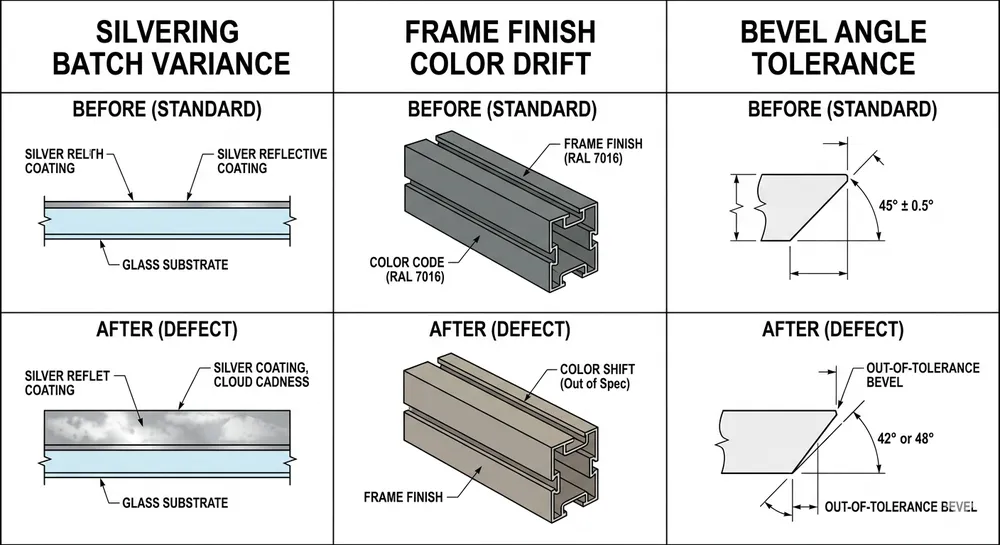
Three production variables drive most of the inconsistency we see in bulk bedroom mirror runs.
Silvering batch variance. Mirror silvering is a wet chemical process — silver nitrate solution applied to float glass, followed by a copper or copper-free protective coating. The reflectivity and tonal quality of the mirror surface depends on solution concentration, application temperature, and line speed. When a large order runs across multiple silvering batches — which happens when a factory doesn't have dedicated line capacity — the mirror tone shifts slightly between batches. On a single unit, you won't notice. Side by side on a retail shelf, the difference is visible. (We switched to copper-free silver coating across all our bedroom mirror lines in 2021 — the process is more stable batch-to-batch and eliminates the greenish tint that copper backing develops over time in humid environments.)
Frame finish color drift. Decorative bedroom mirror frames — whether wood composite, MDF, or metal — go through a finishing sequence: base coat, color coat, topcoat or wax. Each stage has a tolerance window. If the color coat is applied manually or with inconsistent spray pressure, the final color shifts across a production run. Gold finishes are the worst offenders. The difference between "antique gold" and "bright gold" is about 15 seconds of spray time and 5°C of curing temperature. Buyers who specify "gold finish" without a color standard get whatever the line produces that day.
Bevel angle and width tolerance. Beveled bedroom mirrors are a staple of the decorative segment — the angled edge catches light and adds visual weight to the frame. Bevel width and angle are cut during glass processing. On a well-maintained beveling machine, width holds to ±0.5mm and angle holds to ±0.5°. On a machine running without regular calibration, you get ±2mm width variation and visible angle inconsistency across units. The bevel is one of the first things a retail buyer looks at when comparing units from the same SKU.
Why multi-vendor assembly makes this worse
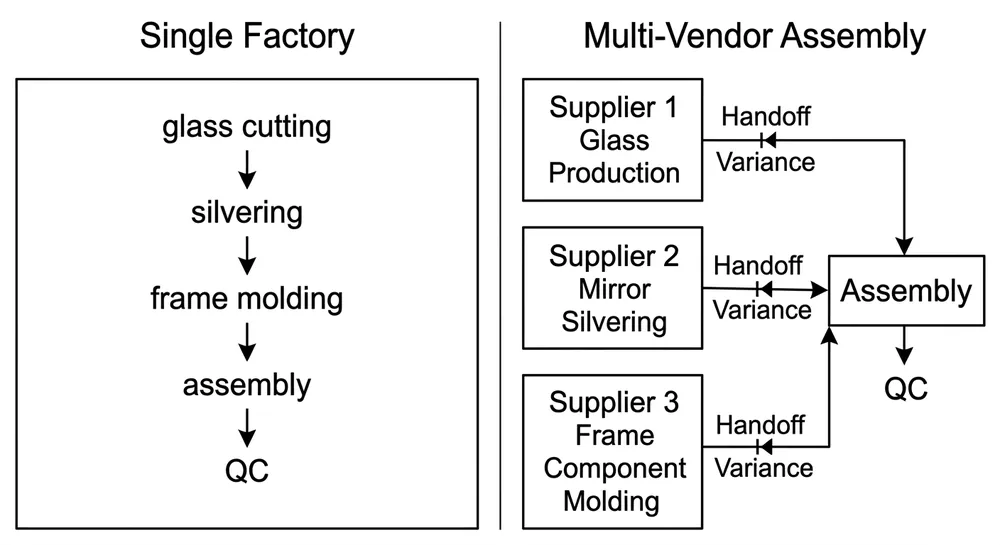
A significant share of "mirror factories" on wholesale directories aren't factories — they're assemblers. They buy glass from one supplier, frames from another, hardware from a third, and put the product together in a warehouse. Each supplier runs their own batch schedule. The glass silvering from Supplier A doesn't get matched to the frame finishing from Supplier B. Nobody owns the consistency of the finished product.
This is the core sourcing risk for bulk bedroom mirror orders. When you split production across vendors, you lose the ability to batch-control the variables that drive style consistency. The frame finisher doesn't know what the glass silvering looks like. The glass cutter doesn't know the bevel spec the frame was designed around. The assembler is working from a purchase order, not a product standard.
Single-facility production eliminates this by default. When glass cutting, silvering, frame molding, and assembly run under one roof on a coordinated production schedule, the same batch of silvered glass goes into the same batch of finished frames. Variation still exists — no production process is perfectly uniform — but it's controlled within a single quality system rather than accumulated across three separate suppliers.
Our 12,000 m² facility in Dong Nai runs the full production chain: glass cutting, beveling, silvering, frame molding, and final assembly. One QC team, one batch schedule, one point of accountability. When a bedroom mirror order ships from here, every unit in that container was built from materials processed in the same production window.
The sourcing process that prevents style drift
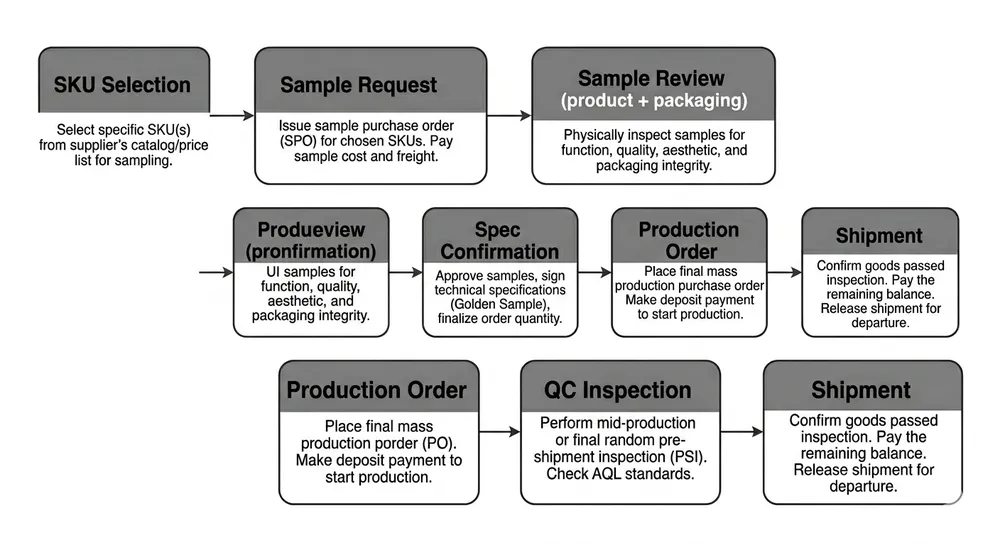
Getting consistency across a bulk bedroom mirror order isn't about finding a better factory and hoping for the best. It's about building the right controls into the sourcing process before production starts. Here's how we walk buyers through it.
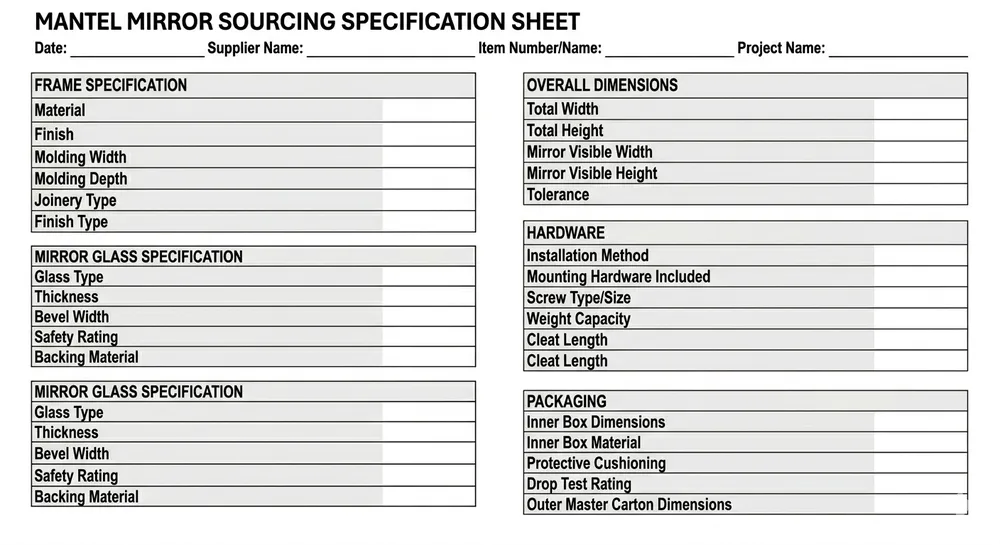
Step 1: Write a finish specification, not just a finish name
"Antique gold" is not a specification. A specification looks like this:
- Base material: MDF frame, 18mm thickness
- Primer: white water-based, 1 coat
- Color coat: RAL 1036 Pearl Gold, 2 coats, 60–80μm dry film thickness
- Topcoat: matte lacquer, 1 coat
- Acceptable color delta-E: ≤3.0 vs. approved golden sample
Delta-E is the standard colorimetric measurement for color difference. A delta-E of 1.0 is barely perceptible to the human eye. A delta-E of 3.0 is the outer limit of acceptable variation for decorative finishes. Anything above 3.0 is visible on a retail shelf. If your supplier can't tell you what delta-E tolerance they hold, they're not controlling finish consistency — they're hoping it comes out right.
The same logic applies to mirror glass. Specify the silvering standard: copper-free silver coating, minimum 100nm silver layer, salt spray resistance ≥ 96 hours per ISO 9227. These aren't exotic requirements — any serious mirror manufacturer should be able to confirm them.
Step 2: Approve a golden sample before production starts
A golden sample is a single approved unit that becomes the physical reference standard for the entire production run. Every unit in the order is compared against it. This sounds obvious, but a large share of bulk mirror orders skip this step — buyers approve a digital photo or a factory showroom sample that was made under different conditions than the production run.
The golden sample approval process should include:
- Physical sample shipped to your location (or inspected at factory by your QC agent)
- Written sign-off on: frame color, mirror tone, bevel width and angle, hardware placement, packaging
- Sample retained at factory for in-line comparison during production
- Sample retained by buyer for pre-shipment inspection comparison
Don't approve a sample over video call. The color rendering on a phone camera is not accurate enough for finish approval.
Step 3: Require a pre-production run sign-off
Before the full production run starts, ask for 5–10 units from the first production batch. These should be built using the actual production materials — not the sample batch, not leftover stock. Compare them against the golden sample. Check:
- Frame color delta-E (visual comparison or colorimeter reading)
- Mirror tone consistency across units
- Bevel width measurement (±0.5mm tolerance)
- Hardware alignment
If the pre-production units pass, production proceeds. If they don't, you've caught the problem before 500 units are built. This is the checkpoint that saves orders.
Step 4: In-line QC during production
For orders above 200 units, in-line inspection matters. A QC inspector on the production floor checks units at regular intervals — typically every 50–100 units — against the golden sample. The checks are fast: frame color, mirror surface, bevel, hardware. The goal is to catch drift before it accumulates across the full run.
What to ask your supplier: "Do you have in-line QC checkpoints during production, and what is the inspection interval?" A factory that can't answer this question specifically is doing end-of-line inspection only — which means problems are found after the damage is done.
Step 5: Pre-shipment inspection with measurable acceptance criteria
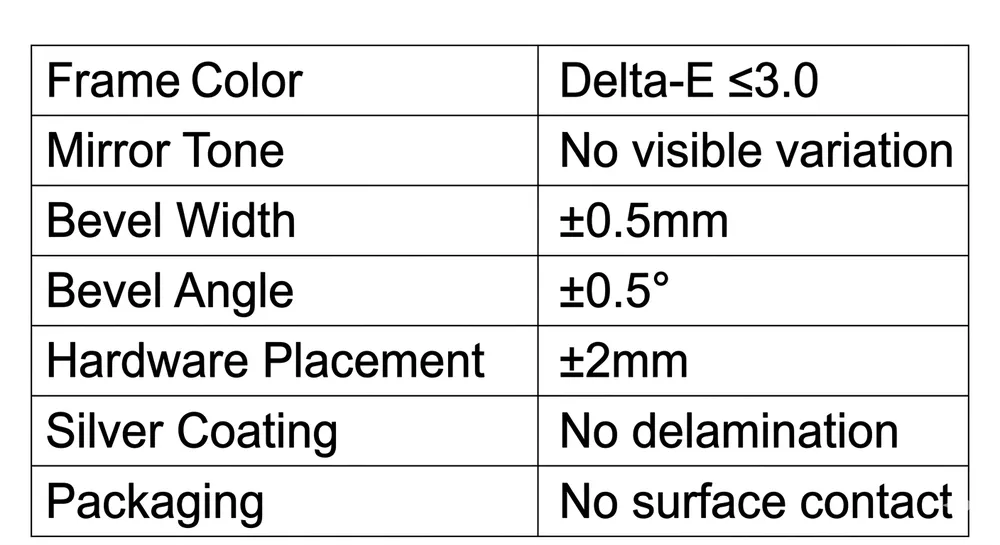
The pre-shipment inspection is your last checkpoint before the container loads. Use AQL 2.5 sampling as a baseline — for a 500-unit order, that means inspecting approximately 50 units. The inspection should cover:
| Checkpoint | Acceptance Criteria |
|---|---|
| Frame color | Delta-E ≤ 3.0 vs. golden sample |
| Mirror tone | No visible tonal variation between units |
| Bevel width | ±0.5mm vs. spec |
| Bevel angle | ±0.5° vs. spec |
| Hardware placement | ±2mm vs. spec |
| Silver coating adhesion | No delamination on tape pull test |
| Packaging integrity | No surface contact between mirror and carton |
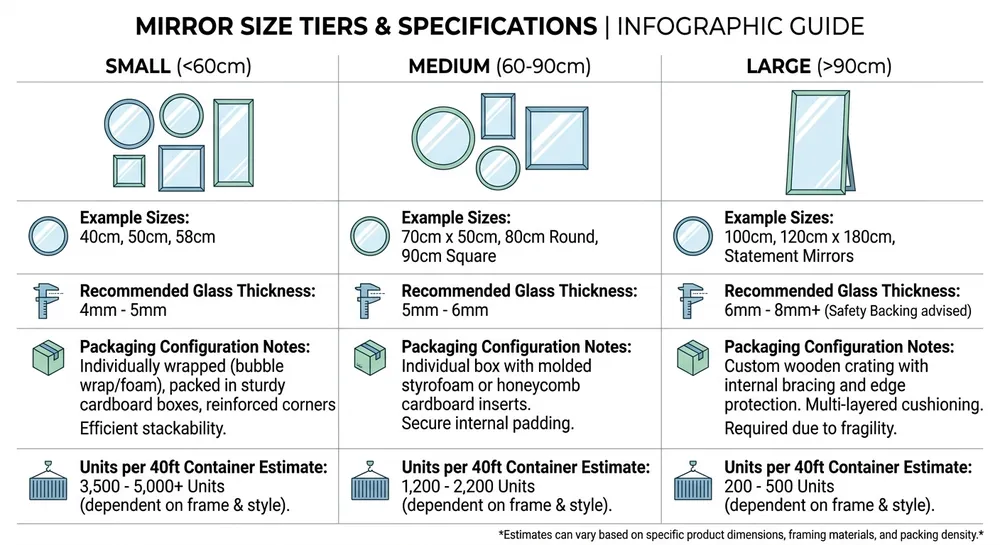
The packaging check matters more than most buyers realize. Bedroom mirrors with decorative frames are vulnerable to surface damage during transit — frame finish can transfer to the mirror glass if the inner packaging allows contact. Specify foam separation between the mirror surface and the carton, and check it at pre-shipment.
Common sourcing mistakes that create the problem
These are the patterns we see repeatedly when buyers come to us after a bad order from another supplier.
Underspecifying finish tolerances. Ordering by finish name without a color standard is the single most common cause of frame color drift. "Champagne gold" means something different to every factory. A RAL code or a physical Pantone chip eliminates the ambiguity.
Skipping golden sample approval. Approving a sample digitally, or approving a showroom sample that wasn't built on the production line, gives you no reference point for the actual run. The golden sample is the contract between you and the factory on what the product looks like.
Ordering across multiple factories to hit a lower price. Splitting a 1,000-unit bedroom mirror order across two factories to get a better unit price is a reliable way to get two visually different products. Even if both factories use the same finish name, the output won't match. If you're building a product line that needs visual consistency across SKUs, single-source it.
Ignoring packaging specs. A mirror that passes QC at the factory can arrive damaged if the packaging isn't right. Bedroom mirrors with ornate frames have protruding elements — carved details, applied moldings — that concentrate pressure during stacking. Specify individual carton weight limits and stacking orientation.
Buyer checklist: what to confirm before placing a bulk bedroom mirror order
Use this before committing to any supplier for a bulk bedroom mirror run:
- [ ] Supplier runs glass cutting, silvering, and frame finishing under one roof (or can demonstrate batch coordination between facilities)
- [ ] Supplier can provide copper-free silvering with documented salt spray test results
- [ ] Supplier holds frame finish to a stated delta-E tolerance (≤3.0 recommended)
- [ ] Golden sample approval process is standard, not optional
- [ ] Pre-production run sign-off is available for orders above 200 units
- [ ] In-line QC inspection interval is defined and documented
- [ ] Bevel width tolerance is ±0.5mm or better
- [ ] Pre-shipment inspection uses AQL 2.5 or equivalent sampling
- [ ] Packaging spec includes foam separation between mirror surface and carton
If a supplier can't confirm the majority of these points, the consistency risk is real. The questions aren't difficult for a factory that actually controls its process — they're only difficult for one that doesn't.
FAQ
What is an acceptable color delta-E tolerance for decorative mirror frames in bulk orders?
For retail-grade decorative mirrors, delta-E ≤ 3.0 is the standard working tolerance. Below 1.0 is imperceptible to most people. Between 1.0 and 3.0 is acceptable for most decorative applications. Above 3.0 is visible on a retail shelf, especially under store lighting. For hospitality projects where mirrors are installed in the same room, tighten the tolerance to delta-E ≤ 2.0 and require colorimeter readings in the inspection report.
How do I know if a mirror supplier is actually manufacturing or just assembling?
Ask for a factory audit report or request a video walkthrough of the production floor. Specifically ask: "Do you cut and silver your own glass on-site?" and "Do you run your own frame finishing line?" A trading company or assembler will either deflect or show you a partner factory. A manufacturer will show you the machines. ISO 9001 certification is a useful baseline, but it doesn't distinguish between a manufacturer and an assembler — the audit question does.
What MOQ makes sense for a first bulk bedroom mirror order with a new supplier?
Start with 100–200 units on a standard model before committing to a large run. This gives you a real production sample to evaluate finish consistency, packaging quality, and lead time reliability without the full exposure of a 500+ unit order. Most serious manufacturers will accommodate a trial run at this scale. If a supplier requires 500 units minimum on a first order with no sample option, that's a risk flag — they're optimizing for their production efficiency, not your sourcing confidence.
Does copper-free silvering actually matter for bedroom mirrors?
For bedroom applications specifically, yes. Copper-free silver coating eliminates the edge blackening that develops over time when copper backing oxidizes in humid conditions. Bedrooms aren't as moisture-intensive as bathrooms, but temperature cycling and humidity variation still occur. Copper-free silvering also produces a cleaner, more neutral mirror tone — relevant for decorative bedroom mirrors where the glass quality is part of the product's visual appeal. Ask your supplier for salt spray test results: copper-free coatings should hold ≥ 96 hours per ISO 9227 without edge deterioration.
—
If you're building a bedroom mirror program and want to lock down the spec before placing a bulk order, our Bedroom Decor Mirrors page covers the standard configurations we run. For a broader look at how room application affects mirror specs, Decor Mirrors by Room is a useful reference — bedroom and bathroom mirrors share a factory but almost nothing in the spec sheet.
When you're ready to move forward, submit your specs through our RFQ page — frame material, finish, mirror size, bevel requirements, and target quantity — and we'll come back with a technical proposal that includes our consistency guarantees and QC checkpoint plan.