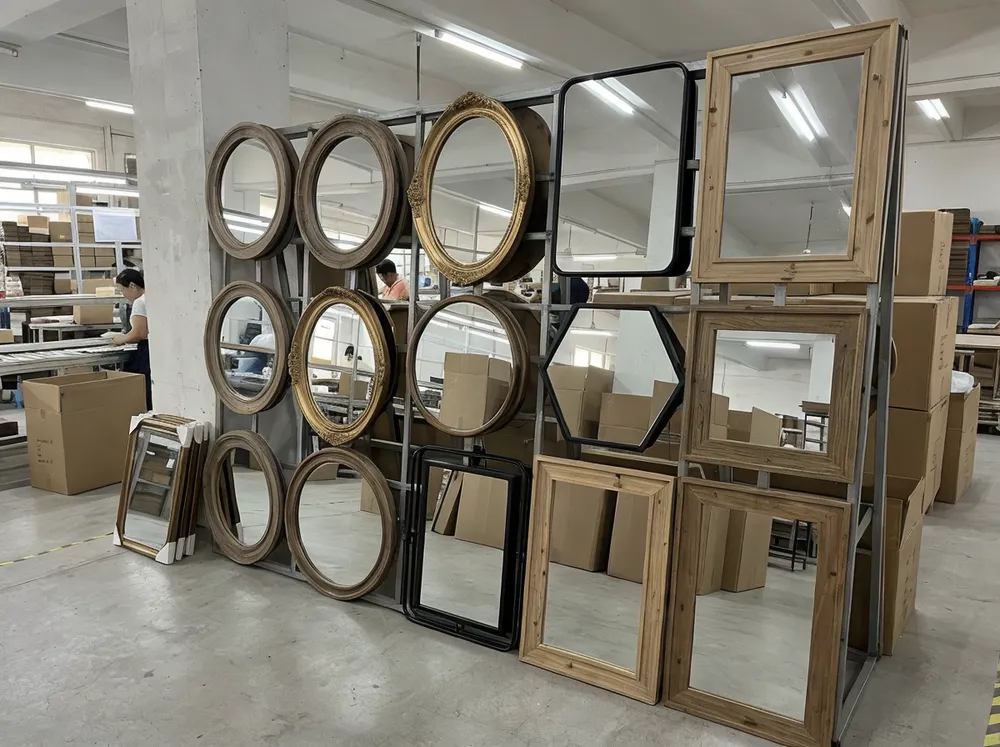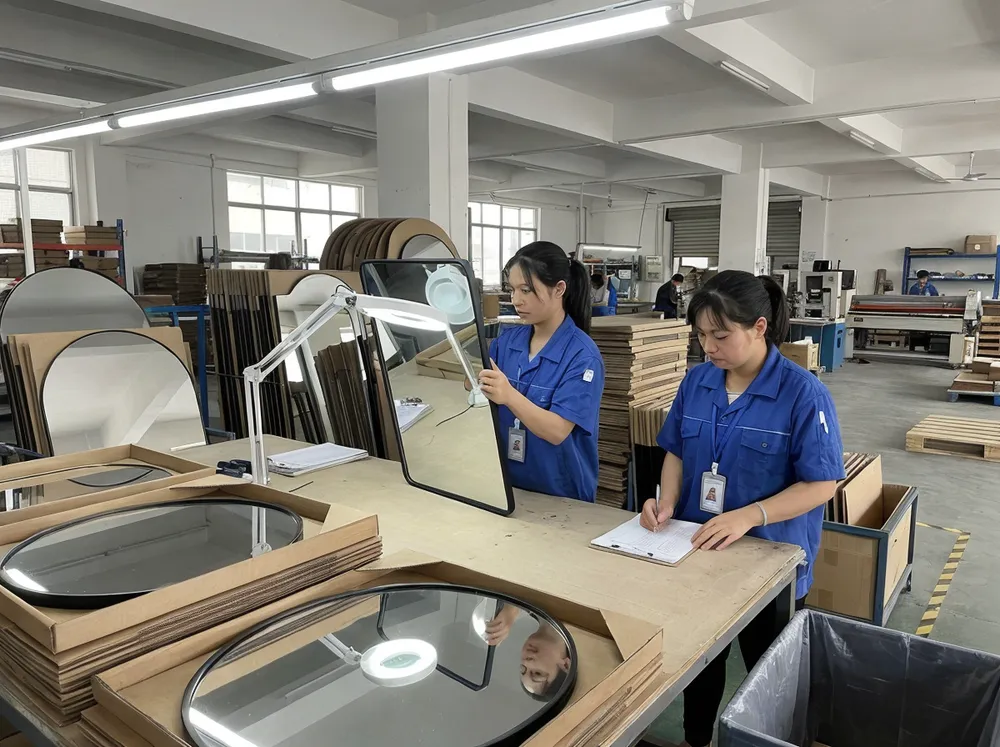
Compact decorative mirrors built for corridor proportions, manufactured and shipped direct from our Dong Nai facility. Narrow verticals, accent shapes, and simple framed rectangles in the 16"–28" width range — high container density, flexible MOQ from 100 pieces, and custom frame profiles for your hallway mirror line.
Hallway decor mirrors are sized for corridor proportions — typically 16" to 28" wide, with vertical orientations and accent shapes that fit narrow wall spaces where a full-size living room or mantel mirror won't work. The product mix splits into two tiers: simple framed rectangles that serve a functional check-your-appearance role, and decorative accent pieces — arches, sunbursts, irregular silhouettes — that turn a hallway wall into a design moment.
That split is commercially useful. The functional tier gives you a lower price point for volume channels, multi-unit residential projects, and e-commerce listings where price drives conversion. The decorative tier supports higher retail margins in home decor stores and hospitality specifications. We produce both tiers on the same lines in our 12,000 m² facility, so you can mix them in a single order without coordinating between suppliers or extending your lead time.
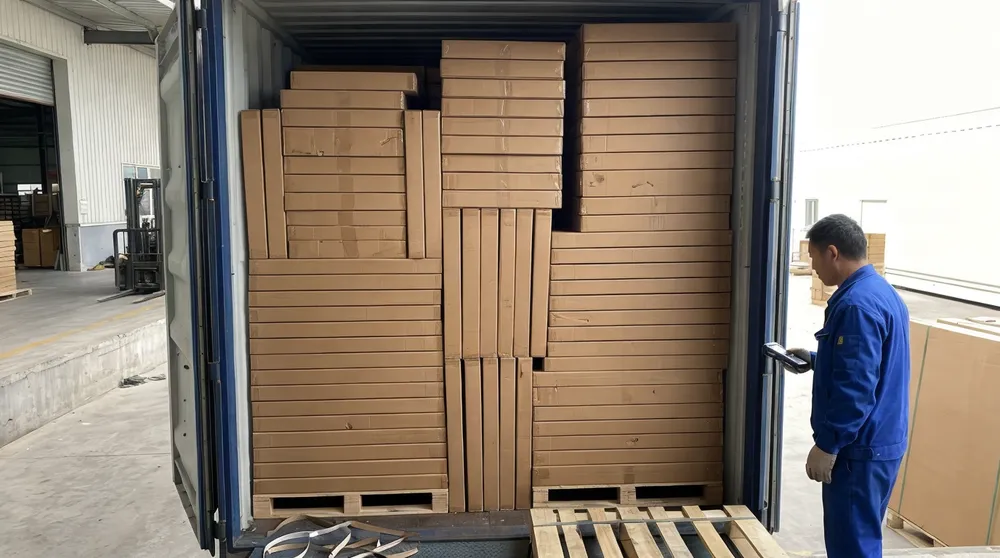
What separates hallway mirrors from our other room categories isn't just size. It's the combination of compact dimensions, lighter weight, and higher container density that changes your shipping economics. A 40' HQ container holds 1,800–2,500 hallway mirrors depending on your size and frame mix — compared to 800–1,200 for larger categories like living room or mantel mirrors. If you're building a room-by-room assortment, hallway mirrors are often the category where your per-unit freight cost works hardest in your favor.
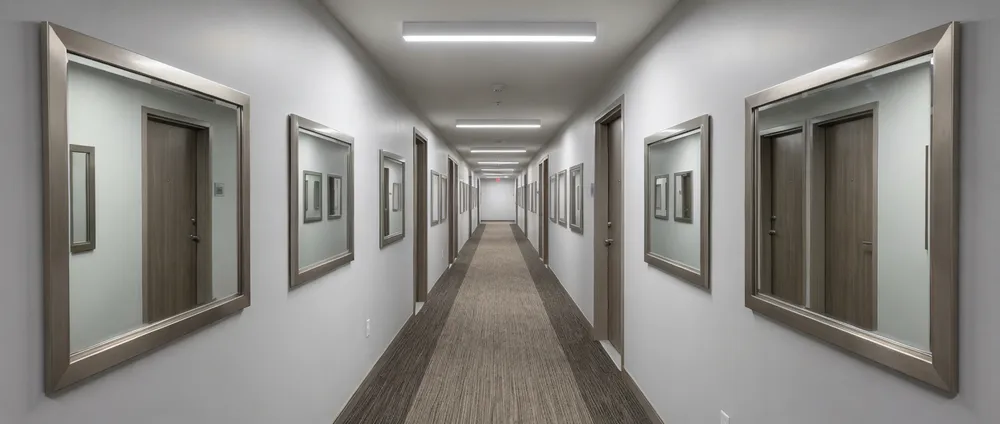
Simple framed rectangles for volume channels, multi-unit residential, and price-driven e-commerce listings.
Arches, sunbursts, and irregular silhouettes for higher retail margins and hospitality specifications.
These are the standard parameters for our hallway mirror range. If you need dimensions outside this window, our 12-engineer team develops custom sizes — the constraint is glass cutting capacity (up to 48" × 60") and frame tooling, not catalog limitations.
| Parameter | Specification |
|---|---|
| Typical width range | 16"–28" (400–710 mm) |
| Typical height range | 20"–48" (500–1220 mm) |
| Glass thickness | 3 mm–5 mm float glass |
| Mirror shapes | Rectangle, oval, arch, irregular/accent |
| Silvering process | Copper-free, multi-layer protective coating |
| Frame materials | MDF, solid wood, metal, resin |
| Frame finishes | Any RAL/Pantone match, gold/silver leaf, antique patina, powder coat, electroplating |
| Hanging hardware | D-ring, sawtooth, French cleat, keyhole — specified to your market's wall standards |
| Unit weight range | 1.5–6 kg depending on size and frame material |
| Packaging options | Individual retail-ready carton, e-commerce ship-ready, bulk palletized |
Glass cutting capacity up to 48" × 60" for non-standard sizes
Any color specification for frame finishes
Dedicated engineering for custom development
Custom profile development available
Hallway mirrors pack dense, and that density directly affects your margin.
Compact dimensions and lighter frame profiles mean you fit substantially more units per container than you would with living room, dining room, or mantel mirrors. A standard 40' HQ container holds approximately 1,800–2,500 hallway mirrors — roughly double the unit count of our larger room categories. We optimize carton dimensions for each hallway mirror SKU to maximize container utilization, and our logistics team provides a detailed loading plan before you confirm quantities so you can model your per-unit freight cost accurately.
For mixed-category orders — hallway mirrors alongside bedroom or bathroom mirrors, for example — we calculate the optimal carton arrangement to fill container volume without wasted space. Hallway mirrors are useful filler in a mixed load because their compact cartons slot into gaps that larger mirrors leave behind.
The freight math matters because hallway mirrors typically sit at a lower retail price point than statement pieces. Your margin depends more heavily on landed cost efficiency than on unit markup. We've seen distributors improve their hallway mirror margins by 8–12% simply by optimizing carton dimensions and container loading — before touching the product cost itself. (This is one of the first things we discuss with new accounts ordering this category.)
Roughly double the unit count of larger room categories like living room or dining room mirrors.
Achieved through carton dimension and container loading optimization alone — before touching product cost.
Hallway mirrors serve as efficient filler in mixed loads — compact cartons slot into gaps that larger mirrors leave behind, maximizing container volume utilization.
Hallway decor mirrors open specific commercial channels that differ from the broader decorative mirror market. These are the segments where our wholesale hallway decor mirrors buyers build recurring business:
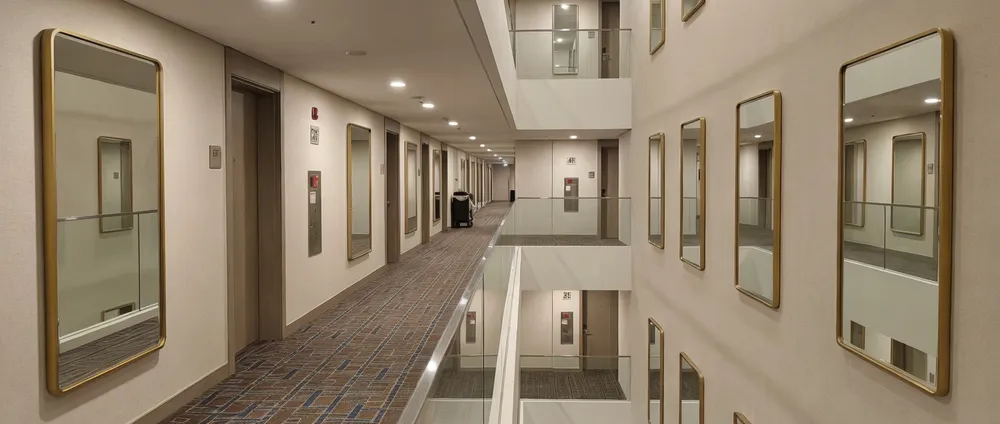
Hotel corridors, resort hallways, and boutique hotel common areas specify mirrors by placement. A single mid-size hotel project can require 50–200 hallway mirrors across floors, with consistent frame finish and size throughout.
We produce to project specs with batch-to-batch consistency — same gold tone on floor 3 as floor 12, because mismatched finishes across a property create punch-list problems for the FF&E buyer and the designer.
Repeat potential: Hospitality projects reorder when properties renovate or expand, so this is a repeatable segment once you're specified into a procurement firm's vendor list.
Apartment buildings, condominiums, and townhouse developments need hallway mirrors for common areas and individual units. Developers order in bulk — 100–500 units per project — and value consistent quality across the delivery.
Logistics support: We sort and label cartons by unit number or floor when your project requires it, so your site team installs without sorting through a mixed pallet.
"Hallway mirror" is a specific search term on Amazon, Wayfair, and independent home decor stores. Listing mirrors by room placement matches how consumers search, so your hallway mirror SKUs capture traffic that generic "decorative mirror" listings miss.
E-commerce-ready packaging: Individual ship-ready cartons with foam corner protection that survive carrier handling without an outer shipping box — your fulfillment team labels and ships without repackaging.
Staging companies and interior designers source hallway mirrors as part of room-by-room staging kits. They need variety in a compact size range — three or four different frame styles in similar dimensions.
Low inventory commitment: Our MOQ of 100 pieces per standard SKU lets you stock a diverse hallway assortment without heavy inventory commitment.
Brick-and-mortar home decor retailers organize mirror sections by room. Hallway mirrors fit into compact shelf or wall display areas that larger categories can't use.
Shelf-ready packaging: Retail-facing graphics and carton dimensions designed for standard gondola and endcap displays. Hallway mirrors' compact carton footprint means you can stock more SKUs per linear foot of display wall than you can with larger room categories — more variety on the floor without expanding your fixture allocation.
Tell us which segments you're targeting and we'll recommend specific hallway mirror models for your channel.
Our hallway decor mirrors ship in standard catalog configurations, but most wholesale hallway decor mirrors orders involve some degree of customization. Here's what we can adjust and where the boundaries are.
| Customization Dimension | Options | Impact on MOQ / Lead Time |
|---|---|---|
| Frame material | MDF, solid wood, metal, resin | No impact on standard MOQ |
| Frame profile | Any CNC-routable profile (MDF/wood), custom mold (resin), custom bend/weld (metal) | New resin molds add 15–20 days; MDF/wood/metal profiles add 7–10 days for tooling |
| Frame finish | Any RAL or Pantone color match, gold/silver leaf, antique patina, distressed, powder coat, electroplating | No impact on lead time for standard finishes; specialty finishes (leafing, multi-layer patina) add 3–5 days |
| Mirror size | Any dimension within our glass cutting range (up to 48" × 60") | No impact if within standard range |
| Mirror shape | Rectangle, oval, arch, irregular/accent — custom shapes require a cutting template | Custom shapes add 5–7 days for template development |
| Glass type | Standard silver mirror, tinted (bronze, grey, black), antiqued/distressed mirror | Tinted and antiqued glass available at same lead time |
| Hanging hardware | D-ring, sawtooth, French cleat, keyhole, or your specified hardware | No impact |
| Packaging | Retail-ready, e-commerce ship-ready, bulk palletized, custom insert/label | Custom packaging design adds 5–7 days |
RAL or Pantone color matching available on all frame materials with no lead time impact for standard finishes.
Going thinner creates breakage risk in transit that isn't worth the weight savings. Going thicker adds cost and weight without meaningful benefit at hallway mirror dimensions. (We've tested 2 mm glass for a buyer who wanted to minimize shipping weight — the breakage rate on ocean freight made it a net loss. We don't offer it anymore.)
We don't run traditional copper-backed silvering because maintaining two chemical lines creates cross-contamination risk and quality control complexity that isn't justified by the marginal cost difference.
If you're developing a proprietary hallway mirror line, our engineering team handles the full development cycle:
Send us a sketch, reference photo, or spec sheet — our engineering team will quote your custom hallway mirror within 48 hours.
The parent decor mirrors by room page covers our full production chain in detail — glass cutting, silvering, frame molding, assembly. Here's what matters specifically for hallway placement.
Hallway mirrors take more incidental contact than mirrors in most other rooms. People brush past them, bags bump frames, kids touch the glass. The frame finish needs to hold up under casual contact without showing wear, and the hanging hardware needs to stay secure on walls that vibrate from foot traffic and door closures.
We run copper-free silvering as standard across all hallway mirror production. The multi-layer protective coating on the mirror back resists moisture and oxidation — relevant for hallway mirrors installed near entryways where humidity fluctuates with door openings, especially in coastal or tropical markets.
Frame finish durability depends on the material and finish type. Powder-coated metal frames pass 500-hour salt spray testing — suitable for your accounts in humid climates. Painted MDF frames get a sealed topcoat that resists fingerprints and scuff marks from daily hallway traffic.
Hanging hardware is specified to the mirror's actual weight with a safety margin. For hallway mirrors in the 1.5–6 kg range, we typically use D-ring or sawtooth hangers rated for drywall mounting without studs — because most hallway walls in residential and hospitality settings are standard drywall.
100% visual inspection applies to every hallway mirror unit — glass clarity, silvering uniformity, frame finish, assembly integrity. No statistical sampling. At our production volumes, that's a staffing commitment, but it's the only way to hold the defect rates that retail and hospitality channels require.
We test frame finish adhesion and scratch resistance against your approved sample on every production run, so your reorders maintain the same durability standard. Cross-hatch adhesion testing on every production batch catches any silvering process drift before it reaches your container.
100 pieces per SKU for standard catalog hallway mirrors, 300 pieces per SKU for custom designs. If you're building an initial hallway assortment across multiple frame styles, we can work with lower per-SKU quantities as long as total order volume supports a production run.
30–45 days from order confirmation to ready-for-shipment for standard and modified-finish orders. Custom frame development adds 15–25 days before production starts. We provide a production timeline at order confirmation so you can plan your receiving schedule.
Hallway mirrors sit at a lower per-unit cost than our larger room categories because of smaller glass area and lighter frame material usage. Decorative accent shapes (arches, sunbursts, irregular silhouettes) carry a premium over simple framed rectangles due to additional glass cutting and frame tooling, but the retail markup on decorative pieces typically outpaces the cost increase — your margin percentage often improves on the decorative tier even though your unit cost rises. We can quote both tiers for any frame style so you can model your margin before committing.
Hallway mirrors' compact carton dimensions mean high container utilization. A standard 40' HQ container holds approximately 1,800–2,500 hallway mirrors depending on size and frame mix. We provide a detailed loading plan before shipment. For mixed-category orders, hallway mirror cartons fill gaps left by larger mirrors, improving your overall container efficiency.
EDI capability, UPC/EAN labeling, retail-specific packaging, and routing guide compliance for major retailers. We've shipped hallway mirrors to Walmart, Wayfair, and Amazon seller accounts and handle the documentation and labeling standards these channels require.
3 mm is our standard for hallway mirrors up to 24" wide — it keeps unit weight low and maximizes container density without compromising durability at these dimensions. For mirrors in the 24"–28" range or with minimal frame support (frameless beveled designs), we move to 4 mm for added rigidity during shipping and wall mounting. 5 mm is available but rarely necessary at hallway mirror sizes unless your application involves high-traffic commercial corridors where impact resistance is a concern.
MDF frames offer the widest range of profile shapes at the lowest tooling cost, so they're the go-to for mid-market retail and e-commerce where you need design variety without high per-unit cost. Metal frames (iron, aluminum, stainless) suit modern and industrial aesthetics and carry a higher perceived value — they support premium retail pricing and hold up well in hospitality specifications. Resin frames replicate ornate carved details that would be prohibitively expensive in solid wood, making them the choice for decorative accent mirrors where the frame is the visual centerpiece. We produce all three on our own lines, so you can mix materials across your hallway mirror assortment in a single order.
Yes. We produce antiqued (distressed/foxed) mirror glass and tinted options in bronze, grey, and black. Antiqued glass is popular in the hospitality and interior design segments — boutique hotels and staging companies use it for a vintage aesthetic in corridors. Tinted glass works well for modern retail positioning. Both options run at the same lead time as standard silver mirror glass. MOQ and pricing are consistent with standard glass; the only variable is glass material cost, which we itemize in your quote.
Our 6 production lines run different frame types and sizes concurrently, so a mixed order across hallway, living room, bedroom, and bathroom mirrors doesn't create scheduling conflicts. The per-SKU MOQ still applies (100 standard, 300 custom), but we consolidate everything into a single shipment. We sort cartons by room category, by SKU, or by your warehouse zone — however your receiving team needs them organized. Most of our distributors order hallway mirrors as part of a broader room-by-room assortment rather than as a standalone category.
We produce physical samples in 15–25 days depending on frame complexity. Sample cost covers materials and labor — it's credited against your first production order. For finish modifications on existing catalog models (color change, hardware swap), samples ship faster since no new tooling is involved. We ship samples via air express so you can evaluate before committing to a production order.
Send us your target frame styles, size range, and approximate volume per SKU. If you have reference images or competitor samples you're benchmarking against, include those — our engineering team will recommend the closest catalog match or quote a custom development. Detailed quote with container loading plan typically comes back within 48 hours.