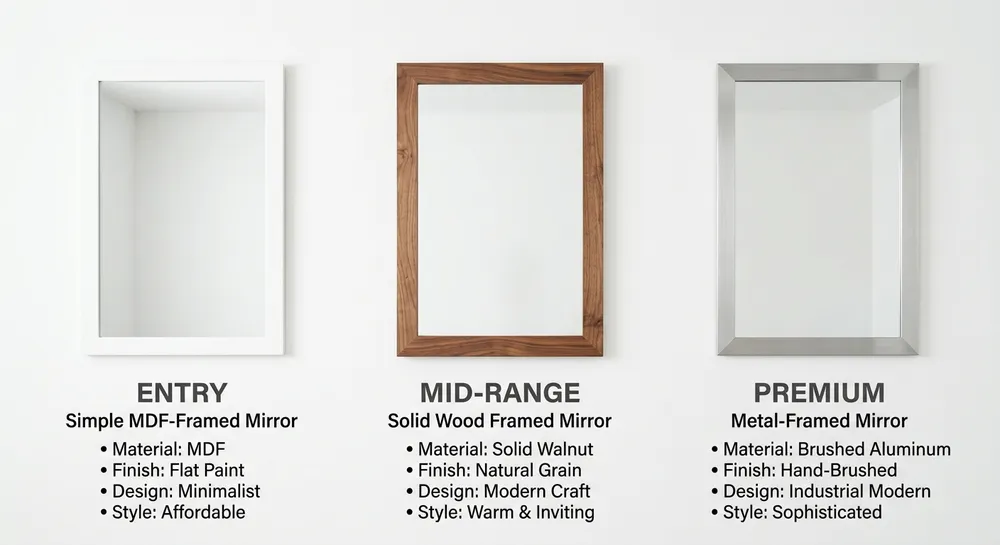
Most buyers who come to us with assortment problems aren't missing SKUs. They're missing a framework. They've added mirrors reactively — a few entry-level pieces because the price was right, a couple of premium frames because a customer asked — and ended up with a product mix that doesn't hold together at retail. Gaps in the middle. Overlap at the top. No clear story for their buyers.
The cost of a poorly structured assortment isn't always obvious on the first order. It shows up in slow-moving inventory, in customers who can't find what they need at the price they're willing to pay, and in reorder patterns that never stabilize. We've seen distributors carry 40 SKUs and still lose sales because they had nothing clean in the $80–$120 retail band.
This guide walks through how to build a home decor mirror wholesale assortment that actually covers the market — three tiers, each with its own material logic, glass spec, and MOQ consideration.

Why the assortment fails before you place the first order
The failure usually starts with a sourcing decision that ignores the production logic behind price. Buyers treat mirror price tiers as a marketing concept — "good, better, best" — when they're actually driven by material cost, process complexity, and glass specification. If you don't understand what's driving the cost at each tier, you can't evaluate whether a supplier's pricing is real or whether you're getting a mid-range product at a premium price.
Here's what actually separates the tiers at the factory level:
Frame material is the biggest cost driver. MDF (medium-density fiberboard) is the workhorse of entry-level mirror frames — it machines cleanly, takes paint and foil wrap well, and keeps landed cost low. Solid wood moves you into mid-range territory because the material cost is higher and the milling tolerances are tighter. Metal frames — steel, aluminum, iron — require different tooling entirely and often more finishing steps, which is why they anchor the premium tier or sit at the top of mid-range depending on profile complexity.
Glass specification is the second lever. A 3mm float glass mirror with standard silver backing is appropriate for entry-level product. Move to 5mm glass and you get better rigidity, less distortion on larger formats, and a noticeably heavier feel that reads as quality at retail. Copper-free silvering — which we run as our default across all tiers — matters for longevity and compliance, but it's the glass thickness and backing coat count that the end buyer actually perceives.
Finishing complexity is where mid-range and premium diverge most. A flat-painted MDF frame takes one coat and a foil wrap. An antique-finish solid wood frame requires multiple stain passes, a distressing step, and a topcoat. A brushed metal frame needs controlled oxidation or electroplating depending on the look. Each step adds labor and process time.
Understanding this production logic is what lets you build an assortment with real price separation — not just different SKU numbers at different price points.
Tier 1: Entry-level mirrors — the volume foundation
Retail price band: roughly $25–$60 depending on size and market.
Entry-level mirrors carry your volume. They're the SKUs that move consistently, anchor your catalog, and give new accounts a low-risk way to test your product. The mistake is treating them as throwaway product. A well-specified entry mirror with clean finishing and consistent silvering will outperform a poorly made mid-range piece every time.
Frame material: MDF with foil wrap or flat paint
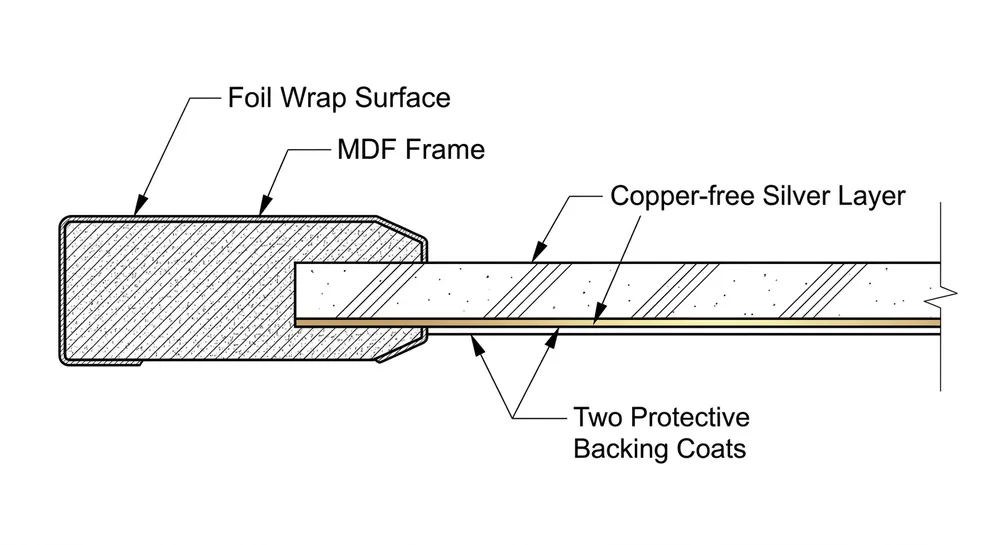
MDF is the right call here. It's dimensionally stable, takes profile routing well, and the foil-wrap process gives you a clean, consistent surface that holds up in normal retail environments. We run MDF frames in profiles from 15mm to 45mm width — narrower profiles for minimalist looks, wider for more traditional shapes.
One thing buyers often overlook: MDF quality varies. Low-density board will telegraph moisture absorption over time, especially in bathroom-adjacent retail. We spec medium-density board at minimum, and for any frame going into humid-environment retail (coastal accounts, bathroom category), we seal the cut edges before wrapping. It adds a small cost but eliminates the swelling complaints that kill reorders.
Glass: 3mm float with copper-free silver backing
For frames under roughly 60cm on the long side, 3mm glass is structurally appropriate and keeps weight and cost in check. Copper-free silvering is non-negotiable for us regardless of tier — the standard copper-backed process produces a mirror that starts showing edge oxidation within 18–24 months in normal conditions. That's a warranty problem your downstream customers will bring back to you.
Two protective backing coats are standard on our entry line. Some suppliers run one coat to save cost. You'll see the difference in 18 months when the silver starts lifting at the edges.
MOQ and assortment width
Entry-tier mirrors are where you build SKU breadth. Our standard MOQ on entry models is 100 pieces per SKU, which means you can test 4–5 shapes and finishes without committing to a full container on any single item. A practical entry assortment covers: round, rectangular, arch-top, and one decorative shape (sunburst or starburst profiles move well in North American retail). Two finish options — matte black and white — cover the majority of the market without fragmenting your inventory.
(We've seen buyers try to run 12 entry SKUs on their first order. The inventory carrying cost kills the margin advantage. Four to six SKUs, reorder the winners.)
Tier 2: Mid-range mirrors — where margin lives
Retail price band: roughly $65–$150 depending on size, material, and finish complexity.
Mid-range is where most distributors underinvest. They have entry product and they have a few premium pieces, but the $80–$130 retail band is thin. That's a problem because this is where the majority of gift, home decor, and specialty retail volume sits. Buyers in this band are willing to pay for visible quality — real wood grain, a more complex profile, a finish that looks intentional — but they're not buying art.
Frame material: solid wood or MDF with high-build paint
Solid wood frames — we work primarily with rubberwood and paulownia for this tier — give you real grain texture and a weight that reads as premium without crossing into the cost territory of hardwood. Rubberwood is particularly good for painted finishes because it takes stain evenly. Paulownia is lighter, which matters for larger formats where shipping weight affects landed cost.
For buyers who want the mid-range price point without the solid wood cost, high-build paint on MDF with a hand-applied distress or glaze finish can get close. The difference is visible on close inspection — the grain isn't there — but at retail display distance it's competitive. We're honest with buyers about this trade-off because it affects how you position the product.
Glass: 5mm float with copper-free silver, three backing coats
The step up to 5mm glass is worth it at this tier. On formats above 60cm, 3mm glass flexes enough to cause slight distortion — not obvious in a quick look, but noticeable when a customer stands in front of it. 5mm eliminates that. It also adds a tactile weight when the mirror is handled that signals quality before the customer even looks at the reflection.
Three backing coats on the silver layer extend the edge-oxidation resistance meaningfully. For mid-range product going into retail environments with any humidity variation, this is the right spec.
Finish complexity and the margin opportunity
This is where the assortment earns its keep. A mid-range mirror with an antique gold frame, a hand-applied glaze, or a reclaimed-wood look commands a retail price that's 2–3x the entry tier while the landed cost increase is more like 40–60%. That spread is where your margin lives.
We run several finish processes in-house for this tier: multi-step staining, antiquing with controlled crackle, gold and silver leaf application, and whitewash effects on natural wood. Each has a different labor cost, and we'll walk you through the cost implications when you're building your SKU list. The point is that finish selection at this tier is a margin decision, not just an aesthetic one.
MOQ considerations
Standard models in our mid-range line run at 100-piece MOQ. Custom frame profiles or non-catalog finishes move to 200 pieces minimum — the tooling and line setup cost needs to amortize across enough units. For buyers building a mid-range assortment for the first time, we typically suggest starting with 3–4 SKUs at 100 pieces each, identifying the 1–2 that sell through fastest, then developing custom variations on those winners.

Tier 3: Premium mirrors — the anchor and the margin ceiling
Retail price band: $150–$400+ depending on size, material, and complexity.
Premium mirrors do two jobs in your assortment. They anchor the top of your line and signal quality to buyers evaluating your catalog. And for the accounts that actually sell through at this price point — specialty home stores, hospitality procurement, interior design trade — they're your highest-margin SKUs.
The mistake at this tier is over-specifying for the wrong market. A $300 retail mirror going into a mid-market furniture chain needs different specs than the same price point going into a boutique hotel procurement program. We'll come back to that.
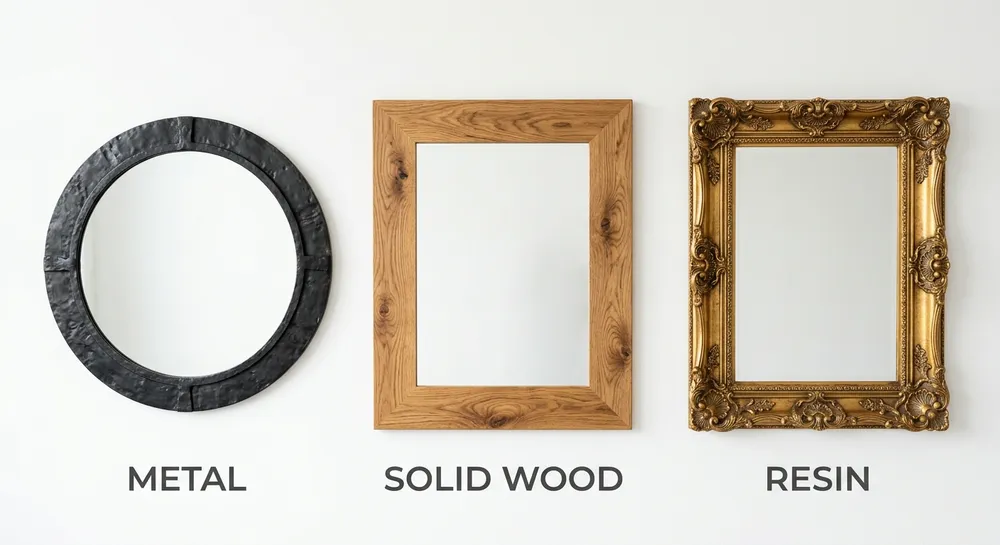
Frame material: metal, solid hardwood, or resin with complex profiles
Metal frames — wrought iron, steel with powder coat or patina finish, brushed aluminum — are the most common premium frame material for contemporary and industrial aesthetics. The profile complexity varies enormously: a simple round iron frame is relatively straightforward; a sunburst with 40 individual rays welded and finished by hand is a different production conversation entirely.
Solid hardwood at this tier means species with visible character — oak, walnut, teak — where the grain itself is part of the product story. These require more careful drying and milling to avoid warping, and the finishing process is more involved. We source hardwood from certified suppliers and can provide documentation for buyers with sustainability requirements in their retail programs.
Resin frames deserve more attention than they get. High-quality resin casting can produce ornate profiles — baroque, rococo, heavily carved looks — that would be prohibitively expensive in real wood. The weight and finish quality on a well-made resin frame is competitive with wood at a fraction of the tooling cost. We've supplied resin-frame mirrors to buyers who sell them successfully at $200–$350 retail.
Glass: 5mm or 6mm, copper-free silver, full edge treatment
At the premium tier, glass edge treatment matters. Beveled edges — typically 15mm to 25mm bevel width — add a light-refracting quality that's immediately visible and justifies the price point. Polished flat edges are the minimum; beveling is the differentiator.
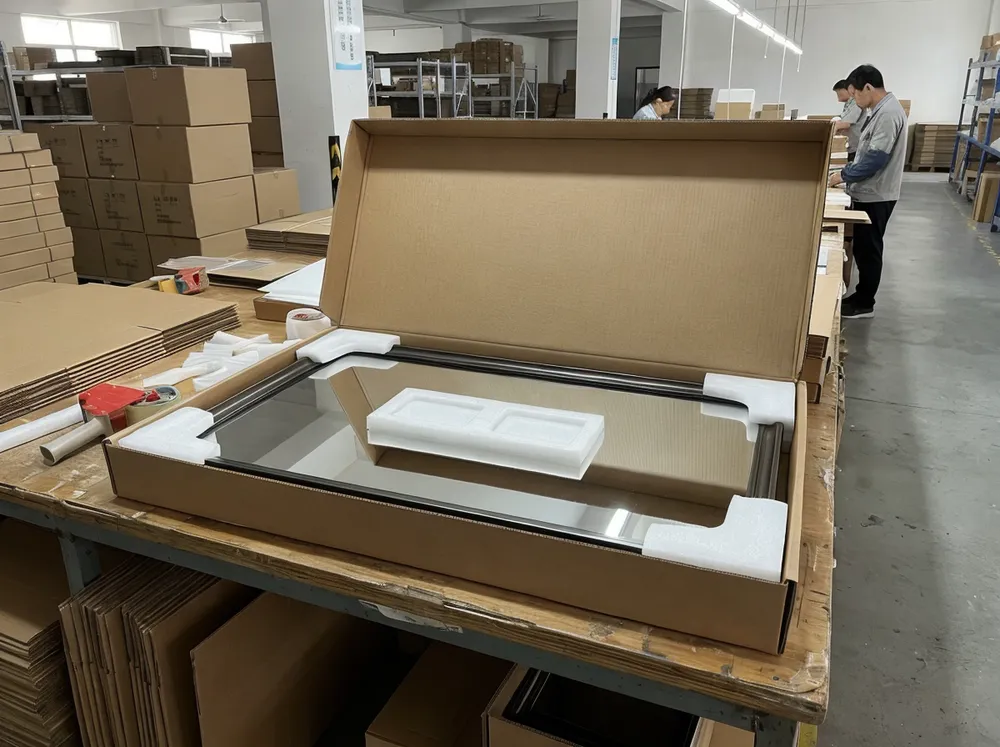
For large-format premium mirrors (above 90cm), we recommend 6mm glass. The additional rigidity reduces the risk of stress cracking during shipping and installation, and the weight adds to the perceived quality. Packaging for this tier needs to reflect the product — we run custom foam-insert cartons for premium SKUs, not just corner protectors.
The hospitality and project segment
This is worth calling out separately because it changes the MOQ math. Hospitality buyers — hotel chains, serviced apartment developers, restaurant groups — often need 50–200 units of a single SKU for a project. That's a different conversation than retail distribution. The specs are tighter (they'll often have a specific size, finish, and hardware requirement), the lead time is more compressed, and the relationship is project-based rather than catalog-based.
We handle both. Our OEM/ODM team — 12 engineers — can develop a custom frame profile for a hospitality program and have samples within 3–4 weeks. For buyers who want to serve this segment, having 2–3 premium SKUs that can be customized on request is more valuable than a deep catalog of fixed designs.
(The hospitality segment has grown significantly for us over the last few years. If you're a distributor with hotel or commercial accounts, it's worth having a conversation about what a project-ready premium SKU looks like for your market.)
The decision matrix: frame material to retail price band
This is the practical reference for building your SKU list. Use it to check whether your assortment has real price separation or whether you're stacking similar-cost products at different price points.
| Frame material | Typical finish | Glass spec | Target retail band | MOQ (standard) |
|---|---|---|---|---|
| MDF + foil wrap | Flat color, wood-look foil | 3mm, 2-coat silver | $25–$60 | 100 pcs |
| MDF + high-build paint | Distressed, glaze, antique | 3mm–5mm, 2-coat silver | $45–$90 | 100 pcs |
| Rubberwood / paulownia | Stain, whitewash, antique | 5mm, 3-coat silver | $70–$150 | 100 pcs |
| Metal (steel / iron) | Powder coat, patina, brushed | 5mm, 3-coat silver | $90–$200 | 100 pcs |
| Solid hardwood (oak, walnut) | Natural, stained, oiled | 5mm–6mm, 3-coat silver | $150–$350 | 200 pcs |
| Resin (ornate profiles) | Antique gold/silver, painted | 5mm, 3-coat silver | $120–$350 | 150 pcs |
| Metal (complex / handmade) | Patina, hand-finish | 5mm–6mm, beveled | $200–$400+ | 100 pcs |
A few things this table makes visible: MDF and solid wood can overlap in retail price if the finish complexity is high enough on the MDF side. That's fine — the margin profile is different even if the retail price is similar. What you want to avoid is paying solid-wood landed cost for a product that retails at MDF prices.
Balancing SKU count against inventory carrying cost
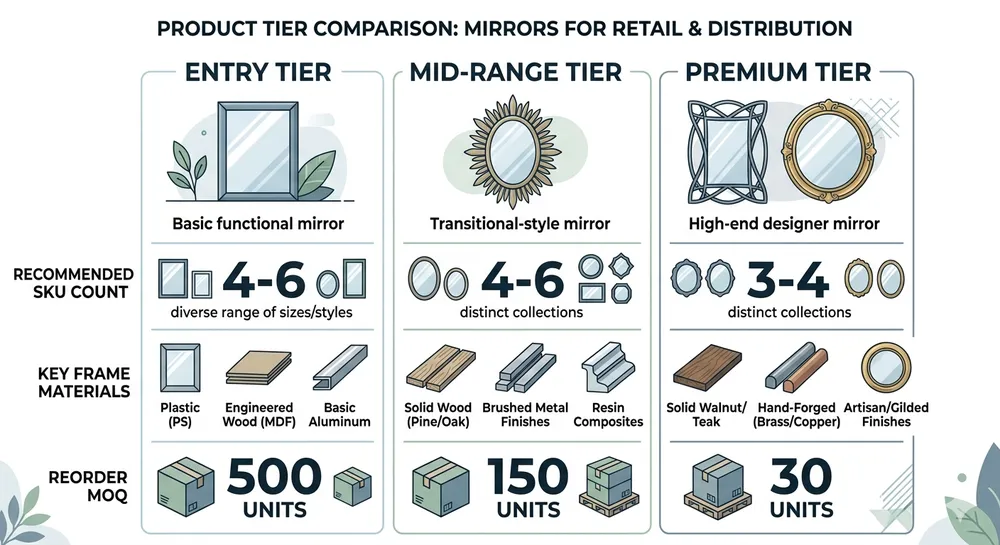
The most common assortment mistake isn't missing a tier — it's too many SKUs within a tier. Every additional SKU adds carrying cost, complicates reordering, and fragments your sell-through data. A clean assortment of 12–18 SKUs across three tiers will outperform a bloated 40-SKU catalog for most distributors.
A practical starting framework:
- Entry tier: 4–6 SKUs. Cover the core shapes (round, rectangular, arch) in 2 finishes. Prioritize the sizes that fit standard retail display fixtures in your market.
- Mid-range tier: 4–6 SKUs. Lead with your strongest finish story — the one that has the clearest visual differentiation from entry. Add 1–2 size variations on your best-performing shape.
- Premium tier: 3–4 SKUs. One metal, one wood or resin, one statement piece. These don't need to be your volume drivers — they need to anchor the line and serve your top accounts.
The reorder logic matters here. Entry SKUs should reorder at 100 pieces without hesitation — the MOQ is low enough that you're not taking significant inventory risk. Mid-range reorders at 100 pieces on standard models. Premium reorders depend on your account base; if you have 2–3 accounts that consistently move a premium SKU, a 100-piece reorder is straightforward.
We track sell-through patterns for buyers who share their data with us. It's not a formal program — it's just that after 18 years of shipping to distributors across North America and Europe, we've seen which SKU mixes hold up and which ones stall. If you're building a new assortment, we'll tell you what's moving for buyers in your region.
How glass thickness and silvering method affect landed cost per unit
This section exists because we've seen buyers get surprised by cost differences they didn't anticipate. The frame gets most of the attention in sourcing conversations, but glass specification and silvering method have a real impact on landed cost — and on the downstream quality problems that eat into your margin.
Glass thickness: 3mm vs 5mm vs 6mm
The cost difference between 3mm and 5mm glass on a standard 60×80cm mirror is roughly 15–20% of the glass component cost. On a $12 FOB mirror, that's a small number. On a $45 FOB mirror, it's more meaningful. The question isn't whether 5mm costs more — it does — but whether the quality improvement justifies the cost at your target retail price point.
For formats above 60cm on the long side, 5mm is the right call regardless of tier. The distortion risk on 3mm at larger formats creates customer complaints that cost more to handle than the glass upgrade.
Copper-free silvering: why it matters for your accounts
Standard copper-backed silvering uses a copper layer between the silver and the backing paint. Over time, especially in humid environments, the copper layer oxidizes and the oxidation migrates under the silver, creating the dark edge spots that customers associate with cheap mirrors. The timeline varies — 18 months in a dry climate, 6–9 months in a coastal or bathroom environment.
Copper-free silvering eliminates the copper layer and uses a different chemical process to bond the silver to the glass. The result is a mirror that holds its edge clarity significantly longer. We run copper-free as our default across all tiers because the cost difference is small and the downstream warranty exposure is real.
If a supplier quotes you standard copper-backed silvering on a mid-range or premium product, that's a red flag. The cost savings don't justify the quality risk at those price points.
Backing coat count: two vs three coats
Two backing coats are standard for entry product. Three coats add a meaningful layer of protection against moisture penetration and physical damage to the silver layer during shipping and installation. For mid-range and premium product, three coats is the right spec. For entry product going into dry retail environments, two coats is acceptable.
Testing a new tier before committing to full container volume
One of the practical advantages of our 100-piece MOQ on standard models is that you can test a new tier without full-container risk. A 100-piece order of a mid-range solid wood SKU fits in a partial container alongside your existing entry product. You get real sell-through data before you commit to a 500-piece reorder.
The sequence we recommend for buyers adding a new tier:
- Start with 1–2 SKUs at 100 pieces each. Pick the shapes and finishes with the clearest differentiation from your existing line.
- Run them for one full sell cycle — typically 60–90 days for most retail accounts.
- Identify which SKU has the better sell-through rate and reorder that one at 200–300 pieces.
- Use the second SKU's performance data to decide whether to continue, modify the spec, or replace it with a different option.
This approach keeps your inventory risk contained while building real market data. It also gives you a conversation to have with your accounts — "we're testing a new mid-range line, here are two options, tell me which one your customers respond to" — which is more useful than guessing from a catalog.
For buyers who want to develop custom frame profiles for a specific tier, our OEM/ODM process starts with a sample development phase. Send us your target retail price, your market, and any reference images — our engineering team will come back with a frame profile recommendation and a cost breakdown. Most sample development runs 3–4 weeks from brief to physical sample.
Sourcing from one factory across all three tiers
The practical argument for single-source assortment supply is consistency, not convenience. When your entry, mid-range, and premium mirrors come from different factories, you're managing three quality systems, three lead time schedules, and three sets of packaging standards. Inconsistencies show up in ways that are hard to trace — a slight color variation in the silver tone, a different hardware finish standard, packaging that doesn't stack the same way in your warehouse.
We produce MDF, solid wood, metal, and resin frames in-house on our 12,000 m² facility in Ho Chi Minh, Vietnam. Glass cutting, silvering, frame molding, and assembly all run under one roof. That means the copper-free silvering standard, the backing coat spec, and the QC process are consistent across every tier in the same production run. When you reorder a mid-range SKU six months after your entry SKUs, the silver tone matches.
Our 6 production lines and 150-person team handle roughly 400,000 pieces a year. The practical implication for your order: a mixed-tier PO — say, 300 entry pieces, 200 mid-range, and 100 premium — runs through the same facility without the coordination overhead of managing multiple suppliers. One quality inspection, one shipping document set, one point of contact.
For buyers with Walmart, Wayfair, or Amazon compliance requirements, we have EDI capability and retail compliance experience. The documentation and labeling requirements for these channels are specific, and getting them wrong on the first shipment is expensive. We've been through the compliance process with these retailers and know what the audit checklist looks like.
If you're building or rebuilding a wholesale decorative mirror assortment and want to map your target price tiers to specific frame materials and glass specs, send us your brief — target retail prices, market, and any existing SKUs you're working around. We'll come back with a concrete assortment recommendation and landed cost estimates for each tier.