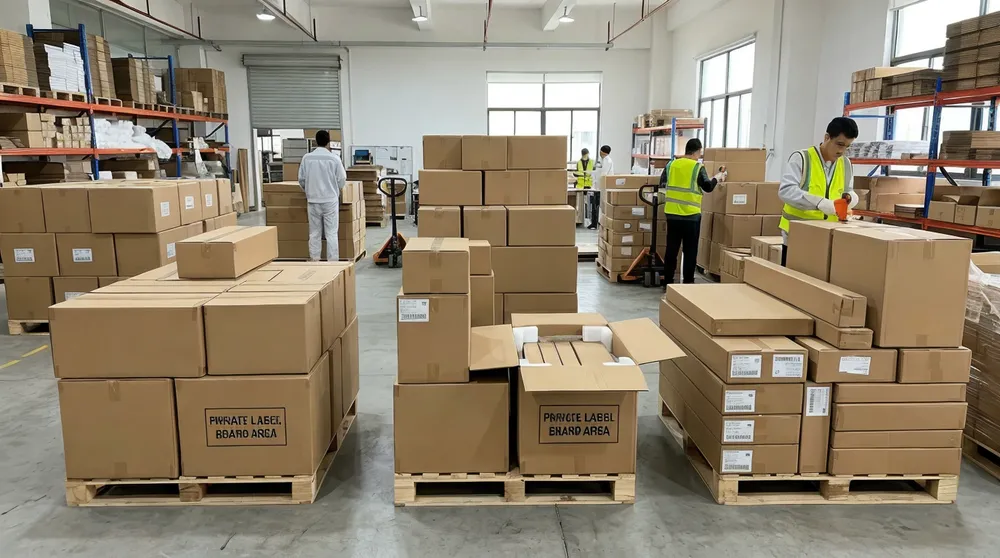
A cracked mirror arriving at a customer's door isn't just a replacement cost. It's a negative review, a return label, a reshipment, and a chargeback conversation with your retail buyer. At 400,000 units a year across Walmart, Wayfair, and Amazon, we've seen what happens when packaging is designed for wall mirrors and then applied to table mirrors without adjustment. The damage rates tell the story immediately.
Table decor mirrors are a different engineering problem than wall mirrors. The geometry is wrong for standard fragile-item packaging logic, and most generic guides miss this entirely.
Why table mirrors break more often than wall mirrors in transit
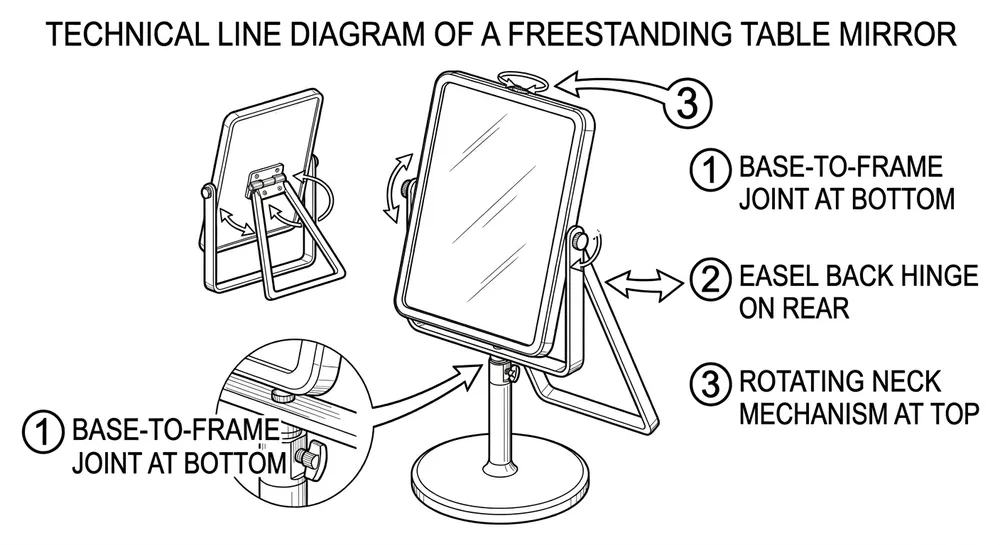
Wall mirrors are flat. You protect the face, protect the corners, put it in a box with adequate wall clearance, done. Table mirrors have three failure points that wall mirrors don't:
Freestanding bases. A base adds a rigid, often heavy anchor point at the bottom. Under drop impact, the base doesn't compress — it transmits force directly up through the frame joint. We've seen clean frame cracks at the base-to-frame connection on mirrors that had perfectly adequate face protection but nothing stabilizing the base laterally.
Easel backs. An easel back that isn't locked or restrained during shipping becomes a lever. It pivots under vibration, and the pivot point is usually a thin metal hinge or a plastic clip. After 1,500 km of road freight, that hinge has cycled thousands of times. The easel back either breaks at the hinge or — worse — it opens mid-transit and the mirror face contacts the carton wall.
Rotating mechanisms. Tilt-adjust and swivel-base table mirrors have the most complex failure profile. The rotation joint is a stress concentrator. Vibration loads that a fixed mirror absorbs through its frame get amplified at the joint. We configure these with a foam collar around the neck and a locking insert that prevents rotation during transit — without that, the joint loosens and the mirror arrives with visible wobble even if the glass is intact.
The practical consequence: a packaging spec that works for a 600 mm wall mirror will produce a 4–8% damage rate on a comparable table mirror if you don't address these three points specifically.

Step-by-step inner pack design for table mirrors under 500 mm
This is the configuration we use for our standard Table Decor Mirrors in the 300–500 mm height range. Adjust wall thickness and insert density for heavier frames.
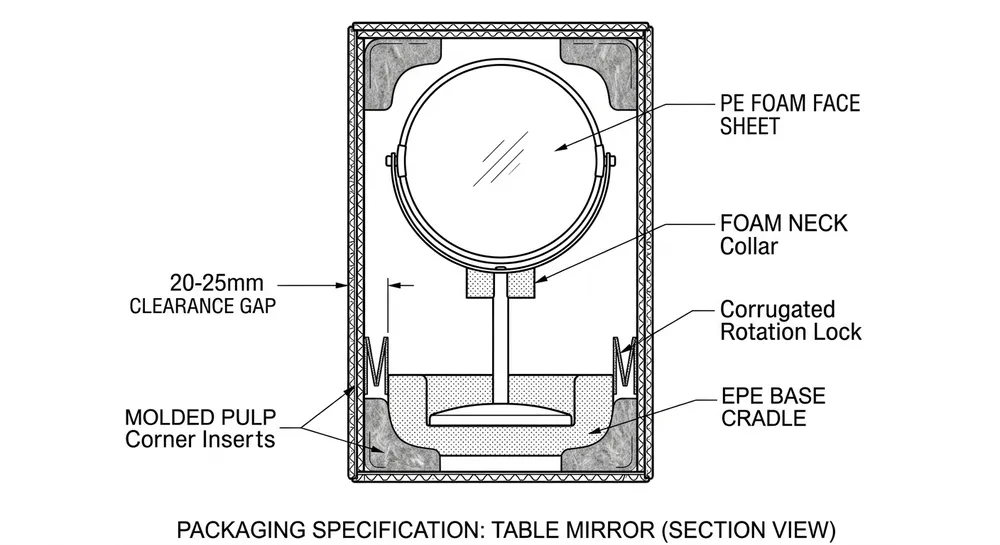
Step 1 — Lock the easel back before anything else. Fold the easel back flat against the mirror rear and secure it with a 50 mm PE foam strip or a die-cut cardboard retainer clip. Don't rely on tape alone — tape releases under temperature cycling in container freight. The easel must be mechanically constrained, not just held.
Step 2 — Face protection. Apply a 3 mm PE foam sheet cut to mirror face dimensions, held with two strips of low-tack film. Don't use bubble wrap directly against the mirror face — the bubble pattern can leave pressure marks on silver coating under sustained load. (We switched away from bubble wrap on face contact in 2019 after seeing coating impressions on a 2,000-unit Wayfair order. The marks weren't deep enough to be defects, but the buyer flagged them.)
Step 3 — Corner and base cushioning. Molded pulp corner inserts at all four frame corners, minimum 25 mm wall thickness. For the base, a separate molded pulp or EPE foam cradle that captures the base geometry — not just a flat pad underneath. The base cradle needs to prevent lateral movement, not just vertical drop absorption.
Step 4 — Neck/rotation joint protection. For tilt-adjust mirrors: wrap the neck with a 15 mm EPE foam collar, then insert a die-cut corrugated lock piece that prevents the head from rotating. This is the step most third-party repackers skip because it requires a custom insert. It's also the step that eliminates the wobble-on-arrival complaints.
Step 5 — Inner box sizing. Box clearance: 20–25 mm on all sides between the cushioned mirror and the inner box wall. Less than 15 mm and the insert can't do its job under a 1-meter drop. More than 35 mm and the mirror shifts inside the box under vibration. For double-boxing (required for Amazon FBA glass items), the outer box adds another 25 mm clearance with void fill.
Step 6 — Carton closure and labeling. H-tape pattern on both top and bottom flaps, minimum 50 mm tape width. "Fragile / This Side Up" labels on four sides. For Amazon FBA: FNSKU label on one face, suffocation warning on poly bag if inner packaging includes any poly film, and "Ready to Ship" sticker if the item ships in its own packaging (SIOC).
Material selection: molded pulp vs PE foam vs corrugated inserts
The right insert material depends on your channel, your frame weight, and your cost target. Here's how the three main options compare at MOQ 1,000+ units:
| Material | Protection level | Cost per unit (MOQ 1,000+) | Sustainability | Best for |
|---|---|---|---|---|
| Molded pulp corners + base cradle | High for corner/base impact | $0.35–$0.55 | Recyclable, retail-preferred | Walmart, Wayfair shelf-ready cartons |
| EPE (expanded PE) foam inserts | High for vibration, moderate for drop | $0.20–$0.40 | Not recyclable | Amazon FBA, bulk fulfillment |
| Die-cut corrugated dividers | Moderate — good for face, weak for base | $0.10–$0.20 | Recyclable | Low-cost SKUs, secondary inner pack only |
| Hybrid: molded pulp corners + EPE base cradle | Highest overall | $0.45–$0.65 | Partially recyclable | Premium retail, high-value frames |
A few notes from running these configurations across different channels:
Corrugated-only inserts are fine for flat wall mirrors. For table mirrors with bases, they're not adequate as the primary cushioning system — the base needs a three-dimensional cradle, not a flat divider. We use corrugated as a secondary layer inside the hybrid configuration, not as the load-bearing insert.
EPE foam is the workhorse for Amazon FBA volume. It's cheaper than molded pulp, cuts to any shape, and absorbs vibration well. The trade-off is that it compresses permanently after a hard drop, so it's single-use. For Walmart SQEP compliance, molded pulp is the cleaner choice because it photographs better in packaging audits and signals sustainability intent.
(The cost ranges above assume Vietnam-sourced materials at our standard supplier pricing. If you're sourcing packaging independently in North America, add 30–40% to the insert cost.)
Retail channel compliance: Amazon FBA, Walmart SQEP, and ISTA test protocols
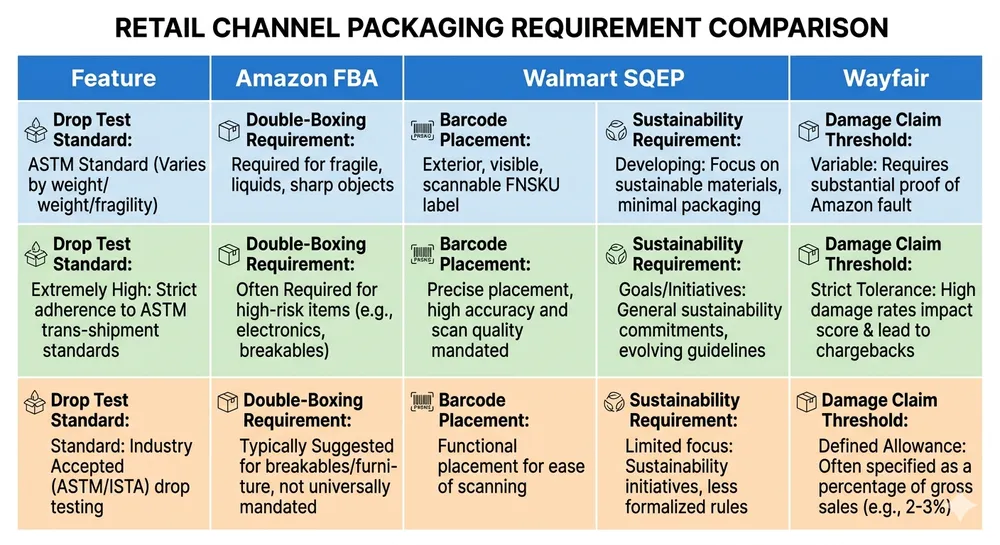
Getting the physical packaging right is half the problem. The other half is meeting channel-specific compliance requirements that vary significantly between Amazon, Walmart, and Wayfair.
Amazon FBA — glass and mirror category requirements:
- Items must pass ISTA 6-Amazon drop test protocol before FBA acceptance. For glass items, Amazon requires the item to survive a 1-meter drop on all six faces plus two edges without glass breakage or structural failure.
- Double-boxing is required for any glass item where the inner packaging alone doesn't provide sufficient protection. Table mirrors almost always require double-boxing.
- FNSKU label must be scannable on the outer carton. Don't place it on a surface that will be covered by void fill or stretch wrap.
- Poly bags on any component must include a suffocation warning printed in minimum 5-point type if the bag opening exceeds 5 inches.
- "Fragile" labels are required but not sufficient — Amazon's receiving centers don't handle fragile items differently. Your packaging must survive normal handling without relying on the fragile label.
Walmart SQEP (Supplier Quality Excellence Program):
- Walmart's packaging audit scores carton compression strength, labeling accuracy, and sustainability metrics. Single-wall corrugated (B-flute or E-flute) is typically insufficient for table mirrors over 2 kg — specify double-wall (BC-flute) for heavier frames.
- UPC barcode must be on two faces of the master carton, scannable at 90° rotation.
- Retail-ready packaging (RRP) requirements apply if the item ships floor-ready: price ticket placement, hanger or display hardware, and shelf-ready carton opening must meet Walmart's planogram specs.
- Walmart's SQEP audit includes a drop test component aligned with ISTA 3A, which covers random vibration and multiple drop orientations. We test our Walmart-bound cartons to ISTA 3A before the first shipment of any new SKU.
Wayfair:
Wayfair's requirements sit between Amazon and Walmart in strictness. They require FNSKU-equivalent item-level barcoding, fragile labeling, and adequate inner cushioning, but don't mandate ISTA testing documentation upfront. That said, Wayfair's damage claim process is aggressive — three damage claims on a SKU within 90 days triggers a packaging review. We've seen buyers lose their Wayfair listings over packaging failures that were entirely preventable.
Packaging bill of materials for a standard 400 mm table mirror
This BOM covers a single-SKU freestanding table mirror, 400 mm height, wood or MDF frame, approximately 1.8–2.2 kg finished weight. Costs are at MOQ 1,000 units, Vietnam-sourced materials.
| Component | Specification | Qty per unit | Unit cost (USD) |
|---|---|---|---|
| Inner box | Double-wall corrugated, BC-flute, custom size | 1 | $0.55–$0.75 |
| Outer box (FBA double-box) | Single-wall corrugated, B-flute | 1 | $0.30–$0.45 |
| PE foam face sheet | 3 mm EPE, cut to mirror face | 1 | $0.08–$0.12 |
| Molded pulp corner inserts | 25 mm wall, 4-corner set | 1 set | $0.30–$0.45 |
| EPE base cradle | Custom die-cut, 30 mm wall | 1 | $0.15–$0.22 |
| Foam neck collar | 15 mm EPE tube, pre-slit | 1 | $0.04–$0.07 |
| Corrugated rotation lock | Die-cut, single-wall | 1 | $0.03–$0.05 |
| Easel back retainer | PE foam strip, 50 × 200 mm | 1 | $0.02–$0.03 |
| Void fill (outer box) | Kraft paper crumple | ~80g | $0.04–$0.06 |
| Labeling (fragile, FNSKU, barcode) | Printed labels, 4-side application | 1 set | $0.03–$0.05 |
| Total packaging cost | $1.54–$2.25 |
At 1,000 units, total packaging cost runs $1.54–$2.25 per mirror. At 5,000+ units with optimized carton sizing and consolidated insert sourcing, we typically land at $1.20–$1.70. The biggest lever is the inner box — custom-sized corrugated cuts material waste and reduces the void fill needed, which compounds across large orders.
Common packaging mistakes that inflate damage rates
These are the failures we see most often when buyers come to us after a damage problem with their previous supplier:
Undersized cartons. The most common mistake. A carton sized for the mirror dimensions without accounting for insert thickness leaves less than 10 mm clearance on some faces. Under a 1-meter drop, the insert bottoms out and the mirror takes the impact directly. Spec the carton after the insert, not before.
Single-wall corrugated on frames over 1.5 kg. B-flute single-wall has a compression strength of roughly 200–250 lbs. A 2 kg table mirror in a master carton stack of 10 units puts 20 kg on the bottom carton. Add warehouse stacking and you're at 40–50 kg. Single-wall fails. Specify BC-flute double-wall for anything over 1.5 kg.
Missing easel back restraint. Covered above, but worth repeating: an unrestrained easel back is the single most common cause of glass breakage in table mirror shipments. It's also the cheapest fix — a $0.03 foam strip eliminates it entirely.
Loose hardware in the carton. Hanging hardware, assembly screws, and base bolts packed loose in a poly bag inside the carton will migrate during transit and contact the mirror face. Pack hardware in a separate compartment or tape the hardware bag to the carton wall, not to the mirror.
No ISTA testing before first shipment. Buyers often skip ISTA testing on the first order to save time. The first order is exactly when you need it — before you've committed to a packaging spec across 5,000 units. ISTA 3A testing costs $300–$500 per configuration. A single damage claim on a 1,000-unit Amazon order costs more than that in returns and account health impact.
Fragile label placement on non-scannable faces. Placing fragile labels on the same face as the barcode creates a scanning conflict at receiving. Put fragile labels on the two short faces; put barcodes on the two long faces.
How we configure packaging per channel at Livewellcraft
We run an in-house packaging line that configures cartons and inserts per channel — no third-party repack, no additional handling cost between production and container loading. When you order Table Decor Mirrors from us, the packaging spec is part of the product spec, not an afterthought.
For Amazon FBA orders, we build to ISTA 6-Amazon drop test standards, apply FNSKU labels at the line, and double-box all glass items before palletizing. We've been an Amazon supplier since 2016 and have the packaging documentation — test reports, carton specs, label placement diagrams — ready to submit to Seller Central or your 3PL.
For Walmart orders, we build to SQEP standards with BC-flute double-wall cartons, molded pulp inserts, and retail-ready carton configurations where required. Our QC team photographs carton compression tests and label placement for every new SKU before the first shipment.
For Wayfair and mid-market e-commerce buyers, we configure to a hybrid standard that meets Amazon FBA requirements (the stricter baseline) and adds Wayfair-specific barcoding. This means the same carton spec works across both channels, which simplifies your inventory management if you're selling on multiple platforms.
Our copper-free silvering process is also relevant here: copper-free silver coatings have better adhesion stability under temperature cycling and vibration than traditional copper-backed silver. Transit through Southeast Asian ports in summer means temperature swings of 20–35°C inside a container. Copper-backed silver can develop micro-delamination at the coating edge under repeated thermal cycling — copper-free doesn't. It's one of the reasons our post-delivery coating failure rate is under 0.3% across all channels.
(We've had buyers ask whether the copper-free spec adds cost. It adds about $0.80–$1.20 per unit at our production volumes. For a mirror retailing at $45–$120, that's a rounding error compared to the cost of a coating warranty claim.)
For a full view of our OEM/ODM Custom Mirror Services — including custom frame profiles, finish options, and channel-specific packaging configurations — that page covers the full scope of what we can configure per order.
FAQ
What ISTA test protocol applies to table mirrors shipped via Amazon FBA?
Amazon requires ISTA 6-Amazon (also called ISTA 6-AMAZON.COM) for items sold through FBA. For glass and mirror items, the relevant test sequence includes a 1-meter drop on all six faces and two edges, plus a vibration simulation. If your item passes in its own packaging (SIOC), you can ship without an outer box. Table mirrors almost never pass SIOC — the geometry makes it difficult to achieve adequate corner protection without a secondary carton. Budget for double-boxing and test both the inner and outer configuration together.
Can I use the same packaging spec for both Amazon FBA and Walmart store replenishment?
Not directly. Amazon FBA requires FNSKU item-level labeling and ISTA 6-Amazon drop test compliance. Walmart SQEP requires UPC on two carton faces, BC-flute double-wall for heavier items, and ISTA 3A vibration testing documentation. The physical packaging can often be shared (same carton, same inserts), but the labeling configuration and test documentation differ. We configure dual-channel packaging for buyers who sell on both platforms — one carton spec, two label layouts, tested to the stricter standard.
What's the minimum order quantity to get custom packaging inserts?
For die-cut corrugated inserts, MOQ is typically 500 units — tooling cost is low and amortizes quickly. For molded pulp inserts, MOQ is 1,000–2,000 units because the mold cost runs $800–$1,500 per configuration. EPE foam die-cuts have the lowest MOQ, often 200–300 units, because the cutting dies are inexpensive. If your order is below molded pulp MOQ, we use EPE foam inserts as the primary cushioning system — the protection level is comparable, the cost is slightly lower, and there's no tooling lead time.
How do I reduce damage rates on table mirrors already in my product line?
Start with the easel back. If you're seeing glass breakage, check whether the easel back is restrained in the current packaging. If it isn't, that's your first fix — it costs almost nothing and eliminates the most common failure mode. Second, check carton clearance: measure the gap between the cushioned mirror and the carton wall on all six faces. If any face is under 15 mm, resize the carton. Third, weigh your current carton and check whether single-wall corrugated is adequate for your frame weight and stacking configuration. Those three checks resolve the majority of table mirror damage issues we diagnose for new buyers.
If your current packaging is producing damage rates above 1–2% on table mirror SKUs, the fix is almost always in the inner pack geometry, not in adding more bubble wrap. Share your mirror dimensions, frame material, weight, and target retail channel with our team — we'll spec a packaging configuration and send back a detailed quote. Request a Quote or browse our full Decor Mirrors by Room range to see the product specs alongside the packaging options.