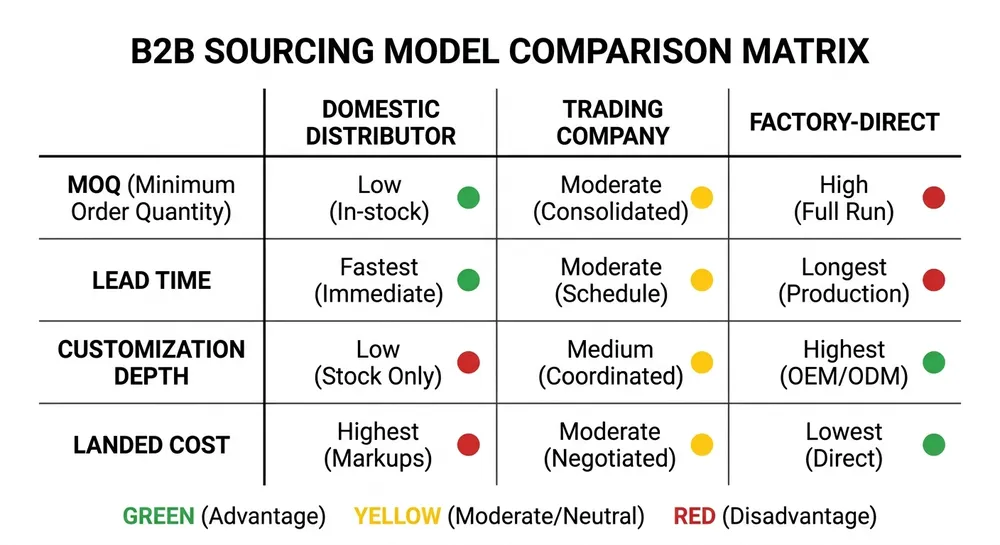
The USA decorative mirror market runs on a layered supply chain that most buyers only partially understand. You have domestic distributors holding inventory in New Jersey and California warehouses, trading companies importing from Asia with a 20–35% markup baked into the FOB price, and a small number of factory-direct options that ship container loads straight from the production floor. Each model has a real use case. The problem is that most toplist articles don't tell you which model you're actually looking at — so you end up comparing a domestic stocking distributor against a factory-direct importer as if they're the same kind of supplier. They're not.
This guide covers 10 real suppliers available to USA wholesale buyers in 2026. We've organized them by supplier type so you can match the sourcing model to your actual buying situation — whether that's a 50-unit reorder you need in two weeks or a 2,000-unit container program you're building for a retail chain.
Before the list, a quick note on how we evaluated these suppliers: we looked at publicly available information on MOQ, product range, certifications, and supply chain model. Where factory-level detail wasn't publicly confirmed, we've kept descriptions conservative. We haven't invented capabilities or certifications.
What Separates a Reliable Mirror Supplier from a Catalog Vendor
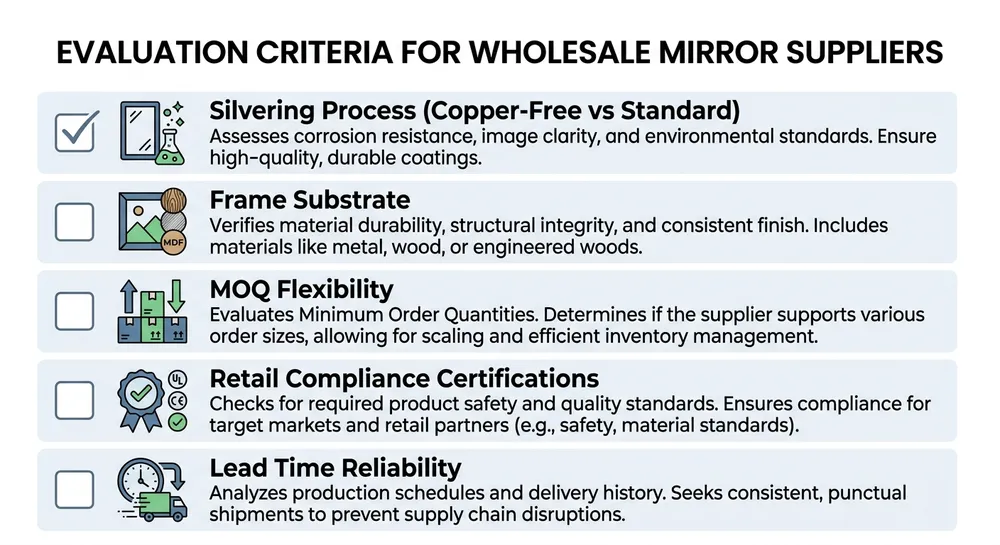
Most buyers screen on price first and discover quality problems later — usually when a container arrives with silver bleed, delaminating backing, or frames that don't match the approved sample. Here's what actually matters at the sourcing stage:
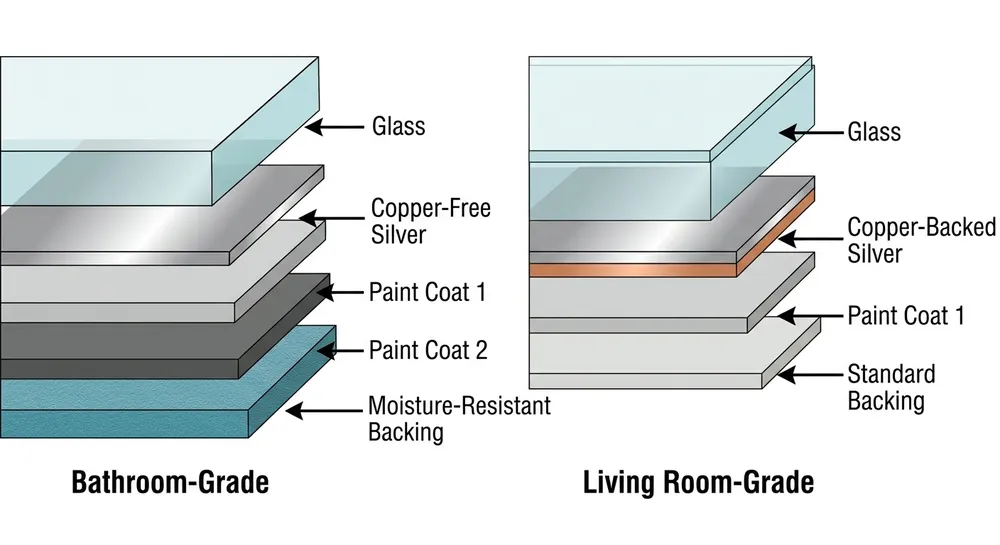
Silvering process and backing protection. Standard mirrors use a silver nitrate coating over float glass, sealed with copper sulfate and then paint. The copper layer is the weak point — it oxidizes at the edges over time, producing the black edge creep you see on cheaper mirrors after 18–24 months in humid environments. Copper-free silvering eliminates that failure mode. Ask any supplier whether their silver line is copper-free before you commit to a bathroom or hospitality program. (We switched our entire line to copper-free in 2016 after seeing edge oxidation complaints from a Gulf Coast hotel buyer — it's not a premium option for us anymore, it's the baseline.)
Frame construction and finish adhesion. Decorative mirror frames are typically MDF, solid wood, PS (polystyrene) foam molding, or metal. Each has a different failure profile. MDF swells in high-humidity rooms. PS foam molding is lightweight and cost-effective but can't be refinished. Solid wood holds up but adds weight and cost. Ask for the frame substrate, not just the finish description.
MOQ and program flexibility. A supplier with a 500-unit MOQ per SKU is structurally incompatible with a boutique retailer building a 10-SKU room mirror assortment. Know your volume before you start conversations — it filters out half the list immediately.
Retail compliance documentation. If you're supplying Walmart, Target, HomeGoods, or any major chain, you need BSCI, REACH, Prop 65, and potentially CA65 documentation. Not every supplier carries these. Asking upfront saves weeks of back-and-forth after samples are approved.
Lead time reliability, not just quoted lead time. The number on the quote sheet means nothing without a track record. Ask for references from buyers in your segment, or look for suppliers with verifiable export history to major retail channels.

The 10 Suppliers: Who They Are and What Model They Run
1. Fetco Home Decor — Domestic Distributor, Illinois
Website: fetcohome.com
Fetco has been distributing decorative home accessories including wall mirrors from their Illinois base for decades. Their catalog covers a wide range of frame styles — metal, wood, and composite — targeting gift, home décor, and specialty retail channels. They operate as a domestic stocking distributor, which means shorter lead times for reorders and no container minimums. MOQ is accessible for smaller buyers. The trade-off: you're buying from inventory, not specifying production, so customization depth is limited and unit cost reflects the domestic distribution margin.
2. Umbra — Design-Led Wholesale Supplier, USA/Canada
Website: umbra.com
Umbra is a design-focused home accessories brand with a strong wholesale program for retailers and interior trade buyers. Their mirror range skews contemporary and design-forward — frameless, geometric, and modular formats that perform well in boutique retail and hospitality FF&E. They manufacture in Asia and distribute through North American wholesale channels. MOQ varies by product. Not a factory-direct option, but their retail-ready packaging and brand recognition carry margin value for certain buyer segments. (Their mirror category has expanded significantly in the last three years — worth checking if your buyers skew design-conscious.)
3. Howard Elliott Collection — Wholesale Décor Distributor, USA
Website: howardelliott.com
Howard Elliott is a well-established wholesale home furnishings and décor distributor with a substantial mirror catalog — wall mirrors, floor mirrors, and decorative accent mirrors across traditional, transitional, and contemporary styles. They serve interior designers, furniture retailers, and hospitality buyers. Domestic stocking model with warehouse fulfillment. Strong on style breadth; less suited for buyers who need custom sizing or private-label programs.
4. Mirrorize Canada / USA Operations — Specialty Mirror Supplier
Website: mirrorize.ca
Mirrorize operates as a specialty mirror supplier with both retail and wholesale channels, covering standard and custom-cut decorative mirrors. Their range includes frameless, beveled, and framed wall mirrors. They serve both residential and commercial buyers. Custom sizing is available, which differentiates them from pure catalog distributors. Lead times on custom orders are longer than stocking items. Worth evaluating if your program requires non-standard dimensions.
5. Reflection Glass Industries — Commercial Mirror Fabricator, USA
Website: reflectionglass.com
Reflection Glass is a domestic glass fabricator and mirror manufacturer serving commercial and architectural markets. Their focus is on large-format, custom-cut, and specialty mirror applications — gym mirrors, salon mirrors, architectural installations. Less relevant for decorative frame mirror programs, but a strong option if your buyers are in fitness, hospitality renovation, or commercial interior segments where custom glass dimensions and domestic fabrication matter.
6. Spancraft Glass — Domestic Mirror Manufacturer, Wisconsin
Website: spancraft.com
Spancraft manufactures mirrors and glass products domestically in Wisconsin, serving both retail and commercial channels. Their product range includes wall mirrors, medicine cabinet mirrors, and custom glass. Domestic production means shorter lead times and easier quality escalation, but unit costs are higher than import options. A credible choice for buyers where domestic origin is a procurement requirement or where lead time predictability outweighs unit cost.
7. NeuType — Direct-Import Mirror Brand, USA Market
Website: neutypecraft.com
NeuType has built a significant presence in the USA decorative mirror market through Amazon and DTC channels, with a wholesale program available to retailers. Their range covers full-length, arched, and wall mirrors in metal and wood frames. They source factory-direct from Asia and pass some of that cost efficiency to wholesale buyers. MOQ is relatively accessible. The limitation: they operate as a brand, not a factory, so customization and private-label options are restricted.
8. Coaster Company of America — Furniture & Mirror Wholesale Distributor
Website: coasterfurniture.com
Coaster is one of the larger domestic wholesale distributors of furniture and home décor, with a mirror category that covers accent mirrors, dresser mirrors, and wall mirrors across a wide style range. They serve furniture retailers, online sellers, and interior trade buyers. Domestic warehouse stocking, accessible MOQ, and broad catalog depth make them a practical option for buyers building multi-SKU room mirror assortments. Not a customization-capable supplier.
9. Privilege International — Wholesale Home Décor Distributor, USA
Website: privilegeinternational.com
Privilege International distributes decorative home accessories and mirrors to wholesale buyers across the USA. Their catalog includes wall mirrors in various frame styles and sizes. They operate as a domestic importer-distributor, holding inventory for faster fulfillment. Suitable for buyers who need catalog variety without container-level commitments. Custom programs are not their model.
10. Livewellcraft — Factory-Direct Mirror Manufacturer, Vietnam (Exporting to USA)
Website: livewellcraft.com
We're the only factory on this list. Everything else here is a distributor, brand, or domestic fabricator — we're the production source. Our 12,000 m² facility in Dong Nai, Vietnam runs 6 dedicated production lines with 150 workers and ships roughly 400,000 pieces a year to buyers in North America, Europe, and Australia. We've been doing this since 2008.
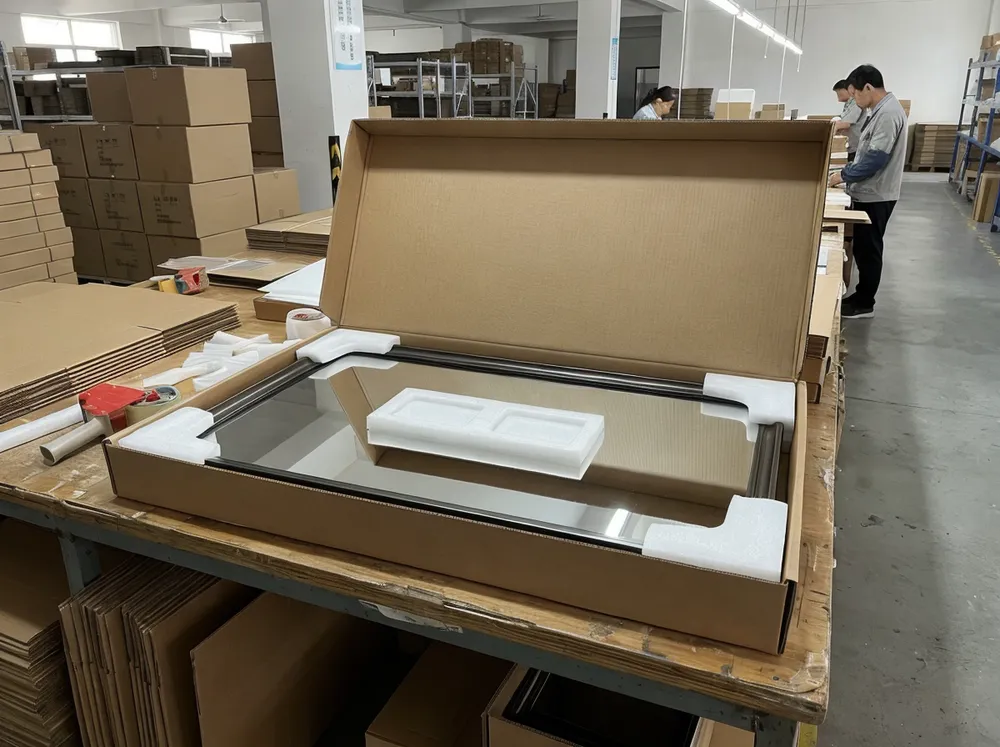
The practical difference: when you order from a domestic distributor, you're buying from their inventory at their margin. When you order from us, you're specifying production — frame profile, glass thickness, silvering spec, finish, packaging — and your container ships directly from our floor. No trading company layer, no markup sitting between your PO and the production decision.
Our copper-free silvering line is the detail most buyers notice first when they start asking technical questions. Standard silver-copper-paint construction oxidizes at the edges in humid environments — bathrooms, coastal properties, hotel corridors. Copper-free construction eliminates that failure mode at the source. We run 100% visual inspection on every unit before it loads, and our silver coating adhesion testing is part of the standard QC protocol, not an optional audit.
For buyers supplying major retail channels, we carry ISO 9001:2015, SGS, CE, and BSCI certifications, and we have direct experience with Walmart, Wayfair, and Amazon supplier compliance requirements including EDI. MOQ starts at 100 pieces for standard models — low enough for a boutique buyer to run a trial program, high enough that we're not a sample shop.
Domestic Wholesale vs. Factory-Direct: Where the Economics Diverge
Local distributors solve a real problem: you can reorder 50 units in two weeks without a container. That convenience has genuine value for certain buying situations — urgent restocks, small-format retail programs, emergency project fills. We're not going to pretend otherwise.
The economics shift when you're running a repeat-volume program. A domestic distributor's landed cost already includes their import margin (typically 30–50% over FOB), domestic warehousing, and fulfillment overhead. For a $25 FOB mirror, you might be paying $38–45 at the distributor wholesale level. At 500 units per order, that spread is $6,500–10,000 per container that stays in the distribution chain instead of your margin.
Factory-direct import adds lead time — typically 45–60 days from order confirmation to port of destination, versus 1–2 weeks from a domestic distributor. It also requires container-level planning and a longer cash cycle. Those are real costs. The question is whether the unit cost savings and customization control justify them at your order volume.
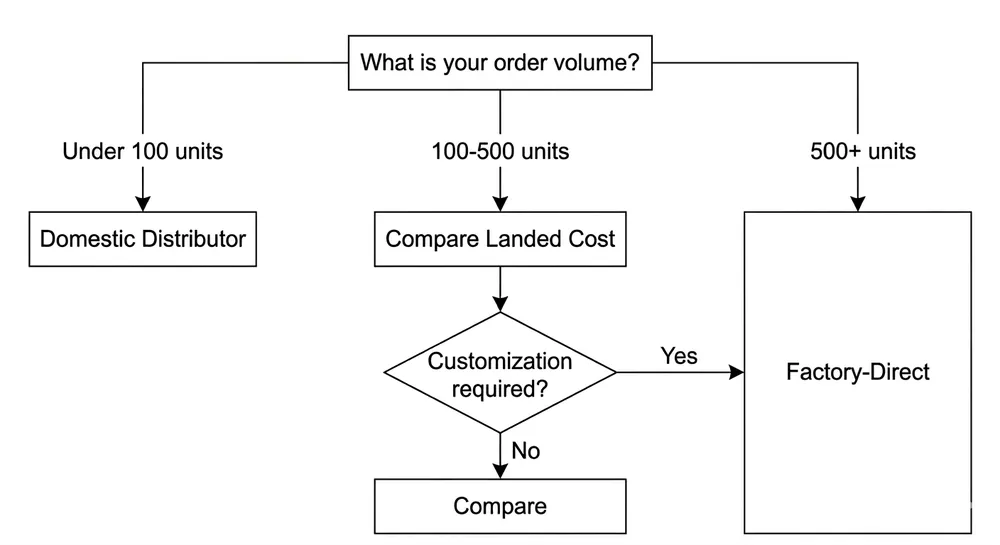
A rough framework:
- Under 100 units, urgent timeline: domestic distributor is almost always the right answer
- 100–500 units, standard styles, no customization: either model works — compare landed cost carefully
- 500+ units, repeat program, or any customization requirement: factory-direct economics are hard to ignore
- Retail compliance required (Walmart, Target, major chains): verify certification documentation regardless of supplier model
The other factor buyers underestimate is quality control visibility. With a domestic distributor, your QC happens at receiving — you find problems after the product is already in the country. With factory-direct, you can specify QC checkpoints, request pre-shipment inspection reports, and catch problems before they load. For a hospitality buyer putting 800 mirrors into a hotel renovation, that difference matters.
Coating Durability as a Sourcing Benchmark
Most toplist articles skip this entirely, so it's worth spending a moment on it. Mirror quality isn't just about frame finish — the glass backing is where long-term performance diverges between suppliers.
Standard mirror construction: float glass → silver nitrate coating → copper sulfate layer → protective paint. The copper layer is the industry standard, but it's also the failure point. Copper oxidizes when moisture penetrates the edge seal, producing the black edge creep that makes a mirror look aged within two years in a bathroom or coastal environment.
Copper-free construction replaces the copper layer with an alternative barrier coating. The result is significantly better edge durability in humid environments — relevant for any buyer supplying bathroom mirrors, hotel rooms, spa facilities, or coastal residential projects.
When you're evaluating any supplier on this list — or any supplier not on this list — ask one question: is your silvering process copper-free? If they don't know the answer, that tells you something about how close they are to the production floor.
We use copper-free silvering across our full decorative mirror range. It's not a premium tier — it's how we build every unit, because the warranty claim cost of edge oxidation isn't worth the material savings.
Room-Specific Specs That Change Your Supplier Requirements
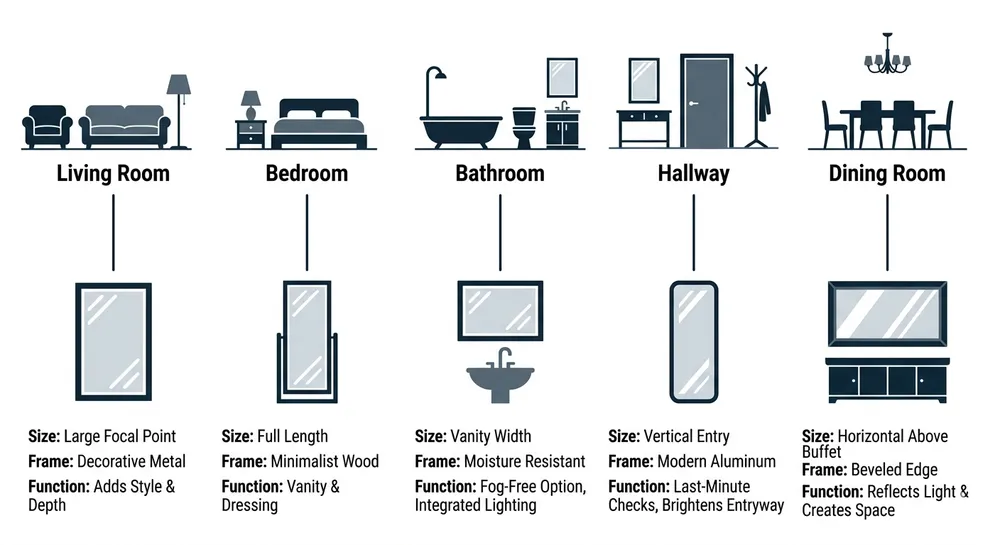
This is where a lot of buyers lose money: ordering the same mirror spec across multiple room categories when the application requirements are actually different. A bathroom mirror and a living room mirror share a factory — but almost nothing else in the spec sheet.
Bathroom mirrors: copper-free silvering is non-negotiable for any program with a quality guarantee. Frame substrate matters — MDF swells in steam environments. Specify moisture-resistant MDF or aluminum frames for bathroom programs. Glass thickness of 4–5mm is standard; thinner glass increases breakage risk during installation.
Living room and entryway mirrors: larger format, heavier frames, and wall-mounting hardware become the critical spec. D-ring and French cleat mounting systems need to be rated for the mirror weight with a safety factor. Frame finish durability matters more than moisture resistance here.
Bedroom and dresser mirrors: often paired with furniture, so finish matching and consistent color batches across a program matter. If you're supplying a furniture retailer, ask about color batch consistency across production runs — this is where cheaper suppliers create problems.
Hospitality and contract: volume, consistency, and documentation. Every mirror in a 200-room hotel needs to look identical. That requires tight production controls, not just a good sample. Ask for production batch QC reports, not just pre-shipment inspection.
For buyers building multi-room programs, our Decor Mirrors by Room category covers the full spec breakdown by room type — it's a useful reference when you're building a PO that spans bathroom, bedroom, and living room SKUs in a single order.
Supplier Comparison at a Glance
| Supplier | Type | MOQ | Customization | Retail Compliance | Best For |
|---|---|---|---|---|---|
| Fetco Home Decor | Domestic distributor | Low | Catalog only | Standard | Gift/specialty retail reorders |
| Umbra | Brand/wholesale | Medium | Limited | Standard | Design-forward retail |
| Howard Elliott | Domestic distributor | Low–Medium | Catalog only | Standard | Style-breadth assortments |
| Mirrorize | Specialty supplier | Low–Medium | Custom sizing | Standard | Non-standard dimensions |
| Reflection Glass | Domestic fabricator | Medium | Custom glass | Standard | Commercial/architectural |
| Spancraft Glass | Domestic manufacturer | Medium | Limited | Standard | Domestic-origin requirement |
| NeuType | Import brand | Low | Brand SKUs only | Standard | Amazon/DTC channel buyers |
| Coaster Company | Domestic distributor | Low | Catalog only | Standard | Multi-SKU furniture retail |
| Privilege International | Domestic distributor | Low | Catalog only | Standard | Catalog variety, fast fill |
| Livewellcraft | Factory-direct | 100 pcs | Full OEM/ODM | ISO, SGS, CE, BSCI | Repeat programs, retail compliance, custom |
How to Run a Credible RFQ Process for Room Mirrors
Most buyers send vague inquiries and get vague quotes back. The suppliers who respond fastest to a well-structured RFQ are usually the ones with real production capability — because they can actually answer specific questions.
When you contact any supplier on this list, send these details upfront:
- Room type and application — bathroom, living room, hospitality, retail display
- Mirror dimensions — width × height in inches or cm, and whether custom sizing is needed
- Frame material preference — metal, wood, MDF, PS molding, or open to recommendation
- Finish and color — or reference a sample/image if you have one
- Glass spec — standard clear, bronze tint, antique effect, or copper-free silvering requirement
- Target quantity — initial order and expected annual volume
- Packaging requirement — master carton only, retail-ready, or specific retail compliance packaging
- Destination port — for landed cost comparison between domestic and import options
- Compliance documentation needed — BSCI, REACH, Prop 65, CA65, or retailer-specific requirements
Sending this upfront cuts the back-and-forth from three weeks to three days. It also immediately separates suppliers who can actually handle your program from those who will stall on every detail.
For factory-direct sourcing, also ask for: a pre-production sample policy, QC checkpoint documentation, and a reference from a buyer in a similar channel. Any factory with real export experience will have all three ready.
If you're evaluating Livewellcraft alongside domestic options, the most useful comparison is landed cost at your target volume. We can return FOB pricing within 48 hours on a structured RFQ — enough detail to run a real landed cost calculation against your current domestic supplier. Visit our About Livewellcraft page for a full overview of our production setup, or go directly to Request Quote with your room type, dimensions, and target quantity.
When Local Supply Is Still the Right Answer
Factory-direct import isn't always the smarter choice. Here's when domestic suppliers on this list are genuinely the better option:
Urgent small orders. If you need 30 mirrors for a project that starts in three weeks, no factory-direct option helps you. A domestic distributor with warehouse stock is the only answer.
Unpredictable reorder patterns. If your volume is inconsistent and you can't commit to container-level planning, domestic stocking distributors give you the flexibility to reorder on short notice without tying up capital in inventory.
First-time category entry. If you're adding mirrors to your product line for the first time and aren't sure which styles will move, buying from a domestic distributor's catalog lets you test the market without a production commitment. Once you know what sells, factory-direct economics make more sense.
Compliance timing pressure. If a retail buyer has given you a 30-day compliance deadline and you don't have time to run a factory audit, a domestic supplier with existing compliance documentation is the lower-risk path.
The honest answer is that most serious wholesale buyers end up running both models simultaneously — domestic distributors for fast-turn replenishment and emergency fills, factory-direct for their core repeat programs where volume and margin justify the planning overhead. That's not a compromise; it's a mature supply chain strategy.