5 room-based collections running on shared mirror production infrastructure — same frame lines, same QC, same packaging operation. OEM/ODM with custom sizing and framing from 100 pieces.
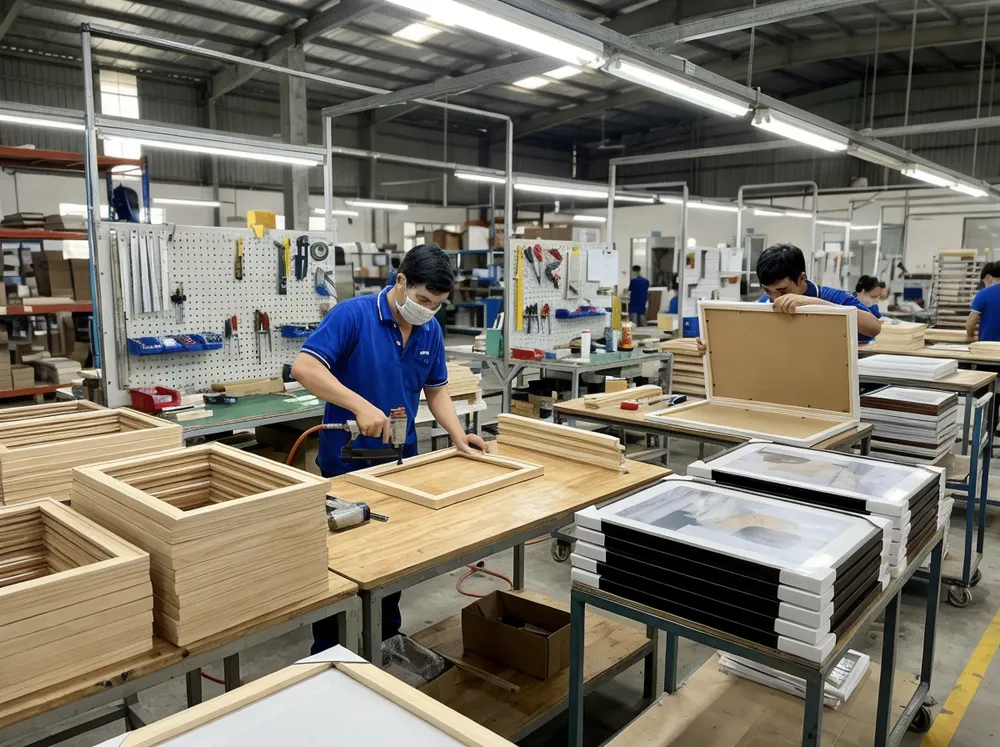
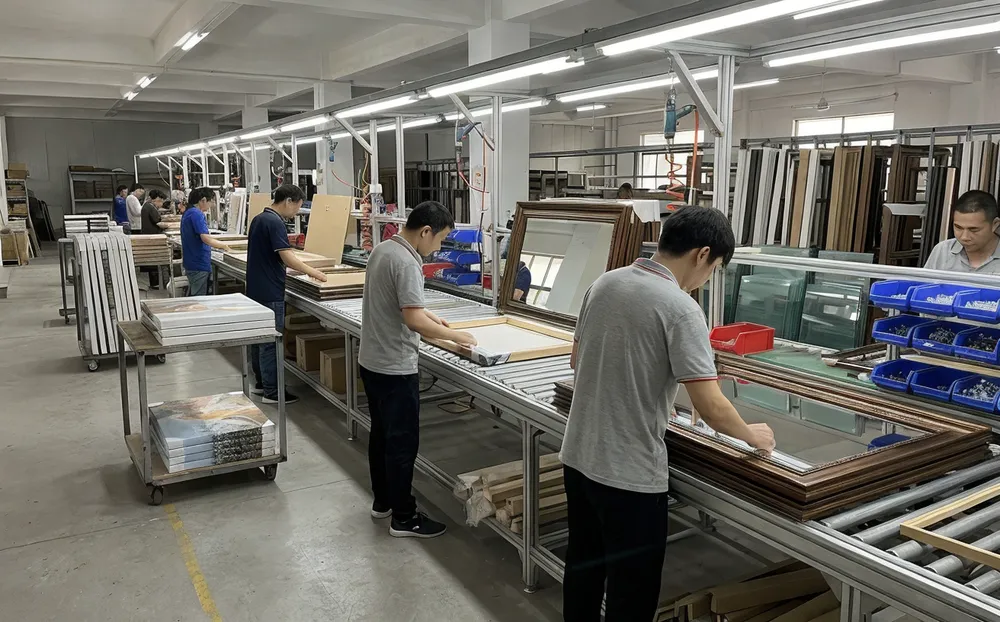
We didn't set out to make wall art. We've been making decorative mirrors since 2008 on our 12,000 m² facility in Dong Nai, Vietnam — glass cutting, silvering, frame molding, assembly, all under one roof. But when you already run frame lines in MDF, solid wood, metal, and resin, plus finishing stations for multi-coat painting, powder coating, and electroplating, the jump to framed wall art is shorter than you'd think. The frame is the frame. The finishing is the finishing. The packaging challenge — protecting a flat, fragile decorative piece through ocean freight — is identical.
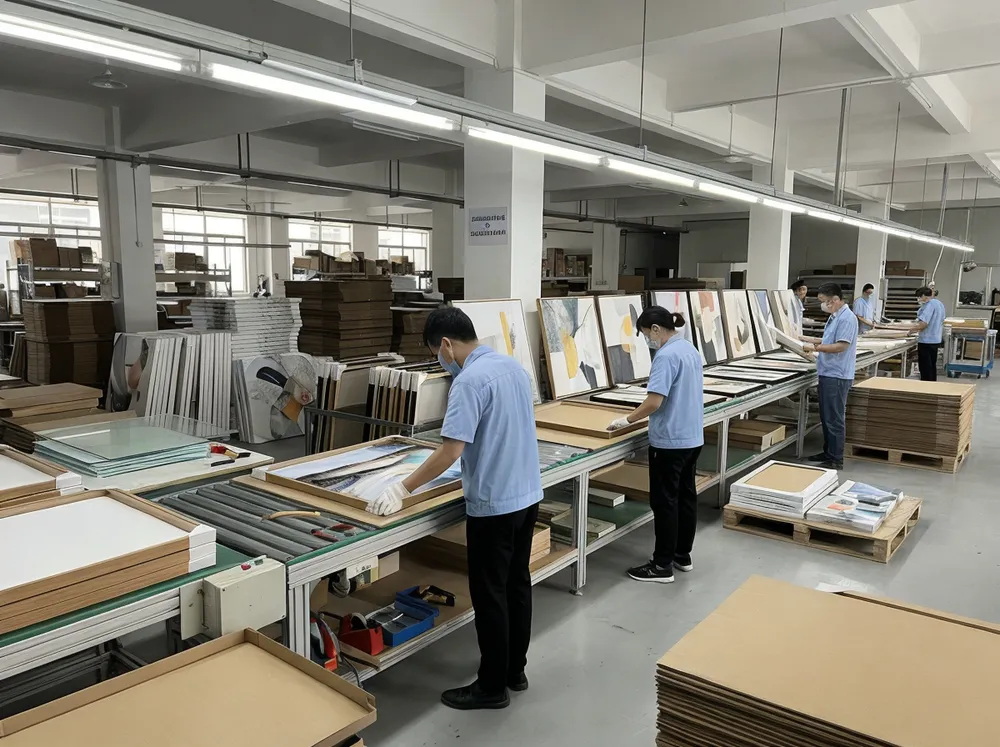
Our buyers pushed us into it. Distributors already sourcing mirrors wanted to consolidate wall decor under one supplier. Hospitality project buyers needed coordinated mirrors and art pieces for the same rooms. Rather than sending them to a separate factory and adding another vendor to their supply chain, we expanded the panel side of the operation — canvas stretching, panel printing, mixed-media assembly — using the same frame lines, finishing stations, and QC protocols that already ran 400,000 mirror units a year. Today, wall arts by room account for a growing share of our output, and every piece ships from the same 12,000 m² facility in Dong Nai that handles our mirror production.
You can order decorative mirrors and wall art on the same purchase order, in the same container, from the same production team. One invoice, one quality standard, one point of contact. If you're building a room-based wall decor program for retail or hospitality, that consolidation cuts your vendor management in half.
We organize wall arts by room because that's how your customers shop — and more importantly, it's how your retail buyers merchandise. A "living room wall art" search has different sizing expectations, color palettes, and price tolerance than "office wall art." We've structured our production around those differences so you can order room-targeted collections without custom-engineering every SKU from scratch.
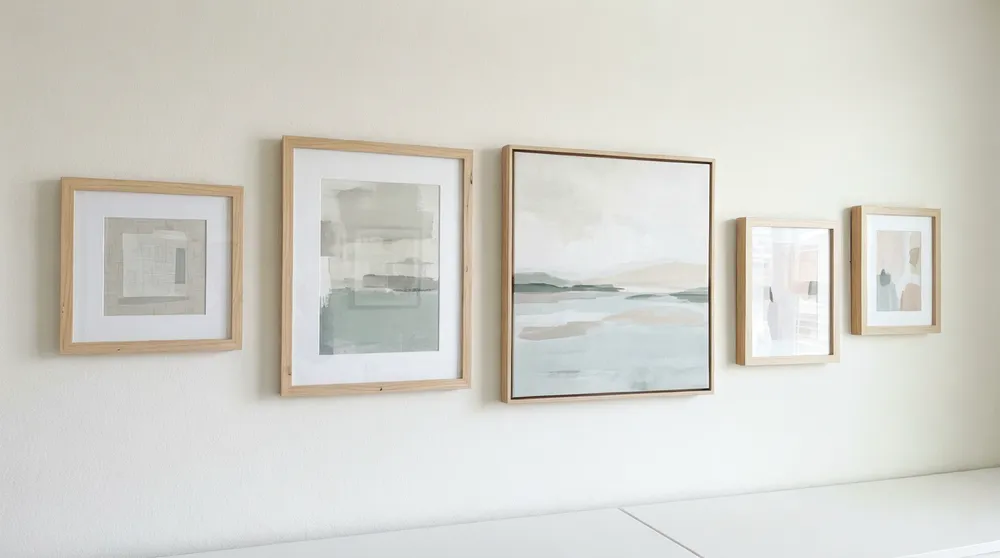
Soft tones, smaller to mid-size formats, and frames that read calm rather than bold. Bedroom pieces tend toward canvas prints, abstract soft-palette panels, and linen-textured substrates in wood or slim MDF frames.
This is a high-volume segment for online retailers — bedroom decor is one of the top-searched wall art categories on Amazon and Wayfair, and the price points (typically mid-range) protect healthy margins for resellers.
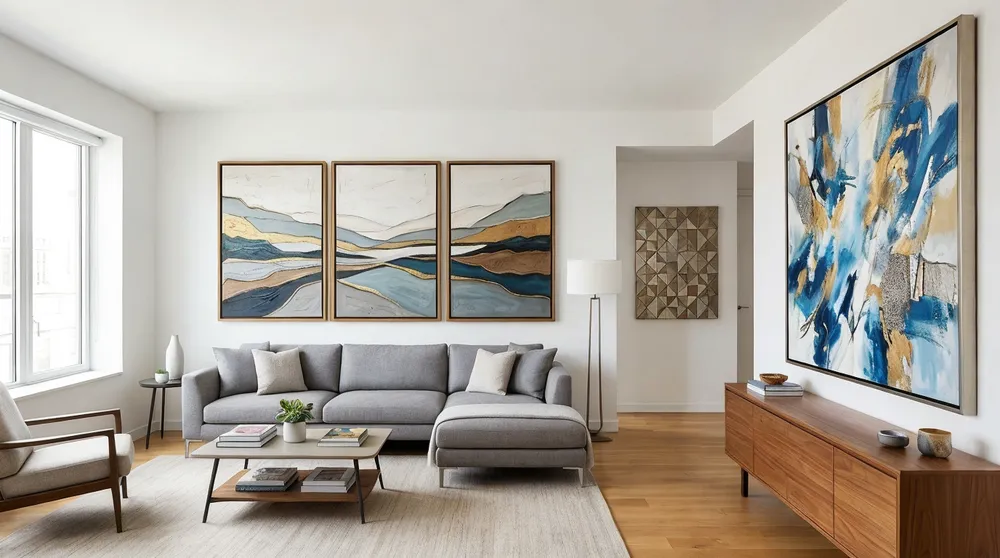
Larger formats, statement pieces, multi-panel sets. Living room wall art is where your buyers expect visual impact — oversized canvases, triptych arrangements, and mixed-media panels with dimensional texture. Frame options run wider here: thick wood profiles, metal gallery frames, and resin-molded ornamental frames all move well.
Multi-panel sets are particularly strong for e-commerce because the perceived value is higher, so your retail markup holds.
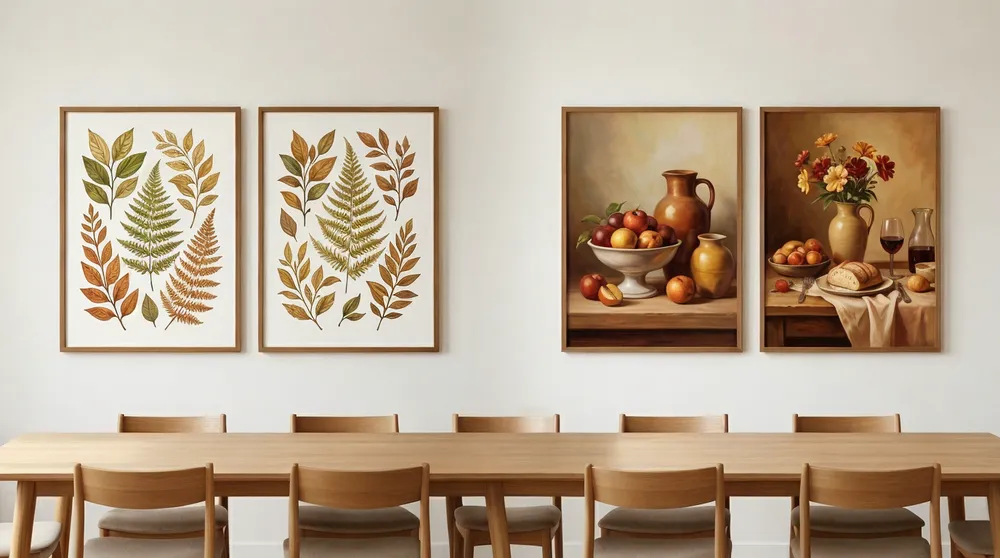
Mid-size pieces with warm tones and subject matter that fits food and gathering spaces — botanical prints, still life, abstract warm-palette work. Dining room art tends to sell in pairs or coordinated sets, which is worth noting for your SKU planning.
We produce matched sets on the same production run to guarantee color consistency across pieces. Color matching across separate runs is possible but adds a QC step — ordering sets together is always cleaner.
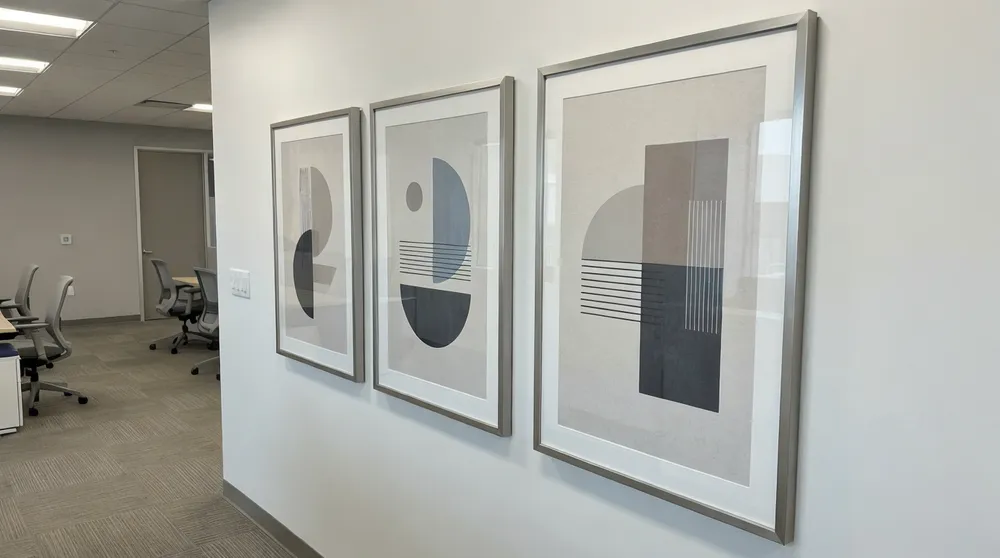
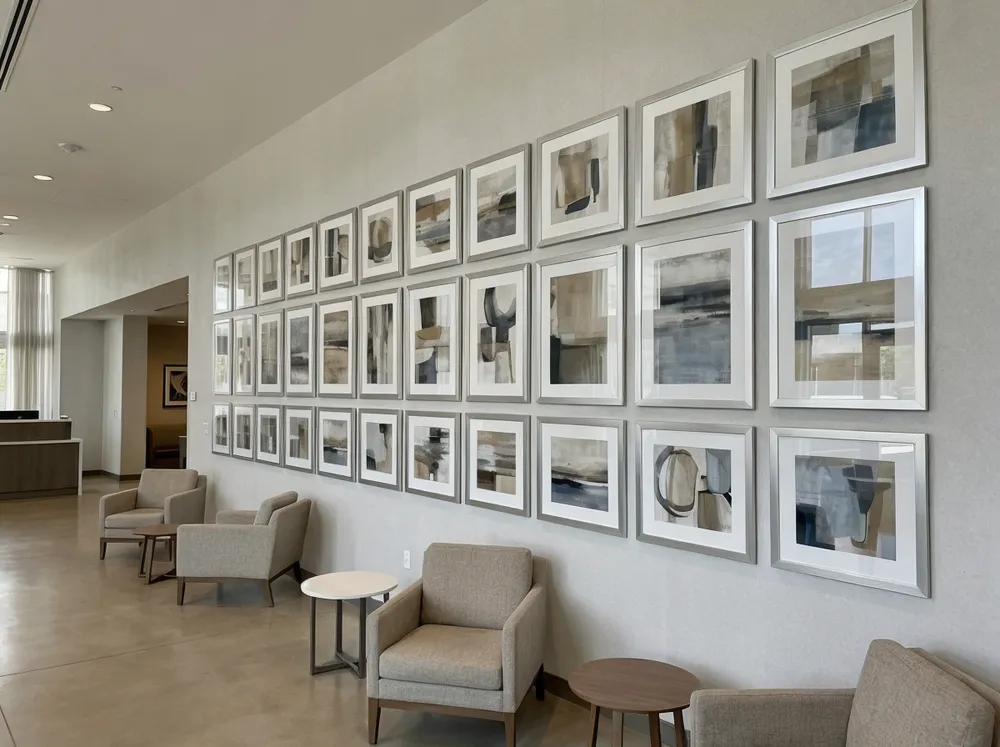
Clean lines, neutral palettes, professional-grade framing. Office wall art is a different buyer profile entirely — you're often selling to commercial interior firms, coworking space operators, or corporate procurement. The volumes per project are higher (20–100 pieces for a single office fit-out), the framing needs to be durable enough for high-traffic environments, and the aesthetic has to stay neutral across diverse tastes.
We run office art primarily in metal frames and slim MDF with matte finishes. This is also where custom sizing matters most — office walls don't follow residential proportions.
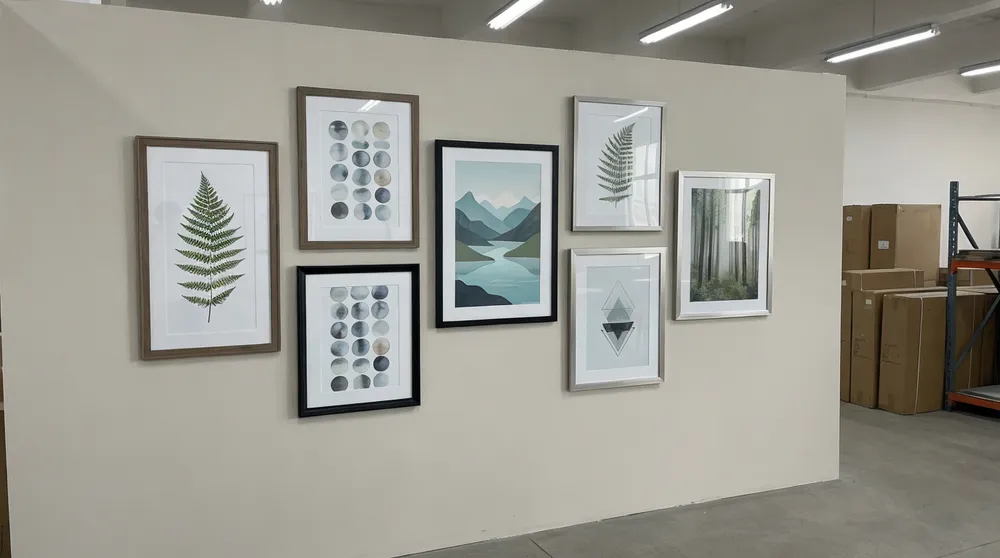
The broadest collection — pieces that work across multiple rooms and don't lock into a single space. Home wall art is your general-purpose SKU range: versatile subjects, standard sizes, mid-market framing.
If you're a distributor building a starter catalog or testing a new market, this collection gives you the widest appeal per SKU. We keep standard models in this range at 100-piece MOQ specifically because it's the entry point for most new buyers.
Ready to discuss your target room categories and quantities? We'll recommend the SKU mix that fits your channel.
Since our wall art runs on the same frame infrastructure as our mirror lines, the material and finish options are identical. Here's what we work with at the category level:
MDF, solid wood (pine, paulownia), metal (iron, aluminum), resin (polyurethane)
MDF and metal are the volume runners; solid wood and resin serve premium lines
Multi-coat paint, powder coating, electroplating (gold, silver, chrome), hand-applied patina, natural wood stain
Powder coating and electroplating run on automated lines; hand-patina is manual and adds 3–5 days to lead time
Stretched canvas on wood bars, MDF panel, acrylic sheet, metal sheet
Canvas is the default for art prints; MDF and acrylic for mounted prints and mixed-media
Giclée-quality inkjet on canvas, UV printing on rigid substrates, hand-painted elements (for mixed-media lines)
UV printing gives the sharpest output on rigid panels; canvas inkjet handles texture and color depth better
20×20 cm to 120×160 cm (single panel); multi-panel sets up to 200 cm total span
Custom sizes available on OEM orders — we cut frames and substrates to your spec
D-rings, sawtooth hangers, French cleats (for heavier pieces), wire kits
Hardware choice depends on weight and your end market's wall type expectations
These are category-wide ranges. Each room collection page breaks down the specific sizes, substrates, and frame profiles that move best for that segment.
Room-based wall art isn't one market — it's several, and each has different volume patterns, price sensitivity, and ordering behavior. We've shipped into all five of these channels, so here's what we see from the production side.
This is the largest channel for room-specific wall art. Your listings compete on imagery and price, and your margin lives or dies on landed cost per unit.
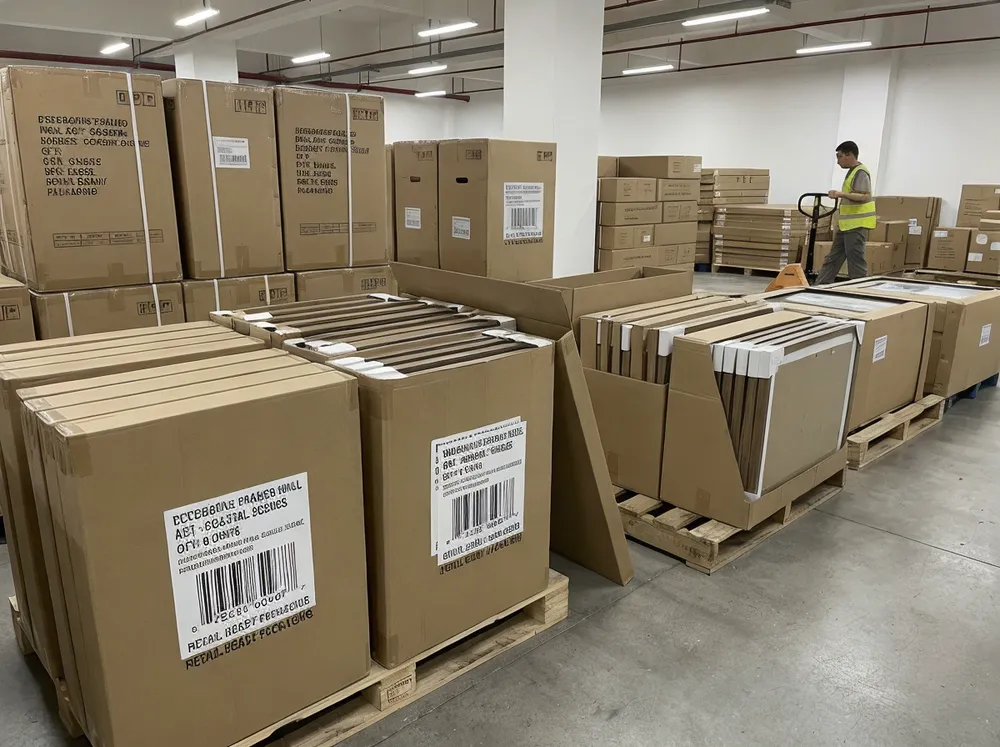
We optimize for this channel by offering flat-pack packaging that maximizes container density — a 40HQ container holds significantly more flat-packed canvas art than pre-assembled framed pieces. (We'll get into the exact loading numbers below.)
Standard sizes in this channel move fastest because they match the search terms buyers use on Amazon and Wayfair.
Retail-ready packaging with UPC labels, shelf-ready cartons, and sometimes display-ready frames that hang directly from the shipping box.
We've done this for Walmart and Wayfair vendor programs on the mirror side, and the packaging compliance process is identical for wall art.
If your retail buyer requires EDI integration, we already have the systems running.
Hotels, restaurants, coworking spaces, senior living facilities. These projects order 50–500 pieces at a time, often with custom sizing to fit specific wall dimensions, and they need color consistency across the entire batch.
Our production advantage here is running the full order on a single print and frame batch — no color drift between units 1 and 300.
Smaller quantities, higher design specificity. These buyers often send reference images and need us to match a particular aesthetic.
Our 12-person engineering team handles the translation from mood board to production spec — frame profile, finish, substrate, print color calibration.
You need breadth — enough SKUs across rooms, styles, and price points to fill a catalog that your downstream retailers will order from.
We support this by offering mixed-container orders across room collections, so you can load bedroom, living room, and office art into a single shipment without hitting separate MOQs for each category.
Roughly 60% of our wall art output ships as OEM — your design, your branding, your packaging, produced on our lines. The other 40% is ODM, where buyers select from our existing designs and customize the frame, size, or finish to fit their market.
Any dimension within our cutting range — we're not locked to standard sizes. Custom proportions available for your market requirements.
Choose from existing mold profiles or develop a new one. New mold development takes 15–20 days and stays with your program.
Pantone matching on paint finishes, RAL matching on powder coat. Exact color reproduction for brand consistency.
You supply the files, we handle color calibration and proofing. Minimum 300 DPI at print size required for production quality.
Canvas, MDF, acrylic, metal — matched to your price point and product positioning. Each substrate serves different market segments.
Your brand, your UPC, your insert cards, your carton design. Complete white-label capability from factory to shelf.
Send reference images or artwork files and your target specs to our engineering team.
Technical drawing and material recommendation returned within 48 hours.
Physical sample produced in 7–10 days for your approval before bulk commitment.
25–40 days depending on quantity and complexity. Multi-panel sets with mixed media take longer.
Mold Investment: New frame mold development is a one-time investment that stays with your program. Once we've cut the mold, reorders on that profile run at standard lead times with no tooling delay.
Send us your artwork files or reference images — our engineering team will spec the production approach and quote within 48 hours.
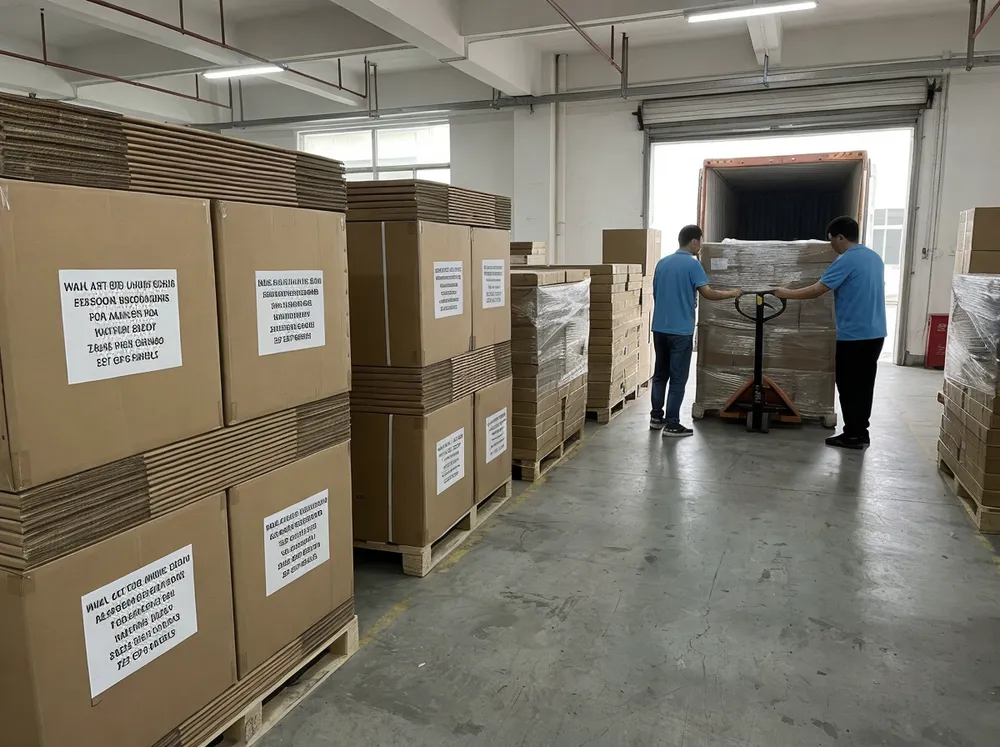
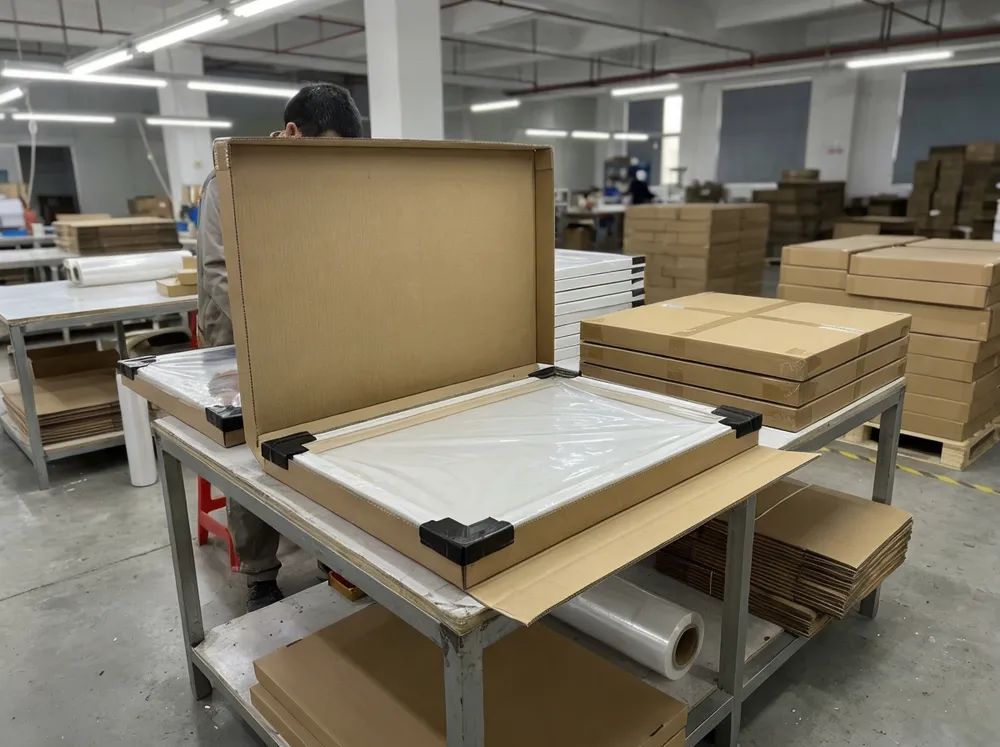
Wall art is flat, fragile, and deceptively awkward to ship efficiently. The frame corners are the vulnerability point — one crushed corner means a return, and returns on wall art eat your margin faster than almost any other home decor category. We've spent years refining the packaging to solve both problems: protection and density.
Flat-packed wall art loads efficiently because the pieces nest. We provide exact loading plans with your quote so you can calculate your landed cost per unit before committing.
Mid-size wall art (60×80 cm range), depending on frame depth and packaging configuration.
If you're mixing wall art with mirrors in the same container, we plan the loading sequence so the heavier mirror cartons sit at the bottom — this isn't optional, it's how you avoid crushing the art.
If your channel requires shelf-ready packaging — hang-tab cartons, window boxes, or display-ready frames — we produce those on the same packaging line.
The cost per unit increases slightly, but it eliminates your repackaging step at the warehouse.
That includes ocean freight to North America and Europe. We achieve that through drop-testing our packaging configurations before committing to a design.
Testing Standard: If a packaging spec doesn't survive a 75 cm drop test on all six faces, we redesign it before your order ships.
Our QC system was built for mirrors, where the tolerance for defects is essentially zero — a scratch on silvered glass is visible from across the room, and there's no touching it up. We apply that same inspection intensity to wall art, but the checkpoints shift.
Every print run gets a color calibration check against the approved sample before bulk printing starts. We pull units at intervals during the run to verify color consistency — inkjet heads can drift over long runs, and catching it at unit 50 is very different from catching it at unit 500.
This is one of those things that separates a factory with print experience from one that just bought a printer.
Same protocol as our mirror frames: 100% visual inspection for finish defects, dents, and coating adhesion.
Panel-to-frame fit, backing security, hanging hardware installation, and overall structural integrity.
Corner protectors in place, poly bag sealed, carton integrity, label accuracy.
For retail-ready orders, we verify UPC placement, insert cards, and carton print quality.
Every unit passes through these checkpoints. We don't do sampling-only QC on finished goods — the cost of a single defective unit reaching your customer (return shipping, replacement, lost trust) exceeds the cost of inspecting it here.
MDF and metal are the two workhorses for volume. MDF takes paint finishes well, keeps the per-unit cost down, and is light enough to ship efficiently — your container holds more units and your end customer gets easy hanging. Metal frames (typically iron with powder coating) cost slightly more but signal premium positioning, which supports higher retail pricing.
Solid wood and resin frames serve boutique and luxury lines where the frame itself is part of the design story, but they add weight and cost that only make sense if your retail price point absorbs it.
Yes — and most of our distributors do exactly this. We produce all room collections on the same facility, so mixing bedroom, living room, and office wall art in a single container doesn't create production complications.
The only constraint is meeting the overall order minimum, not per-SKU minimums across every room category. We plan the container loading to group by size and fragility, not by room collection.
OEM orders with your own artwork start at 200 pieces per design for standard sizes. If you're using an existing frame profile from our catalog, that's the only minimum.
If you need a new custom frame mold, there's a one-time tooling charge, but the mold belongs to your program and all reorders run at standard MOQ.
For testing purposes, we can produce a smaller sample run of 5–10 pieces before you commit to bulk.
Color calibration happens at three points:
Canvas and rigid substrates absorb ink differently, so the calibration profile changes by substrate type. For multi-panel sets, all panels in a set print in the same batch to eliminate any variation between pieces that will hang side by side.
Our facility holds ISO 9001:2015, and our products carry CE marking for the European market.
SGS testing reports cover material safety — particularly relevant if you're selling into markets with restrictions on VOCs or formaldehyde in MDF substrates.
For US retail channels, we handle the compliance labeling (California Prop 65 where applicable, CPSIA for any children's room products).
BSCI certification covers our social compliance, which matters if your retail partners audit supply chain labor practices.
The core difference is weight distribution. Mirrors are heavier per unit (glass plus silver coating plus frame), so mirror packaging prioritizes crush resistance and weight support. Wall art — especially canvas — is lighter but more vulnerable to flex damage and corner impact.
We use rigid stiffeners inside canvas art cartons that we don't need for mirrors, and the corner protectors are shaped differently to guard the frame's decorative face.
Container loading is also different: wall art loads denser because it's lighter, so your per-unit freight cost drops compared to mirrors of the same dimensions.
Whether you're expanding an existing mirror program or exploring wall art for the first time, we've designed entry points that minimize risk while letting you validate quality and market fit.
Adding wall art to your next order is the simplest expansion you'll make — same production team, same logistics, same commercial terms. Your existing relationship means streamlined communication and proven quality standards already in place.
Wall art is a low-risk entry point. The MOQ starts at 100 pieces on standard models, and a sample order of 5–10 custom pieces lets you test the quality before scaling. Evaluate our craftsmanship, communication, and logistics without committing to container volumes.
Room Categories
Which spaces are you targeting?
Volume Expectations
Annual or per-order quantities
OEM or ODM
Your artwork or our designs, your specs
We'll send back a product recommendation, pricing, and a container loading plan — typically within 48 hours.
Reach out directly to discuss your wall art requirements. Whether you need a sample shipment or a full container loading plan, our team is ready to help you build the right product mix for your market.