A bathroom mirror and a living room mirror share a factory — but almost nothing else in the spec sheet.
That's not a design observation. It's a sourcing reality. Buyers who treat mirror sizing as a single variable across room types end up with spec mismatches, freight surprises, and SKUs that don't move because they're wrong for the application. The dimensions that work in a living room create installation problems in a bathroom. The glass thickness that's fine for a bedroom accent piece is undersized for a full-length hospitality mirror that gets handled daily.
This guide covers standard mirror dimensions, glass thickness ranges, frame material constraints, and the production and freight implications that change when you move from one room category to another. It's written for distributors, retailers, and project buyers who need to spec mirrors correctly before they place an order — not after the container arrives.
We produce Decor Mirrors by Room across all major room categories from our 12,000 m² facility in Ho Chi Minh, Vietnam. Everything in this guide reflects what we actually cut, silver, frame, and ship.
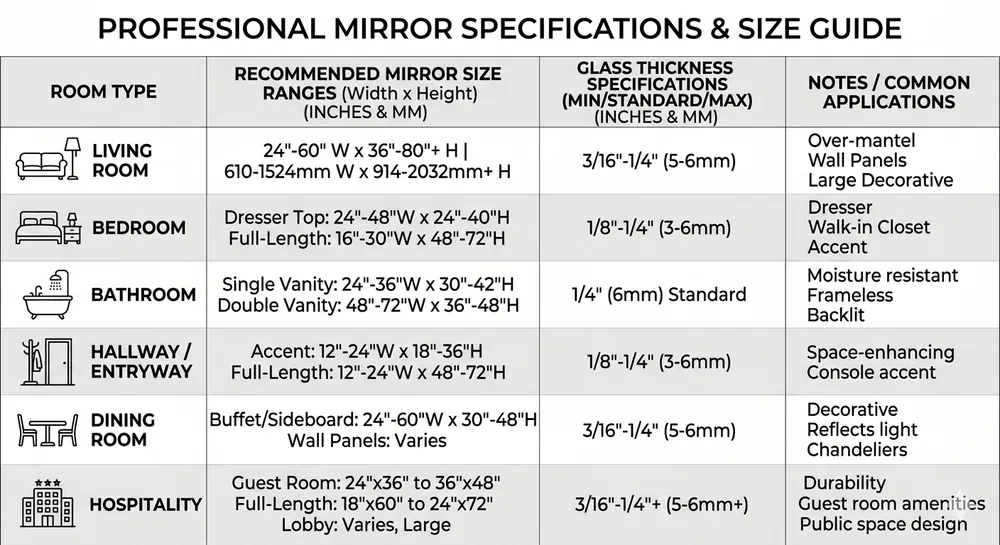
The Spec Table: Standard Mirror Dimensions and Glass Thickness by Room Type
This is the reference most sizing guides skip. Consumer articles talk about proportions and visual balance. What you actually need when writing a PO or briefing your engineering team is a working spec range — dimensions, glass weight, and thickness — by room application.
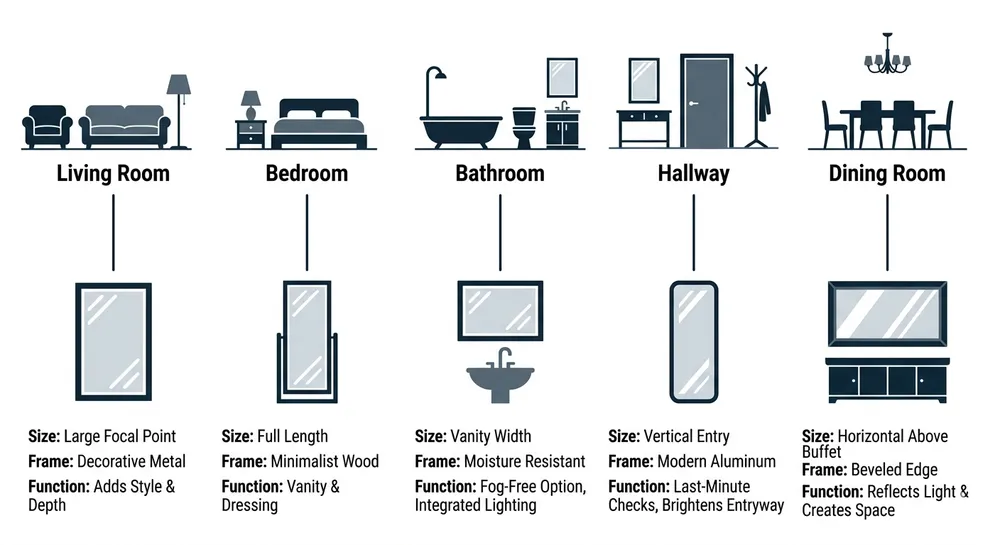
| Room Type | Typical Size Range (W × H) | Standard Glass Thickness | Frame Material Options | Notes |
|---|---|---|---|---|
| Living room | 60×80 cm – 90×120 cm | 5mm–6mm | MDF, wood, metal, resin | Larger formats common; 5mm minimum for stability |
| Bedroom | 50×70 cm – 80×100 cm | 4mm–5mm | MDF, wood, resin | Full-length floor mirrors: 45×150 cm, 5mm |
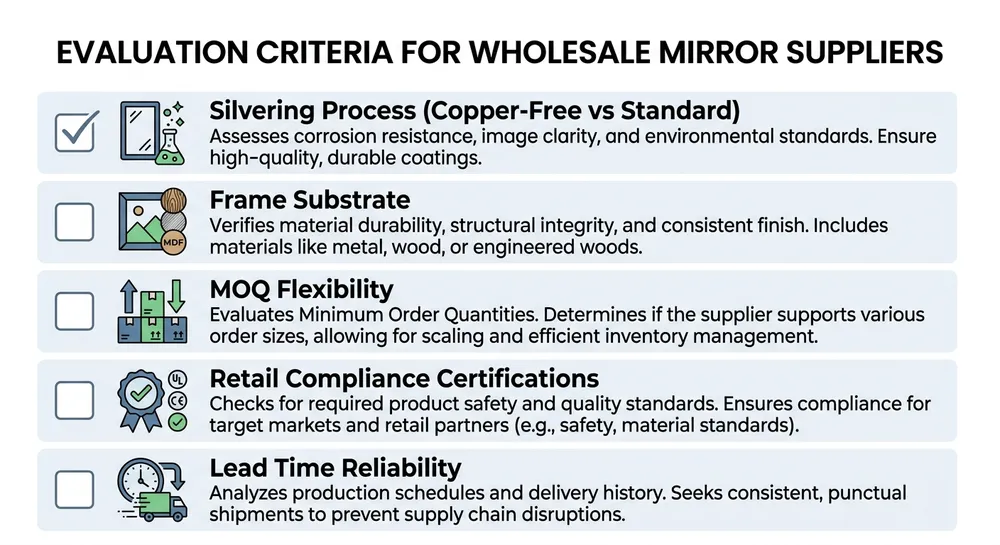
| Bathroom | 50×60 cm – 80×90 cm | 4mm–5mm | Metal, MDF (sealed) | Moisture spec critical; copper-free silvering standard |
| Hallway / entryway | 30×90 cm – 45×120 cm | 4mm–5mm | Metal, MDF, wood | Tall narrow format; weight distribution matters |
| Dining room | 70×90 cm – 100×130 cm | 5mm–6mm | Wood, metal, resin | Often statement pieces; heavier frames common |
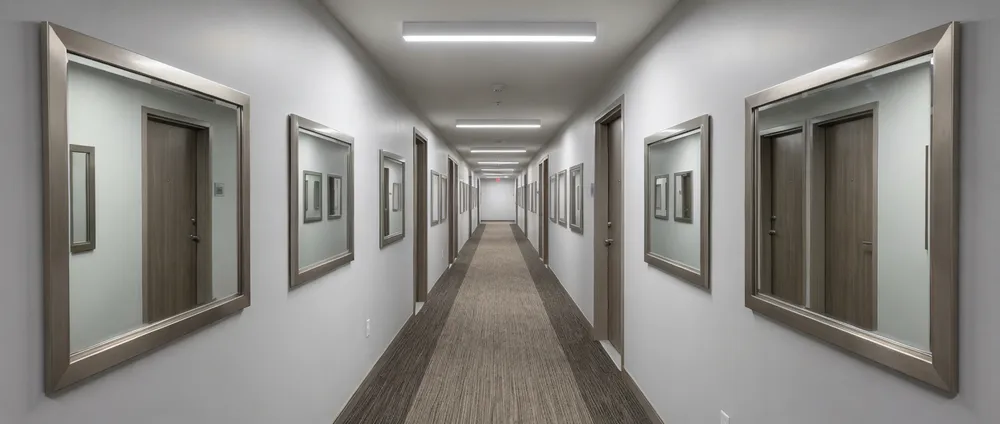
| Hospitality / hotel | 60×80 cm – 90×150 cm | 5mm–6mm | Metal, MDF (sealed) | High-use environment; backing and hardware upgraded |
A few things worth noting about this table. First, the size ranges reflect what actually moves in wholesale and project channels — not the full theoretical range of what's possible. We can cut glass outside these ranges, but the sizes above are where standard tooling, stock frame profiles, and predictable freight costs align. Second, glass thickness isn't just a structural spec — it affects mirror weight, which affects packaging, freight cost per unit, and installation hardware requirements. A 90×120 cm mirror in 6mm glass weighs roughly 16 kg before framing. That changes your carton spec, your pallet configuration, and your per-unit landed cost.
How Room Function Changes the Spec — Beyond Dimensions
Dimensions are the starting point. What actually differentiates a bathroom mirror from a living room mirror at the production level is a set of environmental and use-condition requirements that affect material selection, coating process, and hardware.
Moisture exposure (bathroom and hospitality)
Bathrooms are the most demanding environment for mirror longevity. Steam, cleaning chemicals, and condensation attack the silver layer from the edges inward — a process called "black edge" or silvering deterioration. The fix isn't thicker glass. It's the silvering process and edge sealing.
We run copper-free silvering as our standard process across all production. For bathroom decor mirrors, we add edge sealing with a moisture-resistant backing paint and specify sealed frame profiles — typically powder-coated metal or sealed MDF — that don't absorb humidity. Hospitality buyers often request an upgraded backing spec with an additional protective layer, which adds a small cost but meaningfully extends the mirror's service life in high-use hotel bathrooms. (We've had buyers come back after their first hospitality project asking why their previous supplier's mirrors started showing black edges within 18 months — the answer is almost always an unsealed edge on a standard silvering process.)
For bathroom mirror moisture specs in detail, that's covered separately. The short version for sourcing purposes: specify copper-free silvering and sealed edges on any mirror going into a wet or high-humidity environment.
Weight and wall-load (living room and dining room)
Larger decorative mirrors — the 80×120 cm and above formats common in living rooms and dining rooms — put real load on wall fixings. A 90×120 cm mirror in a 5mm glass with a solid wood frame can weigh 20–25 kg. That's not a problem if the hanging hardware is specified correctly, but it's a sourcing detail that gets missed when buyers focus only on the visual spec.
We specify D-ring hardware rated to the mirror's actual weight, with a safety factor built in. For mirrors above 15 kg, we move to a French cleat or dual-bracket system rather than wire hanging. If your downstream customers are installing into drywall without stud backing, that's worth flagging at the RFQ stage — we can adjust the hardware spec accordingly.
Daily handling (hospitality and retail)
Hotel mirrors and retail display mirrors get touched, bumped, and cleaned far more often than residential pieces. For these applications, we upgrade the backing to a shatter-resistant safety film — a laminated layer bonded to the rear glass surface that holds fragments in place if the mirror breaks. This is standard in most hospitality specifications and increasingly required by retail chains for floor-standing mirrors. It adds roughly 8–12% to the unit cost but eliminates liability exposure from breakage.
Frame Material Constraints by Mirror Size
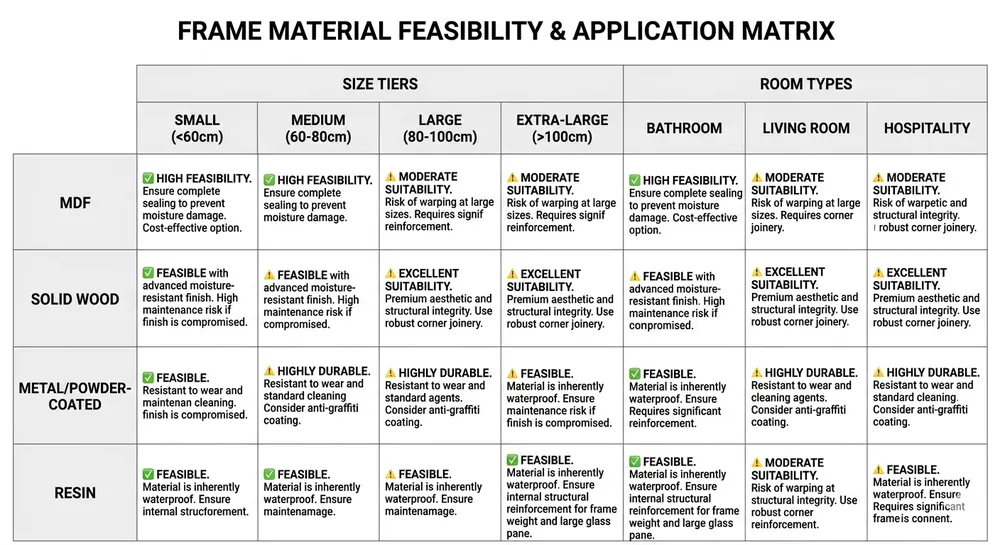
Frame material selection isn't just aesthetic. At the production level, different frame materials have different structural limits, and those limits interact directly with mirror size.
MDF frames are the most common choice for mid-range decorative mirrors in the 50×70 cm to 80×100 cm range. MDF machines cleanly, takes paint and foil finishes well, and keeps unit costs competitive. The constraint is weight-bearing capacity at larger sizes — an MDF frame on a 90×120 cm mirror needs internal reinforcement (typically a metal bracket system inside the frame channel) to prevent joint failure over time. We add this reinforcement as standard on MDF frames above 80 cm in either dimension.
Solid wood frames handle larger formats better structurally, but they add weight and cost. Wood is the right choice when your buyer is positioning the mirror as a premium piece — the material communicates quality in a way MDF doesn't, and it justifies a higher retail price point. The trade-off is that wood frames require more careful moisture management in transit and storage, particularly for buyers in humid markets.
Metal frames (powder-coated steel or aluminum) are the preferred spec for bathroom and hospitality applications because they don't absorb moisture. They're also the right choice for very large formats — above 90 cm width — where structural rigidity matters more than weight reduction. Metal frames add to the unit weight, which affects freight, but they're the most durable option for high-use environments.
Resin frames are used primarily for decorative profiles that can't be economically produced in wood or metal — ornate moldings, textured surfaces, complex shapes. Resin is lighter than wood at equivalent profile thickness, which helps on larger pieces. The constraint is that resin frames are more susceptible to impact damage in transit, so packaging requirements are higher.
The practical sourcing implication: if you're building a room-based product line that spans multiple size tiers, you may need different frame materials at different size points — not because of aesthetics, but because of structural and environmental requirements. We see this most often with buyers building bathroom and living room collections simultaneously. The bathroom SKUs need metal or sealed MDF; the living room SKUs can use wood or standard MDF. Trying to standardize on one frame material across both categories usually means compromising on one of them.
Non-Standard Sizes: What Changes in Production and Cost
Standard sizes exist for a reason. When you move outside the ranges in the table above, several things change simultaneously — and buyers who don't account for them end up with higher unit costs and longer lead times than they planned for.
Glass cutting on our automated tables is optimized for standard sheet sizes. Non-standard dimensions increase glass offcut waste, which raises the material cost per unit. A 10% size deviation from a standard cut pattern can increase glass waste by 20–30% depending on the nesting geometry. We absorb some of this on large orders, but on smaller runs it shows up directly in the unit price.
Frame tooling is the bigger variable. Standard frame profiles — the mold that shapes the frame cross-section — are already in our tooling library. If your size requires a new profile, tooling development adds 15–20 days and a one-time tooling cost that typically runs between $300–$800 depending on profile complexity. For buyers ordering 500+ units of a custom size, that cost amortizes quickly. For a 100-unit trial order, it's a meaningful addition to your landed cost per unit.
MOQ implications are real. Our standard MOQ is 100 pieces on existing molds and standard sizes. Non-standard sizes that require new tooling typically carry a higher MOQ — usually 300–500 pieces minimum — to justify the tooling investment. If you're testing a new room category with a non-standard size, the economics work better if you can commit to a larger initial run or accept the tooling cost as a development expense.
Lead time extends by 15–20 days for any order requiring new tooling. On a standard 5,000-piece order, our production lead time is 30–35 days. Add tooling development and you're at 45–55 days. That's not a problem if it's planned for — it becomes a problem when buyers assume standard lead times apply to custom specs.
The practical guidance: if you're building a new room-based SKU, start with sizes that fall within the standard ranges. Test sell-through at standard dimensions before investing in custom tooling. We've seen buyers spend on custom sizing for a new market entry, then discover the standard size would have sold just as well. (The reverse also happens — a buyer finds that a non-standard size is genuinely their market's preference, and the tooling investment pays back within two orders. But verify demand first.)
Packaging and Freight: How Mirror Size Affects Your Landed Cost
This is the section most sizing guides don't cover, and it's where B2B buyers lose money without realizing it.
Mirror size affects freight cost in two ways: direct weight/volume, and packaging efficiency per container. Both matter, and they interact.
Carton configuration by size tier
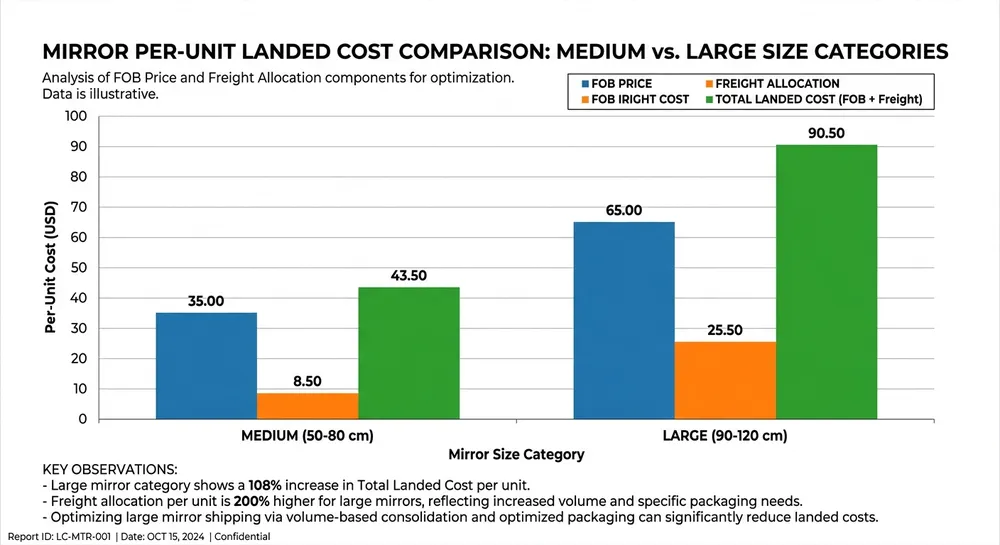
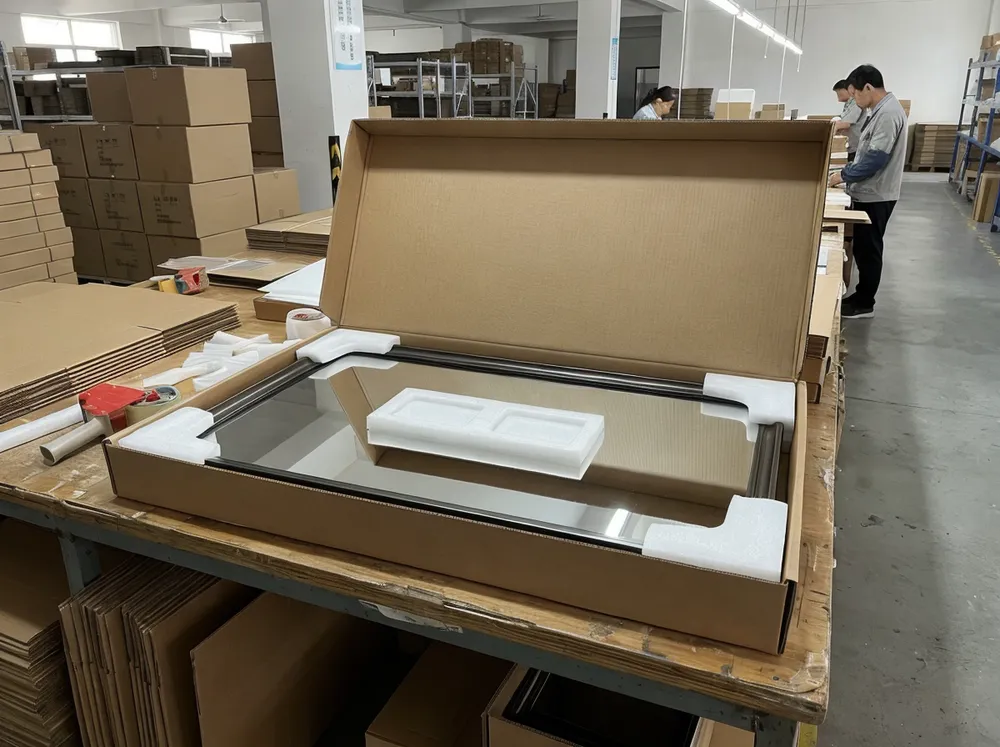
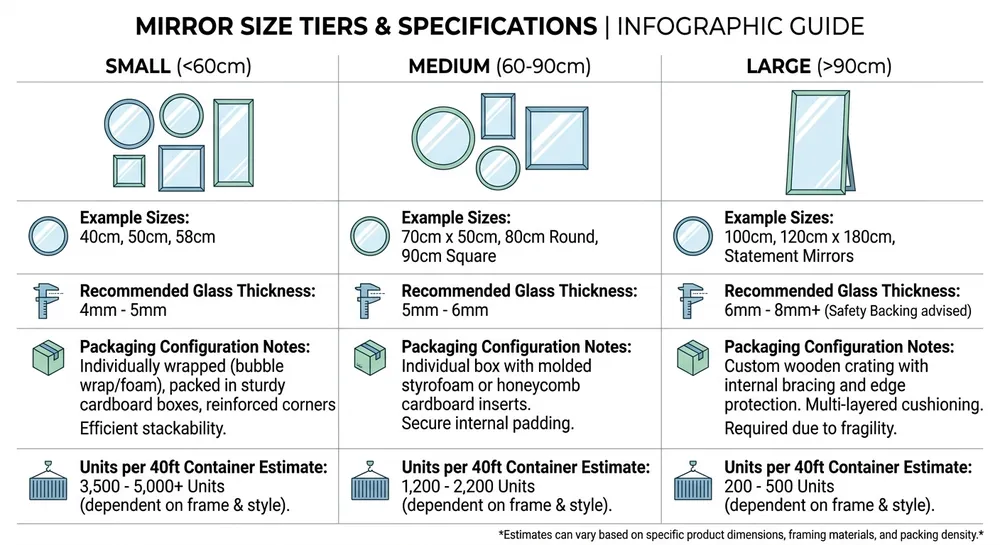
Small mirrors (under 60 cm in either dimension) can typically be packed 2–4 units per carton with foam corner protection and a corrugated inner divider. Medium mirrors (60–90 cm) go one unit per carton with full-perimeter foam and a double-wall outer carton. Large mirrors (above 90 cm) require custom carton engineering — typically a wooden crate or a reinforced carton with internal foam molding — which adds $3–8 per unit in packaging cost.
The packaging cost per unit is small in isolation. Across a 1,000-unit order of large mirrors, it's $3,000–$8,000 in packaging alone before freight.
Container loading efficiency
A 40-foot container holds roughly 28–33 CBM of cargo. How many mirrors fit depends entirely on carton dimensions, which depend on mirror size. A 60×80 cm mirror in a standard carton loads efficiently — you can typically fit 400–500 units in a 40-foot container. A 90×120 cm mirror in a reinforced carton might load at 150–200 units per container. That's a 2–3x difference in per-unit freight cost for the same container.
Our engineering team routinely re-engineers inner packaging on large mirror orders to improve container loading efficiency. On a recent hospitality project, adjusting the foam profile and carton orientation added an extra layer per pallet and reduced the buyer's per-unit freight cost by roughly 12%. That kind of optimization is only possible when the packaging is designed alongside the product spec — not after the carton is already built.
Breakage rates and glass thickness
Thinner glass (3mm–4mm) is lighter and cheaper, but it's more vulnerable to transit stress — particularly on long ocean freight routes with multiple handling points. We've tracked breakage rates across shipments and the pattern is consistent: 3mm glass in large formats (above 70 cm) shows meaningfully higher breakage rates than 4mm–5mm glass in the same size. The weight saving from 3mm glass rarely justifies the breakage risk on anything above a small accent mirror.
For buyers shipping to North America or Europe from Vietnam, the transit time is 25–35 days with multiple port handlings. Specify 4mm minimum on anything above 50 cm, and 5mm on anything above 80 cm. The weight increase is real, but the reduction in breakage claims pays for it.

How to Specify Mirror Size, Glass Thickness, and Frame Material for an OEM Order
Buyers who send a complete spec brief get faster quotes and fewer revision rounds. Here's what a complete mirror spec looks like at the RFQ stage.
Minimum required information:
- Mirror dimensions (W × H in mm or cm) — specify glass size, not frame outer dimension
- Glass thickness (3mm / 4mm / 5mm / 6mm)
- Edge treatment (straight cut, beveled, polished — and bevel width if applicable)
- Frame material (MDF / solid wood / metal / resin) and finish (paint color, foil, powder coat, plating)
- Silvering spec (standard or copper-free — specify if moisture environment applies)
- Backing requirement (standard backing / safety film / moisture-resistant backing)
- Hanging hardware (wire / D-ring / French cleat / wall bracket)
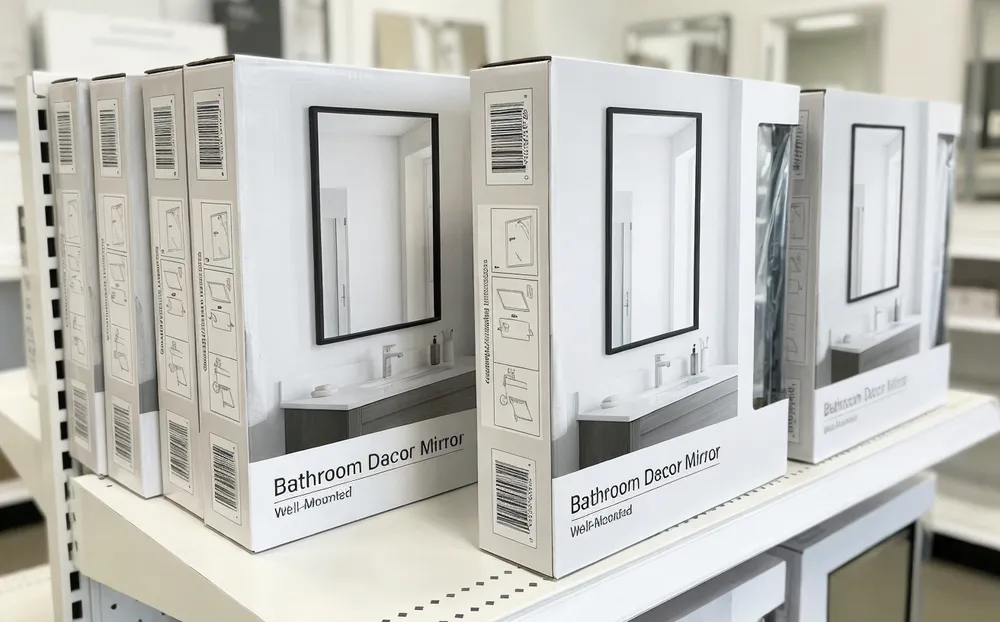
- Packaging requirement (retail shelf-ready / bulk pallet / project delivery)
- Target quantity and delivery destination
What happens when spec information is missing:
We quote based on assumptions when information is missing, and assumptions add cost. If you don't specify glass thickness, we default to the standard for the size range — which may be heavier than you need, or lighter than your application requires. If you don't specify silvering process, we quote copper-free as standard (which is correct for most applications but adds a small cost premium over basic silvering). If you don't specify packaging, we quote retail-ready cartons — which is more expensive than bulk packing for project delivery.
The fastest path to an accurate quote is a complete brief. For living room decor mirrors or bedroom decor mirrors, we have standard spec templates we can share as a starting point.
Reference samples and approved samples
If you're sourcing a mirror that matches an existing product — a competitor sample, a current supplier's piece, or a retail reference — send us the physical sample or detailed photos with measurements. We'll reverse-engineer the spec, identify the frame profile, and confirm whether it falls within our standard tooling library or requires new development. Most standard decorative mirror profiles are already in our library. Custom profiles that aren't add tooling time and cost, but we'll tell you upfront before you commit.
Non-Standard Sizes, Custom Profiles, and the MOQ Conversation
One question we get regularly: "Can you do [unusual dimension] at 100 pieces?"
Sometimes yes, sometimes no — and the answer depends on whether the size requires new tooling or just a different cut pattern on existing glass and frame stock.
No new tooling required (standard frame profile, non-standard glass cut): We can often accommodate at 100–200 pieces with a modest glass waste surcharge. The frame profile is already in our library; we're just cutting glass to a different dimension. Lead time stays at 30–35 days.
New frame tooling required (custom profile or non-standard frame width): MOQ moves to 300–500 pieces minimum, tooling cost applies ($300–$800 range), and lead time extends by 15–20 days. Below 300 pieces, the tooling cost per unit makes the economics difficult for most buyers.
New glass processing required (unusual edge treatment, non-standard bevel width): Depends on whether our existing grinding and polishing stations can handle the spec. Most standard bevel widths (10mm–25mm) are within our equipment range. Unusual profiles may require a setup fee.
The honest guidance: if you're entering a new room category and aren't sure whether your target size is standard or custom, send us the dimensions before you finalize your product brief. We'll tell you within 24 hours whether it's a standard cut, a glass-only custom, or a full tooling project — and what the MOQ and cost implications are. That conversation costs nothing and saves you from building a product brief around a size that doesn't work at your target volume.
For a full overview of room-specific mirror categories and standard SKU options, see our Decor Mirrors by Room category page. For hallway and entryway mirror sizing specifically, the hallway mirror sizing guide covers the tall-narrow format constraints in more detail.
Frequently Asked Questions
What glass thickness should I specify for a bathroom mirror at wholesale?
4mm minimum for standard bathroom sizes (50×60 cm to 70×80 cm). For larger bathroom mirrors above 80 cm in either dimension, specify 5mm. The thickness matters less for structural reasons in these sizes and more for transit durability — thinner glass in larger formats has higher breakage rates during ocean freight. Pair any bathroom mirror spec with copper-free silvering and sealed edges to prevent moisture-driven silvering deterioration.
Does mirror size affect MOQ at Livewellcraft?
Yes, directly. Standard sizes within our existing tooling library carry a 100-piece MOQ. Non-standard sizes that require new frame tooling move to 300–500 pieces minimum, with a one-time tooling cost. If you're testing a new room category, start with standard dimensions to keep your entry MOQ and lead time at the baseline.
What's the difference between standard and copper-free silvering, and when does it matter?
Standard silvering uses a copper layer between the silver and the protective backing paint. Copper-free silvering eliminates that layer, replacing it with an alternative adhesion process. The practical difference: copper-free silvering holds up better in humid environments (bathrooms, coastal hospitality, humid climates) and meets EU environmental requirements for copper-bearing wastewater. We run copper-free as our default process. For dry-environment applications like living room or bedroom mirrors, the difference in service life is minimal — but copper-free is the right spec for anything going into a wet or high-humidity environment.
How do I calculate how many mirrors fit in a 40-foot container?
Rough calculation: take your carton outer dimensions (L × W × H in cm), calculate carton volume in CBM (divide by 1,000,000), then divide 26–28 CBM (usable container volume after dunnage) by carton CBM. For medium mirrors (60–80 cm) in standard retail cartons, typical loading is 350–450 units per 40-foot container. For large mirrors (90–120 cm) in reinforced cartons, expect 150–220 units. We provide exact container loading calculations with every quote — send us your target dimensions and we'll run the numbers.
What's the lead time for a custom-size mirror order with new frame tooling?
Standard production lead time is 30–35 days on existing molds. Add 15–20 days for new frame tooling development and sampling. Total: 45–55 days from order confirmation to shipment. If your timeline is tight, we can sometimes run tooling development in parallel with material procurement to compress the schedule — ask us at the RFQ stage.
If your sourcing brief is ready, Request Quote and include your room type, target dimensions, glass thickness, frame material preference, and destination market. Our engineering team will return a technical proposal with dimensions, glass and frame specs, and pricing.