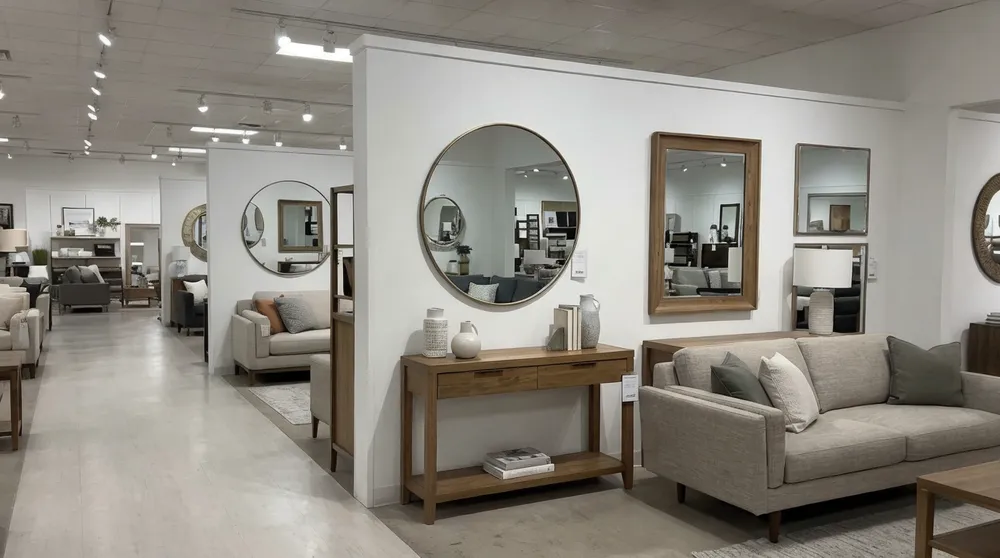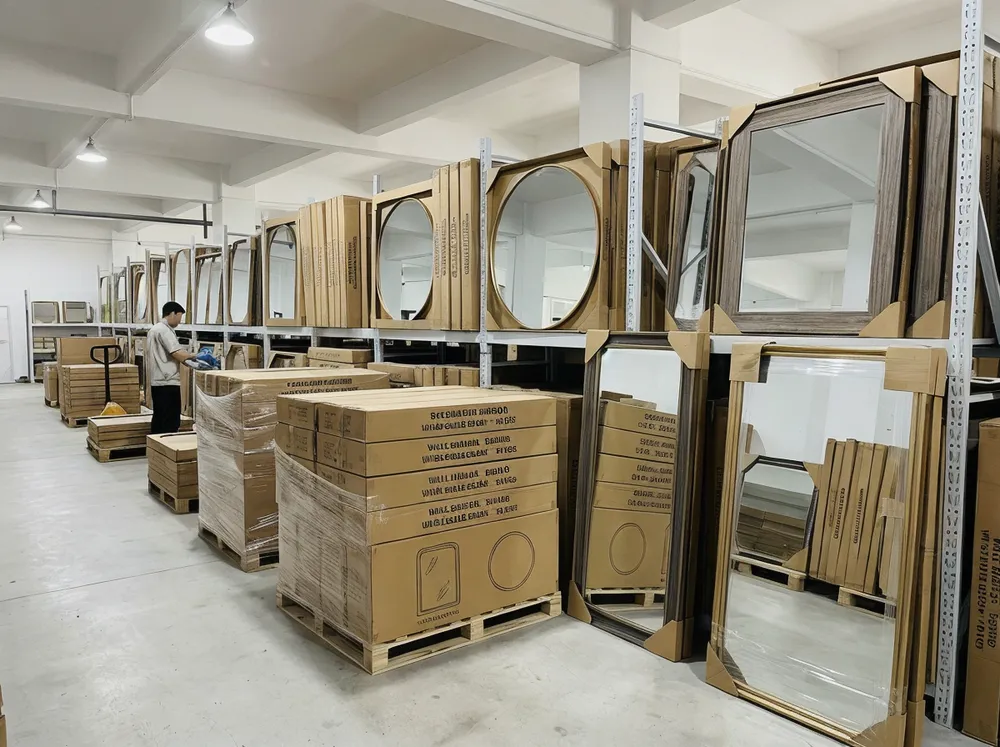
Large-format decorative mirrors built for the highest-margin room category in your product line. Sunburst, geometric, and ornate carved frames in 28"–48" sizes — manufactured and shipped direct from our 12,000 m² facility in Vietnam. MOQ from 100 pieces.
Living room decor mirrors are the highest-margin segment in our product line, and most of our distributors say the same about theirs. The reason is straightforward: living room mirrors are statement pieces where the frame — not the glass — drives the retail price. A 36" sunburst mirror with a hand-finished gold resin frame retails at 3–5× the price of a same-diameter bathroom mirror with a simple metal frame. Your glass cost is nearly identical; the frame is where your markup lives.
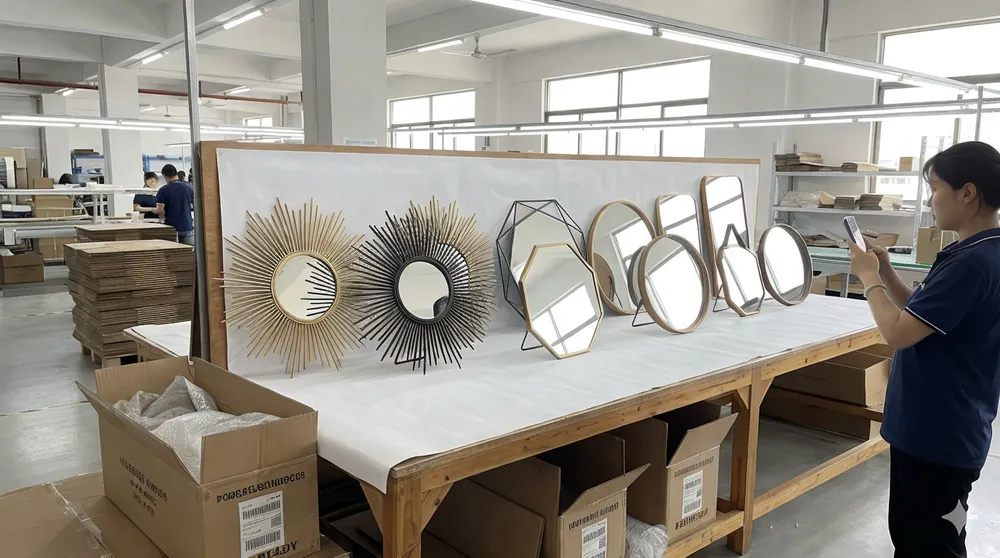
We produce living room mirrors across four frame families — sunburst/starburst, geometric, ornate carved, and modern minimalist — in MDF, solid wood, metal, and resin. Sizes run from 28" to 48" diameter (or equivalent rectangular), which positions them as focal-point pieces that command wall space and price tags. The category also carries the most design variation of any room type we manufacture, so your catalog can go deep without repeating yourself.
If you're building or expanding a decorative mirror line, living room is where you start. The per-unit revenue justifies the slightly higher landed cost from larger cartons, and the design diversity lets you segment offerings across price tiers without sourcing from multiple factories.
Same 4mm glass as bathroom mirrors, but 3–5× retail price from frame design
Sunburst, geometric, ornate carved, modern minimalist — deep catalog without repetition
Focal-point pieces that command wall space and price tags
If your focus is smaller-format or functional mirrors instead, our bedroom, hallway, and bathroom categories may be a better starting point.
The frame is the product in this category. Two living room mirrors with identical 4mm glass and copper-free silvering can retail $40 apart based purely on frame design and finish. We produce four main frame families for living room placement, each targeting a different retail price band and aesthetic segment.
Our highest-volume living room frame style. Sunburst mirrors run 30"–48" in overall diameter with ray extensions ranging from 4" to 8" beyond the mirror edge.
Price guidance: Metal sunburst is your sweet spot for $50–80 wholesale. Above $80, resin with hand-finishing opens up.
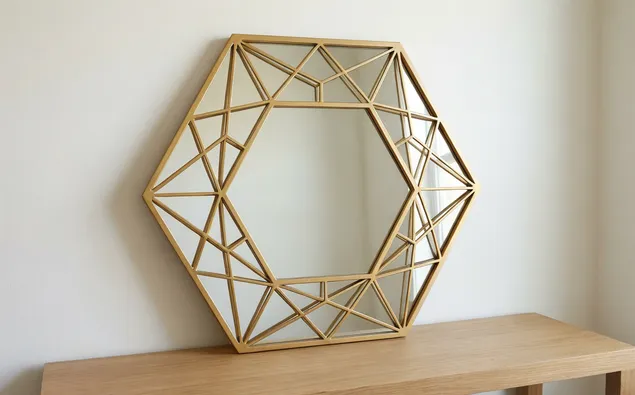
Hexagonal, octagonal, diamond, and multi-panel configurations. These appeal to the modern/contemporary segment and perform well in e-commerce because the shapes photograph distinctively.
Clean lines and distinctive shapes make these top performers for online product photography.
Traditional and transitional styles — scrollwork, acanthus leaf, baroque profiles. These are your premium SKUs — they carry the highest per-unit cost but also the widest retail margin.
Typical sizes: 28"–42" diameter or equivalent rectangular
Thin-profile metal or wood frames, often 1"–2" wide, where the mirror itself is the visual focus. These are your volume movers — lower price point, broader appeal, faster inventory turn.
Lower production cost, faster turnaround — ideal for high-velocity SKUs
We'll send samples and pricing for your target mix. Whether you're focused on premium ornate pieces or high-velocity minimalist designs, we can build a program around your margin goals.
Request Samples & PricingThese are the specific parameters for our living room decor mirror range. For category-wide spec ranges across all room types, see our Decor Mirrors by Room overview.
| Parameter | Living Room Specification |
|---|---|
| Mirror sizes | 28"–48" diameter (round); 24" × 36" to 36" × 48" (rectangular/irregular) |
| Glass thickness | 4mm–5mm float glass (4mm standard; 5mm for mirrors over 36") |
| Edge finishing | Beveled (1" standard bevel width), polished, or straight-edge |
| Silvering | Copper-free, multi-layer protective coating (default process) |
| Frame materials | MDF, solid wood, metal (iron/aluminum), resin |
| Frame width | 1"–8" depending on style (minimalist to ornate) |
| Frame finishes | Painted (any RAL/Pantone), gold/silver leaf, antique patina, powder-coated, electroplated, distressed |
| Hanging hardware | D-rings + wire for mirrors under 15 lbs; French cleat for heavier units |
| Unit weight range | 5 lbs (24" minimalist) – 28 lbs (48" ornate resin) |
| Packaging | Individual carton with foam corner protection; retail-ready or bulk options |
We bump to 5mm glass on anything over 36" — the rigidity difference during transit is significant. A 4mm panel at 40" flexes enough in the carton to stress the silvering layer at the edges, which can cause micro-delamination that shows up months later as dark spots. We spec this proactively rather than deal with return claims.
Every frame style we produce maps to a commercial channel. These are the segments where our buyers build repeat volume with living room mirrors specifically.
The primary channel. Living room mirrors are a top-performing category on Amazon, Wayfair, and independent home decor stores because they photograph well and carry high perceived value relative to shipping cost.
A 6–10 SKU living room mirror assortment covering sunburst, geometric, and minimalist styles at three price tiers gives you broad keyword coverage and cross-sell opportunities.
We supply several e-commerce sellers on these platforms and build packaging to meet FBA prep requirements, including scannable barcodes and ship-ready cartons that don't need reboxing.
Hotel lobbies, lounge areas, and upscale restaurant interiors use large-format decorative mirrors as design anchors. A single hospitality project can pull 50–200 living room-style mirrors across common areas.
These orders tend toward ornate or geometric frames in gold and brass finishes.
The reorder cycle follows renovation schedules — typically every 5–7 years per property, but hotel groups with multiple properties create steady annual volume.
Staging companies buy living room mirrors in sets of 3–5 styles that rotate across properties. They need durable frames that survive repeated handling and transport.
Metal and MDF frames outperform resin here because they're lighter and more impact-resistant. This segment orders smaller quantities per SKU but reorders frequently as inventory wears out or trends shift.
This channel has grown noticeably for us over the past few years — worth considering if you serve the residential real estate supply chain.
If you supply brick-and-mortar furniture stores or home goods chains, living room mirrors are a natural add-on category. They display well alongside sofas and console tables, and the price point fits the impulse-upgrade purchase.
We produce shelf-ready packaging with retail graphics and UPC labels configured for your distribution channel.
Send us your target market and volume range — we'll recommend a starter SKU mix based on what's moving in your region.
Our category-wide OEM/ODM capabilities apply across all room types. Here's what customization looks like specifically for living room mirrors, where frame design carries most of the product value.
Where most living room mirror programs start. You send us a reference image, a sketch, or a competitor sample, and our engineering team develops the frame profile.
Once your frame profile is locked, it's yours — we store the mold or jig and it's ready for reorders without setup cost.
Runs deep in this category because living room mirrors live in visible, well-lit spaces where finish quality is immediately apparent.
Getting a distressed finish consistent across 2,000 units is harder than it sounds. We photograph and approve a "golden sample" with you before production starts, and our QC team checks every unit against it.
Within the living room range:
Beyond 52", glass weight and shipping fragility become cost factors that usually don't make commercial sense for standard wholesale — but we've done custom oversize runs for hospitality projects where the buyer absorbs the higher packaging cost.
Your logo, retail graphics, UPC/EAN barcodes, and care instructions printed on the carton or on an insert card.
Private-label programs get full white-label treatment: no Livewellcraft branding anywhere on the product or packaging.
| Customization Dimension | Options | MOQ Impact |
|---|---|---|
| Frame profile (new design) | Custom mold/jig development | 300 pieces first order; 100 pieces reorder |
| Frame finish / color | Any RAL/Pantone, leaf, patina, distressed | No MOQ change for standard models |
| Mirror size | 24"–52" round; up to 36" × 60" rectangular | No MOQ change within range |
| Glass type | Standard silver, copper-free, tinted, antiqued | 200 pieces for non-standard glass |
| Packaging / branding | Custom carton print, inserts, UPC labels | No MOQ change |
| Hanging hardware | D-ring, French cleat, sawtooth, keyhole | No MOQ change |
Send us your design reference or specs — we'll confirm feasibility, MOQ, and timeline within 48 hours.
The category-level production overview covers our general manufacturing setup. Here's what's specific to living room mirrors, where larger glass panels and heavier frames create quality risks that don't exist in smaller-format categories.
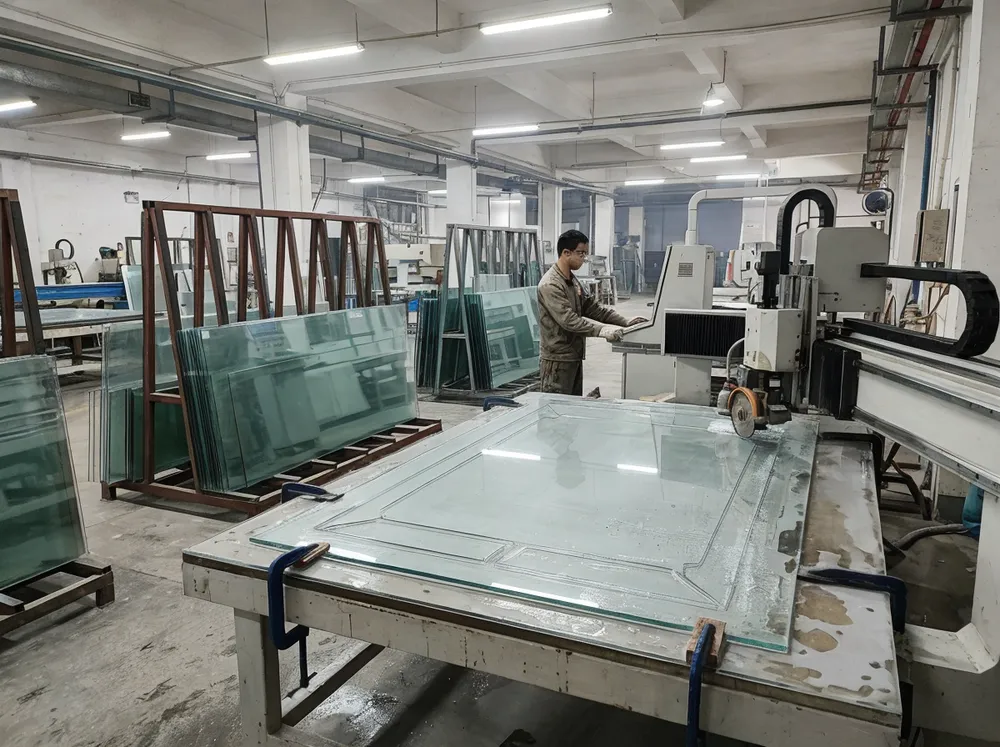
Living room mirrors use 4mm–5mm float glass panels that are larger than most other room categories. We cut on an automated CNC glass cutting table that holds ±0.3mm tolerance across the panel.
Edge finishing matters more at these sizes because any bevel inconsistency is visible at eye level in a well-lit room. Our beveling line runs a consistent 1" bevel width at 3–5° angle, and every panel passes edge inspection before moving to silvering.
A sloppy bevel on a 36" mirror is obvious from across the room. On a 16" hallway mirror, you might not notice. That's why we run tighter visual QC on living room panels.
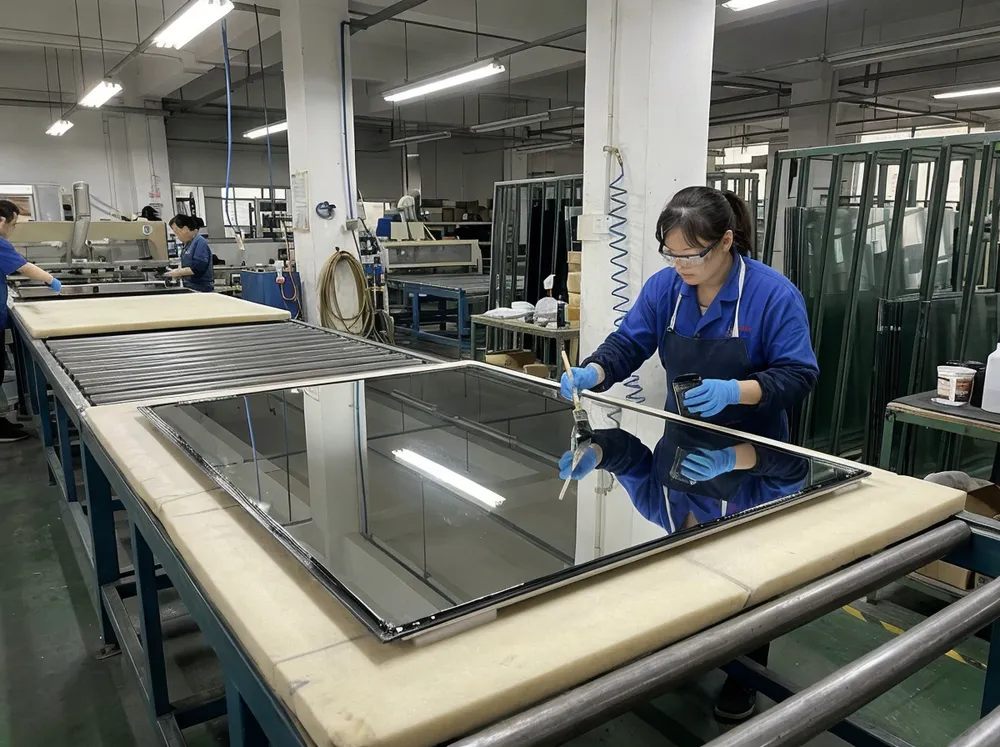
We run copper-free silvering as our default process. The silver layer goes down first, followed by two protective paint layers that seal against moisture and oxidation.
For living room mirrors specifically: We add an additional edge-seal step on panels over 30" — a bead of protective coating along the mirror perimeter that prevents silver degradation starting from the edges.
This is where most mirror quality failures originate on larger panels, and it's a step many factories skip because it adds labor time.
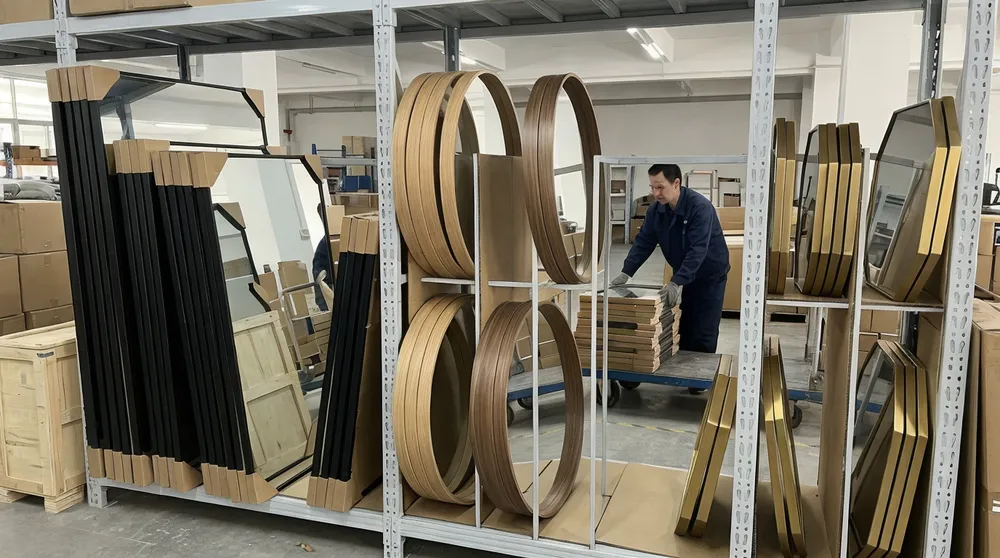
Frame production runs parallel to glass processing.
Come out of molds with minor flash and parting lines that get hand-trimmed and sanded before finishing.
Go through welding, grinding, and then either powder coating or electroplating.
Finishing sequence runs 4–5 separate steps: primer, base coat, accent application, clear seal — with drying time between each.
We don't rush the drying. Compressed finishing schedules are the number-one cause of adhesion failure and finish peeling in decorative mirrors, and we've seen enough warranty claims from other factories' product to know the cost of cutting that corner.
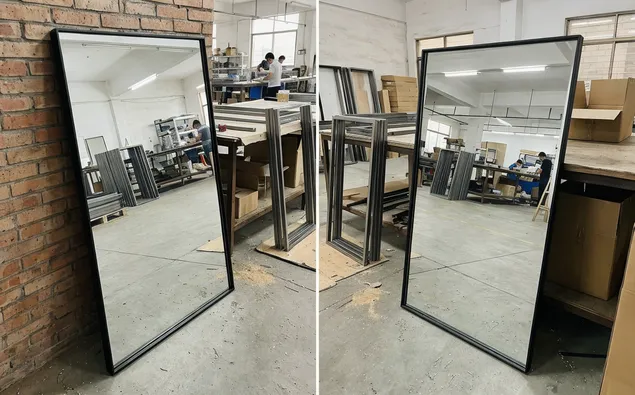
Glass mounts into the frame with silicone adhesive and mechanical clips. Every assembled unit goes through 100% visual inspection.
Silvering defects
(dark spots, edge haze)
Frame finish
consistency
Secure mounting
hardware
Clean glass
surface
Units that fail get pulled and reworked or scrapped — they don't ship.
Adhesion testing on sample units from each batch, applying and removing adhesive tape to verify coating bond meets our internal standard.
Mirror breakage in transit is the single biggest margin killer in this category. A 2% breakage rate on a 2,000-unit shipment means 40 mirrors that cost you money twice — once for the product, once for the customer claim. We've spent years refining packaging specifically for large-format decorative mirrors because this is where the problem concentrates.
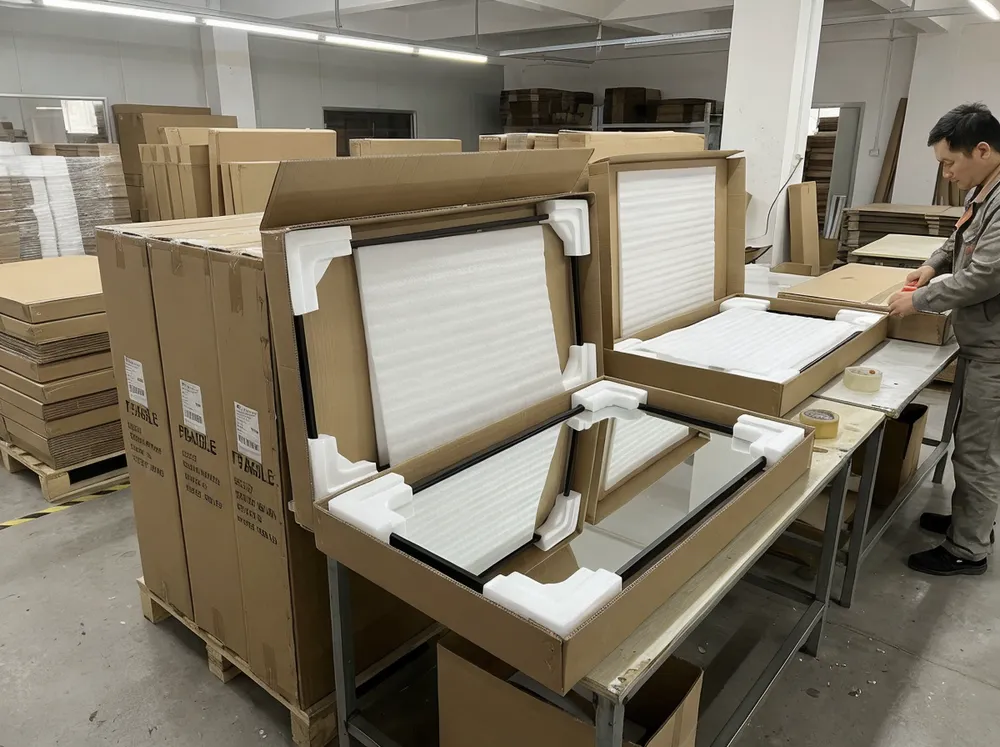
Each living room mirror ships in an individual carton with foam corner protectors and a foam sheet between the glass face and the carton wall. Mirrors over 30" get additional edge foam strips. The carton itself is double-wall corrugated rated for the unit's actual weight plus a 30% safety margin. We run drop-test validation on new packaging configurations — a 60 cm flat drop and a 45 cm corner drop — before approving them for production.
We track breakage claims across all our accounts. Our current rate on living room mirrors is under 0.5% — and when breakage does happen, it's almost always a carrier handling issue, not a packaging failure. We document packaging specs in every shipment so you have evidence for freight claims.
Living room mirrors are bulkier than other room categories, so container efficiency matters for your landed cost.
We provide a container loading plan with every quote so you can calculate your per-unit freight cost before committing.
If you sell through Amazon FBA or similar channels, the individual carton doubles as the shipping box.
For brick-and-mortar distribution, we print retail-facing graphics on the carton.
Living room decor mirrors are our highest-margin, most design-diverse category — but they're not the right fit for every buyer's product mix. Here's how living room mirrors compare to sibling categories, so you can decide where to focus or how to build a multi-room assortment.
| Dimension | Living Room | Bedroom | Dining Room | Bathroom | Hallway |
|---|---|---|---|---|---|
| Typical Size Range | 28"–48" | 14" × 50" to 24" × 30" | 30"–42" | 20"–36" | 16"–28" width |
| Frame Emphasis | High — frame drives price | Medium — clean lines | Medium-high — decorative | Low-medium — moisture-resistant | Low-medium — compact |
| Price Tier | Mid to premium | Entry to mid | Mid to premium | Entry to mid | Entry to mid |
| Design Variation | Highest | Moderate | Moderate | Limited by material constraints | Moderate |
| Key Spec Difference | Heavier frames, 5mm glass on large sizes | Lightweight for drywall mounting | Beveled glass standard | Copper-free silvering, sealed frames | Narrow/vertical formats |
| Best For | Retailers, e-commerce, hospitality | Furniture stores, staging companies | Furniture retailers, hospitality | Home improvement, hospitality | Home decor, staging |
If you're building a full room-by-room assortment, living room mirrors anchor the premium end of your catalog. Here's how to complement them strategically.
Pair with living room mirrors for volume. Entry to mid price tier with moderate design variation.
Explore categoryAdd for the functional segment. Copper-free silvering and sealed frames for moisture resistance.
Explore categoryRound out contemporary/minimalist assortments without overlapping living room SKUs.
Explore categoryMid to premium tier with beveled glass standard. Ideal for furniture retailers and hospitality.
Explore categoryVersatile category that complements living room mirrors for broader home decor coverage.
Explore categoryView the complete room-by-room mirror catalog to plan your full assortment strategy.
View all categoriesDirect answers to the sourcing questions we hear most from distributors, retailers, and hospitality buyers.
100 pieces per SKU for standard models from our existing catalog. Custom frame designs require 300 pieces on the first order (to justify mold or jig development), then drop to 100 pieces on reorders.
If you're testing a new market, we recommend starting with 2–3 standard SKUs at 100 pieces each to validate demand before investing in custom tooling.
For mirrors under 30", 4mm float glass is standard and performs well through shipping and installation. Above 30", we default to 5mm because the added rigidity reduces flex during transit — and flex is what causes micro-delamination of the silver layer at the edges.
The cost difference is roughly 8–12% on the glass component, which is a small fraction of total unit cost on a framed living room mirror. If you're sourcing 36"+ mirrors from any supplier and they're quoting 4mm glass, ask about their breakage and return rates.
It depends on your target retail price point and channel:
Most distributors carry at least two frame materials to cover different price tiers.
Our facility holds ISO 9001:2015, and our products carry CE marking and SGS test reports.
For the North American market, decorative mirrors don't require UL listing, but retailers like Walmart and Wayfair require specific compliance documentation — we've been through their vendor qualification process and maintain the documentation they need.
For the EU market, CE marking covers the safety requirements, and we can provide REACH compliance documentation for materials. BSCI certification covers social compliance audits if your supply chain policy requires it.
Yes — this is how most custom programs start. Send us a photo, a sketch, or a physical sample, and our engineering team will develop the frame profile, recommend materials, and send back a technical drawing with a quote.
We produce a pre-production sample for your approval before committing to the full run. Turnaround on a new custom sample is typically 20–25 days including mold development. (If the design is close to an existing profile in our catalog, we can often modify rather than build from scratch, which cuts sample time roughly in half.)
Standard catalog models: 30–35 days for production plus your shipping transit time.
Custom orders with new mold development: add 15–20 days for tooling and sample approval before the production clock starts.
Reorders on established custom designs: ship on the standard 30–35 day timeline.
We provide a production schedule with milestone dates at order confirmation so you can plan your inventory accordingly.
You've seen the specs, the frame options, the customization parameters, and the packaging details. The next step is straightforward: tell us what you need, and we'll put together a detailed quote.
Send us your target frame styles, sizes, quantities, and any design references you have. Our team will respond within 48 hours with pricing, a container loading plan, and sample options. If you're not sure where to start, tell us your target market and retail price range — we'll recommend a starter SKU mix based on what's performing for our existing distributors in your region.