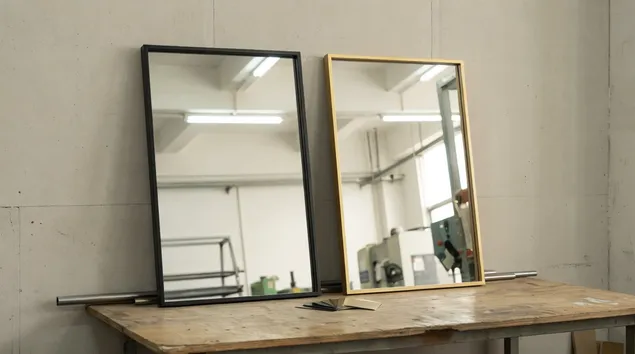
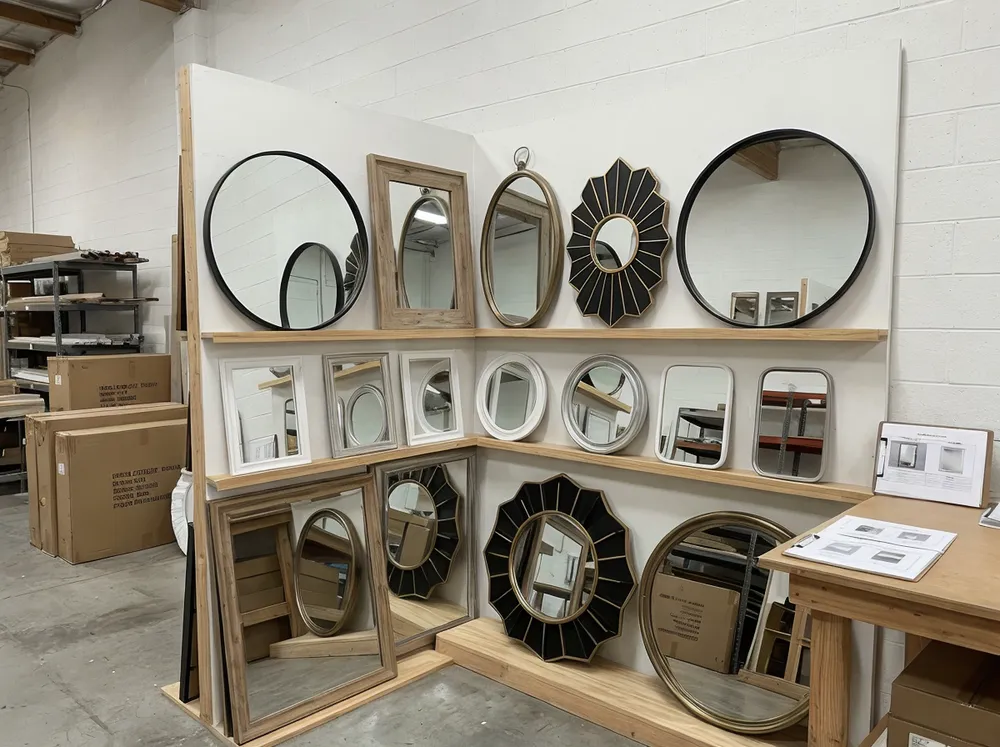
Every frame type, every size range, one factory. The room-agnostic mirror category that gives you maximum merchandising flexibility. Manufactured on our 12,000 m² facility in Vietnam, shipped direct to distributors, e-commerce sellers, and project buyers worldwide.
Home decor mirrors are decorative mirrors positioned for general home use rather than a single room. No "bathroom" in the title, no "living room" qualifier — just a mirror designed to look good wherever your customer decides to hang it. That distinction matters more than it sounds.
When you list a mirror as "living room decor mirror," you've narrowed your buyer pool to people actively furnishing a living room. List the same mirror as a home decor mirror, and you capture every shopper browsing general home decor — a search pool that runs significantly wider on Amazon, Wayfair, and Google Shopping. We see this in our own order data: distributors who carry a dedicated home decor mirror line alongside their room-specific SKUs consistently reorder the home decor range at higher frequency, because the sell-through isn't tied to a single room renovation cycle.
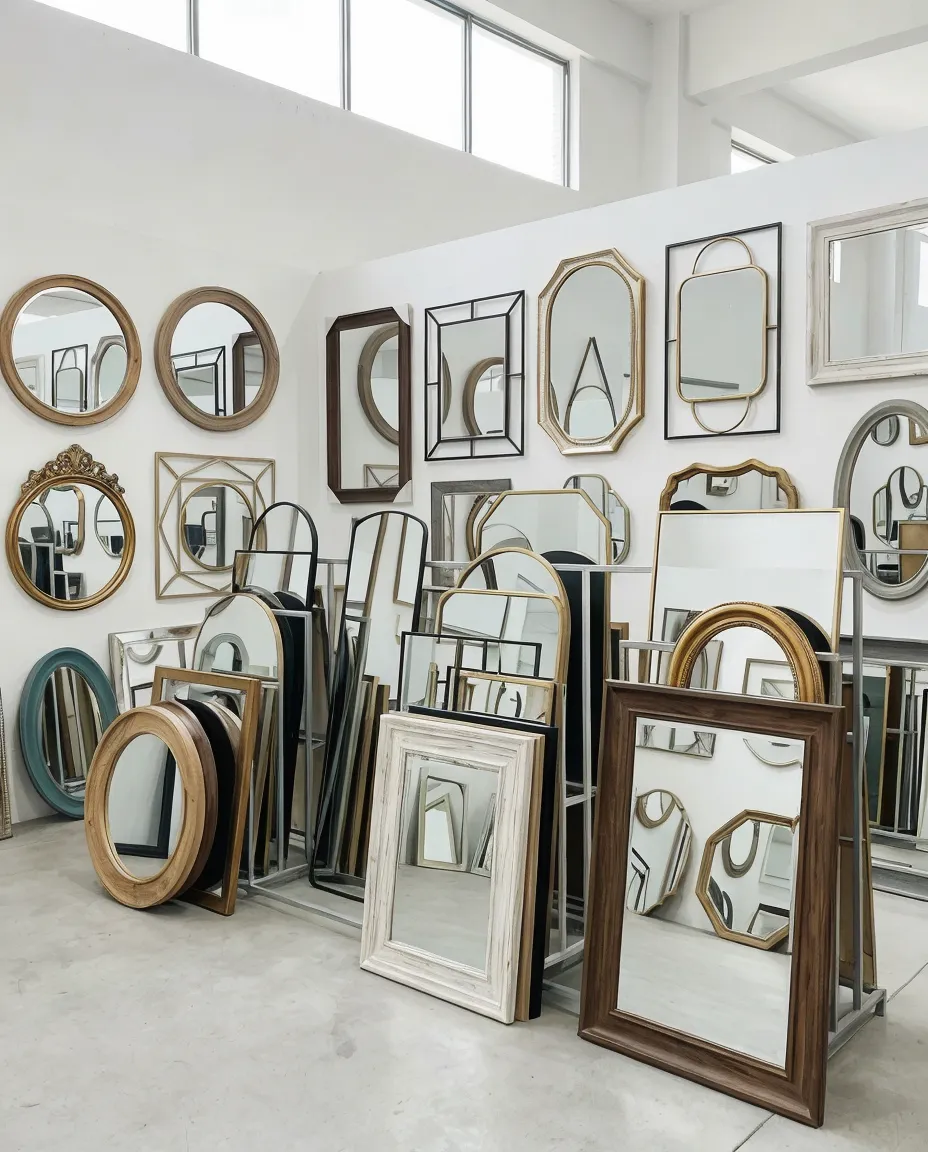
From a manufacturing standpoint, home decor mirrors pull from our full production capability — every frame material, every shape, every size within our range. We produce them in MDF, solid wood, metal, and resin frames, with round, rectangular, oval, arch, and irregular shapes, in sizes from 12" accent pieces to 48" statement mirrors. The spec flexibility is the point. You build the assortment that fits your channel, and we produce it without the constraints that room-specific categories impose. (Our bestselling home decor mirror SKUs tend to be mid-size rounds and arches in gold or black frames — they photograph well for e-commerce and move across demographics.)
If you need mirrors tied to a specific room, we produce those too — living room, bedroom, bathroom, dining room, hallway, table, and mantel mirrors each have their own spec profiles. This page covers the broad home decor category specifically.
Home decor mirrors capture every shopper browsing general home decor — not just those furnishing a specific room.
Sell-through isn't tied to a single room renovation cycle, leading to more consistent reorders.
Mid-size rounds and arches in gold or black frames — photograph well for e-commerce and move across demographics.

Because home decor mirrors span the full design range rather than targeting one room's constraints, the spec window is wider than any single room category. Here's what we produce:
| Parameter | Specification |
|---|---|
| Glass thickness | 3mm, 4mm, or 5mm float glass (5mm for mirrors over 36") |
| Mirror shapes | Round, oval, rectangle, arch, irregular/custom cut |
| Size range | 12" × 12" to 48" × 60" (custom sizes within this range) |
| Edge finishing | Beveled (standard 1" bevel), polished, straight-edge |
| Silvering | Copper-free, multi-layer protective coating (default) |
| Frame materials | MDF, solid wood, iron, aluminum, resin |
| Frame finishes | Painted (any RAL/Pantone match), gold leaf, silver leaf, antique patina, distressed, powder-coated, electroplated |
| Hanging hardware | D-ring, sawtooth, French cleat, wire — rated to mirror weight |
| Packaging | Retail shelf-ready (UPC, custom inserts) or bulk palletized |
| MOQ | 100 pieces (standard catalog) / 300 pieces (custom design) |
Send us your target specs and quantities — we'll quote exact pricing within 48 hours.
Request QuoteGlass thickness drives weight, which drives freight cost. For mirrors under 30", 3mm glass keeps your per-unit shipping cost down without sacrificing perceived quality — the frame does the heavy lifting on perceived value. Above 36", we default to 5mm because thinner glass at that size flexes during handling and increases breakage risk in transit. We've tested this threshold across thousands of shipments, and 36" is where the breakage curve inflects.
Beveled edges add a visible quality signal that supports a higher retail price. We run beveling in-house on calibrated grinding stations that hold consistent bevel width and angle across a full production run, so unit 3,000 matches unit 1. If your product line targets mid-to-premium positioning, beveled edges are worth the incremental cost — they're one of the first things an end customer notices, and they're hard to replicate cheaply.
Room-specific mirrors lock you into room-specific demand cycles. Home decor mirrors don't. This is the core commercial argument for carrying this category, and it plays out in three ways.
On e-commerce platforms, "home decor mirror" captures broader search traffic than any single room keyword. You're not competing only against other living room mirror listings — you're appearing in general home decor searches, gift searches, housewarming searches, and interior styling searches. One SKU, multiple traffic streams.
A mirror listed as general home decor sells year-round across customer segments. Room-specific mirrors spike when people renovate that specific room. Home decor mirrors move steadily because the purchase trigger is "I want something on this wall," not "I'm remodeling my bathroom." For distributors managing warehouse space, that steady turn rate matters more than occasional spikes.
If you supply brick-and-mortar stores, home decor mirrors can be merchandised in any department — home accessories, wall decor, gifts, seasonal displays. Room-specific mirrors get shelved in one section. Your retail buyer has more placement options, which means more reorder opportunities.
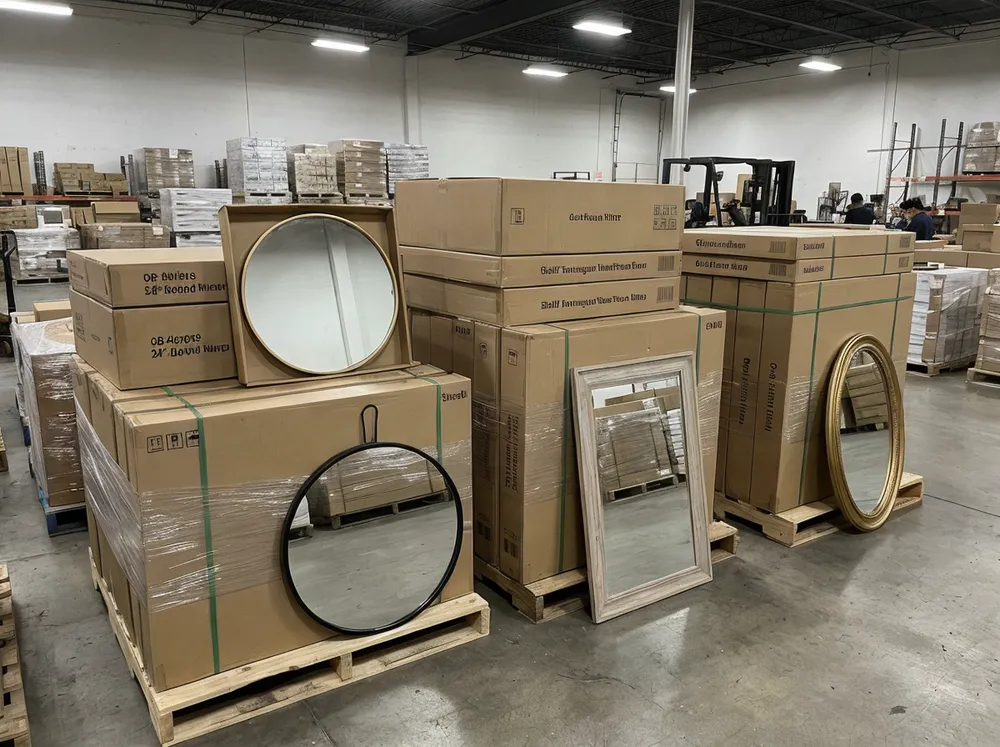
We produce home decor mirrors across all frame types and sizes specifically to support this flexibility. You can build a 20-SKU home decor mirror assortment that covers accent pieces, statement mirrors, and everything between — all from a single purchase order, all shipping in one container.
Each segment below represents a channel where our distributors and retail partners build recurring orders. Home decor mirrors fit more channels than room-specific categories because the product positioning is inherently flexible.
This is the highest-volume channel for home decor mirrors. Amazon, Wayfair, Etsy, and independent e-commerce stores all categorize mirrors under "home decor" as a primary listing path.
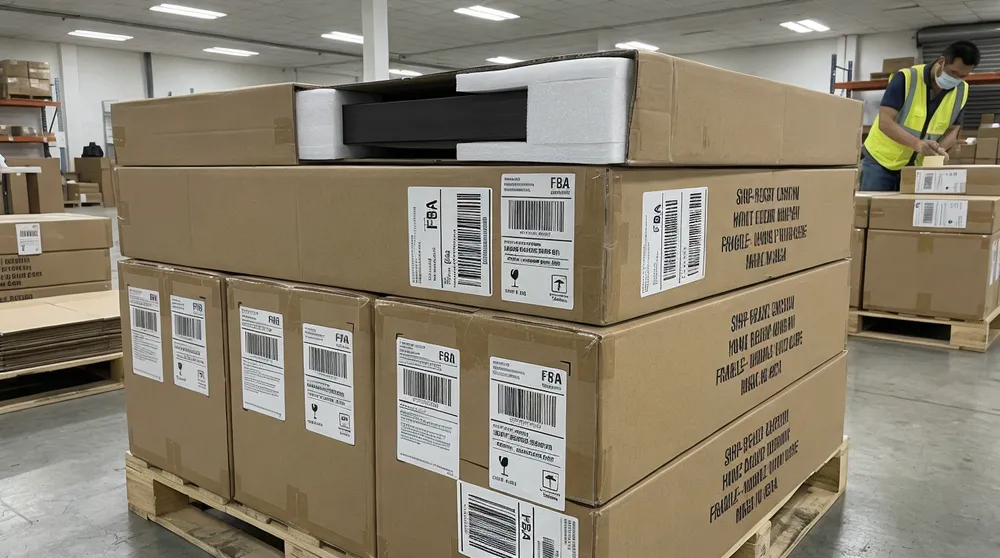
We produce e-commerce-optimized packaging — individual ship-ready cartons with foam corner protection that double as the shipping box, so your fulfillment team labels and ships without repackaging. FBA-ready prep with scannable barcodes is standard for our Amazon seller accounts.
If you supply independent retailers, gift shops, or home decor chains, home decor mirrors are a staple catalog category. The broad positioning means your downstream retailers can place them anywhere in-store.
We support private label packaging with your branding, so the product builds your brand equity rather than ours. Most of our wholesale buyers start with a 500–1,000 piece mixed assortment across 8–12 SKUs to test which styles move in their market, then scale the winners.
Typical starter order: 500–1,000 pieces across 8–12 SKUs for market testing
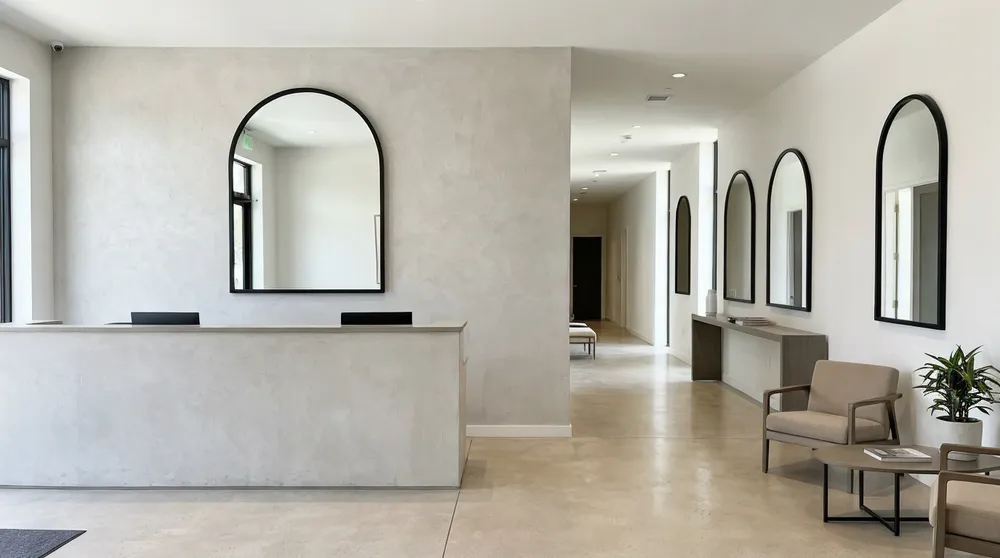
Hotels, restaurants, co-working spaces, and retail store fit-outs all use decorative mirrors as wall decor without room-specific constraints. A boutique hotel might place the same mirror design in the lobby, hallway, and guest rooms.
Project buyers order 200–2,000 pieces per project, and we configure packaging for job-site delivery — bulk-packed on pallets, labeled by floor or zone.
We handled a 150-room hotel project last year where the designer specified the same arch mirror in three sizes across all public areas and guest rooms — one design, three SKUs, one production run.
Decorative mirrors in the 12"–20" range sell well as gift items and seasonal decor, particularly in gold, rose gold, and antique finishes. This segment peaks in Q4 for holiday retail.
If you're building a seasonal program, plan your order for Q2 production to hit your warehouse by September. We can run seasonal packaging — gift boxes, holiday inserts — alongside standard retail packaging in the same production order.
Designers sourcing mirrors for client projects often need 5–20 pieces per order across varied styles. Our 100-piece MOQ on standard models lets you stock a curated selection for your trade showroom without overcommitting.
Custom sizing and finish matching are available through our OEM program for designers who need specific dimensions for a project.
We'll recommend a starter SKU mix based on what's moving in your region.
Get Channel-Specific RecommendationsHome decor mirrors offer the widest customization window in our product line because there are no room-specific constraints limiting your options. Here's what you can control:
Custom mold development for MDF, resin, and metal frames. If you have a design concept, a competitor sample, or a sketch, our 12-engineer team develops the tooling and sends back a detailed drawing with material callouts and cost breakdown. Wood frames can be machined to custom cross-section profiles.
Timeline: Most custom frame molds are ready in 10–15 days, and the mold is yours — we store it at our facility and use it exclusively for your orders.
Any RAL or Pantone color match. Gold leaf, silver leaf, antique patina, distressed effects, brushed metal, high-gloss lacquer — we produce all of these in our finishing department. If you're matching a finish to an existing product line, send us a physical sample or a Pantone reference and we'll match it.
Note: Color matching across different frame materials — say, gold on MDF and gold on iron — requires separate process calibration. We send pre-production samples for approval because the same paint code looks different on different substrates.
Standard round, oval, rectangle, and arch shapes are cut on our automated glass cutting tables. Irregular and custom shapes — hexagons, abstract organic forms, window-pane grids — are also produced in-house.
No tooling surcharge: Custom shapes don't carry a tooling surcharge; the CNC cutting table works from your CAD file directly.
Custom dimensions anywhere within our 12" to 48" × 60" production range. If you need a specific size to fit a retail planogram or a project specification, we produce to your exact dimensions.
Private label with your logo, retail-ready with custom inserts and UPC labels, or plain bulk packaging. E-commerce sellers get ship-ready cartons sized to minimize dimensional weight charges. Retail buyers get shelf-ready cartons with facing graphics.
Hanging system specified to your market's wall construction standards. D-rings for North American drywall, French cleats for heavier mirrors, sawtooth for lightweight pieces. We rate every hanging system to the mirror's actual weight and include appropriate wall anchors when specified.
15–20 days from approved drawing to first production sample for most frame types. Once you approve the sample, production follows our standard 30–35 day lead time for existing molds, 35–45 days for new custom orders.
Send Us Your Design ConceptThe frame is where your margin lives. Glass and silvering costs stay relatively stable across home decor mirror SKUs — the frame material, complexity, and finish are what move your unit cost and your retail price ceiling in opposite directions.
CNC-profiled, sanded, primed, and multi-coat painted or wrapped. Clean lines, consistent finish across thousands of units, and the lowest frame cost in our range. MDF works for modern, minimalist, and farmhouse styles.
Margin insight: Retail price points for MDF-framed home decor mirrors typically land in the mid-range, and the cost-to-retail ratio gives you healthy margin on volume.
Iron and aluminum frames serve the modern and industrial aesthetic. Powder-coated or electroplated finishes. Thin-profile metal frames are trending in the home decor market right now, particularly in matte black and brushed gold.
Margin insight: Metal frames cost more than MDF but support a higher retail price, and the perceived quality difference is immediately visible to the end customer. Powder coating gives you zero-VOC compliance if your retail channel requires environmental claims.
Where design complexity lives. Cast from molds, hand-finished for detail work — ornate baroque profiles, carved floral patterns, textured surfaces. Resin frames carry the highest frame cost but also support the highest retail markup.
Margin insight: A resin-framed home decor mirror can retail at 3–4× the price of an equivalent MDF-framed piece, and the margin percentage improves even as your cost per unit rises. This is your premium tier.
Machined profiles, hand-sanded, multi-coat finishing. Wood reads as premium to end customers and supports strong retail pricing. We source wood locally in Vietnam, which keeps material cost competitive compared to European or North American wood frame production.
Margin insight: Solid wood serves the mid-to-premium range with perceived quality that justifies higher price points while maintaining competitive production costs.
We produce all four frame types on separate production lines, so mixing frame materials in a single order doesn't create scheduling conflicts.
Typical home decor mirror assortment order:
Covering your full price tier range in one shipment.
Every home decor mirror ships through our standard QC protocol — the same process that handles our Walmart and Wayfair vendor programs, where defect tolerances are tight and chargebacks are expensive.
Glass clarity, silvering uniformity, frame finish consistency, assembly integrity, and hardware installation — all checked before the mirror moves to packaging. No statistical sampling. At our production volume, that's a deliberate staffing commitment, but it's the only approach that holds the defect rates retail channels demand.
Cross-hatch adhesion test per ISO 2409 catches silvering process drift before it reaches your container. We run copper-free silvering as our default across all home decor mirrors — it resists moisture degradation and eliminates the black-edge oxidation that generates returns, even on mirrors that end up in kitchens or humid climates.
Adhesion, scratch resistance, and color consistency checked against your approved sample. We store your approved color reference in our sample library and match against it on every reorder, so your fifth order matches your first.
Drop test and vibration simulation on packed cartons before shipment. Mirrors are fragile, and transit damage is the single largest source of returns in this category. Our packaging engineering is designed around preventing that specific problem.
Documentation available on request for your procurement files.
For mirrors under 30", 3mm float glass is standard and performs well — the frame provides structural rigidity, and 3mm keeps your per-unit weight and freight cost down. Between 30" and 36", we recommend 4mm. Above 36", 5mm is our default because thinner glass at that size flexes during handling and increases transit breakage risk.
If you're selling primarily through e-commerce where carrier handling is rougher than palletized freight, consider stepping up one thickness grade for added durability. The cost difference between 3mm and 4mm is minimal per unit but measurable across a container.
Traditional silvering uses a copper layer between the silver and the protective paint. Over time — especially in humid environments — moisture penetrates the edges and reacts with the copper, producing the black-edge oxidation that generates customer complaints and returns.
Copper-free silvering eliminates that copper layer entirely, replacing it with chemical protective layers that resist moisture without the oxidation risk. We run copper-free as our default process across all home decor mirrors. The per-unit cost difference is negligible, and it eliminates edge degradation claims regardless of where your customer hangs the mirror.
For markets with high humidity — Southeast Asia, coastal regions, the Gulf — copper-free is essential, not optional.
Yes, and most of our distributors do exactly this. Our 6 production lines run different frame types and sizes concurrently, so a mixed order — say, 500 home decor mirrors plus 300 bathroom mirrors and 200 living room mirrors — doesn't create scheduling conflicts.
Per-SKU MOQ applies (100 pieces for standard, 300 for custom), but we consolidate everything into a single shipment. We can sort cartons by category, by SKU, or by your warehouse zone — however your receiving team needs them organized.
For existing catalog models on existing molds: 30–35 days from order confirmation to shipment.
For custom designs requiring new mold development: add 15–20 days for tooling and sample approval before the production clock starts.
Rush production is possible on standard models if our line schedule allows — ask us when you inquire and we'll give you an honest answer on timing. (We don't promise rush timelines we can't hold. If the schedule is tight, we'll tell you upfront.)
It depends on your price positioning:
We can quote all three frame types for the same mirror size so you can model your margin across price tiers before committing.
Full private label support. Your logo on the carton, your brand name on the care card, your UPC on the label.
We produce custom retail-ready packaging with facing graphics designed to your specifications — send us your artwork files and packaging dimensions, and we'll produce samples for approval.
For e-commerce, we can print your brand on the inner packaging while keeping the outer shipping carton plain. No Livewellcraft branding appears on any customer-facing element unless you want it there.
Send us your target market, preferred styles, and approximate volume per SKU. If you have reference images or competitor products you're benchmarking against, include those — our engineering team will recommend specific configurations, quote exact pricing with container loading plans, and ship samples for your evaluation.
Recommended Starting Point
Most new buyers in this category start with a 500-piece mixed assortment across 5–8 SKUs to test which styles move, then scale the winners on reorder.