Miss the order window by three weeks and you have two bad options: pay for air freight to save the season, or watch your spring floral SKUs land in June when the floor is already transitioning to summer. We see both happen every year. The buyers who avoid it aren't smarter — they just mapped their PO calendar to the actual production and freight timeline, not to the retail floor date they're targeting.
This guide lays out the full chain: US retail reset windows, the factory lead times behind them, and the sourcing decisions that determine whether your flower wall art lands on the floor at full margin or gets marked down before it moves.

Why the retail floor date is the wrong anchor point
Most sourcing mistakes start here: a buyer targets the floor date and works backward only one step — to the ship date. That leaves out production, sample approval, and the variability in ocean freight and customs clearance that can add two to four weeks without warning.
For flower wall art specifically, the risk is higher than for evergreen SKUs. Floral designs are season-specific. A cherry blossom canvas that misses spring doesn't sell in August. A sunflower piece that arrives in October is a markdown waiting to happen. The margin on seasonal items is already thinner because of the markdown risk if they don't sell through — so getting the timing right is the one lever you actually control.
The correct anchor is the DC receiving deadline: the date your distribution center needs to have product in hand to pick, pack, and ship to stores before the reset. Work backward from there, not from the floor date.
A realistic chain for ocean freight from Vietnam to a US East Coast DC:
| Stage | Typical Duration |
|---|---|
| Artwork finalization & sample approval | 7–14 days |
| Bulk production (existing frame molds) | 30–35 days |
| Bulk production (new molds required) | 45–55 days |
| Factory loading & export clearance | 5–7 days |
| Ocean freight (Vietnam → US West Coast) | 18–22 days |
| Ocean freight (Vietnam → US East Coast) | 25–30 days |
| US customs clearance | 3–7 days |
| DC receiving & processing | 5–10 days |
Add it up for a standard order on existing molds shipping to an East Coast DC: you're looking at roughly 75–95 days from artwork sign-off to product on the shelf. Call it 11–14 weeks as your working number. If you're introducing new frame profiles, add three weeks.
(We run our flower wall art on six existing frame mold families, so most seasonal reorders don't trigger the longer mold timeline — but if you're developing a new silhouette for a season, flag that early.)
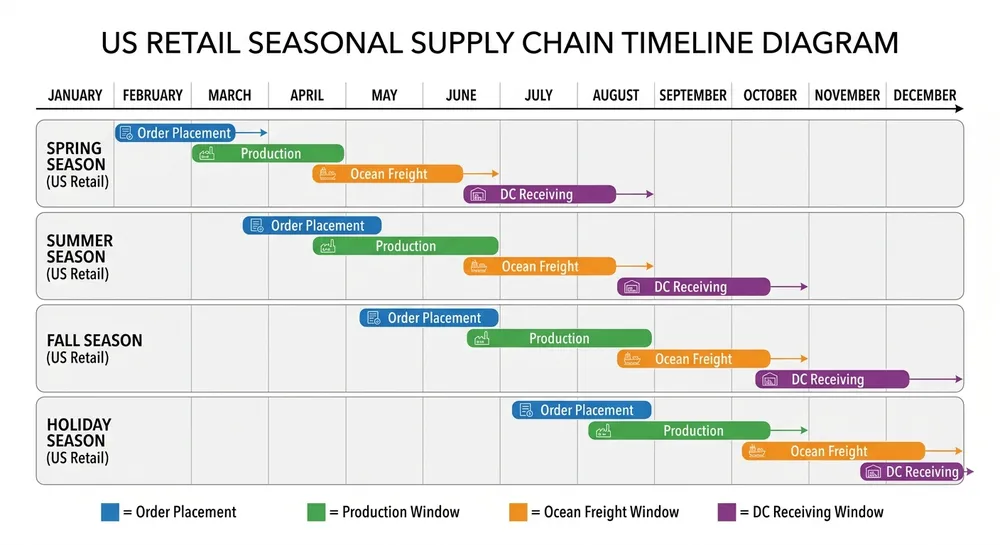
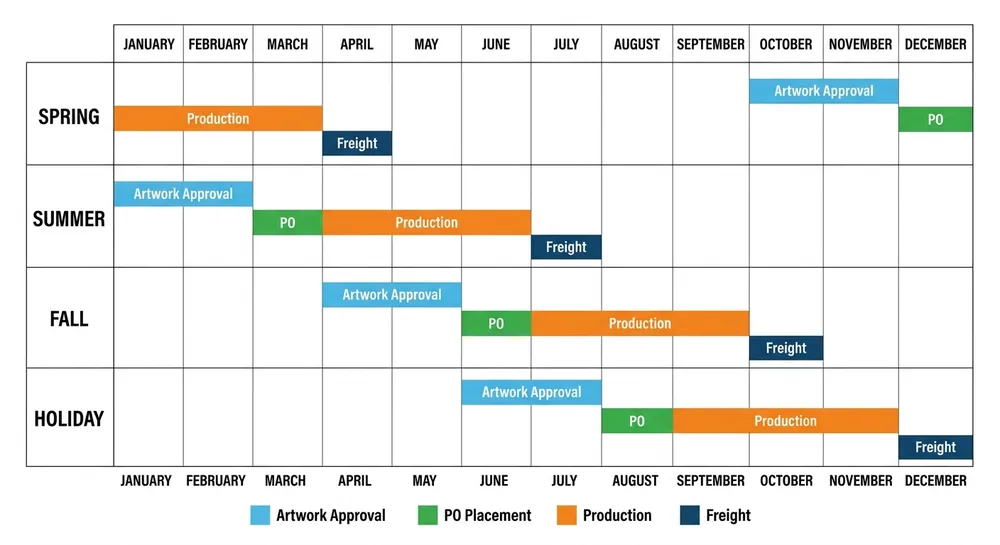
The four US retail seasons and when to place your POs
Spring reset (floor date: late February – early March)
Spring is the highest-stakes season for floral wall art. Cherry blossom, peony, wildflower, and pastel botanical subjects all peak here. Retailers typically reset home decor floors in late February, with some big-box chains running resets as early as the first week of February.
Working backward from a February 28 floor date:
- DC receiving deadline: February 10–14
- US customs clearance starts: February 3–7
- Vessel departs Vietnam: January 5–10 (East Coast) / January 12–17 (West Coast)
- Production complete: December 1–10
- Bulk PO placed: October 27 – November 5
- Artwork approved: October 20–27
That puts your spring PO in late October. Most buyers we work with who miss spring placed their order in December — six weeks too late for ocean freight, and too expensive to fix with air.
Summer refresh (floor date: late May – early June)
Summer floral subjects shift toward tropical botanicals, hibiscus, sunflower, and high-contrast color palettes. The reset is softer than spring — many retailers do a partial refresh rather than a full floor reset — but the timing math is the same.
- Bulk PO placed: late January – early February
- Artwork approved: mid-January
Summer is actually the season where low-MOQ test orders make the most sense. If you're not sure whether a new tropical floral subject will perform in your channel, a 100-piece test run placed in January gives you sell-through data before you commit to a full spring program the following year.
Fall transition (floor date: late August – mid-September)
Fall floral subjects — dried botanicals, rust and amber palettes, pampas grass, late-season wildflowers — have grown steadily in US retail over the past three years. The fall reset window is tight: retailers want product on the floor before Labor Day weekend.
- Bulk PO placed: late April – early May
- Artwork approved: mid-April
One thing worth noting on fall: the color palette shift between summer and fall is significant enough that you can't reuse summer artwork with a filter adjustment. Buyers who try to shortcut this end up with product that looks off-season on the floor. Lock the fall palette separately.
Holiday season (floor date: late October – early November)
Holiday floral subjects are narrower — poinsettia, winter botanicals, frosted eucalyptus — but the volume is higher and the markdown risk if you miss the window is severe. Retailers start holiday home decor resets in late October, and some club-store formats reset as early as mid-October.
- Bulk PO placed: late June – early July
- Artwork approved: mid-June
Holiday is also the season where container space gets tight. If you're planning a full-container load of holiday flower wall art, book your freight forwarder in May — don't wait until the PO is placed.
How print method and substrate choice affect your seasonal turnaround
This is the part most sourcing guides skip, and it's where buyers lose time they didn't know they were losing.
Flower wall art comes off the line in several substrate and print combinations, and they don't all have the same production cycle. The two most common for US retail:
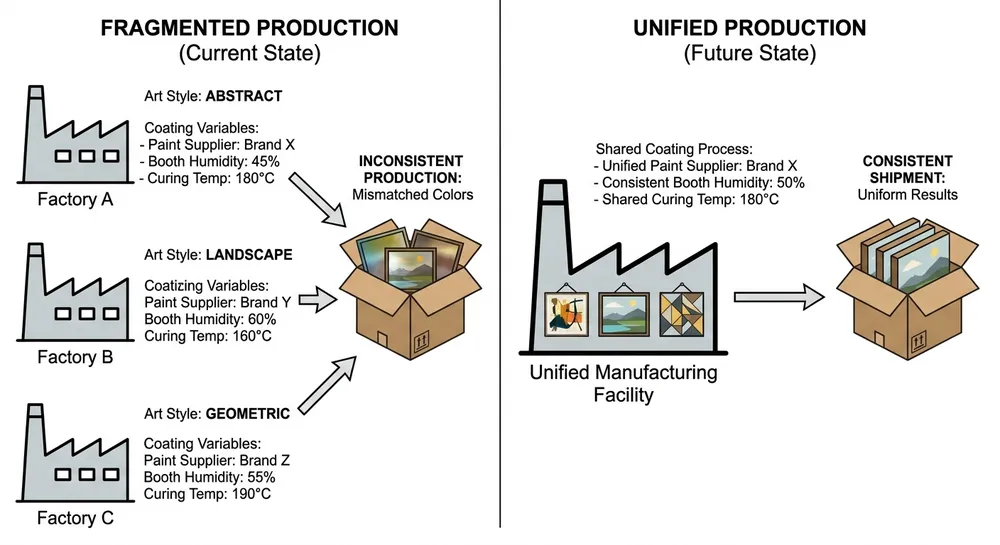
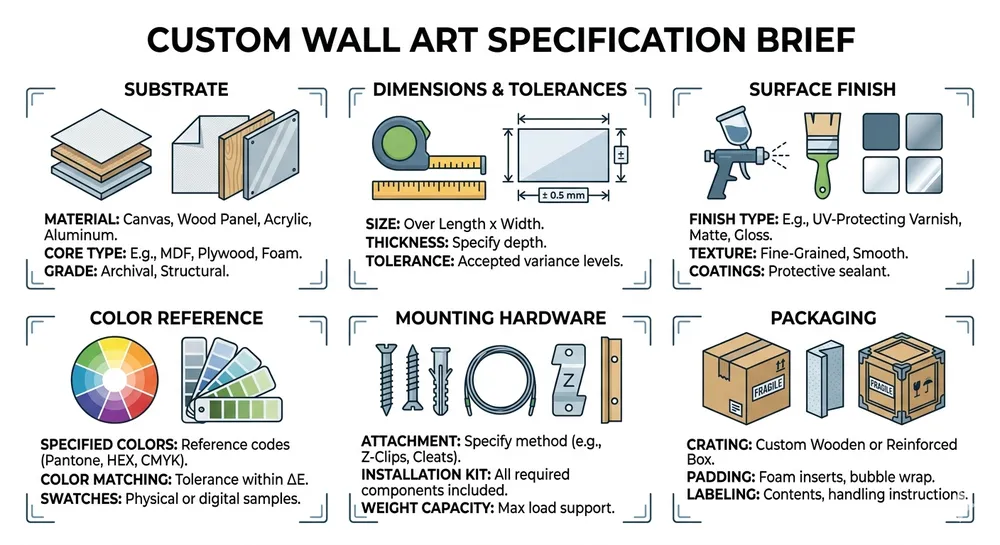
Canvas with UV flatbed print: fastest turnaround on reorders. Once the artwork file is approved and color-matched to our reference print, reorder production runs 30–35 days. Color consistency across a 500-piece run is tight — we hold to a Delta-E tolerance of ≤3 on floral subjects, which matters when you have a peony pink that needs to match across a three-piece set.
Wood or MDF panel with surface print and frame assembly: adds 5–8 days to the production cycle because the frame assembly and finishing step runs after printing. For seasonal items where you're introducing a new frame profile, budget the full 45–55 day window.
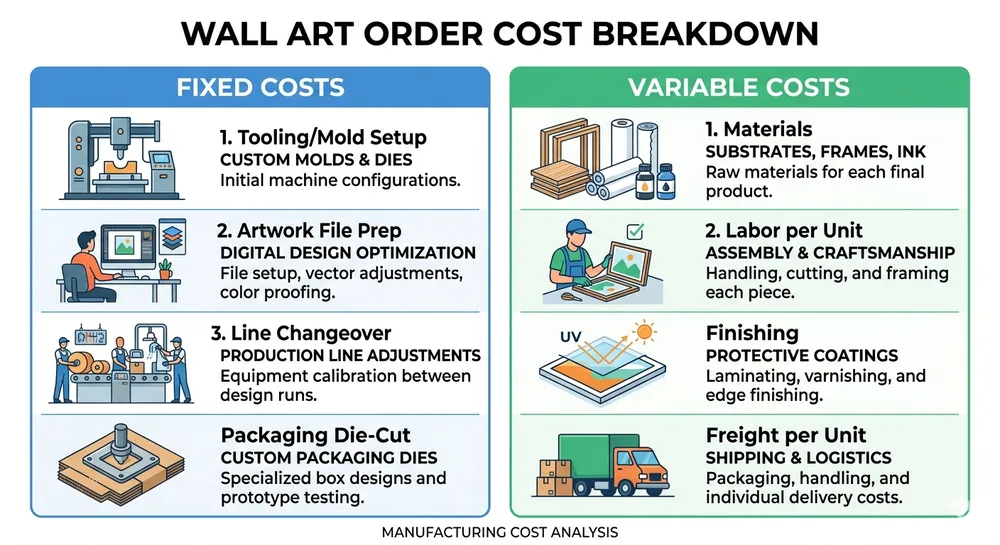
The substrate choice also affects how the product ships. Canvas pieces in KD (knocked-down) flat-pack load more efficiently — we typically get 30–40% more units per container compared to pre-assembled framed pieces. For seasonal items where you're managing markdown risk, the landed cost difference from container efficiency is real margin.
(We've had buyers switch from pre-assembled to KD flat-pack on their spring floral program and recover $0.80–$1.20 per unit in landed cost just from the container loading improvement. On a 1,000-unit order, that's worth paying attention to.)
Locking artwork early without overcommitting on volume
The tension most buyers face: floral design trends shift between when you need to lock artwork (October for spring) and when you actually know what's selling (January, when early spring sell-through data comes in). You're making a design decision four months before you have market confirmation.
Two approaches that work:
Lock the subject, flex the colorway. Commit to a subject — peony, wildflower, botanical — in October when you approve samples. Hold the colorway decision until December by requesting two or three colorway variants in the sample run. We can produce sample colorway variants on the same subject for a modest sampling fee, and you pick the one that matches your read of the market before the bulk PO drops.
Use a 100-piece test order to validate before scaling. Our 100-piece MOQ exists specifically for this. Place a 100-piece test run of a new seasonal subject in August for fall, or in February for summer. It won't arrive in time for the main reset, but it gives you real sell-through data to size your next season's order with confidence. Buyers who run test orders consistently end up with tighter inventory positions and fewer end-of-season markdowns.
What doesn't work: waiting for trend confirmation before placing the bulk PO. By the time a floral subject is clearly trending on social or showing up in competitor assortments, you're already six weeks behind the production window.
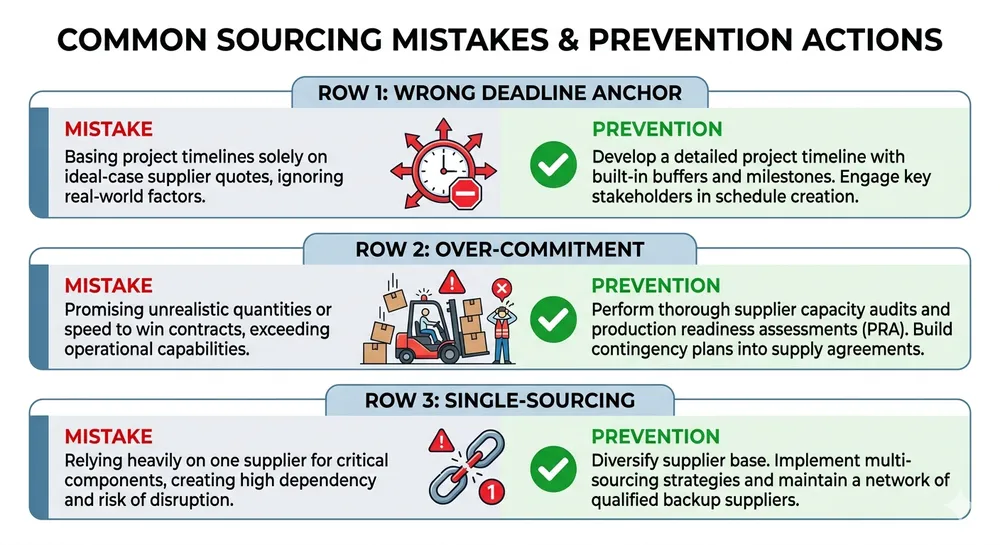
The three sourcing mistakes that cause most seasonal failures
1. Treating the ship date as the deadline
The ship date is not the deadline. The DC receiving deadline is. Buyers who optimize for ship date often find that customs clearance variability or DC processing backlogs push their product past the floor reset date anyway. Build the buffer into the PO date, not the ship date.
2. Over-committing on unproven seasonal SKUs
A new floral subject with no sell-through history in your channel is a risk. Ordering a full container of an unproven design because the artwork looks strong is how you end up with a clearance problem in May. Use the 100-piece MOQ to test, then scale the following season with data behind you.
3. Single-sourcing your seasonal program
If your entire spring floral program is on one PO with one supplier, any production delay — a material shortage, a quality hold, a factory capacity crunch — puts the whole season at risk. We see this most often with buyers who are new to factory-direct sourcing and haven't built in a backup plan. At minimum, have a secondary supplier qualified for your top two or three seasonal SKUs, even if you don't use them every cycle.
Building a repeatable seasonal sourcing calendar
The buyers who execute seasonal programs cleanly aren't doing anything complicated. They're running the same calendar discipline every cycle:
- January: Review prior year's sell-through by subject and colorway. Identify which spring subjects to reorder, which to retire, and whether any new subjects need test orders.
- Mid-January: Submit artwork briefs for new spring subjects. Request colorway variants if needed.
- Late January: Approve samples. Lock colorways.
- Early February: Place spring bulk POs. Confirm freight booking with forwarder.
- March: Spring production runs. Request mid-production QC photos.
- Early April: Spring orders load and ship.
- Late April: Place fall bulk POs (same cycle, offset by season).
- Late May – early June: Spring product arrives at DC. Confirm receiving.
- June: Place holiday bulk POs.
- August: Fall product arrives. Run summer test orders for new subjects.
- October: Holiday product arrives. Begin spring artwork review for next year.
Run this calendar for two full years and your seasonal sourcing becomes predictable. The first year is always the hardest because you're building the baseline sell-through data you need to size orders confidently.
FAQ
What's the minimum order quantity for a seasonal flower wall art test run?
100 pieces per SKU on standard frame profiles. That's enough to put product in front of real customers and get sell-through data without the inventory risk of a full container. For new frame profiles or custom sizes, the minimum is higher — ask us when you submit the brief.
How far in advance do I need to lock artwork for a new floral subject?
For bulk production on existing molds, artwork needs to be approved 11–14 weeks before your DC receiving deadline. If you're developing a new frame profile alongside the artwork, add three weeks. The artwork approval step is the one buyers most often underestimate — a single round of color correction can add 5–7 days, so don't assume first-submission approval.
Can I adjust colorways between seasons without re-sourcing the frame?
Yes, and this is one of the practical advantages of working with a factory that handles both printing and frame finishing in-house. We can run the same frame profile with a new print colorway without retooling. The only requirement is a new sample approval cycle — budget 7–10 days for that before the bulk PO drops.
What happens if ocean freight is delayed and my product misses the reset window?
It depends on how much buffer you built in. Buyers who place POs to our recommended calendar typically have 10–14 days of buffer between the vessel arrival date and the DC receiving deadline. That covers most routine delays. If a vessel is significantly delayed (typhoon season, port congestion), we can discuss partial air freight for the highest-velocity SKUs — but that's a cost conversation you want to have before the PO is placed, not after the vessel is late.
—
For your Flower Wall Arts sourcing program, the calendar above is the starting point. If you want to go deeper on color accuracy and finish consistency across seasonal runs, the flower wall art color specs guide covers the production side in detail. And if you're ready to map out a specific season, Request Quote with your target retail date, preferred subjects, and estimated volume — we'll send back a sourcing timeline with pricing within 48 hours.
Browse the full Wall Arts by Style & Subject range to see which subjects are available on existing molds for faster turnaround.