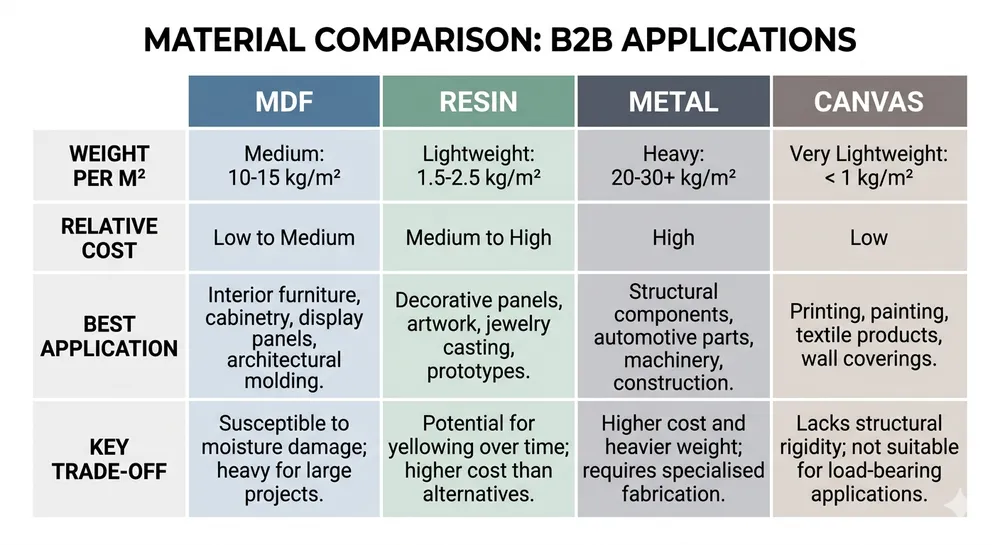
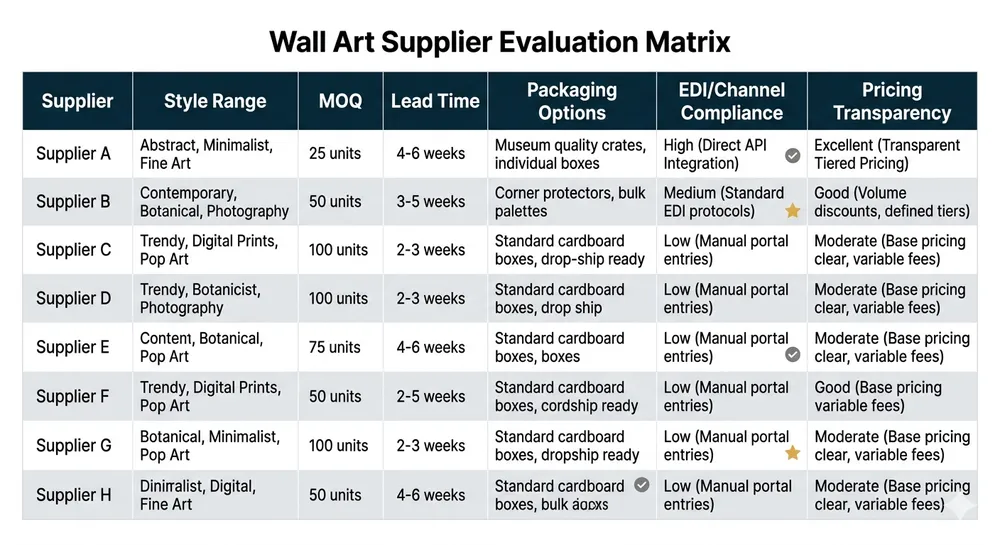
Livewellcraft

DNOOO blank theme is active for local preview.

Top 10 Style Wall Art Wholesalers in Canada for Cross-Border Buyers

Canada's wholesale wall art market is more fragmented than most buyers expect. You won't find a single dominant distributor the way you might in the US — instead, the landscape splits between regional gift and home décor wholesalers, a handful of art-focused distributors, and marketplace intermediaries who aggregate product from overseas factories. For a cross-border buyer — whether you're a US retailer sourcing under CUSMA, an international importer routing through a Canadian 3PL, or a hospitality buyer building out a project — understanding who actually holds inventory, who drop-ships, and who is simply a catalog reseller matters more than any ranked list.

This guide covers 10 real Canadian suppliers active in the style wall art space. I've organized them by supplier model rather than a fake quality ranking, because the honest answer is that your best option depends on order size, style requirements, and how much margin you can afford to leave on the table at the wholesale layer.

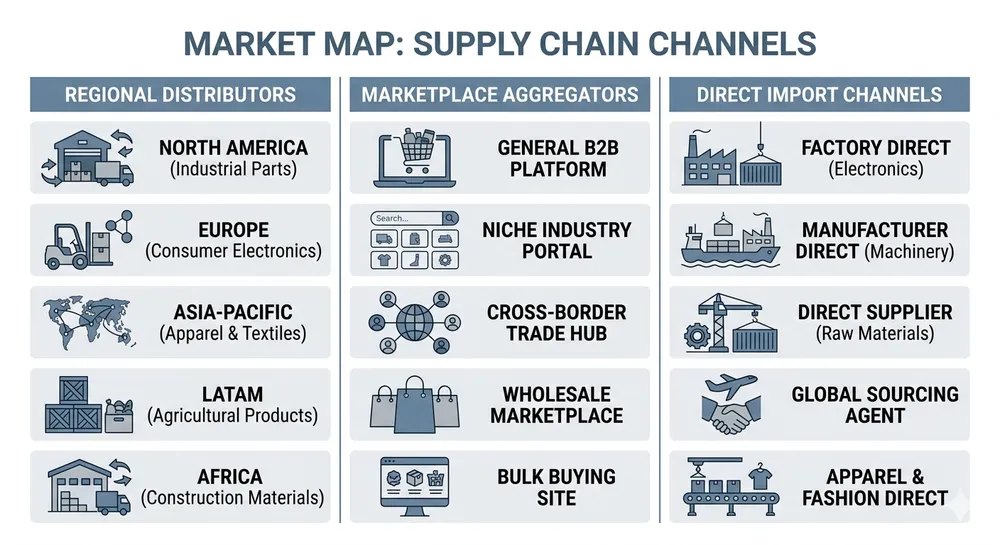
Overview map of Canadian wholesale wall art supplier types including distributors, marketplaces, and direct importers

What Serious Cross-Border Buyers Should Evaluate Before Shortlisting

Before you commit to any Canadian wholesaler, run them through these criteria. The ones that can't answer clearly on all five are catalog resellers, not real supply partners.

Criterion Why It Matters for Cross-Border Buyers
MOQ per SKU Low MOQ sounds attractive but often signals drop-ship or marketplace model — no real inventory depth
Style category depth Abstract, modern, nature, boho — does the supplier actually stock across styles or just list them?
Cross-border shipping terms DAP to US address vs. FOB Canadian warehouse — who handles customs, brokerage, and duty?
CUSMA/USMCA eligibility Canadian-origin goods may qualify for duty-free entry into the US — but only if the product genuinely originates in Canada
OEM/custom capability Can they develop a custom size, finish, or subject for your private label, or are they locked to a fixed catalog?
Lead time on reorders First order lead time is easy to quote — ask specifically about reorder lead time when their stock runs low

(One thing I see buyers miss consistently: CUSMA duty-free treatment applies to goods that originate in Canada. A Canadian wholesaler reselling Chinese-manufactured wall art does not automatically qualify your import for duty-free entry into the US. Ask for the country of origin on the product itself, not just the shipping origin.)

The 10 Canadian Style Wall Art Wholesalers

1. Artcraft Greetings — artcraftgreetings.com

Artcraft is one of Canada's longer-standing wholesale gift and wall décor distributors, operating out of Ontario. Their catalog covers framed prints, canvas art, and decorative wall panels across traditional, nature, and inspirational subject categories. They supply independent gift retailers, home décor boutiques, and garden centres across Canada, with cross-border shipping available to US accounts.

Strengths: Established trade relationships, broad style coverage for gift-channel buyers, Canadian warehouse stock for faster replenishment. Limitations: Catalog is largely fixed — limited OEM or custom development. Style range skews toward traditional and inspirational rather than contemporary abstract or modern. Best fit: US gift retailers or boutique buyers who need low-MOQ replenishment from a Canadian-origin warehouse.

2. Candym Enterprises — candym.com

Candym is a Barrie, Ontario-based wholesale distributor covering home décor, giftware, and seasonal products. Wall art is part of a broader home accessories catalog. They work primarily with independent retailers and have a well-established Canadian distribution network.

Strengths: Wide home décor assortment means you can consolidate wall art with other SKUs in a single order. Reliable Canadian warehouse stock. Limitations: Wall art is not a core category — depth within specific style segments (abstract, modern, boho) is limited. Not structured for large-volume or project-based procurement. Best fit: Canadian retailers or US buyers who want to bundle wall art into a broader home décor order rather than source it as a standalone category.

3. Ganz — ganz.com

Ganz is a Toronto-based wholesale gift and home décor company with decades of distribution history across North America. Their wall art offering sits within a large giftware catalog and covers inspirational, nature, and seasonal subject categories.

Strengths: Strong North American distribution infrastructure, cross-border shipping to US accounts is routine, established EDI capability for larger retail accounts. Limitations: Wall art style range is gift-channel oriented — not the right source for contemporary abstract or design-forward modern pieces. Fixed catalog, no custom development. Best fit: Mass-market gift retailers and pharmacy/convenience chains sourcing seasonal or inspirational wall art at moderate volumes.

4. Homedics Canada / Wholesale Club Suppliers (via Faire) — faire.com/brand/homedics (representative)

Faire's Canadian wholesale marketplace aggregates dozens of independent Canadian wall art brands and studios. This is not a single supplier — it's a discovery layer. You'll find everything from hand-lettered typography prints to abstract canvas art from small Canadian studios, with MOQs as low as $100–$150 CAD per brand.

Strengths: Enormous style variety, low entry MOQ, net-60 payment terms available through Faire's financing layer, easy cross-border ordering for US retailers. Limitations: Each brand is a separate supplier — no consolidated inventory, no volume pricing across brands, no OEM capability. Reorder reliability varies by studio size. Best fit: US boutique retailers or interior designers sourcing small quantities of style-specific or artisan wall art for differentiated retail assortments.

Faire wholesale marketplace showing Canadian wall art brand listings with MOQ and style filters

5. Indaba Trading — indabatrading.com

Indaba is a Vancouver-based wholesale home décor and lifestyle brand with a strong presence in the Canadian and US gift trade. Their wall art and wall décor range covers boho, nature-inspired, and globally-influenced styles — woven wall hangings, macramé panels, framed botanical prints, and mixed-media pieces.

Strengths: Distinctive style positioning in boho and nature categories — genuinely differentiated from mass-market catalog suppliers. Strong US cross-border shipping capability. Consistent presence at major trade shows (Atlanta Market, Las Vegas Market). Limitations: Style range is niche — if you need contemporary abstract or modern geometric, this is not the right source. MOQ and pricing are structured for boutique retail, not high-volume distribution. Best fit: US boutique retailers, lifestyle stores, and specialty home décor chains sourcing boho and nature-inspired wall art for differentiated assortments.

6. Pacific Coast Lighting / Pacific Décor (wholesale division) — pacificcoastlighting.com

Pacific Coast operates primarily as a lighting distributor but carries a wall art and decorative accessories line through their wholesale division. Their wall art catalog covers framed canvas, metal wall art, and decorative panels in contemporary and transitional styles.

Strengths: Established wholesale infrastructure, cross-border shipping to US accounts, ability to bundle wall art with lighting and accessories for consolidated freight. Limitations: Wall art is secondary to their lighting core — style depth and SKU count within wall art is limited. Not structured for OEM or custom development. Best fit: US interior design firms or hospitality buyers who are already sourcing lighting from Pacific and want to consolidate décor accessories in the same order.

7. Koyal Wholesale Canada — koyalwholesale.com

Koyal is a US-headquartered wholesale event and décor supplier with Canadian warehouse operations. Their wall art and backdrop panel range covers contemporary, floral, and event-style decorative pieces. Canadian warehouse stock means faster delivery to Canadian accounts and simplified cross-border logistics for US buyers routing through Canada.

Strengths: Event and hospitality décor focus — useful for buyers supplying wedding venues, event planners, or hospitality projects. Canadian warehouse reduces cross-border friction for US buyers. Limitations: Style range is event-oriented rather than retail-oriented — not the right source for residential or commercial interior wall art programs. Limited OEM capability. Best fit: Event décor wholesalers, hospitality project buyers, and floral/event supply distributors.

8. Umbra — umbra.com (wholesale/trade program)

Umbra is a Toronto-based design brand with a global wholesale and trade program. Their wall art and wall décor range — including modular wall panels, geometric metal art, and contemporary framed pieces — is genuinely design-forward and well-positioned for modern and contemporary retail channels.

Strengths: Strong brand equity in the design and contemporary home space. Consistent style identity across SKUs. Trade program with volume pricing available. Cross-border shipping to US trade accounts is standard. Limitations: You're buying a branded product — no OEM, no private label, no custom development. Margin is compressed by the brand premium. MOQ is structured for retail replenishment, not bulk distribution. Best fit: US design retailers, furniture stores, and home décor chains that want a recognized Canadian design brand in their wall art assortment.

9. Bouclair (wholesale/trade channel) — bouclair.com

Bouclair is a Quebec-based home décor retailer with a wholesale and trade supply channel. Their wall art range covers contemporary, abstract, and nature-inspired styles with a strong emphasis on seasonal trend alignment. They supply interior designers, hospitality buyers, and trade accounts across Canada and into the US.

Strengths: Trend-responsive style range — they update their wall art assortment seasonally, which is useful if you're sourcing for retail programs that need fresh SKUs each season. Contemporary and abstract styles are genuinely well-executed. Limitations: Trade channel pricing and availability can be inconsistent — Bouclair's primary business is retail, and wholesale supply is secondary. Not structured for large-volume or project-scale procurement. Best fit: Interior designers and boutique retailers sourcing trend-aligned contemporary or abstract wall art for seasonal refresh programs.

10. Structube (trade/wholesale program) — structube.com

Structube is a Montreal-based furniture and home décor brand with a trade program covering interior designers and commercial buyers. Their wall art range focuses on modern, Scandinavian-influenced, and abstract styles — canvas prints, framed photography, and geometric metal pieces.

Strengths: Clean modern and Scandinavian aesthetic — well-suited for commercial interior projects, co-working spaces, and hospitality environments. Trade pricing available. Canadian origin for CUSMA purposes on qualifying products. Limitations: Like Umbra, you're buying a branded product — no OEM or private label. Style range is deliberately narrow (modern/Scandi). Not structured for high-volume distribution. Best fit: Commercial interior designers and hospitality project buyers sourcing modern or Scandinavian-style wall art for project-scale installations.

Comparison matrix of 10 Canadian wall art wholesalers showing MOQ, style range, cross-border shipping, and OEM capability

The CUSMA Advantage — and Where It Actually Applies

US buyers sourcing from Canada have a legitimate duty advantage under CUSMA (the Canada-United States-Mexico Agreement, formerly NAFTA). Wall art and decorative panels that genuinely originate in Canada — meaning they are manufactured or substantially transformed in Canada — can enter the US duty-free under CUSMA Chapter 97 (works of art) or the relevant HTS heading for manufactured décor goods.

The catch: most Canadian wholesalers are not manufacturers. They import finished wall art from China, Vietnam, or India and redistribute it from Canadian warehouses. The Canadian warehouse address does not make the product Canadian-origin for CUSMA purposes. If you're counting on duty-free entry into the US, ask your supplier for the country of origin on the product itself and request a CUSMA Certificate of Origin before you commit to an order.

For buyers where CUSMA duty treatment is a real factor in landed cost, the honest answer is that the pool of genuinely Canadian-manufactured wall art at wholesale volume is small. Most of what you'll find in the Canadian wholesale channel is imported product with a Canadian distribution layer on top.

What the Wholesaler Margin Actually Costs You

A Canadian wholesaler buying from an overseas factory and reselling to you is adding a margin layer — typically 30–50% above their landed cost — plus warehousing, local freight, and their own overhead. That's the price of convenience: local stock, familiar communication, and the ability to reorder in small quantities without a container commitment.

For low-volume, high-urgency orders — say, 20–50 pieces to fill a retail gap or complete a project — that convenience premium is worth paying. The wholesaler's inventory is already in-country, the freight is simple, and the risk is low.

The math changes at volume. If you're placing 500+ units per style per season, you're paying the wholesaler's margin on every single piece, every single order, indefinitely. At that scale, the question isn't whether factory-direct sourcing is cheaper — it is — the question is whether the operational complexity of direct import is worth the savings.

(We've had buyers come to us after three years of sourcing through a Canadian distributor. When we ran the numbers on what they'd paid in wholesaler margin over that period, it was enough to have funded their own dedicated production run with custom sizing and private-label packaging. The distributor relationship made sense at the start — it stopped making sense at scale.)

Factory-Direct from Vietnam: When the Economics Shift

We manufacture decorative mirrors and wall art at our facility in Dong Nai, Vietnam — 12,000 m², 6 production lines, 400,000 pieces per year. We've been shipping to North American buyers since 2008, and we supply Walmart, Wayfair, and Amazon vendors with EDI-compliant, retail-ready product.

The comparison to Canadian wholesalers is straightforward on a few dimensions:

Unit cost: We ship FOB Vietnam or CIF to Canadian ports. At 500+ units per style, your landed cost — including ocean freight, Canadian import duty, and local delivery — is typically 25–40% below what a Canadian wholesaler charges for equivalent product. The exact gap depends on style complexity, frame specification, and your freight terms.

CPTPP duty advantage: Vietnam is a CPTPP signatory. Wall art and decorative mirrors manufactured in Vietnam enter Canada at reduced or zero duty under CPTPP, depending on the HTS classification. This is a real, documentable landed-cost advantage — not a theoretical one. (Ask your customs broker to run the CPTPP rate against the MFN rate for your specific HTS heading before you finalize your sourcing decision.)

Style and OEM development: Every Canadian wholesaler on this list sells a fixed catalog. We develop custom frame profiles, finishes, sizes, and subject matter from scratch. If you need a 36×48" abstract canvas in a specific colorway to match your private-label program, or a custom beveled mirror with a frame profile your competitors don't carry, that's what our OEM/ODM services are built for. Our 12-person engineering team handles the development — you get production samples before any bulk commitment.

MOQ: We start at 100 pieces for standard models. Custom development typically starts at 200–300 pieces depending on frame complexity. That's lower than most buyers expect from a factory-direct relationship, and it's structured to let you test a new style before committing to a full container.

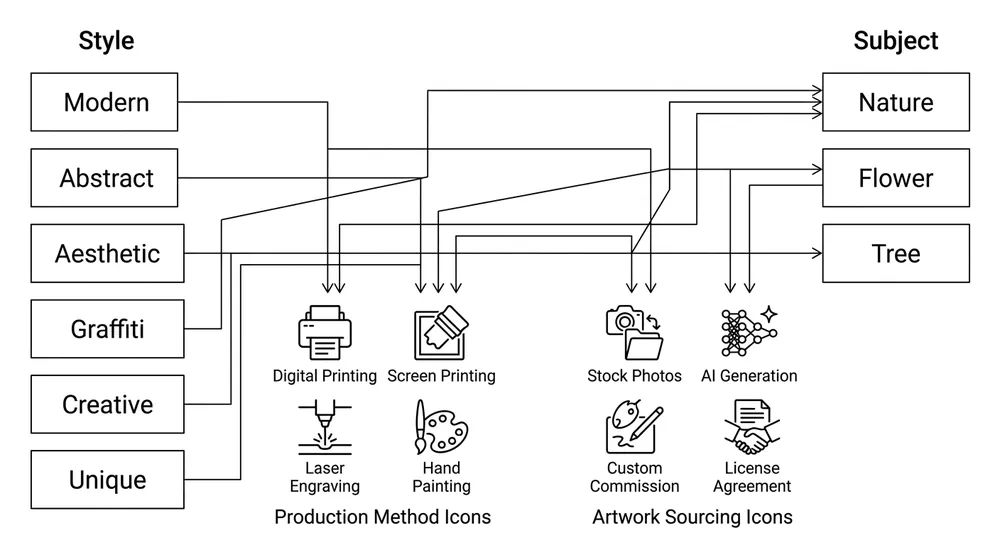
For a broader view of the Wall Arts by Style & Subject category — including abstract wall arts and modern wall arts — our category pages cover the full style range we produce and the retail segments each style serves.

Landed cost comparison chart between Canadian wholesale wall art sourcing and factory-direct import from Vietnam

Which Sourcing Route Fits Your Situation

This isn't a binary choice. Most serious buyers use both channels at different points in their procurement cycle.

Use a Canadian wholesaler when:

  • You need fewer than 200 units and can't justify a container commitment
  • You have an urgent reorder and can't wait 45–60 days for ocean freight
  • You're testing a new style category before committing to a direct-import program
  • Your project timeline is fixed and local inventory is the only way to hit it

Move to factory-direct when:

  • You're placing 500+ units per style per season on a repeatable basis
  • You need custom sizing, private-label packaging, or a frame profile your current supplier doesn't offer
  • Your margin is being compressed by wholesaler pricing and you need to recover it
  • You're building a house brand or exclusive product line that requires OEM development

The hybrid approach — which is what most of our North American buyers actually run — is to use Canadian wholesalers for emergency replenishment and small-batch testing, while running their core volume through a direct-import program. The wholesaler relationship stays useful; it just stops being the primary supply chain.

For buyers comparing sourcing options across North America, our article on style wall art suppliers in the USA covers the US wholesale landscape with the same framework. If you're evaluating the full factory-direct option, style wall art manufacturers in Vietnam walks through how Vietnamese production compares on quality, lead time, and certification.

Sourcing Decision Checklist for Cross-Border Buyers

Before you finalize your supplier shortlist, work through these:

  • [ ] Confirm country of origin — not shipping origin — for CUSMA/CPTPP duty calculation
  • [ ] Request reorder lead time, not just first-order lead time
  • [ ] Verify inventory depth — ask how many units they actually hold in stock vs. what's on order
  • [ ] Clarify cross-border shipping terms — DAP to your door vs. FOB Canadian warehouse are very different landed costs
  • [ ] Ask about OEM capability — if they can't develop a custom size or finish, you're locked to their catalog forever
  • [ ] Run a landed-cost comparison at your actual order volume — the wholesaler premium is invisible until you calculate it

If you're at the point of comparing factory-direct pricing against your current Canadian wholesaler, send your style references, target sizes, and order volume to Request a Quote — we'll return a detailed quote with landed-cost estimates so you have a real number to compare against.

Aesthetic Wall Art Trend Specs — What Drives Demand on US E-Commerce Platforms

Most trend reports on aesthetic wall art are written for consumers. They tell you what looks good. They don't tell you what sells at volume, what specs the major platforms actually require, or which styles are producible at scale without blowing your lead time.

This article is the other kind. We've been manufacturing decorative wall art and mirrors for US e-commerce buyers since 2008 — Wayfair, Amazon, Walmart vendor programs, all of them. What follows is a production-side breakdown of the spec dimensions that drive sell-through on US platforms, the sub-styles gaining traction right now, and the sourcing decisions that separate a profitable SKU from a slow-moving one.

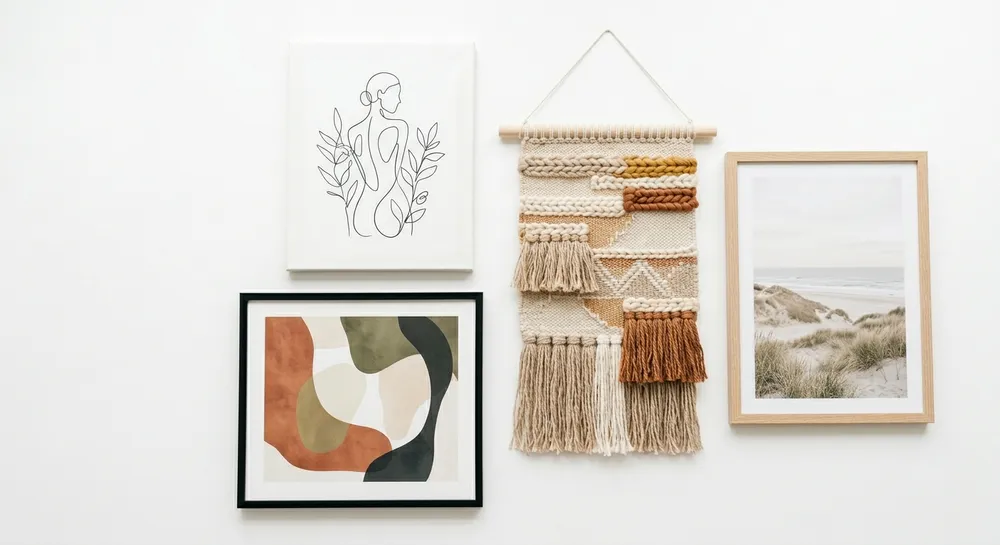
Flat-lay of trending aesthetic wall art styles including minimalist line art, boho texture, and neutral tone photography on a light background

What "Aesthetic" Actually Means in a Sourcing Context

"Aesthetic" as a retail category is broader than it looks. On Amazon and Wayfair, it covers anything that reads as intentionally styled — the opposite of generic. But for sourcing purposes, it breaks into four distinct sub-styles, each with its own spec profile and buyer demographic.

Understanding which sub-style you're targeting determines your frame material, your finish, your size run, and your price point. Conflating them is how buyers end up with inventory that looks fine in a sample photo but doesn't convert on a product listing.

The four sub-styles we see driving consistent volume on US platforms:

  • Minimalist line art — single-color line drawings, usually black on white or cream. Thin profile frames, matte finish, sizes clustering around 12×16" and 18×24". High search volume, competitive pricing, fast trend cycle.
  • Boho/organic texture — woven elements, natural fiber, earthy tones. Often frameless or with raw wood frames. Harder to produce at scale consistently; texture variation is a QC challenge.
  • Neutral tone photography — landscape, botanical, architectural prints in muted palettes. Natural wood or whitewash frames. Strong in the Wayfair mid-market segment.
  • Abstract organic — fluid shapes, soft color gradients, sometimes metallic accents. MDF or resin frames with matte or satin finish. The fastest-growing sub-style in the 2024–2026 window based on platform search trend data.

(We track these four separately in our sampling pipeline because each one has a different production bottleneck — line art is a printing and framing precision issue, boho texture is a materials sourcing issue, and abstract organic is a color-matching issue across a bulk run.)

The Spec Dimensions That Actually Affect Sell-Through

Trend style gets buyers to click. Specs determine whether the product gets returned, reviewed poorly, or reordered. These are the dimensions that matter for US e-commerce performance.

Size

Size is the single most consequential spec decision for sell-through rate. US consumers buying wall art online have strong size expectations by room type, and listings that don't match those expectations generate returns.

Size Range Platform Sweet Spot Notes
8×10" / 10×12" Amazon impulse / gift segment Low ASP, high volume, competitive
12×16" / 16×20" Amazon & Wayfair mid-tier Best margin-to-volume ratio for most resellers
18×24" / 20×24" Wayfair statement piece segment Higher ASP, lower return rate when framed well
24×36" Wayfair / boutique retail Requires stronger frame construction; freight cost matters
Multi-panel sets (3×8×24") Amazon trending Higher perceived value, complex packaging

The 12×16" and 16×20" range is where most of our US buyers land for their core SKU. It's producible at scale, fits standard carton configurations for FBA, and hits the price points that convert without triggering price-sensitivity hesitation.

(Multi-panel sets look attractive on paper but add real complexity — three pieces need to arrive undamaged, and the assembly instruction insert has to be right for your target market. We've seen buyers underestimate the packaging engineering on these.)

Frame Material

Frame material affects landed cost, return rate, and platform compliance more than most buyers realize upfront.

Frame Material Weight MOQ Flexibility Lead Time Best For
MDF with veneer or foil wrap Light High — standard tooling 25–35 days Amazon FBA, Wayfair mid-market
Solid wood (pine/paulownia) Medium Medium — depends on profile 30–40 days Premium Wayfair, boutique retail
Resin/composite Light Medium 30–40 days Decorative profiles, boho styles
Metal (aluminum extrusion) Medium-heavy Lower — tooling cost 35–45 days Minimalist/modern, gallery style
Frameless (canvas wrap / float mount) Lightest High 20–30 days Abstract, photography prints

MDF is the workhorse of the US e-commerce wall art market. It's dimensionally stable, takes paint and foil wrap cleanly, and keeps freight costs manageable. We run MDF frames on the majority of our US-bound aesthetic wall art orders because the cost-to-quality ratio is hard to beat at volumes above 500 units.

Solid wood commands a higher retail price point and photographs better for lifestyle imagery, but the grain variation means more QC sorting. For Wayfair programs where product photography is a major conversion driver, that extra cost is usually justified. For Amazon FBA where the listing photo is smaller and the price competition is tighter, MDF with a good finish often outperforms.

Surface Finish

Finish is where aesthetic sub-style and production reality intersect most directly. The wrong finish on the right frame kills the look — and generates reviews that mention "cheap" or "plastic-looking."

Finish Type Aesthetic Sub-Style Match Production Note
Matte black paint Minimalist line art, abstract organic Most consistent across MDF and metal; low glare in listing photos
Natural wood / whitewash Neutral tone photography, boho Grain variation requires sorting; adds 1–2 days to QC
Gold/brass metallic Abstract organic, glam aesthetic Electroplating or foil — foil is more consistent at scale
White gesso / chalk Minimalist, farmhouse crossover Clean look, shows handling marks; packaging matters
Raw/unfinished wood Boho, organic texture Moisture content control is critical for US climate stability

Matte black is the safest finish for a first aesthetic wall art order. It photographs well, hides minor surface variation, and works across multiple sub-styles. We recommend it as a starting point for buyers entering the category without strong data on their customer's finish preference.

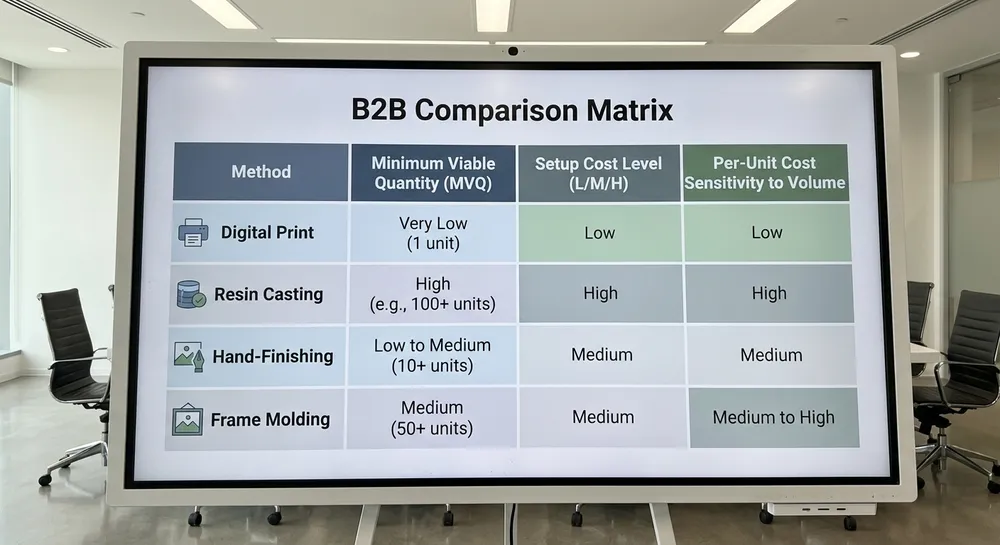
Comparison matrix of aesthetic wall art frame materials and surface finishes mapped to US e-commerce platform segments

Which Sub-Styles Are Moving on US Platforms Right Now

Trend identification is only useful if it's connected to a production timeline. Here's where demand is sitting in the 2025–2026 window, and what it means for your order planning.

Abstract organic — the growth story

Abstract organic wall art — fluid shapes, soft earth tones, occasional gold or terracotta accents — has been the strongest-growing sub-style on both Amazon and Wayfair since mid-2023. Search volume for terms like "abstract boho wall art," "organic shape wall decor," and "neutral abstract print" has grown consistently, and the category hasn't saturated the way minimalist line art did in 2021–2022.

The production spec that matters here: color accuracy across a bulk run. Abstract organic pieces often use gradient backgrounds or multi-tone color fields, and color shift between units is the most common QC failure mode. We run color calibration checks at the print stage and again after framing — a step that adds time but eliminates the "colors look different than the photo" reviews that tank conversion.

For buyers sourcing Aesthetic Wall Arts in this sub-style, the key spec to lock down is the color profile of your print file. We work from ICC-profiled files and can provide a pre-production color proof before bulk printing starts.

Minimalist line art — mature but stable

Line art peaked in 2021–2022 but hasn't collapsed. It's now a stable, competitive segment with thin margins and high price sensitivity. The buyers doing well in this segment are either running high volume at low ASP (Amazon FBA, 8×10" to 12×16") or differentiating on frame quality at a higher price point (Wayfair, 18×24" with solid wood frames).

If you're entering this sub-style now, the frame is your differentiation lever. The print itself is commoditized. A clean matte black MDF frame at 12×16" will compete on price. A paulownia wood frame with a natural finish at 18×24" can hold a $45–65 retail price point with better margin protection.

Neutral tone photography — Wayfair's core

Botanical prints, soft landscape photography, and architectural detail shots in muted palettes are the backbone of Wayfair's mid-market wall art category. This sub-style has a longer trend cycle than abstract or line art — it's less fashion-driven and more tied to interior design fundamentals.

The spec profile here is different from the others: buyers in this segment prioritize print resolution and frame finish quality over novelty. A 300 DPI print on archival-quality paper in a clean natural wood frame at 16×20" or 20×24" is the standard. Return rates in this sub-style are lower when the product matches the listing photo accurately — which means your sample approval process matters more than in faster-moving sub-styles.

Boho texture — high appeal, production complexity

Woven wall hangings, macramé-adjacent pieces, and natural fiber wall art have strong consumer appeal but are the hardest sub-style to produce consistently at scale. Texture variation is inherent to the materials, which means your QC standard has to define acceptable variation ranges explicitly — otherwise you'll have disputes on every shipment.

We handle boho texture pieces, but we're honest with buyers about the production reality: MOQ is higher (typically 200+ units per SKU), lead time is longer (40–50 days), and the first order should include a pre-production sample approval step. Buyers who skip the sample step on boho texture orders are the ones who end up with a container of product that's technically within spec but looks inconsistent on the shelf.

Trend-Cycle Timing and Order Planning

The US e-commerce wall art market has two demand peaks: Q4 (October–December, driven by holiday gifting and home refresh) and Q1–Q2 (January–April, driven by new year home improvement intent and spring refresh). Missing either peak by 4–6 weeks means your inventory arrives after the search volume spike.

Working backward from those peaks:

Target Sales Window Order Placement Production Start Notes
Q4 (Oct–Dec) Late June – mid July July Allows 35–45 day production + 20–25 day ocean freight to US
Q1–Q2 (Jan–Apr) October – November November Avoids Chinese New Year production gaps
Spring refresh (Mar–May) December – January January Tightest window; confirm factory capacity before committing

The Chinese New Year gap is the most common timing mistake we see from buyers who are new to Vietnam and China sourcing. Our factory is in Vietnam, so we don't shut down for CNY — but if any of your frame components or print substrates come from Chinese suppliers, the gap still affects your timeline. We flag this proactively when we see it in a buyer's BOM.

(The Q1–Q2 window is underutilized by most wholesale buyers who focus on Q4. New year home refresh intent on Wayfair and Amazon is real and consistent — worth building a separate SKU plan around it.)

For buyers sourcing across the full Wall Arts by Style & Subject category, staggering orders across sub-styles by season is a more reliable strategy than concentrating everything in a single Q4 push.

Order timing calendar for aesthetic wall art wholesale buyers showing US e-commerce demand peaks and production lead time windows

Platform Compliance Specs That Affect Your Sourcing Decision

Amazon, Wayfair, and Walmart each have vendor requirements that affect how you spec your product — not just how you list it. Getting these wrong costs you chargebacks, listing suppression, or failed vendor audits.

Amazon FBA

  • Packaging: Each unit must be poly-bagged or boxed to survive warehouse handling. Framed wall art needs corner protection — we use molded pulp corners on all FBA-bound orders.
  • Weight and dimensions: FBA standard-size tier caps at 20 lbs and 18×14×8". Oversized triggers higher fulfillment fees. Most 12×16" and 16×20" framed pieces fit standard-size with the right carton design.
  • FNSKU labeling: Must be on the outer carton, scannable, not covered by tape. We include FNSKU label placement in our carton spec sheet.
  • Fragile item requirements: Glass-fronted pieces need "Fragile" and "This Side Up" markings. We use tempered glass on all framed pieces — it's a safety requirement for FBA and reduces breakage claims.

Wayfair

  • EDI compliance: Wayfair requires EDI 850/856/810 transaction capability for vendor programs. We have EDI capability and have been through Wayfair's vendor onboarding process.
  • Product data: Wayfair's product data requirements are detailed — dimensions, weight, material composition, finish description, and assembly instructions all need to be accurate. Inaccurate data is the primary cause of Wayfair return spikes.
  • Packaging: Wayfair's drop-ship model means your product ships directly to the consumer. The outer carton is the unboxing experience. We design cartons for both warehouse efficiency and consumer presentation.

Walmart Marketplace / Supplier Program

  • BSCI audit: Walmart supplier programs require BSCI or equivalent social compliance audit. We hold BSCI certification — buyers entering the Walmart channel can use our audit documentation.
  • Item setup: Walmart's item setup process requires specific attribute mapping. We've been through this process and can provide the attribute data your team needs.
  • Packaging compliance: Walmart has specific requirements for retail-ready packaging if you're in the brick-and-mortar program. Drop-ship packaging requirements are similar to Wayfair.

Our ISO 9001:2015, SGS, CE, and BSCI certifications cover the compliance baseline for all three platforms. Buyers who need platform-specific documentation — test reports, material safety data, or compliance declarations — can request these during the RFQ stage.

Production Realities: What's Scalable vs. What's Trend-Only

Not every aesthetic trend that performs on Pinterest or TikTok is producible at the volumes and price points that make sense for wholesale. Here's a direct assessment.

Scalable at 200+ units with standard lead times:

  • MDF-framed minimalist line art (any size up to 24×36")
  • Abstract organic prints with flat or gradient backgrounds
  • Neutral tone photography in natural wood or MDF frames
  • Canvas wrap (frameless) in any of the above styles
  • Multi-panel sets in standard configurations (2-panel, 3-panel)

Scalable but requires longer lead time or higher MOQ:

  • Solid wood frames with natural finish (grain sorting adds time)
  • Metallic finish frames (electroplating requires dedicated line time)
  • Custom frame profiles (requires tooling, typically 500+ unit MOQ)
  • Oversized pieces (24×36" and above — carton engineering and freight cost planning needed)

High consumer appeal, production complexity warrants discussion:

  • Boho texture / natural fiber pieces (texture variation, longer lead time)
  • Mixed-media pieces with 3D elements (resin pours, raised texture)
  • Hand-painted or hand-finished pieces (labor-intensive, consistency challenges at scale)

We've had buyers come to us with trend references that look great but require hand-finishing on every unit. That's fine for a 50-unit boutique order — it's not viable for a 1,000-unit Amazon FBA run. The conversation we have early in the RFQ process is: what's your target retail price, what's your volume, and what's your channel? Those three answers determine which production path makes sense.

(We've turned down orders that weren't a good fit for our production setup. It's better to say that upfront than to take the order and deliver something that doesn't meet the buyer's expectations.)

Sourcing Mistakes That Show Up in Platform Reviews

The most useful thing I can tell you about aesthetic wall art sourcing is that the problems buyers encounter on US platforms are almost always traceable to spec decisions made at the RFQ stage — not to production failures.

Color mismatch between sample and bulk: The most common complaint in aesthetic wall art reviews. Caused by approving a sample printed on a different substrate or with a different color profile than the bulk run. Fix: require a pre-production print proof on the actual bulk substrate before approving production.

Frame finish inconsistency: Matte black that looks slightly different across units in the same shipment. Caused by inconsistent paint application or batch variation in foil wrap. Fix: specify finish tolerance in your PO and request a QC report with finish photos from the production run.

Glass breakage in transit: Tempered glass reduces but doesn't eliminate breakage. The real variable is corner protection. Molded pulp corners outperform foam corners for framed pieces — we switched to molded pulp on all FBA-bound orders after seeing breakage rates drop significantly.

Size discrepancy: A 16×20" piece that measures 15.75×19.75" is technically within tolerance, but if your listing says 16×20", you'll get returns. Specify your dimensional tolerance in the PO (we work to ±3mm on frame outer dimensions) and confirm it on the inspection report.

Mounting hardware missing or wrong: US consumers expect D-ring hangers or sawtooth hangers included and pre-installed. Specify the hardware type, quantity, and installation requirement in your product spec sheet. This sounds obvious but it's a frequent omission in first-time orders.

For buyers building a new aesthetic wall art line, the Abstract Wall Arts category is a useful starting point — it's the sub-style with the most consistent spec profile and the lowest risk of the color and finish issues described above.

Frequently Asked Questions

What aesthetic wall art sizes sell best on Amazon vs. Wayfair?

On Amazon, 12×16" and 16×20" are the volume leaders — they hit the price points that convert without triggering size hesitation, and they fit FBA standard-size carton requirements. On Wayfair, the 18×24" and 20×24" range performs better because Wayfair's customer base skews toward considered purchases with higher ASP tolerance. If you're building a line for both channels, a 16×20" core SKU with an 18×24" or 20×24" upsell covers both.

What frame material is best for aesthetic wall art wholesale?

MDF with a quality finish is the right answer for most wholesale programs — it's dimensionally stable, lightweight for freight, and takes paint and foil wrap consistently. Solid wood is worth the premium for Wayfair premium-tier listings where lifestyle photography drives conversion. Metal frames work well for minimalist and gallery-style aesthetics but add weight and cost. The frame material decision should follow your target retail price point and channel, not the other way around.

How far in advance should I place aesthetic wall art orders for Q4?

Place your order by late June to mid-July for Q4 delivery. That allows 35–45 days of production plus 20–25 days of ocean freight to a US port, with buffer for customs clearance. Buyers who place Q4 orders in August are taking a real risk on arrival timing. If you're air-freighting to catch a missed window, the freight cost will compress your margin significantly on a product category with already-thin ASPs.

What certifications do I need for aesthetic wall art sold on US platforms?

For Amazon and Wayfair, the baseline requirements are: ASTM F963 compliance for any product that could be marketed to children, California Prop 65 compliance for any product with glass or certain frame finishes, and accurate material composition data for product listings. For Walmart supplier programs, BSCI or equivalent social compliance audit is required. We hold ISO 9001:2015, SGS, CE, and BSCI — and can provide test reports and compliance documentation as part of the order package.

What's the minimum order quantity for custom aesthetic wall art specs?

For standard frame profiles and sizes, MOQ starts at 100 units per SKU. Custom frame profiles (new tooling required) typically need 500+ units to amortize the tooling cost. Custom sizes within our standard frame profiles can often be accommodated at 200+ units. The right answer depends on your spec — send us your requirements through the Request Quote page and we'll give you a direct answer on MOQ and tooling cost.

“`

Abstract vs Nature Wall Arts — Which Subject Sells Better for US Retailers and Distributors

Here's the question we get from US buyers more than almost any other: should I load up on abstract or go heavier on nature subjects? It sounds like a style question. It isn't. It's a margin and inventory-turn question, and the answer depends on your channel, your seasonal exposure, and how much production flexibility your supplier can actually give you.

We've been making wall art for Walmart, Wayfair, and Amazon vendor programs since before most of the current crop of wholesale platforms existed. We've watched abstract dominate a season, seen botanical explode out of nowhere in spring 2021 and never fully retreat, and we've had buyers come back to us after a bad buy asking why their nature SKUs stalled in October. The pattern is consistent enough that I can give you a direct answer — with the caveats that actually matter.

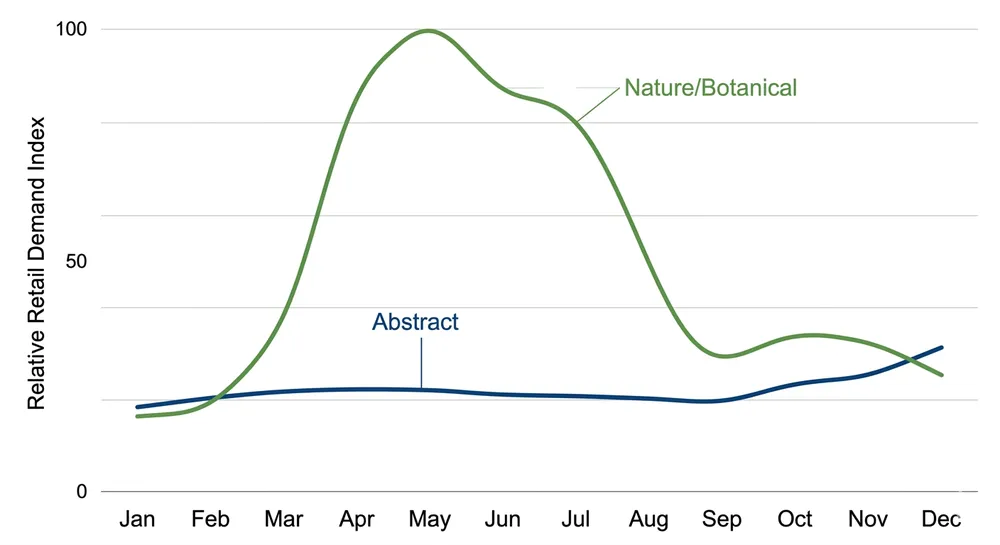
Quick verdict: Abstract wins on year-round velocity and channel breadth. Nature wins on seasonal peak margins and trend-driven sell-through in spring/summer. If you're building a core wall art program, abstract is your foundation. If you're chasing seasonal lift or targeting home décor boutiques and hospitality buyers, nature earns its place in the mix. The right answer for most US distributors is a weighted split — not a binary choice.

Seasonal demand comparison chart showing abstract wall art selling year-round versus nature wall art peaking in spring and summer

What These Two Categories Actually Mean at the Sourcing Level

Before the comparison lands, it helps to be precise about what we're comparing — not as art theory, but as production and SKU categories.

Abstract wall art at the wholesale level covers non-representational compositions: color-field pieces, geometric forms, brushstroke canvases, ink wash prints, and mixed-media looks. The defining characteristic from a production standpoint is that the design doesn't need to be botanically or photographically accurate. A slightly shifted color register on an abstract piece is a style choice. On a botanical print, it's a defect.

Nature wall art covers representational subjects drawn from the natural world — botanicals, florals, landscapes, wildlife, and coastal scenes. Botanical and floral prints are the dominant subcategory in US retail right now, followed by landscape and coastal. The production challenge is color fidelity: a eucalyptus leaf rendered in the wrong green reads as wrong to the end buyer immediately.

Both categories run on the same core substrates — canvas over MDF or stretcher frame, framed fine-art paper prints, and metal prints for the premium tier. The difference shows up in color complexity, design licensing exposure, and how forgiving the production run is when color drift happens across a 2,000-piece order.

(We run color calibration checks at three points during a nature print run — start, mid-batch, and end — because the drift risk is real on high-saturation botanical colors. On abstract, we still check, but the tolerance window is wider.)

Head-to-Head: Retail Performance and Sourcing Profile

Dimension Abstract Wall Art Nature Wall Art
Year-round demand High — consistent across all quarters Moderate — strong Q1–Q2, softer Q3–Q4
Seasonal peak Mild Q4 lift (holiday gifting) Strong spring/summer peak (March–July)
Channel breadth Mass retail, e-commerce, hospitality, office Home décor boutiques, e-commerce, hospitality
Average retail price range $35–$150 (canvas/framed) $40–$180 (botanical framed prints command premium)
Color complexity Low–medium Medium–high
Production color risk Low Medium–high
Design licensing exposure Low (original compositions common) Medium (licensed botanical illustrations common)
MOQ flexibility High — abstract designs repeat well Medium — nature designs often tied to seasonal collections
Trend cycle Slow-moving, multi-year cycles Faster — botanical trends shift 12–18 months
Reorder predictability High Moderate — seasonal timing matters
Decision matrix comparing abstract and nature wall art suitability across US retail channels including mass retail, boutique, hospitality, and e-commerce

The Hidden Cost Most Buyers Don't Price In

The unit cost difference between abstract and nature wall art looks small on a factory quote — often $0.50 to $2.00 per piece depending on color complexity and substrate. That's not where the real cost gap lives.

Color correction and reprint risk is where nature wall art costs you more. When a botanical print arrives with color drift — and it happens, even with good suppliers — you're looking at a return authorization, a reprint cycle, and a gap in your planogram. We've had buyers come to us after a competitor's factory shipped 1,500 units of a eucalyptus print where the background had shifted warm. The retailer rejected the shipment. The buyer ate the freight both ways and the reprint lead time blew their seasonal window entirely.

Abstract doesn't carry that risk at the same level. A warm shift on an abstract brushstroke piece is often indistinguishable from intentional variation. Your QC threshold is wider, your rejection rate is lower, and your reorder cycle is more predictable.

Design licensing is the second hidden cost. A significant share of nature wall art in the US market — particularly botanical illustrations and wildlife prints — runs on licensed artwork. If your supplier is sourcing designs without proper licensing, you carry the IP liability. We develop original designs in-house for both categories, which eliminates that exposure, but it's a question worth asking any supplier you're evaluating. (We've seen buyers get hit with takedown notices on Amazon for botanical prints their supplier assured them were "royalty-free." It's more common than people admit.)

Seasonal inventory risk is the third. Nature wall art that doesn't sell through by July is sitting in your warehouse at full carrying cost through Q3 and Q4. Abstract doesn't have that cliff. A slow-moving abstract SKU is a slow-moving SKU — it doesn't become actively wrong for the season.

Which Subject Wins by Channel and Buyer Situation

Mass Retail and Large-Format E-commerce (Walmart, Wayfair, Amazon)

Abstract is the workhorse here. The demand is year-round, the reorder cycles are predictable, and the color consistency requirements — while still strict for retail compliance — are more forgiving than botanical. We supply both categories into these channels, and abstract SKUs consistently show higher reorder frequency and lower return rates.

Nature wall art earns its place in these channels as a seasonal program — a spring refresh assortment, a coastal summer collection, a botanical accent series. Buyers who treat nature as a permanent core SKU in mass retail tend to get caught with inventory in Q4.

Home Décor Boutiques and Independent Retailers

This is where nature wall art, particularly premium botanical and landscape prints, commands its best margins. Boutique buyers are willing to pay for design specificity, and a well-executed framed botanical print at $120 retail carries margin that a comparable abstract piece at the same price point doesn't always justify to the end buyer.

The trade-off: boutique order volumes are smaller, trend cycles are faster, and you need design freshness more often. If you're supplying this channel, your supplier's ability to develop new nature designs quickly — and sample them at low MOQ — matters more than it does in mass retail.

Hospitality and Commercial Projects

Abstract dominates. Hotel buyers, restaurant groups, and commercial interior specifiers want pieces that work across varied lighting conditions, don't date quickly, and don't require seasonal rotation. A 200-room hotel ordering 400 pieces of abstract wall art is a clean, repeatable transaction. Nature subjects in hospitality tend to be accent pieces — a botanical feature wall in a lobby, coastal prints in a beach resort property — not the core program.

E-commerce Private Label and DTC Brands

Both subjects work, but the margin dynamics differ. Abstract private-label programs benefit from design exclusivity — a buyer who develops original abstract compositions with us owns designs that competitors can't easily replicate. Nature private-label programs benefit from trend timing — a buyer who gets a trending botanical subject to market three months before the channel saturates captures the margin premium.

(This segment has grown significantly for us over the last three years — worth paying attention to if you're building a wall art private-label program.)

Sourcing Trade-offs: What to Specify in Your RFQ

When you're quoting either category, the variables that actually move your landed cost and risk profile are:

For abstract wall art:

  • Substrate and frame spec (canvas over MDF vs stretched canvas — MDF is more stable for container shipping)
  • Color profile: how many ink passes, what color gamut the printer runs
  • Frame finish: whether the frame is wrapped in the print or has a separate molding profile
  • Reorder consistency: ask for a color-match guarantee across production batches, not just the first run

For nature wall art:

  • Color accuracy standard: ask specifically how color drift is controlled across a production run — what's the tolerance, how is it measured, and what's the remedy if a batch fails
  • Design origin: original in-house design, licensed artwork, or public domain — get this in writing
  • Seasonal MOQ: can your supplier run a 200-unit nature collection for a spring test, or do they require 500+ to justify the setup?
  • Lead time relative to your seasonal window: a nature collection that ships in August misses the spring sell-through window entirely

We can run mixed-subject sample orders at 100 pieces minimum — abstract and nature in the same shipment — which is how most of our new US buyers test both categories before committing to a full production run. It's the lowest-risk way to read your own channel's response before you're sitting on 2,000 units of the wrong subject.

Sourcing decision flowchart helping US retailers choose between abstract and nature wall art based on channel type, seasonal exposure, and order volume

Scenario Verdicts: Three Buying Situations, Direct Answers

Situation 1: You're building a 12-month wall art program for a mid-size US retailer with 200+ doors. Abstract is your core. Plan 60–70% of your SKU count in abstract, with a nature/botanical refresh for spring (February–March delivery) and a coastal or landscape accent for summer. Don't carry nature SKUs as permanent planogram items — rotate them seasonally and clear them by August.

Situation 2: You're a distributor entering the home décor boutique channel for the first time. Start with nature. Boutique buyers respond to design specificity, and a curated botanical or landscape collection gives you a story to sell. Keep your first order small — 100–200 pieces across 4–6 SKUs — and test sell-through before scaling. Abstract will come into your mix once you understand which price points your boutique accounts support.

Situation 3: You're sourcing wall art for a hospitality FF&E project — 300+ rooms. Abstract, full stop. Specify a cohesive color palette across 2–3 abstract designs, confirm the supplier can hold color consistency across the full run, and make sure the frame profile is specified for wall-mount stability, not just retail display. Nature subjects in hospitality work as accent pieces only — don't build your core FF&E program around them.

What to Verify Before You Commit to Either Subject

The comparison above assumes your supplier can actually execute on the category. Here's what separates a supplier who can from one who can't:

Color consistency across a production run — not just sample-to-bulk, but batch-to-batch within the same order. Ask for their color control process in writing. If they can't describe it specifically, that's your answer.

Design ownership documentation — especially for nature subjects. Ask for the design origin for every SKU you're quoting. "Royalty-free" is not a sufficient answer. You want to know whether the design is original, licensed (with documentation), or public domain (with the source).

Retail compliance capability — if you're supplying Walmart, Wayfair, or Amazon, your supplier needs EDI capability, retail-ready packaging specs, and experience with those programs' compliance requirements. We've been in Walmart and Wayfair vendor programs long enough to know what gets a shipment rejected, and it's usually packaging and labeling, not the product itself.

Mixed-subject sampling — a supplier who can only run single-subject sample orders is limiting your ability to test your market efficiently. The ability to mix abstract and nature in a 100-piece sample order is a practical capability that matters for your buying process.

For a broader view of what's moving in US retail across both categories, see our Trending Wall Art Subjects analysis. If you're ready to explore specific SKUs, our Abstract Wall Arts and Nature Wall Arts category pages show current production-ready designs. The full Wall Arts by Style & Subject collection gives you the complete picture of what we run.

Frequently Asked Questions

Does abstract or nature wall art have better sell-through in US mass retail? Abstract consistently shows higher year-round sell-through in mass retail channels. Nature wall art performs strongly in spring and early summer but slows significantly in Q3–Q4. For a 12-month planogram, abstract carries less seasonal inventory risk.

What's the MOQ difference between abstract and nature wall art at wholesale? At Livewellcraft, both categories start at 100 pieces for standard models. The practical difference is that nature designs tied to seasonal collections may have shorter production windows — if you miss the booking deadline for a spring nature collection, you're waiting until the following year. Abstract reorders are available year-round without seasonal constraints.

How does color complexity affect unit cost for nature vs abstract wall art? Nature wall art — particularly high-detail botanical and floral prints — typically requires more ink passes and tighter color calibration, which adds to unit cost. The difference is usually $0.50–$2.00 per piece depending on design complexity and substrate. More importantly, nature prints carry higher reprint risk if color drift occurs during production, which is a cost that doesn't show up in the initial quote.

Can I order a mixed abstract and nature sample assortment before committing to a full run? Yes. We run mixed-subject sample orders at 100-piece minimum. Most new US buyers use this to test both categories with their own retail accounts before scaling. It's the most efficient way to read your channel's response without committing to a full production run of a single subject.

What design licensing risks should I watch for with nature wall art? Botanical illustrations, wildlife prints, and some landscape photography are frequently licensed artwork. If your supplier is using licensed designs without proper documentation, you carry the IP liability — including potential Amazon takedowns and retailer chargebacks. Ask for design origin documentation on every nature SKU you source. Original in-house designs eliminate this risk entirely.

Is abstract wall art a safer choice for hospitality and commercial projects? For core FF&E programs, yes. Abstract designs work across varied lighting conditions, don't date quickly, and don't require seasonal rotation — all of which matter when you're specifying 200+ rooms. Nature subjects work well as accent pieces in hospitality (lobby botanicals, coastal resort themes) but shouldn't anchor a large-scale commercial program.

How to Source Modern Wall Arts With Clean Finishes and Tight Production Tolerances

The rejection rate on modern wall art shipments is higher than most buyers expect — and it almost never comes from catastrophic defects. It comes from vague specs. A supplier ships what they think "clean finish" means. You receive what you didn't ask for. The container gets held, the retail launch slips, and you're negotiating a credit memo instead of reordering.

We've been on the production side of this for 18 years. The orders that arrive right the first time share one thing: the buyer wrote a tight RFQ. The ones that generate disputes almost always trace back to finish specs that were left open to interpretation.

This guide walks through what to lock down before you place an order — substrate selection, surface finish thresholds, frame tolerances, QC checkpoints, and packaging requirements. The goal is to give you specs you can paste directly into your next RFQ.

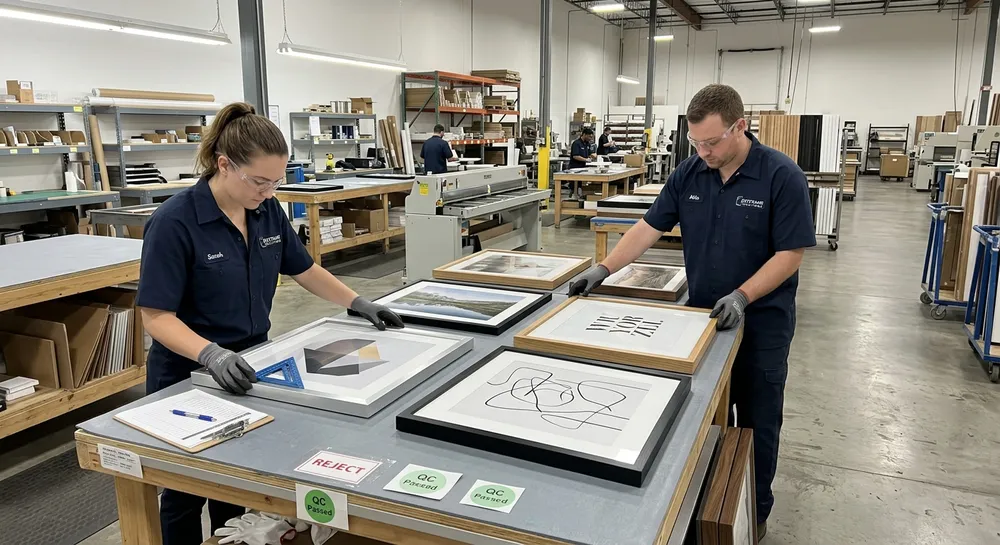
Modern wall art pieces with metal frames and printed canvas surfaces arranged for quality inspection on a factory floor

What "clean finish" actually means in production terms

"Clean finish" is not a spec. It's a preference. When you write it in an RFQ without numbers, every supplier interprets it differently — and they're all technically correct.

Here's what clean finish means when it's written as a production requirement:

Surface defect thresholds (what to specify per piece):

  • Scratches: none visible at 60 cm viewing distance under 500 lux ambient light
  • Dust inclusions in coating: max 2 particles under 0.3 mm diameter per 0.1 m²
  • Print banding or color streaking: zero tolerance on pieces larger than 40 × 40 cm
  • Coating bubbles or pinholes: zero tolerance on gloss and semi-gloss finishes

Color consistency — Delta E targets: Delta E is the standard measurement for color deviation between your approved sample and bulk production. For modern wall art going into retail:

  • Delta E ≤ 2.0: acceptable for most mid-market retail programs
  • Delta E ≤ 1.5: required for color-matched sets or gallery-style collections
  • Delta E > 3.0: visible to the naked eye — most retail buyers will reject at this level

We run color checks against the approved sample at three points: after printing, after coating, and after frame assembly. The coating step is where color shift happens most often, particularly on matte finishes over dark backgrounds. (We switched to a UV-stable topcoat on our matte line in 2022 specifically because we were seeing Delta E drift of 0.8–1.2 after coating on deep navy and charcoal prints — small enough to pass a casual check, large enough to cause set-matching problems at retail.)

Edge treatment specs:

  • Canvas wrap: specify corner fold method (gallery fold vs. straight fold) and maximum gap at corner joins — we hold ≤ 1.5 mm
  • Metal frame: specify whether cut edges are deburred and whether corners are welded, crimped, or mitered — each has a different visible seam profile
  • MDF frame: specify whether edges are sealed before painting to prevent grain raise under topcoat

Put these numbers in your RFQ. A supplier who can't commit to them in writing is telling you something.

Substrate selection: cost, durability, and finish-quality tradeoffs

The substrate choice drives most of the downstream finish decisions. Modern wall art for wholesale typically runs across four substrate types, and each has a different risk profile for finish consistency at volume.

Substrate Typical finish options Color stability Edge finish risk Relative landed cost
Canvas (stretched) Matte, satin, UV-laminate High with UV coat Low — soft edge Low–Medium
Aluminum composite Gloss, brushed, powder coat Very high Medium — cut edge burr risk Medium
Tempered glass print High-gloss ceramic print Excellent Low — polished edge High
Acrylic face-mount Ultra-gloss, deep color High Medium — edge clarity variance High
MDF with frame Matte, satin, textured Medium — moisture sensitive Medium — grain raise risk Low–Medium

A few things worth knowing from the production side:

Canvas is the most forgiving substrate for large-format modern wall art. Print registration tolerances are easier to hold, and the soft edge means minor dimensional variance doesn't create visible gaps at the frame join. For buyers building a broad SKU range across multiple sizes, canvas gives you the most consistent finish-to-cost ratio.

Aluminum composite is the right call when your buyer needs a contemporary flat look — no texture, no canvas grain, just a clean printed surface. The risk is at the cut edge: if the supplier isn't deburring consistently, you'll get micro-scratches on adjacent pieces during transit. Specify deburring and edge tape protection in your packaging requirement.

Tempered glass print is the premium tier. Color depth is exceptional and the surface is genuinely durable. The tradeoff is lead time — glass printing requires a separate production run and the reject rate on large-format pieces is higher than canvas or metal. We don't recommend it for first-time orders over 500 pieces unless you've already validated the supplier's glass print line with samples.

Acrylic face-mount gives you the deepest color saturation of any substrate, but edge clarity varies significantly between suppliers. The acrylic sheet needs to be optically clear and consistently thick — ask for the sheet spec (typically 3 mm or 5 mm) and confirm the supplier sources from a single mill, not spot-buy.

Comparison chart of modern wall art substrates showing canvas, aluminum, glass, and acrylic finish quality and cost tradeoffs

Frame tolerance specs that prevent retail rejection

Frame alignment is the second most common rejection trigger after surface finish — and it's almost entirely preventable with tighter specs.

For modern wall art, the frame is structural and visual. A frame that's 2 mm out of square on a 60 × 60 cm piece is visible on the wall. A hanging wire mounted 5 mm off-center means the piece tilts. Neither of these fails a vague "good quality" spec. Both fail a retail floor inspection.

Frame alignment tolerances to specify:

  • Squareness: diagonal measurement variance ≤ 2 mm on pieces up to 60 cm; ≤ 3 mm on pieces 60–120 cm
  • Frame-to-artwork gap: ≤ 1 mm on all four sides for tight-fit frames; ≤ 2 mm for floating-mount styles
  • Hanging hardware position: centered ±2 mm from horizontal midpoint; height from top edge ±3 mm from spec
  • Frame joint gap (at corners): ≤ 0.5 mm for painted MDF; ≤ 0.3 mm for metal mitered corners

We run 6 production lines with in-house frame molding across MDF, metal, resin, and solid wood. The reason we keep frame molding in-house is exactly this: when you outsource frame production to a separate supplier, you lose control of the tolerance stack. The frame arrives at your assembly line already at the edge of spec, and by the time you've added the artwork and hardware, you're outside it. Vertical integration isn't a marketing point — it's how you hold ±2 mm squareness across a 5,000-piece run.

Coating adhesion on frames: For painted MDF frames, specify a cross-hatch adhesion test (ASTM D3359) with a minimum rating of 4B. For powder-coated metal frames, specify 500-hour salt spray resistance (ASTM B117) — this matters for coastal retail accounts and any buyer selling into humid climates.

(One thing we see regularly: buyers specify the artwork finish carefully but leave the frame coating spec blank. The frame is what the end customer touches first. A chalky or peeling frame finish generates returns even when the print is perfect.)

How to write a modern wall art RFQ that locks down tolerances

Most RFQs for modern wall art are too short. They specify size, quantity, and a reference image. That's enough to get a price — it's not enough to get a consistent product.

Here's the spec block we recommend buyers include in every RFQ:

Artwork surface:

  • Substrate: [canvas / aluminum composite / tempered glass / acrylic — specify]
  • Print method: [UV flatbed / latex / dye-sublimation — specify or ask supplier to confirm]
  • Color target: Delta E ≤ [1.5 / 2.0] vs. approved sample
  • Surface finish: [matte / satin / gloss] with coating adhesion test required
  • Defect threshold: zero visible scratches, banding, or bubbles at 60 cm viewing distance

Frame:

  • Material: [MDF / metal / solid wood / resin — specify]
  • Corner treatment: [welded / mitered / wrapped — specify]
  • Squareness tolerance: diagonal variance ≤ 2 mm (pieces ≤ 60 cm) / ≤ 3 mm (pieces 60–120 cm)
  • Frame-to-artwork gap: ≤ 1 mm
  • Coating: [paint / powder coat] — specify adhesion test standard

Hardware:

  • Hanging system: [D-ring / sawtooth / wire — specify]
  • Position tolerance: centered ±2 mm, height from top ±3 mm
  • Weight rating: minimum [X] kg — specify based on piece weight

Packaging:

  • Corner protection: foam or cardboard corner guards on all four corners
  • Surface protection: poly bag or tissue wrap before boxing — no direct contact between frame and box
  • Box compression strength: specify if retail-ready packaging is required (Walmart/Wayfair/Amazon each have their own ISTA test requirements)
  • Master carton: specify pieces per carton and maximum carton weight for your warehouse receiving spec

Send this block with your reference image and target price. A supplier who responds with a detailed production proposal — not just a price — is one worth continuing the conversation with.

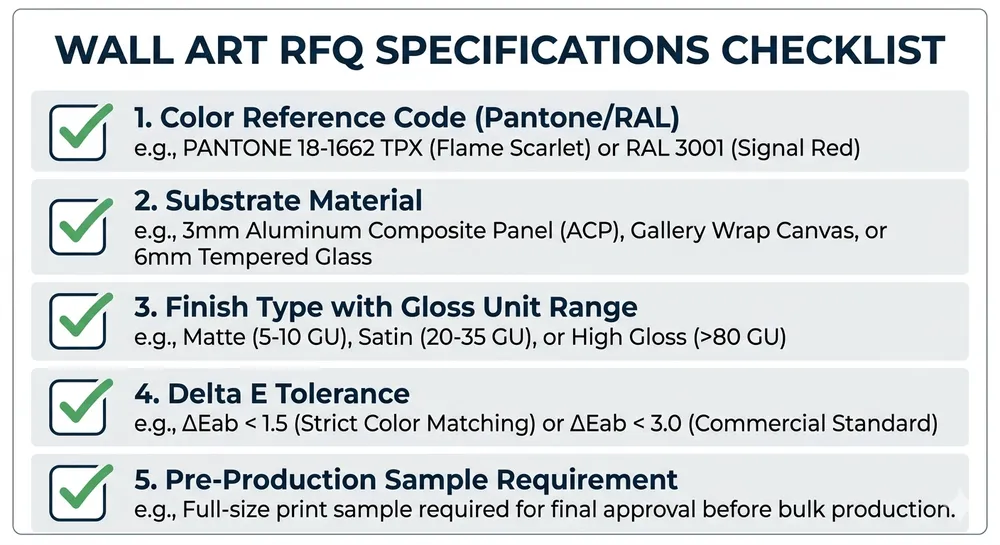
RFQ specification checklist for modern wall art showing surface finish, frame tolerance, hardware, and packaging requirements

QC checkpoints that catch problems before they reach your warehouse

A pre-shipment inspection catches defects after they've already been produced. By that point, your options are rework, partial rejection, or a credit negotiation. The better approach is checkpoints earlier in the production sequence.

Stage 1 — Pre-production sample (before bulk run starts)

This is the most important checkpoint and the one most buyers skip to save time. The pre-production sample confirms:

  • Color accuracy vs. your approved artwork file (Delta E measurement, not visual only)
  • Frame construction and corner treatment match spec
  • Hardware position and weight rating confirmed
  • Packaging prototype reviewed and approved

Approve nothing in bulk until you have a signed-off pre-production sample. If a supplier pushes back on this step, that's a red flag.

Stage 2 — In-line inspection (at 20–30% production completion)

At this stage, defects are still correctable without scrapping the run. Check:

  • Print color consistency across the first batch — compare pieces from the start, middle, and end of the print run
  • Frame squareness on a random sample of 10–15 pieces
  • Coating adhesion on frame samples — run the cross-hatch test on 3–5 pieces
  • Hardware installation position — measure, don't eyeball

Stage 3 — Pre-shipment audit (100% visual + AQL sampling)

Before the container loads:

  • 100% visual inspection for surface defects at 60 cm viewing distance
  • AQL 2.5 sampling for dimensional tolerances (squareness, frame gap, hardware position)
  • Carton drop test on 3–5 master cartons
  • Barcode scan verification if retail compliance labels are required

We run 100% visual inspection on every piece before it loads. That's 400,000 pieces a year going through visual check — it's not a differentiator we invented for marketing, it's what retail programs like Walmart and Wayfair require to stay on their vendor compliance lists.

What to ask your supplier:

  • Do you have an in-house QC team or do you rely on third-party inspection only?
  • Can you provide in-line inspection photos at the 30% production mark?
  • What is your internal defect rate on this product type?
  • Do you have SGS or equivalent third-party audit reports available?

A supplier who can answer these questions with specifics — not generalities — has a real QC system. One who says "we have strict quality control" without data doesn't.

Common sourcing mistakes that generate the most expensive problems

These aren't edge cases. We see versions of these on a regular basis, usually from buyers who are new to sourcing modern wall art at volume.

Leaving finish specs open to interpretation

"High quality finish" and "clean surface" are not specs. Write Delta E targets, defect thresholds, and coating adhesion requirements. If you don't, you'll receive what the supplier considers acceptable — which may not match what your retail buyer considers acceptable.

Skipping substrate testing on new suppliers

A supplier can show you beautiful samples. Samples are not bulk production. Before committing to a 1,000+ piece order with a new supplier, order 50–100 pieces across your key SKUs and run them through your own inspection process. Our 100-piece MOQ exists specifically for this reason — validate finish quality at low risk before scaling.

Ignoring packaging until it's too late

Retail compliance packaging is not optional for Walmart, Wayfair, or Amazon vendor programs. Each has specific requirements for barcode placement, ISTA test compliance, and master carton labeling. If you're building a retail program, get the packaging spec from your retail buyer before you finalize the production spec — not after. Retrofitting packaging compliance after production is expensive and sometimes impossible without repackaging the entire order.

Sourcing frame and artwork from separate suppliers

When the frame comes from one factory and the artwork from another, tolerance stack-up is your problem to manage. The frame arrives at 2.5 mm out of square. The artwork is cut to nominal. The assembly gap is now 2.5 mm on one side and 0 mm on the other. Neither supplier is "wrong" — but the finished piece fails your spec. Sourcing from a factory with in-house frame molding and artwork production eliminates this problem at the source.

Not specifying hanging hardware weight rating

Modern wall art pieces vary significantly in weight — a 60 × 80 cm aluminum composite piece can weigh 4–6 kg. A sawtooth hanger rated for 2 kg is a liability claim waiting to happen. Specify the minimum weight rating for all hanging hardware, and ask for the test report.

How vertical integration reduces finish variance at scale

This is worth explaining from the production side, because it's not obvious from the outside.

When a factory outsources frame molding, they're buying frames from a supplier who is also selling to 20 other factories. That supplier optimizes for their own production efficiency, not your tolerance spec. Frames arrive in batches. Batch-to-batch variance is real — the first delivery might hold ±1.5 mm squareness, the third delivery might be ±3 mm. Your assembly line absorbs that variance, and it shows up in your finished product.

We run frame molding in-house across four material types: MDF, metal, resin, and solid wood. The molding line feeds directly into assembly — there's no receiving inspection step for frames because the frames never leave our facility between molding and assembly. When we see a tolerance drift on the molding line, we catch it before it reaches a single finished piece.

The same logic applies to coating. We run coating in a controlled environment — temperature and humidity monitored, not just ambient. Color shift on matte finishes is strongly correlated with humidity during application. A supplier running coating in an open workshop in a humid climate will see Delta E drift that they can't explain and can't consistently control. We've measured the difference: controlled-environment coating holds Delta E variance to ±0.3 across a production run; open-environment coating can drift ±1.0 or more on the same artwork file.

For buyers sourcing Modern Wall Arts at volume, vertical integration is the single biggest structural factor in finish consistency. It's worth asking every supplier you evaluate: which steps in your production chain are in-house, and which are outsourced?

If you want to explore the full range of Wall Arts by Style & Subject we produce, or review our modern wall art design standards before writing your spec, both are worth reading before your next RFQ.

Practical FAQ for modern wall art sourcing

What Delta E tolerance should I specify for a retail wall art program?

For standard mid-market retail (Wayfair, Amazon), Delta E ≤ 2.0 is the working standard. For color-matched sets or gallery collections where pieces hang together, tighten to Delta E ≤ 1.5. Delta E > 3.0 is visible to most consumers and will generate returns.

What's the minimum order quantity to validate a new supplier's finish quality?

50–100 pieces across your key SKUs is enough to run a meaningful inspection. It's not enough to catch every production variable, but it will expose systematic problems — color drift, frame squareness issues, coating adhesion failures — before you're committed to a full run. Our MOQ starts at 100 pieces for standard models specifically to support this validation step.

Canvas vs. aluminum composite for modern wall art — which holds finish better at volume?

Canvas holds color consistency better across large runs because print registration tolerances are easier to maintain and the substrate is more forgiving of minor humidity variation during production. Aluminum composite gives you a cleaner, more contemporary surface but requires tighter edge finishing controls. For a broad SKU program, start with canvas. Add aluminum composite SKUs once you've validated a supplier's metal finishing process.

What retail compliance packaging requirements should I specify for Walmart or Wayfair?

Both programs require ISTA 2A or 3A test compliance for master carton packaging. Walmart additionally requires specific barcode placement and supplier compliance label formats. Wayfair has its own vendor portal with current packaging specs. Get the current spec directly from your retail buyer's vendor compliance team — these requirements update periodically and the version on the portal is always current.

How do I verify a supplier's QC system before placing a bulk order?

Ask for three things: their internal defect rate on the product type you're ordering, in-line inspection photos from a recent production run, and a third-party audit report (SGS, Bureau Veritas, or equivalent). A supplier with a real QC system can produce all three without hesitation. If they can only offer a factory visit invitation, that's not a substitute for documented process data.

Ready to put these specs to work? Send your artwork files, target finish requirements, and order quantity to our team — we'll come back with a production proposal that includes tolerance commitments, substrate recommendations, and a sample timeline. Request Quote

Top 10 Style Wall Art Manufacturers in Vietnam — Quality, Lead Time & OEM Capability Review

“`

Vietnam's wall art manufacturing sector has matured considerably over the past decade. What started as a low-cost overflow from Chinese factories has become a legitimate sourcing destination in its own right — with dedicated facilities, export-trained QC teams, and OEM programs that can handle retail-compliance packaging for Walmart, Wayfair, and Amazon. If you're screening local suppliers or reconsidering your current source, this article maps the real landscape: who's operating at scale, what they're actually good at, and where the trade-offs land.

I've spent 12 years at Livewellcraft developing wall art styles and managing production across hundreds of SKUs for US and European retail programs. The evaluation criteria below are the ones that actually determine whether a bulk order lands cleanly — not the ones that look good in a supplier brochure.

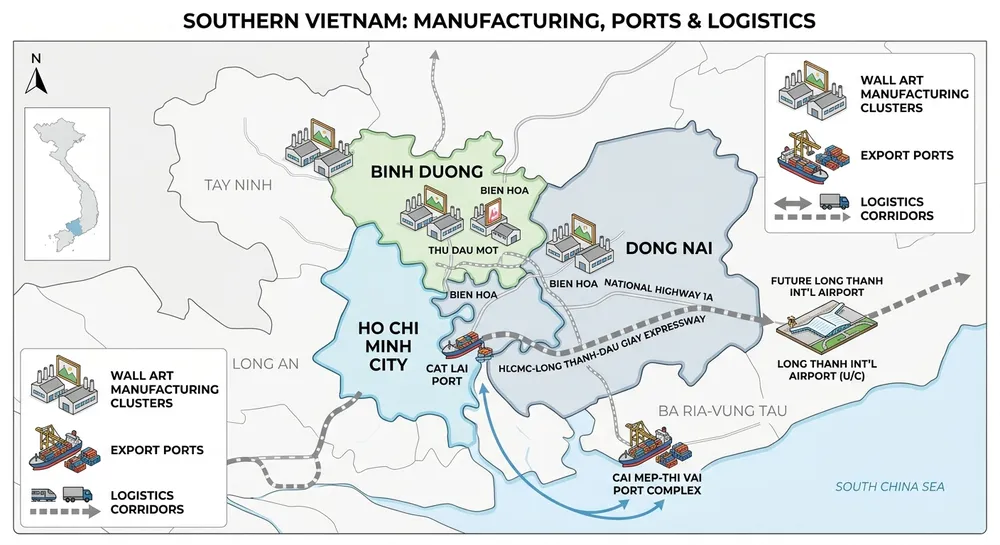
Overview map of Vietnam's major wall art manufacturing clusters in Dong Nai, Ho Chi Minh City, and Binh Duong provinces

What Serious Buyers Evaluate Before Placing Volume

Before the list, the framework. Most sourcing mistakes in this category happen because buyers evaluate on price and sample quality alone — then discover the real problems at bulk: color drift between print batches, frame finish inconsistency across a 2,000-unit run, or packaging that fails retail compliance on arrival.

The criteria that actually matter:

  • Style range and specialization — Does the factory have genuine depth in abstract, modern, nature, or mixed-media, or are they a general décor factory that prints anything? Style-specific tooling, color libraries, and substrate expertise are not interchangeable.
  • Print technology and color accuracy — UV flatbed, screen print, and canvas transfer each have different color gamut limits and batch-to-batch consistency profiles. Ask for Delta-E tolerances on repeat orders, not just first-sample approval.
  • Frame finishing consistency — MDF, solid wood, metal, and resin frames each require different surface prep before finishing. A factory that outsources frame molding to a third party introduces a quality control gap that shows up in your return rate.
  • Lead time on existing vs. custom molds — Standard SKUs on existing tooling typically run 25–35 days from deposit. Custom frame profiles or new substrate configurations add 15–25 days for tooling. Know which category your order falls into before comparing quotes.
  • MOQ flexibility — A 500-piece MOQ per SKU sounds reasonable until you're building a 20-SKU assortment. Factories with 100-piece MOQ on standard models give you real range-building flexibility.
  • Export documentation and retail compliance — EDI capability, FSC certification for wood frames, CARB compliance for MDF, and retail-ready packaging specs are non-negotiable for major US retail programs. Not every Vietnamese factory is set up for this.

(The color accuracy point is where I see the most sourcing failures. A factory can nail your sample and then drift 8–12 Delta-E units on the bulk run because they're mixing inks manually between batches. Always ask for their batch-to-batch color control process, not just their sample approval process.)

The 10 Manufacturers: A Verified Sourcing Landscape

The companies below represent the real operating landscape for style wall art manufacturing in Vietnam. They range from large vertically integrated facilities to specialized print-and-frame operations. Where production data is publicly available, it's included. Where it isn't, the description stays conservative.

1. Livewellcraft (CÔNG TY TNHH LIVEWELL CRAFT VN)

Website: livewellcraft.com Location: Dong Nai, Vietnam Founded: 2008

Livewellcraft operates a 12,000 m² facility with 6 dedicated production lines and 150 staff, shipping approximately 400,000 pieces annually to North America, Europe, Australia, Southeast Asia, and the Middle East. The full production chain — glass cutting, beveling, silvering, frame molding (MDF, solid wood, metal, resin), and final assembly — runs under one roof. That vertical integration is the operational detail that matters most for style wall art buyers: when frame molding and surface finishing happen in the same facility as final QC, color and finish consistency across a 3,000-unit run is controllable in a way it simply isn't when you're coordinating three separate suppliers.

The in-house engineering team of 12 handles custom frame profile development, so OEM/ODM programs don't require a separate tooling vendor. Lead time on existing molds runs 30–35 days from deposit confirmation. Custom frame profiles add tooling time depending on complexity. MOQ starts at 100 pieces for standard models — low enough to run a genuine trial order before committing to volume.

Certifications: ISO 9001:2015, SGS, CE, BSCI. Walmart, Wayfair, and Amazon supplier experience with EDI and retail compliance capability means your packaging and documentation requirements are already understood, not negotiated from scratch.

Style specialization: Abstract, modern, nature, mixed-media, decorative mirror-integrated wall art Lead time (standard): 30–35 days MOQ: 100 pieces (standard models) OEM/ODM: Full — custom sizing, frame profiles, finishes, and packaging

Livewellcraft's 12,000 square meter wall art and mirror production facility in Dong Nai Vietnam showing frame molding and assembly lines

2. AA Corporation (AA Corp)

Website: aacorporation.com.vn Location: Ho Chi Minh City, Vietnam

AA Corporation is one of Vietnam's larger home décor and wall art exporters, with a product range spanning canvas prints, framed art, and decorative panels. They supply to European and North American retail chains and have established export documentation processes. Their production covers a broad style range including abstract and nature subjects. AA Corp operates at meaningful scale and is a recognized name in Vietnamese export trade directories.

Style specialization: Canvas prints, framed decorative art, abstract and nature subjects Export markets: Europe, North America OEM: Available

3. Minh Long I Co., Ltd.

Website: minhlongi.com.vn Location: Binh Duong, Vietnam

Minh Long I is primarily known for ceramics and decorative home goods, but their wall décor division produces decorative wall panels and art pieces for export. Their strength is in ceramic and lacquer-finish wall art — a niche that commands higher retail price points and suits buyers targeting premium home décor channels. Lead times on ceramic-based wall art are longer than print-on-canvas operations due to kiln processing, but the margin profile is different.

Style specialization: Ceramic wall art, lacquer decorative panels, traditional Vietnamese motifs Export markets: Europe, Japan, Southeast Asia OEM: Available for custom motifs and colorways

4. Saigon Furniture (Noi That Saigon)

Website: noithatsaigon.vn Location: Ho Chi Minh City, Vietnam

Saigon Furniture covers a broad home furnishings range that includes wall art and decorative panels. Their wall art output leans toward wood-framed and lacquered pieces suited to hospitality and project buyers. They have experience with hotel and resort procurement programs, which means their documentation and bulk-order handling processes are developed. Style range is more traditional and transitional than contemporary abstract.

Style specialization: Wood-framed wall art, lacquered decorative panels, transitional and traditional styles Export markets: Southeast Asia, Middle East, Europe OEM: Available

5. Vietnam Craft Village Export (Craft Link affiliated suppliers)

Website: craftlink.com.vn Location: Hanoi and northern Vietnam craft clusters

Craft Link and its affiliated supplier network represent Vietnam's artisan-production tier — handmade lacquerware, silk embroidery panels, and hand-painted wall art produced in traditional craft villages. This is not a factory-scale operation; it's a sourcing channel for buyers who need authentic handcraft provenance for premium retail positioning. MOQs are low, but production consistency and lead time predictability are different from industrial manufacturing. Worth knowing if your channel includes specialty boutiques or museum gift shops.

Style specialization: Handcraft lacquerware, silk embroidery, hand-painted traditional and folk art Export markets: Europe, North America (specialty retail) OEM: Limited — custom colorways possible, not custom structural profiles

6. Hung Thinh Furniture & Décor

Website: hungthinh.com.vn Location: Binh Duong, Vietnam

Hung Thinh operates in the furniture and home décor manufacturing space with wall art as part of their export product range. Their production covers MDF-framed prints and wood-composite decorative panels. They supply to Southeast Asian and Middle Eastern markets and have experience with container-load export programs. Style range is broad rather than specialized.

Style specialization: MDF-framed prints, wood-composite decorative panels, modern and transitional styles Export markets: Southeast Asia, Middle East OEM: Available

7. Viet My Handicraft

Website: vietmyhandicraft.com Location: Ho Chi Minh City, Vietnam

Viet My Handicraft produces decorative wall art and home accessories with a focus on resin, lacquer, and mixed-media pieces. Their product range includes abstract resin wall panels and nature-themed decorative art that performs well in contemporary retail channels. They export to North America and Europe and have experience with wholesale and retail buyer programs.

Style specialization: Resin wall art, lacquer panels, abstract and nature mixed-media Export markets: North America, Europe OEM: Available for custom colorways and sizing

8. Thien Minh Craft

Website: thienminhcraft.com Location: Hanoi, Vietnam

Thien Minh Craft specializes in lacquerware and decorative art with wall art panels as a core export category. Their lacquer technique — multiple application layers with hand-polishing between coats — produces a finish depth that's difficult to replicate with industrial spray processes. This is a relevant supplier for buyers targeting premium home décor or hospitality segments where finish quality justifies a higher landed cost.

Style specialization: Lacquer wall art panels, traditional and contemporary Vietnamese motifs, nature subjects Export markets: Europe, Japan, North America OEM: Available for custom motifs and panel sizing

9. Dong Ky Furniture Village Exporters

Website: dongkyfurniture.com Location: Bac Ninh, Vietnam

Dong Ky is Vietnam's most recognized traditional woodworking cluster, producing carved wood furniture and decorative wall panels for export. Their wall art output is carved wood — relief panels, decorative screens, and framed carved art — suited to buyers serving traditional, Asian-contemporary, or high-end hospitality channels. Production is workshop-scale rather than factory-scale, so lead times and consistency expectations differ from industrial manufacturers.

Style specialization: Carved wood wall panels, relief art, traditional Vietnamese and Asian motifs Export markets: Europe, North America, East Asia OEM: Available for custom carving patterns and sizing

10. Goldsun Media Group (Print & Décor Division)

Website: goldsun.com.vn Location: Hanoi, Vietnam

Goldsun operates primarily in commercial printing and media, but their décor division produces large-format printed wall art and canvas panels for commercial and retail applications. Their strength is in print technology — large-format UV and latex printing with color management systems — which makes them relevant for buyers who need high-volume canvas or poster-format wall art with tight color accuracy requirements. Frame finishing is not their core competency; they're strongest on the print side.

Style specialization: Large-format canvas prints, photographic and graphic wall art, abstract and modern subjects Export markets: Domestic Vietnam, Southeast Asia, some North America OEM: Available for print content and canvas sizing

Lead Time and MOQ Comparison

The table below summarizes publicly available or conservatively estimated data across the 10 manufacturers. Where exact figures are not publicly confirmed, ranges reflect typical market patterns for each supplier type.

Manufacturer Facility Type Style Focus Est. Lead Time (Standard) MOQ (Standard) OEM/ODM
Livewellcraft Vertically integrated factory Abstract, modern, nature, mirror-integrated 30–35 days 100 pcs Full
AA Corporation Export factory Canvas, abstract, nature 35–45 days 200–500 pcs Yes
Minh Long I Ceramic/lacquer specialist Ceramic, lacquer, traditional 45–60 days 100–300 pcs Custom motifs
Saigon Furniture Furniture + décor factory Wood-framed, transitional 35–50 days 200 pcs Yes
Craft Link network Artisan/workshop Handcraft, embroidery, folk art 30–60 days 50–100 pcs Limited
Hung Thinh MDF/composite factory Modern, transitional 35–45 days 200 pcs Yes
Viet My Handicraft Mixed-media workshop Resin, lacquer, abstract 30–45 days 100–200 pcs Custom colorways
Thien Minh Craft Lacquer specialist Lacquer, traditional, nature 40–55 days 100 pcs Custom motifs
Dong Ky Village Wood carving workshop Carved wood, traditional 45–70 days 50–100 pcs Custom carving
Goldsun Media Print-focused operation Canvas, graphic, photographic 20–30 days 100–500 pcs Print content
Comparison chart of lead times and MOQ requirements across 10 Vietnam wall art manufacturers for standard and custom orders

Where Local Convenience Adds Real Value

Before going further on the factory-direct case, it's worth being direct about when local sourcing — whether from a Vietnamese distributor or a regional importer — is the right answer.

Urgent small orders: If you need 50 units to fill a gap on a retail floor within two weeks, a local importer with warehouse stock wins. No factory in Vietnam can compete with same-week fulfillment on emergency quantities.

First-time category entry: If you're testing a new wall art style with no volume commitment, buying from a local distributor at a higher unit cost is a rational risk management decision. You're paying for optionality, not inefficiency.

Local compliance timing: Some markets have import documentation timelines that make factory-direct impractical for a specific project deadline. Know your compliance calendar before committing to a direct import program.

The honest trade-off: local convenience typically costs 25–40% more per unit than factory-direct at equivalent quality. That premium is worth paying when speed or flexibility is the constraint. It stops making sense when you're running repeat volume on established SKUs.

The Quality Problems That Show Up at Bulk — and How to Screen for Them

The three failure modes I see most often in style wall art sourcing from Vietnam:

1. Print color drift across batches A factory approves your sample at Delta-E 2.5 and then ships bulk at Delta-E 9. This happens when ink mixing is manual and there's no spectrophotometer-based color management in the production process. Ask specifically: "How do you control batch-to-batch color consistency on repeat orders?" A factory with a real answer will describe their color management system. A factory without one will describe their sample approval process — which is a different thing entirely.

2. Frame finish inconsistency MDF frames that are outsourced to a third-party molding supplier introduce a surface prep variable that's hard to control from a distance. The most common defect is powder coat or paint adhesion failure at corners and edges — the areas where the substrate transitions and surface prep is most critical. Factories that mold and finish frames in-house can control the pre-treatment step. Factories that buy pre-molded frames cannot.

3. Packaging compliance failures Retail-compliance packaging — master carton labeling, inner pack configuration, barcode placement, and drop-test certification — is not a default capability. It's a program that has to be built and maintained. If your buyer is a major US retailer, ask for evidence of previous retail compliance programs, not just a statement that they can do it.

(We've seen containers turned away at distribution centers over barcode placement issues that were clearly specified in the vendor manual. The factory had the right product — the packaging was wrong. That's a $15,000 problem that a 30-minute pre-production packaging review would have prevented.)

Quality control evaluation checklist for sourcing style wall art from Vietnam manufacturers covering print accuracy, frame finish, and packaging compliance

Vertically Integrated vs. Fragmented Supply: The Production Model That Determines Your Risk

Most of the manufacturers on this list operate some version of a fragmented model — they handle one or two production steps well and coordinate the rest through subcontractors. That's not a criticism; it's a structural reality of how the Vietnamese manufacturing ecosystem developed. But it has direct implications for your order.

A fragmented supply chain means:

  • Frame molding happens at Supplier A
  • Surface finishing at Supplier B
  • Print production at Supplier C
  • Final assembly and QC at the main factory

Each handoff is a quality control gap. Each subcontractor has their own scheduling pressures. When your order is 500 units, you're not their priority — you're one of twenty orders moving through a shared production queue.

Livewellcraft's 12,000 m² facility runs the full chain under one roof: glass processing, frame molding across MDF, solid wood, metal, and resin substrates, surface finishing, assembly, and final QC. Six production lines, 150 staff, 400,000 pieces annually. The engineering team that develops your custom frame profile is in the same building as the line that builds it and the QC team that inspects it. When something needs to be adjusted mid-production — a finish tolerance, a frame dimension, a packaging configuration — the decision loop is hours, not days.

That's the operational mechanism behind the 30–35 day lead time on existing molds. It's not a marketing claim — it's what vertical integration actually produces when it's working correctly.

For buyers building a Wall Arts by Style & Subject program with multiple SKUs across abstract, modern, and nature categories, the ability to run all SKUs through one QC system with one point of accountability is worth more than a 5% unit cost difference from a cheaper fragmented supplier. The RMA cost on one bad container erases that margin advantage immediately.

When Factory-Direct Import Makes Financial Sense

The economics shift decisively at repeat volume. Here's the scenario where factory-direct from Vietnam outperforms local sourcing:

Order size: 500+ units per SKU, 2+ SKUs per order Order frequency: Quarterly or more frequent Quality requirement: Consistent finish and color across the full run Packaging requirement: Retail-ready or retail-compliance

At this profile, the landed cost advantage of factory-direct — typically 25–40% below local distributor pricing at equivalent quality — compounds across every reorder. A buyer running four SKUs at 500 units each, quarterly, is looking at meaningful annual savings that fund range expansion, not just margin protection.

The risk factors that make buyers hesitate — lead time, minimum order, quality consistency — are all addressable with the right factory partner. Lead time of 30–35 days is manageable with a 6-week forward planning horizon. A 100-piece MOQ on standard models means you can test new styles without overcommitting inventory. And a factory with ISO 9001:2015, SGS, and BSCI certifications has a documented QC system, not just a verbal assurance.

If you're currently sourcing from a local distributor and running repeat volume, the question isn't whether factory-direct makes sense — it's whether your current supplier relationship is worth the premium you're paying for it.

Common Sourcing Pitfalls When Screening Vietnamese Wall Art Factories

A few patterns worth knowing before you start sending RFQs:

The sample-to-bulk gap is the most common disappointment. Factories put their best operators on sample production. Bulk runs through the standard line. If you can't visit the factory, ask for a pre-production sample from the actual bulk run — not a repeat of the original sample.

Certification theater is real. An ISO 9001 certificate on the wall means a QC system was documented and audited at a point in time. It doesn't mean the system is running today. Ask for the most recent audit date and whether the certificate is current. SGS and BSCI audits are more operationally meaningful because they involve physical factory inspections.

Trading company vs. factory confusion costs buyers money and control. Many Alibaba listings for "Vietnam wall art factory" are trading companies sourcing from multiple factories. You get a layer of markup and a layer of communication distance from the actual production floor. Ask directly: "Is this your own factory?" and ask for the factory address to cross-reference.

MOQ negotiation without understanding tooling costs leads to misaligned expectations. A factory quoting 100-piece MOQ on standard models may require 500 pieces on a custom frame profile because the tooling amortization math changes. Understand which category your order falls into before negotiating MOQ.

For a deeper look at how to structure your sourcing process for style-specific wall art, see How to Source Style-Specific Wall Arts. If you're also evaluating domestic suppliers as a comparison point, Style Wall Art Suppliers in the USA covers the landed cost and lead time trade-offs in that market.

Sourcing Decision Guide: Which Route Fits Your Situation

Your Situation Recommended Route
Urgent order, <200 units, needed within 2 weeks Local distributor or regional importer
First-time category test, no volume commitment Local distributor — pay the premium for optionality
Repeat volume, 500+ units/SKU, quarterly cadence Factory-direct Vietnam — economics are clear
Custom frame profile or OEM packaging required Factory-direct only — local distributors can't do this
Retail compliance program (Walmart, Wayfair, Amazon) Factory with documented retail compliance experience
Premium handcraft or artisan provenance required Craft village network or lacquer specialist
Large-format canvas or graphic print focus Print-specialist factory with color management system

The Wall Art Style Guide covers style-specific demand patterns if you're still deciding which categories to build your program around — worth reading before you finalize your SKU mix.

Frequently Asked Questions

What is the typical MOQ for custom OEM wall art from a Vietnamese factory? For standard frame profiles with custom print content, most factories start at 200–500 pieces per SKU. Factories with in-house frame molding — where tooling costs are internal — can often go lower. Livewellcraft's standard OEM MOQ starts at 100 pieces on existing molds. Custom frame profiles require a separate tooling discussion, but the MOQ on the production run itself doesn't automatically jump to 500 pieces.

How do I verify that a Vietnamese wall art supplier is a real factory and not a trading company? Ask for the factory's business registration address and cross-reference it against the production facility address. Request a video call that includes a walk through the production floor — not just the showroom. Ask which production steps happen in-house and which are subcontracted. A real factory will answer these questions specifically. A trading company will deflect or give vague answers about their "partner factories."

What certifications should I require from a Vietnamese wall art manufacturer for US retail? ISO 9001:2015 covers the QC management system. BSCI covers social compliance, which major US retailers require. For wood-framed products, FSC certification covers chain-of-custody for the wood substrate. For MDF-framed products, CARB Phase 2 compliance covers formaldehyde emissions — required for California and increasingly standard across US retail. CE marking is relevant for European market entry. SGS audit reports provide independent verification of factory conditions.

What causes color inconsistency between my approved sample and bulk production? The most common cause is manual ink mixing without spectrophotometer-based color management. When a factory mixes inks by eye or by formula without measuring the output, batch-to-batch variation is inevitable. A second cause is substrate variation — if the canvas or board stock changes between sample and bulk production, the same ink formula produces a different visual result. Ask your factory specifically how they control ink mixing and whether they use a spectrophotometer for color verification on bulk runs.

Is 30–35 days a realistic lead time for style wall art from Vietnam? For standard models on existing tooling, yes — 30–35 days from deposit confirmation is achievable at a vertically integrated factory. That timeline assumes no tooling development, no new substrate introduction, and no major packaging customization. Custom frame profiles add 15–25 days for tooling. New print content on existing frames doesn't add lead time if the artwork is supplied in the correct format. Build your planning horizon around 35 days for standard orders and 50–55 days for first-time custom orders.

If you're ready to compare factory-direct options against your current supplier, the most efficient next step is a direct quote with your style preferences, target quantities, and any reference images. See our OEM/ODM Services page for the full capability overview, or go straight to Request Quote to start the conversation.

How to Source Style-Specific Wall Arts Without Mismatched Color and Finish

What a Mismatched Wall Art Shipment Actually Costs You

I've watched this play out too many times: a buyer orders 3,000 pieces across three wall art styles, and when the container arrives, the gold on the modern frames reads warm, the gold on the abstract frames reads cool, and the nature pieces have a slightly different sheen. Same PO, same "gold" callout, three visibly different results.

If you're selling through retail or e-commerce, your customer sees those pieces side by side on a shelf or in a product grid. Inconsistent finish reads as cheap. Returns climb. Reorders don't come. And you're stuck negotiating a partial credit with a factory that technically met the spec you wrote, because "gold" was all you specified.

The fix isn't finding a better factory. It's controlling the variables that cause finish drift before production starts, and choosing a sourcing structure that keeps those variables from multiplying.

Why Color and Finish Drift Happens Across Style Categories

The root cause is almost always one of two things: vague finish specifications in the RFQ, or multiple suppliers handling different style categories.

When you write "gold finish" on a purchase order without a reference standard, you're leaving the interpretation to whoever mixes the paint that morning. Gold can mean anything from RAL 1036 pearl gold to a warm brass tone to a champagne metallic. Each substrate absorbs and reflects coating differently, so even the same paint formula looks different on an MDF frame versus a metal one versus resin.

Multi-vendor sourcing compounds the problem. If your modern frames come from one factory and your nature frames come from another, each facility runs its own coating equipment, spray booth humidity, curing temperature, and paint supplier. The chance of two separate factories producing a visually identical gold across different substrates is close to zero.

This is the core issue with sourcing wall arts by style from fragmented suppliers. Every additional vendor you add is another set of uncontrolled variables between your approved sample and your delivered product.

Diagram showing how multi-vendor wall art sourcing causes finish drift compared to single-factory production

How to Write a Wall Art RFQ That Locks In Color, Finish, and Substrate

Most finish problems get solved or created at the specification stage. Here's how to write specs that leave no room for interpretation.

1. Specify color with a reference standard, not a name. Use Pantone, RAL, or NCS codes. "Matte black" is not a specification. "RAL 9005 jet black, matte finish, 10-15 gloss units measured at 60°" is. If you're matching an existing product line, send a physical sample. Digital color references shift between screens and printers.

2. Call out the substrate for each style. Your modern geometric pieces might use metal frames. Your nature pieces might use MDF with a wood-grain texture. State the substrate explicitly in each line item, because the coating process and primer system change with the material. A primer that works on metal won't bond the same way to MDF.

3. Define finish type and gloss level separately. "Matte" means different things to different factories. Specify the gloss unit range you'll accept, measured at 60° angle:

Finish Type Gloss Units (60°)
Dead matte 0-5 GU
Matte 5-20 GU
Satin 20-40 GU
Semi-gloss 40-70 GU
High gloss 70-100 GU

Put the number in the RFQ. "Matte, 10-15 GU at 60°" removes ambiguity.

4. Include a tolerance band for color deviation. Delta E (ΔE) is the standard measurement for color difference between two samples. For wall art, a ΔE of 1.5 or less between approved sample and production is a reasonable target. Anything above 3.0 is visible to the naked eye and will cause problems on a retail shelf. Write this into your QC agreement.

5. Request a pre-production sample for each style-substrate-finish combination. Not one sample for the whole order. One per combination. If you have three styles with different substrates, that's three samples minimum. Approve each one individually before the line starts.

Checklist showing required color and finish specification fields for a wall art RFQ

Material and Finish Pairing by Style Category

Different wall art styles pair naturally with specific materials and finishes. Getting this pairing right at the specification stage prevents rework and returns.

Modern wall arts rely on clean lines and geometric precision. Metal and high-density MDF frames work best here. Finishes are typically solid and uniform: matte black, brushed gold, satin white. The coating needs to be defect-free because geometric designs expose every imperfection. We spray these with electrostatic application in a controlled booth to keep coverage even on sharp edges and flat planes. If you're building a modern wall arts program, specify solid-color finishes with tight gloss tolerances.

Abstract wall arts often feature unpredictable color palettes in the artwork itself, so the frame finish needs to complement without competing. Neutral frames work best: raw wood tone, matte charcoal, antique bronze. Resin and MDF are common substrates because abstract wall arts often use irregular or sculptural frame profiles that metal can't achieve cost-effectively. Antique and patina finishes require multi-step application, so make sure your factory can run those steps in sequence without outsourcing the topcoat.

Nature wall arts lean toward organic finishes: wood grain, distressed textures, matte earth tones. These are the hardest finishes to keep consistent across a large run because distressing and texture effects involve manual steps. If you're ordering 2,000 nature wall arts with a distressed white oak frame, make sure the factory maintains a physical reference panel that operators check against throughout the run. Without that reference, "distressed" drifts from piece 100 to piece 2,000.

(We keep a physical reference library of over 200 finish samples at our facility. When a repeat order comes in, we pull the original approved sample and re-match before production starts. It sounds basic, but a surprising number of factories rely on phone photos for color matching between orders.)

How to Verify Finish Consistency Before Shipment

Approving a pre-production sample is step one. Verifying that the bulk run matches the sample is step two, and it's where a lot of buyers lose control.

  • Request in-line inspection photos at 25% and 75% of the production run. Color drift often happens gradually as coating materials are replenished or spray equipment wears. Catching it mid-run is cheaper than catching it at the port.
  • Ask for gloss meter readings on a per-batch basis. A gloss meter costs under $200 and gives you an objective number instead of a subjective opinion. If the factory won't provide readings, that tells you something about their QC setup.
  • Compare pieces from the beginning and end of the run side by side under the same lighting. Fluorescent warehouse lighting hides color differences that daylight reveals. Specify D65 or daylight-equivalent lighting for color sign-off in your QC protocol.
  • Check edges and recessed areas. These are where coating coverage drops first. On MDF frames, edges absorb more primer and can read darker than flat surfaces. On metal frames, inside corners may have thinner coverage from the spray gun angle.

(I've had buyers approve samples under warm showroom lighting, then reject the bulk shipment when they unpacked it under cool LED warehouse lights. Same color, different perception. Always specify the lighting condition for color approval upfront.)

How Single-Factory Production Eliminates Cross-Style Finish Drift

When all your wall art styles are produced under one roof, the coating line, paint supplier, curing oven, and QC team are the same across every SKU. That removes the biggest variable in finish consistency: different factories interpreting the same spec with different equipment and materials.

At our facility, we produce frames in MDF, wood, metal, and resin on the same 12,000 m² production floor. The coating line runs the same primer system, the same topcoat supplier, and the same curing parameters regardless of which style category the piece belongs to. When you order wall arts across multiple style categories, the gold on your modern frames and the gold on your nature frames comes from the same batch of paint, sprayed in the same booth, cured in the same oven. Our QC team inspects every unit against the same approved reference sample under the same D65 lighting station.

That's the practical fix for style-specific wall decor sourcing with consistent finish. It's not about having better paint. It's about removing the variables that cause drift between your first SKU and your last.

Validate Finish with a Pilot Run Before You Scale

If you're launching a new style-finish combination or entering a new wall art category, don't commit to full volume on the first order.

Our standard MOQ starts at 100 pieces for standard models. That's enough to test a style-finish combination with your actual customers before you lock in thousands. Order 100 pieces of your modern geometric in matte black, 100 of your abstract in antique bronze, and 100 of your nature line in distressed white. Put them in front of your retail buyers or on your e-commerce listings. Confirm the finish reads correctly in your actual sales environment before you commit to a full production run.

(One distributor tested a textured champagne finish on 100 abstract pieces, found it photographed poorly under studio lighting, and switched to a smoother satin version before the main run. That pilot order prevented a much larger problem.)

A pilot run also gives you a physical production sample, not a hand-finished showroom piece, but an actual unit off the line. That's the reference standard your QC should measure against during bulk production. Keep it. Label it. Ship it back to the factory with your next PO if needed.

If you're building out a wall art program across multiple styles and need finish consistency from the first sample through the last container, send your style references and target specs with the substrate, color codes, and gloss ranges outlined above. That gives any factory, including ours, enough information to quote accurately and sample correctly on the first attempt.

How to Order Unique Wall Arts in Small Batches Without Excessive Per-Unit Cost

Small-batch wall art orders go wrong in a predictable way. A buyer sends over a design, gets a quote for 100 pieces, and the per-unit price is nearly double what they expected. They push back, the factory explains "setup costs," and the conversation stalls. The buyer either overpays, over-orders to hit a lower price tier, or walks away and tries a different supplier — only to hit the same wall.

The problem isn't the factory. The problem is that most buyers don't know which cost components are fixed and which scale with volume. Once you understand that, you can structure your order to absorb fixed costs efficiently — and get to a viable per-unit price without committing to 500 pieces you don't need yet.

We've been running small-batch Unique Wall Arts orders since before "low MOQ" became a marketing phrase. Here's how the math actually works, and what to do about it.

Diagram showing fixed vs variable cost components in a small-batch unique wall art order

What Actually Makes Small Orders Expensive Per Unit

Three cost components don't move when your quantity drops. They sit on top of every order regardless of whether you're buying 50 pieces or 500.

Tooling and mold amortization. If your design requires a custom frame profile, resin cast shape, or die-cut mat, the mold or die costs the same to make whether it runs 50 units or 5,000. On a 500-piece order, that $800 mold adds $1.60 per unit. On a 50-piece order, it adds $16.00. That's the entire story behind "small orders cost more."

Line setup and changeover. Every time a production line switches to a new SKU — new frame profile, new finish color, new glass size — there's a setup window where the line isn't producing. That dead time gets priced into your order. At high volumes, it's a rounding error. At 100 pieces, it can add $3–6 per unit depending on the process.

Artwork and pre-production preparation. Digital print files need color profiling and test prints. Hand-finishing samples need approval rounds. Packaging artwork needs dieline setup. These are flat fees that don't scale. A $200 artwork prep charge on a 200-piece order is $1 per unit. On a 50-piece order, it's $4.

The variable costs — materials, labor, finishing consumables — do scale with quantity, but they're usually not where the gap is. When a buyer sees a 40% price difference between 100 and 500 pieces, the fixed costs are almost always the explanation.

Which Production Methods Scale Down Most Cost-Effectively

Not all wall art production methods behave the same at low volumes. The right method for your design can cut per-unit cost significantly at 100–200 pieces.

Digital printing on substrate is the most small-batch-friendly method. There's no plate, no screen, no mold. The setup cost is essentially the file prep and a test print. We can run 50 digitally printed canvas or aluminum panel pieces with the same per-unit economics as 300, minus a small color-calibration charge. If your design is graphic, photographic, or pattern-based, this is where to start.

Resin casting and 3D-textured finishes are the opposite. The mold is the cost. A resin-cast wall art piece with a custom relief texture requires a silicone or polyurethane mold that typically runs $400–900 depending on complexity. Below 150–200 pieces, that mold cost dominates the per-unit price. Above 300 pieces, it amortizes to a manageable level. If you want a resin-textured design at low volume, the practical move is to use an existing mold with a custom colorway — not a new mold.

Hand-finishing and mixed-media (applied foil, hand-painted accents, fabric inlay) sits in the middle. Labor is the main cost, and labor does scale with quantity — but not as steeply as tooling. A 100-piece hand-finished order is viable; a 30-piece order usually isn't worth the production scheduling overhead for either side.

Frame molding is where in-house production makes a real difference. When a factory subcontracts frame molding, there's a minimum order from the molding supplier — often 200–300 linear meters — that gets passed to you as a hidden floor. We run our own frame molding line, so a 100-piece order doesn't trigger a subcontractor minimum. That's a cost that disappears when you source from a vertically integrated factory.

Comparison table of wall art production methods by minimum viable quantity and setup cost

How to Structure Your Order to Absorb Fixed Costs

The buyers who get the best per-unit pricing on small batches aren't necessarily ordering more — they're ordering smarter. Three approaches consistently work.

Consolidate SKUs onto shared tooling. If you're planning three abstract wall art designs in the same frame profile and size, run them as one tooling setup. The mold gets made once, the line gets set up once, and each design runs sequentially. We do this regularly for buyers building out a style collection — four or five designs, same frame, different artwork. The setup cost spreads across the full combined quantity, and each individual SKU can be as low as 50–80 pieces.

Use standard molds with custom finishes. We have existing molds for a range of frame profiles — arched tops, beveled edges, layered shadow-box frames. If your design can work within one of those profiles, you skip the tooling cost entirely. The customization comes through finish: paint color, metallic foil, distressed texture, antiqued patina. Finish changes cost a fraction of new tooling. (This is the approach most of our retail program buyers use when they're testing a new style before committing to a custom profile.)

Combine your small-batch order with a reorder of a proven SKU. If you already have a running product with us, adding a new small-batch design to the same production run shares the container, the QC inspection, and the freight. The new design's fixed costs stay the same, but your landed cost per unit drops because you're not paying solo freight on 100 pieces.

Step-by-Step: How to Place a Small-Batch Order with a Manufacturer

Underspecified orders are the single biggest source of cost surprises on small batches. When a factory has to chase down missing information, they quote with a buffer. Here's what to have ready before you send an inquiry.

Step 1 — Define your design intent, not just your design. Send reference images, mood boards, or sketches. But also tell the factory what the design needs to do commercially: what retail price point you're targeting, what market segment it's for, whether it needs to coordinate with existing SKUs. That context lets an experienced OEM team suggest production methods and existing tooling that fit your budget — instead of quoting the most literal interpretation of your file.

Step 2 — Specify finish requirements completely. "Gold frame" is not a finish spec. Specify: base material (MDF, solid wood, metal), finish type (spray paint, powder coat, electroplating, foil wrap), sheen level (matte, satin, gloss), and any aging or distressing effect. Incomplete finish specs get quoted at the safest (most expensive) interpretation.

Step 3 — Confirm glass or substrate requirements. For mirror-based wall art, specify glass thickness (typically 3mm or 5mm for wall pieces), edge treatment (polished, beveled, seamed), and any coating (silver mirror, bronze tint, antique effect). For print-based pieces, specify substrate (canvas, aluminum composite, MDF with gesso). These choices affect both cost and shipping weight.

Step 4 — State your packaging requirements upfront. Retail-ready packaging — individual color boxes, insert foam, UPC labeling — adds cost that surprises buyers who don't ask about it early. On a 100-piece order, packaging can represent 15–25% of total cost. If you're selling to a retailer with specific packaging requirements, share those specs at the quote stage, not after samples are approved.

Step 5 — Request a pre-production sample before bulk. On small batches, a defect found at bulk inspection means scrapping a significant percentage of your order. A pre-production sample — one or two units built to your exact spec — costs $80–150 and eliminates that risk. Any factory that discourages pre-production samples on custom work is telling you something about how they handle problems.

Step-by-step checklist for placing a small-batch custom wall art order with a manufacturer

Common Mistakes That Inflate Per-Unit Cost on Small Orders

These show up consistently. Most are avoidable.

Ignoring freight-per-unit math. A 100-piece order of wall art that ships in a single pallet costs nearly the same ocean freight as a 300-piece order in the same container space. The freight doesn't scale linearly with quantity — it scales with cubic volume and container utilization. At 100 pieces, you might be paying $4–7 per unit in ocean freight. At 300 pieces in the same container, that drops to $1.50–2.50. If your margin model was built on 300-piece freight rates, a 100-piece order will look unprofitable even if the factory price is fair.

Requesting fully custom tooling for a first order. New tooling on a first order with a new factory is a high-risk move. You haven't validated the factory's color accuracy, finish consistency, or QC process yet. If the bulk production doesn't match your sample, you're stuck with a mold you can't use elsewhere. Start with existing tooling and custom finishes. Commit to custom tooling on the second or third order, once you've seen how the factory handles production.

Underspecifying and then revising after samples. Every revision after the sample stage — change the frame color, adjust the glass edge, swap the packaging insert — triggers a re-quote and often a new sample charge. On a 100-piece order, two revision rounds can add $200–400 in pre-production cost. Get the spec right before the first sample.

Treating MOQ as a floor, not a starting point. Some buyers hit the factory's stated MOQ (say, 100 pieces) and assume that's the minimum for any configuration. It's often the minimum for standard models. Custom configurations — new frame profiles, new glass treatments, new packaging — typically have higher effective minimums because of tooling and setup. Ask specifically: "What is the minimum for this exact configuration?" before building your order plan around a number from the website.

When Standard Molds with Custom Finishes Beat Full Custom Tooling

This is the decision that separates buyers who get viable small-batch pricing from those who don't.

Full custom tooling — a new mold built to your exact frame profile or shape — makes sense when you're ordering at volume (typically 300+ pieces per run), when the design is a genuine differentiator that competitors can't replicate with standard profiles, and when you've already validated the style with a smaller test order.

Below that threshold, standard molds with custom finishes almost always produce better economics. Here's why: a standard mold has already been amortized across hundreds of previous runs. You're not paying for it. Your customization cost is limited to finish development — color matching, texture application, foil selection — which runs $50–150 per new colorway versus $400–900 for new tooling.

The commercial result is often indistinguishable to the end buyer. A standard arched-top frame in a custom antiqued bronze finish reads as a unique product on a retail shelf. The frame profile is the same as ten other SKUs in our catalog; the finish makes it yours.

We have buyers in the US home décor market who have built 15–20 SKU lines entirely on standard mold + custom finish combinations. Their per-unit cost is competitive at 100-piece runs, their tooling investment is zero, and they can introduce new colorways every season without retooling. (The tradeoff: if a competitor sources the same standard profile, the frame shape isn't proprietary. For most retail channels, that's an acceptable risk.)

How Livewellcraft's Production Setup Handles Small-Batch Economics

Our 100-piece MOQ on standard models isn't a marketing number — it reflects how our production lines are actually set up. Six lines running under one roof means we can schedule a 100-piece run of one SKU alongside a 2,000-piece run of another without the small order sitting in a queue waiting for a dedicated line slot.

The in-house frame molding line is the part that matters most for small-batch buyers. We don't go to an external molding supplier for frame stock. We run our own profiles, which means there's no subcontractor minimum sitting underneath your order. A 100-piece order gets the same frame stock access as a 1,000-piece order.

Our 12-engineer OEM/ODM team handles the design adaptation work that makes standard-mold + custom-finish orders viable. When a buyer sends a reference image and a target retail price, the team identifies which existing mold family fits the design intent, specifies the finish stack to match the reference, and returns a quote with a per-unit breakdown showing exactly where the cost sits. That process typically takes 48 hours. It's not a favor — it's how we qualify orders efficiently.

For buyers who need unique wall art custom specs beyond standard configurations, the same team handles full OEM development. The difference is we're honest about where the tooling cost threshold is, so you can decide whether the volume justifies it before committing.

Our certifications — ISO 9001:2015, SGS, CE, BSCI — matter for small-batch buyers specifically because retail compliance requirements don't scale down with order size. A 100-piece order going into a US retail chain needs the same documentation as a 1,000-piece order. Having those certifications in place means you're not paying a compliance premium on small runs.

Browse our full Wall Arts by Style & Subject range to see which standard mold families are available for custom finish development.

Practical FAQ: Small-Batch Unique Wall Art Ordering

What is the realistic minimum order for a custom finish on a standard frame profile? 100 pieces for most standard profiles in our catalog. Below 100, the line changeover cost makes the per-unit price unworkable for both sides. If you need fewer than 100 for a market test, consider ordering 100 and holding the excess as reorder stock — the per-unit savings usually justify the inventory carry.

How much does a pre-production sample cost, and is it credited against the bulk order? Sample cost depends on complexity: $80–150 for standard finish variations, $200–350 for new finish development with multiple colorway tests. We credit the sample cost against your bulk order once you confirm production. If you don't proceed, the sample cost covers our material and labor.

Can I split a 100-piece MOQ across two different designs? Yes, if both designs use the same frame profile and size. We treat it as one production run with two artwork variants. If the designs require different frame profiles, each variant needs to meet the MOQ independently because the line setup is separate.

What's the lead time on a 100-piece small-batch order? Standard finish on an existing mold: 18–25 days from sample approval. New finish development adds 7–10 days for the colorway approval round. Custom tooling adds 20–30 days for mold fabrication before production starts.

How do I keep freight cost from erasing my margin on small orders? Two options: consolidate with another order going to the same destination (we can hold your goods for up to 30 days to combine with a follow-up order), or ship by air for high-value, low-weight pieces where the freight premium is offset by faster inventory turn. For most wall art, ocean LCL is the baseline — budget $4–7 per unit at 100 pieces and model your margin from there.

If you have a design reference and a target quantity, send it through our Request Quote form with your finish requirements and target retail price. We'll return a per-unit cost breakdown at your exact volume within 48 hours — including a note on whether existing tooling fits your design or whether custom mold investment makes sense at your scale.

Unique Wall Art Custom Specs — What B2B Buyers Need in a Custom Brief for One-of-a-Kind Wall Art

Most revision cycles we see on custom wall art orders trace back to the same problem: the buyer sent a mood board and a size, and assumed the factory would fill in the rest. We don't fill in the rest — we make decisions, and those decisions may not match what you had in mind. A substrate choice, a finish call, a mounting method — each one affects your landed cost, your retail price point, and whether your downstream customer returns the piece.

This guide walks through every field a complete custom brief needs, the material trade-offs behind each one, and the tolerance and QC standards that separate a production-ready spec from a wishlist. If you're sourcing Unique Wall Arts for resale or project deployment, this is the spec logic your factory contact needs before they can quote you accurately.

Diagram showing the key fields in a custom wall art manufacturing spec brief including substrate, finish, dimensions, mounting, and packaging

What "Custom Specs" Actually Means on the Factory Floor

When a buyer says "custom," they usually mean the design is unique — a specific graphic, a proprietary color palette, a shape that isn't in our catalog. That's one layer. But from a production standpoint, "custom" touches six distinct spec fields, and each one has to be resolved before we can cut a single piece of substrate or mix a single gram of coating.

The six fields are: substrate, dimensions and tolerances, surface finish and color, mounting hardware, packaging, and QC acceptance criteria. A brief that covers all six gives our engineering team everything needed to build a production plan, price the tooling, and commit to a lead time. A brief that covers two or three of them means we're going back and forth on email for two weeks before production starts — and that delay lands on your delivery schedule, not ours.

We've received briefs that were essentially a Pinterest screenshot and a target retail price. We've also received briefs with full material callouts, Pantone references, tolerance tables, and packaging diagrams. The second type ships faster, costs less to sample, and has fewer surprises at final inspection.

Substrate Selection: the Decision That Drives Everything Else

Substrate is the first call, and it affects every other spec. The four materials we work with most on unique wall art designs are MDF, resin composite, metal (typically cold-rolled steel or aluminum sheet), and stretched canvas over a wood frame. Each has a different weight profile, a different surface behavior under coating, and a different cost structure at volume.

Substrate Typical Weight (per m²) Best For Trade-off
MDF (12mm) ~10 kg Painted, printed, or routed designs Moisture-sensitive; needs sealed edges for humid markets
Resin composite ~6–8 kg 3D texture, sculptural relief Higher tooling cost; longer sampling cycle
Cold-rolled steel (0.8mm) ~6.3 kg Industrial, geometric, metal-finish designs Heavier per unit; freight cost climbs on large formats
Aluminum sheet (1.0mm) ~2.7 kg Lightweight large-format, coastal markets Softer surface; dent risk in transit without proper packaging
Stretched canvas (wood frame) ~2–3 kg Print-on-canvas, gallery-wrap styles Frame warp risk in high-humidity shipping lanes

(We've had buyers spec MDF for Southeast Asian hotel projects without sealing the edges — the pieces came back swollen after six months in a humid corridor. Edge sealing adds roughly $0.30–0.50 per unit and eliminates that warranty exposure entirely.)

For most retail wall art programs targeting North America or Europe, MDF with a sealed edge and a UV-resistant topcoat is the default. It machines cleanly, takes paint and print well, and ships flat. Resin is the right call when the design has sculptural depth — raised texture, layered relief — that can't be achieved with a routed MDF surface. Metal is a growing segment for industrial-loft and commercial interior buyers; we've seen strong reorder rates on geometric steel pieces for hospitality accounts.

Your substrate choice also determines your MOQ flexibility. MDF and canvas designs can often run at 100 pieces on standard tooling. Resin molds carry a tooling cost — typically $800–2,500 depending on complexity — that needs to be amortized across a minimum run to keep your unit cost viable. Specify your target unit cost alongside your substrate preference and we can tell you immediately whether the tooling math works at your volume.

Comparison chart of MDF, resin, metal, and canvas substrates for custom wall art showing weight, cost, and application trade-offs

Dimensions, Tolerances, and What "Custom Size" Costs You

Dimension spec seems straightforward until you realize that "36 x 48 inches" means different things depending on whether you're measuring the substrate, the frame outer edge, or the hanging footprint. We need all three called out explicitly, because a frame profile adds 15–40mm per side depending on the molding depth, and that changes your retail packaging dimensions, your carton count per pallet, and your container utilization.

Standard tolerance on cut substrate at our facility is ±1.5mm on length and width, ±1.0mm on thickness. For framed pieces, the assembled outer dimension tolerance is ±2.0mm. If your retail program has tighter requirements — some big-box buyers specify ±1.0mm on assembled dimensions for planogram compliance — call that out in the brief. We can hold tighter tolerances, but it affects line speed and therefore unit cost.

Non-standard shapes (hexagons, arches, irregular silhouettes) require CNC routing templates. Template setup is a one-time cost, typically $150–400 depending on path complexity. Once the template is cut and approved, repeat orders run at standard lead time. Buyers who plan a multi-SKU program with several unique shapes should consolidate their shape library early — each new shape is a new template cost.

One thing worth flagging: if your design includes a printed graphic that bleeds to the edge, your artwork file needs to account for the substrate cut tolerance. We ask for a minimum 3mm bleed on all edge-to-edge print designs. Artwork submitted without bleed almost always requires a revision round before we can send a pre-production sample.

Surface Finish and Color: Where Most Spec Briefs Fall Short

This is the section where incomplete briefs cause the most expensive problems. "Matte white" is not a spec. "Matte white, similar to the reference image" is not a spec. A production-ready color and finish spec includes a Pantone reference (or RAL code for European programs), a gloss level in GU (gloss units), and a substrate-specific note on whether the finish is painted, UV-printed, or powder-coated.

For painted MDF and resin pieces, we use water-based acrylic coatings with a UV-resistant topcoat. Gloss levels run from 5 GU (dead matte) to 85 GU (high gloss). Most retail wall art programs land in the 10–30 GU range — enough sheen to photograph well without looking plasticky on the shelf. If your buyer's planogram specifies a particular finish level, get that number from them before you brief us.

For metal pieces, the finish options split into powder coat, brushed metal (mechanical finish), and patina/oxidation treatments. Powder coat is the most durable and the most color-consistent across a production run — we run our powder line at 60–80μm film thickness, which passes 500-hour salt spray. Brushed finishes are directional and require a consistent brushing spec (grit, direction, pass count) to stay uniform across units. Patina treatments are the hardest to control at volume; we can do them, but we require a signed color-range approval sample before bulk production starts.

Color matching across a 500-piece run is a real production challenge, not a theoretical one. We do batch color checks at the start of each production run and at every 100-unit interval. If your brief includes a physical color chip or an approved sample, we match to that. If it includes only a digital reference, we match to our closest Pantone equivalent and send a pre-production sample for your sign-off before bulk coating starts. Skipping that sign-off step is how color disputes happen at final inspection.

(We've had buyers reject a full container over a color that was 3 GU off from their reference — a difference invisible to the naked eye but detectable with a gloss meter. The fix was a signed gloss spec in the brief. Now we require it on every custom finish order.)

Mounting Hardware: the Spec Most Buyers Forget Until It's Too Late

Mounting hardware is almost always the last thing in a buyer's brief and the first thing their end customer notices when the piece arrives. A wall art unit that ships without the right hardware — or with hardware that doesn't match the wall construction in the target market — generates returns and negative reviews that land on your account, not ours.

The spec fields for mounting are: hardware type, weight rating, wall anchor compatibility, and pre-installation requirement. For the North American market, the standard is a D-ring or sawtooth hanger rated to at least 2x the piece weight, with a keyhole slot option for heavier pieces over 5 kg. For the European market, many buyers specify a French cleat or a concealed rail system for a flush-wall look. For hospitality and commercial projects, anti-theft hardware (tamper-resistant screws, security brackets) is often a project requirement.

Mounting Type Best For Weight Limit Notes
Sawtooth hanger Lightweight retail pieces (<2 kg) Up to 5 kg Low cost; standard for e-commerce
D-ring with wire Mid-weight retail (2–5 kg) Up to 15 kg Adjustable hang angle
Keyhole slot Heavier pieces (5–10 kg) Up to 20 kg Requires wall anchor; include in packaging
French cleat Commercial / hospitality 30 kg+ Flush wall look; two-part system
Security bracket Hospitality, public spaces Varies Tamper-resistant; specify screw type

If your target market requires wall anchors to be included in the retail package, specify that in the brief. We source anchors to match the hardware spec and pack them in the accessory bag. It's a small cost — typically $0.15–0.40 per unit — but it has to be in the brief for us to include it in the BOM and the quote.

Packaging Spec: Protecting Margin from Factory to Shelf

Packaging is a cost driver and a damage-prevention system. For unique wall art, the packaging spec needs to cover inner protection (foam corners, bubble wrap, kraft paper interleave), outer carton strength (ECT rating), and retail presentation requirements (hang tag, barcode placement, poly bag).

Most of our wall art ships in individual RSC cartons with foam corner inserts. For pieces with textured or relief surfaces, we add a layer of tissue paper or foam sheet between the face and the carton inner wall to prevent surface abrasion. For metal pieces with brushed finishes, we use a peel-off protective film applied at the end of the production line — the film stays on through shipping and the end customer removes it at installation.

If your program is retail shelf-ready, your packaging brief needs to include: barcode type and placement, hang tag copy and attachment method, poly bag requirement (yes/no), and any retailer-specific labeling requirements (Walmart, Wayfair, and Amazon each have their own compliance specs). We've handled EDI compliance for major US retailers, so if you're supplying into a retail program with specific packaging requirements, send us the retailer's vendor guide and we'll build the packaging spec to match.

Carton master pack quantity affects your container utilization. A 36 x 48-inch piece in a standard RSC carton typically runs 1 piece per carton. Smaller pieces (under 20 x 20 inches) can often run 2–4 per master carton with interleave protection. Getting the carton dimensions right before production starts means your container count is accurate in your landed cost model — a detail that matters when you're quoting a project with a fixed logistics budget.

Diagram of custom wall art retail packaging components including foam corners, RSC carton, hang tag placement, and barcode position

Tolerance Standards and QC Checkpoints for One-of-a-Kind Runs

Custom and one-of-a-kind designs don't get a pass on QC standards — they get tighter scrutiny because there's no catalog reference to compare against. The only reference is your approved pre-production sample, and every unit in the bulk run is measured against it.

Our QC process on custom wall art runs four checkpoints: incoming material inspection, in-process dimensional check, finish and color verification, and final pre-shipment inspection. For truly one-of-a-kind designs where the approved sample is the only reference, we photograph the sample under controlled lighting and use that as the visual standard for the production run.

The acceptance criteria your brief should specify:

  • Dimensional tolerance: ±1.5mm substrate, ±2.0mm assembled (or tighter if your retail program requires it)
  • Color delta: ΔE ≤ 2.0 against approved Pantone reference (ΔE ≤ 1.5 for premium programs)
  • Gloss tolerance: ±5 GU against approved finish spec
  • Surface defects: zero visible scratches, chips, or coating voids on face; minor cosmetic marks on back acceptable if not visible when hung
  • Hardware function: 100% pull-test on mounting hardware at rated load

We do 100% visual inspection on face surfaces before packing. For orders over 500 units, we also pull a statistical sample for dimensional and color measurement — typically 32 units per AQL 2.5 standard. If your program requires a third-party pre-shipment inspection (SGS, Bureau Veritas, Intertek), call that out in the brief so we can schedule the inspection window into the production timeline.

(One thing buyers often miss: QC criteria need to be agreed before production starts, not after the container arrives at your warehouse. Disputes over acceptance criteria at final inspection are almost always the result of a brief that didn't include them.)

MOQ, Tooling Costs, and the Real Cost Drivers for Unique Designs

The MOQ question on unique wall art is more nuanced than on catalog items. For designs that use standard substrates and off-the-shelf hardware, we can often run at 100 pieces — the same floor as our standard models. The cost driver isn't the run quantity; it's the setup cost amortized across that quantity.

Setup costs on a unique design typically include: artwork file preparation and color separation ($50–150), CNC routing template if the shape is non-standard ($150–400), any custom frame profile tooling if you're specifying a proprietary molding ($800–3,000 depending on profile complexity), and pre-production sampling ($200–500 for a 2–3 unit sample set with shipping).

At 100 units, a $1,500 total setup cost adds $15 per unit to your cost base. At 500 units, the same setup cost adds $3 per unit. That math is why buyers who plan a multi-SKU unique wall art program benefit from consolidating their design library — shared substrate formats, shared frame profiles, and shared hardware specs reduce per-SKU setup costs significantly.

For designs that require a new resin mold, the economics shift. A resin mold for a medium-complexity relief design runs $1,200–2,500. At 100 units, that's $12–25 per unit in tooling amortization before you've paid for materials or labor. Most buyers in this situation either increase their opening order quantity or plan a two-phase program: a 200-unit trial run to validate sell-through, then a 500+ unit reorder that brings the unit cost into target range.

We're transparent about tooling costs upfront. Send us your design references and target unit cost, and we'll tell you the tooling math before you commit to anything. That's a better use of your time than discovering the cost structure after you've already briefed your retail buyer on a price point.

For more on ordering strategy for smaller unique design programs, see Unique Wall Art Small Batch Ordering.

The Spec Brief Template: Fields to Fill Before You Contact a Factory

Here's the framework we use internally when a buyer sends a custom inquiry. Fill these fields before your first conversation with any manufacturer — it compresses the quoting cycle from weeks to days.

Design & Substrate

  • Design reference (file format: AI, PDF, or high-res JPG minimum 300 DPI)
  • Substrate material (MDF / resin / steel / aluminum / canvas)
  • Substrate thickness (mm)
  • Shape (rectangular / non-standard — include silhouette file if non-standard)

Dimensions

  • Substrate dimensions (W x H, in mm or inches — specify which)
  • Frame outer dimensions if framed (W x H)
  • Hanging footprint (W x H including any protruding hardware)
  • Dimensional tolerance requirement (standard ±2mm or tighter)

Surface Finish & Color

  • Finish type (painted / UV-printed / powder-coated / brushed metal / patina)
  • Color reference (Pantone number / RAL code / physical chip)
  • Gloss level (GU value or descriptor: dead matte / satin / semi-gloss / high gloss)
  • Topcoat requirement (UV-resistant / standard / none)

Mounting Hardware

  • Hardware type (sawtooth / D-ring / keyhole / French cleat / security bracket)
  • Weight rating required
  • Wall anchor inclusion (yes / no)
  • Pre-installation requirement (hardware pre-installed at factory / packed separately)

Packaging

  • Inner protection (foam corners / bubble wrap / tissue interleave)
  • Outer carton type (RSC / custom)
  • Retail presentation (hang tag yes/no, barcode type and placement, poly bag yes/no)
  • Retailer compliance requirement (if applicable — attach vendor guide)

QC & Compliance

  • Color delta acceptance (ΔE value)
  • Gloss tolerance (±GU)
  • Surface defect criteria
  • Third-party inspection requirement (SGS / BV / Intertek / none)
  • Target market certifications (CE / ASTM / none)

Commercial

  • Target quantity (units)
  • Target unit cost (FOB or landed — specify)
  • Required ship date
  • Sample requirement (yes / no, quantity)

A brief that covers these fields gives a factory everything needed to return a technical proposal, a tooling cost breakdown, and a production timeline in one round. Anything missing means a follow-up question — and each follow-up question is a day added to your quoting cycle.

Common Spec Gaps That Cause Cost Overruns

We see the same gaps repeatedly. Not because buyers are careless — because the gaps aren't obvious until you've been on the production side of a few hundred custom orders.

No bleed on edge-to-edge print artwork. The fix is a 3mm bleed on all edges. The cost of not doing it is a revision round and a delayed sample.

Color reference is a screen capture. Screen colors are RGB and vary by monitor calibration. A Pantone or RAL reference is the only way to get consistent color across a production run. If you don't have a Pantone number, we can match from a physical chip — but you need to send the chip, not a photo of it.

Mounting hardware not specified. We default to a D-ring with wire on unspecified pieces. If your market or retail program requires something different, the default will generate returns or compliance failures.

No tolerance callout for retail programs. Big-box retailers often have planogram compliance requirements that are tighter than our standard tolerance. If your buyer has a spec, it needs to be in your brief.

Packaging spec missing retailer compliance details. If you're supplying Walmart, Wayfair, or Amazon, each has specific labeling, barcode, and packaging requirements. A generic packaging spec will fail their receiving inspection.

QC criteria absent from the brief. Without agreed acceptance criteria, any dispute at final inspection becomes a negotiation. With agreed criteria, it's a measurement.

For a broader look at design options and style directions for custom programs, Creative Wall Art Design Options covers the style and subject decisions that typically precede the spec brief stage.

Frequently Asked Questions

What's the minimum order quantity for a truly unique wall art design with custom tooling?

It depends on the tooling type. For designs using standard substrates and off-the-shelf hardware, 100 pieces is achievable. For designs requiring a new resin mold or custom frame profile, the practical minimum is 200–300 pieces to keep the tooling amortization from making the unit cost unworkable. Send us your design and target unit cost — we'll tell you the minimum that makes commercial sense for your program.

How do I specify color for a custom wall art order if I don't have a Pantone number?

Send a physical color chip or an approved physical sample. We'll match to it and send you a pre-production sample for sign-off before bulk coating starts. Digital references (screen captures, JPG files) are not reliable for production color matching because they're RGB and monitor-dependent. If you're working from a brand color guide, ask your brand team for the Pantone equivalent — most brand guides include it.

What file formats do you need for a custom wall art design?

Vector files (AI or PDF) are preferred for any design with clean lines, text, or geometric shapes. High-resolution raster files (JPG or PNG at 300 DPI minimum at final print size) are acceptable for photographic or painterly designs. If your design includes a custom shape or silhouette, include a separate DXF or AI file for the CNC routing path. Sending a low-resolution JPG as the only reference is the single most common cause of a delayed first sample.

Can you match a competitor's existing wall art piece for a private-label program?

We can develop a design that achieves a similar aesthetic, but we don't copy existing products. Send us reference images of the style direction you're targeting, your substrate and finish preferences, and your target price point — our design team will develop an original spec that fits your program. This is standard OEM/ODM practice and protects your program from IP exposure.

What certifications apply to wall art for the US and European markets?

For the US market, wall art doesn't typically require mandatory product certification, but if your pieces include electrical components (LED, backlit), UL or ETL listing applies. For the European market, CE marking is required if the product falls under a relevant directive (e.g., Low Voltage Directive for lit pieces). For general decorative wall art with no electrical components, the main compliance requirements are chemical safety (REACH, California Prop 65 for US) and packaging compliance. We hold ISO 9001:2015, SGS, CE, and BSCI certifications — documentation available on request.

If your brief is ready or close to ready, the fastest next step is to send your design references, target specs, and quantities through our Request Quote page. Our engineering team reviews every custom inquiry and returns a technical proposal with tooling costs and lead time within 48 hours.

You can also browse our full Wall Arts by Style & Subject catalog to see the style directions and substrate combinations we've already developed — useful context before you finalize your own brief.

How to Identify Trending Wall Art Subjects Before Your Competitors Do

Most buyers I talk to discover a trending wall art subject about six months too late. By the time a subject shows up in a trade publication roundup or a competitor's catalog, the early-margin window is already closing. The buyers who consistently get there first aren't guessing — they're reading a specific set of signals, validating fast with small runs, and committing to volume only after the data confirms demand.

I've spent 12 years at Livewellcraft watching which subjects gain traction across US retail, European e-commerce, and hospitality procurement. Some of what I've seen is counterintuitive. A subject can go viral on Pinterest and completely stall at wholesale. Another subject barely registers on social platforms but moves 3,000 units a quarter for a mid-size distributor in the Midwest. The difference is almost always in how the buyer read the signal — and whether they tested before scaling.

This guide walks through the full process: where to find reliable trend signals, how to validate them before committing to a production run, and how to match a trending subject to production specs that actually hold up at volume.

Diagram showing multiple trend signal sources feeding into a wall art sourcing decision framework

Why late trend entry costs more than a missed sale

Entering a subject category six months after peak demand doesn't just mean lower sell-through. It means you've committed MOQ to a subject that's already being discounted by early movers, your retail buyer is negotiating harder because they've seen the category soften, and you're holding inventory that competes on price rather than novelty.

We see this pattern regularly with nature wall art. A subject like "botanical line drawings" will spike on Etsy, get picked up by a few fast-moving importers, and within two seasons it's a commodity subject with three factories undercutting each other on price. The buyers who entered at the signal stage — not the saturation stage — captured the margin. The late arrivals fought over what was left.

The cost of getting it wrong isn't just the unsold inventory. It's the opportunity cost of the production capacity you locked up on a declining subject instead of the next rising one.

The four signal layers worth monitoring

Not all trend signals carry equal weight for B2B sourcing decisions. Here's how I rank them by reliability and lead time.

Layer 1 — Consumer search volume (Google Trends)

Google Trends is free and underused by wholesale buyers. Search for the subject term plus "wall art" or "wall decor" — "botanical wall art," "abstract landscape wall art," "graffiti wall decor" — and look at the 12-month trajectory, not the current spike. A subject with a steady 6-month climb is more actionable than a single viral week.

Set up comparison views between subjects you're already carrying and subjects you're evaluating. If "nature wall art" is flat and "abstract wall art" is climbing at a consistent angle, that's a sourcing signal worth acting on. (I check this every quarter for the categories we produce — it's a 20-minute exercise that's saved us from overproducing the wrong subjects more than once.)

Layer 2 — Retailer bestseller and trending lists

Amazon's "Movers & Shakers" in the Home & Kitchen category, Wayfair's trending sections, and Target's online bestseller lists are real sell-through data, not aspirational forecasts. When a subject appears in multiple retailer trending lists simultaneously, it's already validated at consumer level — your job is to get ahead of the next reorder cycle.

Check these lists monthly. When you see a subject climbing across two or more major retailers at the same time, that's a 3-6 month window before wholesale demand peaks.

Layer 3 — Trade show order patterns

High Point Market, Las Vegas Market, and Ambiente Frankfurt are where retail buyers commit budgets. The subjects that get the most booth traffic and the most written orders at these shows are the ones that will drive wholesale reorders 6-12 months later. If you can't attend, the show recap reports from trade publications like Furniture Today and Home Accents Today are the next best thing.

We track which subject categories generate the most sample requests at trade shows. Abstract and modern subjects have been consistently strong for three years running in North American shows. Nature subjects — particularly botanicals and organic forms — have been gaining ground in European markets.

Layer 4 — Manufacturer order data

This is the signal layer most buyers don't have direct access to, but it's the most reliable. When a factory starts seeing repeat reorders on a specific subject from multiple independent buyers across different markets, that's genuine demand confirmation — not a trend forecast.

At Livewellcraft, we produce across 9 subject categories: modern wall arts, abstract wall arts, nature wall arts, aesthetic wall arts, and five others including flower, tree, graffiti, creative, and unique styles. After 18 years of OEM/ODM orders across North America, Europe, Australia, and the Middle East, we have a clear picture of which subjects are gaining reorder frequency and which are plateauing. When you're evaluating a new subject, ask your manufacturer directly: "Are you seeing repeat orders on this subject from other buyers?" A factory that's honest with you about order patterns is worth more than a trend report.

Bar chart comparing reorder frequency across wall art subject categories including abstract, nature, modern, and graffiti

From signal to sample: the validation process

Spotting a trend signal is step one. The mistake most buyers make is jumping from signal directly to a volume order. The right sequence is: signal → sample → small batch → volume commitment.

Step 1 — Shortlist 2-3 subjects showing signals across at least two layers

Don't chase a subject that's only trending on one platform. If "graffiti wall art" is climbing on Google Trends but absent from retailer bestseller lists and trade show reports, it may be a niche aesthetic movement rather than a commercial opportunity. Wait for confirmation across layers.

Step 2 — Request samples across subject variations

Within a trending subject, there are usually 3-5 distinct visual treatments. "Abstract wall art" can mean geometric abstraction, fluid pour-style compositions, minimalist line work, or bold color-field pieces. Each treatment has a different buyer demographic and price point. Sample across the variations before deciding which to scale.

At Livewellcraft, standard sample lead time is 7-10 days for existing subject categories. For a new subject treatment that requires custom frame profiles or finish development, allow 2-3 weeks. (We can often run samples for multiple subject variations in parallel if you give us the full shortlist upfront — worth asking.)

Step 3 — Test with a 100-piece minimum order

Our standard MOQ starts at 100 pieces for most subject categories. That's a deliberate choice — it lets buyers test a trending subject with a real retail placement before committing to container quantities. A 100-piece run on a new subject costs you a fraction of a full order and gives you actual sell-through data within 60-90 days.

The buyers who use this approach consistently are the ones who build product lines rather than chase individual trends. They test 3 subjects at 100 pieces each, identify the one with the best sell-through, and scale that subject to 500-1,000 pieces on the next order.

Step 4 — Validate regional demand before scaling

A subject trending in US retail doesn't automatically translate to European or Middle Eastern markets. We've seen abstract geometric subjects perform strongly in Scandinavian retail while the same designs underperform in Gulf hospitality projects, where buyers prefer organic and nature-inspired subjects. Before scaling a subject to your full distribution network, confirm demand in each regional channel separately.

Step-by-step process flow diagram from trend signal detection to volume production order for wall art subjects

Matching a trending subject to production specs

A subject that trends commercially needs to be producible at scale without quality drift. This is where a lot of buyers run into problems — they identify a trending subject, place a volume order, and discover mid-production that the finish or frame profile doesn't hold consistency across 500+ units.

The subjects that scale cleanly share a few characteristics:

Frame profile compatibility. Some subject treatments work best in thin, minimal frames (common in modern and abstract categories). Others need deeper, more substantial frames to carry the visual weight (typical in nature and botanical subjects). If the frame profile you're ordering doesn't match the visual weight of the subject, the finished piece looks wrong — and your retail buyer notices. We develop custom frame profiles in-house with our 12-person engineering team, so we can match the profile to the subject treatment rather than forcing the subject into a standard frame.

Finish durability by subject category. High-contrast abstract subjects with bold color fields are more demanding on print consistency than softer nature subjects. A 5% color shift across a 500-piece run is invisible on a muted botanical print and obvious on a high-contrast geometric abstract. Specify your acceptable color tolerance upfront — we run 100% visual inspection before shipment, but knowing your tolerance threshold lets us set the right QC checkpoint during production rather than at final inspection.

Size range and container efficiency. Trending subjects often get requested in multiple sizes simultaneously. A subject that works at 24"×36" may not translate well to 12"×16" without redesigning the composition. Plan your size range before production, not after — it affects both the visual outcome and your container loading efficiency. We can advise on which size combinations load most efficiently for your target market's standard container configurations.

Common mistakes that cost buyers margin

These are the patterns I see repeatedly. They're all avoidable.

Chasing viral without checking wholesale velocity. A subject with 2 million Pinterest saves doesn't automatically have wholesale demand. Pinterest engagement skews toward aspiration, not purchase intent. Cross-reference with actual retailer sell-through data before ordering.

Over-ordering an unvalidated subject. The pressure to hit a lower per-unit price by ordering 500 pieces instead of 100 is real, but it's the wrong calculation when the subject is unvalidated. The per-unit savings disappear fast if sell-through is 40% instead of 80%. Start at 100 pieces, validate, then scale.

Ignoring regional demand differences. A subject trending in one export market may be flat or declining in another. If you distribute across multiple regions, validate each channel before committing to a single large production run that covers all markets.

Skipping the production feasibility check. Some trending subjects involve complex compositions, unusual aspect ratios, or finish requirements that add cost or reduce consistency at scale. Before you commit to a subject, ask your manufacturer: "What's the production complexity on this, and where does quality risk increase at volume?" A factory that answers that question honestly is telling you something useful.

Locking in volume before the sample is approved. We see this occasionally when buyers are under time pressure. The sample approval step exists to catch color drift, frame fit issues, and finish inconsistencies before they multiply across 500 units. Skipping it to save a week almost always costs more time in rework or reshipment.

How small-batch testing protects your sourcing position

The 100-piece MOQ isn't just a minimum — it's a risk management tool. Here's how the buyers who use it most effectively structure their testing:

  • Test 2-3 subjects simultaneously rather than sequentially. If you test one subject at a time, you're 6 months behind by the time you've validated three. Run parallel small batches and let sell-through data pick the winner.
  • Use the test run to qualify the supplier, not just the subject. A 100-piece order tells you about color consistency, packaging quality, lead time reliability, and communication responsiveness. All of that matters more at 1,000 pieces than at 100.
  • Set a sell-through threshold before you order. Decide in advance: if this subject hits 70% sell-through in 60 days, we scale. If it doesn't, we don't. Having that threshold set before the order ships removes the emotional decision-making when the data comes in.

We've had buyers come back with reorders on subjects we both thought were marginal — the sell-through data surprised us. We've also had buyers wisely walk away from subjects that looked strong on trend signals but didn't convert at retail. The small-batch test is the only way to know which situation you're in.

Sourcing across multiple trending subjects from one facility

One practical advantage of working with a manufacturer that covers multiple subject categories is that you can test across subjects without managing multiple supplier relationships. When you're running parallel small-batch tests on abstract, nature, and graffiti subjects simultaneously, having all three produced at the same facility means consistent quality standards, a single point of contact for production updates, and simpler logistics.

Our Wall Arts by Style & Subject range covers 9 categories from one 12,000 m² facility in Vietnam. If you're testing three subjects at 100 pieces each, that's a single production order, a single QC process, and a single shipment. The alternative — sourcing each subject from a different factory — multiplies your coordination overhead and makes it harder to compare quality consistently across subjects.

This matters more than it sounds when you're trying to move fast on a trend window. Every additional supplier relationship adds lead time, communication overhead, and quality variability. Consolidating subject testing at one facility is a supply chain efficiency decision, not just a convenience.

FAQ

What's the fastest way to confirm whether a trending subject has real wholesale demand?

Check retailer bestseller lists (Amazon Movers & Shakers, Wayfair trending) and ask your manufacturer directly about reorder frequency on that subject. If a subject is trending on consumer platforms but your manufacturer isn't seeing repeat orders from multiple buyers, it may not have crossed into wholesale demand yet. Wait for both signals before committing to volume.

How do I know if a trending subject will hold quality consistency at scale?

Ask for a production sample at the exact size and finish you plan to order, then request a second sample from a different production batch. Color and finish consistency between two separate production runs tells you more about scale reliability than a single perfect sample. If the two samples match within your acceptable tolerance, the subject is producible at volume.

Can I test multiple trending subjects in one order?

Yes — and it's the most efficient way to validate. At Livewellcraft, you can combine multiple subject categories in a single order at 100 pieces per subject. One order, one shipment, parallel sell-through data across subjects. Most buyers who use this approach identify their strongest subject within one selling season and scale from there.

What wall art subjects are currently gaining traction in wholesale?

Abstract and modern subjects have shown consistent reorder growth in North American and European wholesale channels over the past two years. Nature subjects — particularly organic forms and botanical treatments — are gaining ground in European retail and hospitality. Graffiti and creative subjects are a smaller but growing segment in urban retail and specialty channels. These are patterns from our own order data, not forecasts — actual demand in your specific market and channel may differ, which is why the small-batch test matters.

What's the minimum order to test a new subject at Livewellcraft?

100 pieces for standard subject categories. For custom frame profiles or finish development on a new subject treatment, the MOQ may be higher depending on the tooling involved. Request a quote with your subject shortlist and target quantities and we'll confirm the MOQ and lead time for each.

Nature Wall Art Material Options — Canvas, Wood, and Metal Substrate Comparison for Wholesale Buyers

Buyers get this wrong more often than you'd expect. They pick a substrate based on what looks good in a sample photo, place a 500-unit order, and then discover the freight cost blew their margin — or the product arrived with corner damage because the packaging spec wasn't built for that material. Substrate choice isn't an aesthetic decision. It's a cost structure decision, a logistics decision, and a channel-fit decision all at once.

We produce all three substrates — canvas, wood panel, and metal — at our facility in Dong Nai, Vietnam. Twelve years of running nature wall art through these lines gives us a clear picture of where each material wins and where it creates problems. This comparison is built on production specs and export data, not consumer opinion.

Side-by-side display of canvas, wood panel, and metal nature wall art pieces showing surface texture and finish differences

What each substrate actually is at the production level

Before the comparison table, it helps to be precise about what we're actually building — because "canvas wall art" and "metal wall art" mean different things depending on who's quoting you.

Canvas in our production is a polyester-cotton blend canvas (typically 260–300 gsm) stretched over a 1.5 cm or 3.8 cm pine or MDF stretcher frame. The image is printed via UV or latex inkjet directly onto the canvas face. The stretcher depth determines whether the piece reads as a gallery wrap (3.8 cm, image wraps the sides) or a standard print (1.5 cm, requires separate framing). We run both configurations. The 3.8 cm gallery wrap is the dominant format for US retail and e-commerce.

Wood panel is either solid pine board (12–18 mm thickness) or MDF panel (9–15 mm) with a UV-printed or direct-transfer image on the face. Some buyers want a raw wood-grain texture showing through the image — that requires a specific semi-transparent ink pass, which we do on the pine boards. MDF gives a flatter, more consistent surface for high-detail photography prints. (We lean toward MDF for nature photography subjects and pine for botanical or rustic-style art where the grain adds to the aesthetic.)

Metal in this context is aluminum composite panel (ACP) — two thin aluminum skins bonded to a polyethylene core — typically 3 mm total thickness. The image is dye-sublimated directly onto a white-coated aluminum surface. The result is a hard, glossy or semi-matte finish with no texture. Some buyers also specify brushed aluminum for a more industrial look, which we can do with a pre-treated substrate before sublimation.

These distinctions matter when you're writing a purchase order or comparing quotes. A supplier quoting "metal wall art" on solid aluminum sheet is quoting a completely different weight and cost profile than ACP.

Substrate spec comparison: weight, durability, and moisture resistance

This is where the sourcing decision actually lives. The table below reflects our standard production specs for a 40×60 cm piece — a common mid-size SKU for nature wall art in retail and hospitality.

Spec Canvas (3.8 cm wrap) Wood Panel (MDF, 15 mm) Metal (ACP, 3 mm)
Approx. unit weight 0.6–0.9 kg 1.8–2.4 kg 0.9–1.2 kg
Surface finish Matte / satin Matte / semi-gloss Gloss / semi-matte / brushed
Moisture resistance Low (untreated) / Medium (UV-coated) Low (untreated) / High (multi-coat sealed) High (inherent)
UV resistance Medium (latex ink) / High (UV-cured ink) Medium–High (UV-cured) High (dye-sub, sealed surface)
Edge/corner fragility Medium (stretcher corners) Low–Medium (sealed edges) Low (rigid panel)
Breakage risk in transit Medium Medium–High (MDF edge chips) Low
Typical retail price tier Entry–Mid Mid–Premium Mid–Premium
Hospitality grade suitability Moderate High (sealed) High

A few things worth unpacking from that table.

Canvas is the lightest option, which directly affects your freight cost per container. A 40-foot container of canvas wall art carries significantly more units than the same container loaded with MDF panels — we've seen buyers underestimate this by 30–40% when switching substrates mid-season. The tradeoff is moisture sensitivity: untreated canvas in humid climates (Southeast Asia retail, coastal US markets) can develop warping or mold on the stretcher frame within 12–18 months. We apply a UV-protective coating on the canvas face as standard, but the stretcher itself needs to be kiln-dried timber to hold stable. We specify kiln-dried pine on all our stretcher frames — it's a detail that doesn't show up in most trading-company quotes.

Metal (ACP) has the best inherent moisture and UV resistance of the three. For hospitality buyers — hotels, resorts, restaurant chains — this matters because the art goes into bathrooms, pool areas, and exterior corridors where canvas would fail within a year. The surface is sealed during the sublimation process, so there's no separate coating step required. Breakage risk in transit is also the lowest of the three: ACP flexes slightly rather than cracking, and the rigid panel survives corner impacts that would split an MDF edge.

Wood panel sits in the middle on most specs, but it's the most variable depending on finishing. Unfinished or single-coat MDF edges are the most common source of damage claims we see on wood panel orders — the edge absorbs moisture during ocean freight and swells or chips. Our standard is a 3-coat edge seal on all MDF panels before packaging. If a supplier isn't specifying edge treatment, that's a gap worth asking about before you commit to volume.

Bar chart comparing unit weight of canvas, wood panel, and metal nature wall art at 40x60cm standard size

How substrate choice moves your landed cost

Weight is the most obvious cost lever, but it's not the only one. Packaging spec, breakage rate, and MOQ structure all shift depending on which substrate you're ordering.

Freight weight and container density. Canvas is the clear winner here. A standard 40-foot container can hold roughly 2,000–2,500 units of 40×60 cm canvas gallery wraps (stacked flat in custom cartons). The same container loaded with MDF wood panels of the same size holds closer to 1,200–1,500 units. Metal ACP falls between the two at around 1,600–2,000 units. If your landed cost target is tight, canvas gives you the most units per freight dollar — which is why it dominates the mass-market e-commerce channel.

Packaging cost per unit. Canvas wraps can ship in flat corrugated cartons with foam corner protectors — relatively low packaging cost. MDF panels need foam-lined boxes with edge protection on all four sides, which adds material cost and increases carton volume. Metal ACP is the most forgiving to package: the rigid panel doesn't need as much internal cushioning, and we can often fit two pieces back-to-back in a single carton with a foam separator, which recovers some of the per-unit packaging cost.

Breakage and RMA rate. In our export history, MDF wood panels have the highest in-transit damage rate of the three substrates when packaging spec is inadequate — primarily edge chipping and corner splits. Canvas has occasional stretcher frame damage (corners pulling away from the frame) if the carton is compressed. Metal ACP has the lowest damage rate. For buyers selling into retail channels where a single damaged-goods return triggers a chargeback, the RMA rate difference between substrates is worth factoring into your total cost model, not just the unit price.

MOQ and lead time. We run all three substrates on the same production floor, so there's no supplier-switching cost if you want to mix substrates in one order. Our standard MOQ is 100 pieces per SKU for canvas and wood panel, and 150 pieces per SKU for metal (the sublimation setup cost is slightly higher). Lead time across all three is 25–35 days for standard sizes after sample approval.

Matching substrate to channel: where each material actually sells

This is the part most substrate comparison articles skip. The right material depends on where your buyer is selling, at what price point, and to whom.

Mass retail and e-commerce (Walmart, Amazon, Wayfair tier). Canvas dominates this channel. The price point is competitive, freight efficiency matters, and the consumer expectation is a gallery-wrap canvas — it's the default format for nature wall art in this segment. We supply canvas wall art to buyers in this channel regularly; the typical order is 500–2,000 units per SKU, with 3–5 nature subjects per run. Retail compliance requirements (ASTM, CARB for MDF, Prop 65) are manageable across all substrates, but canvas has the simplest compliance profile.

Boutique retail and independent home décor stores. Wood panel and metal both perform well here. The higher price point supports the material cost, and the tactile quality of a wood panel or the sharp finish of a metal print differentiates the product from mass-market canvas. Nature photography subjects — landscapes, botanicals, wildlife — translate particularly well to metal's high-contrast glossy surface. Boutique buyers in this segment often want smaller runs (100–300 units) with more SKU variety, which our flexible MOQ structure supports.

Hospitality: hotels, resorts, restaurant groups. Metal ACP is the preferred substrate for most hospitality specifications, particularly for bathrooms, spas, and any area with humidity exposure. Wood panel with full multi-coat sealing is also used in dry interior spaces — lobbies, corridors, guest rooms. Canvas is generally avoided in hospitality unless the space is climate-controlled and the buyer accepts a shorter replacement cycle. Hospitality orders tend to run 200–800 units per project with tight size standardization, which suits our production setup well.

Contract and commercial interiors (offices, healthcare, education). This segment is growing for us. Nature wall art — particularly botanical and landscape subjects — is specified by interior designers for biophilic design projects. Metal and sealed wood panel are both used. The key requirement here is often fire rating and VOC compliance, which our ACP panels and water-based wood finishes satisfy. (We can provide material safety data sheets and fire-rating documentation for commercial project specifications on request.)

Decision matrix showing which nature wall art substrate fits mass retail, boutique, hospitality, and commercial interior channels

Livewellcraft's production capability across all three substrates

We run canvas, wood panel, and metal under one roof — 12,000 m² facility, 6 production lines, 150 people. The practical advantage for your order is that you don't need to split a mixed-substrate program across two or three suppliers. One purchase order, one QC process, one shipment.

For canvas, we run UV and latex inkjet printing on our dedicated canvas lines. Color profiles are calibrated per substrate — the same nature image file will print differently on canvas versus metal, and we manage that translation in-house rather than asking the buyer to supply separate files for each substrate. Our 12-person engineering team handles the color matching and sample approval process before bulk production starts.

For wood panel, our finishing line runs a 3-coat sealing process on MDF edges as standard — primer, base coat, topcoat — before the panel goes into packaging. We also offer a raw-edge natural wood finish on solid pine panels for buyers who want the exposed grain as part of the aesthetic. The UV printing on wood uses cured inks that bond directly to the sealed surface, giving a scratch resistance that water-based inks on unsealed wood can't match.

For metal, our dye-sublimation line handles the image transfer onto pre-coated aluminum composite panels. We offer gloss, semi-matte, and brushed finishes. The brushed finish requires a pre-treated substrate and adds 2–3 days to the production schedule, but it's a meaningful product differentiation for boutique and hospitality buyers who want something that doesn't read as a standard photo print.

All three substrates go through our standard QC process: 100% visual inspection, color accuracy check against approved sample, and packaging integrity check before container loading. We hold ISO 9001:2015 certification and have passed SGS, CE, and BSCI audits — documentation available on request for retail compliance submissions.

If you're building a multi-substrate nature wall art program and want to see how the specs translate to your specific size and quantity requirements, the Nature Wall Arts category page covers our current subject range. For a broader view of our wall art production across styles, Wall Arts by Style & Subject is the right starting point.

Substrate selection guide: which material fits your order

The decision comes down to three variables: channel, price tier, and environment.

Choose canvas if:

  • Your channel is mass retail or e-commerce
  • Your target retail price is in the entry-to-mid range
  • Freight cost efficiency is a priority
  • The end-use environment is climate-controlled interior

Choose wood panel if:

  • Your channel is boutique retail or commercial interiors
  • You want a tactile, premium-feeling product that justifies a higher price point
  • The nature subject benefits from a natural or semi-textured surface (botanicals, landscapes with earthy tones)
  • You're willing to specify edge sealing and accept slightly higher freight cost

Choose metal (ACP) if:

  • Your channel is hospitality, coastal retail, or any humidity-exposed environment
  • You want the sharpest color reproduction and highest contrast — metal handles nature photography particularly well
  • Breakage rate and RMA risk are a concern for your downstream customers
  • You're targeting a premium price tier where the material cost is supportable

One thing worth saying directly: for most buyers building a nature wall art program from scratch, starting with canvas for the volume SKUs and adding one or two metal or wood panel accent pieces is the lowest-risk entry. Canvas gives you the freight efficiency and price flexibility to test sell-through; the premium substrates give you margin upside once you know which subjects are moving. We've helped buyers structure programs this way — it's a more conservative approach, but it protects your first-order economics while you build channel data.

For color accuracy considerations across substrates — particularly how nature photography subjects translate differently on canvas versus metal — see our article on Nature Wall Art Color Accuracy.

Frequently asked questions

What is the minimum order quantity for mixed-substrate nature wall art orders? Our standard MOQ is 100 pieces per SKU for canvas and wood panel, 150 pieces per SKU for metal. If you're ordering multiple substrates in one shipment, each SKU holds its own MOQ — we don't require a combined minimum across substrates. A typical mixed program might be 300 canvas units across three subjects plus 150 metal units in one or two subjects, all in a single container.

Does substrate choice affect CARB and Prop 65 compliance for US retail? MDF wood panels require CARB Phase 2 compliance for formaldehyde emissions — we use CARB-compliant MDF as standard and can provide documentation. Canvas stretcher frames using MDF or composite board also fall under this requirement; solid pine stretchers do not. Metal ACP has no CARB requirement. For Prop 65, our water-based inks and UV-cured coatings across all substrates are formulated to comply — we can provide material safety data sheets for your retail compliance submission.

How does moisture affect each substrate during ocean freight? Ocean freight is the highest-risk environment for moisture exposure. Canvas stretcher frames made from non-kiln-dried timber can warp during a 30-day ocean transit in humid conditions — we specify kiln-dried pine and seal all cartons with moisture-barrier poly bags as standard. MDF panels are the most moisture-sensitive: edge swelling is the most common damage mode, which is why our 3-coat edge seal is non-negotiable on export orders. Metal ACP is essentially unaffected by transit humidity. If your destination port has high ambient humidity (Southeast Asia, Middle East summer), we recommend requesting moisture-barrier packaging on canvas and wood panel orders regardless.

Can the same nature image file be used across all three substrates? The same source file can be used, but the color profile and resolution requirements differ by substrate. Metal dye-sublimation requires a higher-resolution file and a different ICC color profile than canvas UV printing — the same file printed without profile adjustment will look oversaturated on metal and flat on canvas. We handle the profile conversion in-house as part of our pre-production process, so you don't need to supply separate files. What you do need to confirm is that your source files are at least 150 dpi at final print size — below that, the quality difference becomes visible on metal's high-contrast surface before it shows on canvas.

What lead time should I plan for a first order with mixed substrates? 25–35 days from sample approval to container loading, across all three substrates. The sample approval step typically adds 7–10 days before production starts — we ship physical samples for color and finish sign-off before committing to bulk. If you're on a tight seasonal deadline, tell us upfront and we'll flag whether the timeline is achievable before you place the order.

Send us your substrate preference, target size, and order quantity — or tell us your retail price point and channel, and we'll recommend the right material. Request a quote to get specs, samples, and pricing.