“`
Vietnam's wall art manufacturing sector has matured considerably over the past decade. What started as a low-cost overflow from Chinese factories has become a legitimate sourcing destination in its own right — with dedicated facilities, export-trained QC teams, and OEM programs that can handle retail-compliance packaging for Walmart, Wayfair, and Amazon. If you're screening local suppliers or reconsidering your current source, this article maps the real landscape: who's operating at scale, what they're actually good at, and where the trade-offs land.
I've spent 12 years at Livewellcraft developing wall art styles and managing production across hundreds of SKUs for US and European retail programs. The evaluation criteria below are the ones that actually determine whether a bulk order lands cleanly — not the ones that look good in a supplier brochure.

—
What Serious Buyers Evaluate Before Placing Volume
Before the list, the framework. Most sourcing mistakes in this category happen because buyers evaluate on price and sample quality alone — then discover the real problems at bulk: color drift between print batches, frame finish inconsistency across a 2,000-unit run, or packaging that fails retail compliance on arrival.
The criteria that actually matter:
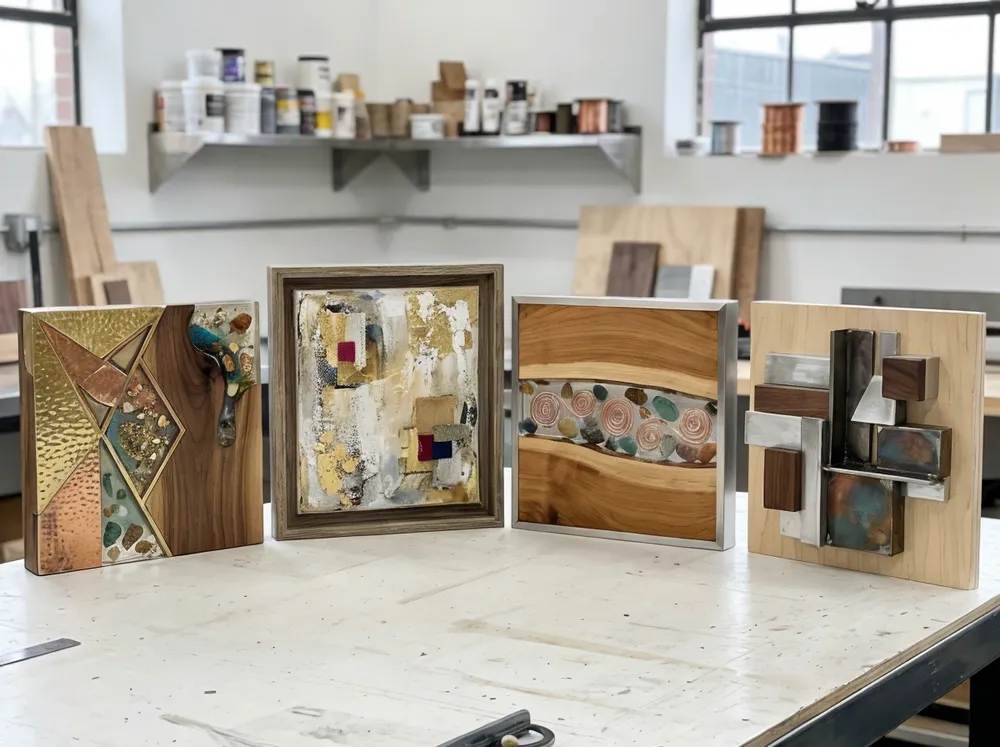
- Style range and specialization — Does the factory have genuine depth in abstract, modern, nature, or mixed-media, or are they a general décor factory that prints anything? Style-specific tooling, color libraries, and substrate expertise are not interchangeable.
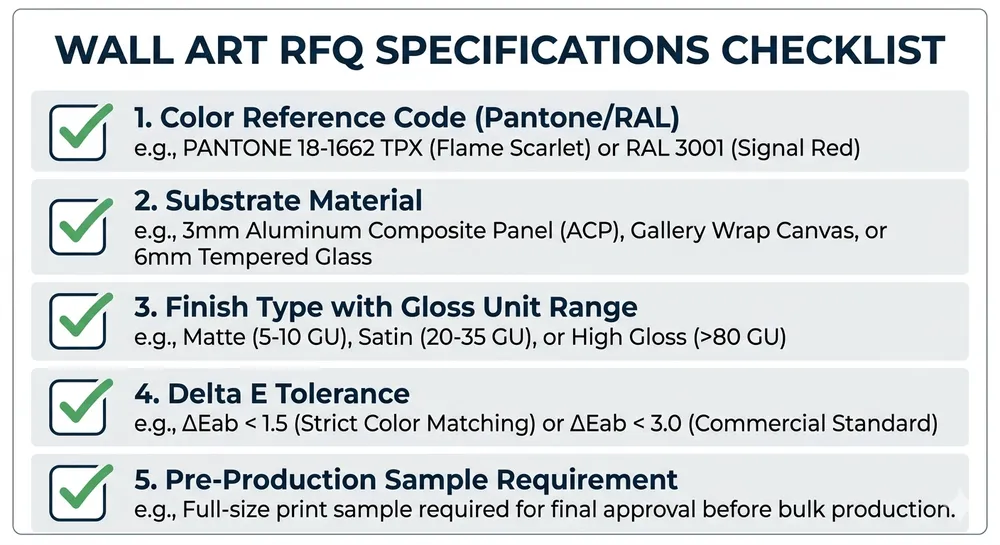
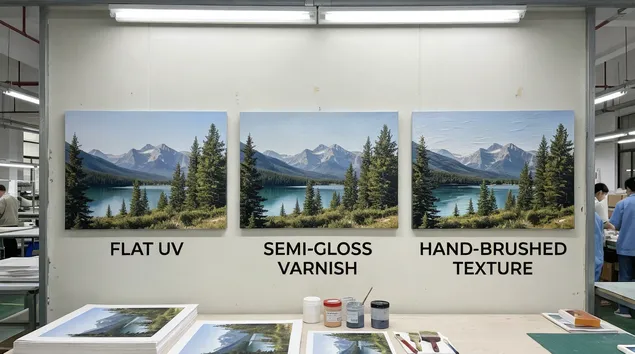
- Print technology and color accuracy — UV flatbed, screen print, and canvas transfer each have different color gamut limits and batch-to-batch consistency profiles. Ask for Delta-E tolerances on repeat orders, not just first-sample approval.
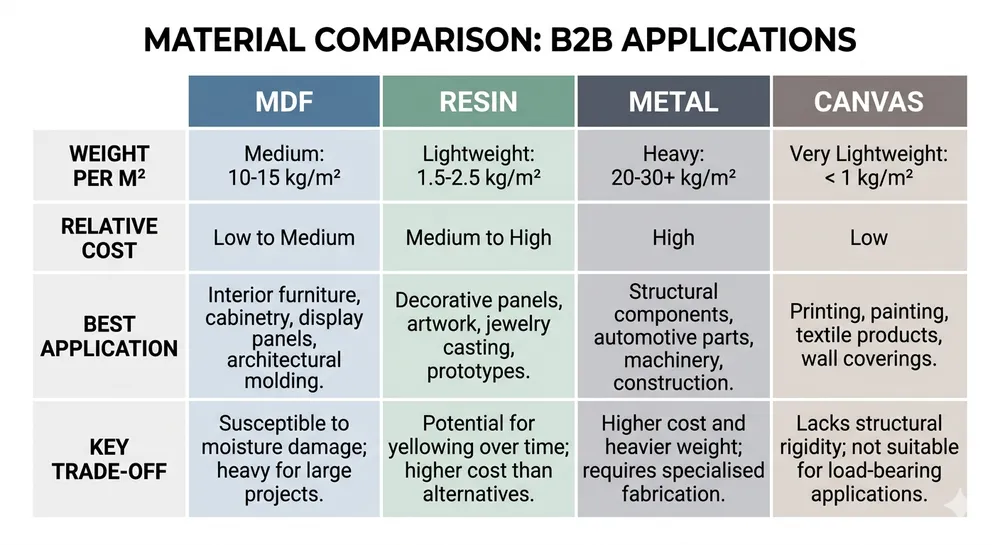
- Frame finishing consistency — MDF, solid wood, metal, and resin frames each require different surface prep before finishing. A factory that outsources frame molding to a third party introduces a quality control gap that shows up in your return rate.
- Lead time on existing vs. custom molds — Standard SKUs on existing tooling typically run 25–35 days from deposit. Custom frame profiles or new substrate configurations add 15–25 days for tooling. Know which category your order falls into before comparing quotes.
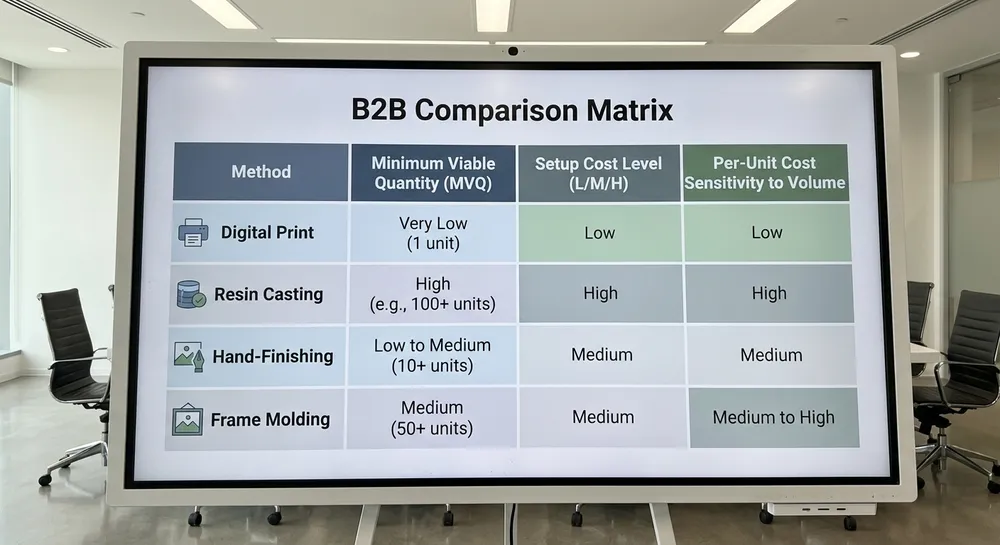
- MOQ flexibility — A 500-piece MOQ per SKU sounds reasonable until you're building a 20-SKU assortment. Factories with 100-piece MOQ on standard models give you real range-building flexibility.
- Export documentation and retail compliance — EDI capability, FSC certification for wood frames, CARB compliance for MDF, and retail-ready packaging specs are non-negotiable for major US retail programs. Not every Vietnamese factory is set up for this.
(The color accuracy point is where I see the most sourcing failures. A factory can nail your sample and then drift 8–12 Delta-E units on the bulk run because they're mixing inks manually between batches. Always ask for their batch-to-batch color control process, not just their sample approval process.)
—
The 10 Manufacturers: A Verified Sourcing Landscape
The companies below represent the real operating landscape for style wall art manufacturing in Vietnam. They range from large vertically integrated facilities to specialized print-and-frame operations. Where production data is publicly available, it's included. Where it isn't, the description stays conservative.
—
1. Livewellcraft (CÔNG TY TNHH LIVEWELL CRAFT VN)
Website: livewellcraft.com Location: Dong Nai, Vietnam Founded: 2008
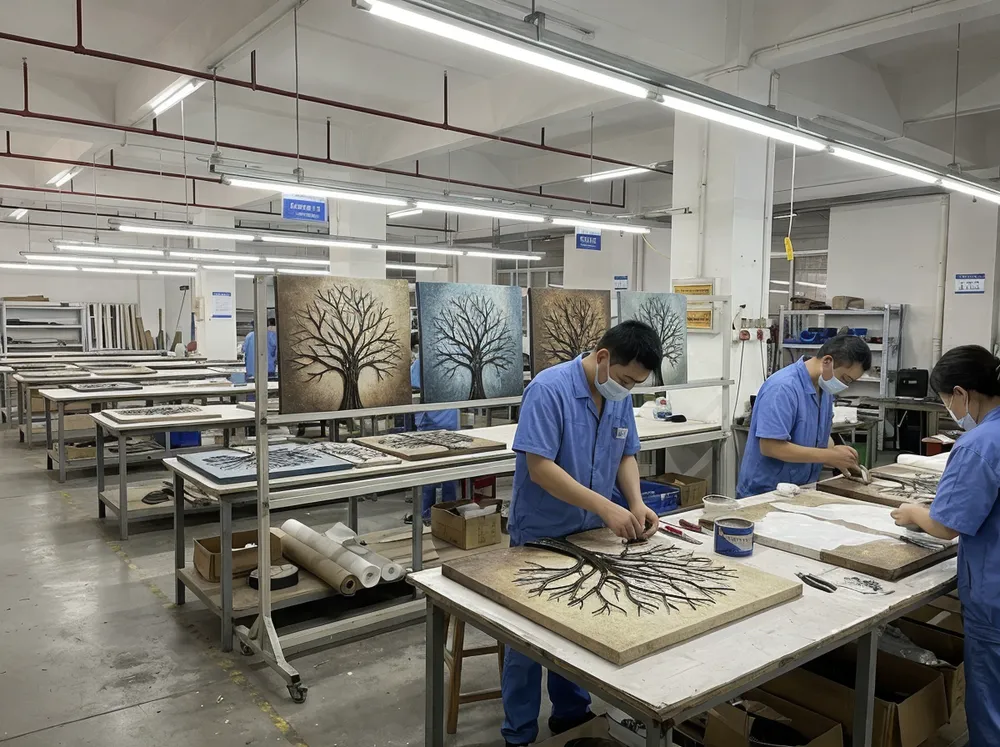
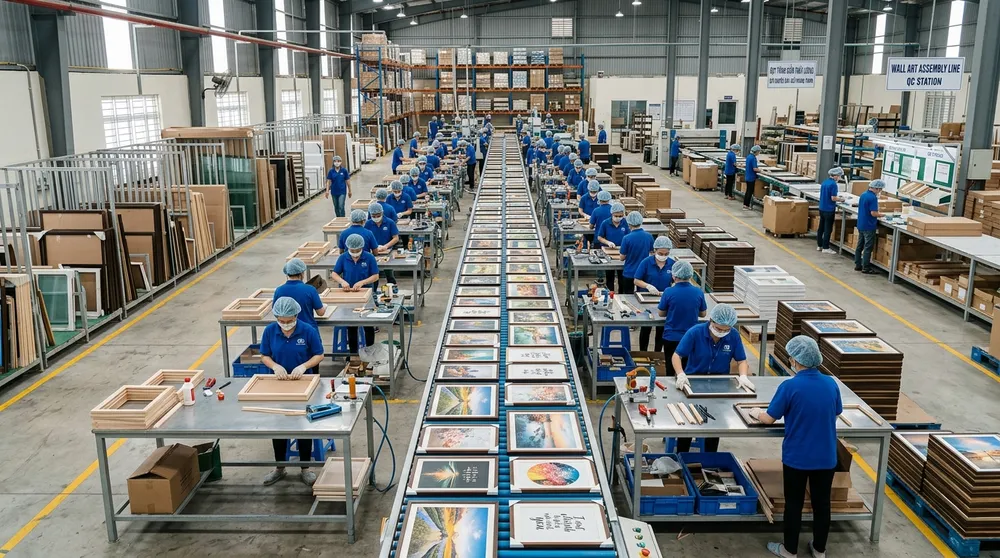
Livewellcraft operates a 12,000 m² facility with 6 dedicated production lines and 150 staff, shipping approximately 400,000 pieces annually to North America, Europe, Australia, Southeast Asia, and the Middle East. The full production chain — glass cutting, beveling, silvering, frame molding (MDF, solid wood, metal, resin), and final assembly — runs under one roof. That vertical integration is the operational detail that matters most for style wall art buyers: when frame molding and surface finishing happen in the same facility as final QC, color and finish consistency across a 3,000-unit run is controllable in a way it simply isn't when you're coordinating three separate suppliers.
The in-house engineering team of 12 handles custom frame profile development, so OEM/ODM programs don't require a separate tooling vendor. Lead time on existing molds runs 30–35 days from deposit confirmation. Custom frame profiles add tooling time depending on complexity. MOQ starts at 100 pieces for standard models — low enough to run a genuine trial order before committing to volume.
Certifications: ISO 9001:2015, SGS, CE, BSCI. Walmart, Wayfair, and Amazon supplier experience with EDI and retail compliance capability means your packaging and documentation requirements are already understood, not negotiated from scratch.
Style specialization: Abstract, modern, nature, mixed-media, decorative mirror-integrated wall art Lead time (standard): 30–35 days MOQ: 100 pieces (standard models) OEM/ODM: Full — custom sizing, frame profiles, finishes, and packaging
—
2. AA Corporation (AA Corp)
Website: aacorporation.com.vn Location: Ho Chi Minh City, Vietnam
AA Corporation is one of Vietnam's larger home décor and wall art exporters, with a product range spanning canvas prints, framed art, and decorative panels. They supply to European and North American retail chains and have established export documentation processes. Their production covers a broad style range including abstract and nature subjects. AA Corp operates at meaningful scale and is a recognized name in Vietnamese export trade directories.
Style specialization: Canvas prints, framed decorative art, abstract and nature subjects Export markets: Europe, North America OEM: Available
—
3. Minh Long I Co., Ltd.
Website: minhlongi.com.vn Location: Binh Duong, Vietnam
Minh Long I is primarily known for ceramics and decorative home goods, but their wall décor division produces decorative wall panels and art pieces for export. Their strength is in ceramic and lacquer-finish wall art — a niche that commands higher retail price points and suits buyers targeting premium home décor channels. Lead times on ceramic-based wall art are longer than print-on-canvas operations due to kiln processing, but the margin profile is different.
Style specialization: Ceramic wall art, lacquer decorative panels, traditional Vietnamese motifs Export markets: Europe, Japan, Southeast Asia OEM: Available for custom motifs and colorways
—
4. Saigon Furniture (Noi That Saigon)
Website: noithatsaigon.vn Location: Ho Chi Minh City, Vietnam
Saigon Furniture covers a broad home furnishings range that includes wall art and decorative panels. Their wall art output leans toward wood-framed and lacquered pieces suited to hospitality and project buyers. They have experience with hotel and resort procurement programs, which means their documentation and bulk-order handling processes are developed. Style range is more traditional and transitional than contemporary abstract.
Style specialization: Wood-framed wall art, lacquered decorative panels, transitional and traditional styles Export markets: Southeast Asia, Middle East, Europe OEM: Available
—
5. Vietnam Craft Village Export (Craft Link affiliated suppliers)
Website: craftlink.com.vn Location: Hanoi and northern Vietnam craft clusters
Craft Link and its affiliated supplier network represent Vietnam's artisan-production tier — handmade lacquerware, silk embroidery panels, and hand-painted wall art produced in traditional craft villages. This is not a factory-scale operation; it's a sourcing channel for buyers who need authentic handcraft provenance for premium retail positioning. MOQs are low, but production consistency and lead time predictability are different from industrial manufacturing. Worth knowing if your channel includes specialty boutiques or museum gift shops.
Style specialization: Handcraft lacquerware, silk embroidery, hand-painted traditional and folk art Export markets: Europe, North America (specialty retail) OEM: Limited — custom colorways possible, not custom structural profiles
—
6. Hung Thinh Furniture & Décor
Website: hungthinh.com.vn Location: Binh Duong, Vietnam
Hung Thinh operates in the furniture and home décor manufacturing space with wall art as part of their export product range. Their production covers MDF-framed prints and wood-composite decorative panels. They supply to Southeast Asian and Middle Eastern markets and have experience with container-load export programs. Style range is broad rather than specialized.
Style specialization: MDF-framed prints, wood-composite decorative panels, modern and transitional styles Export markets: Southeast Asia, Middle East OEM: Available
—
7. Viet My Handicraft
Website: vietmyhandicraft.com Location: Ho Chi Minh City, Vietnam
Viet My Handicraft produces decorative wall art and home accessories with a focus on resin, lacquer, and mixed-media pieces. Their product range includes abstract resin wall panels and nature-themed decorative art that performs well in contemporary retail channels. They export to North America and Europe and have experience with wholesale and retail buyer programs.
Style specialization: Resin wall art, lacquer panels, abstract and nature mixed-media Export markets: North America, Europe OEM: Available for custom colorways and sizing
—
8. Thien Minh Craft
Website: thienminhcraft.com Location: Hanoi, Vietnam
Thien Minh Craft specializes in lacquerware and decorative art with wall art panels as a core export category. Their lacquer technique — multiple application layers with hand-polishing between coats — produces a finish depth that's difficult to replicate with industrial spray processes. This is a relevant supplier for buyers targeting premium home décor or hospitality segments where finish quality justifies a higher landed cost.
Style specialization: Lacquer wall art panels, traditional and contemporary Vietnamese motifs, nature subjects Export markets: Europe, Japan, North America OEM: Available for custom motifs and panel sizing
—
9. Dong Ky Furniture Village Exporters
Website: dongkyfurniture.com Location: Bac Ninh, Vietnam
Dong Ky is Vietnam's most recognized traditional woodworking cluster, producing carved wood furniture and decorative wall panels for export. Their wall art output is carved wood — relief panels, decorative screens, and framed carved art — suited to buyers serving traditional, Asian-contemporary, or high-end hospitality channels. Production is workshop-scale rather than factory-scale, so lead times and consistency expectations differ from industrial manufacturers.
Style specialization: Carved wood wall panels, relief art, traditional Vietnamese and Asian motifs Export markets: Europe, North America, East Asia OEM: Available for custom carving patterns and sizing
—
10. Goldsun Media Group (Print & Décor Division)
Website: goldsun.com.vn Location: Hanoi, Vietnam
Goldsun operates primarily in commercial printing and media, but their décor division produces large-format printed wall art and canvas panels for commercial and retail applications. Their strength is in print technology — large-format UV and latex printing with color management systems — which makes them relevant for buyers who need high-volume canvas or poster-format wall art with tight color accuracy requirements. Frame finishing is not their core competency; they're strongest on the print side.
Style specialization: Large-format canvas prints, photographic and graphic wall art, abstract and modern subjects Export markets: Domestic Vietnam, Southeast Asia, some North America OEM: Available for print content and canvas sizing
—
Lead Time and MOQ Comparison
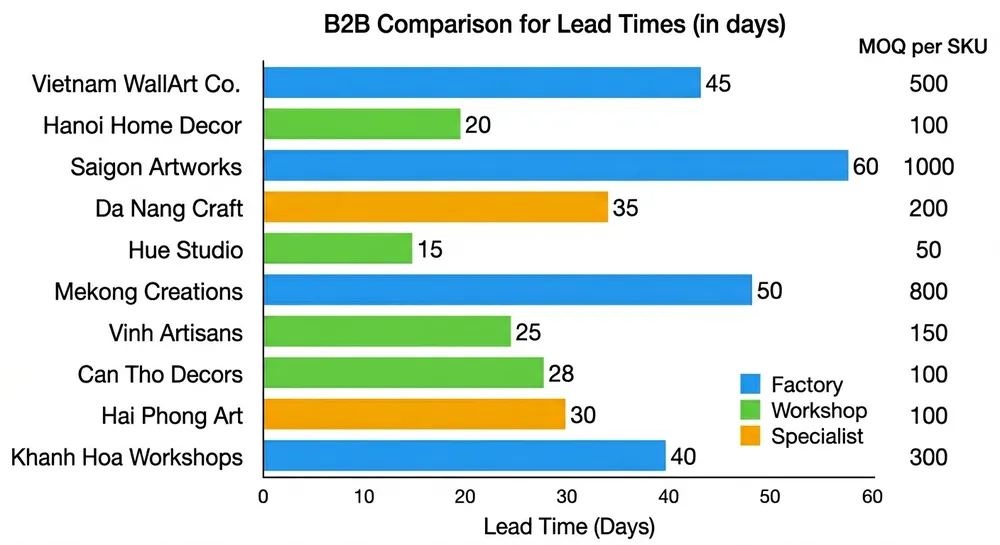
The table below summarizes publicly available or conservatively estimated data across the 10 manufacturers. Where exact figures are not publicly confirmed, ranges reflect typical market patterns for each supplier type.
| Manufacturer | Facility Type | Style Focus | Est. Lead Time (Standard) | MOQ (Standard) | OEM/ODM |
|---|---|---|---|---|---|
| Livewellcraft | Vertically integrated factory | Abstract, modern, nature, mirror-integrated | 30–35 days | 100 pcs | Full |
| AA Corporation | Export factory | Canvas, abstract, nature | 35–45 days | 200–500 pcs | Yes |
| Minh Long I | Ceramic/lacquer specialist | Ceramic, lacquer, traditional | 45–60 days | 100–300 pcs | Custom motifs |
| Saigon Furniture | Furniture + décor factory | Wood-framed, transitional | 35–50 days | 200 pcs | Yes |
| Craft Link network | Artisan/workshop | Handcraft, embroidery, folk art | 30–60 days | 50–100 pcs | Limited |
| Hung Thinh | MDF/composite factory | Modern, transitional | 35–45 days | 200 pcs | Yes |
| Viet My Handicraft | Mixed-media workshop | Resin, lacquer, abstract | 30–45 days | 100–200 pcs | Custom colorways |
| Thien Minh Craft | Lacquer specialist | Lacquer, traditional, nature | 40–55 days | 100 pcs | Custom motifs |
| Dong Ky Village | Wood carving workshop | Carved wood, traditional | 45–70 days | 50–100 pcs | Custom carving |
| Goldsun Media | Print-focused operation | Canvas, graphic, photographic | 20–30 days | 100–500 pcs | Print content |
—
Where Local Convenience Adds Real Value
Before going further on the factory-direct case, it's worth being direct about when local sourcing — whether from a Vietnamese distributor or a regional importer — is the right answer.
Urgent small orders: If you need 50 units to fill a gap on a retail floor within two weeks, a local importer with warehouse stock wins. No factory in Vietnam can compete with same-week fulfillment on emergency quantities.
First-time category entry: If you're testing a new wall art style with no volume commitment, buying from a local distributor at a higher unit cost is a rational risk management decision. You're paying for optionality, not inefficiency.
Local compliance timing: Some markets have import documentation timelines that make factory-direct impractical for a specific project deadline. Know your compliance calendar before committing to a direct import program.
The honest trade-off: local convenience typically costs 25–40% more per unit than factory-direct at equivalent quality. That premium is worth paying when speed or flexibility is the constraint. It stops making sense when you're running repeat volume on established SKUs.
—
The Quality Problems That Show Up at Bulk — and How to Screen for Them
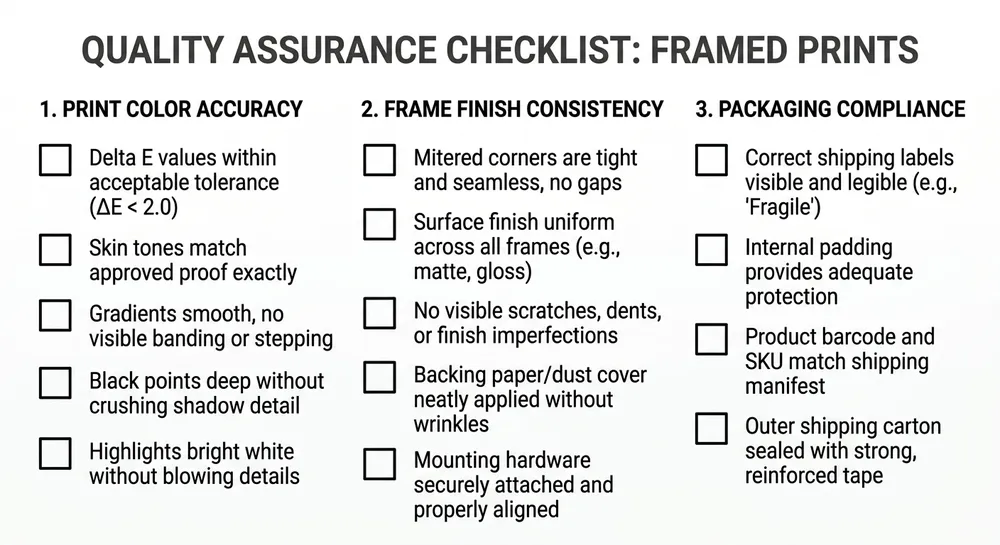
The three failure modes I see most often in style wall art sourcing from Vietnam:
1. Print color drift across batches A factory approves your sample at Delta-E 2.5 and then ships bulk at Delta-E 9. This happens when ink mixing is manual and there's no spectrophotometer-based color management in the production process. Ask specifically: "How do you control batch-to-batch color consistency on repeat orders?" A factory with a real answer will describe their color management system. A factory without one will describe their sample approval process — which is a different thing entirely.
2. Frame finish inconsistency MDF frames that are outsourced to a third-party molding supplier introduce a surface prep variable that's hard to control from a distance. The most common defect is powder coat or paint adhesion failure at corners and edges — the areas where the substrate transitions and surface prep is most critical. Factories that mold and finish frames in-house can control the pre-treatment step. Factories that buy pre-molded frames cannot.
3. Packaging compliance failures Retail-compliance packaging — master carton labeling, inner pack configuration, barcode placement, and drop-test certification — is not a default capability. It's a program that has to be built and maintained. If your buyer is a major US retailer, ask for evidence of previous retail compliance programs, not just a statement that they can do it.
(We've seen containers turned away at distribution centers over barcode placement issues that were clearly specified in the vendor manual. The factory had the right product — the packaging was wrong. That's a $15,000 problem that a 30-minute pre-production packaging review would have prevented.)
—
Vertically Integrated vs. Fragmented Supply: The Production Model That Determines Your Risk
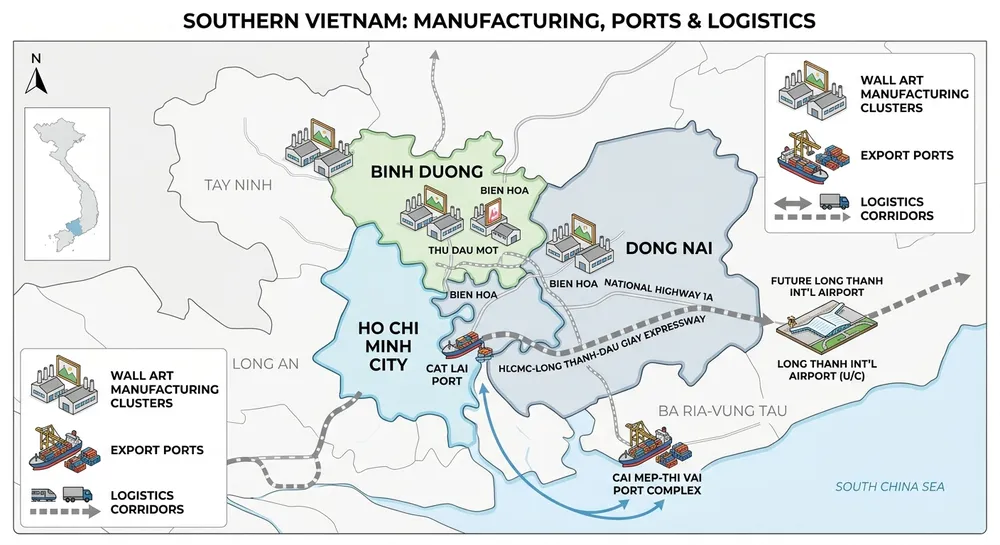
Most of the manufacturers on this list operate some version of a fragmented model — they handle one or two production steps well and coordinate the rest through subcontractors. That's not a criticism; it's a structural reality of how the Vietnamese manufacturing ecosystem developed. But it has direct implications for your order.
A fragmented supply chain means:
- Frame molding happens at Supplier A
- Surface finishing at Supplier B
- Print production at Supplier C
- Final assembly and QC at the main factory
Each handoff is a quality control gap. Each subcontractor has their own scheduling pressures. When your order is 500 units, you're not their priority — you're one of twenty orders moving through a shared production queue.
Livewellcraft's 12,000 m² facility runs the full chain under one roof: glass processing, frame molding across MDF, solid wood, metal, and resin substrates, surface finishing, assembly, and final QC. Six production lines, 150 staff, 400,000 pieces annually. The engineering team that develops your custom frame profile is in the same building as the line that builds it and the QC team that inspects it. When something needs to be adjusted mid-production — a finish tolerance, a frame dimension, a packaging configuration — the decision loop is hours, not days.
That's the operational mechanism behind the 30–35 day lead time on existing molds. It's not a marketing claim — it's what vertical integration actually produces when it's working correctly.
For buyers building a Wall Arts by Style & Subject program with multiple SKUs across abstract, modern, and nature categories, the ability to run all SKUs through one QC system with one point of accountability is worth more than a 5% unit cost difference from a cheaper fragmented supplier. The RMA cost on one bad container erases that margin advantage immediately.
—
When Factory-Direct Import Makes Financial Sense
The economics shift decisively at repeat volume. Here's the scenario where factory-direct from Vietnam outperforms local sourcing:
Order size: 500+ units per SKU, 2+ SKUs per order Order frequency: Quarterly or more frequent Quality requirement: Consistent finish and color across the full run Packaging requirement: Retail-ready or retail-compliance
At this profile, the landed cost advantage of factory-direct — typically 25–40% below local distributor pricing at equivalent quality — compounds across every reorder. A buyer running four SKUs at 500 units each, quarterly, is looking at meaningful annual savings that fund range expansion, not just margin protection.
The risk factors that make buyers hesitate — lead time, minimum order, quality consistency — are all addressable with the right factory partner. Lead time of 30–35 days is manageable with a 6-week forward planning horizon. A 100-piece MOQ on standard models means you can test new styles without overcommitting inventory. And a factory with ISO 9001:2015, SGS, and BSCI certifications has a documented QC system, not just a verbal assurance.
If you're currently sourcing from a local distributor and running repeat volume, the question isn't whether factory-direct makes sense — it's whether your current supplier relationship is worth the premium you're paying for it.
—
Common Sourcing Pitfalls When Screening Vietnamese Wall Art Factories
A few patterns worth knowing before you start sending RFQs:
The sample-to-bulk gap is the most common disappointment. Factories put their best operators on sample production. Bulk runs through the standard line. If you can't visit the factory, ask for a pre-production sample from the actual bulk run — not a repeat of the original sample.
Certification theater is real. An ISO 9001 certificate on the wall means a QC system was documented and audited at a point in time. It doesn't mean the system is running today. Ask for the most recent audit date and whether the certificate is current. SGS and BSCI audits are more operationally meaningful because they involve physical factory inspections.
Trading company vs. factory confusion costs buyers money and control. Many Alibaba listings for "Vietnam wall art factory" are trading companies sourcing from multiple factories. You get a layer of markup and a layer of communication distance from the actual production floor. Ask directly: "Is this your own factory?" and ask for the factory address to cross-reference.
MOQ negotiation without understanding tooling costs leads to misaligned expectations. A factory quoting 100-piece MOQ on standard models may require 500 pieces on a custom frame profile because the tooling amortization math changes. Understand which category your order falls into before negotiating MOQ.
For a deeper look at how to structure your sourcing process for style-specific wall art, see How to Source Style-Specific Wall Arts. If you're also evaluating domestic suppliers as a comparison point, Style Wall Art Suppliers in the USA covers the landed cost and lead time trade-offs in that market.
—
Sourcing Decision Guide: Which Route Fits Your Situation
| Your Situation | Recommended Route |
|---|---|
| Urgent order, <200 units, needed within 2 weeks | Local distributor or regional importer |
| First-time category test, no volume commitment | Local distributor — pay the premium for optionality |
| Repeat volume, 500+ units/SKU, quarterly cadence | Factory-direct Vietnam — economics are clear |
| Custom frame profile or OEM packaging required | Factory-direct only — local distributors can't do this |
| Retail compliance program (Walmart, Wayfair, Amazon) | Factory with documented retail compliance experience |
| Premium handcraft or artisan provenance required | Craft village network or lacquer specialist |
| Large-format canvas or graphic print focus | Print-specialist factory with color management system |
The Wall Art Style Guide covers style-specific demand patterns if you're still deciding which categories to build your program around — worth reading before you finalize your SKU mix.
—
Frequently Asked Questions
What is the typical MOQ for custom OEM wall art from a Vietnamese factory? For standard frame profiles with custom print content, most factories start at 200–500 pieces per SKU. Factories with in-house frame molding — where tooling costs are internal — can often go lower. Livewellcraft's standard OEM MOQ starts at 100 pieces on existing molds. Custom frame profiles require a separate tooling discussion, but the MOQ on the production run itself doesn't automatically jump to 500 pieces.
How do I verify that a Vietnamese wall art supplier is a real factory and not a trading company? Ask for the factory's business registration address and cross-reference it against the production facility address. Request a video call that includes a walk through the production floor — not just the showroom. Ask which production steps happen in-house and which are subcontracted. A real factory will answer these questions specifically. A trading company will deflect or give vague answers about their "partner factories."
What certifications should I require from a Vietnamese wall art manufacturer for US retail? ISO 9001:2015 covers the QC management system. BSCI covers social compliance, which major US retailers require. For wood-framed products, FSC certification covers chain-of-custody for the wood substrate. For MDF-framed products, CARB Phase 2 compliance covers formaldehyde emissions — required for California and increasingly standard across US retail. CE marking is relevant for European market entry. SGS audit reports provide independent verification of factory conditions.
What causes color inconsistency between my approved sample and bulk production? The most common cause is manual ink mixing without spectrophotometer-based color management. When a factory mixes inks by eye or by formula without measuring the output, batch-to-batch variation is inevitable. A second cause is substrate variation — if the canvas or board stock changes between sample and bulk production, the same ink formula produces a different visual result. Ask your factory specifically how they control ink mixing and whether they use a spectrophotometer for color verification on bulk runs.
Is 30–35 days a realistic lead time for style wall art from Vietnam? For standard models on existing tooling, yes — 30–35 days from deposit confirmation is achievable at a vertically integrated factory. That timeline assumes no tooling development, no new substrate introduction, and no major packaging customization. Custom frame profiles add 15–25 days for tooling. New print content on existing frames doesn't add lead time if the artwork is supplied in the correct format. Build your planning horizon around 35 days for standard orders and 50–55 days for first-time custom orders.
—
If you're ready to compare factory-direct options against your current supplier, the most efficient next step is a direct quote with your style preferences, target quantities, and any reference images. See our OEM/ODM Services page for the full capability overview, or go straight to Request Quote to start the conversation.