Most buyers come to us with a channel in mind — a retail program, a hospitality fit-out, an e-commerce catalog — and a rough aesthetic direction. What they often don't have is a clear map between the style they want and what that style actually costs to produce consistently at volume. That gap causes problems: samples that look great but can't be replicated at 2,000 units, color drift between batches, lead times that blow up a launch window.
This guide covers the nine wall art style and subject categories we produce at Livewellcraft. For each one, I'll explain how it's made, where color consistency gets tricky, what the MOQ and lead-time reality looks like, and which commercial channels it fits best. Use it to shortlist before you request samples — it'll save both of us time.
Browse the full Wall Arts by Style & Subject category to see current SKUs across all nine categories.
—
Style vs. Subject: Why the Distinction Matters for Your Product Line
Before getting into individual categories, it's worth separating two things buyers often conflate: style and subject.
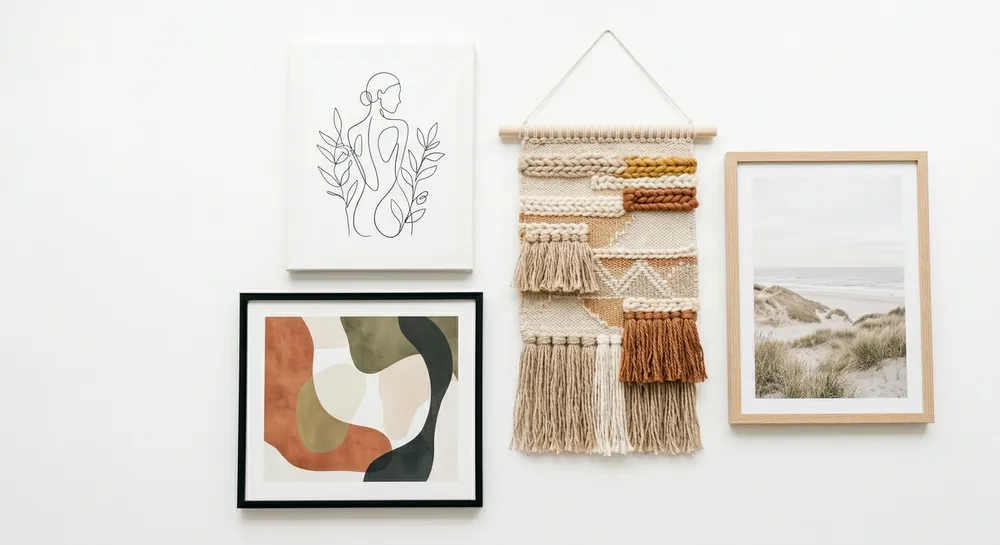
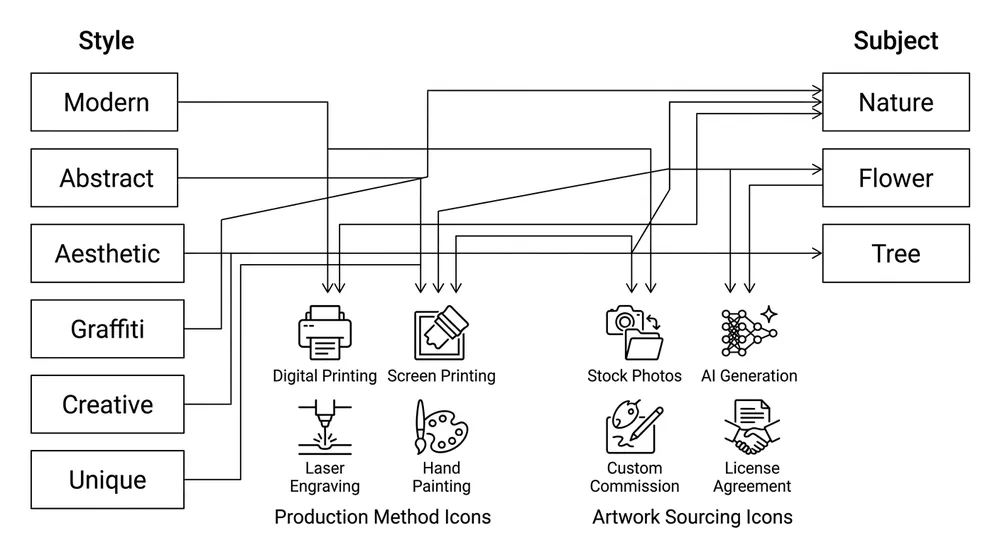
Style is the visual language — modern, abstract, graffiti, aesthetic. It governs composition, line weight, color palette structure, and the overall design grammar. Subject is the content — nature, flowers, trees. A nature subject can be rendered in a modern style or an abstract style. A flower subject can be photorealistic or painterly.
Why does this matter for procurement? Because style drives production method, and subject drives artwork sourcing and licensing exposure.
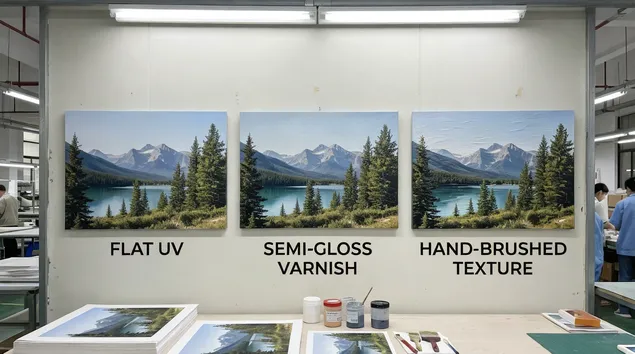
A modern-style piece is typically produced via high-resolution UV or giclée printing on canvas or aluminum composite — consistent, scalable, low defect rate across large runs. An abstract piece with heavy texture might involve resin application or hand-applied medium, which adds labor, extends lead time, and introduces batch-to-batch variation you need to plan for.
On the subject side: if you're ordering nature or flower wall art using licensed photography or third-party illustration, you need to confirm reproduction rights before placing a bulk order. We work with original artwork and in-house design on most of our catalog, but for custom OEM runs using buyer-supplied artwork, the licensing responsibility sits with you. (We flag this early in every custom project — it's one of the most common oversights we see from first-time importers.)
Getting this distinction clear upfront shapes your RFQ, your sample brief, and your production timeline.

—
Modern Wall Art: High-Volume Consistency, Retail-Ready Scalability
Modern wall arts are our highest-volume category, and there's a straightforward reason: the production process is the most controllable. Clean lines, geometric or minimalist compositions, flat or gradient color fields — these translate directly to UV flatbed or giclée canvas printing with minimal hand-finishing. Color accuracy across a 5,000-unit run is tight because there's no hand-applied element introducing variation.
For retail programs — particularly e-commerce at Wayfair or Amazon scale — modern wall art is the lowest-risk entry point. The aesthetic is broad enough to move across demographics, the production lead time is predictable (typically 25–35 days for standard catalog SKUs at 500+ units), and the packaging profile is straightforward: flat canvas or framed panel, stackable, efficient container loading.
Where buyers sometimes miscalibrate: assuming "modern" means cheap. The frame profile and mounting hardware matter a lot for perceived value at retail. We run aluminum and MDF frame options at different price points — the aluminum profile holds tighter tolerances and photographs better for product listings, which directly affects your conversion rate online.
MOQ for standard modern SKUs starts at 100 pieces. Custom colorway or size modifications require 300+ units to justify the print setup cost.
—
Abstract Wall Art: Managing Texture and Batch Consistency at Scale
Abstract wall arts split into two production tracks, and knowing which one you're buying matters before you commit to volume.
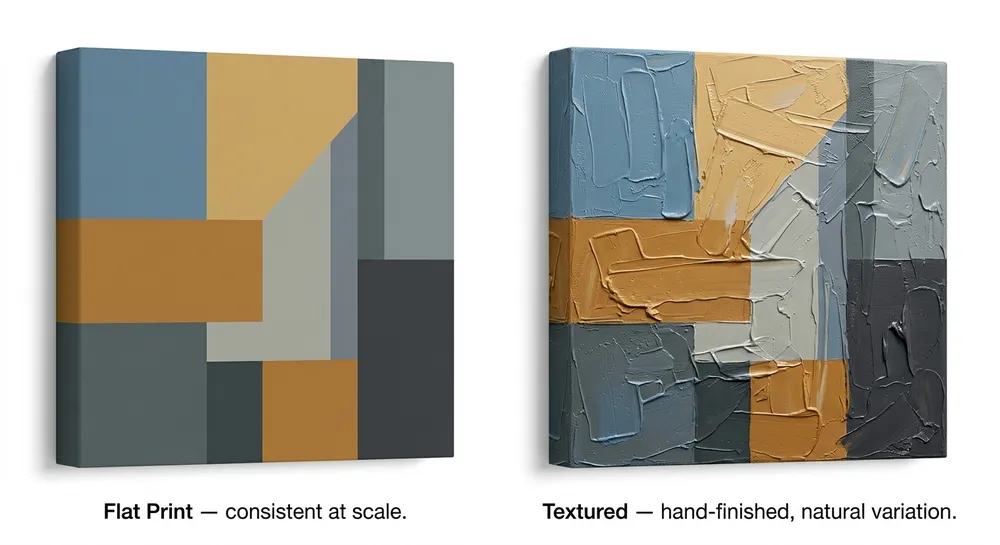
Flat-print abstract — digital compositions with color blocking, gradient fields, or geometric abstraction — produces identically to modern wall art. Consistent, scalable, low defect rate. This is the majority of our abstract catalog.
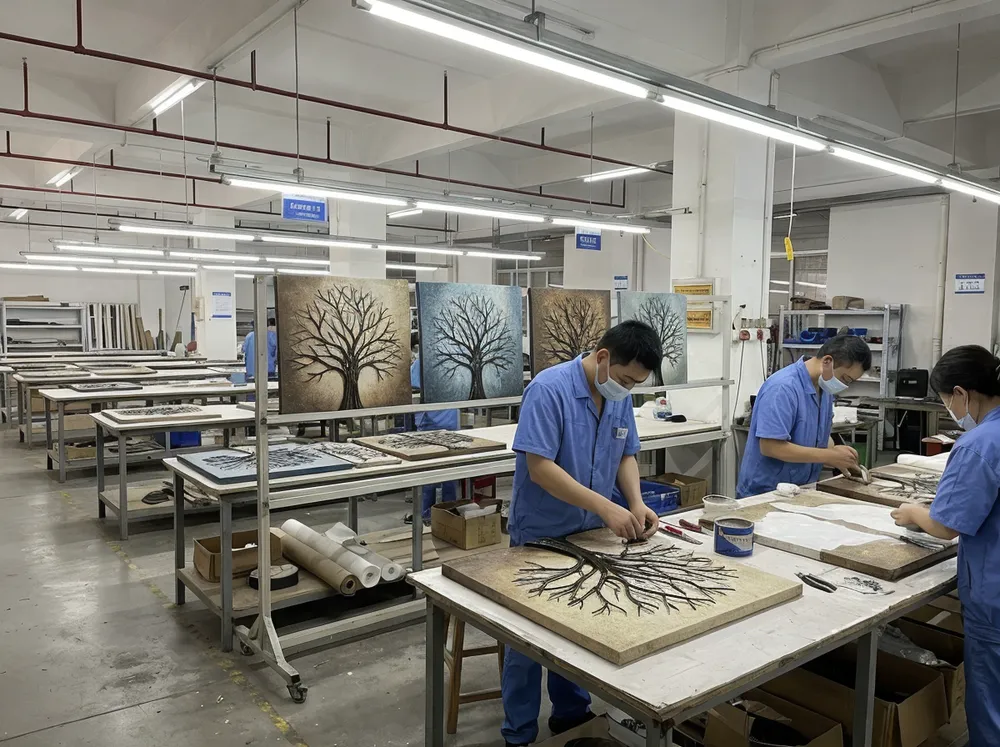
Textured abstract — pieces with raised medium, palette-knife effects, resin pours, or mixed-media surface treatment — is a different conversation. These involve hand-applied elements, which means each unit has natural variation. That's part of the aesthetic appeal, but it also means your QC brief needs to define an acceptable variation range rather than expecting unit-to-unit uniformity. We photograph approved samples and use them as the production reference standard, but "identical" isn't the right expectation here.
Lead time for textured abstract runs 10–15 days longer than flat-print, and MOQ is typically 200+ units because the hand-finishing labor doesn't amortize well below that threshold. For hospitality fit-outs where slight variation between units actually reads as intentional — hotel corridors, restaurant feature walls — textured abstract is a strong margin play. For retail programs where customers compare units side by side, flat-print abstract is the safer choice.
(We've had buyers order textured abstract for retail and get return complaints about "defects" that were actually intentional texture variation. Set expectations with your downstream customers before you list.)
—
Aesthetic Wall Art: Trend Sensitivity and the Shelf-Life Question
"Aesthetic" as a style category is real in retail demand data — it maps to the soft-tone, vintage-adjacent, typographic, and mood-board visual language that's driven significant volume in the 18–35 demographic over the past several years. We track it as a distinct category because the sourcing and production implications differ from pure modern or abstract.
The production method is typically flat digital print, so consistency at scale isn't the issue. The issue is trend velocity. Aesthetic wall art has a shorter commercial shelf life than modern or nature subjects. Color palettes shift — what was selling in dusty rose and sage two years ago has moved toward warmer terracotta and off-white. Typography trends cycle faster than geometric abstraction.
For buyers building a retail catalog, aesthetic wall arts work best as a rotating SKU layer rather than a core permanent range. We recommend keeping MOQ lower on aesthetic SKUs (100–200 units) and refreshing designs seasonally rather than committing to deep inventory. Our in-house design team can develop new colorways or compositions on a 3–4 week turnaround for established buyers — that flexibility is worth more than a lower unit cost on a 1,000-piece run that might be half-obsolete in six months.
For hospitality and commercial interior projects, aesthetic wall art is lower risk because the installation is fixed — you're not managing sell-through. A hotel lobby refresh on a 3-year cycle doesn't need to worry about trend shelf life the same way a retail buyer does.
—
Nature, Flower, and Tree Wall Art: Subject Categories with Distinct Sourcing Profiles
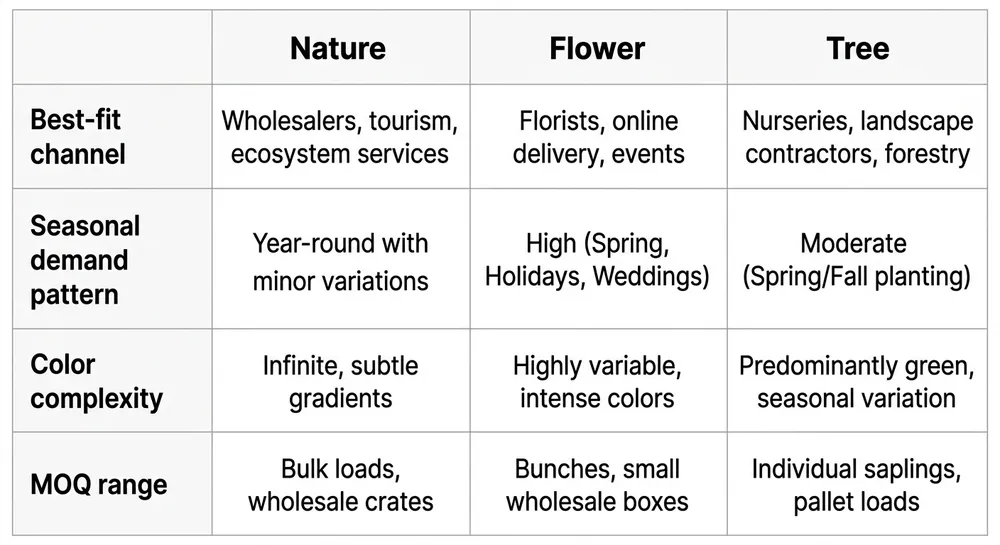
These three subject categories share a production profile — primarily high-resolution photographic or illustrative print on canvas, metal, or acrylic — but each has different commercial demand patterns and artwork sourcing considerations worth separating.
Nature wall art
Nature wall arts are the broadest subject category and the most consistently demanded across channels. Landscape photography, forest scenes, coastal imagery — these move in retail, hospitality, and residential project work with minimal trend risk. The subject is durable.
Color accuracy is the main production variable. Nature photography contains complex color gradients — sky tones, foliage greens, water reflections — that expose any weakness in your print calibration. We run ICC profile-matched printing and do a color-pull check on the first 50 units of every new nature SKU before releasing the full run. A 3% color shift in a forest green reads as a defect to a trained eye; in a geometric abstract, it's invisible.
For buyers sourcing nature wall art using licensed photography: confirm your license covers commercial reproduction at the quantities you're ordering. Stock photo licenses often cap reproduction at a unit count that's well below a typical wholesale order. We use original photography and commissioned illustration for our catalog — for custom OEM runs, we need your artwork files and a license confirmation before we start production.
Flower wall art
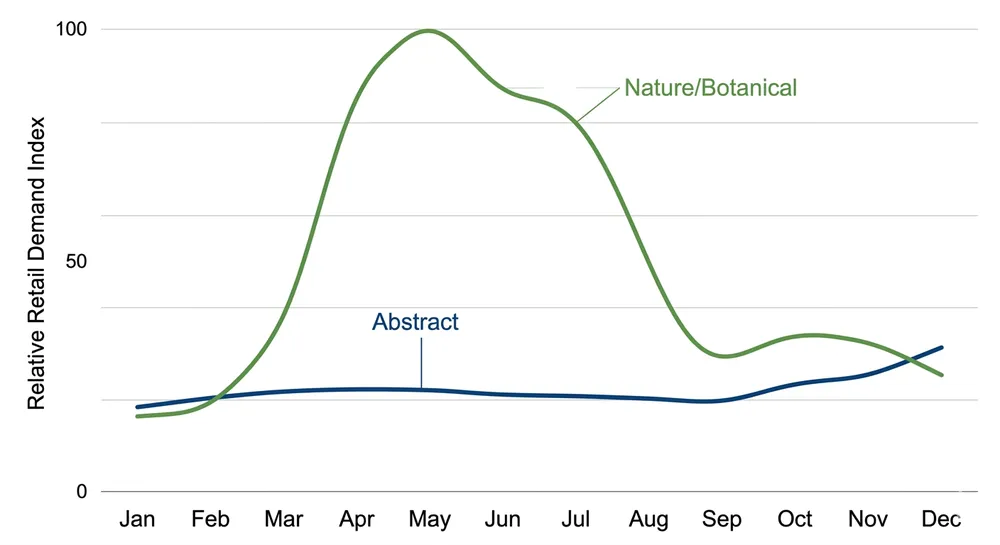
Flower wall arts skew toward the home décor and gifting retail channel. Demand is consistent but seasonal — Q4 and spring windows outperform the rest of the year for most of our flower SKU buyers. If you're building a retail program around flower wall art, plan your inventory timing accordingly.
The production challenge with flower subjects is color saturation. Petal tones — particularly deep reds, magentas, and purples — are among the hardest colors to hold consistently across a large print run. We use pigment-based inks rather than dye-based for all flower SKUs specifically because pigment holds saturation better over time and reduces the risk of color shift between early and late units in a production batch.
Tree wall art
Tree subjects occupy a middle ground — they carry the natural appeal of the broader nature category but with a more graphic, structured composition that often works better in modern interior contexts. Bare branch compositions, single-tree silhouettes, and stylized forest line art are the formats that move best in our export markets.
From a production standpoint, tree wall art is among the most consistent to reproduce at scale. The compositions tend toward high contrast with limited color complexity, which means color drift is less of a risk than with full-spectrum nature photography. Lead times and MOQ align with standard nature SKUs.
—
Graffiti Wall Art: Urban Retail and the Licensing Reality
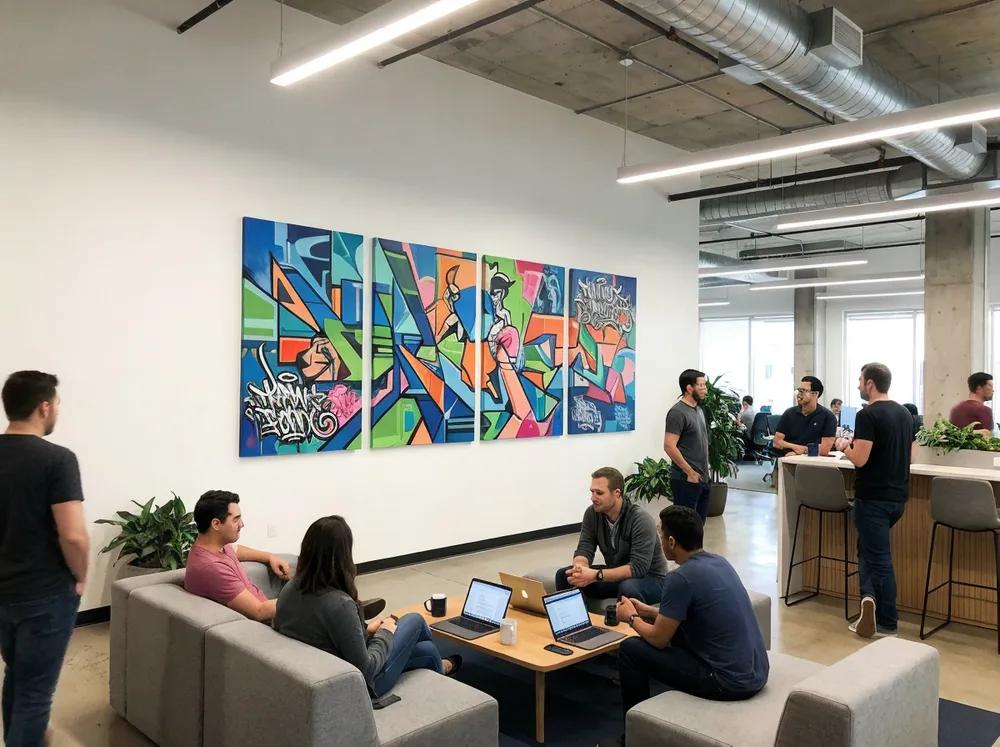
Graffiti wall arts are a strong performer in urban retail, youth-oriented home décor, and commercial spaces targeting a younger demographic — co-working spaces, boutique hotels, entertainment venues.
The production method is typically flat digital print, so scalability isn't the constraint. The constraint is artwork. Graffiti-style wall art that references recognizable street art, specific artists' styles, or identifiable urban imagery carries real IP risk. We don't reproduce work by named street artists or compositions that could be argued as derivative of protected works. Our graffiti catalog uses original commissioned artwork from designers who work in the style — clean IP, no licensing exposure for you downstream.
For custom OEM graffiti wall art using buyer-supplied artwork: we require a written confirmation that the artwork is original or properly licensed before production starts. This isn't bureaucratic caution — it's protection for your retail accounts. A cease-and-desist from a street artist's legal team after you've placed 2,000 units on shelves is a problem we've seen happen to buyers who didn't verify upstream.
Color-wise, graffiti style typically involves high-saturation, high-contrast palettes that print well and hold consistency across runs. Lead times are standard for flat-print production.
—
Creative and Unique Wall Art: Custom Development and the OEM Opportunity
Creative wall arts and unique wall arts are the two categories where our OEM/ODM capability is most relevant. These aren't defined by a single aesthetic — they're defined by differentiation from commodity catalog product.
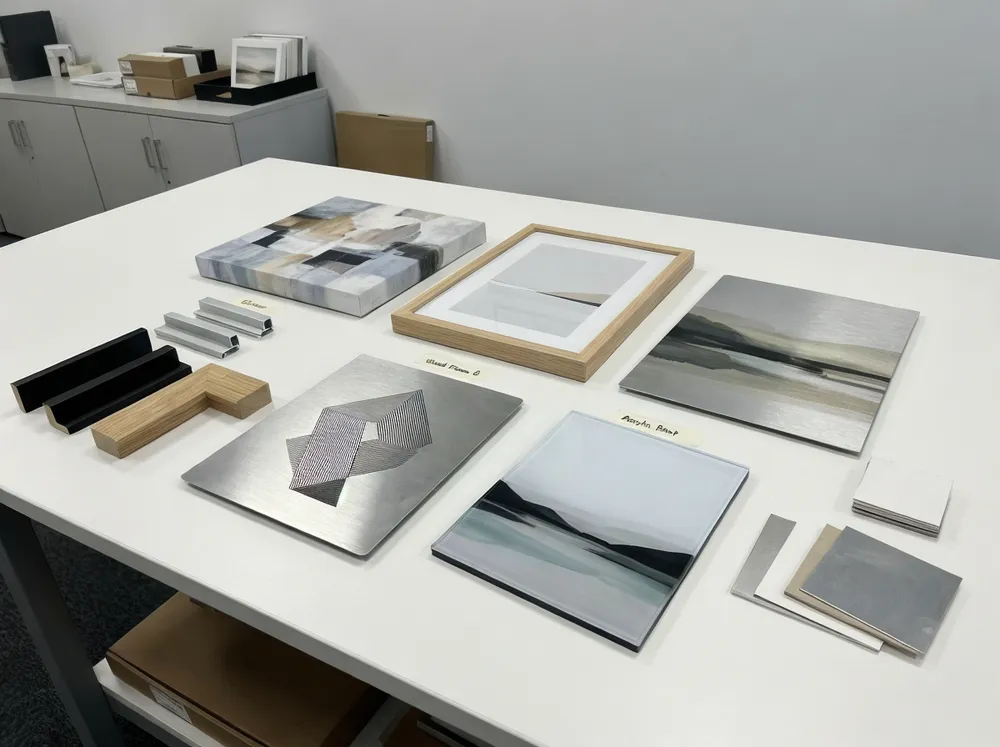
Creative wall art in our production context covers mixed-media formats: canvas combined with 3D elements, shadow box constructions, layered paper or fabric compositions, metal and wood hybrid pieces. These are the SKUs that photograph well, command higher retail price points, and are harder for competitors to replicate from a product listing image alone.
Unique wall art covers one-of-a-kind or short-run formats — hand-painted originals, artist-series limited editions, custom resin pieces. These are not high-volume production items. They're margin plays for buyers who want a premium tier in their catalog without committing to the development cost of a full custom line.
The production reality for both categories: lead times are longer (45–60 days for new development, 30–40 days for repeat orders), MOQ is higher for mixed-media formats (typically 200–500 units depending on complexity), and the sampling phase is more involved. We typically do 2–3 sample rounds on new creative or unique SKUs before approving for production — the first sample establishes the construction method, the second confirms material sourcing and finish, the third is the production-approval sample.
For buyers building a differentiated product line, this is where the investment pays off. A creative or unique wall art SKU that your competitors can't easily source from a catalog gives you pricing power and reduces the race-to-the-bottom dynamic on your retail accounts.
(This segment has grown significantly for us over the past three years — more buyers are using it as a private-label anchor rather than a small add-on. Worth considering if you're building a brand rather than just a catalog.)
—
Style-to-Production Comparison: Procurement Reference Table
Use this table to shortlist styles against your project requirements before requesting samples.
| Style / Subject | Primary Production Method | Color Consistency at 1,000+ Units | Typical Lead Time | MOQ Range | Best-Fit Channel |
|---|---|---|---|---|---|
| Modern | UV / giclée print, flat | High | 25–35 days | 100+ | Retail, e-commerce, hospitality |
| Abstract (flat) | Digital print | High | 25–35 days | 100+ | Retail, e-commerce, hospitality |
| Abstract (textured) | Hand-applied medium + print | Medium (planned variation) | 35–50 days | 200+ | Hospitality, project fit-out |
| Aesthetic | Digital print | High | 25–35 days | 100–200 | Retail, e-commerce |
| Nature | Photo/illustration print | Medium-High (color-managed) | 30–40 days | 100+ | Retail, hospitality, residential project |
| Flower | Pigment print | Medium-High | 30–40 days | 100+ | Retail, gifting, home décor |
| Tree | High-contrast print | High | 25–35 days | 100+ | Retail, modern interior project |
| Graffiti | Digital print (original art) | High | 25–35 days | 100+ | Urban retail, commercial spaces |
| Creative | Mixed media, 3D elements | Medium (sample-controlled) | 45–60 days (new) | 200–500 | Premium retail, private label |
| Unique | Hand-painted / short-run | Low-Medium (intentional) | 45–60 days | 50–200 | Premium tier, brand anchor |
Lead times are from approved artwork and deposit. Custom sizing, frame modifications, or new colorways add 5–10 days.
—
Packaging and Freight Considerations by Style Type
This is the part buyers often skip until they're looking at a freight quote that doesn't match their landed cost model.
Flat canvas and panel formats (modern, aesthetic, flat abstract, nature, flower, tree, graffiti) pack efficiently. We use corner-protected cardboard packaging with foam inserts, and these formats stack well in cartons. A 40-foot container typically holds 800–1,200 units depending on frame size and carton configuration. For e-commerce fulfillment, we can pack individual units in retail-ready packaging with barcodes and hang tags — no repack needed at your warehouse.
Mixed-media and 3D formats (creative, textured abstract) require more protective packaging. The 3D elements — raised resin, attached objects, layered constructions — can't be stacked the same way. Carton density drops, which means your freight cost per unit goes up. For a 500-unit creative wall art order, plan for roughly 30–40% lower container density compared to a flat canvas equivalent. Factor that into your landed cost before you set your retail price.
Framed glass formats — if you're sourcing wall art that incorporates mirror or glass elements — require double-wall cartons with foam suspension. We handle this regularly given our mirror manufacturing background, but it's worth flagging in your RFQ so we spec the right packaging from the start.
For buyers new to importing wall art: the damage rate on improperly packaged framed pieces through ocean freight is not trivial. We've seen buyers switch to us specifically because a previous supplier's packaging failed in transit. Our standard packaging specs are available on request — worth reviewing before you finalize your order.
—
How Subject Choice Affects Custom OEM Runs
When you're developing a custom wall art program — your own designs, your own colorways, your brand on the packaging — the subject category shapes the development process in ways that aren't obvious from a catalog order.
Original artwork vs. licensed artwork: For nature, flower, and tree subjects, buyers often want to use photography. If it's your own photography, the process is straightforward — supply the files, we handle color profiling and print setup. If it's licensed stock photography, confirm the license covers commercial reproduction at your order quantity. Many standard stock licenses don't.
Design file requirements: Abstract and modern subjects typically come from vector files or high-resolution digital compositions — clean, scalable, easy to work with. Nature photography needs to be supplied at minimum 150 DPI at final print size, ideally 300 DPI. We've had buyers supply web-resolution images expecting print-quality output — it doesn't work, and it delays the project.
Colorway customization: We can develop custom colorways for any style category. For flat-print styles, colorway changes are straightforward — a new print profile, a sample confirmation, and you're in production. For textured abstract or mixed-media creative pieces, colorway changes may require new material sourcing (pigments, resin tints, fabric) and add 1–2 weeks to the development timeline.
Packaging and branding: All nine categories support custom packaging — branded cartons, hang tags, barcode labeling, retail-ready inner packaging. For buyers with Walmart or Amazon compliance requirements, we're familiar with the EDI and labeling specs from our existing retail supplier relationships.
—
Procurement FAQ
Which wall art styles hold color consistency best across a 5,000-unit run?
Modern, flat-print abstract, graffiti, and tree subjects are the most consistent at high volume. These formats use high-contrast or geometrically defined compositions where color drift is easier to detect and control. Nature photography and flower subjects require more active color management — we run ICC-profiled printing and batch color checks, but the complexity of the color space means tighter QC protocols are needed. Textured abstract and mixed-media creative pieces have intentional variation by design; the QC benchmark is an approved sample range, not unit-to-unit uniformity.
What's the realistic lead time difference between a catalog order and a custom OEM run?
Catalog SKUs (standard sizes, existing designs): 25–40 days from deposit, depending on style. Custom OEM (new artwork, custom sizing, new colorway): add 15–25 days for the sampling phase. Mixed-media or 3D creative development: 45–60 days total for new SKUs, 30–40 days for repeat orders with approved samples on file. These are production lead times — ocean freight to your port adds 18–30 days depending on destination.
How do I avoid color mismatch between my approved sample and bulk production?
Three things matter: first, approve a production sample (not just a development sample) — the production sample is made on the actual production line with the actual materials. Second, specify your color references in Pantone or CMYK values in your purchase order, not just "match the sample." Third, for nature and flower subjects specifically, request a mid-run color pull at the 500-unit mark on large orders. We do this as standard for orders over 2,000 units; for smaller runs, it's available on request.
Which styles are best for hospitality and commercial project fit-outs vs. retail?
Hospitality and project fit-outs favor textured abstract, nature, and tree subjects — these read well at scale, hold up in high-traffic environments, and don't carry the trend-shelf-life risk of aesthetic or graffiti styles. Retail programs benefit from the full range, but modern and flat-print abstract are the lowest-risk core, with aesthetic and flower as seasonal rotation layers. Graffiti and creative wall art work well as a premium or differentiated tier in retail catalogs targeting urban or younger demographics.
Do you support custom sizing outside your standard catalog dimensions?
Yes, across all nine categories. Custom sizing requires a minimum of 300 units for flat-print formats and 500 units for mixed-media or framed formats. Standard catalog sizes are available from 100 units. If you're building a retail program with specific size requirements — shelf-fit dimensions, standard frame sizes for your market — send us the specs in your RFQ and we'll confirm feasibility and pricing.
—
Matching Your Channel to the Right Style Mix
The buyers who get the most out of our wall art range are the ones who come in with a channel thesis, not just a style preference. Here's how we typically see the categories map to commercial channels:
E-commerce retail (Amazon, Wayfair, independent DTC): Modern and flat-print abstract as the core volume SKUs. Aesthetic and flower as seasonal rotation. Creative or unique wall art as a premium tier to anchor average order value. Keep MOQ lean on trend-sensitive styles; go deeper on proven performers.
Brick-and-mortar retail: Nature and tree subjects perform well in physical retail because they photograph and display well at point of sale. Modern and graffiti work for urban-positioned stores. Textured abstract adds visual interest on a display wall but needs clear in-store merchandising to communicate the hand-finished quality.
Hospitality and commercial fit-out: Nature, tree, and textured abstract are the workhorses. Large-format prints, custom sizing, and site-specific colorway development are common in this channel. Lead times are longer but the order values are higher and the repeat business is predictable — a hotel group that fits out one property with your product and has a good experience will come back for the next one.
Wholesale distribution: Modern and nature subjects move most reliably through distribution because they're the least trend-dependent. Distributors building a wall art range for independent retailers benefit from a mix of proven core SKUs and a smaller rotating selection of trend-forward styles.
If you're not sure which style mix fits your channel, send us your target retail price points and channel description — we can suggest a starter SKU mix based on what's moving for our existing buyers in similar markets.
Request Quote with your target styles, quantities, and channel requirements to receive a technical proposal with pricing.