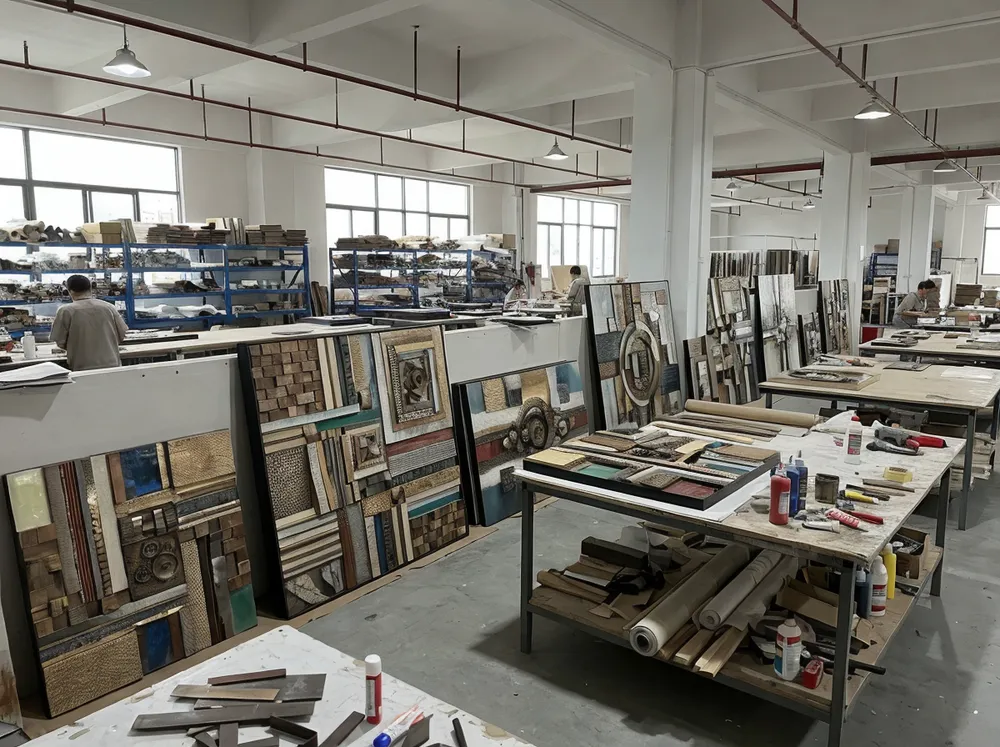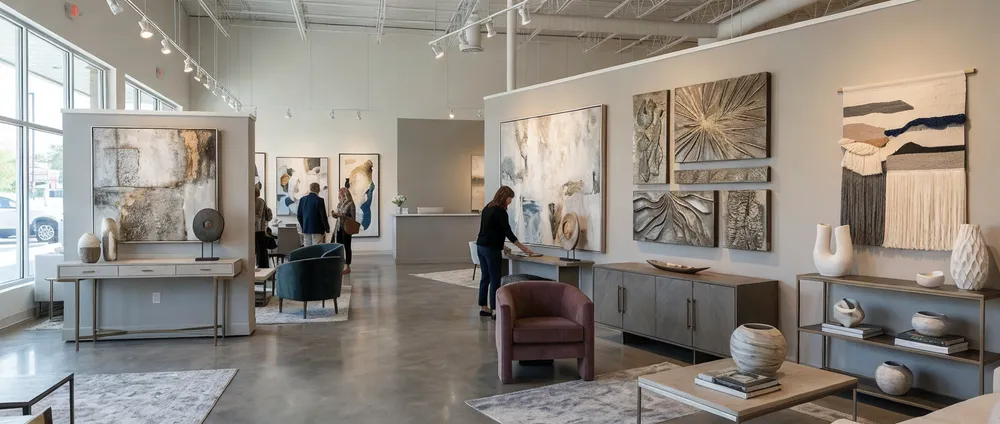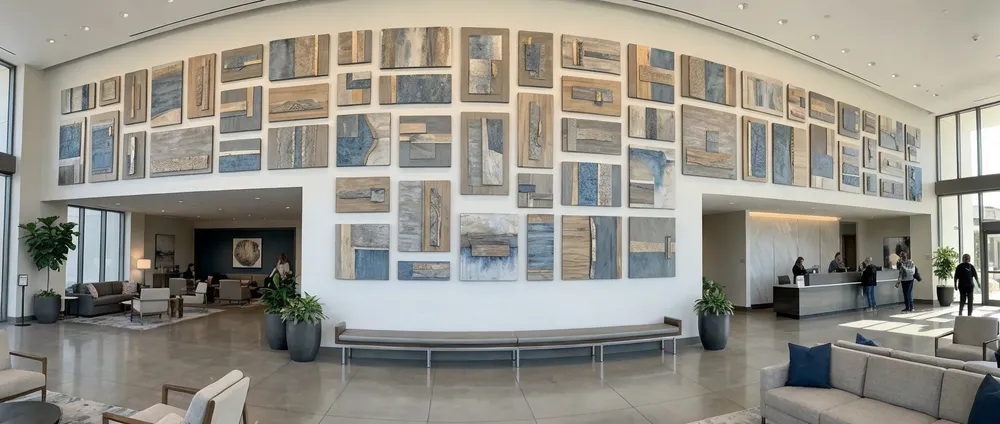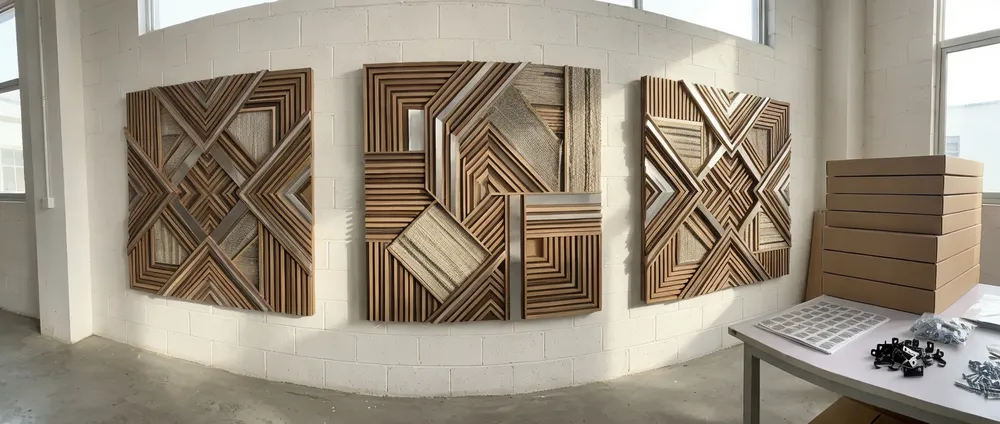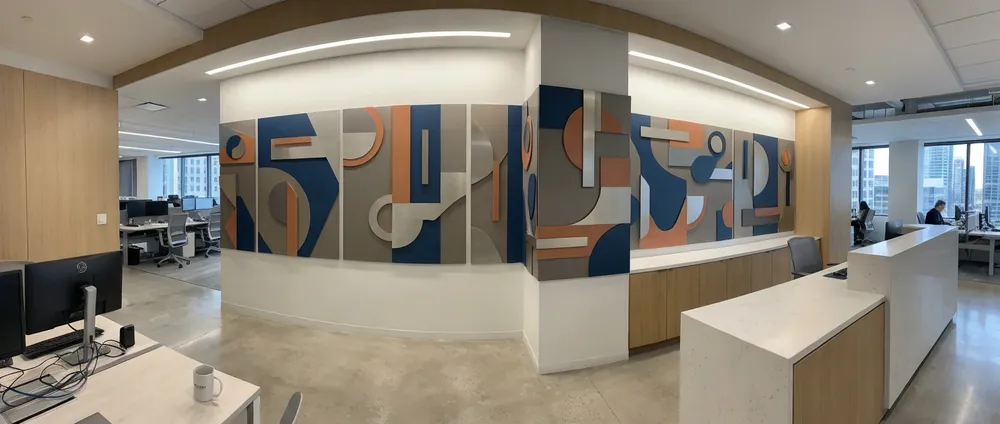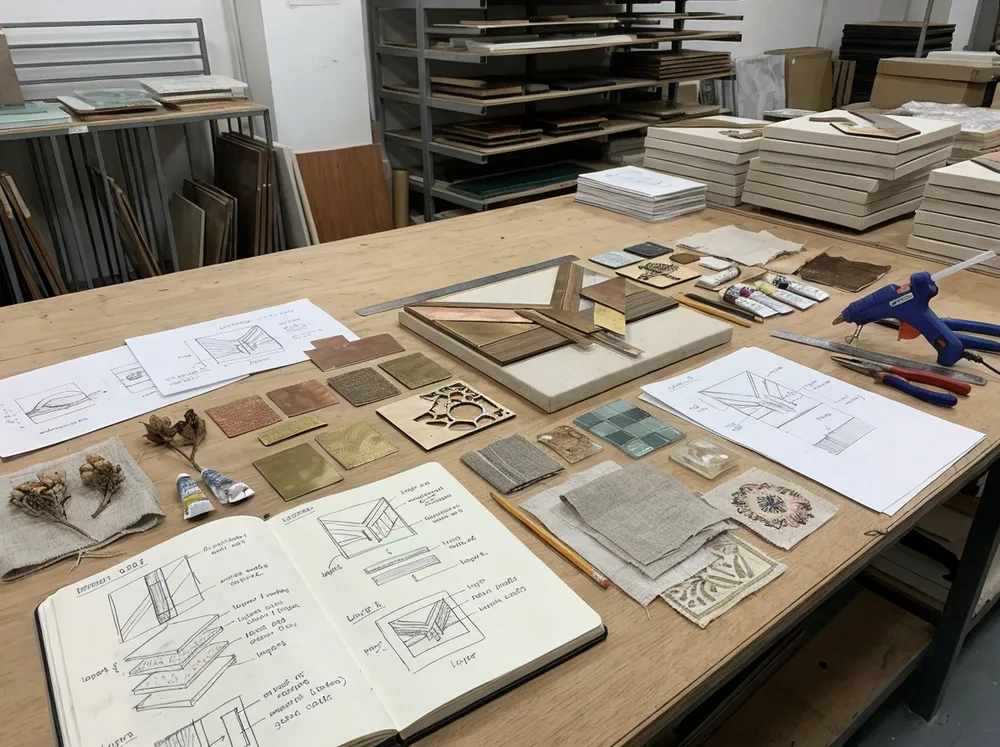
Collage elements, mixed typography, dimensional layering, and multi-substrate construction. These are the hero SKUs that anchor your catalog at premium price points — produced on the same floor where we run wall art programs for major North American and European retailers.
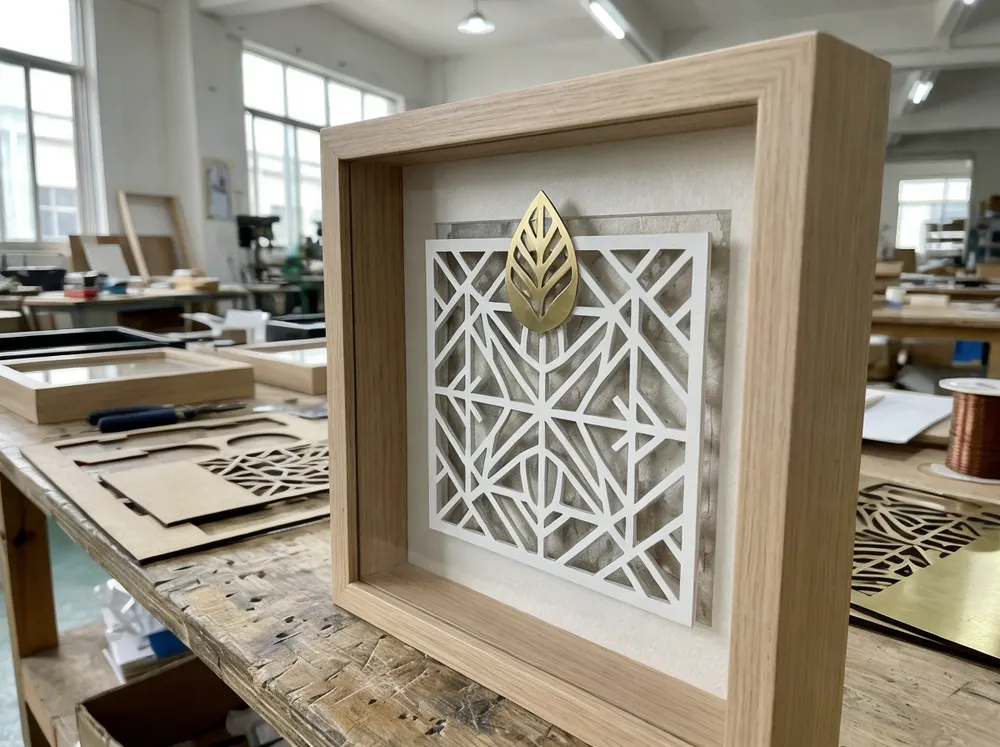
Creative wall arts are not a style variation — they're a different production category. Where a modern piece is a single printed canvas on a stretcher bar, and an abstract piece layers hand-applied texture over a printed base, creative wall art combines multiple techniques and materials in a single composition. Think collage elements bonded to canvas, typographic overlays on textured board, metal or wood accents integrated into a framed panel, or layered cutouts creating dimensional depth within a shadow-box frame.
The commercial distinction matters. These pieces retail at 3–5x the price of standard printed canvas wall art because the material complexity and hand-finishing labor are visible to the end customer. Your downstream buyers — whether they're interior designers, boutique retailers, or hospitality procurement teams — can see and feel the difference between a flat print and a multi-layer constructed piece. That perceived value translates directly into your markup room.
We produce creative wall arts as a distinct line because the production sequence is fundamentally different from our other style categories. The parent category page covers our general wall art manufacturing process — substrates, printing, texture application, framing. This page focuses on what changes when you're building a mixed-media piece, and why those changes matter for your sourcing decisions.
Most wall art factories handle creative pieces as a sideline — they print a canvas, glue something to it, and call it mixed media. We run creative wall art as a dedicated production stream because the assembly sequence is genuinely different, and trying to squeeze it into a standard canvas workflow is how you end up with delamination complaints six months after delivery.
Base Layer Foundation
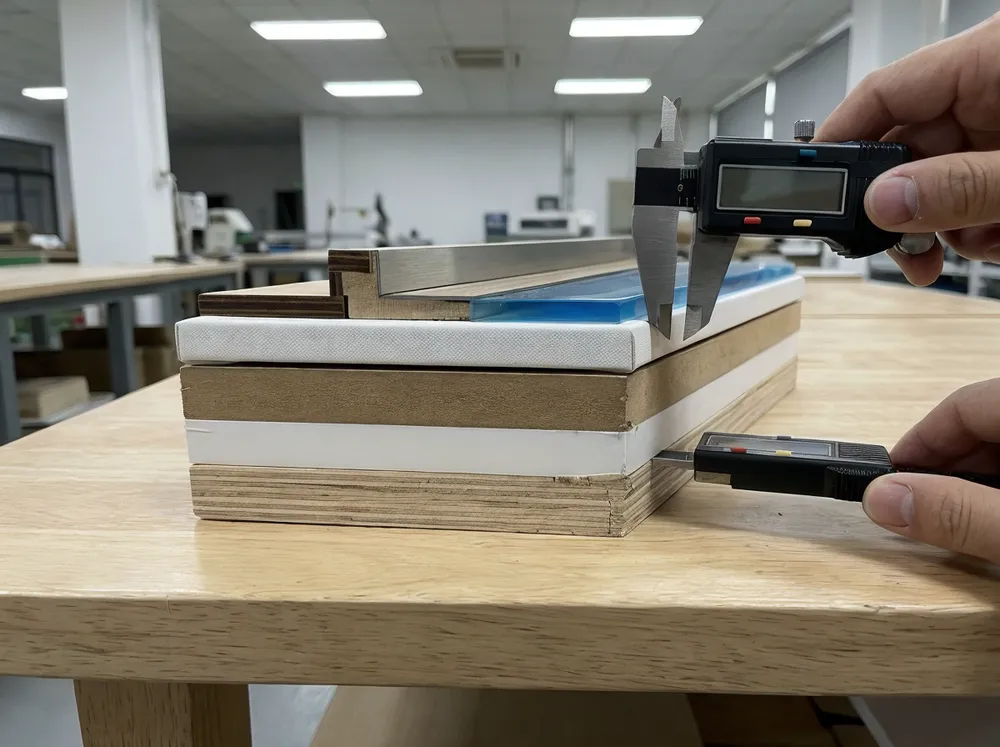
The base layer starts with substrate selection, and creative pieces rarely use a single substrate. A typical composition might pair a printed canvas panel with an MDF backing board, or layer laser-cut wood elements over a textured gesso ground.
The substrate choice drives the weight, the hanging hardware spec, and the frame depth — all of which affect your packaging and freight cost downstream.
Large-Format UV Stations
Printing runs through our large-format UV stations, but creative pieces often require multiple print passes on different layers that get assembled later. We calibrate color against Pantone references at batch start and pull verification prints every 200 units, same as our other lines.
The difference is that creative compositions frequently combine printed elements with hand-finished surfaces, so color matching between the printed and painted portions has to be managed carefully. Our color team mixes custom paint batches to match the UV output — we keep the formula on file for your reorders so the second run matches the first.
Batch Consistency: We've seen competitors' creative pieces where the hand-painted sections shift noticeably between production batches. Your retail buyer notices.
Where Creative Wall Art Diverges Most
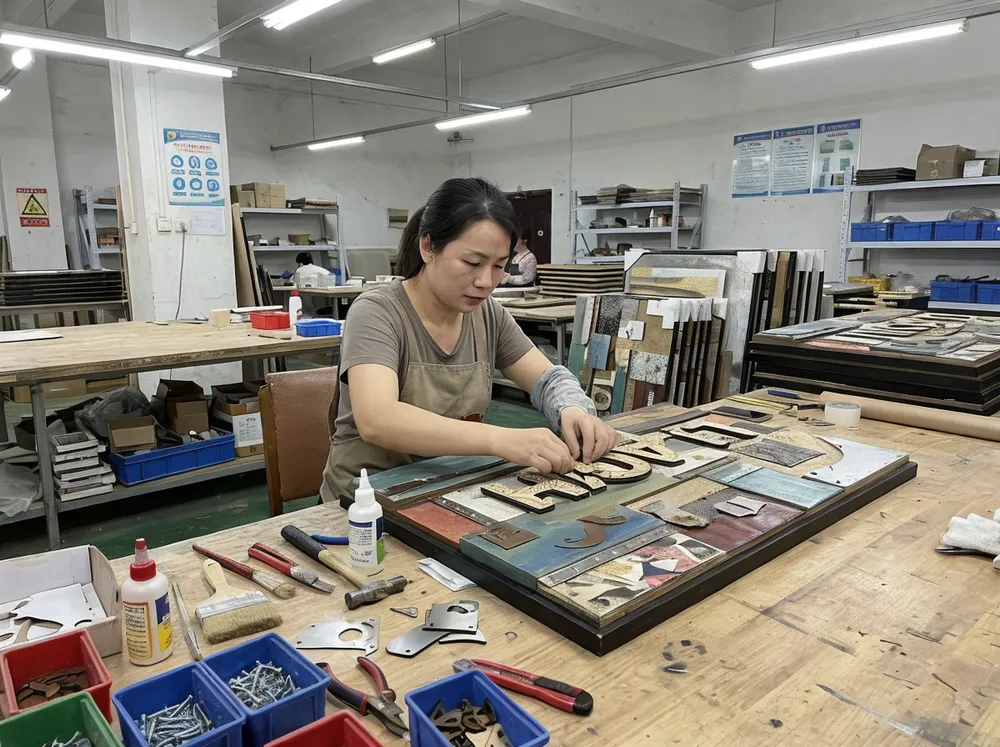
This is hand-work — our 12-person texture and assembly team handles the layering, bonding, and finishing that gives each piece its constructed quality.
Adhesive-bonded with industrial-grade PVA or contact cement depending on the substrate pairing
Either riveted or epoxy-mounted depending on weight
Screen-printed, vinyl-applied, or laser-cut and mounted with standoff spacers for shadow depth
Each technique has a different drying and curing cycle — a factor in your lead time and unit cost
Creative pieces move through production slower than flat canvas — we're transparent about this from the quoting stage.
Protective Topcoats
Final finishing typically involves a protective topcoat — matte or satin polyurethane for painted surfaces, clear lacquer for wood elements, and anti-fingerprint coating for metal components.
Shadow-Box & Deep-Profile
Creative wall arts almost always ship in shadow-box or deep-profile frames because the dimensional elements need clearance behind the glass or acrylic face.
We build these frames in-house — MDF, solid wood, and metal options — so the frame depth, profile, and finish are matched to the composition rather than forced into a standard catalog frame.
Send us a reference image or concept sketch — our engineering team will break down the production sequence and quote the exact unit cost at your target volume.
| Parameter | Standard Range |
|---|---|
| Base substrates | Stretched canvas, MDF (6mm / 9mm), canvas-over-board, rigid PVC, birch plywood |
| Standard sizes | 30×40 cm, 40×60 cm, 50×70 cm, 60×80 cm, 60×90 cm |
| Frame types | Shadow-box (40–80mm depth), deep floater, custom profile |
| Frame materials | MDF, solid wood (pine, paulownia), metal (steel, aluminum) |
| Dimensional elements | Laser-cut wood/MDF, sheet metal accents, resin castings, fabric/paper collage, vinyl typography |
| Surface finishing | Matte/satin polyurethane, clear lacquer, anti-fingerprint coating, hand-applied texture medium |
| Hanging hardware | D-ring (standard), French cleat (pieces over 5 kg), sawtooth (lightweight) |
| Piece weight range | 0.8–6 kg depending on size and material complexity |
| Print method | Large-format UV, giclée, screen print (for typographic elements) |
| Color matching | Pantone reference calibration, custom paint batch mixing |
Scroll table horizontally for full details. Notes column visible on larger screens.
These are our standard parameters. If your project calls for something outside these ranges — oversized panels for hospitality lobbies, ultra-lightweight construction for high-volume e-commerce shipping — send us the spec and we'll confirm feasibility and any cost impact.
Creative wall arts don't compete on price — they compete on perceived value and visual differentiation. That positioning maps to specific commercial channels where your buyers are already paying premium prices for wall decor that doesn't look mass-produced.
This is the highest-margin channel for creative wall art. Independent home stores, design showrooms, and online boutiques carry these pieces as statement SKUs — the items that draw foot traffic and anchor a display wall. Retail prices in this channel run $120–200+ for medium-format pieces, with your wholesale cost sitting at a fraction of that.
Interior designers order creative wall art for client projects where the piece needs to feel curated, not catalog-sourced. Volume per SKU is lower — 50 to 200 units per design — but the per-unit margin justifies the smaller runs.
MOQ flexibility: We handle MOQs as low as 100 pieces on standard constructions, so you can test a 3–5 design assortment without overcommitting inventory.
Hotels, restaurants, and co-working spaces use creative wall art for high-visibility placements — lobby feature walls, restaurant accent areas, boutique hotel room headboard installations. These are project orders: 100–500 pieces per property, typically 2–4 designs in coordinated colorways, with exact sizing to fit architectural dimensions.
The mixed-media construction reads as custom artwork at a fraction of commissioned art pricing, which is exactly the value proposition your hospitality procurement contacts respond to.
Consistency matters: We've produced coordinated creative wall art sets for hotel programs where every piece across 200+ rooms ships from a single production run — matched in color, frame finish, and dimensional element placement. Hospitality buyers care about unit-to-unit consistency more than almost any other channel. One mismatched piece in a hallway of 30 identical rooms gets noticed immediately.
Amazon, Wayfair, and independent Shopify stores all have a premium wall art tier where creative pieces outperform standard prints on conversion rate and average order value. The key for e-commerce is that the dimensional quality photographs well — shadow depth, material texture, and layered construction are visible in listing images and create a perceived value gap between your listing and the flat-print competition.
If you're building an e-commerce wall art program, creative pieces work as your high-AOV anchor SKUs while printed canvas fills the volume tier.
Retail-ready packaging: We configure retail-ready packaging with pre-installed hanging hardware, UPC barcodes, and branded inserts for this channel.
Design firms specifying wall decor for office fit-outs, medical facilities, and retail environments order creative wall art when the space calls for something beyond standard prints but the budget doesn't support original commissioned artwork.
These are specification-driven orders — exact color matching to an interior palette, custom sizing for specific wall dimensions, and delivery timed to construction schedules.
Design adaptation: Our 12-engineer design team handles the adaptation: you send a mood board or Pantone spec, we develop compositions that fit.
Tell us your target channel and retail price range — we'll recommend a creative wall art assortment based on what's performing for our existing distributors in your region.
Discuss Your Channel StrategyCreative wall art is inherently a customization-heavy category. Most of our creative line ships as OEM/ODM — your concept, your branding, your material spec.
Design development starts wherever you are in the process. Bring a finished design file, a rough concept sketch, a competitor product you want to improve on, or just a style direction and price target. Our design team develops the composition, selects materials, and produces a physical sample.
Sample turnaround: 18–21 days for mixed-media creative pieces — longer than standard canvas (10–14 days) because the dimensional elements require material sourcing and assembly prototyping.
Your original design or developed from your brief by our team
Any dimension within our cutting and framing capability — standard sizes ship faster, but custom sizing is straightforward since we cut, stretch, and frame in-house
Choose from our five base substrates or specify a combination for layered constructions
Metal type (steel, aluminum, brass-finish), wood species and finish, resin casting detail, fabric/paper selection for collage work
Shadow-box depth (40–80mm standard, deeper on request), material, and finish — we produce all frame types in-house
Matte, satin, gloss, or textured topcoat per element
Retail shelf-ready with barcodes and inserts, bulk palletized for project delivery, or white-label for your private brand
Using stocked substrates and frame profiles
MOQ 100 pieces · Production lead time 35–40 days after sample approval
Requiring new tooling
MOQ 300 pieces · Add 7–10 days for mold development
Resin castings or CNC-cut elements
MOQ 200 pieces · Add 10–14 days for tooling
Specialty metals, imported papers
Lead time varies — we'll confirm during quoting
If you're testing a new creative wall art line and want to minimize upfront commitment, start with designs that use our standard substrates and frame profiles. You get the mixed-media look at the 100-piece MOQ. Once the line proves out in your market, we can develop custom tooling for the next run.
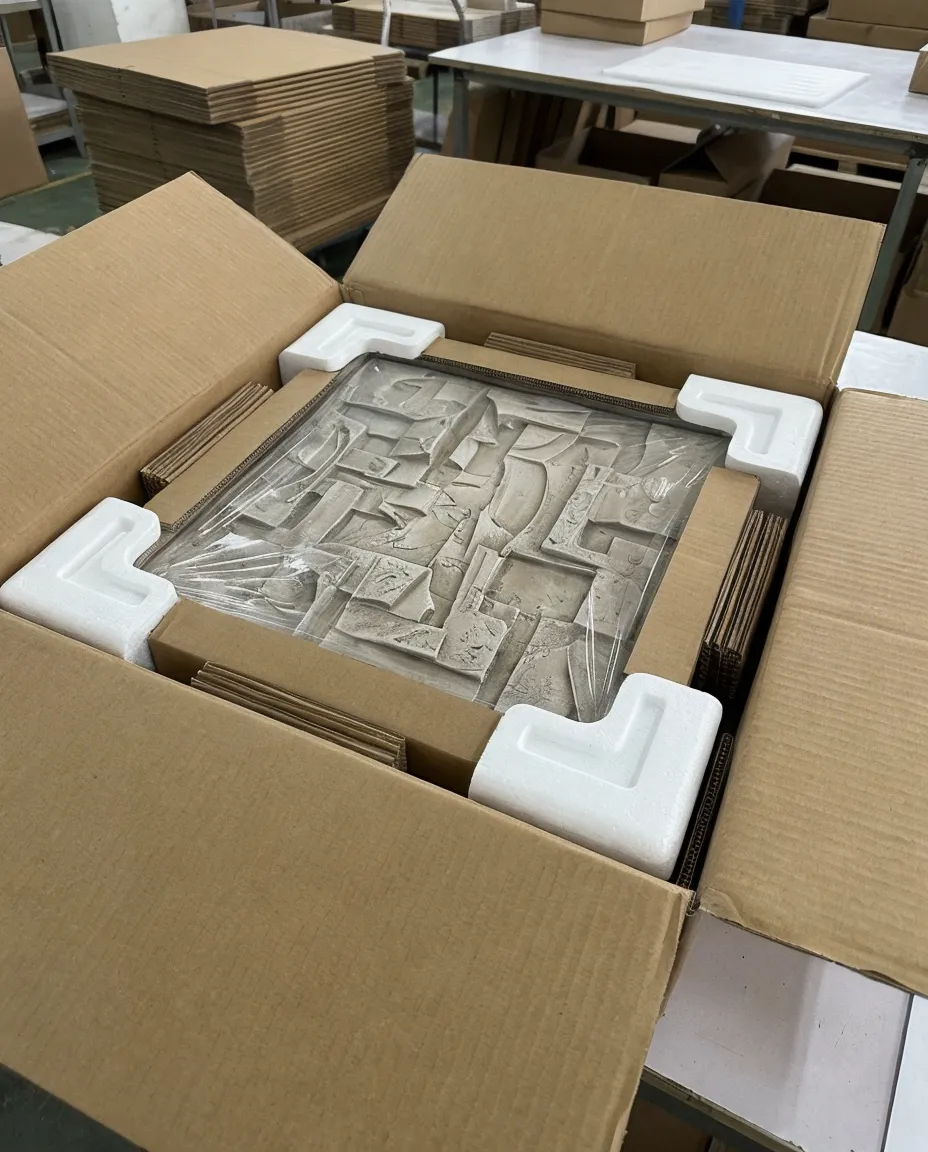
Creative wall art pieces are more packaging-sensitive than flat canvas because the dimensional elements can shift or break under compression. We've developed packaging configurations specifically for this line after learning what fails in transit across ocean freight and last-mile delivery.
Each piece gets individual corner protection with foam or molded pulp corners, poly-wrap to prevent surface scratching, and a corrugated carton sized to the piece with internal cardboard spacers that prevent the dimensional elements from contacting the carton walls. For shadow-box framed pieces, we add a foam insert behind the backing board to absorb compression from stacking.
Slightly higher than flat canvas due to dimensional complexity, but well within acceptable range for the category.
| Piece Size | Approx. Units per 40HQ | Notes |
|---|---|---|
| 30×40 cm | 1,000–1,200 | Depends on frame depth and packaging config |
| 50×70 cm | 600–800 | Shadow-box frames reduce density vs. flat canvas |
| 60×90 cm | 400–550 | Heavier pieces may require pallet stacking limits |
We configure mail-order packaging rated for carrier handling — double-wall corrugated with internal suspension that passes ISTA 3A drop testing.
We palletize and strap with protective layering, labeled by room or zone if your project requires it.
Shipping documents — commercial invoices, packing lists, certificates of origin — follow the format your freight forwarder and customs broker expect.
These three categories sit in the premium tier of our wall art line, and buyers sometimes ask which one fits their program best. The differences are real — in production method, price point, and target channel.
| Dimension | Creative Wall Arts | Abstract Wall Arts | Unique Wall Arts |
|---|---|---|---|
| Core technique | Mixed media — multiple materials and methods in one piece | Hand-applied texture over printed canvas base | Irregular shapes, unusual material combinations, one-of-a-kind elements |
| Substrate | Multi-substrate (canvas + board + dimensional elements) | Canvas-over-board or MDF panel | Varies widely — metal, reclaimed wood, mixed unconventional materials |
| Typical retail price | $80–200 | $50–120 | $150–400+ |
| Volume per SKU | Moderate (100–500 units) | Higher (300–2,000 units) | Low (50–200 units) |
| Best channel fit | Boutique retail, hospitality features, premium e-commerce | Home goods retail, e-commerce mid-tier, office interiors | Design trade, high-end boutique, collector market |
| MOQ | 100 pcs (standard construction) | 100 pcs | 100 pcs |
| Production lead time | 35–40 days | 30–35 days | 40–50 days |
If your program needs volume with visual impact, abstract wall arts give you hand-finished texture at a lower unit cost and faster turnaround.
If you serve interior designers or high-end boutiques where exclusivity drives the sale, unique wall arts push further into one-of-a-kind territory.
Creative wall arts sit in the middle — enough material complexity to justify premium retail pricing, enough production repeatability to support moderate volume runs.
For buyers building a full wall art assortment, creative pieces work as your hero SKUs alongside volume-tier modern or aesthetic lines.
The creative pieces draw attention and set your brand's quality perception; the simpler styles fill the catalog and drive reorder volume.
Creative wall art runs 40–70% higher per unit than comparable-size printed canvas, depending on the complexity of dimensional elements and the number of hand-finishing steps. The cost increase comes from material layering, longer assembly time, and shadow-box framing.
But the retail price differential is typically 3–5x, so your margin percentage actually improves on creative pieces even though your cost per unit is higher. We break down the cost structure in our quotes so you can see exactly where the money goes.
Yes. We run mixed-design orders regularly — most buyers order 3–8 creative designs per production run, with quantities split across the designs.
The MOQ applies per design (100 pieces minimum per design on standard constructions), not per order. If you're testing a new assortment, a 4-design order at 100 pieces each gives you 400 total units to evaluate sell-through before scaling.
Bonding method is matched to the material pairing. Metal-to-canvas uses industrial epoxy rated for shear stress above what shipping vibration produces. Wood-to-board uses PVA with mechanical fasteners as backup.
Every assembled piece goes through a pull test on dimensional elements during QC — we apply 2 kg of lateral force to each bonded element and reject anything that shows movement.
Our field return rate on element detachment is under 0.3% across all markets. (We developed this QC step after an early batch in 2019 where adhesive cure time was cut short during a rush order. Lesson learned — we don't skip cure cycles anymore, regardless of delivery pressure.)
For printed elements: high-resolution files at 300 DPI minimum — AI, PSD, TIFF, or print-ready PDF.
For dimensional elements that require CNC cutting or laser work: vector files in AI or DXF format with cut paths clearly defined.
If you're working from a concept rather than finished files, send whatever you have — reference photos, mood boards, rough sketches — and our design team will develop production-ready artwork. We provide a digital proof for your approval before cutting samples.
Our base materials — canvas, MDF, wood — are not inherently fire-rated. For hospitality and commercial projects that require fire compliance, we apply fire-retardant treatment to fabric and wood elements and can source FR-rated MDF.
We provide test reports for treated materials on request. If your project has specific fire code requirements (ASTM E84 Class A/B, BS 476, or local equivalents), tell us during quoting and we'll spec the materials accordingly.
ISO 9001:2015 covers our quality management system; SGS and CE documentation is available for your compliance files.
We archive every production spec: print color profiles, custom paint formulas, substrate and material sourcing details, frame profiles, and assembly sequence documentation.
When you reorder, we pull the archived spec and produce a confirmation sample before running the full batch. Turnaround on reorder samples is faster — typically 7–10 days since the development work is already done.
Color matching between batches is verified against the archived Pantone reference and a retained sample from your previous run.
Most buyers in this category start with a sample set — 2–3 designs produced as physical samples so you can evaluate material quality, dimensional construction, and packaging before committing to a production run. Sample cost is credited against your first production order.
Send your concept — a design file, a reference image, a competitor product you want to improve on, or just a description of the style direction and your target retail price point.