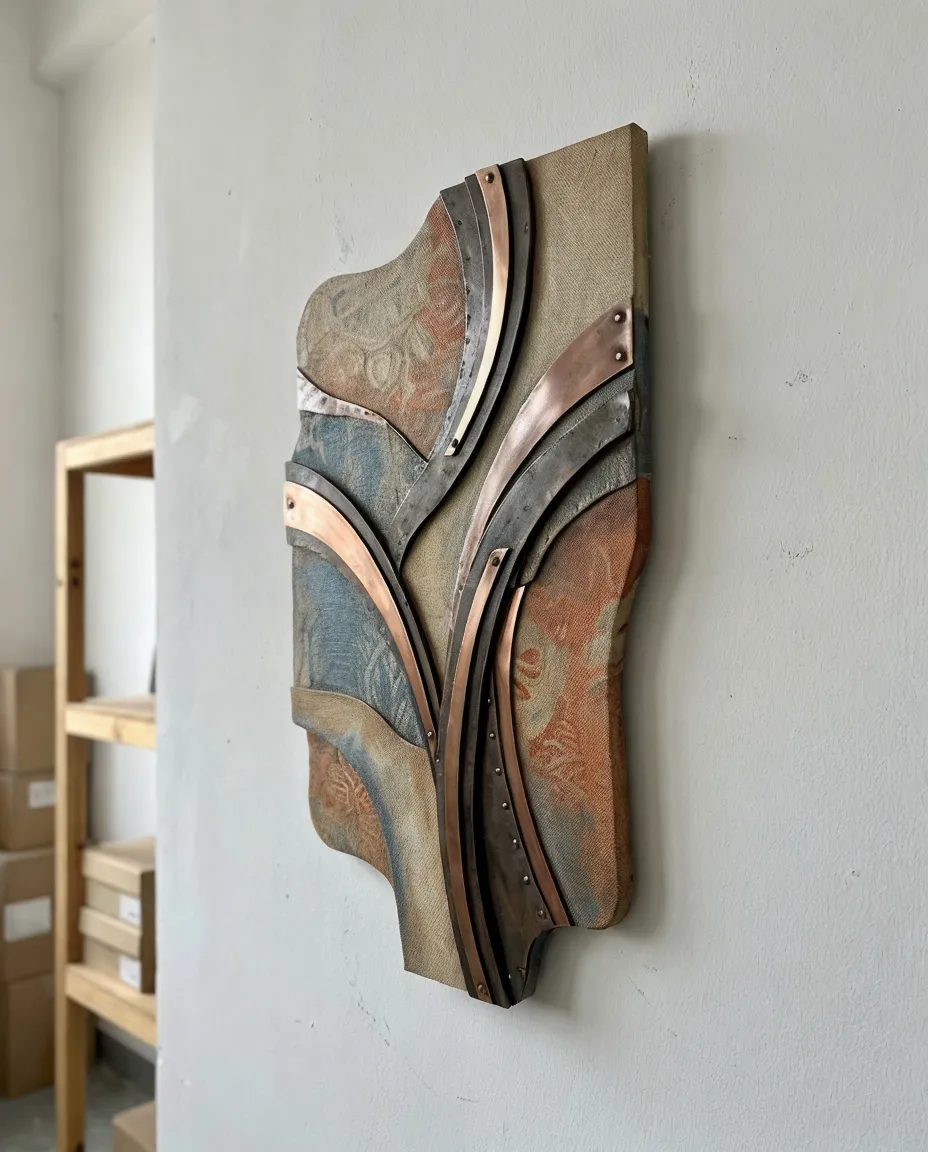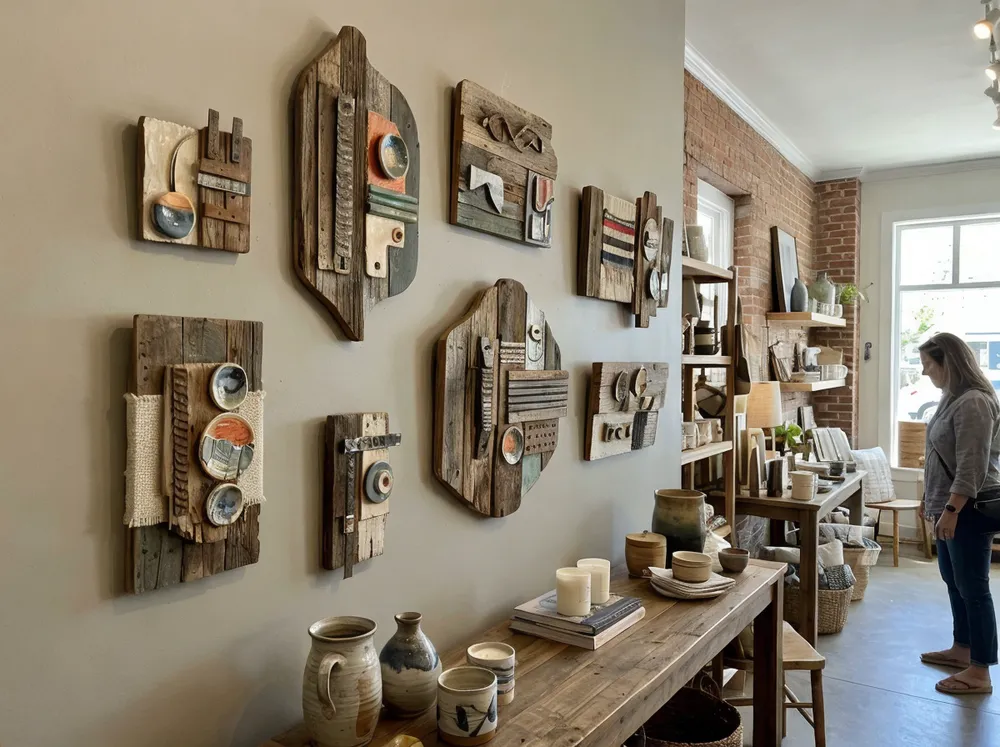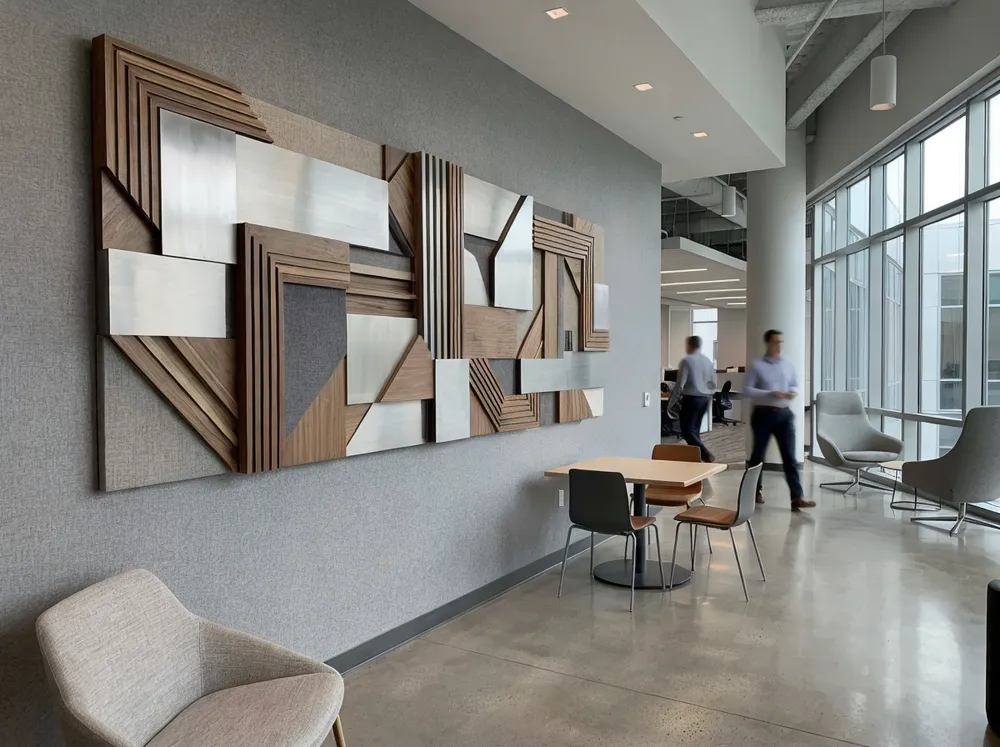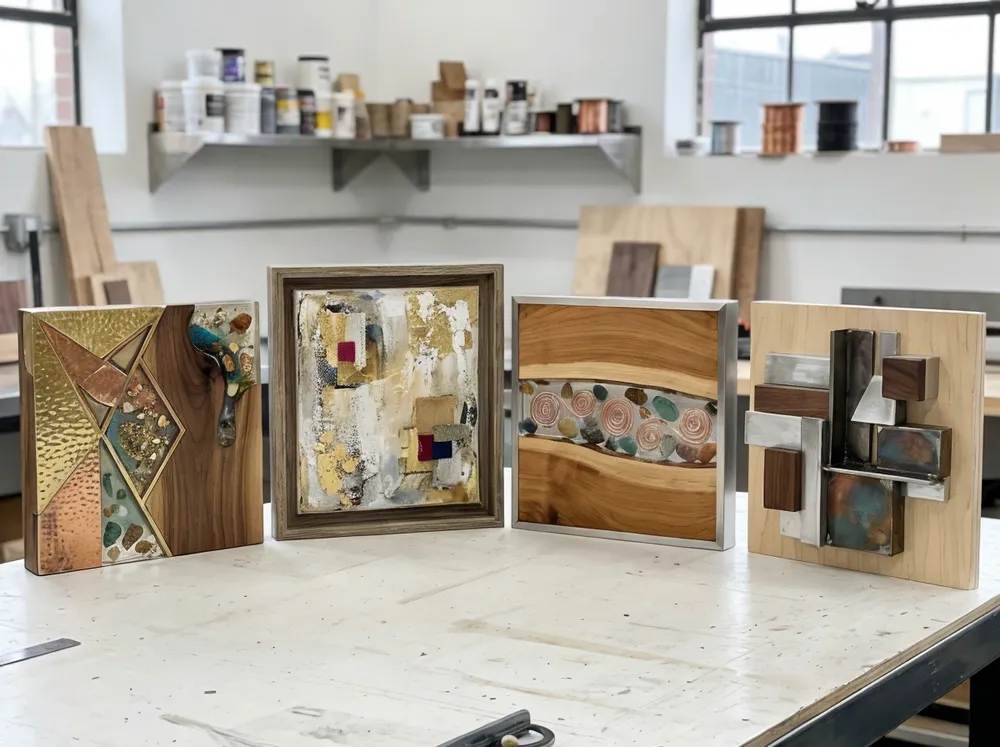
Every piece in this line combines at least two material families (metal + canvas, resin + wood, glass + hand-finished texture) in non-standard shapes. Your retail markup runs 3–5× above standard wall art — and the exclusivity holds because these designs can't be replicated on a flatbed printer.
Most wall art is flat. A printed canvas, a framed poster, a textured panel — all variations on the same rectangular format. Unique wall arts break that constraint. These are pieces built around irregular silhouettes, dimensional elements that project off the wall surface, and material combinations that don't show up in standard production catalogs. A single piece might pair hand-cut metal branches with canvas inserts, or combine cast resin forms with reclaimed wood framing on an asymmetric profile.
The commercial logic is straightforward: unique wall arts carry the highest per-unit margin in our entire wall art range. Volume per SKU runs lower than modern or abstract lines, but your markup potential is substantially higher because these pieces can't be price-compared against commodity alternatives on Amazon. When your customer walks into a showroom and sees a dimensional mixed-media piece with an irregular shape, they're not pulling out their phone to find it cheaper online. That's the margin protection built into the product itself.
We position this line specifically for boutique retail, interior design trade accounts, and hospitality feature installations. If you're building a catalog that needs hero SKUs — the pieces that anchor a collection and justify premium positioning for everything around them — this is the category.
Can't be price-compared against commodity alternatives — no Amazon equivalent exists.
Anchor pieces that justify premium positioning for your entire collection.
Boutique retail, interior design trade, hospitality feature installations.
Get a custom quote for unique wall art designs tailored to your market.
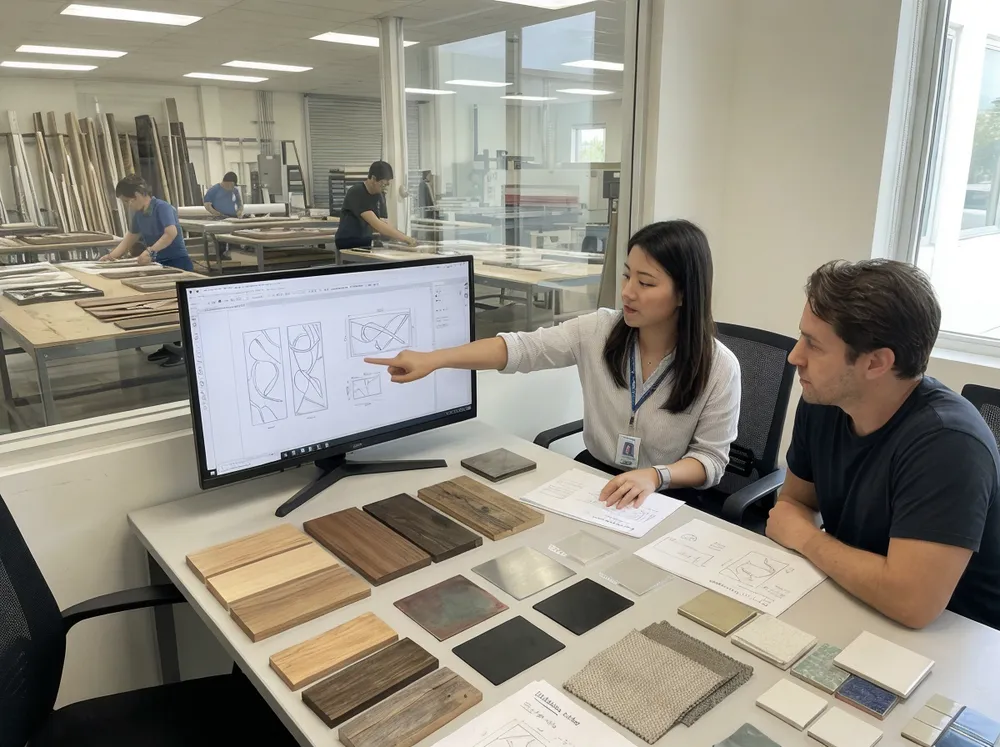
This is the most production-intensive category we run, and it's worth explaining what goes into it because the manufacturing complexity is exactly what protects your margin downstream.
A standard canvas wall art piece moves through our floor in a linear sequence: print, stretch, frame, pack. Unique wall arts don't follow that path. Each design requires its own assembly sequence because the material combinations change from SKU to SKU.
A piece with metal leaf elements over a textured canvas base goes through our metal fabrication station first — laser-cut or hand-cut steel or aluminum shapes, deburred, powder-coated or patinated — then those elements get mounted onto the canvas panel using a jig we build for that specific design.
The jig matters because dimensional alignment across a 500-piece run has to be consistent. Unit 1 and unit 500 need identical element spacing, or your retail display looks like five different products.
Our hand-finishing team does the bulk of the work on this line. They apply texture mediums in multiple passes, hand-position dimensional elements, and do the detail finishing that gives each piece its character.
Why we stopped automating: We tried automating parts of this process in 2022 — specifically the texture application step — and pulled back within a few weeks. The automated output looked automated, and our QC rejection rate jumped to over 20%. Hand application stays. The labor cost is higher, but the return rate from your end customers drops to near zero, which is the trade-off that actually matters for your margin.
Resin elements — cast forms, organic shapes, decorative accents — come from our in-house casting area. We pour and cure resin components on-site, which means we control the color consistency, surface finish, and dimensional accuracy.
Outsourcing resin casting was something we experimented with early on, and the batch-to-batch color variation made it unworkable for production runs where every piece needs to match.
Mixed-media assembly happens at dedicated stations separate from our standard canvas and mirror lines. Each station is set up for a specific design's assembly sequence, with component staging, adhesive curing time built into the workflow, and a final structural integrity check before the piece moves to packaging.
We test hanging hardware load capacity on every dimensional piece — these are heavier than flat canvas, and a piece that falls off a retail display wall is a liability problem, not just a quality problem.
These are our standard configurations. Every parameter on this table is adjustable through OEM/ODM — custom shapes, sizes, material combinations, and finishes are the norm for this line, not the exception.
| Parameter | Specification |
|---|---|
| Construction | Mixed-media: metal + canvas, resin + wood, glass + textured panel, or custom combinations |
| Shape Profiles | Irregular silhouettes, asymmetric forms, multi-panel configurations, circular/organic cutouts |
| Dimensional Depth | 3–12 cm from wall surface (varies by design; standard flat art runs 2–3.8 cm) |
| Base Substrates | MDF panel (12–18 mm), stretched canvas on kiln-dried pine bars, rigid board |
| Dimensional Elements | Laser-cut metal (steel/aluminum), cast resin, hand-formed wire, reclaimed wood, mirror glass inserts |
| Metal Finishes | Powder coat (any RAL color), patina (bronze, copper, verdigris), electroplated gold/silver, raw brushed |
| Surface Finishing | Hand-applied texture, multi-layer varnish, UV-resistant topcoat |
| Standard Sizes | 60×60 cm, 80×80 cm, 60×90 cm, 90×120 cm, multi-panel sets up to 150 cm total span |
| Weight Range | 2.5–8 kg depending on material mix and dimensions |
| Hanging System | Heavy-duty D-ring or French cleat (rated for 2x piece weight) |
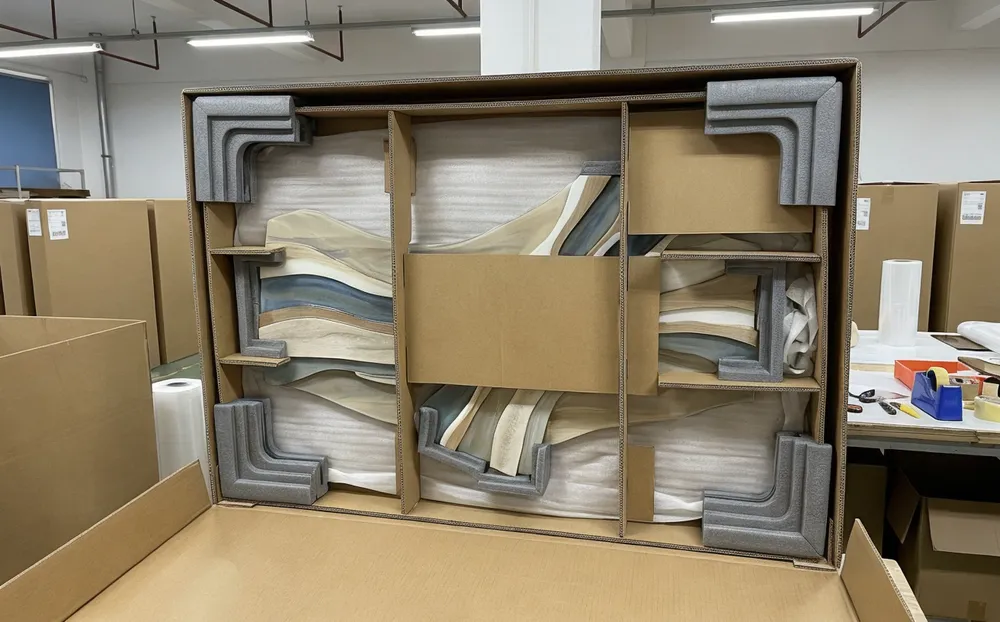
| Packaging | Individual foam-corner protection, poly-wrap, reinforced corrugated carton with internal bracing |
Each segment below represents a commercial channel where unique wall arts command premium pricing. The common thread: buyers in these channels pay for exclusivity and visual impact, not for wall coverage by the square meter.
This is the primary channel for unique wall arts. Independent retailers and curated home stores need pieces that differentiate their assortment from what's available on mass-market platforms. A dimensional mixed-media piece with an irregular silhouette can't be cross-shopped against a $29 canvas print on Amazon — it occupies a different category in the customer's mind.
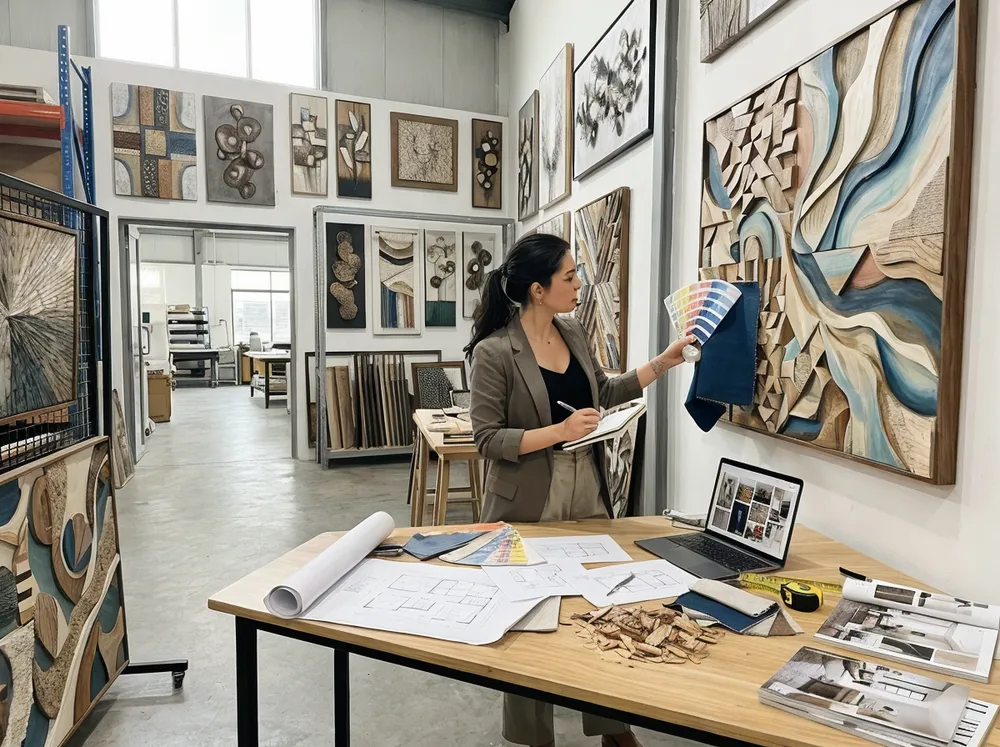
Design firms and independent designers source unique wall arts for residential and commercial projects where the wall piece is a focal element, not background decor. They need specific dimensions to fit designated wall spaces, color palettes that match their material boards, and the ability to order 5–15 units of a single design for a multi-room project.
We work directly with design trade accounts on custom colorways and sizing — your designer client sends a mood board, our team adapts an existing design or develops a new composition to match.
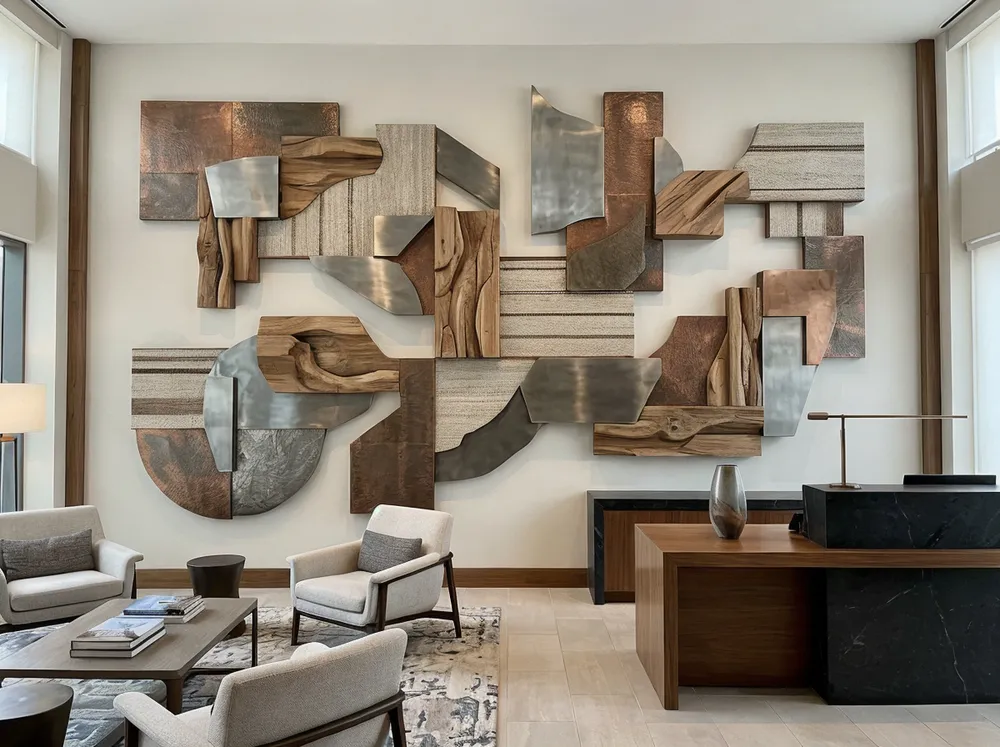
Hotels, restaurants, and high-end commercial spaces use unique wall arts as feature installations — lobby statements, corridor accent pieces, suite focal points. The buying pattern here is project-based: 50–500 pieces per property, consistent design language across the installation, custom sizing to architectural specifications.
What matters to the hospitality buyer is that every piece in a 300-unit order looks intentionally placed, not mass-produced. Dimensional mixed-media construction delivers that perception in a way flat prints cannot.
Office buildings, co-working spaces, and corporate campuses increasingly source statement wall art as part of their interior branding. Procurement runs through facilities management or interior design consultants, with orders of 30–100 pieces per project.
Corporate art budgets are allocated annually and tend to be less price-sensitive than retail — the decision is driven by design fit and vendor reliability, not by shaving $2 off the unit cost.
Tell us your target channel — we'll recommend designs that match your buyers' expectations and price points.
Unique wall arts are inherently custom. Unlike our modern or nature lines where 80% of orders ship from existing designs, this category runs roughly 60% OEM/ODM — your design concept, manufactured to your specifications.
Any profile our CNC router or laser cutter can produce. Irregular, organic, geometric, multi-panel configurations — send us a vector outline or even a hand sketch and we'll engineer it.
Mix and match from our in-house material families: metal (steel, aluminum), resin, wood (MDF, solid pine, reclaimed), canvas, mirror glass, textured board.
Any RAL color on metal elements, custom stain or paint on wood, Pantone-matched printing on canvas components. Patina finishes (bronze, copper, verdigris) available on metal.
Custom sizing from 30×30 cm single panels up to 200 cm multi-panel installations.
D-ring, French cleat, or integrated wire — specified to your market's wall-mounting standards.
| Customization Level | MOQ | Sample Lead Time | Production Lead Time |
|---|---|---|---|
| Existing design, standard size/finish | 100 pcs | 7–10 days | 30–35 days |
| Existing design, custom size or finish | 100 pcs | 10–14 days | 35–40 days |
| New design, standard materials | 200 pcs | 18–21 days | 40–45 days |
| New design, new material combination | 300 pcs | 21–28 days | 45–55 days |
Not every material combination works at production scale. These aren't arbitrary limits — they come from production runs where we learned what fails at volume versus what works on a single sample.
Resin elements thicker than 25 mm tend to develop micro-bubbles during curing in large batches — we cap resin depth at 20 mm for consistent quality.
Extremely thin metal cutouts (under 1 mm steel) warp during powder coating, so we recommend 1.2 mm minimum for any metal element that spans more than 15 cm unsupported.
We'd rather tell you upfront than ship 500 pieces with a 10% defect rate.
Send your design files or reference images — we'll confirm feasibility within 48 hours.
Flat canvas art ships easily. Dimensional mixed-media pieces with protruding elements, irregular shapes, and heavy metal components do not — and this is where a lot of suppliers lose your money.
A 2% breakage rate on a $15 canvas print is annoying. A 2% breakage rate on a $60 mixed-media piece wipes out your margin on the entire shipment.
A standard 40HQ fits 400–700 unique wall art pieces depending on size mix and dimensional depth. That's lower density than flat canvas (800–1,200 per container) because the packaging volume per piece is larger.
We optimize carton dimensions and pallet configurations for each order to maximize your container utilization.
Shelf-ready packaging with barcodes, branded inserts, and pre-installed hanging hardware.
Palletized by design/room zone and labeled accordingly for efficient on-site distribution.
Common questions from wholesale buyers evaluating unique wall arts for their catalog.
Creative wall arts blend techniques — collage, mixed typography, layered materials — but typically stay within a rectangular canvas format. Unique wall arts break the format itself: irregular shapes, dimensional elements that project off the wall, and material combinations (metal + canvas, resin + wood) that require separate assembly sequences.
The production complexity is higher, the per-unit cost is higher, and the retail margin potential is correspondingly stronger.
If your catalog needs statement pieces that anchor a collection, unique is the line. If you need visually distinctive pieces at moderate price points, creative wall arts may be the better fit.
If unique wall arts don't match your current sourcing need, these sibling categories may be a better fit:
Hand-applied texture on canvas, bold color fields. Higher volume per SKU than unique, strong markup potential, and the texture work still reads as premium at retail.
Unconventional compositions with collage and mixed-media elements, but in standard rectangular formats. A step down in production complexity and cost from unique, while still offering differentiation from commodity prints.
Clean geometry, neutral palettes. The volume backbone of most wall art programs — if you need consistent reorder velocity alongside your unique statement pieces, modern fills that role.
Most buyers new to this category begin with a 3–5 piece sample set across different material combinations — metal + canvas, resin + wood, dimensional texture — to evaluate construction quality, finish detail, and packaging before committing to a production run. Sample sets ship within 18–21 days.
If you already have a design concept, reference images, or a competitor product you want us to improve on, send it to allenliu@livewellcraft.com. Our engineering team will come back with a feasibility assessment, material recommendations, unit pricing at your target volume, and a production timeline — typically within 48 hours.