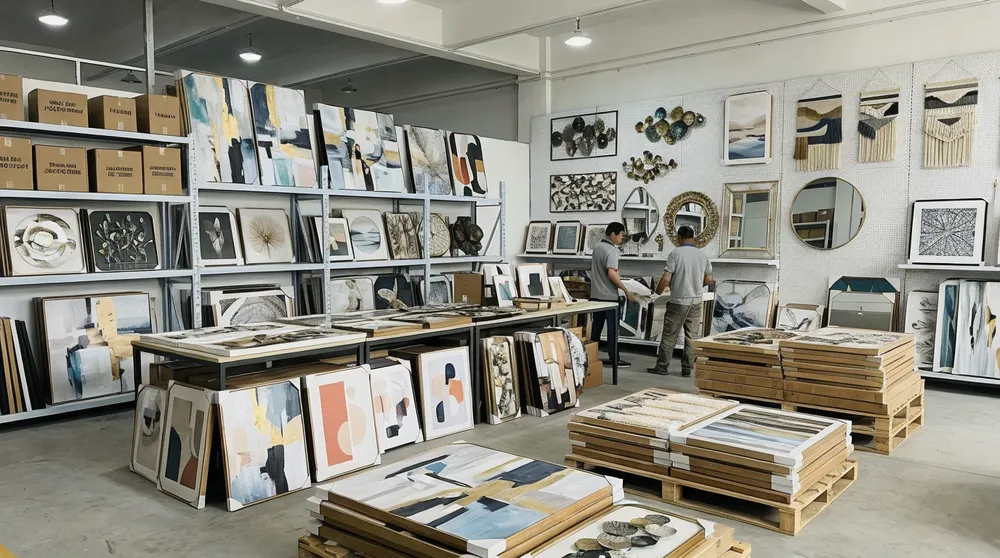
Livewellcraft produces wall arts by type across five distinct product lines, each with dedicated tooling, material sourcing, and finishing processes. One factory, full OEM/ODM capability, 100-piece MOQ on standard models.
We make wall art. Not just mirrors with decorative frames — actual wall art: hand-painted canvases, ink and charcoal drawings, cast and welded sculptures, large-format murals, and textured mixed-media panels. All five types come off our 12,000 m² production floor in Dong Nai, Vietnam, where 150 people run 6 lines producing roughly 400,000 pieces a year across our full mirror and wall decor catalog.
If you're sourcing wall arts by type for retail shelves, e-commerce listings, hospitality fit-outs, or project-based installations, this page breaks down each type — what we make, how we make it, and what that means for your order. Every type ships with the same QC standard: 100% visual inspection before packing, retail-ready or bulk-palletized to your spec.
We organize our wall art output into five types. Each one runs on its own workflow with dedicated stations, tooling, and finishing processes. The reason this matters to you: when you order paintings and sculptures in the same PO, both ship from the same facility on the same timeline. No coordinating between factories, no split shipments eating into your freight budget.
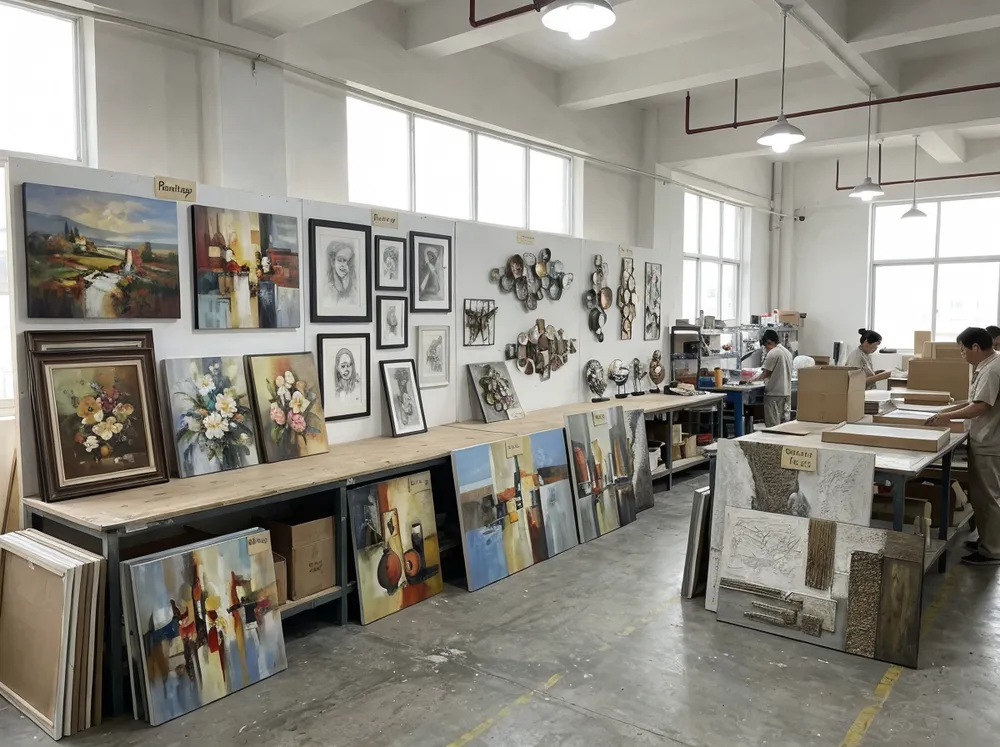
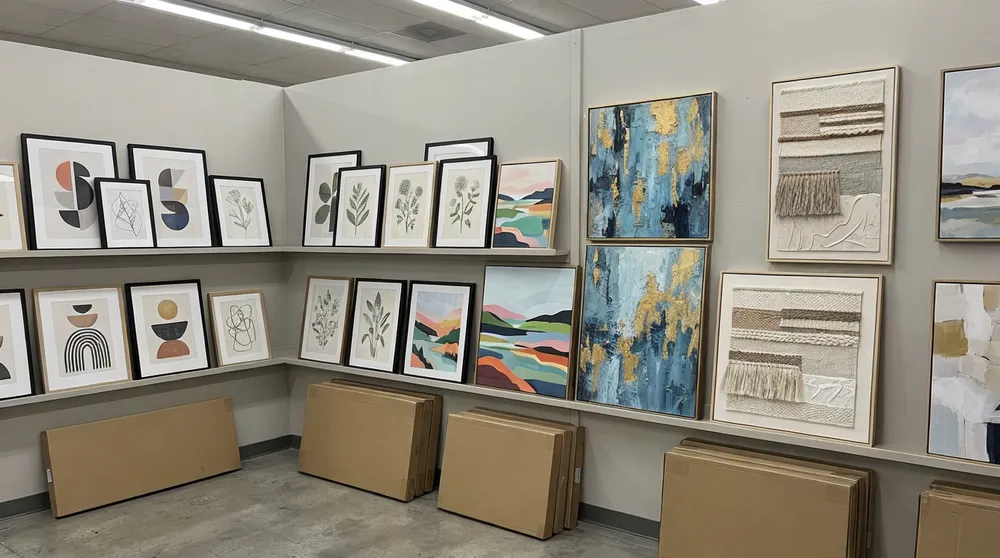
Hand-applied acrylic and oil on canvas, stretched over kiln-dried wooden frames. We run paintings from small 30×40 cm retail pieces up to 150×200 cm statement panels for hospitality projects. Our painters work from your reference artwork or our in-house design catalog — either way, color matching is controlled against Pantone references so your reorder matches your first batch. This is our highest-volume wall art type, and the one where OEM buyers typically start.
View Wall Arts Painting
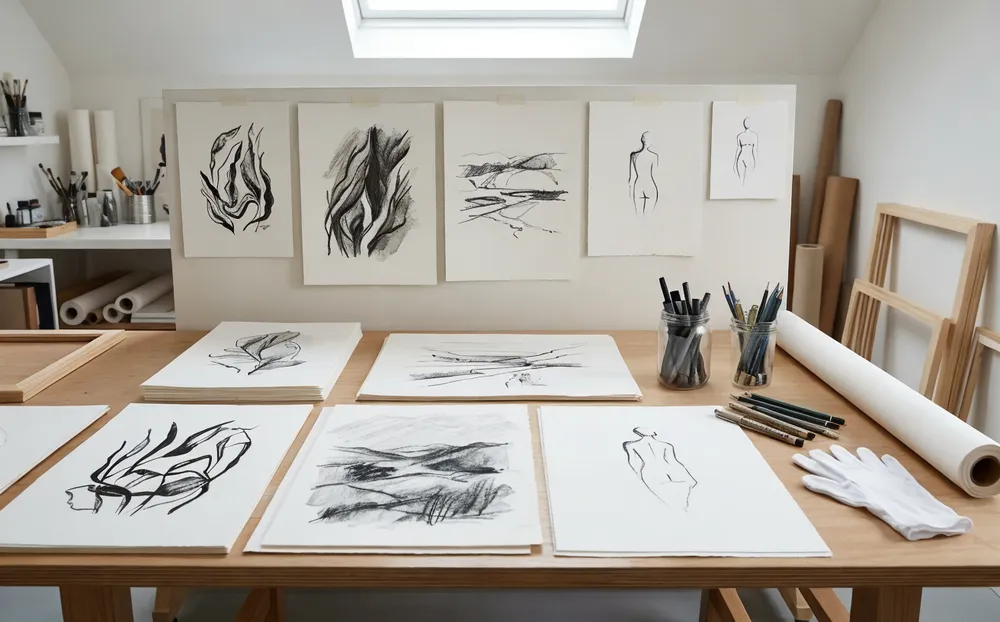
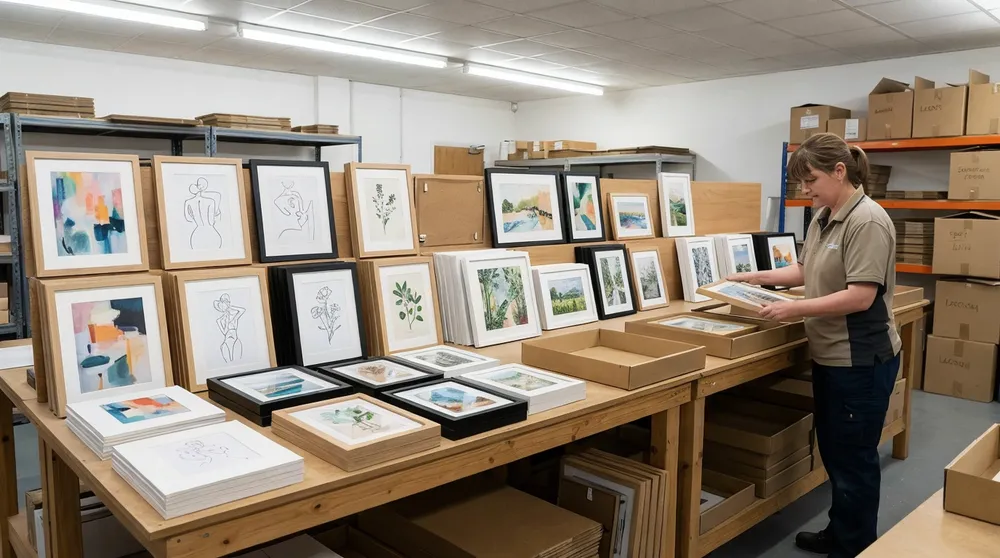
Ink, charcoal, pencil, and mixed-media drawings on archival-grade paper or canvas. Drawings occupy a different price tier than paintings — lower material cost per unit, faster production cycle — so they work well as volume SKUs in a curated wall art collection. We mount and frame in-house, which means your drawing arrives retail-ready, not rolled in a tube.
View Wall Arts Drawing
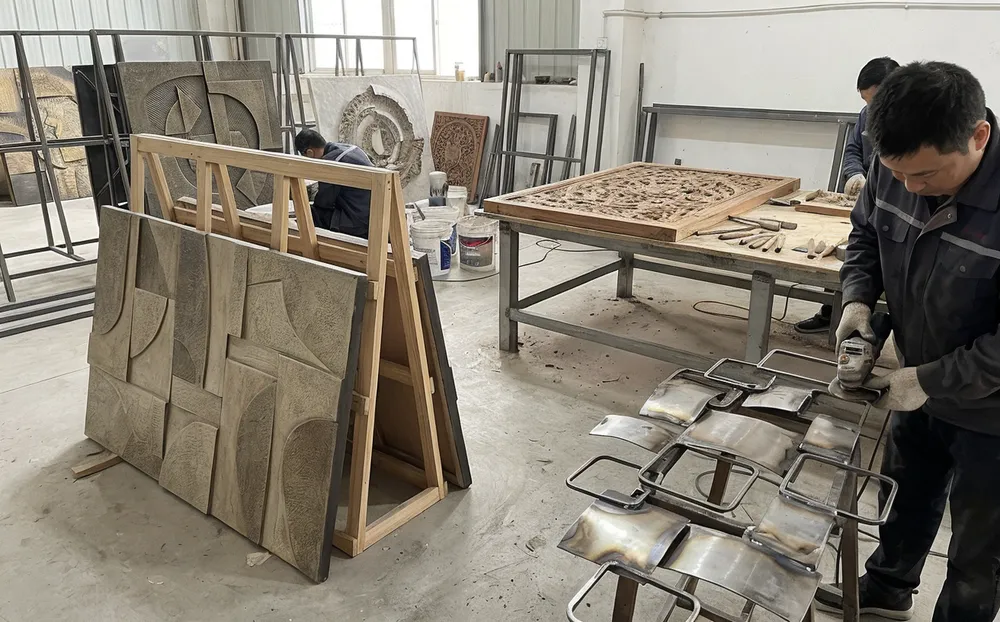
Cast resin, welded metal, and carved wood dimensional pieces designed for wall mounting. Sculptures carry the highest perceived value per unit in a wall art line, so your margin per piece is typically stronger here than on flat art. We handle the structural engineering — mounting hardware, weight distribution, wall anchor specs — so your end customer gets a piece that installs cleanly without callbacks.
View Wall Arts Sculpture
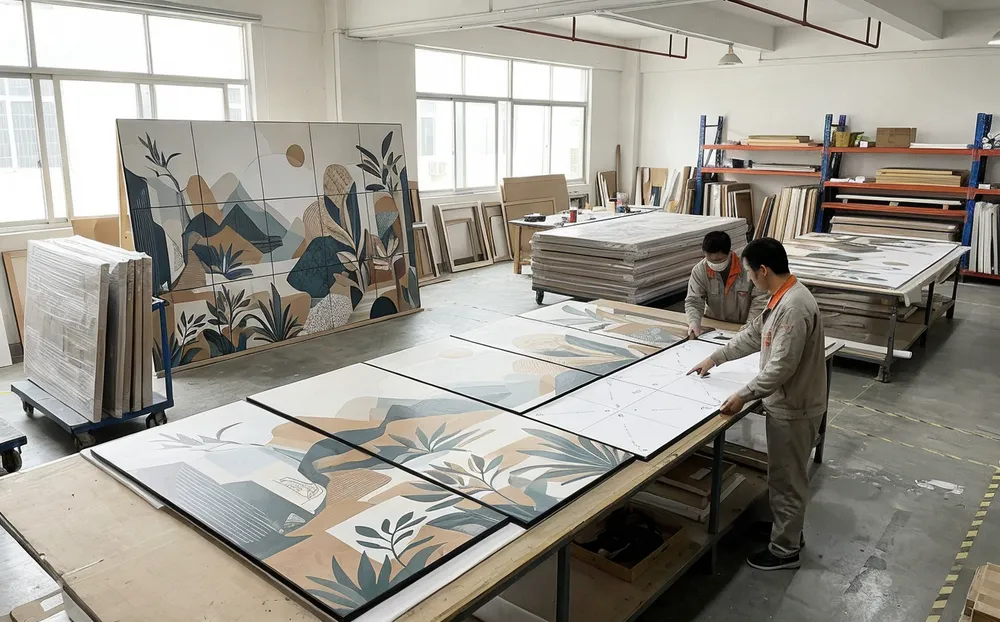
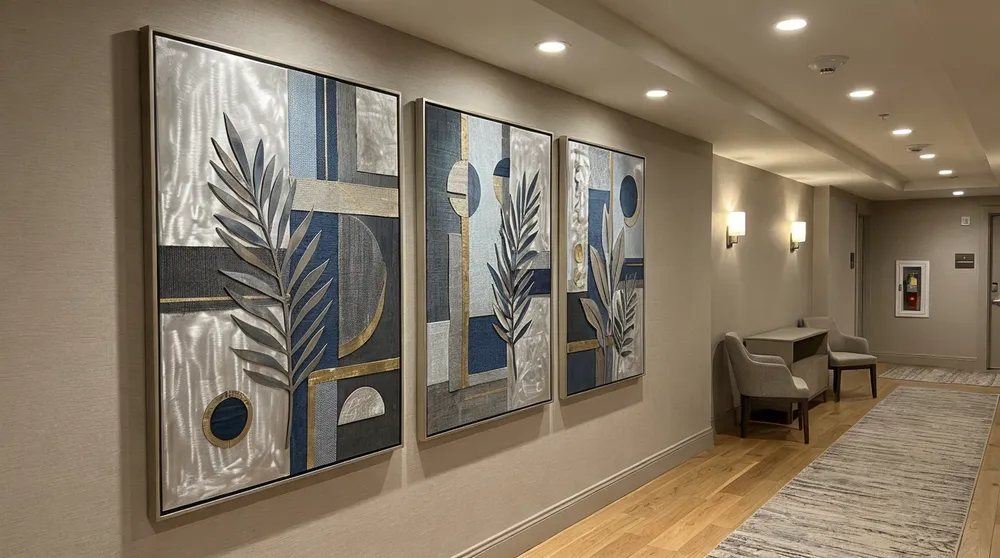
Large-format and multi-panel compositions designed for feature walls. Murals are project-driven — hotel lobbies, restaurant interiors, corporate offices — and the orders tend to be custom-spec with specific dimensions and color palettes. We produce murals as single oversized panels or as tiled multi-panel sets with alignment guides printed on the backing, so your installer gets clean seams without guesswork on site.
View Mural Wall Arts
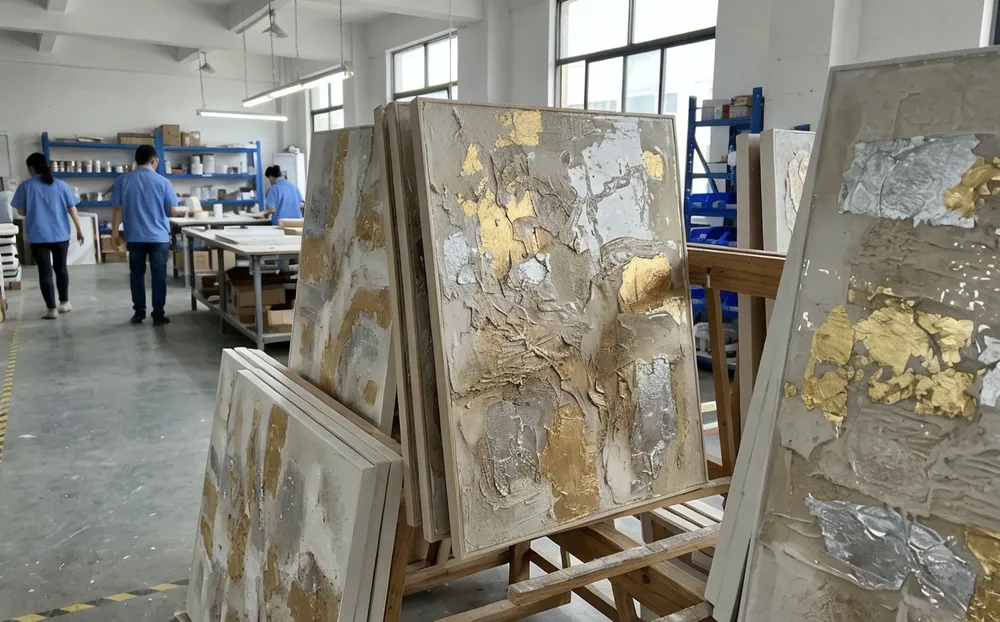
Mixed-media panels with built-up surface texture — plaster, sand, metallic leaf, fabric, resin layering. Texture wall arts are the fastest-growing segment in our order book. The tactile surface quality is difficult to replicate with printing, which gives your product listing a defensible position against mass-printed competitors. Each piece goes through 3-5 layering passes with drying time between coats, so we schedule texture runs in dedicated batches to keep your lead time predictable.
View Texture Wall ArtsWall art sourcing gets complicated fast because each type uses different substrates, media, and finishing methods. Here's how we handle the material chain — and where it affects your pricing and quality.
We source cotton-linen blend canvas for paintings and drawings — it holds pigment better than pure cotton and doesn't sag over time under humidity shifts. Stretcher bars are kiln-dried pine, not air-dried.
The difference shows up 6 months after delivery: air-dried frames warp as they lose residual moisture, and your customer sends it back. Kiln-dried stock stays flat.
Why we switched: We moved to kiln-dried exclusively in 2016 after a batch of returns from a Florida distributor — humidity there is unforgiving.
Resin casting uses polyurethane resin with UV stabilizers for pieces that will hang near windows or in sun-exposed retail displays. Metal sculptures are mild steel or aluminum, MIG-welded and powder-coated at 60-80 μm thickness.
We test every welded joint for structural integrity before finishing — a wall-mounted sculpture that drops is a liability claim, not just a return.
Our texture wall arts use a proprietary layering sequence:
The sealant matters for your retail buyers — it prevents flaking during shipping and handling, which is the number-one complaint we hear about texture art from other suppliers.
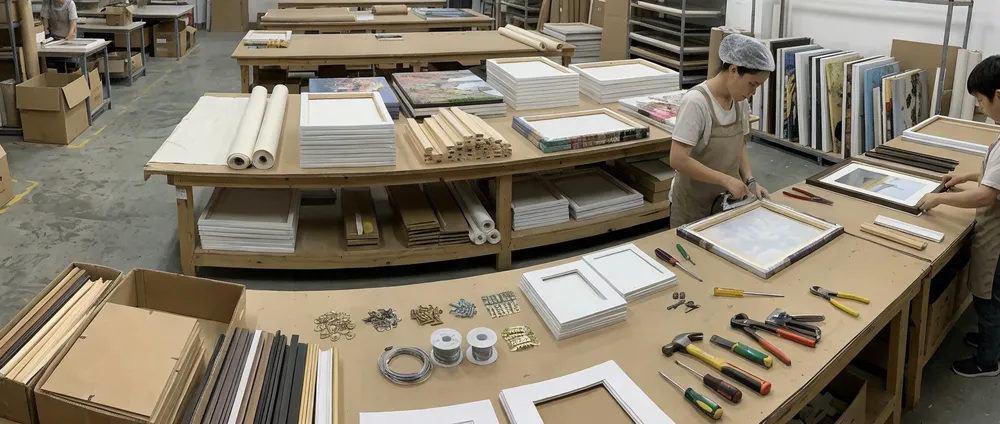
All frame stock — MDF, solid wood, metal — is produced on our mirror frame lines, so wall art frames benefit from the same equipment and QC process we run for our decorative mirror business.
Hanging hardware is rated for 2× the piece weight as a safety margin, and we include wall anchor kits for pieces over 5 kg.
From raw canvas to finished frame — every material choice impacts your landed cost and long-term customer satisfaction.
| Component | Standard Spec | Upgrade Option |
|---|---|---|
| Canvas | Cotton-linen blend, 380 gsm | Pure linen, 450 gsm |
| Stretcher bars | Kiln-dried pine, finger-jointed | Solid pine, mortise-and-tenon |
| Sculpture resin | Polyurethane with UV stabilizer | Fiberglass-reinforced polyester |
| Metal sculpture | Mild steel, powder-coated | Aluminum, anodized or brushed |
| Texture sealant | Acrylic matte topcoat | UV-resistant polyurethane gloss |
| Hanging hardware | D-ring + wire (rated 2× weight) | French cleat system |
Your unit cost shifts depending on which column you're in. We quote both options so you can position SKUs at different price tiers within the same collection.
Each wall art type maps to specific commercial channels. Knowing which types sell into which segments helps you build a product line that covers your market without cannibalizing between SKUs.
Paintings and drawings are your volume movers here — they photograph well for online listings, ship flat, and hit accessible price points.
Texture wall arts are gaining traction in the $80-200 retail bracket because the tactile surface reads as premium in listing photos and unboxing videos.
Proven combination: If you're building an Amazon or Wayfair catalog, a mix of paintings for volume and texture pieces for average order value lift is a proven combination among our current buyers.
Hotels, restaurants, and corporate offices buy murals and sculptures for statement installations. These are project orders — typically 20-100 pieces per property, custom-sized to specific wall dimensions, with color palettes matched to the interior design scheme.
Your margin per piece is higher, and the reorder cycle follows property renovation schedules (every 5-7 years for hotels).
Sales support: We supply spec sheets and installation guides formatted for the general contractor, so your sales team has the documentation ready at the bid stage.
Distributors supplying brick-and-mortar home décor retailers need breadth — multiple types, multiple sizes, multiple price points from one supplier.
Consolidating your wall art sourcing with a single factory that produces all five types cuts your inbound logistics cost and simplifies your vendor management. One PO, one shipment, one quality standard across the full assortment.
Drawings and small-format paintings move well in the gift and art print market. MOQ at 100 pieces per design lets you test new artwork in your catalog without deep inventory commitment.
We can produce the same composition across multiple sizes — a 30×40 cm and a 60×80 cm version of the same artwork — so you offer size options without doubling your design development cost.
Share your distribution channels and customer segments — we'll recommend the right wall art type mix for your product line.
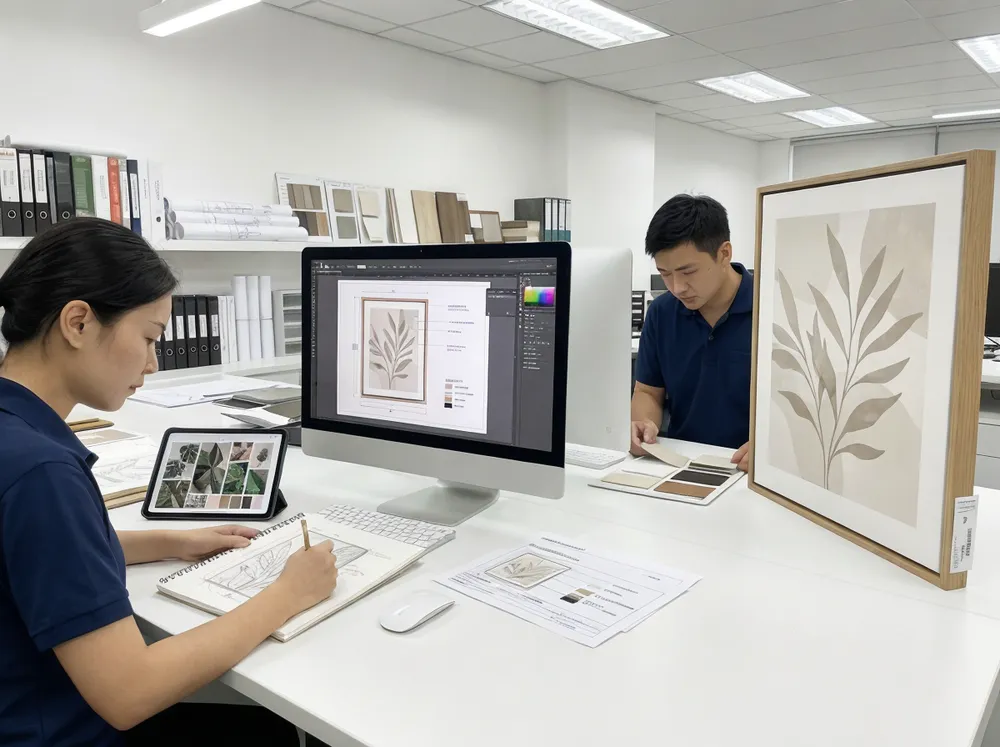
Get Type Mix RecommendationsOur 12-engineer design team handles custom wall art development in-house. You send a concept — a reference image, a mood board, a competitor sample, a rough sketch — and we develop it into a production-ready specification with material callouts, dimensions, color references, and packaging design. Typical development cycle from concept approval to pre-production sample is 15-20 days.
We sign NDAs as standard practice on OEM orders. Your designs stay yours — we don't catalog them, show them at trade fairs, or offer them to other buyers.
Any size from 20×20 cm to 200×300 cm (murals can go larger as multi-panel sets)
Pantone-matched to your brand or interior scheme
Custom molding profiles, any RAL color, wood stain, metallic leaf, or raw finish
Canvas weight, paper type, resin formulation, metal gauge — matched to your price point
Retail shelf-ready with your UPC and branding, or bulk-packed for project delivery
D-ring, sawtooth, French cleat, or keyhole — specified per piece weight and your market's installation preference
For ODM, we maintain a rolling catalog of 200+ original designs across all five types that you can private-label. Pick a design, specify your frame and size, add your brand packaging, and you have a market-ready SKU without the design development timeline. Most of our e-commerce buyers start here and move to full OEM once they've validated demand.
Running five wall art types under one roof means five different QC protocols — you can't inspect a sculpture the same way you inspect a canvas painting. Here's how we handle it.
Color accuracy checks against the approved sample under D65 standard lighting. We check canvas tension, stretcher bar squareness, and frame fit. Every piece gets a surface inspection for drips, uneven brushwork, or pigment inconsistency.
On a 2,000-piece painting order, we pull 8% for detailed inspection and 100% get a visual pass before packing.
Structural test — we mount each piece on a test wall using the included hardware and apply 2× rated load for 60 seconds. Any flex, loosening, or hardware deformation and the piece gets pulled.
Cross-hatch test on powder-coated metal for coating adhesion, resin bubble void inspection, and paint coverage verification on detailed areas.
Dry-assembled in our QC area to verify panel alignment, color continuity across panels, and dimensional accuracy.
A 3-panel mural where panel 2 is 2 mm short creates a visible gap on the wall — we catch that before it ships.
Surface adhesion test — we apply and remove adhesive tape to verify that no aggregate or texture material lifts off. The sealant topcoat is checked for uniform coverage.
This test alone eliminates the most common texture art complaint: flaking particles in the box on arrival.
All types share the same final-stage checks before shipment:
Wall art is fragile. A painting with a dented corner or a sculpture with a chipped finish is a return, not a sale. We've spent years refining our packaging to bring damage rates below 0.3% on ocean freight — here's what that looks like in practice.
Ship in individual corrugated cartons with foam corner protectors and a poly sleeve over the frame face. For retail, we add your branded insert card and UPC label. Paintings stack flat in containers — a standard 40HQ holds approximately 2,400 pieces at 60×80 cm, depending on frame depth.
Get custom foam inserts molded to the piece profile. Each sculpture sits in a double-wall carton with the foam insert absorbing impact from any direction. We run a 60 cm drop test on packed sculpture cartons — if the piece survives that, it survives port handling.
Ship in reinforced flat crates for oversized panels, or in multi-piece carton sets with panel numbering and orientation arrows. We include an assembly diagram in every mural shipment so your installer or end customer knows exactly which panel goes where.
Require extra care because the raised surface is vulnerable to compression damage. We use rigid spacer frames inside the carton that keep the texture surface from contacting any packaging surface. It adds slightly to your carton volume, but it eliminates the surface damage that makes texture art risky to ship.
| Wall Art Type | Typical Carton Size (60×80 cm piece) | 40HQ Loading Estimate | Packaging Method |
|---|---|---|---|
| Painting | 65×85×8 cm | ~2,400 pcs | Foam corners + poly sleeve |
| Drawing | 65×85×6 cm | ~2,800 pcs | Foam corners + glassine sheet |
| Sculpture | Varies by profile | ~800-1,200 pcs | Custom foam insert, double-wall |
| Mural (per panel) | Custom to spec | Project-dependent | Flat crate or reinforced carton |
| Texture | 65×85×12 cm | ~1,600 pcs | Rigid spacer frame, no surface contact |
We generate packing lists and loading plans before production starts, so you can confirm container utilization and freight cost before committing to the order.
If you're building or expanding a wall art catalog, the type mix matters more than the individual SKU count. Here's how we advise buyers based on what we see working across our export markets.
Begin with paintings and texture wall arts. Paintings give you breadth — landscapes, abstracts, botanicals, portraits — at accessible price points with fast production turnaround.
Texture pieces give you a premium tier that justifies higher retail pricing and differentiates your catalog from print-on-demand competitors.
Two types, two price tiers, one supplier.
Sculptures and drawings complement mirrors well in retail displays and online collections.
Sculptures share visual language with decorative mirrors (metallic finishes, geometric forms, dimensional presence on the wall), so your existing customer base already understands the aesthetic.
Drawings add an artisanal, gallery-adjacent feel at a lower price point than paintings.
Murals and large-format paintings are your project types. Tell us the wall dimensions, the interior design direction, and the quantity — we'll develop options and quote accordingly.
Project orders typically run 15-100 pieces with custom specifications, and we handle them on a dedicated production schedule separate from our standard catalog runs.
If you're unsure which types fit your market, send us your current catalog or target customer profile. We'll recommend a type mix based on what's moving for similar buyers in your region.
Get RecommendationsEvery problem below has cost our competitors' buyers money, time, or customer trust. We've engineered our processes to eliminate each one.
The problem: Your reorder doesn't match your first shipment. This is the most frequent complaint in wall art sourcing.
Our prevention: We maintain physical color reference samples for every active SKU and check each production batch against them under standardized D65 lighting. For paintings, our artists mix pigments to a recorded formula, not by eye. Your batch 3 matches batch 1.
The problem: Cheap texture wall arts use inadequate sealant or skip it entirely. The aggregate layer separates during the vibration and temperature swings of ocean freight, and you open the container to find particles loose in the cartons.
Our prevention: Our sealant topcoat is applied in two passes with full cure time between coats, and we run adhesion tape tests on every batch before packing.
The problem: A wall sculpture that falls is a safety issue and a liability claim.
Our prevention: We rate all mounting hardware at 2× the piece weight, test every unit on a mock wall, and include detailed installation instructions with wall anchor specifications. Your end customer — or their installer — gets a piece that stays on the wall.
The problem: Low-quality stretcher bars absorb moisture and warp, loosening the canvas tension.
Our prevention: We use kiln-dried pine with moisture content below 12%, and our stretching process applies consistent tension across all four edges. The canvas stays taut through climate changes in transit and in the end environment.
We've refined our packaging specs over thousands of export shipments. Every carton design is drop-tested, and fragile types (sculpture, texture) get custom protective inserts.
When damage does occur, we document it and adjust the packaging spec for the next run.
MOQ is 100 pieces per design for standard catalog models. You can absolutely mix types in a single purchase order — paintings, sculptures, texture pieces, all on one PO shipping in one container.
We consolidate production scheduling internally so mixed-type orders don't add lead time.
For custom OEM designs, MOQ depends on complexity: simple paintings start at 100 pieces, custom-mold sculptures start at 200 pieces.
Hand-painted pieces carry visible brushwork and slight variation between units — that's the point, and it's what justifies a higher retail price.
Printed reproductions (giclée on canvas) give you exact consistency across thousands of units at a lower per-piece cost. We produce both.
Channel guidance: If your channel is mass retail or e-commerce where price sensitivity is high, printed reproductions make sense for volume SKUs. If you're selling through galleries, boutiques, or interior designers where perceived value drives the purchase, hand-painted is the stronger play.
Many of our buyers run both: printed for the $30-60 tier, hand-painted for the $80-250 tier.
Our facility holds ISO 9001:2015 certification, and our products are tested through SGS and carry CE marking.
We also hold BSCI certification for social compliance — relevant if you're supplying European retailers with ethical sourcing requirements.
For specific material certifications (VOC content on paints, formaldehyde levels on MDF frames), we provide test reports per batch on request. If your market requires specific certifications we haven't listed, ask — we've handled custom compliance documentation for buyers in North America, Europe, and Australia.
We sign a non-disclosure agreement before you share any design files.
Your artwork, your designs, your brand packaging — none of it enters our catalog, gets shown to other buyers, or appears at trade exhibitions. We maintain strict separation between OEM client projects in our design system.
IP transfer: If you're developing original artwork with our in-house design team, we transfer full IP rights to you upon payment.
Standard catalog models on existing tooling
30-35 days from deposit receipt to container loading
Custom OEM orders with new artwork development
Add 15-20 days for sample approval before production starts
Sculpture orders with new molds
Add 10-15 days for mold fabrication
We provide a detailed production timeline at the quotation stage so you can plan your inventory and marketing launch accordingly.
Yes — our sealant topcoat is specifically formulated for moisture resistance. We've shipped texture wall arts to buyers in Southeast Asia, the Middle East, and coastal regions of North America without degradation issues.
The key is the two-pass sealant application with full cure between coats. We can provide accelerated humidity test results if your market requires documentation.
Outdoor installations: For outdoor or semi-outdoor installations, ask us about our UV-resistant polyurethane topcoat upgrade — standard acrylic sealant is rated for indoor use only.
You've seen the five types, the materials, the QC process, and the packaging. The next step is straightforward: tell us what you need.
Typical response within 48 hours
One conversation with the people who actually make your product.
Submit a Quote Request