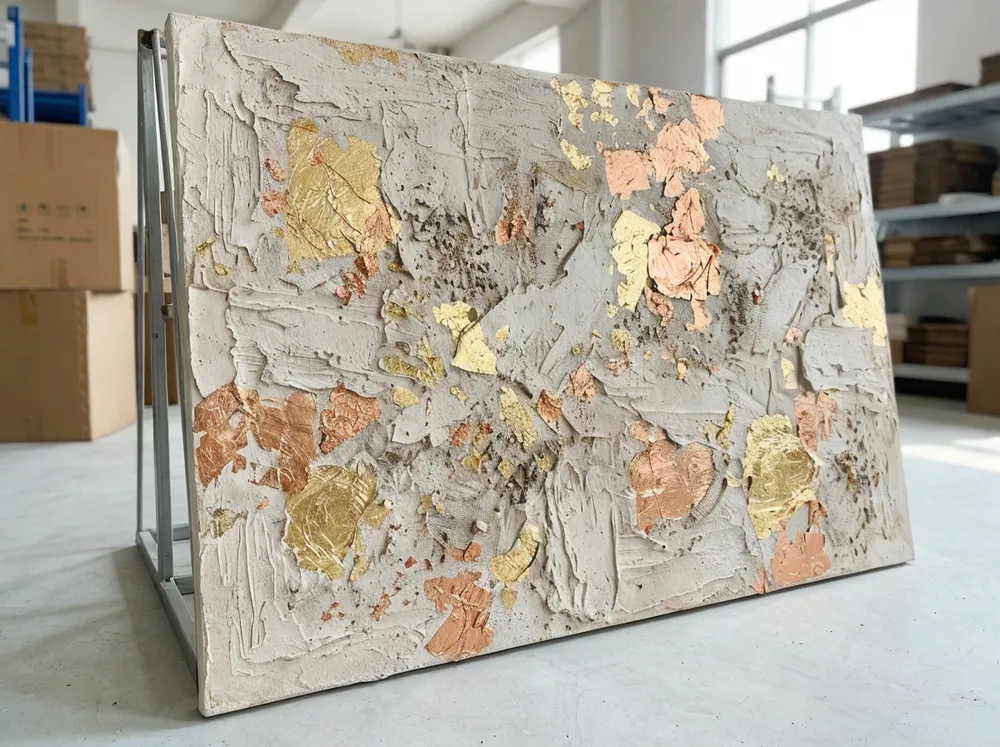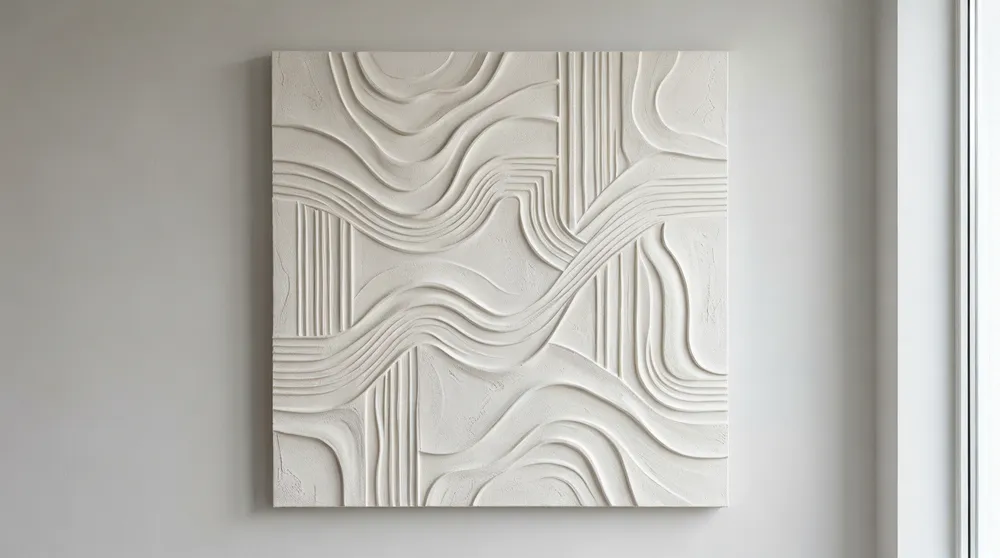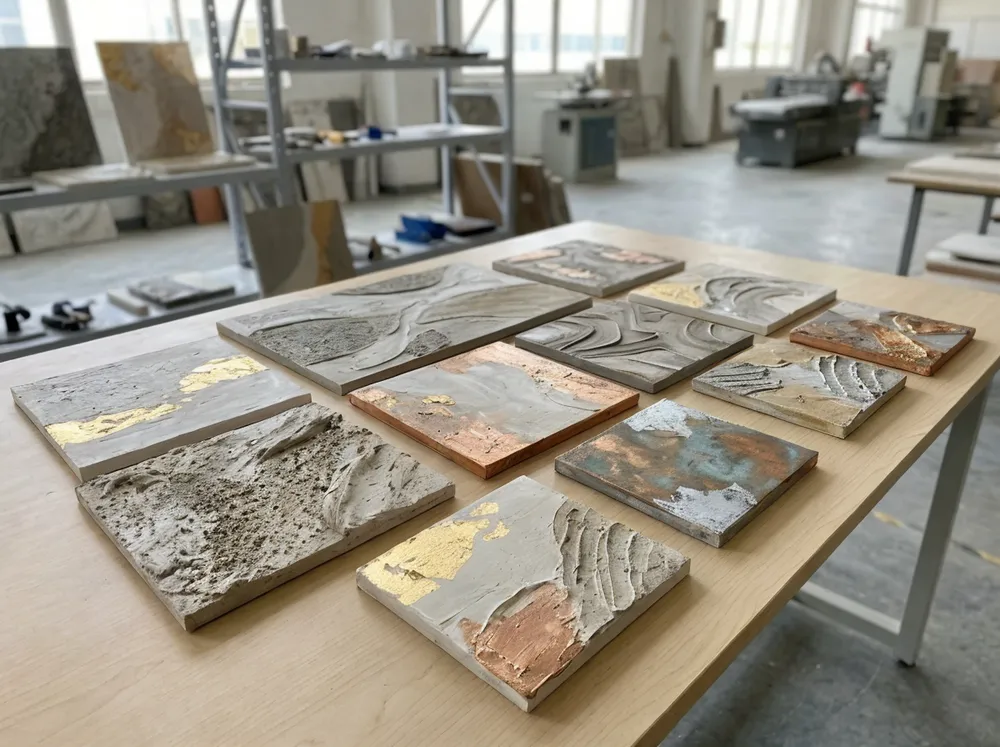
Built-up surface texture that print-on-canvas can't replicate — manufactured and export-packed in our Vietnam facility.
Livewellcraft produces texture wall arts through a multi-layer hand-application process: gesso base, aggregate buildup, pigment coats, and protective sealant. Each piece goes through 3-5 layering passes with controlled drying between coats. Full OEM/ODM capability, 100-piece MOQ on standard designs, retail-ready or bulk packaging to your spec.
Texture wall arts are mixed-media panels with physically built-up surface relief — plaster, sand, metallic leaf, fabric, resin, or combinations layered onto a rigid substrate. Unlike printed canvas art, the texture is real. You can feel it. That tactile quality is what positions these pieces in the $80–200 retail bracket and gives your product listings a defensible edge against the flood of digitally printed wall art that dominates the lower price tiers.
This is the fastest-growing product line in our order book. We've seen texture wall art orders climb steadily over the past three years, driven primarily by e-commerce sellers and hospitality buyers who need wall decor that photographs as premium and feels premium on arrival. If you're sourcing wholesale texture wall arts for resale, distribution, or project installation, this page covers the production specifics, material options, customization parameters, and ordering details you need to evaluate whether our product fits your business.
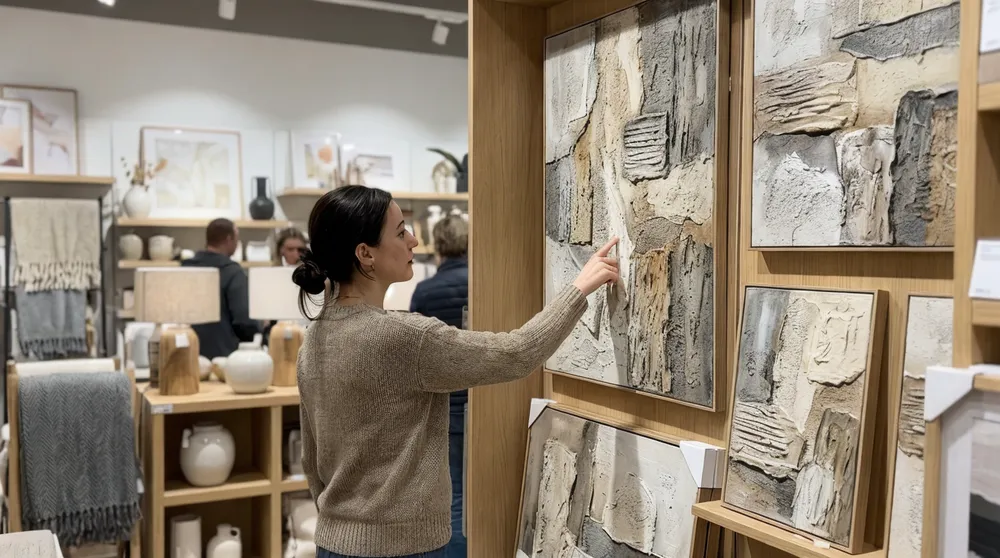
Real surface relief customers can feel
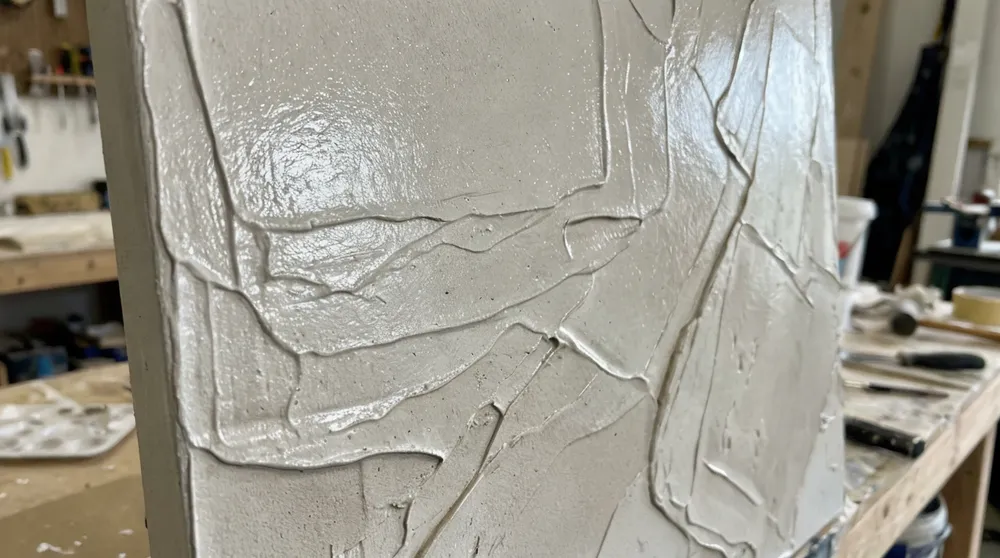
Premium positioning above print-on-canvas
Hard to replicate with digital printing
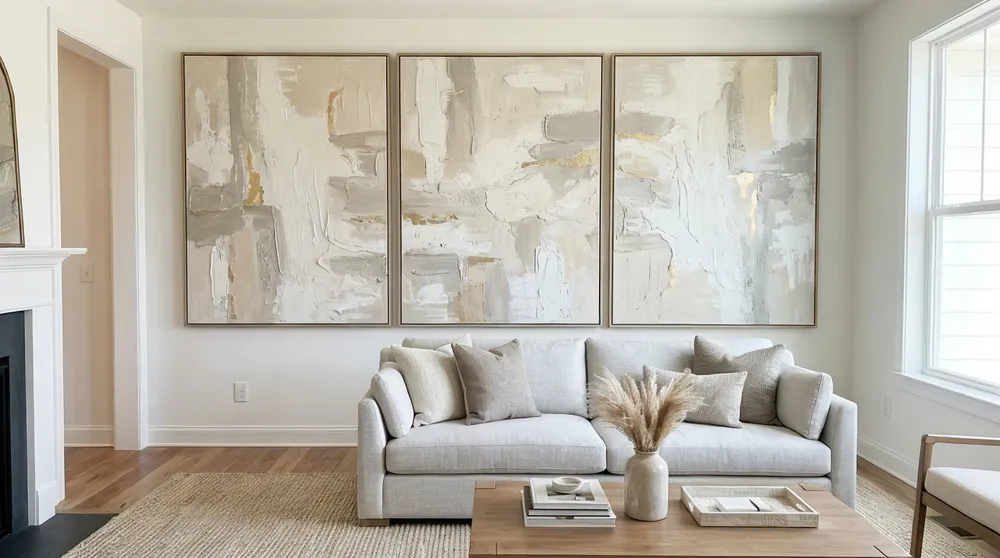
Surface depth visible in product shots
The commercial value of texture wall art lives in the layering. Each piece goes through 3–5 hand-applied passes, and that process is what separates a product your customers will pay $120 for from a $25 printed canvas they scroll past.
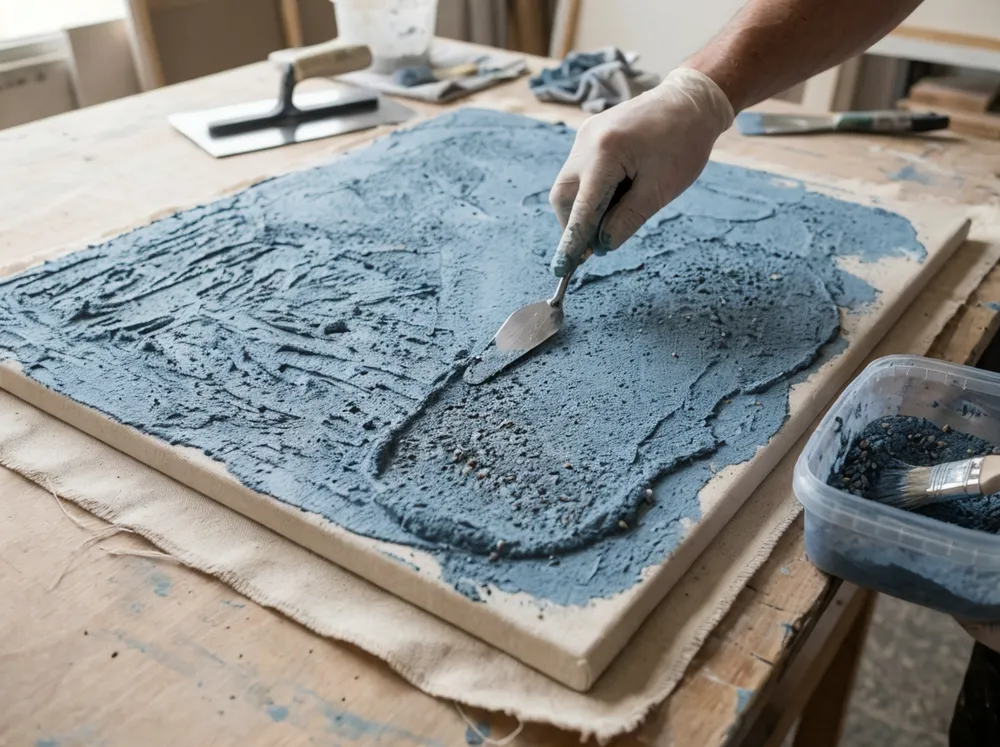
First layer is a gesso base coat applied to the substrate — typically MDF board or stretched canvas depending on your spec. Gesso provides the adhesion foundation for everything that follows.
Second pass is the aggregate layer, where the actual texture gets built. We work with calcium powder, fine sand, marble dust, crushed stone, or metallic leaf depending on the design. This is the layer that creates the surface relief — the ridges, the grain, the dimensional quality that reads as handcrafted rather than manufactured.
Margin note: Most of our best-selling designs use 2–3 aggregate types in a single piece, which adds visual complexity without adding proportional cost because the labor is in the application technique, not the material.
After the aggregate cures — and we allow full drying between every layer, because rushing this step is how factories end up with cracking and delamination six months after delivery.
We apply pigment coats that are hand-brushed or palette-knife applied, not sprayed, which means color variation between pieces adds to the artisanal character rather than reading as inconsistency.
Return rate impact: Your end customer sees a unique piece; your return rate stays near zero because "slight variation" is a feature in this category, not a defect.
Final pass is our protective sealant topcoat — two applications with full cure between coats. The sealant determines whether your texture art survives shipping, handling, retail display, and years on a wall without flaking.
We use an acrylic matte sealant as standard, formulated for moisture resistance.
Why this matters: Flaking aggregate is the number-one complaint buyers report about texture art from other suppliers — our two-pass sealant process specifically addresses that failure mode.
We schedule texture runs in dedicated batches because the drying time between layers means these pieces occupy production floor space longer than flat art. Dedicated batching keeps your lead time predictable — you get a firm ship date at the quote stage, not a moving target.
Specifications vary by design and customization. We provide exact specs on your quote sheet so you can build accurate comparison data before committing.
| Parameter | Standard Spec | Notes |
|---|---|---|
| Substrate | MDF board (6–12 mm) or stretched canvas on kiln-dried pine frame | MDF for rigid frameless panels; canvas for gallery-wrap presentation |
| Texture media | Calcium powder, fine sand, marble dust, crushed stone, metallic leaf, fabric | Mixed combinations available per design |
| Layering passes | 3–5 per piece | Varies by design complexity |
| Pigment | Acrylic-based, hand-applied | Palette knife or brush application |
| Sealant topcoat | Acrylic matte (standard) / UV-resistant polyurethane gloss (available upon request) | Two-pass application with full cure between coats |
| Panel sizes (standard) | 40×60 cm, 60×80 cm, 80×120 cm | Custom sizes available up to 120×180 cm |
| Panel thickness | 20–35 mm (varies by substrate + texture buildup) | MDF panels run thinner; canvas-on-frame runs thicker |
| Weight range | 1.5–6 kg per panel depending on size and media | Heavier aggregate (marble dust, crushed stone) adds ~20% vs calcium powder |
| Hanging hardware | D-ring + wire (rated 2× panel weight) | French cleat upgrade for panels over 4 kg |
| Drying time between layers | 8–24 hours per layer | Varies by aggregate type and ambient humidity; we don't accelerate with heat guns — forced drying causes micro-cracking |
Get exact specifications tailored to your requirements
Texture wall arts occupy a specific commercial niche: they carry higher perceived value than printed canvas, but cost less to produce than original paintings or sculptures. That positioning creates margin opportunity across several segments. Here's where our current buyers are moving volume.
This is the largest channel for texture wall arts in our order book. The product photographs well — the surface relief catches light and shadow in listing images, which drives higher click-through rates than flat printed art at similar price points. Your listing competes on perceived quality, not just on price.
Typical retail pricing for our texture pieces lands in the $80–200 range, with landed cost (FOB + freight, allocated per unit in a full container) leaving room for 3–4× markup depending on your market.
E-commerce sellers on Amazon and Wayfair reorder quarterly once they've validated a design, so this becomes a recurring revenue SKU, not a one-time purchase.
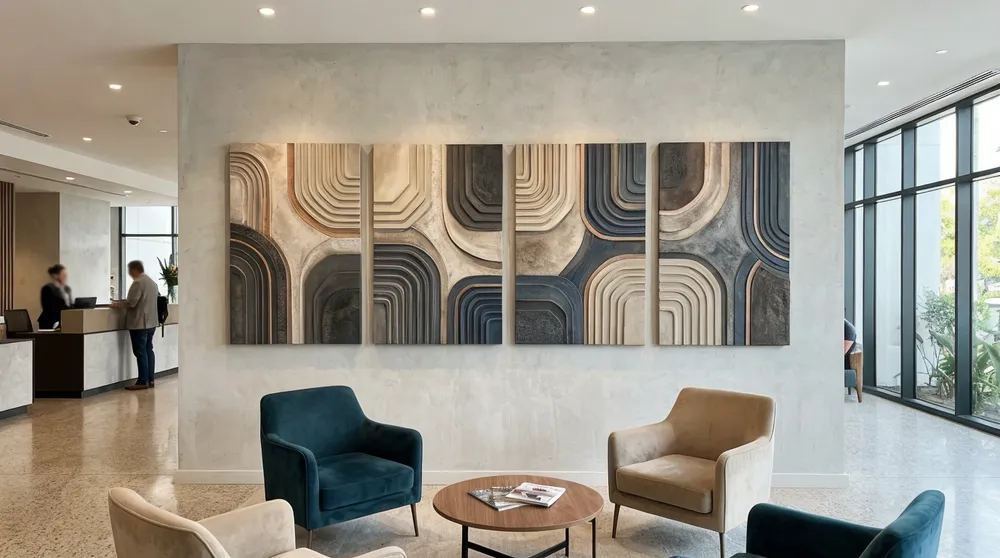
Hotels, restaurants, and corporate offices need wall decor that reads as curated without the budget of original art. Texture wall arts fill that gap — they look and feel handcrafted, they're durable enough for high-traffic environments, and they can be produced in matched sets of 50–200 pieces for a single property.
Hospitality orders tend to be custom-spec: specific dimensions to fit wall sections, color palettes matched to the interior scheme, and sometimes branded or themed compositions.
Your margin per piece on hospitality projects typically runs higher than retail because the buyer is pricing against original art, not against other manufactured wall decor.
If you supply brick-and-mortar home décor retailers, texture wall arts give you a product that customers want to touch in-store — and that tactile impulse is a conversion driver that flat art doesn't trigger.
Distributors typically order 3–5 designs in multiple sizes (40×60 cm and 80×120 cm of the same composition) to offer retailers a range without excessive SKU complexity.
Reorder cycles follow retail seasonality, with peaks before spring home refresh and Q4 holiday gifting.
Property staging companies and model home furnishers need wall art that looks premium in photos and in person, at a price point that works across dozens of properties per year. Texture wall arts hit that brief.
Orders in this segment are typically 20–50 pieces per batch, refreshed every 6–12 months as design trends shift.
The neutral, abstract compositions that dominate our texture catalog align well with staging aesthetics — we can produce variations on a single design theme so your staging inventory looks curated rather than repetitive.
Tell us your target market and volume — we'll recommend a starter SKU mix based on what's moving in your region.
Get SKU RecommendationsWe run texture wall arts as OEM/ODM, which means most orders involve some degree of customization. Here's what you can specify, what's fixed, and how customization affects your order.
These parameters are non-negotiable because they directly affect product durability and your return rate.
We won't produce 1-2 layer pieces because the texture doesn't hold up to shipping and handling — you'd see flaking within the first month. (We tested reduced-layer production in 2019 at a buyer's request to hit a lower price point. The return rate made it clear: three layers is the floor.)
We don't accelerate with heat guns or reduced drying windows. This is non-negotiable because it directly affects product durability and your return rate.
Single-pass sealant is a common cost-cutting move in this category, and it's also the reason texture art from other suppliers flakes during transit.
| Customization Level | MOQ | Lead Time (from deposit) |
|---|---|---|
| Standard catalog design, standard size | 100 pieces | 30–35 days |
| Standard catalog design, custom size | 100 pieces | 35–40 days |
| Custom artwork, standard media | 200 pieces | 45–55 days (includes sample approval) |
| Fully custom (new artwork + new media combination) | 300 pieces | 50–60 days (includes sample approval + media testing) |
Sample approval adds 15–20 days before production starts on any custom order. We ship 2–3 physical samples for your sign-off — not digital renders, not photos. You evaluate the actual texture, color, and weight before we run the batch.
Send us your design brief or reference images — our team will quote customization options within 48 hours.
Texture wall arts are more fragile in transit than flat canvas prints. The raised surface can chip or crack if packaging doesn't account for the relief profile. We've developed our packing method specifically around this problem.
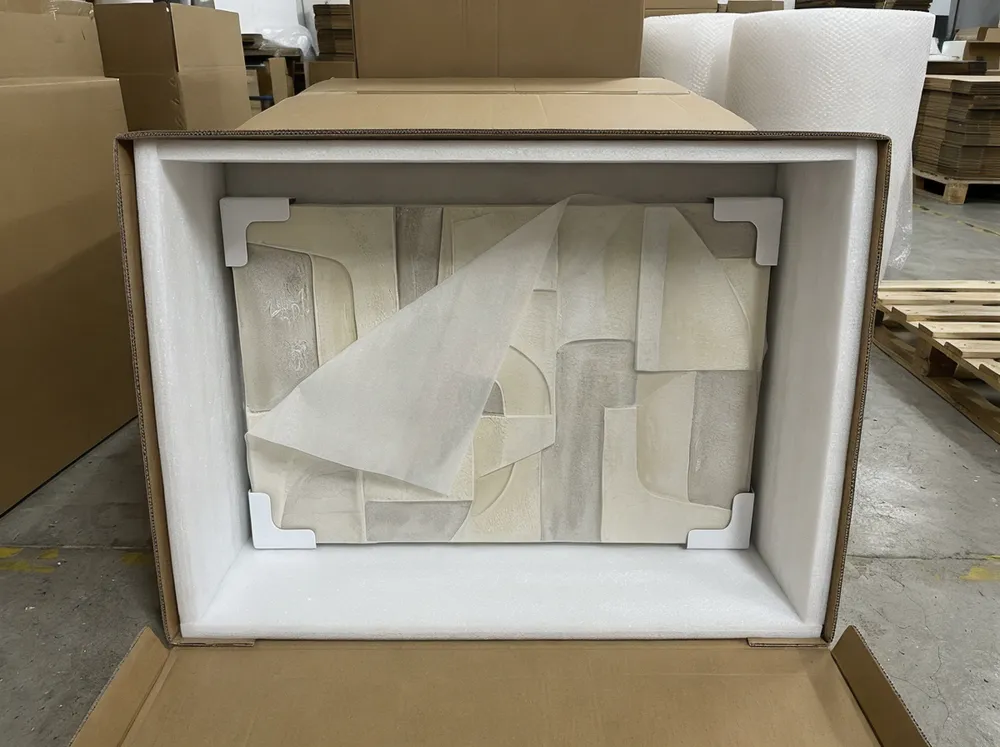
Each piece gets a foam-lined individual box with corner protectors and a tissue interleaf over the textured surface. The box is sized to the panel with minimal void space — too much room and the piece shifts during transit; too little and the box compresses the texture. For panels over 80 cm in any dimension, we add a rigid cardboard spine inside the box to prevent flex.
Container loading follows a tested stacking pattern: heavier MDF panels on the bottom tier, lighter canvas pieces on top, with anti-slip mats between layers. A standard 40HQ container holds approximately 800–1,200 texture wall art pieces depending on panel size, which gives you a per-unit freight allocation that keeps your landed cost competitive.
Foam-lined box with corner protectors and tissue interleaf over textured surface
Box sized to panel with minimal void space — prevents shifting and compression
Cardboard spine added for panels over 80 cm to prevent flex during transit
Tested stacking pattern with anti-slip mats — 800–1,200 pieces per 40HQ
For e-commerce sellers shipping direct to Amazon FBA or your own warehouse, we apply FNSKU labels, scannable barcodes, and poly-bag individual units inside the master carton. Your product arrives warehouse-ready — no relabeling, no repackaging on your end.
We track it because every damaged piece is a margin loss for both of us.
You may be evaluating texture wall arts alongside other types in our catalog. Here's how they compare on the dimensions that affect your purchasing decision.
| Dimension | Texture Wall Arts | Wall Arts Painting | Wall Arts Sculpture | Wall Arts Drawing | Mural Wall Arts |
|---|---|---|---|---|---|
| Perceived Value | High — tactile surface reads as handcrafted | Medium-high — hand-painted originals | Highest — dimensional, sculptural | Medium — works well as curated collection pieces | High — large-format statement pieces |
| Typical Retail Price Range | $80–200 | $50–300 (size-dependent) | $120–400 | $30–120 | $150–500+ |
| Production Lead Time | 35–55 days (drying time between layers) | 25–40 days | 35–50 days (mold fabrication if new design) | 20–30 days | 30–45 days |
| Shipping Fragility | Medium — surface texture needs protection | Low — flat canvas, standard packing | High — dimensional, weight considerations | Low — flat, lightweight | Medium — large panels need rigid packing |
| MOQ (Standard) | 100 pieces | 100 pieces | 50 pieces | 100 pieces | 20 pieces |
| Best Channel Fit | E-commerce, hospitality, staging | E-commerce, retail, hospitality | Hospitality, high-end retail | Gift wholesale, retail, e-commerce | Hospitality, commercial projects |
If you're building a multi-type wall art catalog, texture pieces pair well with paintings — paintings cover your volume tier, texture pieces lift your average order value.
For hospitality projects, texture and mural combinations give you a full wall decor proposal from a single supplier.
Direct answers to the sourcing and specification questions we hear most often from wholesale buyers.
Texture wall arts use physically built-up surface media — plaster, sand, metallic leaf, resin — applied in multiple layers to create dimensional relief you can feel. Hand-painted canvas art uses pigment applied to a flat canvas surface.
The key commercial difference: texture pieces occupy a distinct price tier ($80–200 retail) that printed canvas can't reach, and the tactile quality gives your product listing a defensible position against digitally printed competitors. Both types are produced in our facility, so you can source them on the same PO.
Our two-pass acrylic sealant topcoat is formulated for moisture resistance. We ship texture wall arts to buyers in Southeast Asia, the Middle East, and coastal North America without degradation issues.
The critical factor is the full-cure drying protocol between sealant coats — rushing this step is how moisture penetrates the aggregate layer and causes flaking. We can provide accelerated humidity test data if your market requires documentation.
For semi-outdoor or high-humidity commercial installations, ask about our UV-resistant polyurethane topcoat upgrade.
Yes. Most buyers order 3–5 designs per shipment to test market response before scaling.
As long as total quantity meets the MOQ threshold (100 pieces for standard designs, 200–300 for custom), you can split across multiple designs within the same order. We batch by design during production and consolidate into a single shipment, so your freight cost stays the same as a single-design order.
We work from high-resolution images (300 DPI minimum), vector files (AI, EPS), or physical reference samples.
If you have a concept but not finished artwork, our 12-engineer design team can develop the composition from your brief — mood boards, color references, and dimensional sketches are enough to start. We produce physical samples for your approval before production, and full IP rights transfer to you upon payment.
200 pieces per design for private-label orders with custom box printing and branded inserts. Standard catalog designs with generic packaging start at 100 pieces.
If you're testing a new market and need a smaller initial run, talk to us — we can sometimes accommodate 100-piece private-label orders on designs where we already hold substrate and media stock.
Send us your target designs (reference images, sketches, or a description), quantities, target market, and any packaging requirements. We'll come back with unit pricing, a production timeline, sample options, and a packing plan — typically within 48 hours.
Most new buyers start with a 2–3 piece sample order to evaluate texture quality, color accuracy, and packaging durability before committing to production. We can ship samples within 10–15 days.
You'll be talking to the team that actually makes your product — not a sales office, not a trading company.
Compare production methods and margin profiles across our wall art categories.