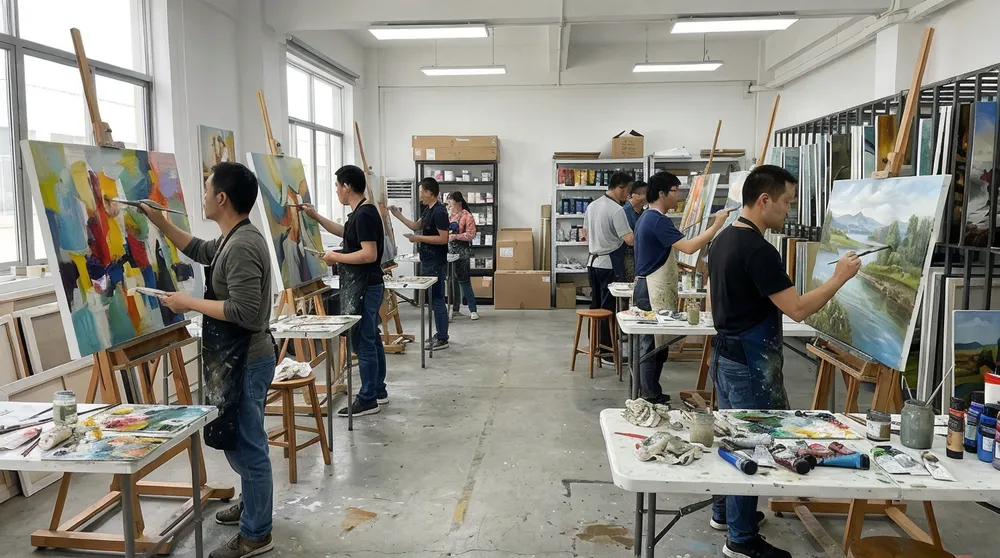
Hand-painted wall art — acrylic and oil on canvas, Pantone-matched, from 30×40 cm retail pieces to 150×200 cm hospitality panels.
Wall arts painting is our highest-volume wall art type and the product line where most OEM buyers place their first order. We hand-apply acrylic and oil paint on cotton-linen canvas stretched over kiln-dried frames, with color controlled against Pantone references so your reorder matches your first batch. 100-piece MOQ on catalog designs, full OEM/ODM on custom artwork.
Paintings are the entry point for most of our wall art buyers, and there's a straightforward reason: they ship flat, photograph well for online listings, and hit price points that work across retail, e-commerce, and hospitality channels. If you're building a wall art catalog or sourcing statement pieces for a project, wall arts painting is the product type with the broadest commercial range.
What separates our wall arts painting line from printed canvas — which is what most of the market sells — is that every piece is hand-applied paint on canvas. Acrylic or oil, brushwork visible, texture you can feel. That distinction matters commercially: hand-painted pieces command 3-5× the retail price of a printed canvas in the same size, and your customer can see and feel the difference immediately. Your margin per unit is structurally higher than anything in the print-on-demand space.
We produce paintings from 30×40 cm pieces for retail shelf display up to 150×200 cm panels for hotel lobbies and corporate feature walls. The parent category page covers our general wall art materials and processes — this page goes deeper on what's specific to paintings: the hand-painting workflow, color control, canvas specs, and how to position paintings profitably in your product line.
Quick Contact
Request QuoteExplore Related Wall Art Types
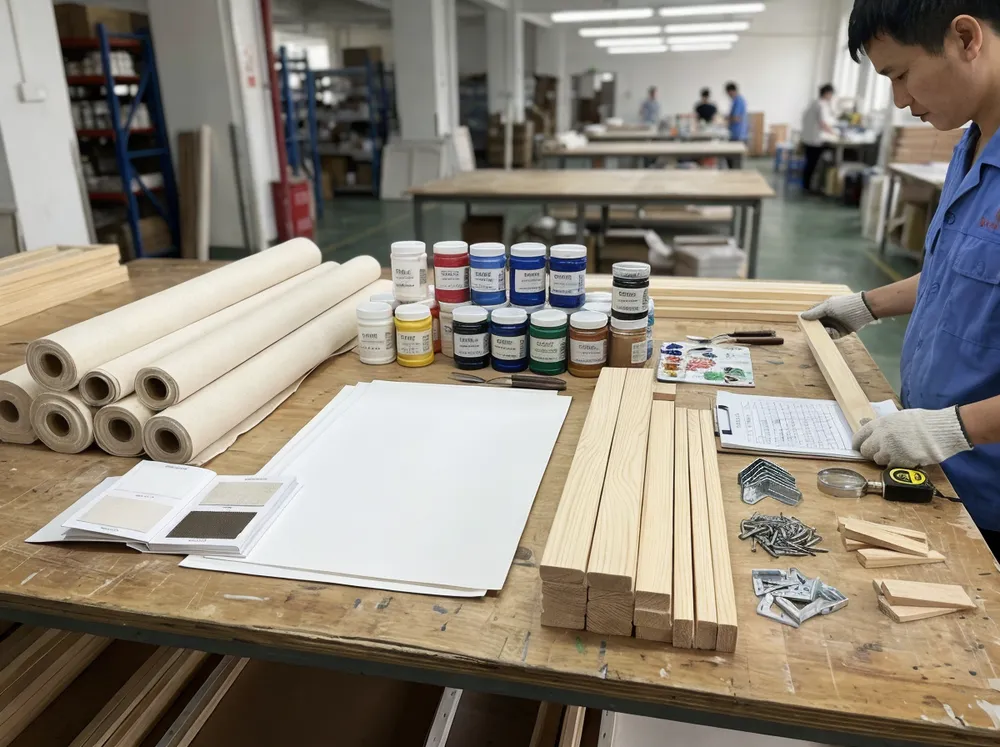
Paintings live or die on three components: the canvas substrate, the paint system, and the stretcher frame. Here's exactly what goes into each unit.
| Component | Standard Specification | Premium Upgrade |
|---|---|---|
| Canvas | Cotton-linen blend, 380 gsm, triple-primed gesso | Pure linen, 450 gsm, museum-grade gesso |
| Paint | Artist-grade acrylic, lightfast-rated pigments | Oil paint, slow-dry formulation for blending depth |
| Stretcher bars | Kiln-dried pine, finger-jointed, with corner keys | Solid pine, mortise-and-tenon joinery |
| Protective coating | UV-resistant acrylic varnish, satin finish | Gallery varnish, removable for restoration |
| Hanging hardware | D-ring + wire, rated 2× piece weight | French cleat system for pieces over 80 cm |
| Size range | 30×40 cm to 150×200 cm | Custom sizes up to 200×300 cm (multi-panel) |
Canvas substrate, paint system, and stretcher frame — the three pillars of painting quality
Canvas weight matters more than most buyers realize at the sourcing stage. Our 380 gsm cotton-linen blend holds paint without bleed-through and resists sag under humidity shifts.
Field test: We tested pure cotton at 320 gsm early on — performed fine in climate-controlled showrooms but sagged visibly in warehouses without AC. The blend solved that.
For pieces shipping to tropical or coastal markets, the 380 gsm minimum is non-negotiable if you want to avoid returns.
Stretcher bars are kiln-dried pine at 8-12% moisture content. Air-dried stock retains 15-20% moisture and warps as it acclimates to your buyer's environment.
Lesson learned: We stopped using air-dried stock in 2016 after tracking warranty claims back to frame warping on a batch shipped to Florida.
The standard spec covers roughly 80% of retail and e-commerce orders. The premium column is where hospitality and gallery buyers typically land — material cost per unit is higher, but so is your sell-through price. We quote both configurations so you can tier your catalog.
Send us your size and finish requirements — we'll quote both configurationsHand-painted doesn't mean unpredictable. We run a structured painting workflow that delivers batch consistency across hundreds or thousands of units — which is the whole challenge of manufacturing hand-painted wall art at commercial scale.
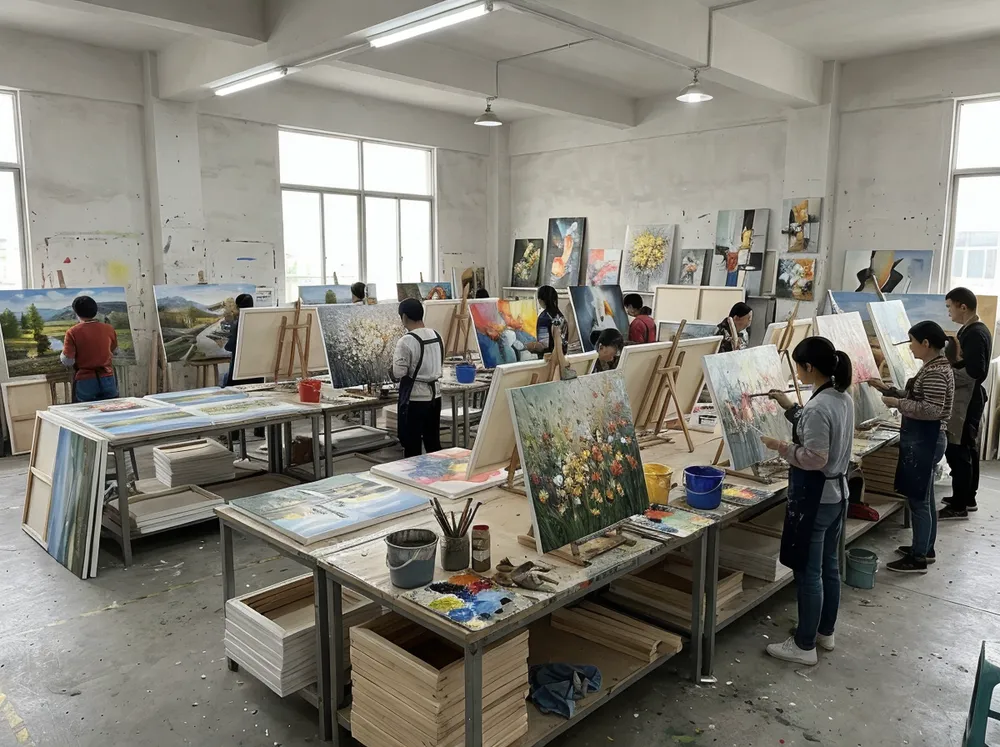
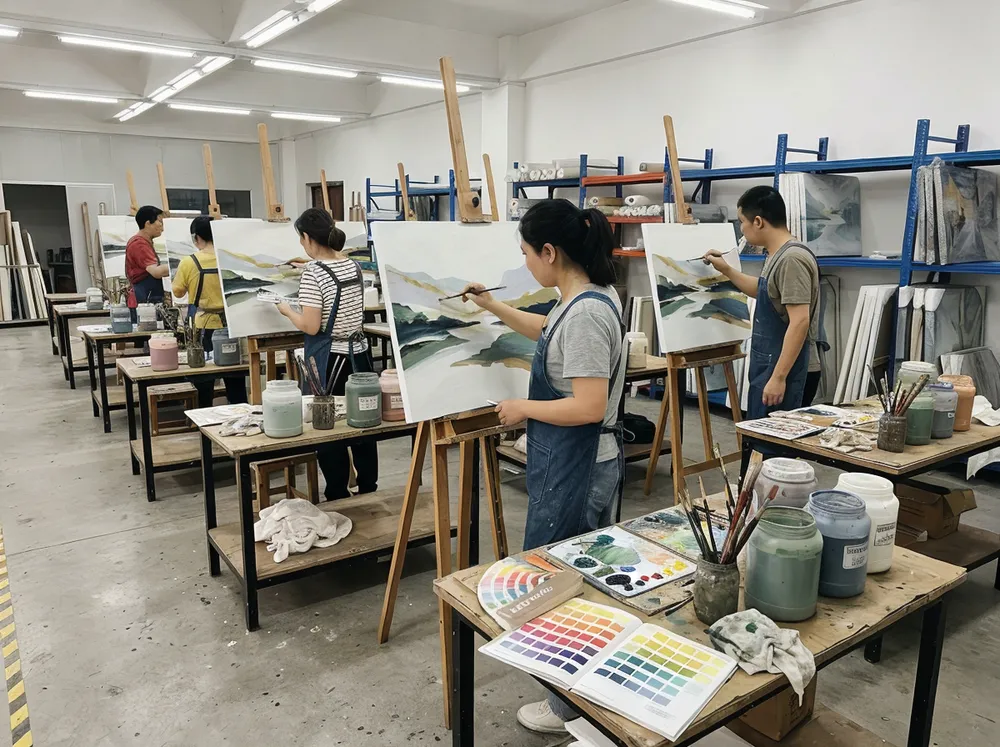
Canvas arrives pre-stretched and triple-primed with gesso on our frame assembly line. Each canvas gets a reference card clipped to the stretcher bar — your approved artwork, Pantone color codes, and any notes from the sample approval stage. Our painting team of 20 works in stations organized by technique: base layers, detail work, and finishing. A single painter doesn't complete an entire piece from start to finish on production runs.
Blocks in backgrounds and primary color fields across all units
Handle focal elements — florals, abstracts, figures, whatever the design calls for
Add highlights, edge work, and sign-off marks
Color matching is controlled against Pantone swatches — we mix paint batches large enough to cover the full production run, so there's no color drift between unit 1 and unit 500. If your order exceeds a single paint batch, we mix the second batch and cross-check against a dried sample from the first. Wet-to-dry color shift in acrylics runs about 5-10% darker, and we account for it in the mixing formula.
After painting, each piece cures for 24-48 hours depending on paint thickness, then receives a UV-resistant varnish coat. The varnish protects the paint surface during shipping and handling, and it standardizes the sheen across the batch. Without varnish, acrylic paintings have inconsistent surface gloss depending on paint thickness and application angle — your retail display looks uneven. With varnish, every piece in the shipment has the same satin finish.
QC inspects every painted piece against the approved sample before varnishing. We check color accuracy, brushwork consistency, canvas tension, and frame squareness. Rejection rate on paintings runs 3-5% — rejects get reworked or scrapped, never shipped. Your container arrives with units that match your sample approval.
Each wall art type maps to different commercial channels. Paintings cover the widest range, which is why they're typically the first type buyers add to their catalog.
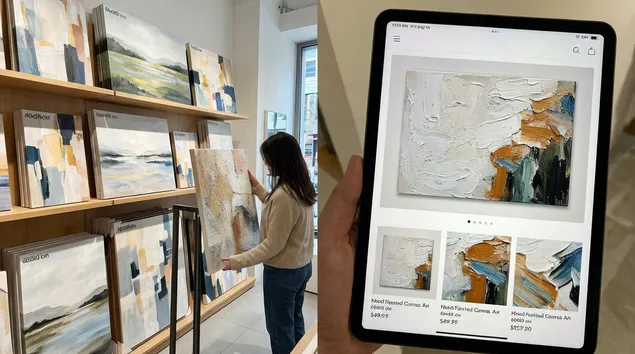
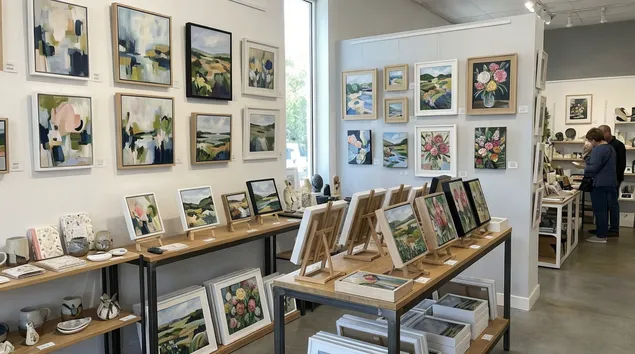
Paintings in the 40×60 cm to 80×100 cm range are the sweet spot for online listings and brick-and-mortar shelf display. They photograph with visible texture and brushwork, which differentiates your listing from the flood of printed canvases on Amazon and Wayfair. Your product images show real paint — that's a conversion advantage you can't replicate with a print.
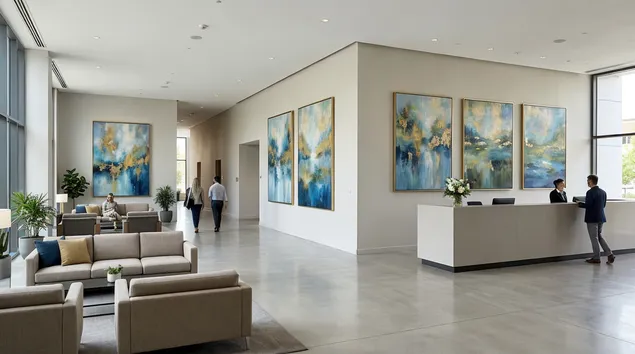
Hotels, restaurants, and corporate offices source large-format paintings (100×150 cm and above) for lobbies, corridors, and feature walls. These are project orders — 20-200 pieces per property, custom color palettes matched to the interior design scheme, specific sizes for specific wall locations. Your margin per piece is significantly higher than retail, and the reorder cycle follows renovation schedules.
We supply spec sheets formatted for the general contractor's submittal package, so your sales team has documentation ready at the bid stage.
Small-format paintings (30×40 cm to 50×70 cm) move well in gift shops, art galleries, and curated home décor stores. MOQ at 100 pieces per design lets you test new artwork with minimal inventory risk. We produce the same composition across multiple sizes — a 30×40 cm and a 60×80 cm version — so you offer size options without doubling your design development cost.
This segment has grown steadily for us over the past three years, especially with buyers targeting the $30-80 retail gift bracket.
Designers specify paintings for residential and commercial projects, typically ordering 5-30 pieces per project with custom sizing and color requirements. Volume per order is lower, but the per-unit value is high and the relationship generates repeat orders as the designer moves between projects.
We supply paintings with custom Pantone palettes and non-standard dimensions — 47×63 cm to fit a specific alcove, for example — and our 100-piece MOQ doesn't apply to project orders where you're ordering mixed sizes across a single design theme. Interior designers are the most detail-oriented buyers we work with. They'll specify frame depth to the millimeter. We accommodate that.
Share your target channel and volume range — we'll recommend a size and finish mix that fits your market.
Get Channel RecommendationsThis is the section that matters most if you plan to reorder. Hand-painted wall art has a reputation for batch-to-batch variation, and for most suppliers, that reputation is earned. We built our color control system specifically to solve this problem because reorder reliability is what turns a one-time buyer into a long-term account.
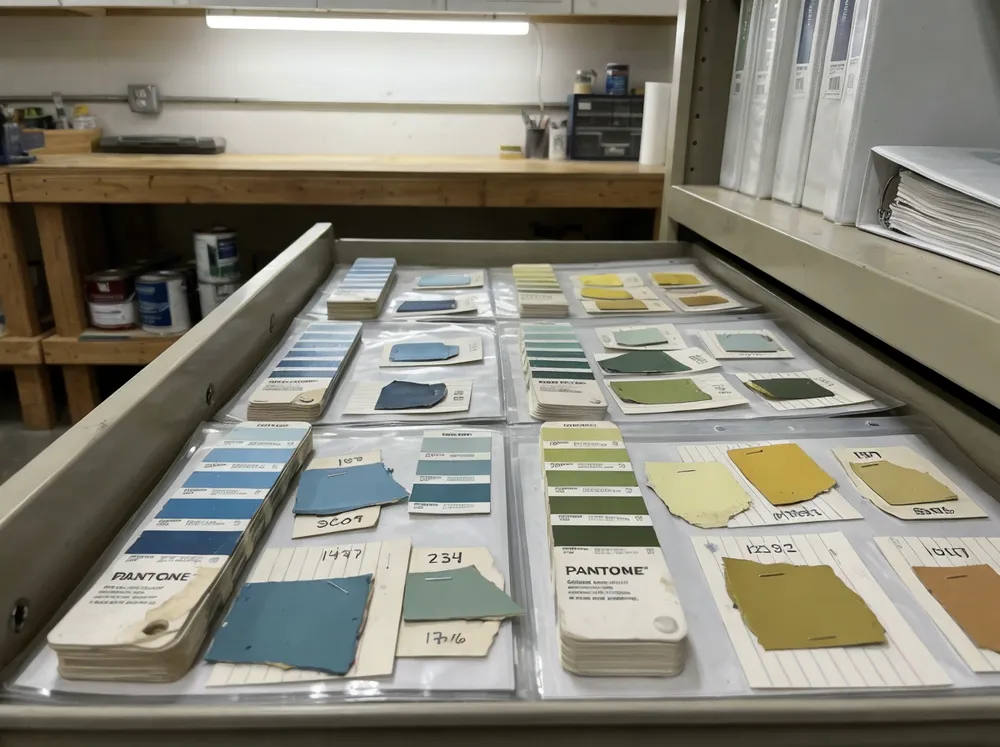
Every painting order starts with a color reference card. You provide Pantone codes, a physical sample, or a digital reference — we mix a master paint batch and create a dried color chip that becomes the permanent reference for your SKU. That chip lives in our sample archive, indexed by your order number. When you reorder six months later, we pull the chip, mix against it, and cross-check the new batch against a dried sample from the original run before production starts.
We mix paint in batches sized to cover the full production run. For a 300-piece order of a 60×80 cm abstract in three colorways, that means three master batches mixed at the start, enough to paint every unit without mid-run remixing. Acrylic paint shifts 5-10% darker as it dries — we account for that in the mixing formula, so the wet mix looks slightly off but the dried result matches your Pantone target. (Oil paint shifts less, around 2-3%, but takes longer to cure. If color precision is your top priority and you can accept a longer lead time, oil is the better medium.)
For buyers running seasonal collections or rotating artwork across retail locations, this system means you can reorder a bestselling design two years later and get a visual match. Your retail display stays consistent, your brand presentation holds, and you don't waste time re-approving samples for a design you already signed off on.
Provide your exact Pantone reference for precise color matching across all units
Send fabric swatches, paint chips, or product samples for direct color matching
High-resolution images with color profiles work for initial matching and approval
Permanent dried color chips stored by order number for future reorder matching
The category page covers our general OEM/ODM capability across all wall art types. Here's what's specific to paintings.
| Customization Dimension | Range / Options | Impact on MOQ & Lead Time |
|---|---|---|
| Canvas size | 20×20 cm to 200×300 cm (single panel) | No MOQ impact; oversized pieces (>150 cm) add 3-5 days for stretcher frame fabrication |
| Multi-panel sets | Diptych, triptych, up to 5-panel configurations | MOQ applies per set, not per panel |
| Paint medium | Acrylic (standard), oil (premium) | Oil adds 5-7 days for curing time |
| Canvas weight | 380 gsm cotton-linen (standard), 450 gsm pure linen (premium) | No lead time impact; affects unit cost |
| Frame profile | Gallery wrap (no frame), slim float frame, ornate molding | Custom molding profiles require 200-piece MOQ; standard profiles at 100 pieces |
| Frame finish | Raw wood, painted (any RAL color), stained, metallic leaf, distressed | Metallic leaf and distressed finishes add 2-3 days |
| Protective coating | Satin UV varnish (standard), matte varnish, gallery varnish (removable) | No lead time impact |
| Artwork source | Your reference image, your original artwork file, or our design catalog | Custom artwork development adds 15-20 days for sample approval |
| Packaging | Bulk carton, individual retail box with your branding, poly-bag for e-commerce | Retail packaging requires print-ready artwork files; add 7-10 days for packaging production on first order |
Applies to catalog designs with standard frames
If you're developing a fully custom painting — new artwork, custom frame profile, branded packaging — the MOQ stays at 100 pieces but the first order includes a sample approval stage that adds 15-20 days before bulk production begins. Reorders on approved designs skip the sample stage entirely.
Regarding copyrighted artwork reproductions
We don't produce photorealistic hand-painted reproductions of copyrighted artwork. If you need licensed reproductions, you'll need to provide licensing documentation. Original compositions, abstract work, and designs based on your own reference material — no restrictions.
Send us your customization specs or a reference image — we'll confirm feasibility and quote within 48 hours.
Get Your Custom QuoteDamage in transit is the fastest way to destroy your margin on wall art. A cracked stretcher bar or a scuffed paint surface turns a profitable unit into a return, a replacement shipment, and a customer who questions your quality. We pack paintings to prevent that.
Each painting is corner-protected with foam blocks, face-wrapped in glassine paper (prevents surface sticking during humidity changes in the container), and placed in an individual corrugated carton with internal cardboard dividers. Cartons are palletized and stretch-wrapped for container loading.
For Amazon FBA or direct-to-consumer fulfillment, we pack each painting in a retail-ready box with your UPC label, FNSKU barcode, and poly-bag inner wrap. The box is designed to survive carrier handling without an outer shipping carton — your 3PL receives units ready to shelve, not repack.
We developed this packing spec with a Wayfair supplier in 2019 after their damage claim rate on paintings dropped from 4.2% to under 0.5% with the upgraded box design.
Paintings ship flat, which makes them one of the most freight-efficient wall art types. Approximate loading per 40HQ container:
| Painting Size | Units per 40HQ (standard packing) |
|---|---|
| 30×40 cm | 2,800–3,200 |
| 60×80 cm | 1,200–1,500 |
| 80×100 cm | 800–1,000 |
| 100×150 cm | 400–500 |
| 150×200 cm | 180–220 |
These numbers assume standard corrugated carton packing. Retail box packing reduces density by roughly 15% due to the thicker box walls, but the trade-off is zero repacking cost at your warehouse.
We can blind drop-ship directly to your customers or retail distribution centers. Your branding on the box, our factory address nowhere visible. White-label capability is standard — no setup fee, just provide your packaging artwork files.
The category page covers our general QC framework. For paintings specifically, every unit passes through a 6-point inspection before it enters the packing line.
Dried paint surface checked against the Pantone reference chip under D65 standard lighting. Delta E tolerance of ≤2.0 — visually indistinguishable to the human eye.
Compared against the approved production sample. We're checking stroke direction, texture density, and paint thickness uniformity. On abstract pieces, this is about overall visual weight matching across the batch, not stroke-for-stroke replication.
Drum test — the canvas should produce a clean, even tone when tapped. Loose spots indicate improper stretching and will sag over time. Failed units get re-stretched or rejected.
Diagonal measurements must match within 2 mm tolerance. Out-of-square frames cause the canvas to pull unevenly and create visible distortion at the corners.
UV light inspection to confirm full, even varnish application. Missed spots show as dull patches under UV and will yellow differently over time.
Pull test at 2× rated weight. D-rings, wire, and French cleats are tested on every unit — not batch-sampled.
Rejection rate on paintings runs 3–5% of production volume. Rejected units are reworked if the issue is correctable (re-varnishing, hardware replacement) or scrapped if it's a paint or canvas defect.
We photograph and log every rejection, and the data feeds back into painter training. Your shipment contains only units that passed all six checkpoints.
Most buyers start with 2–3 pieces to assess paint quality, canvas tension, and packing before committing to production quantities.
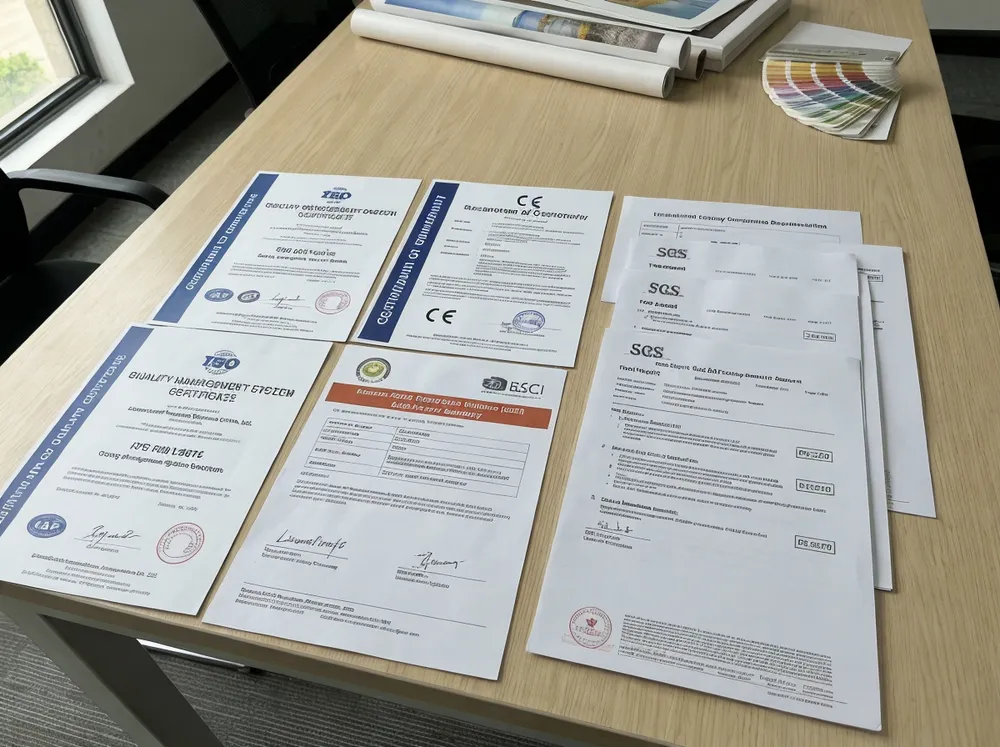
Request a Sample OrderWe hold ISO 9001:2015, CE, and BSCI certifications at the facility level, and SGS testing is available on specific product lines. For paintings, the compliance questions that matter to your downstream market are typically about material safety, not structural certification.
Our acrylic paints are water-based with VOC levels below the thresholds set by REACH (EU) and CPSIA (US). We can provide material safety data sheets (MSDS) for the specific paint formulations used on your order. If you're selling into the EU market, REACH compliance documentation is available on request.
Acrylic paintings produced with our standard paint system do not contain materials on the Prop 65 list above reportable thresholds. Oil paintings use solvents during production that are fully evaporated during the curing process — finished pieces test clean, but if your market requires Prop 65 testing documentation, we can arrange third-party lab testing through SGS.
If your paintings are marketed for children's rooms or nurseries, we can produce with EN 71-certified paints and provide test reports. Standard production paints are not EN 71 tested by default — specify this requirement at the quotation stage so we source the correct paint system.
Canvas paintings are inherently combustible. For hospitality projects where fire rating is required, we apply a fire-retardant treatment to the canvas and can provide test documentation to ASTM E84 Class A or BS 476 standards. This is an add-on process — specify it upfront so we build it into your production schedule and pricing.
If you're evaluating paintings against our other wall art types, here's how they compare on the dimensions that affect your purchasing decision.
| Dimension | Paintings | Drawings | Sculptures | Murals | Texture Wall Arts |
|---|---|---|---|---|---|
| Unit cost range | Mid | Low-Mid | High | Mid-High | Mid-High |
| Perceived retail value | High (hand-painted) | Moderate | Highest | High | High |
| Freight efficiency | Excellent (flat) | Excellent (flat) | Low (dimensional) | Good (flat, large) | Moderate (fragile layers) |
| Damage risk in transit | Low | Low | Moderate | Low | Moderate |
| Reorder color consistency | High (Pantone system) | High | N/A (form-based) | High | Moderate (texture variation) |
| Best-fit channel | Retail, e-commerce, hospitality | Volume retail, gift | Hospitality, high-end retail | Project/hospitality | Premium retail, e-commerce |
| MOQ (standard) | 100 pcs | 100 pcs | 50 pcs | 20 pcs | 100 pcs |
Paintings are the most versatile type — they cover the widest range of price points, channels, and project types. If you're building a wall art catalog from scratch, paintings are the logical starting point.
Add drawings for a lower price tier, sculptures for a premium tier, murals for project-based sales, and texture wall arts for the trending tactile segment.
If you're already sourcing paintings and want to expand your wall art line, tell us your current catalog structure and target market — we'll recommend which types to add based on what's moving for our existing buyers in your region.
Direct answers to the procurement questions we hear most often.
We control color to Delta E ≤2.0 against your Pantone reference, measured under D65 standard lighting. At that tolerance, the human eye cannot distinguish the difference between your approved sample and the production unit. Every batch is mixed from a single master formula sized to cover the full run, so there's no mid-production color drift. Reorders are matched against archived dried color chips from your original batch.
Acrylic is the default for most commercial orders: faster drying (24 hours vs. 5-7 days for oil), lower unit cost, and easier compliance with VOC regulations in the EU and US markets.
Oil paint produces richer color depth and smoother blending, which commands a higher retail price — but the longer curing time adds 5-7 days to your production schedule.
If your retail price point supports the premium and your timeline allows it, oil is the stronger product. For volume e-commerce SKUs where speed and cost matter more, acrylic is the right call.
Yes. We produce the same composition across multiple sizes within a single production run. Your MOQ of 100 pieces applies to the total across all sizes of that design, not per size.
Example breakdown:
= 100 pieces total, qualifies as one order
We scale the composition proportionally — the artwork reads correctly at each size, not just cropped from a single master.
Send us a reference image, mood board, color palette, or rough concept. Our design team develops it into a production-ready painting specification — composition layout, Pantone color codes, brushwork style guide, and size variants.
We produce 1-2 pre-production samples for your approval before bulk production starts. The development cycle is typically 15-20 days from concept to approved sample.
Once approved, the artwork specification is archived for reorders. We transfer full IP rights to you upon final payment.
From deposit receipt to container loading
Add 15-20 days for sample approval stage
Reorders on previously approved designs skip the sample stage — straight to production at 25-30 days.
We provide a detailed production timeline at the quotation stage, broken down by artwork approval, painting, curing, QC, packing, and loading dates.
You've seen the specs, the process, the packing, and the QC checkpoints. If paintings fit your product line, the next step is a conversation about your specific requirements.
Send us your target sizes, quantities, artwork references (or tell us you'd like to browse our design catalog), and your target market. We'll come back with unit pricing, a production timeline, container loading plan, and packing options — typically within 48 hours.
You'll be talking to the same team that paints, inspects, and ships your order. One factory, no middleman, full accountability from sample to container.
Compare paintings with other wall art categories for your product mix.