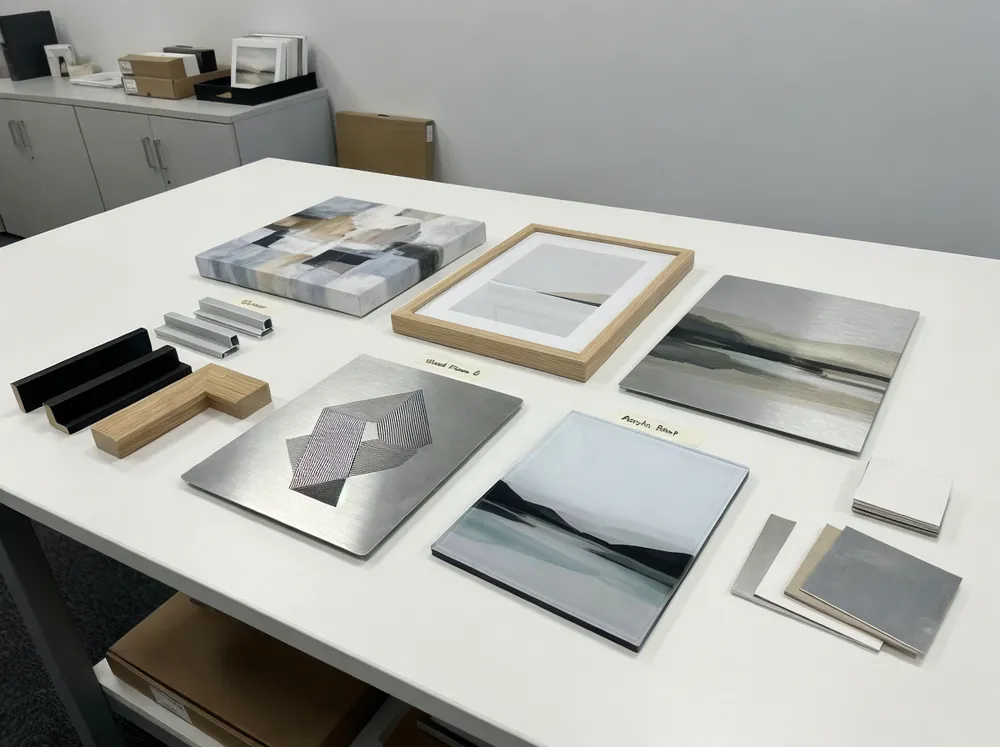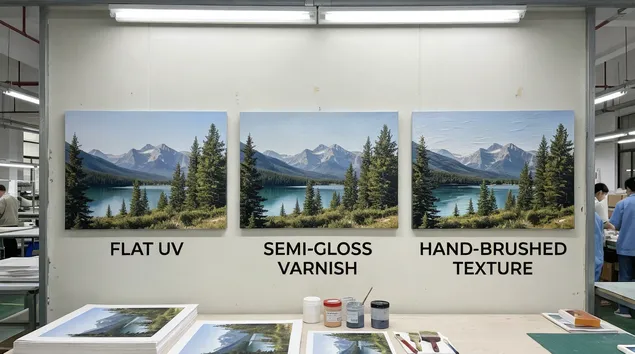

Most trend reports on aesthetic wall art are written for consumers. They tell you what looks good. They don't tell you what sells at volume, what specs the major platforms actually require, or which styles are producible at scale without blowing your lead time.
This article is the other kind. We've been manufacturing decorative wall art and mirrors for US e-commerce buyers since 2008 — Wayfair, Amazon, Walmart vendor programs, all of them. What follows is a production-side breakdown of the spec dimensions that drive sell-through on US platforms, the sub-styles gaining traction right now, and the sourcing decisions that separate a profitable SKU from a slow-moving one.

What "Aesthetic" Actually Means in a Sourcing Context
"Aesthetic" as a retail category is broader than it looks. On Amazon and Wayfair, it covers anything that reads as intentionally styled — the opposite of generic. But for sourcing purposes, it breaks into four distinct sub-styles, each with its own spec profile and buyer demographic.
Understanding which sub-style you're targeting determines your frame material, your finish, your size run, and your price point. Conflating them is how buyers end up with inventory that looks fine in a sample photo but doesn't convert on a product listing.
The four sub-styles we see driving consistent volume on US platforms:
- Minimalist line art — single-color line drawings, usually black on white or cream. Thin profile frames, matte finish, sizes clustering around 12×16" and 18×24". High search volume, competitive pricing, fast trend cycle.
- Boho/organic texture — woven elements, natural fiber, earthy tones. Often frameless or with raw wood frames. Harder to produce at scale consistently; texture variation is a QC challenge.
- Neutral tone photography — landscape, botanical, architectural prints in muted palettes. Natural wood or whitewash frames. Strong in the Wayfair mid-market segment.
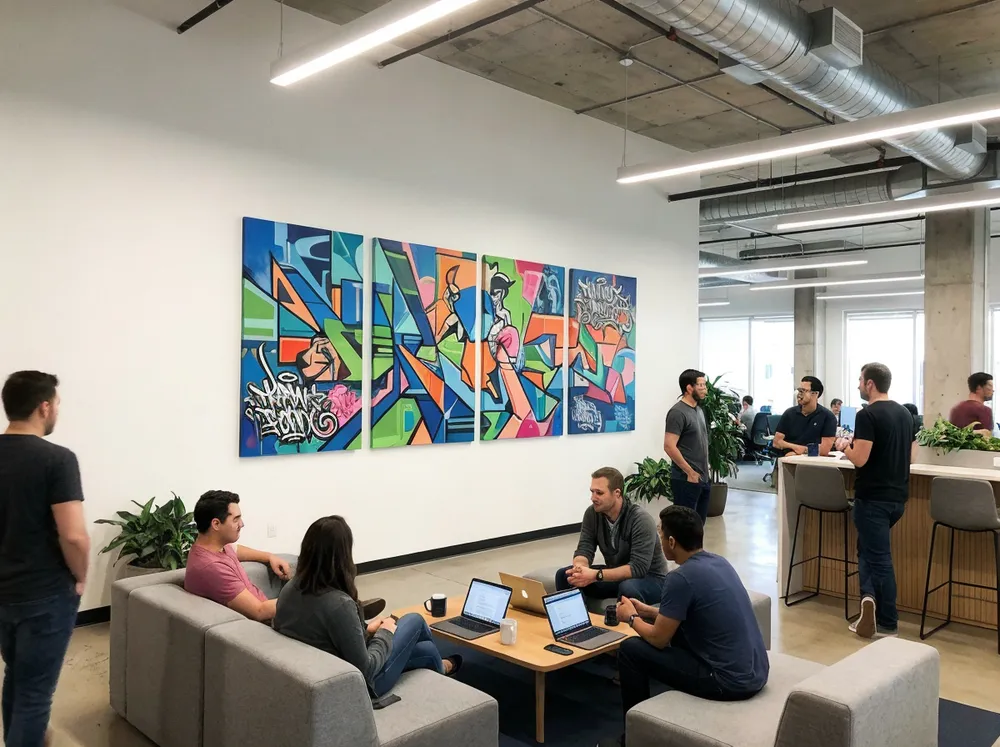
- Abstract organic — fluid shapes, soft color gradients, sometimes metallic accents. MDF or resin frames with matte or satin finish. The fastest-growing sub-style in the 2024–2026 window based on platform search trend data.
(We track these four separately in our sampling pipeline because each one has a different production bottleneck — line art is a printing and framing precision issue, boho texture is a materials sourcing issue, and abstract organic is a color-matching issue across a bulk run.)
The Spec Dimensions That Actually Affect Sell-Through
Trend style gets buyers to click. Specs determine whether the product gets returned, reviewed poorly, or reordered. These are the dimensions that matter for US e-commerce performance.
Size
Size is the single most consequential spec decision for sell-through rate. US consumers buying wall art online have strong size expectations by room type, and listings that don't match those expectations generate returns.
| Size Range | Platform Sweet Spot | Notes |
|---|---|---|
| 8×10" / 10×12" | Amazon impulse / gift segment | Low ASP, high volume, competitive |
| 12×16" / 16×20" | Amazon & Wayfair mid-tier | Best margin-to-volume ratio for most resellers |
| 18×24" / 20×24" | Wayfair statement piece segment | Higher ASP, lower return rate when framed well |
| 24×36" | Wayfair / boutique retail | Requires stronger frame construction; freight cost matters |
| Multi-panel sets (3×8×24") | Amazon trending | Higher perceived value, complex packaging |
The 12×16" and 16×20" range is where most of our US buyers land for their core SKU. It's producible at scale, fits standard carton configurations for FBA, and hits the price points that convert without triggering price-sensitivity hesitation.
(Multi-panel sets look attractive on paper but add real complexity — three pieces need to arrive undamaged, and the assembly instruction insert has to be right for your target market. We've seen buyers underestimate the packaging engineering on these.)
Frame Material
Frame material affects landed cost, return rate, and platform compliance more than most buyers realize upfront.
| Frame Material | Weight | MOQ Flexibility | Lead Time | Best For |
|---|---|---|---|---|
| MDF with veneer or foil wrap | Light | High — standard tooling | 25–35 days | Amazon FBA, Wayfair mid-market |
| Solid wood (pine/paulownia) | Medium | Medium — depends on profile | 30–40 days | Premium Wayfair, boutique retail |
| Resin/composite | Light | Medium | 30–40 days | Decorative profiles, boho styles |
| Metal (aluminum extrusion) | Medium-heavy | Lower — tooling cost | 35–45 days | Minimalist/modern, gallery style |
| Frameless (canvas wrap / float mount) | Lightest | High | 20–30 days | Abstract, photography prints |
MDF is the workhorse of the US e-commerce wall art market. It's dimensionally stable, takes paint and foil wrap cleanly, and keeps freight costs manageable. We run MDF frames on the majority of our US-bound aesthetic wall art orders because the cost-to-quality ratio is hard to beat at volumes above 500 units.
Solid wood commands a higher retail price point and photographs better for lifestyle imagery, but the grain variation means more QC sorting. For Wayfair programs where product photography is a major conversion driver, that extra cost is usually justified. For Amazon FBA where the listing photo is smaller and the price competition is tighter, MDF with a good finish often outperforms.
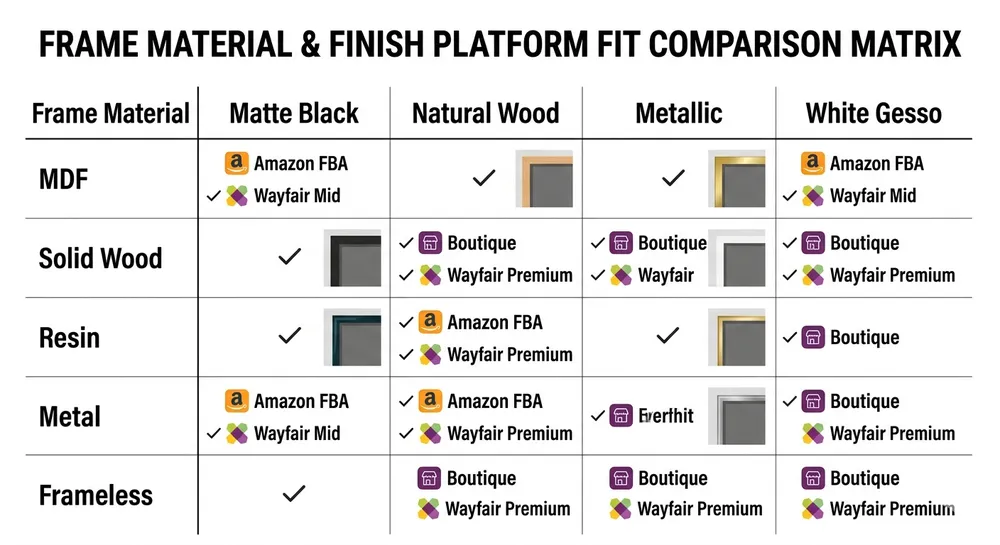
Surface Finish
Finish is where aesthetic sub-style and production reality intersect most directly. The wrong finish on the right frame kills the look — and generates reviews that mention "cheap" or "plastic-looking."
| Finish Type | Aesthetic Sub-Style Match | Production Note |
|---|---|---|
| Matte black paint | Minimalist line art, abstract organic | Most consistent across MDF and metal; low glare in listing photos |
| Natural wood / whitewash | Neutral tone photography, boho | Grain variation requires sorting; adds 1–2 days to QC |
| Gold/brass metallic | Abstract organic, glam aesthetic | Electroplating or foil — foil is more consistent at scale |
| White gesso / chalk | Minimalist, farmhouse crossover | Clean look, shows handling marks; packaging matters |
| Raw/unfinished wood | Boho, organic texture | Moisture content control is critical for US climate stability |
Matte black is the safest finish for a first aesthetic wall art order. It photographs well, hides minor surface variation, and works across multiple sub-styles. We recommend it as a starting point for buyers entering the category without strong data on their customer's finish preference.
Which Sub-Styles Are Moving on US Platforms Right Now
Trend identification is only useful if it's connected to a production timeline. Here's where demand is sitting in the 2025–2026 window, and what it means for your order planning.
Abstract organic — the growth story
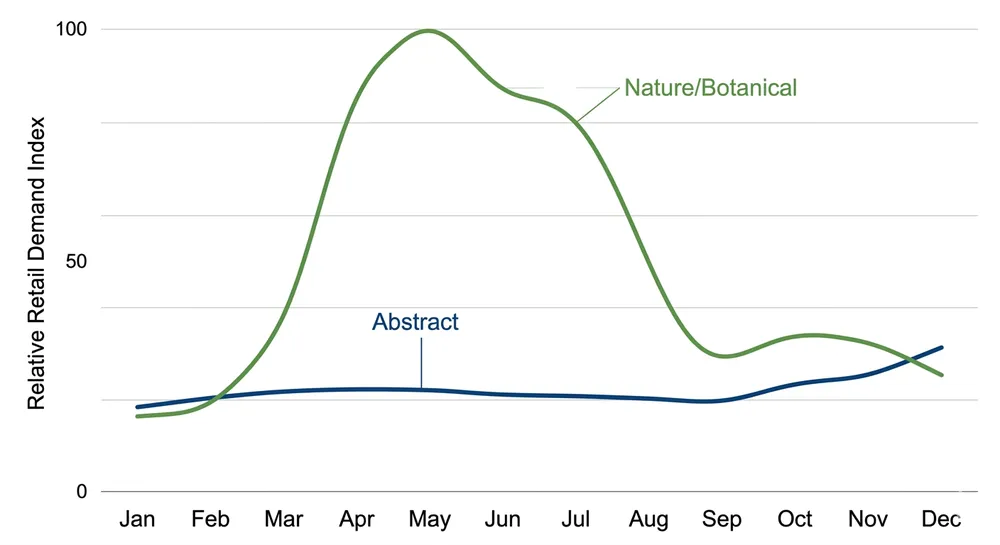
Abstract organic wall art — fluid shapes, soft earth tones, occasional gold or terracotta accents — has been the strongest-growing sub-style on both Amazon and Wayfair since mid-2023. Search volume for terms like "abstract boho wall art," "organic shape wall decor," and "neutral abstract print" has grown consistently, and the category hasn't saturated the way minimalist line art did in 2021–2022.
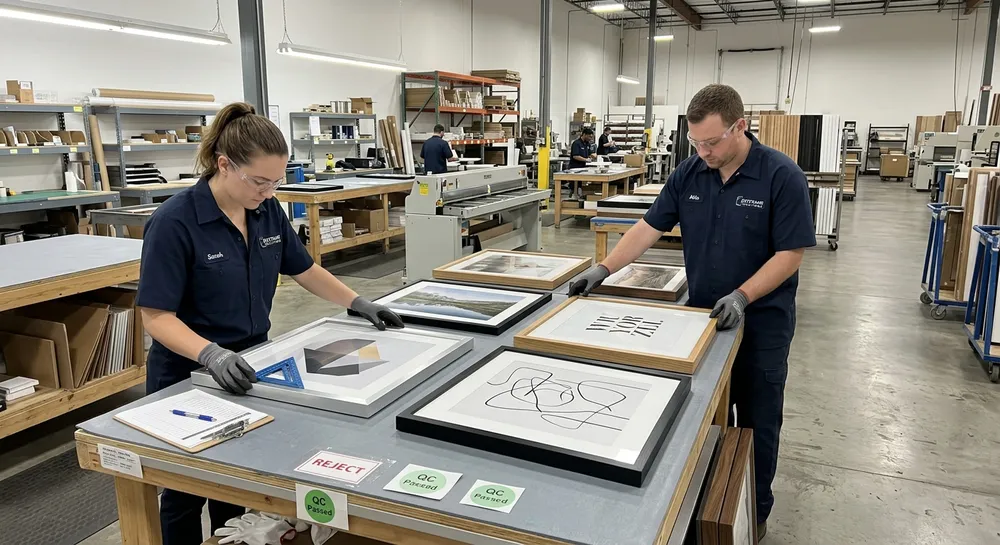
The production spec that matters here: color accuracy across a bulk run. Abstract organic pieces often use gradient backgrounds or multi-tone color fields, and color shift between units is the most common QC failure mode. We run color calibration checks at the print stage and again after framing — a step that adds time but eliminates the "colors look different than the photo" reviews that tank conversion.
For buyers sourcing Aesthetic Wall Arts in this sub-style, the key spec to lock down is the color profile of your print file. We work from ICC-profiled files and can provide a pre-production color proof before bulk printing starts.
Minimalist line art — mature but stable
Line art peaked in 2021–2022 but hasn't collapsed. It's now a stable, competitive segment with thin margins and high price sensitivity. The buyers doing well in this segment are either running high volume at low ASP (Amazon FBA, 8×10" to 12×16") or differentiating on frame quality at a higher price point (Wayfair, 18×24" with solid wood frames).
If you're entering this sub-style now, the frame is your differentiation lever. The print itself is commoditized. A clean matte black MDF frame at 12×16" will compete on price. A paulownia wood frame with a natural finish at 18×24" can hold a $45–65 retail price point with better margin protection.
Neutral tone photography — Wayfair's core
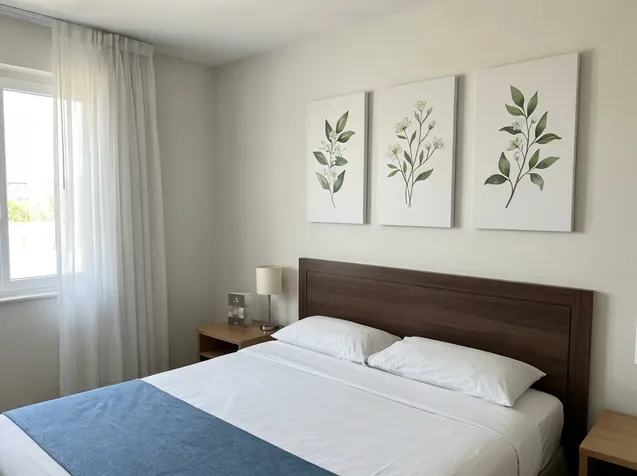
Botanical prints, soft landscape photography, and architectural detail shots in muted palettes are the backbone of Wayfair's mid-market wall art category. This sub-style has a longer trend cycle than abstract or line art — it's less fashion-driven and more tied to interior design fundamentals.
The spec profile here is different from the others: buyers in this segment prioritize print resolution and frame finish quality over novelty. A 300 DPI print on archival-quality paper in a clean natural wood frame at 16×20" or 20×24" is the standard. Return rates in this sub-style are lower when the product matches the listing photo accurately — which means your sample approval process matters more than in faster-moving sub-styles.
Boho texture — high appeal, production complexity
Woven wall hangings, macramé-adjacent pieces, and natural fiber wall art have strong consumer appeal but are the hardest sub-style to produce consistently at scale. Texture variation is inherent to the materials, which means your QC standard has to define acceptable variation ranges explicitly — otherwise you'll have disputes on every shipment.
We handle boho texture pieces, but we're honest with buyers about the production reality: MOQ is higher (typically 200+ units per SKU), lead time is longer (40–50 days), and the first order should include a pre-production sample approval step. Buyers who skip the sample step on boho texture orders are the ones who end up with a container of product that's technically within spec but looks inconsistent on the shelf.
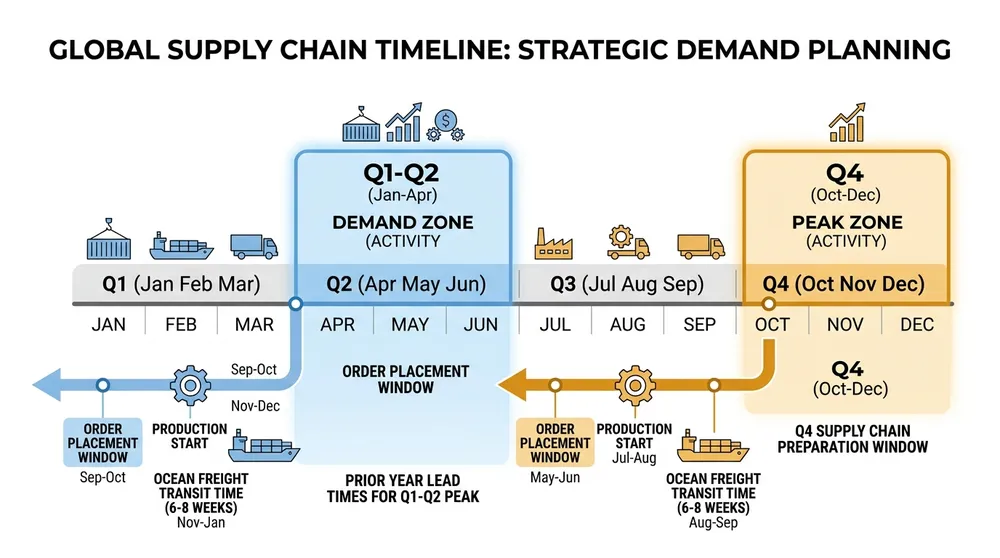
Trend-Cycle Timing and Order Planning
The US e-commerce wall art market has two demand peaks: Q4 (October–December, driven by holiday gifting and home refresh) and Q1–Q2 (January–April, driven by new year home improvement intent and spring refresh). Missing either peak by 4–6 weeks means your inventory arrives after the search volume spike.
Working backward from those peaks:
| Target Sales Window | Order Placement | Production Start | Notes |
|---|---|---|---|
| Q4 (Oct–Dec) | Late June – mid July | July | Allows 35–45 day production + 20–25 day ocean freight to US |
| Q1–Q2 (Jan–Apr) | October – November | November | Avoids Chinese New Year production gaps |
| Spring refresh (Mar–May) | December – January | January | Tightest window; confirm factory capacity before committing |
The Chinese New Year gap is the most common timing mistake we see from buyers who are new to Vietnam and China sourcing. Our factory is in Vietnam, so we don't shut down for CNY — but if any of your frame components or print substrates come from Chinese suppliers, the gap still affects your timeline. We flag this proactively when we see it in a buyer's BOM.
(The Q1–Q2 window is underutilized by most wholesale buyers who focus on Q4. New year home refresh intent on Wayfair and Amazon is real and consistent — worth building a separate SKU plan around it.)
For buyers sourcing across the full Wall Arts by Style & Subject category, staggering orders across sub-styles by season is a more reliable strategy than concentrating everything in a single Q4 push.
Platform Compliance Specs That Affect Your Sourcing Decision
Amazon, Wayfair, and Walmart each have vendor requirements that affect how you spec your product — not just how you list it. Getting these wrong costs you chargebacks, listing suppression, or failed vendor audits.
Amazon FBA
- Packaging: Each unit must be poly-bagged or boxed to survive warehouse handling. Framed wall art needs corner protection — we use molded pulp corners on all FBA-bound orders.
- Weight and dimensions: FBA standard-size tier caps at 20 lbs and 18×14×8". Oversized triggers higher fulfillment fees. Most 12×16" and 16×20" framed pieces fit standard-size with the right carton design.
- FNSKU labeling: Must be on the outer carton, scannable, not covered by tape. We include FNSKU label placement in our carton spec sheet.
- Fragile item requirements: Glass-fronted pieces need "Fragile" and "This Side Up" markings. We use tempered glass on all framed pieces — it's a safety requirement for FBA and reduces breakage claims.
Wayfair
- EDI compliance: Wayfair requires EDI 850/856/810 transaction capability for vendor programs. We have EDI capability and have been through Wayfair's vendor onboarding process.
- Product data: Wayfair's product data requirements are detailed — dimensions, weight, material composition, finish description, and assembly instructions all need to be accurate. Inaccurate data is the primary cause of Wayfair return spikes.
- Packaging: Wayfair's drop-ship model means your product ships directly to the consumer. The outer carton is the unboxing experience. We design cartons for both warehouse efficiency and consumer presentation.
Walmart Marketplace / Supplier Program
- BSCI audit: Walmart supplier programs require BSCI or equivalent social compliance audit. We hold BSCI certification — buyers entering the Walmart channel can use our audit documentation.
- Item setup: Walmart's item setup process requires specific attribute mapping. We've been through this process and can provide the attribute data your team needs.
- Packaging compliance: Walmart has specific requirements for retail-ready packaging if you're in the brick-and-mortar program. Drop-ship packaging requirements are similar to Wayfair.
Our ISO 9001:2015, SGS, CE, and BSCI certifications cover the compliance baseline for all three platforms. Buyers who need platform-specific documentation — test reports, material safety data, or compliance declarations — can request these during the RFQ stage.
Production Realities: What's Scalable vs. What's Trend-Only
Not every aesthetic trend that performs on Pinterest or TikTok is producible at the volumes and price points that make sense for wholesale. Here's a direct assessment.
Scalable at 200+ units with standard lead times:
- MDF-framed minimalist line art (any size up to 24×36")
- Abstract organic prints with flat or gradient backgrounds
- Neutral tone photography in natural wood or MDF frames
- Canvas wrap (frameless) in any of the above styles
- Multi-panel sets in standard configurations (2-panel, 3-panel)
Scalable but requires longer lead time or higher MOQ:
- Solid wood frames with natural finish (grain sorting adds time)
- Metallic finish frames (electroplating requires dedicated line time)
- Custom frame profiles (requires tooling, typically 500+ unit MOQ)
- Oversized pieces (24×36" and above — carton engineering and freight cost planning needed)
High consumer appeal, production complexity warrants discussion:
- Boho texture / natural fiber pieces (texture variation, longer lead time)
- Mixed-media pieces with 3D elements (resin pours, raised texture)
- Hand-painted or hand-finished pieces (labor-intensive, consistency challenges at scale)
We've had buyers come to us with trend references that look great but require hand-finishing on every unit. That's fine for a 50-unit boutique order — it's not viable for a 1,000-unit Amazon FBA run. The conversation we have early in the RFQ process is: what's your target retail price, what's your volume, and what's your channel? Those three answers determine which production path makes sense.
(We've turned down orders that weren't a good fit for our production setup. It's better to say that upfront than to take the order and deliver something that doesn't meet the buyer's expectations.)
Sourcing Mistakes That Show Up in Platform Reviews
The most useful thing I can tell you about aesthetic wall art sourcing is that the problems buyers encounter on US platforms are almost always traceable to spec decisions made at the RFQ stage — not to production failures.
Color mismatch between sample and bulk: The most common complaint in aesthetic wall art reviews. Caused by approving a sample printed on a different substrate or with a different color profile than the bulk run. Fix: require a pre-production print proof on the actual bulk substrate before approving production.
Frame finish inconsistency: Matte black that looks slightly different across units in the same shipment. Caused by inconsistent paint application or batch variation in foil wrap. Fix: specify finish tolerance in your PO and request a QC report with finish photos from the production run.
Glass breakage in transit: Tempered glass reduces but doesn't eliminate breakage. The real variable is corner protection. Molded pulp corners outperform foam corners for framed pieces — we switched to molded pulp on all FBA-bound orders after seeing breakage rates drop significantly.
Size discrepancy: A 16×20" piece that measures 15.75×19.75" is technically within tolerance, but if your listing says 16×20", you'll get returns. Specify your dimensional tolerance in the PO (we work to ±3mm on frame outer dimensions) and confirm it on the inspection report.
Mounting hardware missing or wrong: US consumers expect D-ring hangers or sawtooth hangers included and pre-installed. Specify the hardware type, quantity, and installation requirement in your product spec sheet. This sounds obvious but it's a frequent omission in first-time orders.
For buyers building a new aesthetic wall art line, the Abstract Wall Arts category is a useful starting point — it's the sub-style with the most consistent spec profile and the lowest risk of the color and finish issues described above.
Frequently Asked Questions
What aesthetic wall art sizes sell best on Amazon vs. Wayfair?
On Amazon, 12×16" and 16×20" are the volume leaders — they hit the price points that convert without triggering size hesitation, and they fit FBA standard-size carton requirements. On Wayfair, the 18×24" and 20×24" range performs better because Wayfair's customer base skews toward considered purchases with higher ASP tolerance. If you're building a line for both channels, a 16×20" core SKU with an 18×24" or 20×24" upsell covers both.
What frame material is best for aesthetic wall art wholesale?
MDF with a quality finish is the right answer for most wholesale programs — it's dimensionally stable, lightweight for freight, and takes paint and foil wrap consistently. Solid wood is worth the premium for Wayfair premium-tier listings where lifestyle photography drives conversion. Metal frames work well for minimalist and gallery-style aesthetics but add weight and cost. The frame material decision should follow your target retail price point and channel, not the other way around.
How far in advance should I place aesthetic wall art orders for Q4?
Place your order by late June to mid-July for Q4 delivery. That allows 35–45 days of production plus 20–25 days of ocean freight to a US port, with buffer for customs clearance. Buyers who place Q4 orders in August are taking a real risk on arrival timing. If you're air-freighting to catch a missed window, the freight cost will compress your margin significantly on a product category with already-thin ASPs.
What certifications do I need for aesthetic wall art sold on US platforms?
For Amazon and Wayfair, the baseline requirements are: ASTM F963 compliance for any product that could be marketed to children, California Prop 65 compliance for any product with glass or certain frame finishes, and accurate material composition data for product listings. For Walmart supplier programs, BSCI or equivalent social compliance audit is required. We hold ISO 9001:2015, SGS, CE, and BSCI — and can provide test reports and compliance documentation as part of the order package.
What's the minimum order quantity for custom aesthetic wall art specs?
For standard frame profiles and sizes, MOQ starts at 100 units per SKU. Custom frame profiles (new tooling required) typically need 500+ units to amortize the tooling cost. Custom sizes within our standard frame profiles can often be accommodated at 200+ units. The right answer depends on your spec — send us your requirements through the Request Quote page and we'll give you a direct answer on MOQ and tooling cost.
“`