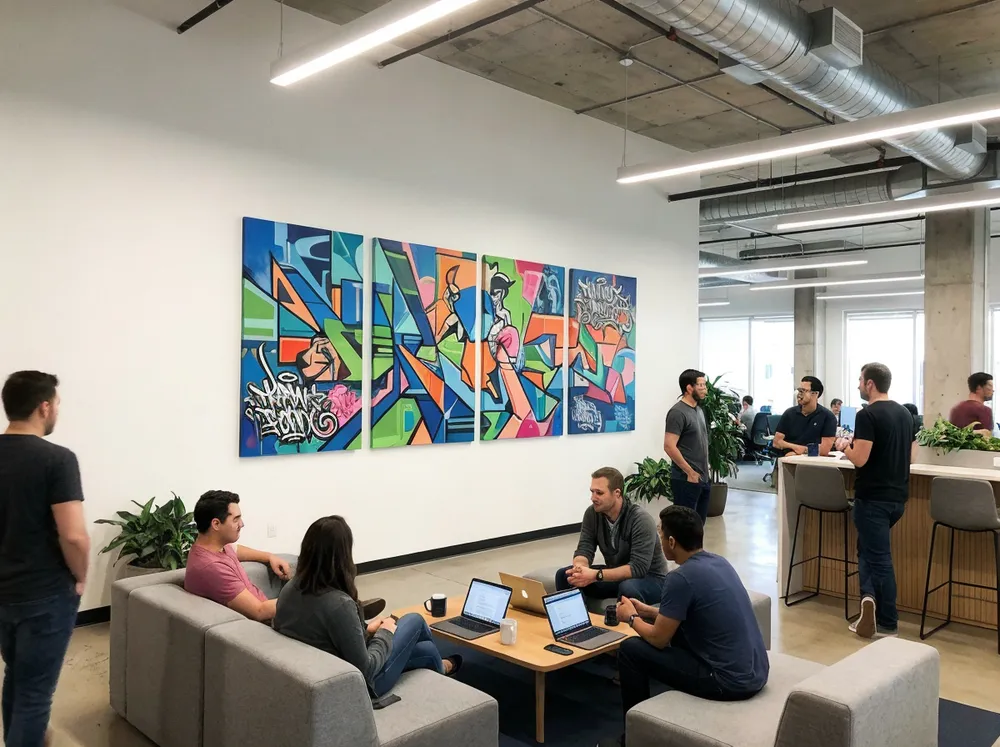
A distributor I know placed a 2,000-unit order for graffiti-style canvas prints through a trading company. The artwork looked original. The factory said it was "royalty-free." Six months after the product hit retail shelves in the US, a cease-and-desist arrived from a street artist's legal team. The retailer pulled the SKU. The distributor ate the return cost, the legal fees, and the relationship damage — all because nobody in the supply chain had actually verified the IP status of the design.
This is not a rare story. Graffiti-style wall art is one of the fastest-growing segments in wholesale wall decor, and it's also one of the most legally exposed. The aesthetic borrows heavily from a tradition where the original works are publicly visible, widely photographed, and frequently copied — which creates a false sense that the imagery is free to use. It isn't.
This guide walks through the IP landscape specific to graffiti and street art, the three sourcing models and their real cost-risk tradeoffs, what due diligence looks like before you place a bulk order, and how commissioning original designs through an OEM factory sidesteps the problem entirely.

Why graffiti-style wall art carries IP risk that generic wall decor doesn't
Most wall decor categories have a straightforward IP structure. A floral print, an abstract geometric, a landscape — these are either original works owned by the designer, licensed from a stock library, or clearly in the public domain. The chain of ownership is short and documented.
Graffiti-style art is different for three reasons.
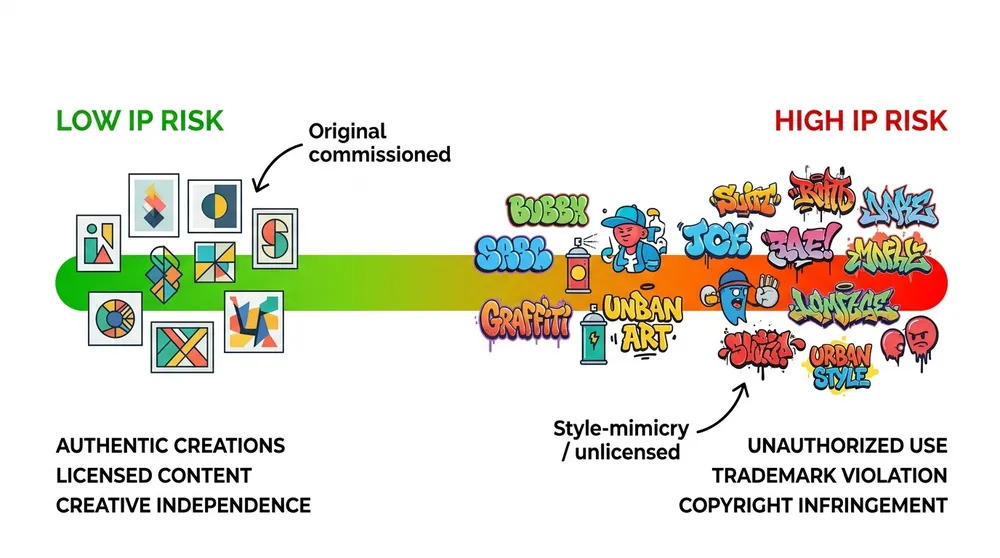
First, the aesthetic is inseparable from specific artists' styles. When a factory produces a "graffiti-style" print, it's often referencing the visual language of identifiable artists — letterforms, color blocking, spray-texture effects, character designs — that those artists have spent years developing and, in many cases, have registered as trademarks or copyrights. A design that "looks like" Banksy, Shepard Fairey, or any number of regional muralists isn't automatically safe just because it wasn't directly copied pixel-for-pixel.
Second, street art exists in public space but is not public domain. A mural painted on a building wall is still the intellectual property of the artist who painted it. Photographing it, reproducing it on a product, and selling that product at wholesale scale is infringement — regardless of whether the original work was commissioned, permitted, or technically illegal graffiti. The Visual Artists Rights Act (VARA) in the US and equivalent moral rights provisions in the EU and Australia add another layer: even if you license the reproduction rights, the artist may retain rights to object to how the work is used commercially.
Third, the supply chain for graffiti-style wall art is opaque. Trading companies and lower-tier factories frequently source designs from freelance platforms, stock sites, or internal design teams without proper IP documentation. When you ask "is this licensed?", the honest answer is often "we don't know" — but what you hear is "yes."
(We've seen this directly. Buyers come to us after a problem, not before. The pattern is consistent: a trading company, an undocumented design source, and a retailer who eventually gets the complaint.)
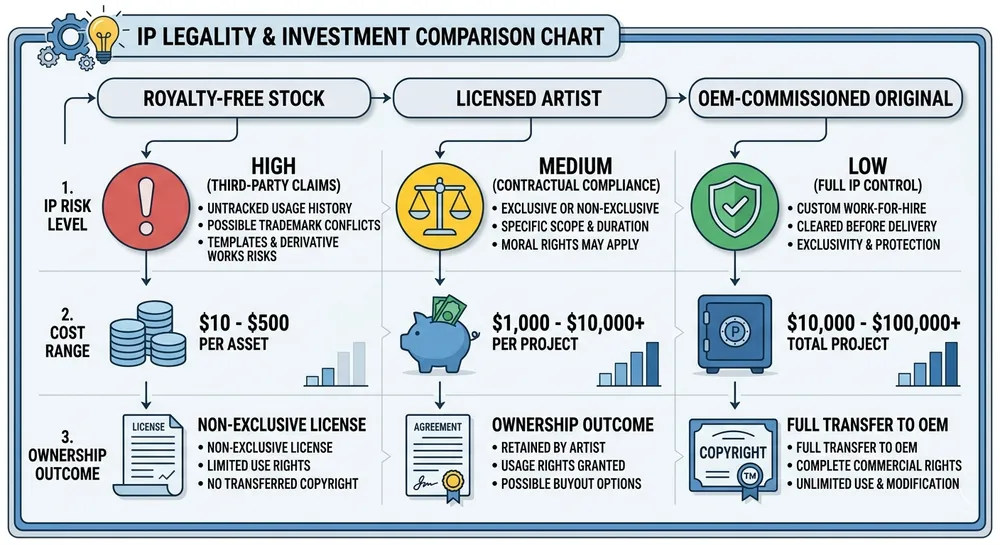
The three sourcing models: cost and risk side by side
Before placing any bulk graffiti wall art order, you need to understand which of these three models your supplier is actually operating under — because the risk profile is completely different for each.
Royalty-free stock graffiti designs
Stock licensing platforms (Shutterstock, Adobe Stock, Getty, and specialized art licensing sites) offer graffiti-style designs under royalty-free licenses. "Royalty-free" means you pay once and don't owe per-unit royalties — it does not mean the design is free or unencumbered.
The practical issues for wholesale buyers:
- License scope matters. Most standard royalty-free licenses cover digital use, print-on-demand, or limited print runs. Wholesale production of 500+ units typically requires an extended commercial license, which costs significantly more and may still cap unit quantities.
- Exclusivity is rarely included. Your competitor can license the same design. If you're building a private-label program, royalty-free stock gives you no differentiation protection.
- Indemnification is limited. If the stock platform's contributor uploaded artwork that infringes a third party's rights, your indemnification from the platform is usually capped at the license fee you paid — not your actual exposure.
For low-volume, non-exclusive SKUs where the graffiti aesthetic is incidental rather than a brand differentiator, royalty-free stock can work. For any program where the design is a selling point, it's the wrong model.
Licensed original artist work
Commissioning a license directly from a graffiti or street artist — or working through an art licensing agency — gives you a cleaner IP position, but the structure of the agreement determines everything.
Key terms to negotiate and document:
- Territory: Does the license cover North America only, or also EU and Australia? Many artist licenses default to a single territory.
- Channel: Is wholesale distribution explicitly covered, or only retail? Some licenses cover direct-to-consumer but not B2B wholesale.
- Duration: Is this a one-time production run license, or an ongoing license tied to a royalty per unit sold?
- Exclusivity: Can the artist license the same design to your competitors during the license period?
- Moral rights waiver: In EU and Australian jurisdictions, artists retain moral rights even after licensing reproduction rights. A proper agreement should address whether the artist can object to how the design is used on your product.
Royalty structures for original artist licenses typically run 8–15% of wholesale price for established artists, or a flat fee for a defined production run. For a 1,000-unit order at $25 wholesale, that's $2,500–$3,750 in royalties on top of production cost — a real margin impact that needs to be modeled before you commit.
(The flat-fee model is usually better for wholesale buyers. Per-unit royalties create accounting complexity and ongoing audit obligations that most distributors aren't set up to manage.)

OEM-commissioned original designs
This is the model that eliminates licensing risk entirely. You commission original graffiti-style artwork — either through your own designer or through the factory's in-house design team — and take full IP ownership via a work-for-hire agreement.
The commercial logic is straightforward: you pay once for the design, you own it, and no third party can claim infringement because the work didn't exist before you commissioned it. There are no royalties, no territory restrictions, no license renewal dates, and no risk that the same design appears on a competitor's product.
The catch is that not every factory can actually deliver this. Producing original graffiti-style artwork that looks credible — not like a clip-art approximation — requires designers who understand the aesthetic: letterform construction, layering, texture, color relationships. A factory that outsources design to a freelancer on a per-piece basis is not the same as one with an in-house team that has developed this capability over years.
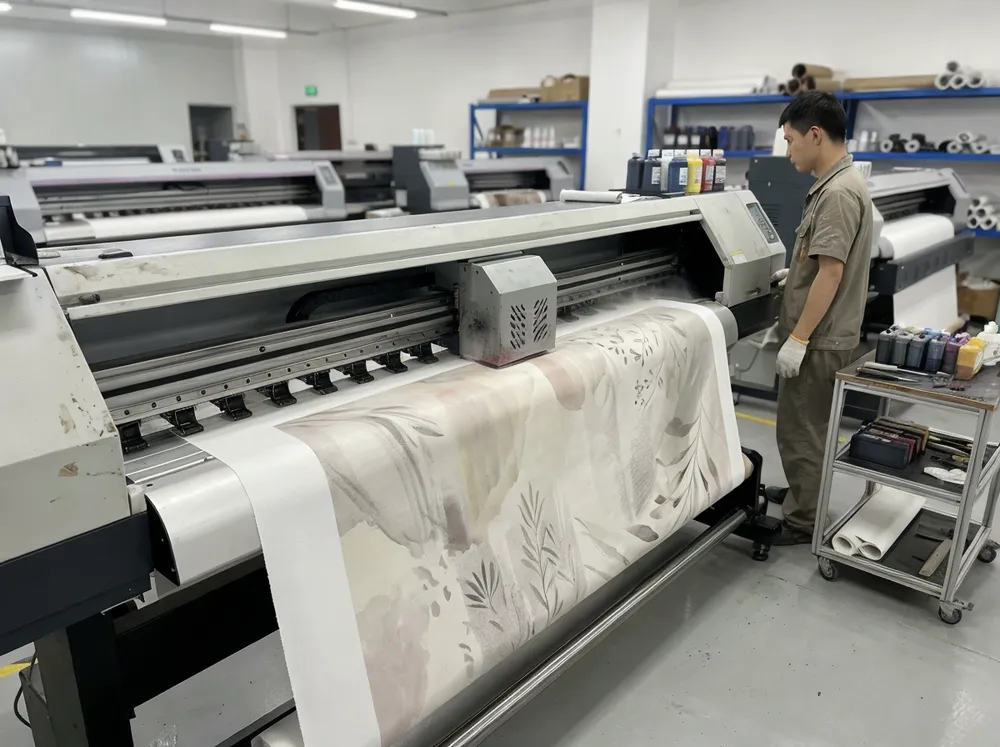
At Livewellcraft, our 12-person engineering and design team has been developing original wall art designs for export programs since 2008. For graffiti-style work specifically, we can produce original artwork adapted to different print methods — screen print, digital print, or hand-painted — under one roof. When you commission a design through us, the work-for-hire agreement transfers full IP ownership to you. Your legal team gets a clean chain of custody document, not a stack of stock license PDFs.
For buyers building a private-label graffiti wall art program, this is the only model that gives you both design exclusivity and IP clarity. See our Graffiti Wall Arts product range for examples of what we've produced for existing programs.
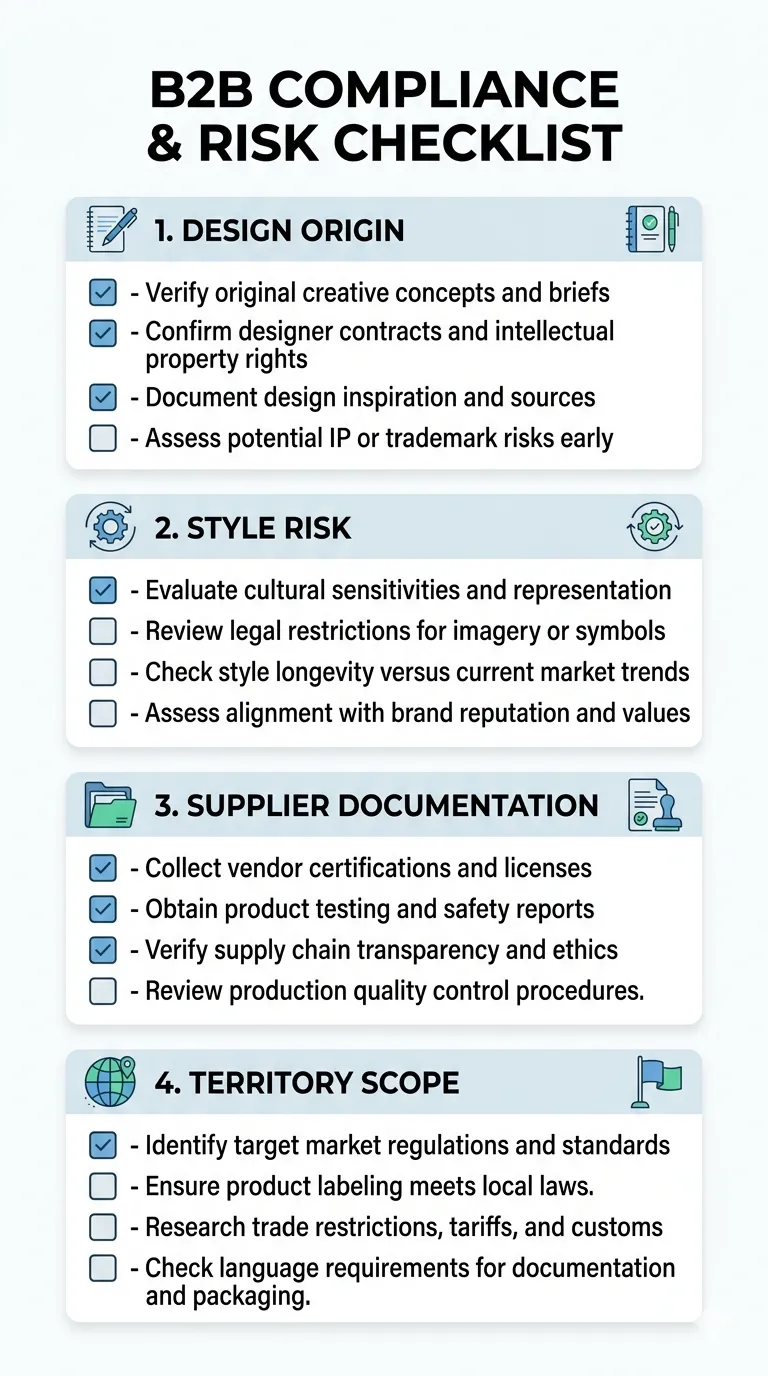
IP due diligence checklist before placing a bulk order
Whether you're sourcing from us or another supplier, run through this before committing to a production run.
Design origin verification
- [ ] Can the supplier provide written documentation of the design's origin (stock license certificate, artist agreement, or work-for-hire contract)?
- [ ] If stock-licensed: does the license explicitly cover wholesale production at your intended quantity?
- [ ] If artist-licensed: does the agreement cover your target territories (US, EU, Australia)?
- [ ] If OEM-commissioned: is there a signed work-for-hire agreement transferring IP ownership to you?
Style and reference check
- [ ] Does the design reference the recognizable style of a specific known artist (Banksy, Shepard Fairey, KAWS, etc.)? If yes, treat it as high-risk regardless of what the supplier says.
- [ ] Does the design incorporate any elements that appear in publicly documented murals or street art installations? Reverse image search the key visual elements.
- [ ] Are any character designs, logos, or typographic elements in the artwork potentially trademarked independently of copyright?
Supplier documentation
- [ ] Has the supplier provided a written IP warranty — a contractual statement that the design does not infringe third-party rights?
- [ ] Does the supplier's contract include an indemnification clause covering your costs if an infringement claim arises?
- [ ] For factory-direct suppliers: can they show you the design brief, revision history, and designer identity for the artwork?
Territory and channel scope
- [ ] Is your intended sales territory explicitly covered by the license or ownership agreement?
- [ ] Is wholesale/retail distribution explicitly covered, not just "commercial use"?
- [ ] If you're selling through Amazon, Wayfair, or other platforms: do those platforms' seller agreements require additional IP documentation? (Wayfair and Amazon both have IP complaint processes that can result in listing removal — having documentation ready prevents this.)
Common mistakes that expose distributors to infringement claims
These are the patterns we see repeatedly when buyers come to us after a problem.
Accepting "royalty-free" as a complete answer. Royalty-free describes the payment structure, not the legal clearance status. A design can be royalty-free and still infringe. Always ask for the specific license certificate and read the scope.
Relying on the factory's verbal assurance. "We own this design" from a trading company means nothing without documentation. The factory may have purchased a design from a freelancer who copied it from somewhere else. The liability travels with the product, not with the factory.
Ignoring style similarity to known artists. Copyright protects specific expression, not style — but trademark law and trade dress claims can reach further. A design that closely mimics a well-known artist's visual identity can generate a claim even if it wasn't directly copied. The legal cost of defending that claim, even if you win, is real.
Assuming the same license covers all markets. A US license does not automatically cover EU distribution. The EU's copyright framework includes stronger moral rights provisions, and some EU member states have additional protections for street art. If you're distributing across North America, Europe, and Australia, each territory needs to be explicitly covered.
Not getting an indemnification clause. If your supplier won't provide a written IP warranty and indemnification clause, that tells you something about their confidence in the design's IP status. Make it a standard contract requirement.
Territory-specific IP considerations for North America, EU, and Australia
The underlying copyright principles are similar across these markets — original works are protected from the moment of creation, without registration — but the practical differences matter for wholesale distribution.
North America (US and Canada)
US copyright protection lasts for the life of the author plus 70 years. Registration is not required for protection, but it is required to sue for statutory damages and attorney's fees — which is why registered works generate more aggressive enforcement. The VARA gives visual artists additional rights to attribution and integrity for works of "recognized stature," which can complicate commercial use even of licensed works.
Canada's copyright term is life plus 70 years (extended from 50 years in 2022 under the CUSMA/USMCA implementation). Canadian moral rights cannot be waived by contract in the same way as US rights.
For wholesale buyers: US customs can seize imported goods that infringe registered copyrights. CBP (Customs and Border Protection) maintains a recordation system for registered works. High-profile street artists with registered works can and do use this mechanism.
European Union
EU copyright term is life plus 70 years, consistent across member states. The EU's moral rights framework is stronger than the US — artists retain the right of integrity (objecting to modifications that harm their reputation) and attribution even after transferring economic rights. A license that covers reproduction rights may not cover the right to modify the design for different product formats.
The EU's Digital Single Market Directive (2019) also strengthened platform liability for infringing content, which affects how EU-based retailers handle IP complaints. If your EU retail partners receive a complaint, they're under more pressure to act quickly.
Australia
Australia's Copyright Act 1968 protects works for life plus 70 years. Australian moral rights are non-waivable — unlike the US, where moral rights can be contractually waived, Australian artists cannot sign away their right of integrity or attribution. This means even a fully licensed design can generate a moral rights claim if the artist objects to how it's used on a product.
For graffiti and street art specifically: Australian courts have addressed the question of whether unauthorized street art is protected by copyright (it is — the illegality of the original act doesn't affect copyright protection). This matters because some suppliers argue that "illegal" graffiti is unprotected. That argument doesn't hold in Australian law, and it doesn't hold in US or EU law either.
How OEM-commissioned originals give you clean IP ownership
The practical advantage of commissioning original designs through a factory with in-house design capability isn't just legal — it's commercial.
When you own the IP, you control the design's lifecycle. You can modify it for different product formats (canvas, framed print, metal print, mirror surround) without going back to an artist for approval. You can register the copyright in your own name, which gives you enforcement rights if a competitor copies your design. You can build a private-label program around a visual identity that nobody else can replicate.
The work-for-hire model also simplifies your supply chain documentation. Instead of maintaining a folder of stock license certificates, artist agreements, and territory addenda, you have one document: the design commission agreement that transfers ownership to you. When Amazon or Wayfair asks for IP documentation, you send one file.
At Livewellcraft, the process works like this: you send us design references — existing graffiti art you like, color palettes, subject matter, the aesthetic direction you're targeting. Our design team develops original artwork that captures that direction without referencing any specific protected work. We go through revision rounds until the design is right, then we produce it using whichever print method fits your product spec. The commission agreement is part of the standard OEM contract. You leave with the product and the IP.
We can adapt the same original design across graffiti wall art print methods — screen, digital, hand-painted — which matters if you're building a range at different price points. A hand-painted version at a higher retail price and a digital print version at a lower price point can share the same underlying design IP, so your whole range is covered by one commission.
(If you're comparing graffiti-style wall art against other aesthetic categories for your product line, our modern vs graffiti wall arts guide covers the demand and margin differences in detail.)
Decision framework: which sourcing model fits your program
Use this to match your situation to the right model before you start talking to suppliers.
| Situation | Recommended model |
|---|---|
| Testing a new SKU, low volume, no exclusivity needed | Royalty-free stock (with extended commercial license) |
| Building a branded program with a specific artist's aesthetic | Direct artist license (flat fee, all territories, exclusivity clause) |
| Private-label program, multiple SKUs, long-term range | OEM-commissioned original (work-for-hire, full IP transfer) |
| Existing design you own, need production only | OEM production with your supplied artwork |
| Unsure of design origin from current supplier | Stop. Run the due diligence checklist before reordering. |
The third row is where most serious wholesale programs end up. The upfront design cost is real — original artwork development runs $300–$800 per design depending on complexity — but it's a one-time cost against a program that may run for years. Compared to the cost of a single infringement claim, it's not a difficult calculation.
For buyers building a Wall Arts by Style & Subject range that includes graffiti as a category, the OEM-commissioned model also gives you the flexibility to develop a cohesive visual identity across multiple SKUs — something you can't do with a mix of stock licenses from different sources.
FAQ
Can I use a photo of a street mural as the basis for a wall art product?
No. The mural is the artist's copyrighted work. Photographing it and reproducing it on a product — even if the photo is yours — infringes the artist's reproduction rights. The fact that the mural is visible in public space doesn't affect this. You need a license from the artist, or you need to commission an original design that doesn't reproduce the mural.
What does "graffiti style" mean legally — is the style itself protected?
Style is not protected by copyright. Copyright protects specific expression — the actual lines, colors, and composition of a particular work — not the general aesthetic approach. You can legally produce graffiti-style wall art that uses spray-texture effects, bold letterforms, and urban color palettes without infringing anyone's copyright, as long as the specific design is original. The risk comes when a design is close enough to a specific artist's work that it could be mistaken for it, or when it incorporates elements (characters, logos, specific compositions) that are protected as individual works.
My supplier says their designs are "original" — what documentation should I ask for?
Ask for: (1) the name and contact of the designer who created the work, (2) the date of creation and any design brief or revision history, (3) a signed work-for-hire agreement or assignment of copyright to the supplier, and (4) a written IP warranty in your purchase contract stating the design doesn't infringe third-party rights. If the supplier can't provide items 1–3, their claim of originality is unverifiable.
Does registering copyright in my market protect me if the design was already infringing?
No. You can only register copyright in a work you actually own. If the design infringes a third party's rights, you don't own it — and registering it doesn't change that. Registration protects original works you legitimately own; it doesn't launder infringing designs.
How do I handle IP documentation for Amazon and Wayfair specifically?
Both platforms have IP complaint processes (Amazon's Brand Registry and IP Complaint system, Wayfair's IP policy). When a complaint is filed, the platform typically removes the listing pending resolution. To defend a listing, you need to provide documentation of your right to use the design — a license certificate, a work-for-hire agreement, or copyright registration. Having this documentation ready before a complaint arrives is much better than scrambling after a listing goes down. For OEM-commissioned designs, the commission agreement and any copyright registration you've obtained are your primary documents.
If you're ready to source graffiti-style wall art with a clean IP position, send your design references and target quantities through our Request Quote page — our design team will come back with original artwork options and full licensing documentation as part of the standard OEM proposal.