Most buyers come to us with a version of the same question: "Can I use your home decor line for a hotel project?" The short answer is sometimes — but usually not without changes you'll want to know about before you commit to a PO. The longer answer is what this article is for.
We run both residential and commercial-grade mirrors on the same 6 production lines here in Ho Chi Minh. That means we see exactly where the specs diverge, where the pricing gaps come from, and where buyers get caught off guard by compliance requirements they didn't know existed. A bathroom mirror and a living room mirror share a factory — but almost nothing else in the spec sheet, and the same logic applies when you scale from a retail SKU to a 200-room hotel fit-out.
Here's the direct verdict before we get into the details: home decor mirrors and commercial-grade mirrors are not interchangeable for most B2B applications. The glass thickness, silvering spec, backing treatment, and safety requirements are different enough that ordering the wrong grade creates real downstream risk — warranty claims, compliance failures, or reorder costs that eat your margin. If you're sourcing for retail shelf placement, the residential catalog is the right starting point. If you're sourcing for hospitality, healthcare, or large-scale commercial fit-outs, you need to spec the commercial grade from the beginning.

Where the Specs Actually Diverge — and Why It Costs You Money
The price difference between a residential catalog mirror and a commercial-grade equivalent isn't arbitrary. It maps directly to four spec dimensions: glass thickness, silvering method, backing treatment, and frame construction. Each one has a downstream cost consequence if you get it wrong.
Glass thickness is the first place buyers underestimate. Our standard home decor mirrors run on 4mm float glass — sufficient for wall-hung residential use, retail packaging, and the drop-test requirements of most e-commerce fulfillment. Commercial applications, particularly hospitality and healthcare, typically specify 5mm or 6mm. The extra millimeter isn't about aesthetics. It's about resistance to flex when the mirror is mounted on uneven drywall in a hotel bathroom, and it's about surviving the handling cycle of a commercial installation crew who isn't treating your product like a retail consumer would. We've seen 4mm mirrors arrive on commercial job sites and get rejected by the GC before they're even unboxed — not because they're defective, but because the spec sheet says 5mm minimum.
Silvering method is where the compliance gap shows up most clearly. Our default process is copper-free silvering across both grades — we made that switch years ago because EU buyers started requiring it and it made sense to standardize. Copper-free silver coating resists moisture penetration better than traditional copper-backed silver, which matters in bathrooms and commercial wet areas where edge blackening is a warranty claim waiting to happen. For residential retail, copper-free is a selling point. For commercial hospitality, it's often a contractual requirement. (We've had buyers come to us after a competitor supplied copper-backed mirrors for a hotel project — the edge degradation started showing within 18 months in the bathroom units. That's a replacement cost conversation nobody wants to have.)
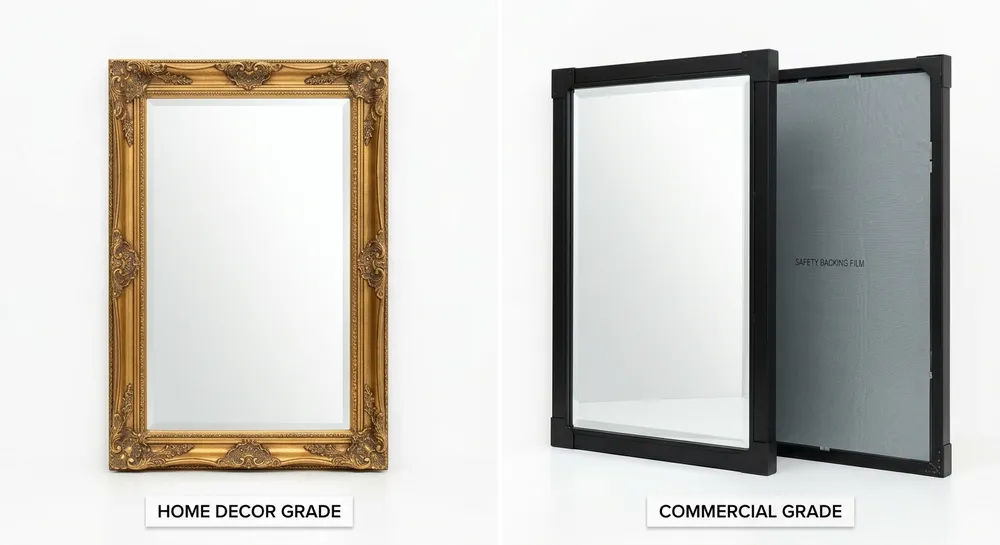
Safety backing is the spec that catches the most buyers off guard. Residential mirrors don't require safety film as a standard — the retail channel doesn't mandate it, and it adds cost. Commercial applications in hospitality, healthcare, and public spaces frequently require shatter-retention film on the back of the glass. In some markets, it's a building code requirement. In others, it's a hotel brand standard or an insurance requirement. We apply safety backing as a standard spec on commercial-grade orders; on residential catalog SKUs, it's an add-on. If you're quoting a hospitality project and your supplier doesn't ask about safety backing, that's a gap in their commercial experience.
Frame construction diverges in ways that aren't obvious from a product photo. Residential frames are engineered for visual appeal and retail price competitiveness — MDF core with decorative veneer or resin molding, hardware sized for standard wall anchors. Commercial frames need to handle higher installation stress, repeated cleaning with commercial-grade chemicals, and in some cases fire-rating requirements for certain room classifications. We use higher-density substrate and heavier-gauge hanging hardware on commercial runs. The frame joint construction is also different — residential frames are assembled for appearance; commercial frames are assembled for structural integrity under repeated load.
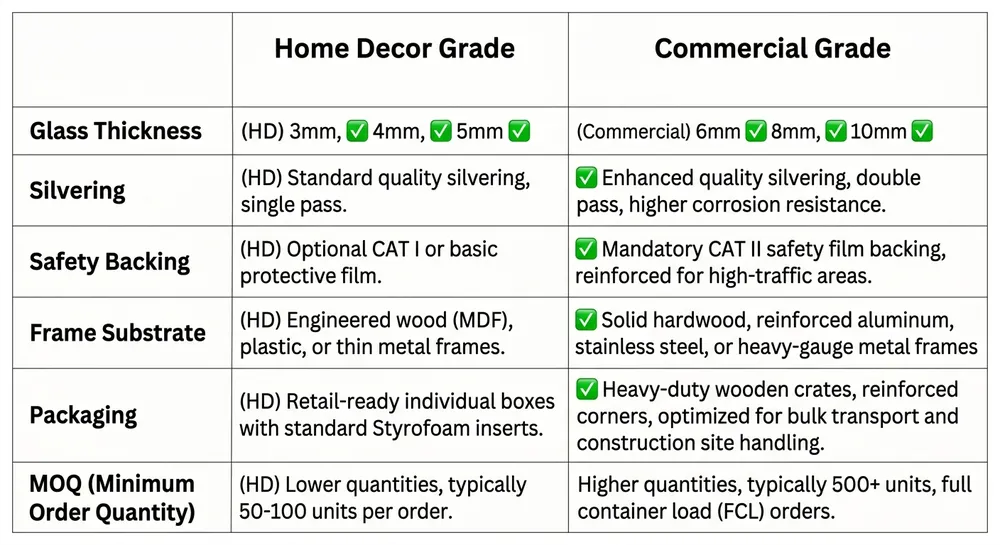
Spec Comparison: Home Decor Grade vs Commercial Grade
| Specification | Home Decor Grade | Commercial Grade |
|---|---|---|
| Glass thickness | 4mm standard | 5–6mm standard |
| Silvering method | Copper-free (standard) | Copper-free (required) |
| Safety backing | Optional add-on | Standard inclusion |
| Frame substrate | MDF / resin molding | High-density substrate |
| Frame hardware | Standard wall anchors | Heavy-gauge commercial hardware |
| Edge treatment | Polished bevel or flat | Polished bevel, seamed edge option |
| Packaging standard | Retail-ready (barcode, hang tag) | Project bulk pack or custom carton |
| Typical MOQ | 100 pieces | 200–500 pieces (project-dependent) |
| Lead time | 30–45 days | 45–60 days (custom spec) |
| Certifications required | CE, SGS (retail markets) | CE, SGS + project compliance docs |
| Typical unit price range | Lower | 15–30% premium over residential |
The Pricing Gap — What You're Actually Paying For
The 15–30% unit cost premium on commercial-grade mirrors over comparable residential SKUs is a number we quote regularly, and buyers always want to know what's inside it. Here's the breakdown from our production side.
Safety film application adds cost in both material and process time — the film itself, the lamination step, and the additional QC check to verify adhesion and bubble-free coverage across the full glass surface. On a 600×800mm mirror, that's a meaningful per-unit addition. Glass upcharge from 4mm to 5mm adds material cost and slightly increases freight weight, which flows through to your landed cost calculation. Frame substrate upgrade from standard MDF to high-density board adds less than you'd expect per unit, but it's real. The heavier hanging hardware is a small line item individually; across a 500-unit hotel order it accumulates.
What buyers sometimes miss is the compliance documentation cost. Commercial projects often require test reports, material safety data sheets, fire-rating certifications for specific frame materials, and in some cases third-party inspection. We carry ISO 9001:2015, SGS, CE, and BSCI — those cover most retail and commercial requirements. But project-specific compliance documentation for a particular hotel brand standard or a regional building code requirement takes engineering time. We build that into commercial project quotes; it doesn't appear as a line item, but it's part of why the commercial grade costs more than just swapping in thicker glass.
The other pricing variable is MOQ structure. Our residential catalog starts at 100 pieces — that's designed for retail buyers testing a new SKU or distributors filling in assortment gaps. Commercial project runs typically start at 200–500 pieces depending on the spec, because the setup cost for custom frame profiles, safety film lamination, and project-specific packaging doesn't amortize efficiently below that volume. If you're sourcing for a 50-room boutique hotel, you're likely looking at a custom run that prices closer to the commercial tier even if the spec is closer to residential — the volume economics drive it.
(One thing worth knowing: if you're a distributor who sells into both retail and commercial channels, we can structure a single PO that covers both grades. We've done this for several North American distributors who stock residential SKUs for their retail accounts and pull commercial-spec units for their hospitality clients — same factory, same QC team, one shipment.)
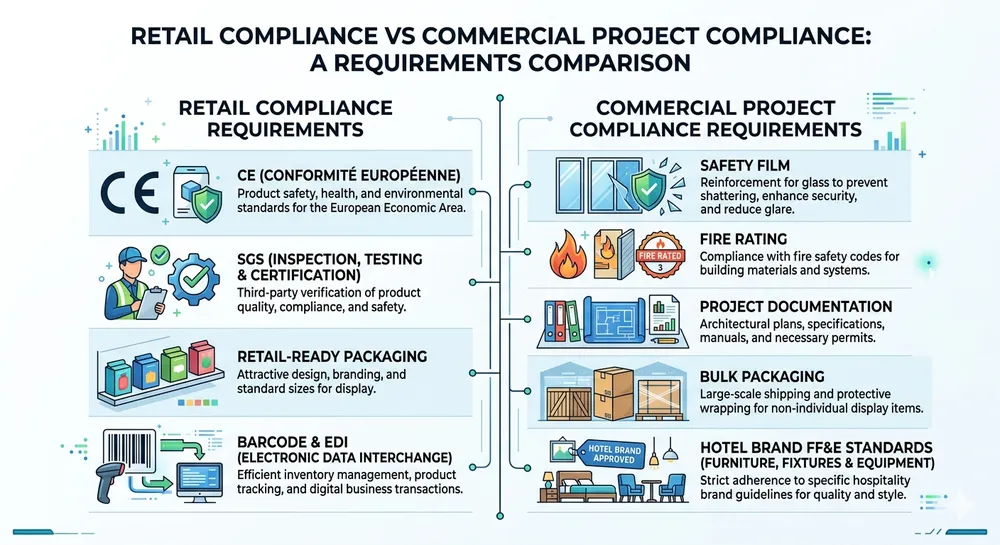
Compliance and Certification: What Retail Shelf vs Commercial Project Actually Requires
Retail channel compliance and commercial project compliance are different problems, and conflating them is one of the more expensive mistakes a sourcing buyer can make.
For retail shelf placement — Walmart, Wayfair, Amazon, independent home goods retailers — the compliance requirements center on product safety standards, retail packaging specifications, and in some cases retailer-specific vendor compliance programs. CE marking covers the EU market. SGS testing covers most North American retail requirements. Retail-ready packaging means barcodes, hang tags, poly-bag or foam protection sized for shelf display, and carton labeling that meets the retailer's EDI and receiving requirements. We have direct experience with Walmart, Wayfair, and Amazon supplier programs — the packaging and labeling requirements are specific and non-negotiable, and getting them wrong means chargebacks.
For commercial project delivery — hotels, serviced apartments, healthcare facilities, office fit-outs — the compliance picture shifts. Safety film is the most common project-specific requirement. Some hotel brands specify minimum glass thickness in their FF&E standards. Healthcare facilities may require antimicrobial frame finishes. Fire-rated frame materials are required in certain room classifications in some building codes. Project delivery packaging is different too — retail-ready packaging is wasteful and unnecessary on a job site; commercial projects typically want bulk cartons sized for efficient site handling, with unit-level protection but no retail presentation elements.
The gap that creates the most sourcing problems: buyers who source residential catalog mirrors for a commercial project because the product looks right, then discover mid-project that the safety film requirement wasn't met, or that the frame material doesn't pass the hotel brand's FF&E audit. At that point you're either retrofitting (expensive and impractical at scale) or reordering (expensive and time-consuming). We flag this in every commercial inquiry because we've seen it happen to buyers who came to us after the fact.
For Bathroom Decor Mirrors specifically — whether residential or commercial — the moisture environment makes copper-free silvering and proper edge sealing non-negotiable. A bathroom mirror that edge-blackens within two years is a warranty claim regardless of whether it's in a home or a hotel.
Three Sourcing Scenarios — Which Grade Wins
Scenario 1: Retail Distributor Stocking Home Decor Mirrors
You're building a 15-SKU assortment of decorative wall mirrors for distribution to independent home goods retailers and a regional furniture chain. Target retail price points are $49–$149. You need retail-ready packaging, consistent quality across reorders, and a supplier who can handle EDI compliance for the furniture chain account.
Winner: Residential catalog grade. The spec is right for the application, the MOQ flexibility (100 pieces per SKU) lets you test sell-through before committing to depth, and retail-ready packaging is standard on our catalog line. The 4mm glass and standard frame construction are appropriate for residential wall-hung use. You don't need safety film, you don't need 5mm glass, and paying the commercial premium for specs your retail buyers don't require just compresses your margin. Our Home Decor Mirrors catalog is the right starting point for this sourcing path.
Scenario 2: Hospitality FF&E Buyer Specifying Mirrors for 200 Hotel Rooms
You're sourcing decorative mirrors for a 200-room mid-scale hotel renovation — bathroom vanity mirrors, full-length mirrors for guest rooms, and accent mirrors for corridors. The hotel brand's FF&E standard requires 5mm glass minimum, safety film on all bathroom mirrors, and copper-free silvering. Delivery is to a job site, not a distribution center.
Winner: Commercial grade, custom spec run. This is exactly the application the commercial grade is built for. The spec requirements (5mm glass, safety film, copper-free silvering) are standard inclusions on our commercial runs, not add-ons. At 200 rooms with 2–3 mirrors per room, you're at 400–600 units — well within the volume range where commercial-grade pricing amortizes efficiently. Project bulk packaging reduces job-site waste. We can also coordinate delivery sequencing if the installation schedule is phased. (We've done phased deliveries for hotel projects before — it requires clear communication on the schedule upfront, but it's manageable.)
Scenario 3: Distributor Expanding from Retail into Hospitality Supply
You currently distribute residential home decor mirrors to retail accounts and have an opportunity to supply a regional hotel management company with mirrors for their annual room refresh program — roughly 300 units per year across multiple properties.
Winner: Single-source strategy, split spec. This is where our production setup creates real value for your business. We can run your residential catalog SKUs and your commercial-spec hospitality units on the same lines, ship in the same container if timing aligns, and manage the spec differences at the production level. You don't need two suppliers, two quality relationships, or two sets of compliance documentation. The hospitality units get safety film, 5mm glass, and project packaging; your retail units get retail-ready packaging and standard spec. One factory, one point of contact, one QC standard. Our OEM/ODM Services page covers how we handle custom spec runs alongside catalog production.
Adapting a Home Decor SKU to Commercial Spec — What It Actually Takes
One of the more common requests we get is from buyers who found a frame profile in our residential catalog that fits their commercial project aesthetically, and want to know if we can produce it to commercial spec. The answer is usually yes, and the process is more straightforward than most buyers expect.
Our 12-engineer OEM/ODM team handles spec adaptation without retooling in most cases. The frame profile stays the same — we're changing the glass thickness, adding safety film lamination, upgrading the hanging hardware, and adjusting the packaging. If the frame substrate needs to change (for fire-rating or chemical-resistance requirements), that's a material substitution at the frame molding stage, not a new mold. We've done this adaptation for buyers who needed to match an existing residential SKU for a commercial project where the aesthetic was already specified by an interior designer.
The lead time for a spec-adapted commercial run is typically 45–60 days from approved sample — longer than a catalog reorder because we build and approve a commercial-spec sample before committing the full run. That sample approval step is non-negotiable on commercial projects; it's the point where the buyer confirms the safety film adhesion, the glass thickness, and the hardware before 400 units go into production.
What doesn't change between the residential and commercial versions: the mirror glass quality, the silvering process (copper-free is standard on both), and the frame profile. What you're paying the commercial premium for is the spec upgrades and the compliance documentation — not a fundamentally different product.
For buyers sourcing across the full Decor Mirrors by Room range, this adaptation capability means you can build a coherent aesthetic across a commercial property using frame profiles from our residential catalog, produced to commercial spec. That's a meaningful advantage when an interior designer has already specified a look and you need to source it at commercial grade.
What to Ask Your Supplier Before You Commit
Whether you're sourcing residential or commercial grade, the questions that separate a reliable factory from a risky one are specific. Here's what we'd ask if we were in your position.
For residential catalog sourcing:
- What is the silvering method — copper-free or traditional copper-backed? (Copper-free is the right answer for any market with moisture exposure.)
- What retail compliance programs have you supplied? (Walmart, Wayfair, and Amazon each have specific requirements — a supplier who hasn't navigated them will create chargebacks for you.)
- What is the reorder consistency on frame finish and glass tint? (Color drift between production runs is a real problem in decorative mirrors — ask for batch-to-batch tolerance specs.)
For commercial project sourcing:
- Is safety film standard or an add-on? (It should be standard on any commercial-grade mirror.)
- What glass thickness is your commercial standard, and can you provide test reports? (5mm minimum is the right answer for most hospitality applications.)
- What project documentation can you provide — material safety data sheets, fire-rating certs for frame materials, third-party inspection reports?
- What is your experience with phased project delivery? (A supplier who has only done retail container shipments may not understand job-site delivery logistics.)
For both grades:
- What certifications do you hold, and are audit reports available? (ISO 9001:2015, SGS, CE, and BSCI are the baseline for serious export manufacturers.)
- What is your QC process at the glass and silvering stage? (100% visual inspection and silver coating adhesion testing before shipment is the standard we hold ourselves to — ask any supplier what their equivalent is.)
The questions that don't get asked are usually the ones that create problems. A supplier who can't answer the safety film and glass thickness questions with specifics is telling you something about their commercial experience.
FAQ
What is the minimum order quantity for commercial-grade mirrors at Livewellcraft? Commercial-grade custom spec runs typically start at 200–500 pieces depending on the frame profile and spec requirements. For standard commercial specs (5mm glass, safety film, copper-free silvering) on existing frame profiles, 200 pieces is usually the floor. For fully custom frame profiles with commercial spec, 500 pieces is more typical because the frame molding setup cost needs to amortize. Residential catalog SKUs start at 100 pieces.
Does copper-free silvering actually make a difference in commercial bathroom applications? Yes, and the difference shows up in the warranty period, not immediately. Traditional copper-backed silver coatings are more susceptible to moisture penetration at the mirror edges — the copper layer oxidizes, which accelerates silver layer degradation and produces the black edge discoloration buyers call "foxing." In a residential bathroom with normal ventilation, this might take 5–7 years to appear. In a commercial hotel bathroom with higher humidity cycling and more frequent cleaning chemical exposure, it can appear in 18–24 months. Copper-free silvering eliminates the copper oxidation pathway, so the edge seal is the only moisture vulnerability. We run copper-free as our default on both grades — it's not a premium option, it's our standard process.
Can I get retail-ready packaging on a commercial-spec mirror order? Yes, but it's unusual and we'd want to understand the use case. Retail-ready packaging (barcode, hang tag, display-ready carton) adds cost and is designed for shelf presentation, not job-site handling. Most commercial buyers want bulk project packaging — individual unit protection without retail presentation elements. If you're supplying a hospitality client who also sells through a retail channel (some hotel brands do this), we can produce a hybrid packaging spec. It requires a conversation upfront, not a checkbox on the order form.
What certifications are required for commercial mirror projects in North America vs Europe? North America commercial projects typically require CE or equivalent safety testing, and some projects require ASTM or ANSI compliance for glass safety. Hotel brand FF&E standards vary — major brands have their own supplier qualification requirements that go beyond standard certifications. European commercial projects typically require CE marking and may require specific EN standards for glass safety in public spaces. We hold ISO 9001:2015, SGS, CE, and BSCI — those cover the baseline for most markets. Project-specific requirements need to be reviewed against the actual project spec, which is why we ask for the full spec sheet on commercial inquiries before quoting.
How long does it take to adapt a residential catalog SKU to commercial spec? From inquiry to approved commercial-spec sample: typically 15–20 days. From approved sample to production completion on a 200–500 unit run: 30–40 days. Total from inquiry to shipment-ready: 45–60 days in most cases. The sample approval step is the variable — if the buyer approves the first sample, the timeline holds. If there are revision rounds on the spec, add time accordingly. We build the sample before committing the production run, which is the right sequence for commercial projects.

![Top 10 Room Decor Mirror Wholesalers in the UK for Import Buyers [2026]](https://www.livewellcraft.com/wp-pages/decor-mirrors-by-room/blog/room-mirror-wholesalers-uk/images/uk-room-decor-mirror-wholesale-supplier-landscape.webp)