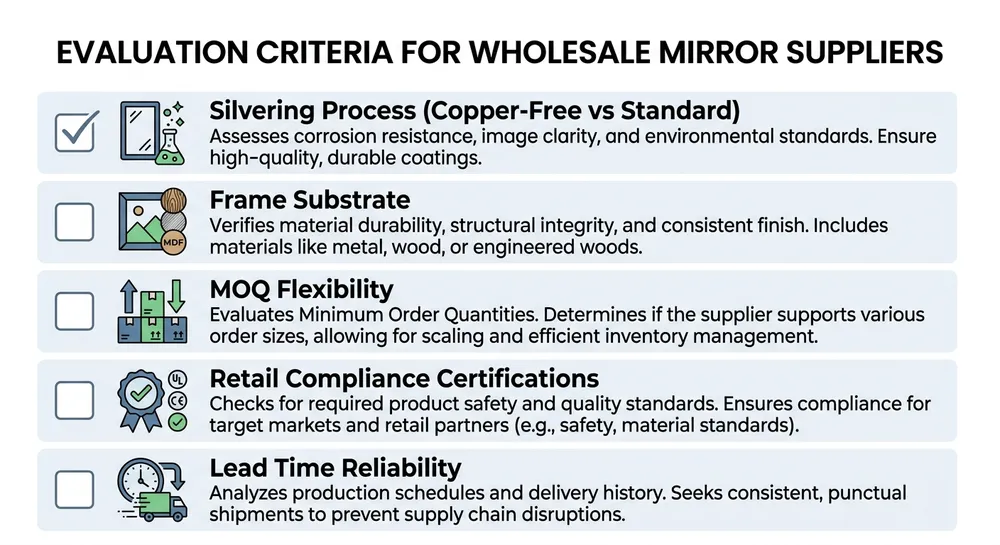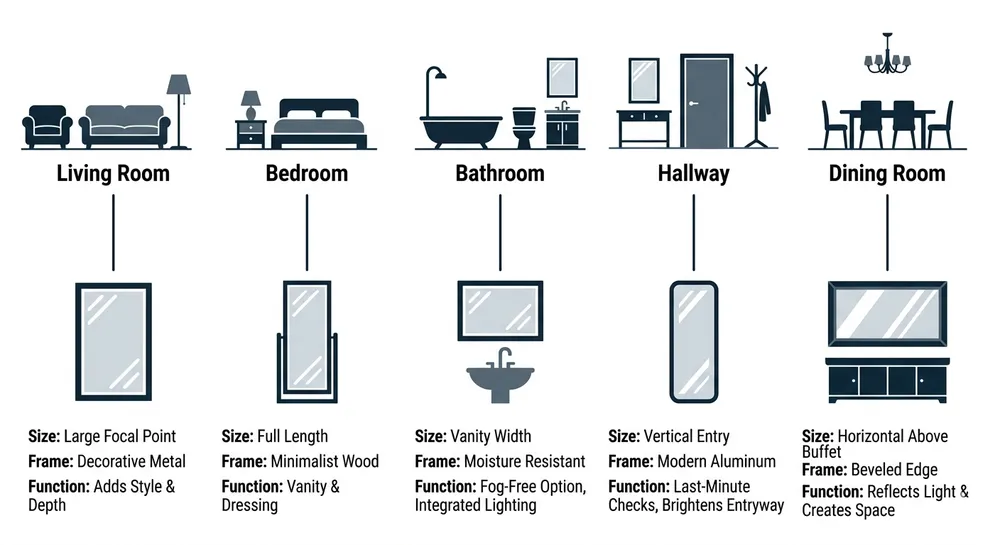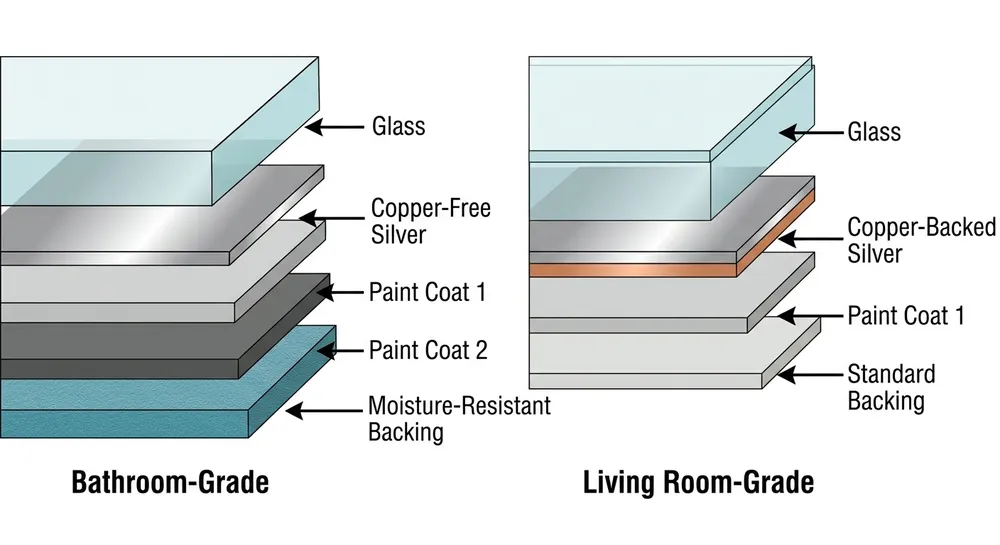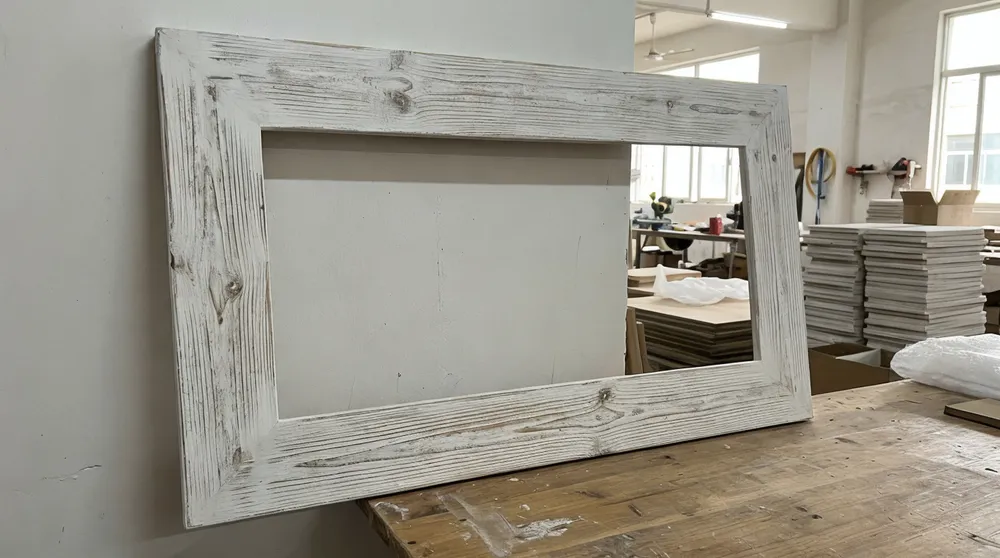
The Real Question Behind This Size Debate
You're not choosing a mirror size for your own living room. You're choosing which size tier to commit warehouse space, freight budget, and purchase order dollars to — and the wrong call ties up capital in slow-moving inventory for months.
We ship both size brackets every week from our facility in Dong Nai. Large living room mirrors (90–120 cm) and medium living room mirrors (50–80 cm) come off the same production lines, use the same silvering process, and pass the same 100% visual inspection. The difference shows up after they leave our dock: in your container utilization, your breakage claims, your retail price positioning, and ultimately your sell-through rate.
Here's the short version: medium mirrors (50–80 cm) move faster in volume retail — brick-and-mortar chains, Amazon marketplace, and mid-tier e-commerce. Large mirrors (90–120 cm) command higher average order value and work better for hospitality projects, DTC home decor brands, and interior design trade accounts. For most wholesale buyers building a general living room mirror program, a 60/40 medium-to-large ratio is the safer opening assortment. The rest of this article shows you why.
What "Large" and "Medium" Mean on a Purchase Order
"Large" and "medium" mean different things to different suppliers, and vague sizing language on a PO is how you end up with product that doesn't match your listing photos. Let's lock down the specs.
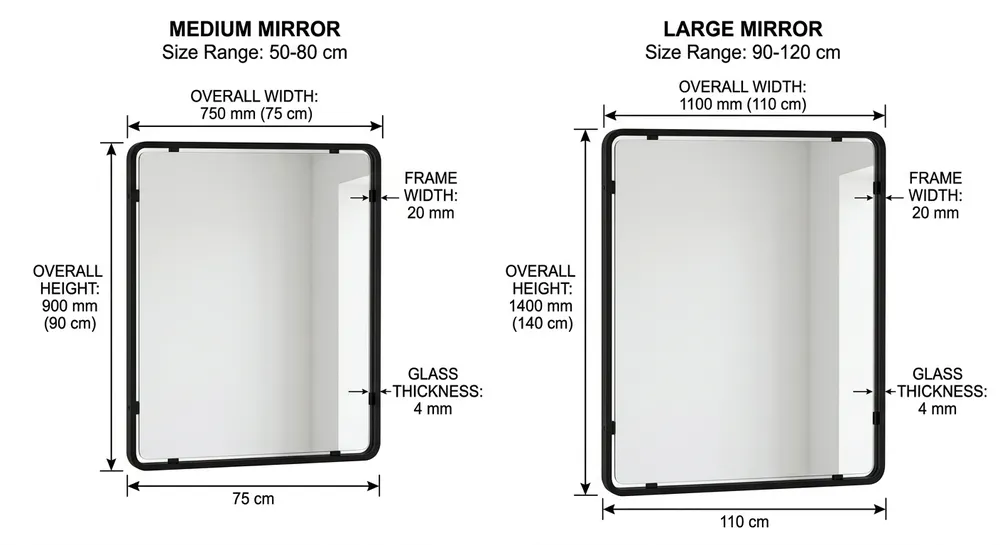
Medium living room decor mirrors: 50–80 cm
- Overall dimensions typically range from 50 × 70 cm to 60 × 80 cm (rectangular) or 60–80 cm diameter (round)
- Standard glass thickness: 3 mm silver-coated float glass
- Frame width: 2–5 cm depending on material
- Typical unit weight: 3–7 kg depending on frame material
- Common frame materials: MDF with wrap finish, PS (polystyrene) molding, thin-gauge metal
Large living room decor mirrors: 90–120 cm
- Overall dimensions typically range from 70 × 90 cm to 90 × 120 cm (rectangular) or 90–120 cm diameter (round)
- Standard glass thickness: 4 mm silver-coated float glass (we don't recommend 3 mm above 90 cm — deflection risk during transit increases significantly)
- Frame width: 3–8 cm; wider frames help with structural rigidity at this scale
- Typical unit weight: 8–18 kg depending on frame material and glass thickness
- Common frame materials: MDF with veneer or lacquer, metal (iron or aluminum), resin composite
(The jump from 3 mm to 4 mm glass sounds minor, but it adds roughly 2.5 kg per square meter of mirror surface. That weight compounds fast across a 40-foot container.)
Landed Cost Per Unit: Where the Price Gap Actually Sits
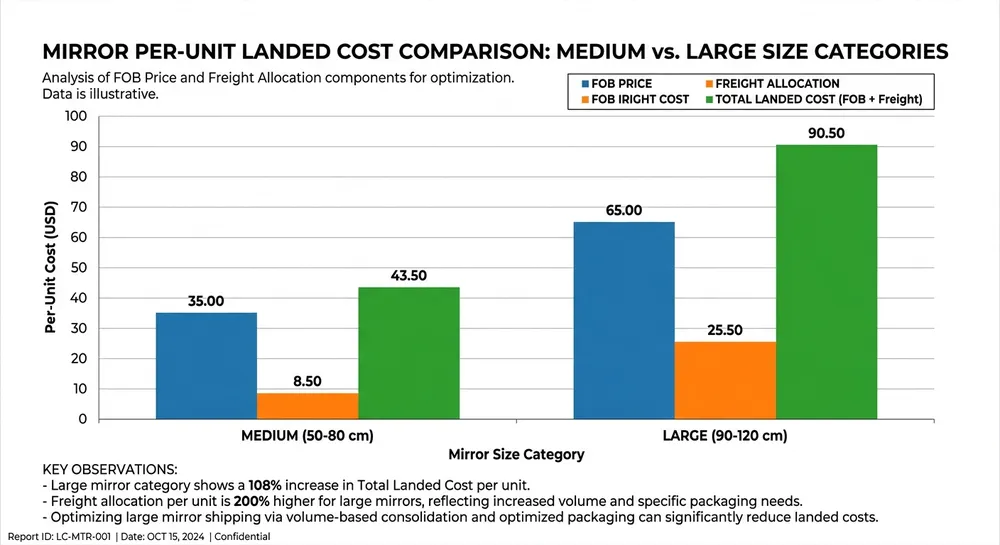
The price gap between large and medium mirrors is not proportional to the size difference. A mirror that's 60% larger in surface area doesn't cost 60% more to produce — it costs more than that, because several cost inputs scale non-linearly.
Glass cost scales roughly with surface area, but the 3 mm to 4 mm thickness jump for large mirrors adds approximately 30% more glass weight per unit. Silvering and coating costs track surface area directly.
Frame cost is where the gap widens. A 90 × 120 cm MDF frame requires thicker stock (15–18 mm vs 10–12 mm for medium) to prevent warping. Metal frames at this size need heavier gauge or internal bracing. Resin frames above 90 cm require reinforced backing structures that medium frames don't need.
Labor per unit runs higher on large mirrors — two-person handling on the assembly line, more careful glass-to-frame fitting, and slower packing. Our medium mirrors average single-operator assembly; large mirrors above 100 cm always require a two-person station.
| Cost Factor | Medium (50–80 cm) | Large (90–120 cm) | Impact on Your Margin |
|---|---|---|---|
| Glass (silver-coated float) | 3 mm standard | 4 mm standard | ~30% higher glass cost per unit |
| Frame material (MDF baseline) | 10–12 mm stock | 15–18 mm stock | Higher material + wider profile needed |
| Assembly labor | Single operator | Two-person station | ~40% higher labor cost per unit |
| QC inspection time | Standard visual + adhesion test | Extended edge-stress + flatness check | Longer per-unit QC cycle |
| Packaging material | Single-wall corrugated + corner guards | Double-wall corrugated + fullfoam cradle | ~2× packaging cost per unit |
| FOB unit price range (MDF frame) | $4.50–$8.00 | $9.00–$18.00 | Varies by frame complexity and finish |
The takeaway: your per-unit cost roughly doubles when you move from medium to large, but your retail price can triple. A 60 × 80 cm MDF-framed mirror that costs you $6.50 FOB might retail at $45–$65. A 90 × 120 cm version at $14.00 FOB can retail at $120–$180. The margin percentage compresses slightly on large mirrors, but the absolute dollar margin per unit is significantly higher.
(We quote both sizes on the same PO regularly — if you're testing a new market, ordering both tiers in one shipment saves you a separate freight cycle later.)
Freight Economics and Container Utilization
This is where many buyers miscalculate. The per-unit FOB price tells you half the story. The other half lives in your freight invoice.
Medium mirrors (50–80 cm) pack efficiently. A standard 60 × 80 cm mirror in retail-ready packaging occupies roughly 0.035–0.045 CBM per unit. In a 40-foot high-cube container (approximately 67 CBM usable), you can load 1,400–1,800 units depending on frame depth and packing configuration. That density means your per-unit freight allocation stays low — typically $0.80–$1.50 per mirror on a Vietnam-to-US-West-Coast lane.
Large mirrors (90–120 cm) eat container space fast. A 90 × 120 cm mirror in double-wall packaging with foam cradle runs 0.08–0.12 CBM per unit. Same container, you're loading 550–800 units. Per-unit freight jumps to $2.00–$4.00 — and that's before you account for the heavier gross weight potentially triggering weight-based surcharges on certain routes.
| Freight Factor | Medium (50–80 cm) | Large (90–120 cm) |
|---|---|---|
| CBM per unit (packed) | 0.035–0.045 | 0.08–0.12 |
| Units per 40' HC | 1,400–1,800 | 550–800 |
| Freight per unit (VN → US West Coast) | $0.80–$1.50 | $2.00–$4.00 |
| Weight risk | Rarely triggers weight limits | May hit weight cap before volume cap on metal-frame SKUs |
For your landed cost calculation: a medium mirror at $6.50 FOB lands at roughly $8.00–$9.00 after freight, duty, and handling. A large mirror at $14.00 FOB lands at $18.00–$22.00. The gap widens after the factory gate, not before.

Sell-Through Velocity: Which Size Actually Moves Off Shelves
Sell-through is the number that pays your warehouse rent. We don't have access to your POS data, but we see reorder patterns across hundreds of wholesale accounts — and those patterns tell a consistent story.
Medium mirrors dominate volume channels. Buyers who sell through Amazon, Wayfair Marketplace, Target-tier retail, and regional home goods chains reorder medium Living Room Decor Mirrors at roughly 2–3× the frequency of large mirrors in the same frame style. The reasons are structural, not aesthetic: medium mirrors hit the $39–$79 impulse-buy price band, they ship via standard parcel carriers without oversize surcharges, and they fit the "add to cart" behavior of online shoppers who haven't measured their wall.
Large mirrors win in project and trade channels. Interior designers, hospitality procurement teams, and DTC brands with curated collections reorder large mirrors at higher per-order quantities but on longer cycles — quarterly rather than monthly. These buyers specify exact dimensions, often request custom frame finishes, and accept higher unit costs because the mirror is a statement piece with a $150–$300 retail price point. The sell-through is slower per SKU, but the revenue per unit sold is substantially higher.
Here's what we see in our own order data across the last three years:
| Channel Type | Winning Size Tier | Typical Reorder Cycle | Average Order Qty |
|---|---|---|---|
| Amazon / Wayfair Marketplace | Medium (50–80 cm) | Monthly to bi-monthly | 300–1,000 units |
| Brick-and-mortar home goods chains | Medium (50–80 cm) | Bi-monthly to quarterly | 500–2,000 units |
| Interior design trade accounts | Large (90–120 cm) | Quarterly | 50–200 units |
| Hospitality / project buyers | Large (90–120 cm) | Per-project | 100–500 units |
| DTC home decor brands | Mixed, skewing large | Monthly | 100–500 units |
(One pattern we've noticed: buyers who start with medium-only programs almost always add large SKUs within 12 months once their brand gains traction. The reverse — starting large and adding medium — happens less often.)
Packaging Specs and Breakage Risk by Size
Breakage claims are margin killers. A 2% breakage rate on a $6 mirror is annoying. A 2% breakage rate on a $15 mirror is a line-item problem on your P&L. Size directly affects both packaging cost and damage probability.
Medium mirror packaging is straightforward. Single-wall corrugated carton, expanded polystyrene corner guards, and a poly bag for surface protection. We use 3-ply B-flute corrugated for most medium SKUs. The mirror-to-carton weight ratio stays favorable — the packaging adds roughly 15–20% to the product weight. At this size, the glass has enough structural rigidity that standard packaging handles normal freight handling without issues.
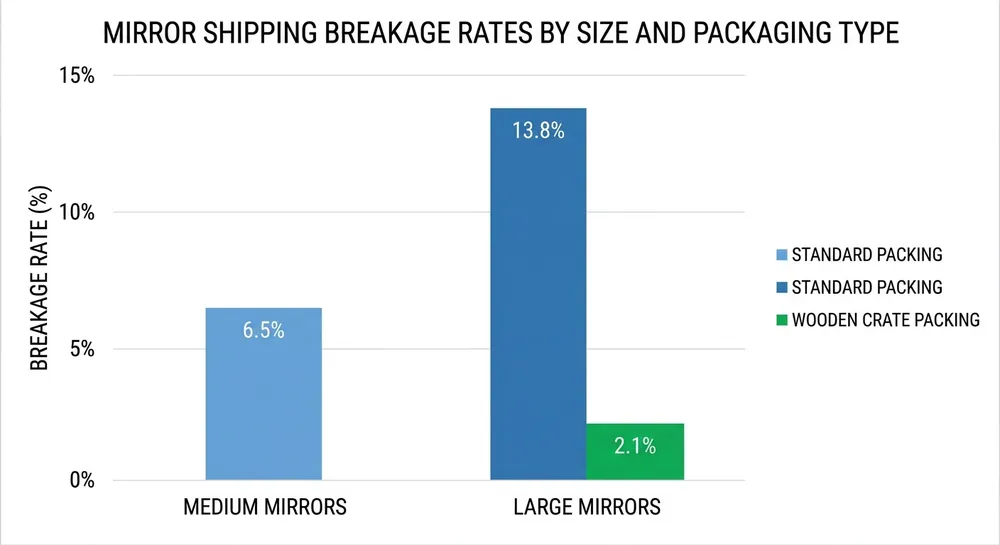
Our breakage rate on medium mirrors across all export shipments over the past two years: 0.3–0.5%. That includes ocean freight, last-mile delivery, and everything in between.
Large mirror packaging requires engineering. Double-wall corrugated (5-ply BC-flute minimum), full-perimeter foam cradle, and often a honeycomb cardboard insert for mirrors above 100 cm. Some buyers request wooden crate packing for high-value metal-framed pieces — that adds $2–$4 per unit but drops breakage to near zero. The packaging itself can weigh 30–40% of the product weight at this size.
Our breakage rate on large mirrors: 0.8–1.2% with standard double-wall packaging, dropping to under 0.3% with wooden crate packing.
| Packaging Spec | Medium (50–80 cm) | Large (90–120 cm) |
|---|---|---|
| Carton type | Single-wall 3-ply B-flute | Double-wall 5-ply BC-flute |
| Internal protection | EPS corner guards + poly bag | Full foam cradle + honeycomb insert |
| Packaging weight as % of product | 15–20% | 30–40% |
| Breakage rate (standard packing) | 0.3–0.5% | 0.8–1.2% |
| Optional upgrade | — | Wooden crate ($2–$4/unit, <0.3% breakage) |
The cost of breakage isn't just the lost product. It's the replacement shipment, the customer service time, the negative review on your marketplace listing, and the return logistics. On large mirrors, we recommend budgeting for the upgraded packaging from the start — the $3 per unit pays for itself after your first avoided claim cycle.
Frame Material Selection Changes by Size Bracket
Frame material isn't just an aesthetic choice — it's a structural and commercial decision that shifts depending on mirror size. What works at 60 cm can fail at 100 cm.
MDF frames are the workhorse for medium mirrors. At 50–80 cm, a 10–12 mm MDF profile with PU wrap or lacquer finish provides adequate rigidity, accepts a wide range of surface treatments (wood grain, marble texture, solid color), and keeps your unit cost in the volume-retail sweet spot. We produce more MDF-framed medium mirrors than any other combination.
At large sizes, MDF needs reinforcement. We increase stock thickness to 15–18 mm and add a rear cross-brace on anything above 90 cm. Without it, the frame can bow over time — especially in humid climates. The thicker stock and bracing add material cost and weight, which is why some buyers switch to alternative frame materials at this size.
Metal frames (iron or aluminum) become more competitive at large sizes. A 20 × 25 mm iron tube frame at 90 × 120 cm weighs less than the equivalent reinforced MDF frame, holds its shape permanently, and gives you a modern/industrial aesthetic that commands premium retail pricing. The trade-off: metal frames cost 30–50% more than MDF at the same size, and they require powder coating or electroplating for corrosion protection. (We run an automated powder line — 60–80 μm consistent thickness, passes 500-hour salt spray test.)
Resin composite frames occupy a middle ground. They can replicate ornate carved profiles that would be prohibitively expensive in solid wood, and they hold up well at large sizes without the weight penalty of thick MDF. Resin is our go-to recommendation for buyers targeting the traditional/transitional decor segment at 90–120 cm — you get the visual weight of a carved frame at roughly 60% of the cost of actual wood carving.
| Frame Material | Best Size Fit | Pros at That Size | Watch Out For |
|---|---|---|---|
| MDF (wrap/lacquer) | Medium (50–80 cm) | Lowest cost, widest finish range | Needs reinforcement above 90 cm |
| MDF (reinforced) | Large (90–120 cm) | Still cost-effective, familiar supply chain | Heavier, humidity-sensitive |
| Metal (iron/aluminum) | Large (90–120 cm) | Rigid, lightweight relative to size, premium positioning | Higher unit cost, requires coating |
| Resin composite | Large (90–120 cm) | Ornate profiles possible, good weight-to-strength | Limited to traditional/transitional styles |
| PS (polystyrene) | Medium (50–80 cm) | Ultra-low cost, lightweight | Not structurally viable above 80 cm |
Retail Price-Point Positioning and Margin Architecture
Your retail price point determines your competitive set, your marketplace visibility, and your margin structure. Size is the single biggest lever you have for moving between price bands.
Medium mirrors sit in the $39–$79 retail band for e-commerce and $29–$59 for brick-and-mortar mass retail. At a landed cost of $8–$9, a $49 retail price gives you roughly 80% gross margin before marketplace fees and fulfillment. This is the high-velocity, high-competition zone — you're competing on listing quality, review count, and price. Margin percentage is strong, but you need volume to make the numbers work.
Large mirrors sit in the $99–$199 retail band for e-commerce and $79–$149 for brick-and-mortar. At a landed cost of $18–$22, a $149 retail price gives you roughly 85% gross margin before fees. Fewer competitors operate in this band because the capital commitment per SKU is higher and the logistics are more complex. Your absolute margin per unit is $50–$80 higher than medium mirrors, but your inventory carrying cost per unit is also 2–3× higher.
The margin math favors large mirrors on a per-unit basis. The cash flow math favors medium mirrors on a per-month basis. Your answer depends on your capital structure and sales velocity.
(If you're selling on Amazon specifically, keep in mind that mirrors above 96 cm in any dimension trigger oversize FBA fees. That threshold sits right in the middle of our "large" bracket — a 70 × 90 cm mirror stays in standard-size FBA, but a 90 × 120 cm mirror does not. This single fee boundary changes the margin math significantly for FBA sellers.)
Assortment Strategy: Building a Living Room Mirror Program That Sells
You don't have to choose one size and ignore the other. The better question is: what ratio should your opening order carry?
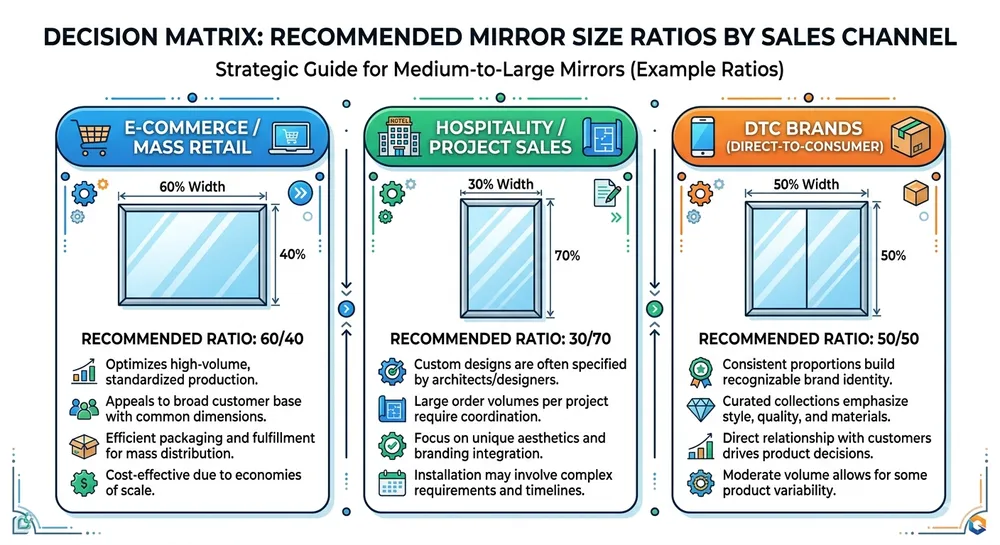
For volume e-commerce and mass retail: Start with a 60/40 medium-to-large split. Lead your catalog with 3–4 medium SKUs across your best-selling frame styles (round, rectangular, arched) and add 2 large SKUs in your highest-margin frame material. The medium SKUs generate consistent reorders and cover your fixed costs. The large SKUs lift your average order value and give your brand a premium anchor.
For hospitality and project-focused distribution: Flip the ratio to 30/70 medium-to-large. Your project buyers are specifying mirrors for specific wall spaces — lobbies, common areas, model units — and those spaces almost always call for 90 cm or larger. Medium mirrors serve secondary spaces (hallways, guest bathrooms) but won't be the core of your program.
For DTC home decor brands: A 50/50 split works well as a starting point. Your customer is browsing a curated collection, not filtering by price on a marketplace. Both sizes serve different rooms and wall configurations, and your brand storytelling can support premium pricing on both tiers.
MOQ and Sample Logic for Testing Both Sizes
You don't need to commit to a full container to figure out which size works for your market. Here's how we structure test orders.
Our standard MOQ is 100 pieces per SKU for any frame profile we already have tooling for. That means you can order 100 medium round mirrors and 100 large rectangular mirrors on the same PO — 200 total units, two size tiers, one shipment. For custom frame profiles that require new mold tooling, MOQ starts at 300 pieces per SKU to amortize the tooling cost.
We ship product samples (typically 1–2 units per SKU) before bulk production on every new buyer relationship. Sample lead time runs 7–10 days for existing mold profiles. You pay for the samples and freight, but we credit the sample cost back against your first bulk order above 500 units.
The smart test approach: order samples of both size tiers in your target frame style, list them simultaneously on your sales channel, and let 60–90 days of sell-through data make the ratio decision for you. We've seen buyers adjust their second order dramatically after real market feedback — sometimes shifting from a planned 50/50 to 80/20 in either direction.
For a deeper look at how room-specific sizing affects your broader Decor Mirrors by Room product strategy, or to explore current Living Room Mirror Trends shaping buyer demand, those resources cover the category-level picture beyond this size comparison.
The Verdict: Size Selection Is a Channel Decision, Not a Product Decision
If you've read this far, you already know the answer isn't "large is better" or "medium is better." The answer is: your sales channel picks the winner.
Stock medium (50–80 cm) if your primary revenue comes from marketplace e-commerce, mass retail placement, or any channel where sub-$80 price points and parcel-friendly shipping drive purchase decisions. Medium mirrors move faster, pack denser, break less, and generate the reorder velocity that keeps your cash flow healthy.
Stock large (90–120 cm) if your primary revenue comes from hospitality projects, interior design trade accounts, or DTC brands where $100+ price points and statement-piece positioning drive purchase decisions. Large mirrors deliver higher absolute margin per unit and face less price competition, but they demand more capital, more warehouse space, and more careful logistics.
Stock both if you're building a living room mirror program with any ambition beyond a single channel. The 60/40 medium-to-large ratio is a proven starting point for general wholesale — adjust based on your first two reorder cycles.
The size you choose determines your freight cost, your breakage exposure, your retail price band, your competitive set, and your reorder frequency. Get the ratio right on your opening order, and the rest of your Living Room Decor Mirrors program builds from a position of data, not guesswork.