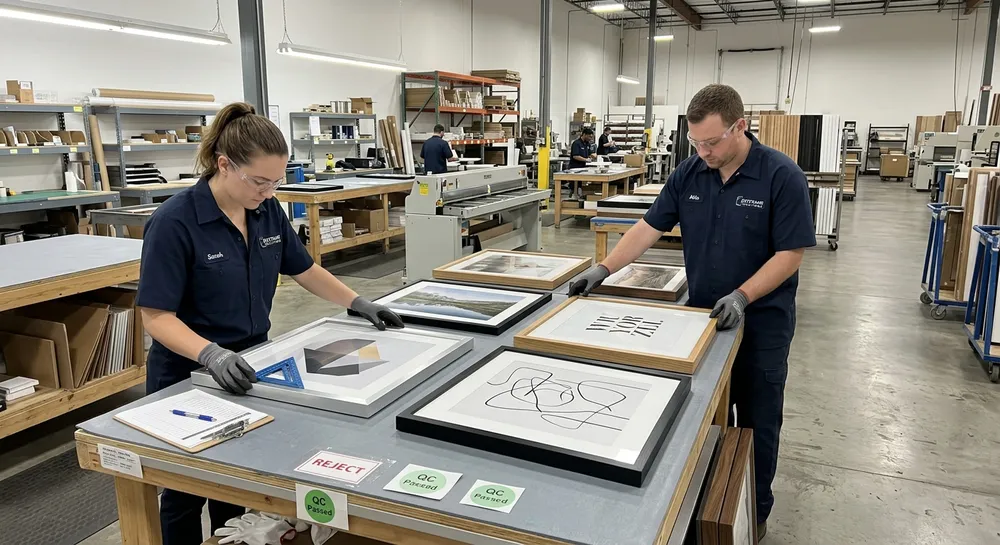
The rejection rate on modern wall art shipments is higher than most buyers expect — and it almost never comes from catastrophic defects. It comes from vague specs. A supplier ships what they think "clean finish" means. You receive what you didn't ask for. The container gets held, the retail launch slips, and you're negotiating a credit memo instead of reordering.
We've been on the production side of this for 18 years. The orders that arrive right the first time share one thing: the buyer wrote a tight RFQ. The ones that generate disputes almost always trace back to finish specs that were left open to interpretation.
This guide walks through what to lock down before you place an order — substrate selection, surface finish thresholds, frame tolerances, QC checkpoints, and packaging requirements. The goal is to give you specs you can paste directly into your next RFQ.

What "clean finish" actually means in production terms
"Clean finish" is not a spec. It's a preference. When you write it in an RFQ without numbers, every supplier interprets it differently — and they're all technically correct.
Here's what clean finish means when it's written as a production requirement:
Surface defect thresholds (what to specify per piece):
- Scratches: none visible at 60 cm viewing distance under 500 lux ambient light
- Dust inclusions in coating: max 2 particles under 0.3 mm diameter per 0.1 m²
- Print banding or color streaking: zero tolerance on pieces larger than 40 × 40 cm
- Coating bubbles or pinholes: zero tolerance on gloss and semi-gloss finishes
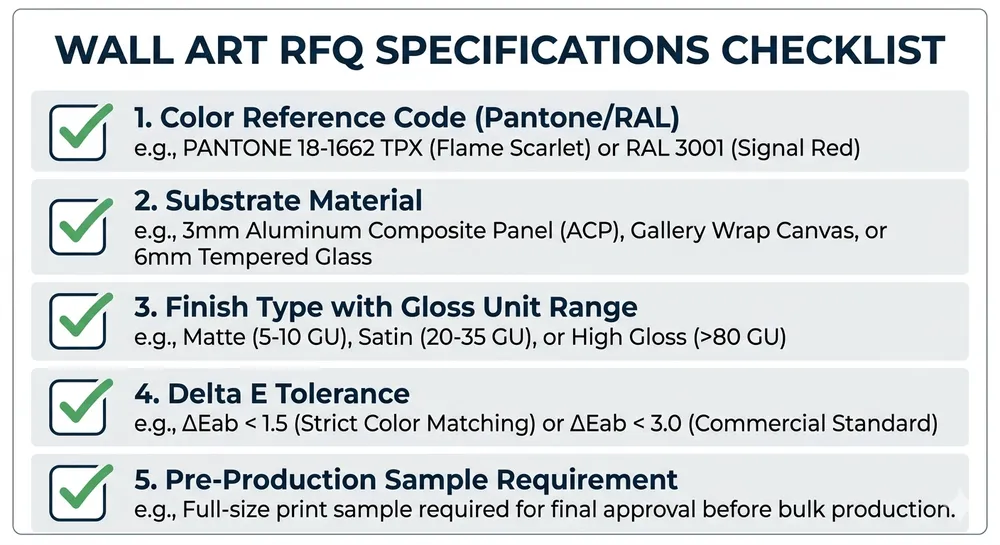
Color consistency — Delta E targets: Delta E is the standard measurement for color deviation between your approved sample and bulk production. For modern wall art going into retail:
- Delta E ≤ 2.0: acceptable for most mid-market retail programs
- Delta E ≤ 1.5: required for color-matched sets or gallery-style collections
- Delta E > 3.0: visible to the naked eye — most retail buyers will reject at this level
We run color checks against the approved sample at three points: after printing, after coating, and after frame assembly. The coating step is where color shift happens most often, particularly on matte finishes over dark backgrounds. (We switched to a UV-stable topcoat on our matte line in 2022 specifically because we were seeing Delta E drift of 0.8–1.2 after coating on deep navy and charcoal prints — small enough to pass a casual check, large enough to cause set-matching problems at retail.)
Edge treatment specs:
- Canvas wrap: specify corner fold method (gallery fold vs. straight fold) and maximum gap at corner joins — we hold ≤ 1.5 mm
- Metal frame: specify whether cut edges are deburred and whether corners are welded, crimped, or mitered — each has a different visible seam profile
- MDF frame: specify whether edges are sealed before painting to prevent grain raise under topcoat
Put these numbers in your RFQ. A supplier who can't commit to them in writing is telling you something.
Substrate selection: cost, durability, and finish-quality tradeoffs
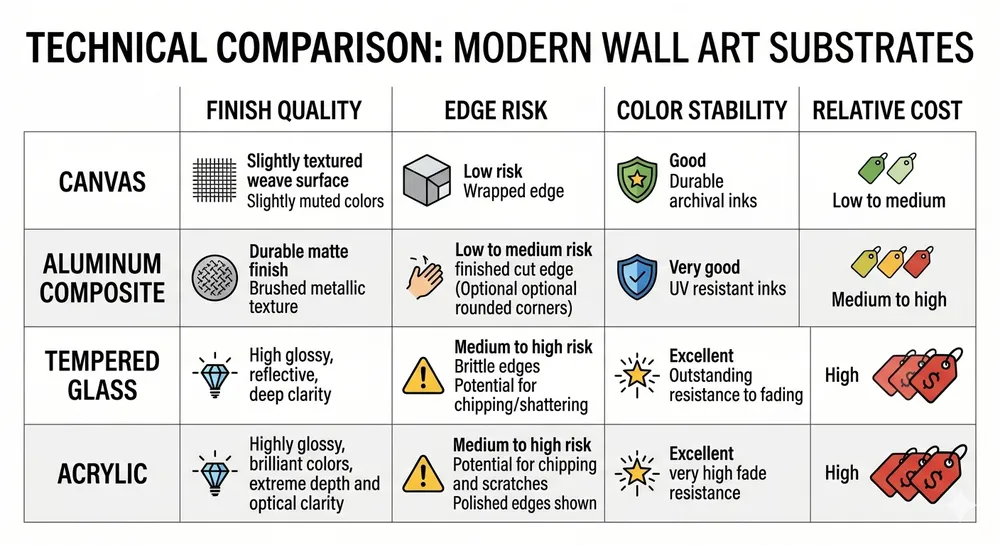
The substrate choice drives most of the downstream finish decisions. Modern wall art for wholesale typically runs across four substrate types, and each has a different risk profile for finish consistency at volume.
| Substrate | Typical finish options | Color stability | Edge finish risk | Relative landed cost |
|---|---|---|---|---|
| Canvas (stretched) | Matte, satin, UV-laminate | High with UV coat | Low — soft edge | Low–Medium |
| Aluminum composite | Gloss, brushed, powder coat | Very high | Medium — cut edge burr risk | Medium |
| Tempered glass print | High-gloss ceramic print | Excellent | Low — polished edge | High |
| Acrylic face-mount | Ultra-gloss, deep color | High | Medium — edge clarity variance | High |
| MDF with frame | Matte, satin, textured | Medium — moisture sensitive | Medium — grain raise risk | Low–Medium |
A few things worth knowing from the production side:
Canvas is the most forgiving substrate for large-format modern wall art. Print registration tolerances are easier to hold, and the soft edge means minor dimensional variance doesn't create visible gaps at the frame join. For buyers building a broad SKU range across multiple sizes, canvas gives you the most consistent finish-to-cost ratio.
Aluminum composite is the right call when your buyer needs a contemporary flat look — no texture, no canvas grain, just a clean printed surface. The risk is at the cut edge: if the supplier isn't deburring consistently, you'll get micro-scratches on adjacent pieces during transit. Specify deburring and edge tape protection in your packaging requirement.
Tempered glass print is the premium tier. Color depth is exceptional and the surface is genuinely durable. The tradeoff is lead time — glass printing requires a separate production run and the reject rate on large-format pieces is higher than canvas or metal. We don't recommend it for first-time orders over 500 pieces unless you've already validated the supplier's glass print line with samples.
Acrylic face-mount gives you the deepest color saturation of any substrate, but edge clarity varies significantly between suppliers. The acrylic sheet needs to be optically clear and consistently thick — ask for the sheet spec (typically 3 mm or 5 mm) and confirm the supplier sources from a single mill, not spot-buy.
Frame tolerance specs that prevent retail rejection
Frame alignment is the second most common rejection trigger after surface finish — and it's almost entirely preventable with tighter specs.
For modern wall art, the frame is structural and visual. A frame that's 2 mm out of square on a 60 × 60 cm piece is visible on the wall. A hanging wire mounted 5 mm off-center means the piece tilts. Neither of these fails a vague "good quality" spec. Both fail a retail floor inspection.
Frame alignment tolerances to specify:
- Squareness: diagonal measurement variance ≤ 2 mm on pieces up to 60 cm; ≤ 3 mm on pieces 60–120 cm
- Frame-to-artwork gap: ≤ 1 mm on all four sides for tight-fit frames; ≤ 2 mm for floating-mount styles
- Hanging hardware position: centered ±2 mm from horizontal midpoint; height from top edge ±3 mm from spec
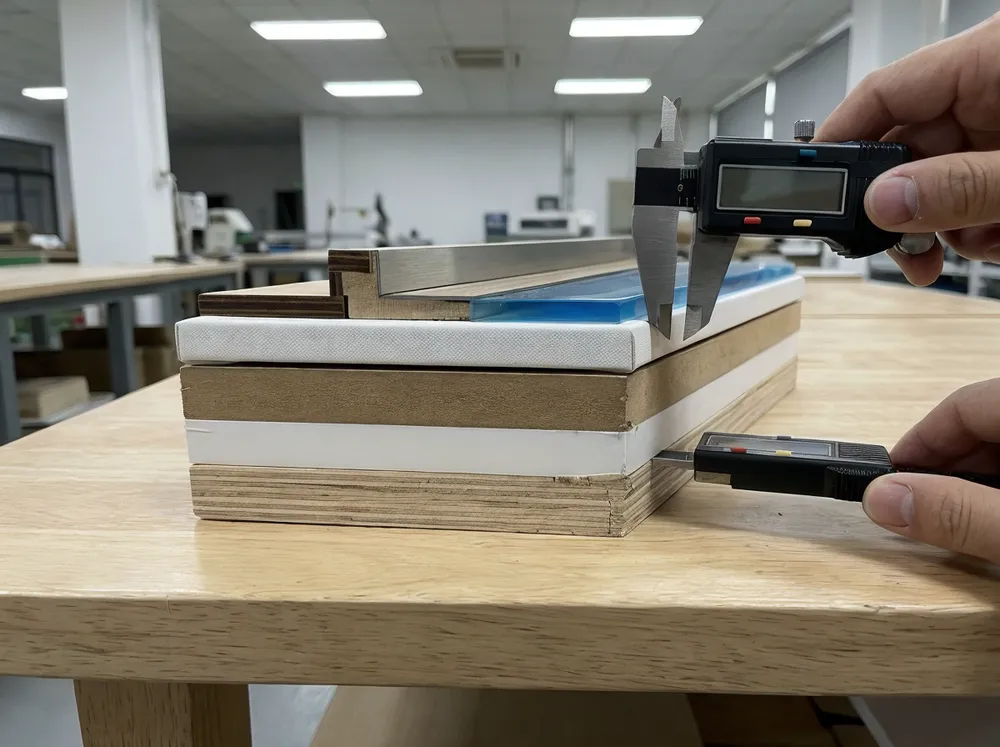
- Frame joint gap (at corners): ≤ 0.5 mm for painted MDF; ≤ 0.3 mm for metal mitered corners
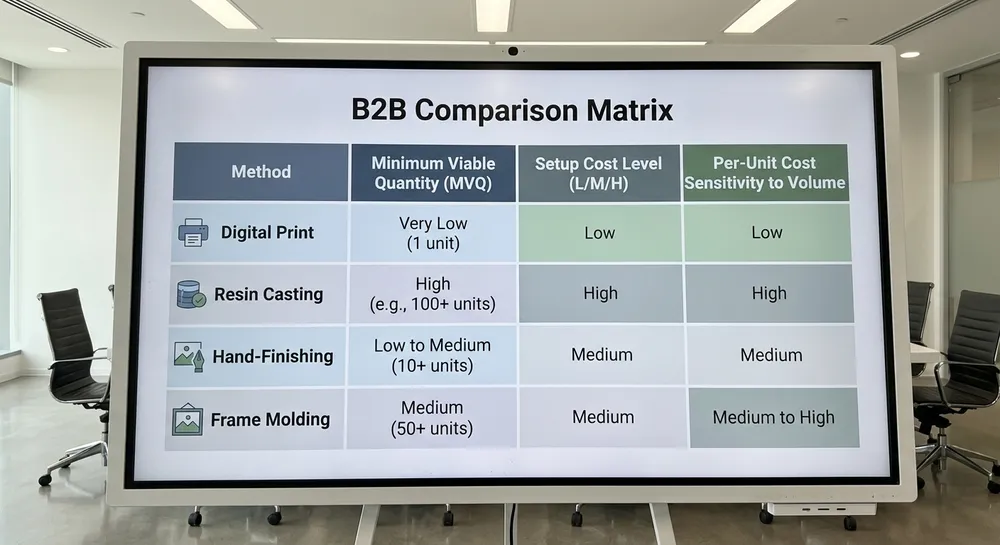
We run 6 production lines with in-house frame molding across MDF, metal, resin, and solid wood. The reason we keep frame molding in-house is exactly this: when you outsource frame production to a separate supplier, you lose control of the tolerance stack. The frame arrives at your assembly line already at the edge of spec, and by the time you've added the artwork and hardware, you're outside it. Vertical integration isn't a marketing point — it's how you hold ±2 mm squareness across a 5,000-piece run.
Coating adhesion on frames: For painted MDF frames, specify a cross-hatch adhesion test (ASTM D3359) with a minimum rating of 4B. For powder-coated metal frames, specify 500-hour salt spray resistance (ASTM B117) — this matters for coastal retail accounts and any buyer selling into humid climates.
(One thing we see regularly: buyers specify the artwork finish carefully but leave the frame coating spec blank. The frame is what the end customer touches first. A chalky or peeling frame finish generates returns even when the print is perfect.)
How to write a modern wall art RFQ that locks down tolerances
Most RFQs for modern wall art are too short. They specify size, quantity, and a reference image. That's enough to get a price — it's not enough to get a consistent product.
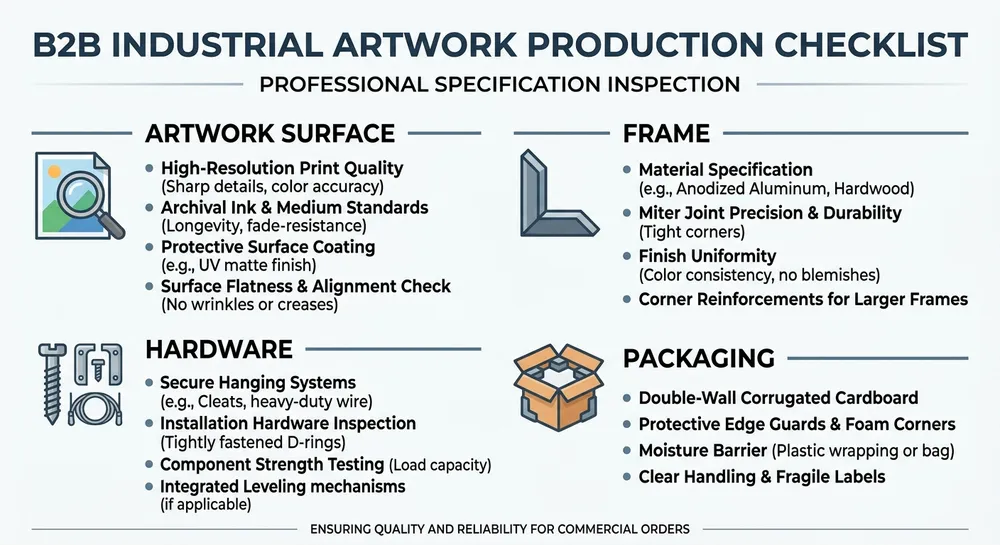
Here's the spec block we recommend buyers include in every RFQ:
Artwork surface:
- Substrate: [canvas / aluminum composite / tempered glass / acrylic — specify]
- Print method: [UV flatbed / latex / dye-sublimation — specify or ask supplier to confirm]
- Color target: Delta E ≤ [1.5 / 2.0] vs. approved sample
- Surface finish: [matte / satin / gloss] with coating adhesion test required
- Defect threshold: zero visible scratches, banding, or bubbles at 60 cm viewing distance
Frame:
- Material: [MDF / metal / solid wood / resin — specify]
- Corner treatment: [welded / mitered / wrapped — specify]
- Squareness tolerance: diagonal variance ≤ 2 mm (pieces ≤ 60 cm) / ≤ 3 mm (pieces 60–120 cm)
- Frame-to-artwork gap: ≤ 1 mm
- Coating: [paint / powder coat] — specify adhesion test standard
Hardware:
- Hanging system: [D-ring / sawtooth / wire — specify]
- Position tolerance: centered ±2 mm, height from top ±3 mm
- Weight rating: minimum [X] kg — specify based on piece weight
Packaging:
- Corner protection: foam or cardboard corner guards on all four corners
- Surface protection: poly bag or tissue wrap before boxing — no direct contact between frame and box
- Box compression strength: specify if retail-ready packaging is required (Walmart/Wayfair/Amazon each have their own ISTA test requirements)
- Master carton: specify pieces per carton and maximum carton weight for your warehouse receiving spec
Send this block with your reference image and target price. A supplier who responds with a detailed production proposal — not just a price — is one worth continuing the conversation with.
QC checkpoints that catch problems before they reach your warehouse
A pre-shipment inspection catches defects after they've already been produced. By that point, your options are rework, partial rejection, or a credit negotiation. The better approach is checkpoints earlier in the production sequence.
Stage 1 — Pre-production sample (before bulk run starts)
This is the most important checkpoint and the one most buyers skip to save time. The pre-production sample confirms:
- Color accuracy vs. your approved artwork file (Delta E measurement, not visual only)
- Frame construction and corner treatment match spec
- Hardware position and weight rating confirmed
- Packaging prototype reviewed and approved
Approve nothing in bulk until you have a signed-off pre-production sample. If a supplier pushes back on this step, that's a red flag.
Stage 2 — In-line inspection (at 20–30% production completion)
At this stage, defects are still correctable without scrapping the run. Check:
- Print color consistency across the first batch — compare pieces from the start, middle, and end of the print run
- Frame squareness on a random sample of 10–15 pieces
- Coating adhesion on frame samples — run the cross-hatch test on 3–5 pieces
- Hardware installation position — measure, don't eyeball
Stage 3 — Pre-shipment audit (100% visual + AQL sampling)
Before the container loads:
- 100% visual inspection for surface defects at 60 cm viewing distance
- AQL 2.5 sampling for dimensional tolerances (squareness, frame gap, hardware position)
- Carton drop test on 3–5 master cartons
- Barcode scan verification if retail compliance labels are required
We run 100% visual inspection on every piece before it loads. That's 400,000 pieces a year going through visual check — it's not a differentiator we invented for marketing, it's what retail programs like Walmart and Wayfair require to stay on their vendor compliance lists.
What to ask your supplier:
- Do you have an in-house QC team or do you rely on third-party inspection only?
- Can you provide in-line inspection photos at the 30% production mark?
- What is your internal defect rate on this product type?
- Do you have SGS or equivalent third-party audit reports available?
A supplier who can answer these questions with specifics — not generalities — has a real QC system. One who says "we have strict quality control" without data doesn't.
Common sourcing mistakes that generate the most expensive problems
These aren't edge cases. We see versions of these on a regular basis, usually from buyers who are new to sourcing modern wall art at volume.
Leaving finish specs open to interpretation
"High quality finish" and "clean surface" are not specs. Write Delta E targets, defect thresholds, and coating adhesion requirements. If you don't, you'll receive what the supplier considers acceptable — which may not match what your retail buyer considers acceptable.
Skipping substrate testing on new suppliers
A supplier can show you beautiful samples. Samples are not bulk production. Before committing to a 1,000+ piece order with a new supplier, order 50–100 pieces across your key SKUs and run them through your own inspection process. Our 100-piece MOQ exists specifically for this reason — validate finish quality at low risk before scaling.
Ignoring packaging until it's too late
Retail compliance packaging is not optional for Walmart, Wayfair, or Amazon vendor programs. Each has specific requirements for barcode placement, ISTA test compliance, and master carton labeling. If you're building a retail program, get the packaging spec from your retail buyer before you finalize the production spec — not after. Retrofitting packaging compliance after production is expensive and sometimes impossible without repackaging the entire order.
Sourcing frame and artwork from separate suppliers
When the frame comes from one factory and the artwork from another, tolerance stack-up is your problem to manage. The frame arrives at 2.5 mm out of square. The artwork is cut to nominal. The assembly gap is now 2.5 mm on one side and 0 mm on the other. Neither supplier is "wrong" — but the finished piece fails your spec. Sourcing from a factory with in-house frame molding and artwork production eliminates this problem at the source.
Not specifying hanging hardware weight rating
Modern wall art pieces vary significantly in weight — a 60 × 80 cm aluminum composite piece can weigh 4–6 kg. A sawtooth hanger rated for 2 kg is a liability claim waiting to happen. Specify the minimum weight rating for all hanging hardware, and ask for the test report.
How vertical integration reduces finish variance at scale
This is worth explaining from the production side, because it's not obvious from the outside.
When a factory outsources frame molding, they're buying frames from a supplier who is also selling to 20 other factories. That supplier optimizes for their own production efficiency, not your tolerance spec. Frames arrive in batches. Batch-to-batch variance is real — the first delivery might hold ±1.5 mm squareness, the third delivery might be ±3 mm. Your assembly line absorbs that variance, and it shows up in your finished product.
We run frame molding in-house across four material types: MDF, metal, resin, and solid wood. The molding line feeds directly into assembly — there's no receiving inspection step for frames because the frames never leave our facility between molding and assembly. When we see a tolerance drift on the molding line, we catch it before it reaches a single finished piece.
The same logic applies to coating. We run coating in a controlled environment — temperature and humidity monitored, not just ambient. Color shift on matte finishes is strongly correlated with humidity during application. A supplier running coating in an open workshop in a humid climate will see Delta E drift that they can't explain and can't consistently control. We've measured the difference: controlled-environment coating holds Delta E variance to ±0.3 across a production run; open-environment coating can drift ±1.0 or more on the same artwork file.
For buyers sourcing Modern Wall Arts at volume, vertical integration is the single biggest structural factor in finish consistency. It's worth asking every supplier you evaluate: which steps in your production chain are in-house, and which are outsourced?
If you want to explore the full range of Wall Arts by Style & Subject we produce, or review our modern wall art design standards before writing your spec, both are worth reading before your next RFQ.
Practical FAQ for modern wall art sourcing
What Delta E tolerance should I specify for a retail wall art program?
For standard mid-market retail (Wayfair, Amazon), Delta E ≤ 2.0 is the working standard. For color-matched sets or gallery collections where pieces hang together, tighten to Delta E ≤ 1.5. Delta E > 3.0 is visible to most consumers and will generate returns.
What's the minimum order quantity to validate a new supplier's finish quality?
50–100 pieces across your key SKUs is enough to run a meaningful inspection. It's not enough to catch every production variable, but it will expose systematic problems — color drift, frame squareness issues, coating adhesion failures — before you're committed to a full run. Our MOQ starts at 100 pieces for standard models specifically to support this validation step.
Canvas vs. aluminum composite for modern wall art — which holds finish better at volume?
Canvas holds color consistency better across large runs because print registration tolerances are easier to maintain and the substrate is more forgiving of minor humidity variation during production. Aluminum composite gives you a cleaner, more contemporary surface but requires tighter edge finishing controls. For a broad SKU program, start with canvas. Add aluminum composite SKUs once you've validated a supplier's metal finishing process.
What retail compliance packaging requirements should I specify for Walmart or Wayfair?
Both programs require ISTA 2A or 3A test compliance for master carton packaging. Walmart additionally requires specific barcode placement and supplier compliance label formats. Wayfair has its own vendor portal with current packaging specs. Get the current spec directly from your retail buyer's vendor compliance team — these requirements update periodically and the version on the portal is always current.
How do I verify a supplier's QC system before placing a bulk order?
Ask for three things: their internal defect rate on the product type you're ordering, in-line inspection photos from a recent production run, and a third-party audit report (SGS, Bureau Veritas, or equivalent). A supplier with a real QC system can produce all three without hesitation. If they can only offer a factory visit invitation, that's not a substitute for documented process data.
—
Ready to put these specs to work? Send your artwork files, target finish requirements, and order quantity to our team — we'll come back with a production proposal that includes tolerance commitments, substrate recommendations, and a sample timeline. Request Quote