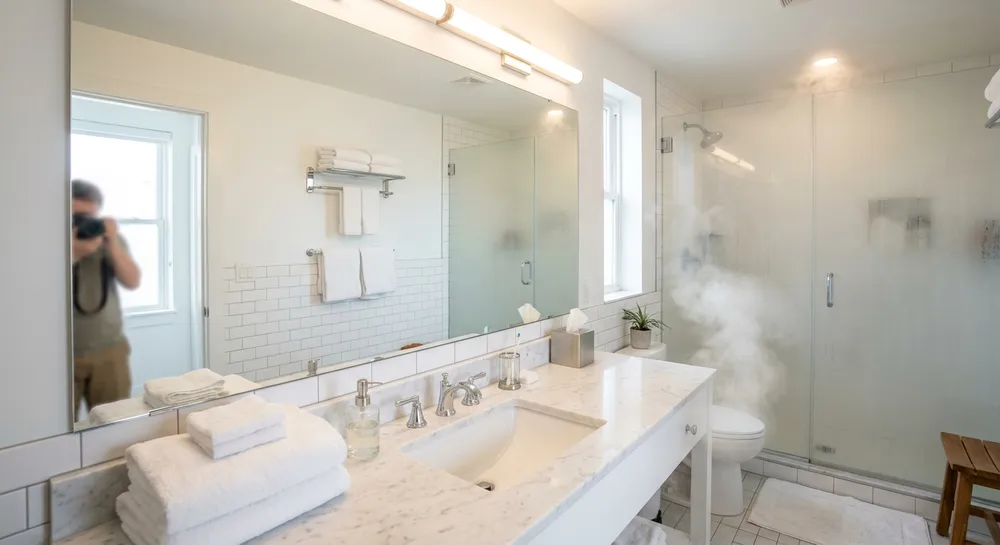
The mirror fogs over within 90 seconds of a guest's shower. Housekeeping gets a complaint. The property manager calls your account rep. You're now defending a spec decision that seemed fine on paper.
This happens more than it should, and almost always traces back to the same upstream mistakes: undersized heating elements, coating systems that weren't designed for heat cycling, or electrical components that don't meet the IP rating requirements for commercial bathroom installations. None of these are hard problems to solve at the spec stage. They become expensive problems when they surface after installation across 200 rooms.
This guide walks through how to specify Bathroom Decor Mirrors with anti-fog performance for hospitality projects — the technology options, the wattage math, the certification requirements, and the coating compatibility questions you need to ask your supplier before the PO goes out.

Why Standard Bathroom Mirrors Fail in High-Occupancy Hospitality Environments
A decorative mirror that performs fine in a residential bathroom can fail consistently in a hotel. The difference is occupancy pattern and ventilation design.
In a residential bathroom, the mirror fogs once or twice a day and has hours to recover. In a hotel room with back-to-back guests, the bathroom may cycle through three or four showers in a morning. Exhaust ventilation in hospitality bathrooms is often undersized relative to shower output — building codes set minimums, but minimum ventilation and adequate ventilation aren't the same thing. The result is a sustained high-humidity environment that a passive mirror can't clear fast enough between guests.
The second failure mode is coating degradation. Standard mirror silvering — particularly older copper-backed formulations — reacts poorly to prolonged moisture exposure at the edges. You get the black edge creep that hospitality buyers know well: oxidation working inward from the perimeter, usually starting within 18–24 months in a high-humidity room. Add a demister pad cycling heat against the back of that mirror daily, and you accelerate the process. The heat expands and contracts the coating layers, and if the adhesion wasn't right to begin with, delamination follows.
Specifying anti-fog correctly means solving both problems at once: active fog prevention through a heating element, and a coating system that can handle the thermal cycling that element introduces.
The Three Anti-Fog Technologies and Their Trade-offs for Commercial Spec
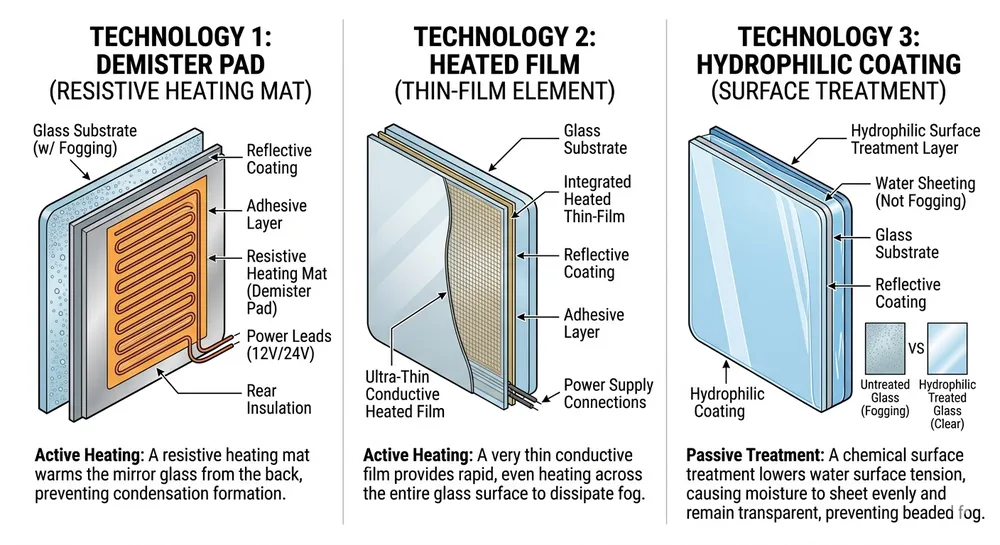
There are three approaches in commercial use. Each has a different cost profile, installation requirement, and maintenance implication.
Demister pads (resistive heating elements) are the standard for hospitality. A thin heating mat bonds to the back of the mirror glass and warms the surface to 2–5°C above ambient room temperature — enough to prevent condensation from forming. They run on low wattage (typically 12–60W depending on mirror size), connect to the bathroom's lighting circuit or a dedicated switched circuit, and have no moving parts. Most hospitality projects we supply use this approach because it's reliable, serviceable, and the cost per unit is predictable.
Heated film is a thinner alternative to pad-style elements, sometimes used when the mirror assembly has tight depth constraints or when the frame profile doesn't accommodate a standard pad thickness. Performance is comparable to demister pads at equivalent wattage density. The trade-off is that film elements are harder to replace in the field if they fail — the bond to the glass is more permanent than a pad adhesive.
Hydrophilic coatings are a passive option: a surface treatment that causes water to sheet off rather than bead and fog. No electrical connection required. The limitation for hospitality is durability — most hydrophilic coatings degrade with cleaning chemical exposure and need reapplication every 12–18 months. For a 200-room property, that's a maintenance program, not a one-time spec decision. We've had buyers try this route to avoid the electrical complexity, and most come back to demister pads after the first maintenance cycle.
For hospitality projects, demister pads are the right default. The rest of this guide focuses on specifying them correctly.
Demister Pad Wattage Sizing: The Calculation That Most Specs Get Wrong
Undersizing the heating element is the most common spec mistake we see on hospitality projects. A pad that's too small for the mirror area will clear the center of the glass while leaving fog at the edges — which looks worse than a fully fogged mirror because it's obviously a failed product rather than a ventilation issue.
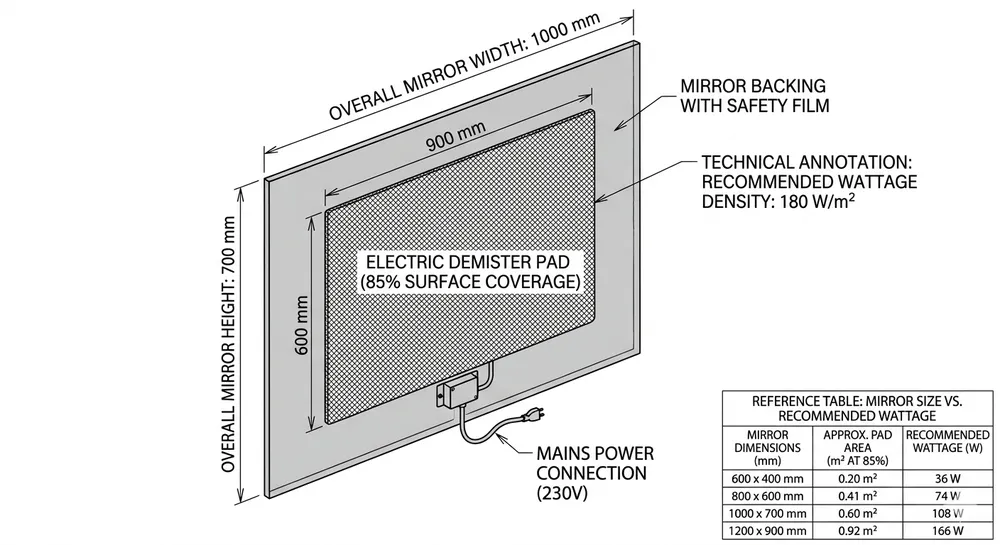
The industry working range for demister pad wattage density is 200–250W per square meter of mirror surface for standard bathroom environments. High-humidity environments — spa bathrooms, steam rooms adjacent to bathrooms, or properties in tropical climates — should target the upper end of that range or slightly above.
Wattage reference table by mirror size:
| Mirror Size | Surface Area | Recommended Wattage (200 W/m²) | High-Humidity Wattage (250 W/m²) |
|---|---|---|---|
| 500 × 700 mm | 0.35 m² | 70W | 88W |
| 600 × 800 mm | 0.48 m² | 96W | 120W |
| 700 × 900 mm | 0.63 m² | 126W | 158W |
| 800 × 1000 mm | 0.80 m² | 160W | 200W |
| 900 × 1200 mm | 1.08 m² | 216W | 270W |
| 1000 × 1400 mm | 1.40 m² | 280W | 350W |
(These are working guidance values based on typical bathroom conditions. Your electrical engineer should confirm circuit loading for the specific installation.)
The pad itself doesn't need to cover 100% of the mirror back — coverage of 80–90% of the glass area is standard, with the element stopping short of the perimeter to avoid heat concentration at the edges. What matters is that the wattage density across the covered area falls within the target range.
One thing worth flagging: the pad wattage needs to match the supply voltage at the installation site. A 230V pad specified for a European property won't run correctly on a 120V North American circuit, and vice versa. This sounds obvious, but we've seen it missed on multi-market hospitality rollouts where the same spec sheet gets applied across properties in different countries.
IP Ratings and Certification Requirements for Commercial Bathroom Installations
This is where hospitality projects diverge most sharply from residential specs, and where missing a requirement creates real liability exposure.
IP rating requirements for bathroom mirror electrical components depend on the mirror's installation zone relative to the water source. The IEC 60364-7-701 standard (adopted in most European markets and referenced in equivalent standards elsewhere) defines bathroom zones:
- Zone 1 (directly above the bath or shower tray, up to 2.25m height): minimum IP45
- Zone 2 (0.6m horizontal from Zone 1 boundary): minimum IP44
- Outside zones (general bathroom area beyond Zone 2): IP20 minimum, but most commercial specs default to IP44 for the entire bathroom
For a vanity mirror above a sink in a standard hotel bathroom, IP44 is the typical minimum requirement. For mirrors in wet rooms, spa bathrooms, or any installation where water spray could reach the mirror surface, IP65 is the correct spec.
The IP rating applies to the complete assembly — mirror, demister pad, and any integrated lighting or electrical connections. A pad rated IP44 connected through an unrated junction box doesn't give you an IP44 installation.
CE marking is required for electrical components sold into European markets. For demister pads, this covers the Low Voltage Directive (LVD) and the Electromagnetic Compatibility (EMC) Directive. When you're sourcing mirrors with integrated heating elements for European hospitality projects, ask your supplier for the CE Declaration of Conformity for the heating component specifically — not just for the mirror as a decorative product.
UL listing is the equivalent requirement for North American commercial installations. Many hospitality chains in the US and Canada require UL-listed electrical components as a condition of their procurement standards, independent of local building code requirements. If your project is going into a branded hotel property, check the brand's FF&E specification standards before finalizing your mirror spec — some chains have explicit requirements that go beyond code minimums.
We supply CE-certified demister pad assemblies as standard for European market orders. For North American projects, we work with buyers to source UL-listed pad components and can integrate them into our mirror assemblies during production. (This is worth confirming at the RFQ stage rather than after samples are approved — retrofitting a different pad into a finished mirror assembly adds time and cost that neither side wants.)
How Copper-Free Silvering Affects Anti-Fog Mirror Durability
Most buyers focus on the heating element when specifying anti-fog mirrors and treat the mirror coating as a separate, standard decision. That's the wrong sequence. The coating system and the heating element interact, and getting that interaction wrong is how you end up with mirrors that look fine at installation and start failing at month 18.
The mechanism is straightforward. A demister pad cycles on and off with the bathroom's lighting circuit or a thermostat. Each cycle introduces a small thermal expansion and contraction in the coating layers behind the glass. Over thousands of cycles across a multi-year installation, that mechanical stress accumulates at the interface between the silver layer and its protective backing. If the adhesion at that interface isn't strong, you get delamination — the silver layer separates from the backing and you see it as dark patches or edge blackening spreading inward from the perimeter.
Copper-backed silvering is more vulnerable to this failure mode. The copper interlayer, used in older silvering processes to improve initial adhesion, is also more reactive to moisture and heat. In a high-humidity bathroom with a demister pad running daily, the copper layer can oxidize and undermine the silver above it. The black edge creep that hospitality buyers associate with "cheap mirrors" is often copper oxidation, not silver failure.
We run copper-free silvering as our default process across all bathroom mirror production. The silver layer goes down directly onto the glass, followed by two protective paint layers — a lead-free primer coat and a topcoat — applied and cured under controlled temperature and humidity conditions. Copper-free silvering costs slightly more per unit to produce, but it meets EU RoHS requirements and holds up significantly better under the thermal cycling that demister pads introduce.
The controlled coating environment matters here in a way that's easy to underestimate. Silver deposition is sensitive to ambient temperature and humidity during application — a 5°C swing in the coating room can affect adhesion uniformity across a batch. We've invested in climate control on our silvering line specifically because we saw the adhesion variance that came from uncontrolled conditions, and the downstream warranty claims that followed. When you're specifying mirrors for a 300-room property, coating consistency across the entire batch isn't a nice-to-have.
For anti-fog applications specifically, ask your supplier whether their silvering process is copper-free and whether their coating line operates under controlled environmental conditions. These two questions will tell you more about long-term durability than any marketing claim about "premium quality."
The Spec Checklist: What to Define Before You Send an RFQ
Hospitality buyers who send an RFQ with only mirror dimensions and a finish reference get back quotes that aren't comparable — because suppliers fill in the unspecified parameters differently, and those differences show up in performance and price. Define these parameters upfront and your quotes will be apples-to-apples.
Mirror dimensions and glass spec:
- Overall mirror size (W × H in mm)
- Glass thickness (4mm or 5mm for most hospitality applications; 6mm for large-format mirrors above 1000mm in either dimension)
- Edge treatment (flat polished, beveled, or seamed)
- Frame material and finish, or frameless
Anti-fog heating element:
- Demister pad wattage (calculated from mirror area × 200–250 W/m²)
- Supply voltage (120V or 230V — confirm for each market)
- Connection type (hardwired to lighting circuit, or switched separately)
- IP rating required (IP44 minimum for standard hotel bathroom; IP65 for wet rooms)
- Certification required (CE for Europe; UL for North America)
Coating specification:
- Copper-free silvering: yes/no (specify yes for all hospitality applications)
- Backing paint system: lead-free required for EU/North American markets
- Edge sealing: specify sealed edges for high-humidity environments
Compliance and documentation:
- CE Declaration of Conformity for heating component
- UL listing documentation if required
- SGS or third-party test reports for coating adhesion
- Country of origin documentation
Commercial terms:
- Quantity per SKU (and whether this is a pilot order or full project volume)
- Packaging requirements (project delivery vs. retail-ready)
- Lead time requirements
We've seen projects delayed by 6–8 weeks because the IP rating or certification requirement surfaced after samples were approved and production was scheduled. Getting these parameters into the RFQ means your supplier can flag any constraints before you're committed to a timeline.
Common Specification Mistakes and How to Prevent Them
These are the errors we see most often on hospitality mirror projects. None are complicated to avoid once you know to look for them.
Specifying pad wattage by mirror perimeter instead of surface area. Some suppliers quote demister pads by the linear dimensions of the mirror rather than the surface area. A 600 × 800mm mirror and a 700 × 700mm mirror have similar perimeters but different surface areas — and the 700 × 700mm mirror needs more wattage. Always calculate from area.
Ordering the same spec for all markets. A 230V pad in a 120V installation won't reach operating temperature. A 120V pad in a 230V installation will overheat. If your hospitality group operates properties across multiple countries, your mirror spec needs to branch by market voltage.
Assuming IP44 covers the whole bathroom. IP44 is the minimum for Zone 2. If the mirror is positioned within 600mm of the shower enclosure boundary, you're in Zone 1 territory and need IP45 or higher. Check the bathroom layout drawings, not just the mirror position.
Skipping the coating compatibility question. A supplier who offers anti-fog mirrors but runs copper-backed silvering is selling you a product that will degrade faster under demister pad heat cycling. Ask the question directly: copper-free or copper-backed? If they don't know, that's also an answer.
Treating the pilot order spec as the production spec. Hospitality buyers often run a 50–100 unit pilot in one property before committing to a full rollout. The pilot spec should be identical to the production spec — same pad, same voltage, same certification, same coating. We've had buyers pilot with a CE-certified pad and then switch to an uncertified component for the production run to save cost. That's a liability decision, not a cost decision.
(The 100-piece MOQ we offer on standard models exists partly for this reason — it's a realistic pilot quantity that lets you test the full spec in a live property before committing to project volume.)
Upstream Prevention: What Should Be Controlled Before the Mirror Leaves the Factory
Anti-fog mirror failures in the field almost always trace back to something that wasn't controlled during production. By the time a mirror is installed in a hotel bathroom, you have limited options. The time to prevent the failure is at the factory.
Coating adhesion testing before shipment. The standard method is cross-cut tape testing on a sample from each production batch — a grid of cuts through the coating layers, tape applied and pulled, adhesion graded against a reference scale. This tells you whether the silver and paint layers will hold under normal use conditions. Ask your supplier for batch test records, not just a general statement that they test.
Demister pad bond integrity. The pad adhesive needs to make full contact with the mirror back — air pockets in the bond create hot spots that can crack the glass under thermal cycling. A simple visual inspection of the pad-to-glass interface before assembly, combined with a brief power-on test, catches most bond failures before the mirror ships.
Electrical continuity check. Every mirror with an integrated heating element should be powered on and checked for correct operating temperature before packaging. This catches wiring faults, pad defects, and connection failures that would otherwise surface at installation — or worse, after installation.
Packaging for project delivery. Anti-fog mirrors with integrated electrical components need packaging that protects the connection points during transit. Loose wiring that gets pinched or abraded in a carton can cause intermittent faults that are difficult to diagnose after installation. Specify that connection leads are secured and protected in the packaging configuration.
We run 100% visual inspection on every unit before packaging, and our QC protocol for anti-fog mirror assemblies includes a power-on check for every heated unit. For large hospitality projects, we can provide batch inspection reports and photographs of the packed cartons — useful documentation if a claim comes up at the destination property.
For more on how coating environment and process controls affect bathroom mirror durability, see our guide on moisture resistance specs for bathroom mirrors.
Sourcing Anti-Fog Mirrors: What to Ask Before You Commit
The market for anti-fog bathroom mirrors ranges from commodity products with uncertified heating elements to properly engineered assemblies with full compliance documentation. The price difference between them is real, but so is the liability difference.
When evaluating suppliers, these are the questions that separate a capable manufacturer from one who's assembling components they don't fully understand:
- Is your silvering process copper-free? Can you provide process documentation?
- What IP rating are your demister pad assemblies certified to, and can you provide the test report?
- Do you hold CE Declaration of Conformity for the heating components? UL listing for North American supply?
- What is your coating adhesion test protocol, and do you test every batch or by sampling?
- Can you produce custom wattage configurations for non-standard mirror sizes?
- What is your MOQ for anti-fog mirror SKUs, and can you accommodate a pilot order at the same spec as the production run?
A supplier who can answer these questions with documentation — not just verbal assurances — is a supplier who has actually built anti-fog mirrors for commercial projects before.
Our OEM/ODM custom mirror development program handles anti-fog mirror assemblies from spec to production: custom dimensions, wattage configurations, IP-rated connection systems, and CE or UL documentation packages. The 12-engineer team that develops our custom frame profiles applies the same process to heating element integration — the spec gets engineered, not assumed.
If you're building a product line of anti-fog mirrors for wholesale distribution into the hospitality segment, the Decor Mirrors by Room category covers the full range of room-specific specs, including bathroom vs living room mirror spec differences that affect how you position and price each SKU.
Send us your mirror dimensions, target quantity, IP rating requirement, and market (for voltage and certification), and we'll return a technical proposal with demister pad spec, coating recommendation, and pricing within 48 hours. Request Quote.