Most bedroom mirror sizing guides are written for homeowners. They tell you to hang a mirror at eye level, pick a frame that matches your nightstand, and leave it at that. That's not what you need when you're building a wholesale catalog or planning a hospitality project order.
What you actually need is a placement-to-spec map: which mirror types belong in which bedroom zones, what dimensions sell through versus sit on shelves, and how those dimensions connect to real production specs — glass thickness, backing type, hanging hardware load rating. That's what this guide covers.
We've been producing bedroom mirrors at Livewellcraft since 2008. The sizing patterns here come from coordinating orders across retail programs, hotel FF&E projects, and distributor catalogs in North America, Europe, and the Middle East. When a buyer's assortment underperforms, it's almost always a sizing mismatch — mirrors that look right in a product photo but don't fit the wall space their end customers actually have.

The Four Bedroom Placement Zones — and Why Each One Drives a Different SKU
Bedroom mirrors don't belong to a single category. A full-length mirror and an above-dresser accent mirror share a factory line, but almost nothing else in the spec sheet — different aspect ratios, different glass thickness requirements, different hanging hardware, different frame depth tolerances. Treating them as interchangeable is how catalogs end up with dead inventory.
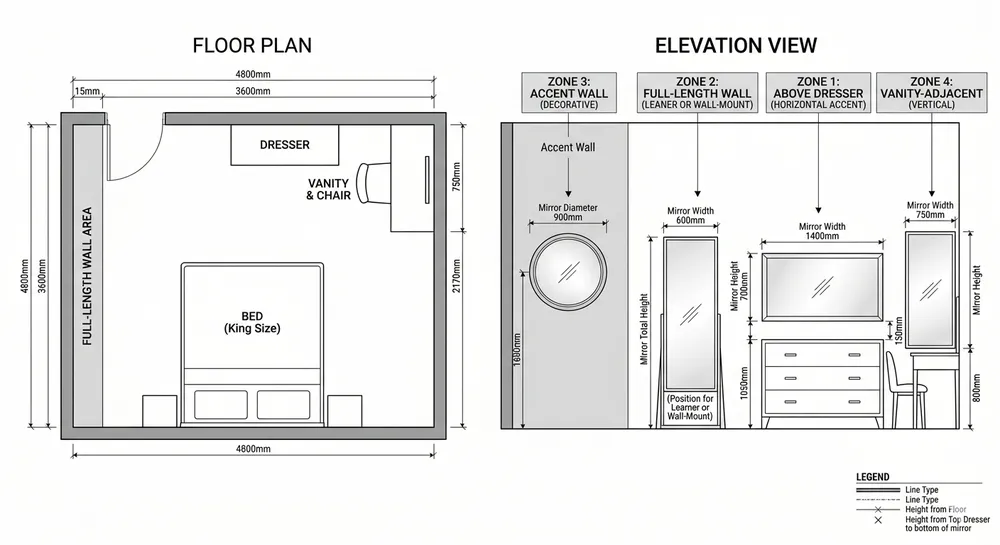
Here are the four placement zones that matter for wholesale planning:
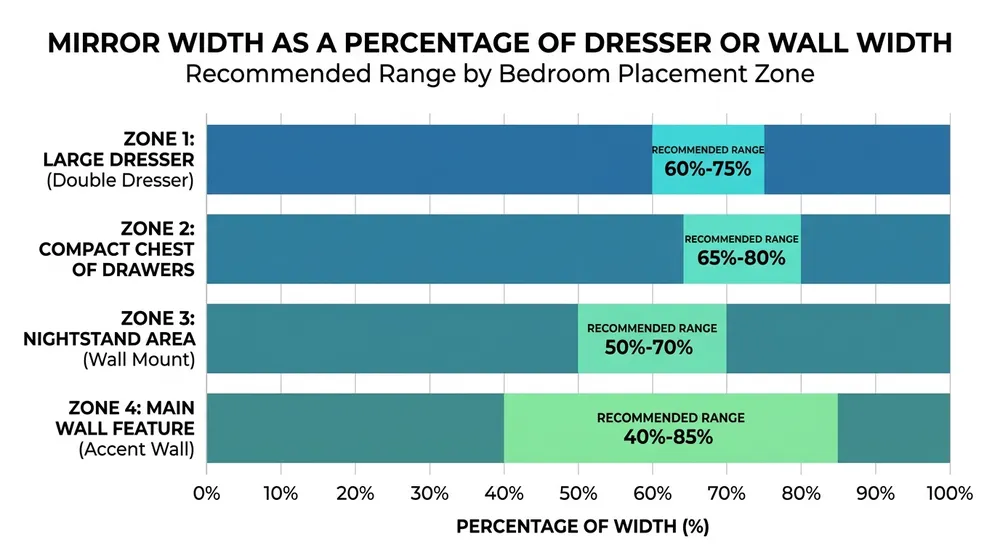
Zone 1 — Above the Dresser (Horizontal Accent) This is the highest-volume bedroom mirror segment in retail programs. The mirror sits centered above a dresser or chest, typically 6–12 inches above the furniture surface. Width should track the dresser width at 75–100% — a 48-inch dresser pairs with a 36–48-inch mirror. Going wider than the dresser creates visual imbalance that end customers notice and return.
Standard wholesale dimensions for this zone: 24"×36" to 36"×48" (landscape orientation). Frame depth matters here because the mirror often sits close to a wall with limited clearance — keep frame projection under 2 inches for standard residential applications.
Zone 2 — Full-Length Wall Mount or Leaner Full-length mirrors are the second-highest volume segment and the one with the most sizing variation across markets. Standard full-length dimensions run 16"×48" to 24"×72", with 18"×60" and 22"×65" being the two sizes we produce most frequently for North American retail programs.
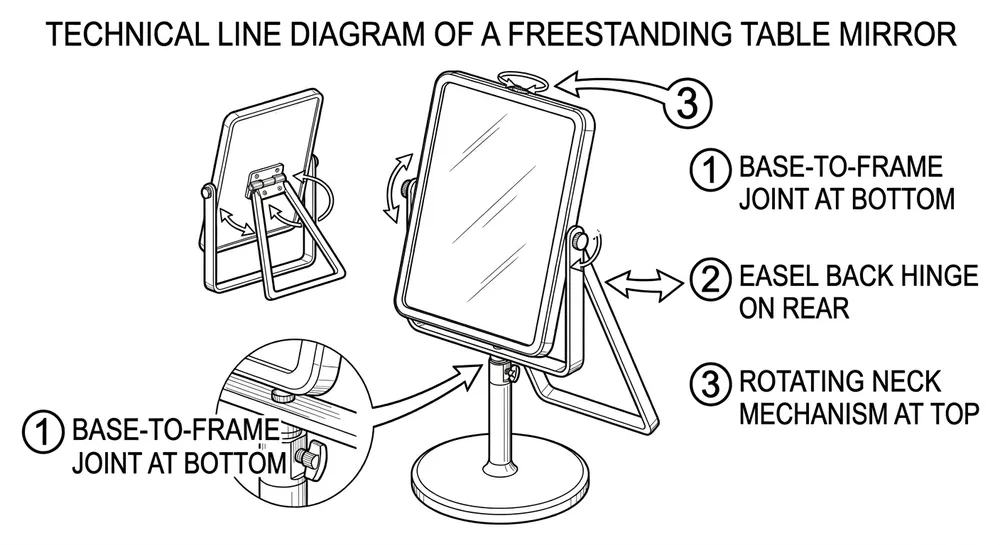
The leaner configuration (floor-standing, angled against the wall) and the wall-mount configuration use the same glass blank but require different hardware packages — leaners need rubber feet and a wall anchor tether, wall-mounts need a rated D-ring or French cleat system. Specify this at order, not after production.
Zone 3 — Accent Wall (Decorative Statement) Accent wall mirrors are the most style-driven zone and the hardest to forecast. Shapes range from arched to sunburst to irregular geometric. For catalog planning, the safest SKUs in this zone are round mirrors (24"–36" diameter) and arched mirrors (24"×36" to 30"×48"). These have consistent sell-through across retail and hospitality channels.
(We've seen buyers over-index on large statement mirrors — 40"+ diameter rounds — for their first order. They move slowly outside of high-end retail. Start with 24"–30" for a new catalog entry.)
Zone 4 — Vanity-Adjacent (Vertical Accent) Narrower vertical mirrors placed beside or above a vanity table, typically 16"×24" to 20"×30". These are often sold as part of a bedroom vanity set and benefit from frame finish coordination with Zone 1 mirrors. If you're building a bedroom collection, matching frame profiles across Zone 1 and Zone 4 SKUs increases your average order value — buyers purchasing a dresser mirror often add the vanity accent when the finish matches.
Standard Bedroom Mirror Sizing Reference Table
This table maps common bedroom wall widths to recommended mirror dimensions by placement zone. Use it when advising your retail or project clients on assortment selection, or when building a catalog that needs to cover the most common bedroom configurations.
| Placement Zone | Typical Wall / Furniture Width | Recommended Mirror Size | Aspect Ratio | Notes |
|---|---|---|---|---|
| Above Dresser | 36" dresser | 24"×36" | 2:3 (landscape) | Minimum viable size for visual balance |
| Above Dresser | 48" dresser | 30"×40" – 36"×48" | 3:4 (landscape) | Most common retail SKU in this zone |
| Above Dresser | 60"+ dresser / double | 40"×30" – 48"×36" | 4:3 (landscape) | Hospitality and master bedroom programs |
| Full-Length | Standard bedroom (10–12 ft wall) | 18"×60" – 22"×65" | 1:3 | Core retail SKU; fits most bedroom doors |
| Full-Length | Larger suite / walk-in | 24"×72" | 1:3 | Hotel FF&E standard; heavier hardware req. |
| Accent Wall | Feature wall, any width | 24"–30" round / 24"×36" arch | 1:1 / 2:3 | Style-driven; prioritize finish variety |
| Vanity-Adjacent | Vanity table 18"–24" wide | 16"×24" – 20"×30" | 2:3 (portrait) | Often sold as set with Zone 1 mirror |
Glass Thickness and Backing Specs by Mirror Size
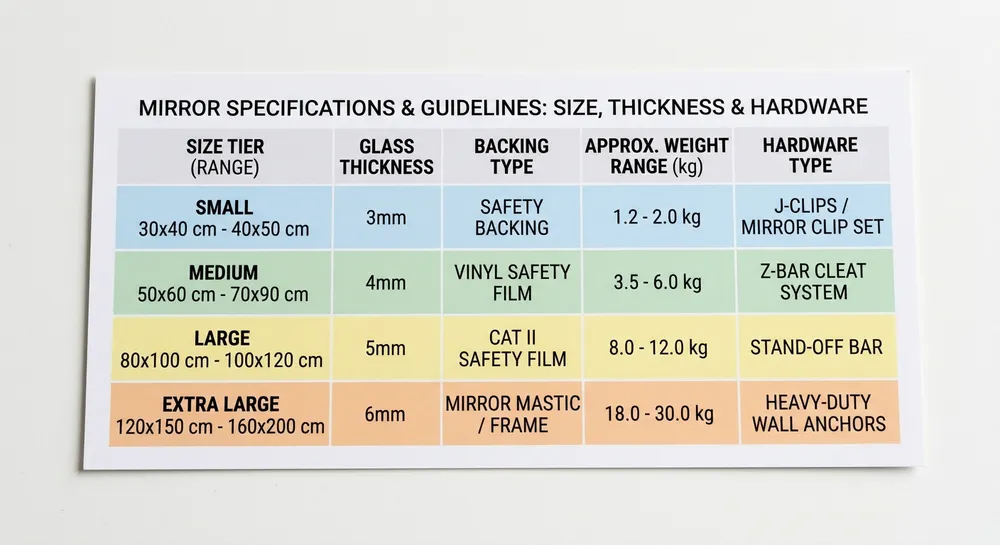
Size drives weight, and weight drives every downstream spec decision — glass thickness, backing board, hanging hardware load rating, and packaging. This is where bedroom mirror orders most often go wrong at the sourcing stage: buyers specify the frame and finish but leave glass thickness and hardware unspecified, then receive product that fails in the field.
Here's how we approach it at Livewellcraft:
3mm glass — standard for mirrors up to approximately 24"×36". Light enough for standard D-ring wall mounts. Suitable for Zone 4 vanity-adjacent and smaller Zone 1 above-dresser SKUs.
4mm glass — our default for the 24"×36" to 36"×48" range. This covers the majority of above-dresser and mid-size accent mirrors. The weight increase over 3mm is meaningful — a 36"×48" mirror in 4mm glass runs approximately 18–22 lbs depending on frame material, which changes your packaging and per-carton count.
5mm glass — specified for full-length mirrors (18"×60" and larger) and any mirror exceeding 36" in either dimension. At this size, 4mm glass carries acceptable deflection risk during shipping and handling. We run 5mm as standard on all full-length SKUs.
6mm glass — used for oversized decorative mirrors (40"+ in any dimension) and custom hospitality orders where the mirror will be permanently wall-mounted in a high-traffic environment. Adds cost and freight weight, so confirm with your buyer before specifying.
Backing board is the other variable buyers frequently underspecify. We use MDF backing as standard on framed mirrors — it provides a stable substrate for the silvering layer and resists warping better than raw particleboard in humid environments. For bathroom-adjacent bedroom applications (master suite, hotel room), we recommend our moisture-resistant backing option, which uses a sealed MDF core with a foil vapor barrier. (This matters more than most buyers expect — we've seen silvering delamination on standard-backed mirrors placed near en-suite bathroom doors in humid climates.)
| Mirror Size Range | Glass Thickness | Backing | Approx. Weight (framed) | Hardware Recommendation |
|---|---|---|---|---|
| Up to 24"×36" | 3mm | Standard MDF | 8–12 lbs | Standard D-ring, 2-point |
| 24"×36" – 36"×48" | 4mm | Standard MDF | 15–25 lbs | Heavy-duty D-ring or Z-bar |
| 18"×60" – 24"×72" (full-length) | 5mm | Standard MDF | 25–40 lbs | French cleat or dual Z-bar |
| 40"+ any dimension | 6mm | MDF or moisture-resistant | 35–55 lbs | French cleat, rated ≥60 lbs |
| Bathroom-adjacent / humid | 4–5mm | Moisture-resistant MDF | Per above | Per above |
Frame Material Selection by Bedroom Segment
Frame material is the spec decision that most directly affects your margin and your buyer's market positioning. We produce bedroom mirror frames in four primary materials — each has a different cost structure, weight profile, and target channel.
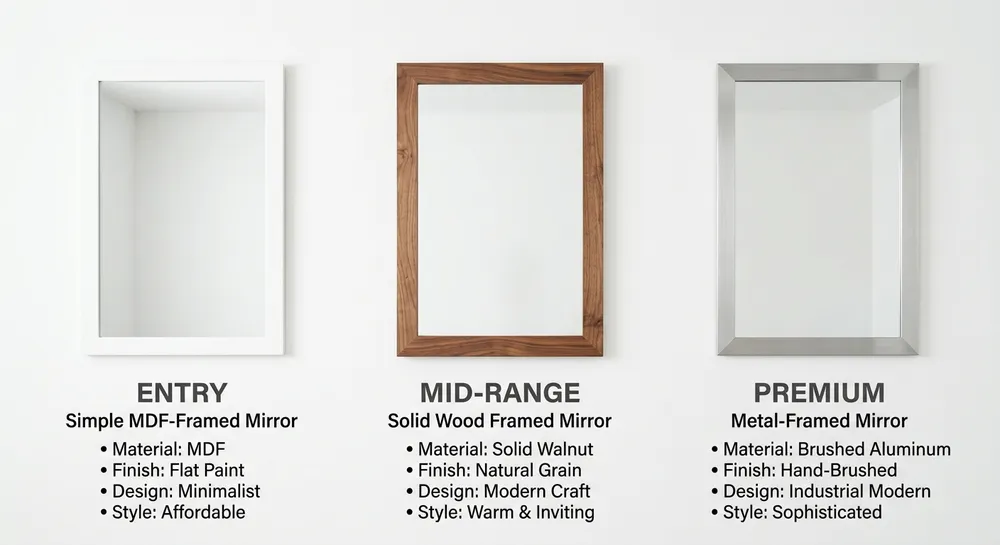
MDF with decorative finish (paint, foil wrap, or veneer) — the highest-volume frame material in retail bedroom programs. Low weight, consistent finish quality, and the widest range of profile options. Most of our 24"×36" to 36"×48" above-dresser SKUs ship in MDF frames. Cost-effective for mid-market retail and e-commerce channels.
Solid wood — higher landed cost but commands a meaningful retail price premium. We work with rubberwood and pine as standard species; oak and walnut are available on custom runs. Solid wood frames are the right call for premium retail programs, boutique hotel FF&E, and any channel where "solid wood" is a marketable claim on the product listing. The weight increase over MDF is real — factor it into your freight calculation on full-container orders.
Metal (iron or aluminum) — the dominant frame material for industrial, loft, and contemporary bedroom aesthetics. Thin-profile metal frames (under 1 inch wide) are particularly strong in the 18"×60" full-length segment right now. We powder-coat all metal frames — 60–80μm thickness, passes 500-hour salt spray — so your coastal and humid-climate accounts won't generate warranty claims.
Resin — used primarily for ornate and carved-look frame profiles where the design complexity would be cost-prohibitive in wood. Resin frames photograph well and hold paint finishes cleanly, which matters for e-commerce channels where the product image is the primary sales tool. Weight is comparable to MDF.
For catalog planning, the most defensible assortment covers at least two frame materials in your core bedroom SKUs — typically MDF for volume and solid wood or metal for margin. Single-material catalogs leave channel gaps.
How Placement Trends Affect SKU Assortment and MOQ Planning
The bedroom mirror market has shifted meaningfully over the past several years, and those shifts have direct implications for how distributors should structure their assortments.
Full-length mirrors have grown as a standalone category. What used to be a secondary SKU — something buyers added to round out a bedroom collection — is now a primary search and purchase driver, particularly in e-commerce. The 18"×60" and 22"×65" sizes are the core of this demand. If your catalog doesn't have at least two full-length SKUs in different frame styles, you're leaving a significant volume segment uncovered.
Arched mirrors have moved from trend to standard. Three years ago, arched-top mirrors were a trend item with uncertain longevity. They've stabilized as a catalog staple in the 24"×36" to 30"×48" range. We now produce arched profiles in MDF, metal, and resin frames as standard options — no custom tooling required for most profiles.
Round mirrors remain strong in the accent wall zone but have bifurcated by size. The 24"–30" range moves consistently across retail and hospitality. The 36"+ range is slower and more style-dependent — worth carrying in one or two finishes, not as a deep SKU.
Hospitality and project buyers specify differently than retail. Hotel FF&E orders typically require 24"×72" full-length mirrors with French cleat mounting, moisture-resistant backing, and custom frame finishes matched to room specifications. These orders run at higher per-unit value but require longer lead times for custom finish matching. If you're serving both retail and hospitality channels, keep your standard retail SKUs and your custom-capable hospitality specs clearly separated in your catalog — they have different MOQ structures and lead times.
On MOQ: our standard bedroom mirror SKUs start at 100 pieces per model for stocked frame profiles and finishes. Custom sizing or custom frame profiles require a minimum of 200 pieces to justify tooling. For buyers building a new bedroom mirror catalog, a practical entry assortment covers 4–6 SKUs across the above-dresser and full-length zones, which typically lands at 400–600 pieces total — manageable for a first container and broad enough to test market response across the key placement zones.
(We've had buyers try to launch with 10+ SKUs at 100 pieces each. The logistics work, but the sell-through data is too fragmented to act on. Four to six focused SKUs gives you cleaner read on what your market actually wants.)
Common Sizing Mistakes That Create Dead Inventory
These are the patterns we see repeatedly when buyers come back to reorder — or don't.
Ordering too many large above-dresser mirrors. The 40"×30" and 48"×36" sizes look impressive in a catalog but require a dresser or console of 48"+ to look proportional. Most residential bedrooms don't have furniture that wide. The 30"×40" and 36"×48" sizes cover a much larger share of real bedroom configurations.
Ignoring the leaner vs. wall-mount distinction on full-length orders. These are different products from a hardware and packaging standpoint, even when the glass and frame are identical. Buyers who don't specify at order receive one configuration — usually wall-mount — and then field complaints from end customers who wanted a leaner. Specify both if your market needs both; they can share the same frame profile with a different hardware kit.
Underspecifying frame finish for e-commerce channels. Online buyers make purchase decisions based on product photography. A frame finish that looks warm and accurate in a showroom can photograph cool and flat under standard e-commerce lighting. If you're selling into e-commerce, request finish samples before committing to a full run — we can produce sample sets across finish options for evaluation before production.
Skipping the size-to-wall-ratio check when building assortments. A catalog that covers 24"×36", 30"×40", and 36"×48" in the above-dresser zone looks like good coverage. But if all three sizes use the same frame profile and finish, your end customers are choosing by size alone — and the middle SKU often stagnates. Vary frame profiles or finishes across sizes to give each SKU a distinct reason to exist in the catalog.
For buyers building or refreshing a Bedroom Decor Mirrors assortment, the sizing table in this guide is a practical starting point. Cross-reference it against your existing catalog to identify gaps before your next order.
Connecting Placement Specs to Producible SKUs at Livewellcraft
Everything in this guide maps to specs we can actually produce. Glass cutting, silvering, frame molding, and assembly all run under one roof at our 12,000 m² facility in Ho Chi Minh, Vietnam — which means when you specify 5mm glass with moisture-resistant backing and a powder-coated metal frame in 22"×65", we're not coordinating between three suppliers to build that. It comes off one production chain.
Our standard bedroom mirror production capabilities:
- Glass: 3mm, 4mm, 5mm, 6mm — cut to size in-house, silver-coated on dedicated silvering lines
- Frame materials: MDF (painted, foil, veneer), solid wood (rubberwood, pine, oak, walnut on custom), metal (iron, aluminum, powder-coated), resin
- Custom sizing: available on runs of 200+ pieces; standard sizes from the table above available at 100-piece MOQ
- Backing: standard MDF, moisture-resistant MDF with vapor barrier
- Hardware: D-ring (standard and heavy-duty), Z-bar, French cleat, leaner kit with rubber feet and tether — specified at order
- Certifications: ISO 9001:2015, SGS, CE, BSCI
We supply Walmart, Wayfair, and Amazon vendor programs, so EDI compliance and retail-ready packaging are standard capabilities, not add-ons. If your channel has specific labeling, barcode, or carton requirements, send them with your RFQ and we'll confirm compliance before production starts.
The full Decor Mirrors by Room category covers placement and spec guidance across bathroom, living room, hallway, and entryway zones as well — useful if you're building a multi-room mirror program rather than a bedroom-only catalog.
For a direct comparison of how bedroom mirror specs differ from bathroom mirror specs (moisture resistance, silvering standards, backing requirements), see Bathroom vs Bedroom Mirror Specs.
Frequently Asked Questions
What is the standard size for a bedroom wall mirror in wholesale catalog programs?
The two highest-volume sizes in retail bedroom programs are 30"×40" (above-dresser, landscape) and 18"×60" (full-length). These cover the most common bedroom furniture configurations and wall dimensions in North American and European residential markets. If you're building a bedroom mirror catalog from scratch, these two sizes are the lowest-risk entry points.
What glass thickness should I specify for a full-length bedroom mirror?
5mm is the correct specification for full-length mirrors in the 18"×60" to 24"×72" range. 4mm glass at full-length dimensions carries deflection risk during shipping and handling — we've seen 4mm full-length mirrors arrive with stress fractures from container vibration that 5mm glass handles without issue. Don't let a supplier talk you into 4mm on full-length SKUs to reduce cost; the warranty claim risk isn't worth it.
How does mirror placement zone affect MOQ and lead time?
Standard placement zones (above-dresser, full-length) use stocked frame profiles and standard glass sizes — these run at 100-piece MOQ with standard lead times. Accent wall mirrors with custom shapes (irregular arches, oversized rounds, geometric frames) require custom tooling and a 200-piece minimum. Lead times on custom profiles run 2–3 weeks longer than standard. Plan your catalog accordingly if you're mixing standard and custom SKUs in a single PO.
What frame material works best for bedroom mirrors sold into e-commerce channels?
MDF with a high-quality paint or foil finish photographs most consistently for e-commerce. The surface is uniform and responds predictably to standard product photography lighting. Solid wood frames can have natural grain variation that reads inconsistently across units — not a quality problem, but a photography challenge. Metal frames photograph well but require careful lighting to avoid glare. For e-commerce-primary catalogs, MDF is the lowest-risk frame material from a product listing consistency standpoint.
Can bedroom mirror sizes be customized for hospitality or project orders?
Yes — custom sizing is available on runs of 200+ pieces. Hotel FF&E orders typically specify non-standard dimensions to fit room layouts precisely, and we handle these regularly. Send your project specs (room dimensions, mounting requirements, finish references) to our engineering team and we'll return a spec sheet with producible dimensions and pricing. See Sourcing Bedroom Mirrors in Bulk for more on how hospitality and project orders differ from standard retail programs.
If your current catalog has sizing gaps or you're planning a new bedroom mirror program, share your target sizes, frame preferences, and order volume with us — Request Quote and our engineering team will return a spec sheet and pricing within 48 hours.