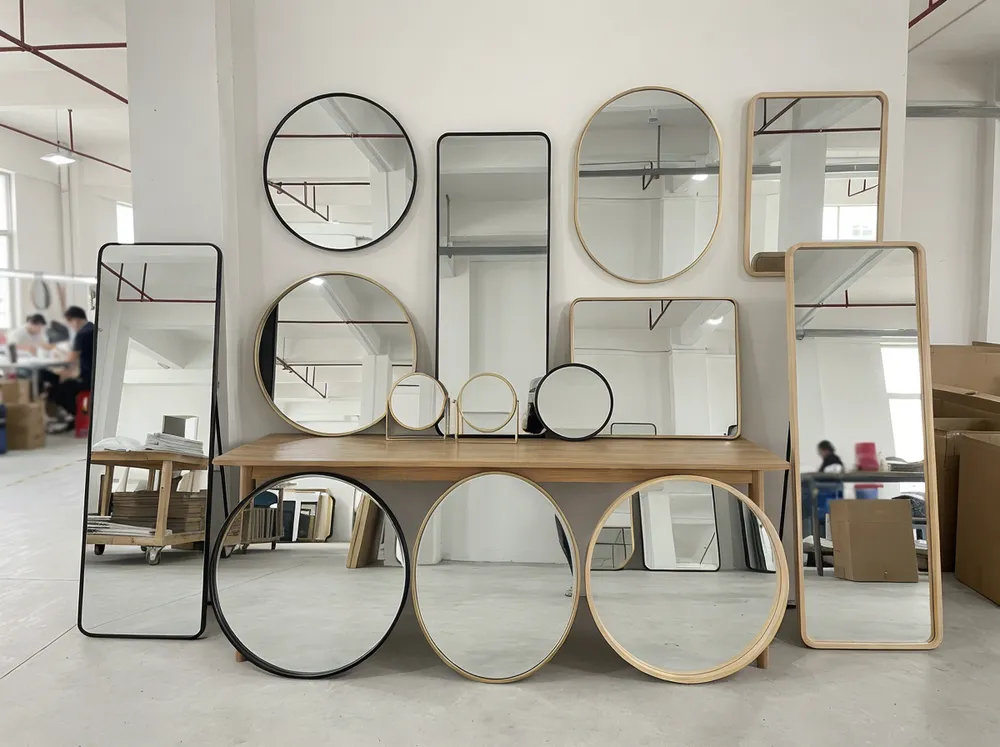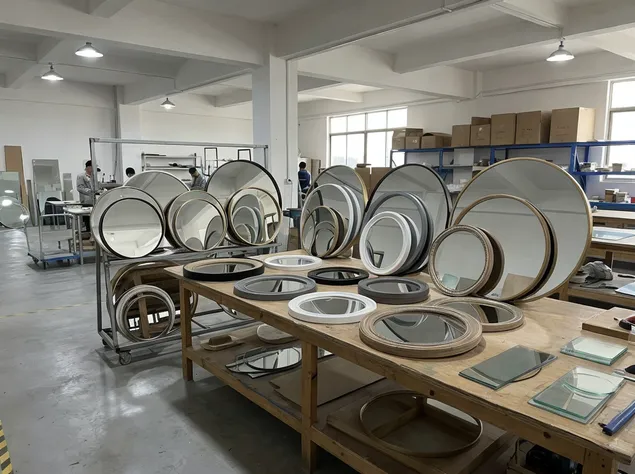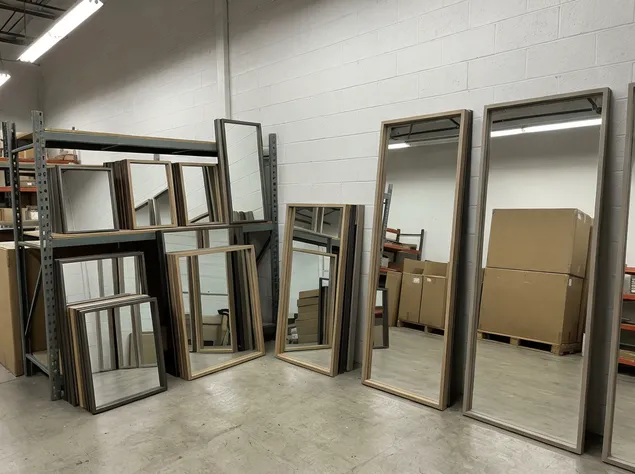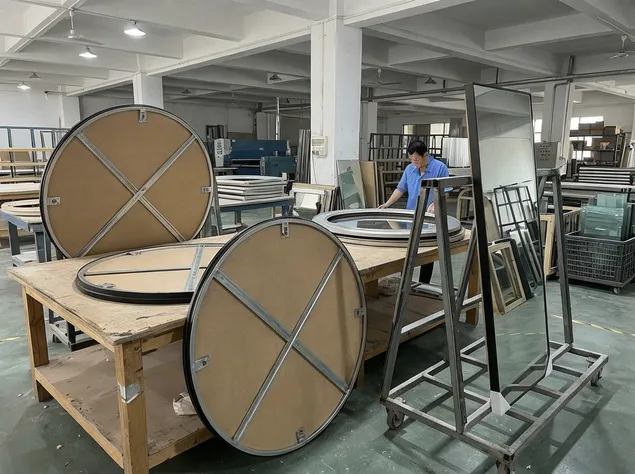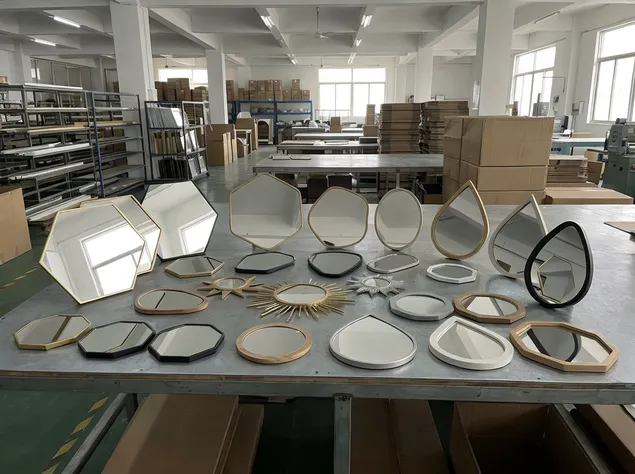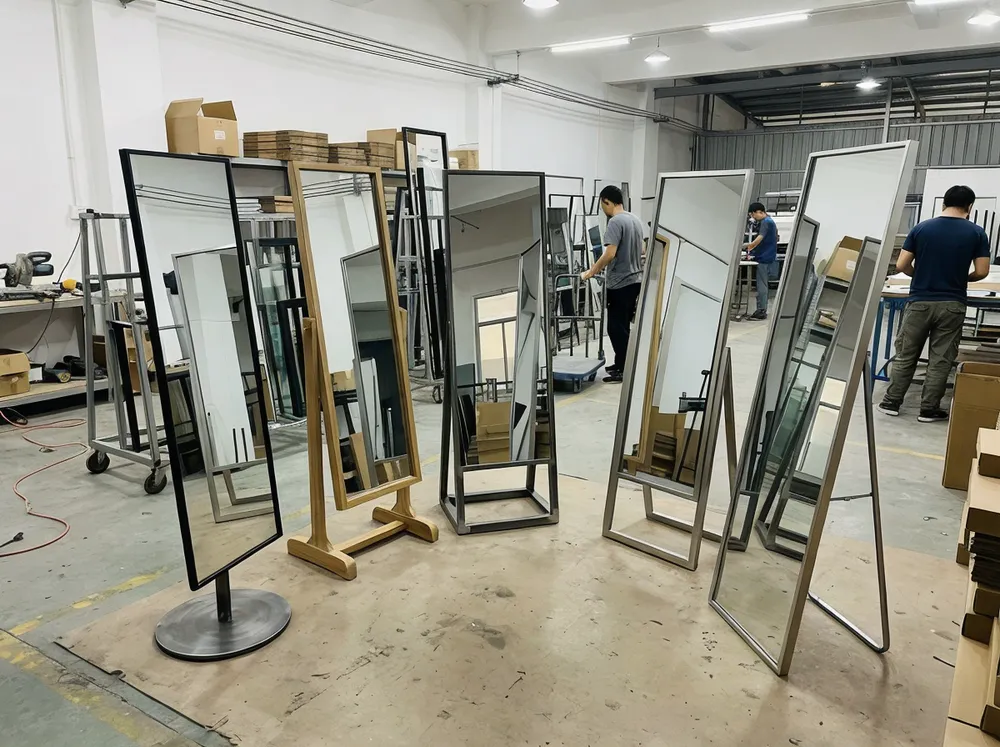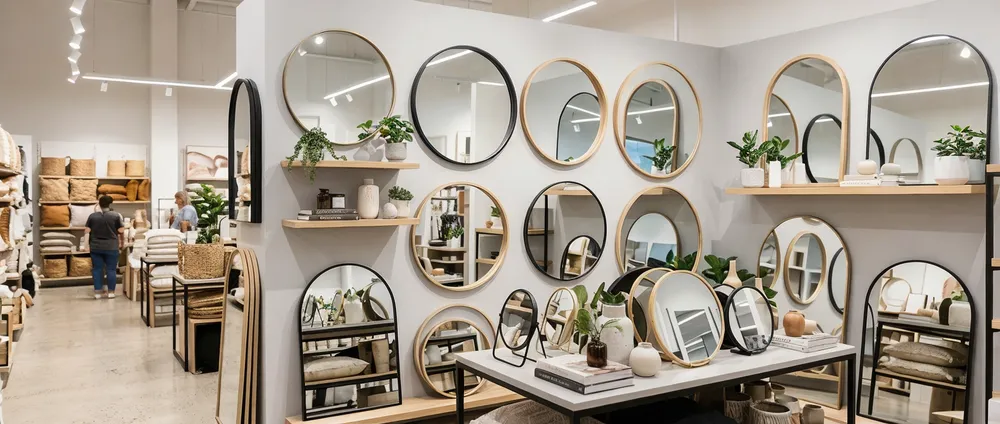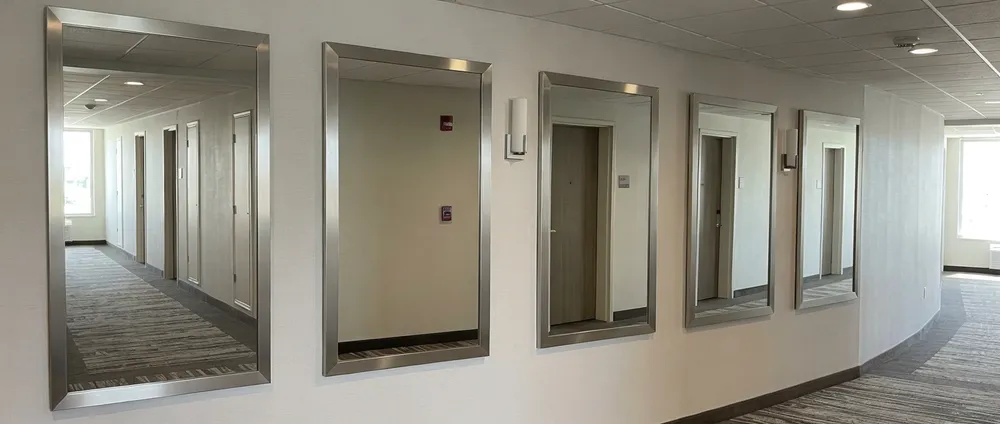
Round, rectangle, large-format, compact, and floor-standing — five product lines covering the full retail and project spectrum, with custom sizing available on any model.
When you source decor mirrors by shape and size, you're making decisions that ripple through your entire product program — packaging costs, container utilization, retail price points, and which end-market segments you can reach. A 90 cm round mirror and a 90 cm rectangle mirror share the same glass diameter on paper, but they require different frame tooling, different carton dimensions, and different packing configurations in a 40-foot container. We manufacture across the full shape and size range, so you can consolidate your mirror sourcing under one factory instead of splitting orders between a round-mirror supplier and a separate large-format vendor.
Livewellcraft has been producing decorative mirrors since 2008. Our facility in Dong Nai, Vietnam runs the complete production chain — glass cutting, beveling, copper-free silvering, frame molding in MDF, solid wood, metal, and resin, plus final assembly and retail-ready packaging. We ship roughly 400,000 pieces a year to distributors, retailers, and hospitality project buyers across North America, Europe, Australia, Southeast Asia, and the Middle East. This page breaks down our shape and size product lines so you can see exactly which configurations fit your catalog and how we handle the manufacturing specifics that affect your landed cost and margin.
We organize our decor mirror production into five shape-and-size categories. Each one targets different retail segments and project applications, and each has its own set of manufacturing considerations that affect your pricing and lead time.
Round mirrors are our highest-volume shape category — they move consistently across home decor retail, hospitality, and e-commerce channels. We produce diameters from 30 cm to 120 cm with frame options in metal, MDF, and resin.
Manufacturing note: The circular glass cutting generates more offcut waste than rectangles (roughly 21% more raw glass per unit at the same nominal size), which is a cost factor we account for in quoting so there are no surprises on your side.
Rectangles are the workhorse of any mirror product line — they fit standard wall spaces, stack efficiently in cartons, and load cleanly into containers. We produce from 30 × 40 cm accent sizes up to 60 × 180 cm full-length formats.
Freight advantage: Rectangle mirrors give you the best container utilization of any shape, so your per-unit freight cost stays low on volume orders.
Large-format mirrors — anything above 80 cm in the primary dimension — are where your retail margin expands. The perceived value jump from a 60 cm mirror to a 100 cm mirror is disproportionate to the material cost increase, which means better markup for your channel. We produce large decor mirrors up to 180 cm with reinforced backing and hanging systems rated for the weight.
Packaging note: Large mirrors are where packaging engineering matters most — a cracked mirror in transit is a total loss, not a partial claim, so we use corner-lock carton inserts and foam edge protection on every unit above 80 cm.
Small and accent mirrors — under 50 cm — are high-velocity SKUs for e-commerce and gift retail. The unit cost is low, the packaging is compact, and you can fit 800–1,200 units in a single 40-foot container depending on frame type. We produce small mirrors in round, rectangle, arch, and irregular shapes with lightweight frames in MDF or thin-gauge metal.
Floor-standing mirrors are a distinct product category with their own structural requirements — they need stable bases or leaning-frame engineering, anti-tip hardware, and packaging that survives upright handling. We produce floor mirrors from 150 cm to 180 cm in full-length formats with metal, wood, and MDF frames. Floor mirrors wholesale well into furniture retail and hospitality procurement channels where the per-unit value justifies dedicated shipping attention.
Custom sizing is available on any model across all five product lines. Share your specifications and we'll quote accordingly.
Discuss Custom SizesChoosing which shapes and sizes to carry isn't just about aesthetics — it's about building a product mix that covers enough price points and use cases to capture a broad slice of your market without overextending your inventory.
Here's how we see buyers typically structure their mirror programs:
| Strategy | Shape/Size Mix | Target Channel | Why It Works |
|---|---|---|---|
| Broad retail | 2-3 round sizes + 2-3 rectangle sizes + 1 floor mirror | Home decor retail, department stores | Covers wall and floor categories, multiple price tiers |
| E-commerce focused | Small rounds + small rectangles + 1 large statement piece | Amazon, Wayfair, direct-to-consumer | Small units ship affordably via parcel; the large piece anchors the brand |
| Hospitality/project | Large rectangles + floor mirrors in 2-3 finishes | Hotels, restaurants, commercial interiors | Standardized sizes simplify spec sheets; bulk orders reduce per-unit cost |
| Distributor starter | 1 round + 1 rectangle + 1 floor in 3 sizes each | Regional wholesale distribution | 9 SKUs cover the core demand without heavy inventory commitment |
We can help you spec the exact size and frame combinations based on your target retail price points. Most new buyers start with 5–10 SKUs and expand after the first reorder cycle once they see which shapes and sizes move in their market.
Tell Us Your Target Market and Price RangeThese are the general parameter ranges across our shape and size product lines. Individual product pages carry the exact specs for each configuration.
| Parameter | Range |
|---|---|
| Glass thickness | 3 mm – 5 mm (4 mm is our standard for wall-mount; 5 mm for floor-standing and large-format) |
| Glass type | Float glass, copper-free silvered |
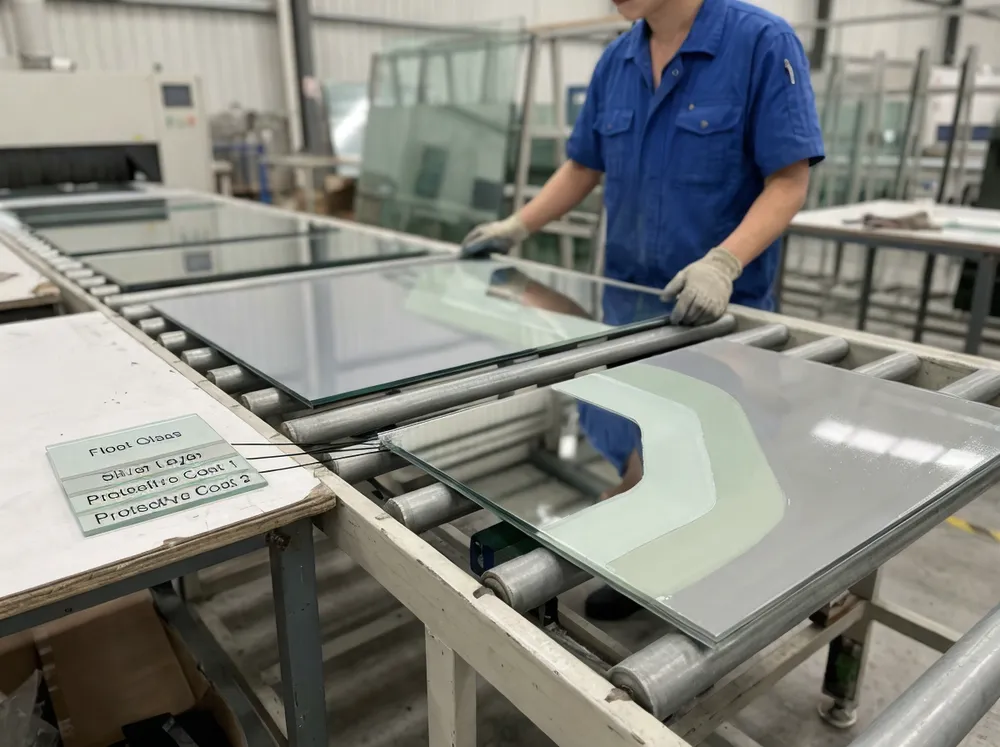
| Mirror coating | Silver + two layers of protective paint, copper-free process |
| Frame materials | MDF, solid wood, metal (iron/stainless steel), resin |
| Frame finishes | Natural wood, painted (any RAL/Pantone color), powder-coated metal, gold/silver leaf, antique patina |
| Size range | 20 cm – 180 cm in primary dimension |
| Shape options | Round, rectangle, square, oval, arch, irregular/custom |
| Hanging hardware | D-ring, sawtooth, French cleat, wire (varies by weight class) |
| Backing | MDF backing board with dust cover, or cardboard backing for lightweight units |
| Weight range | 0.5 kg (small accent) – 25 kg (large floor mirror with solid wood frame) |
We run copper-free silvering as our default process. The silver layer goes down on clean float glass, followed by two protective paint coats that resist moisture and oxidation. We switched to copper-free across all lines in 2017 because it meets EU environmental directives and performs better in humidity — bathroom and coastal hospitality mirrors hold up without edge blackening.
If you're selling into the EU market, this saves you from having to request a special coating spec — it's already standard on every unit we ship.
Shape and size customization is where a factory-direct relationship pays off. You're not picking from a fixed catalog — you're specifying the exact dimensions, frame profile, and finish that your market needs.
Any size within our 20 cm – 180 cm range, in 1 cm increments. Our automated glass cutting tables handle custom sizes without manual intervention, so a non-standard dimension doesn't add cost — it just needs to be specified at order confirmation.
Our 12-person engineering team develops new frame mold profiles in-house. The tooling cost is a one-time charge, and we retain your mold for reorders.
Any RAL or Pantone color on MDF and wood frames. Metal frames can be powder-coated, electroplated, or brushed.
Your logo, UPC codes, and retail-ready carton design. We've built packaging programs for Walmart, Wayfair, and Amazon vendor requirements.
If your channel has specific insert, labeling, or carton-strength specs, we've likely handled them before.
The 200-piece minimum on custom sizes covers the glass cutting setup and any frame tooling amortization — below that quantity, the per-unit setup cost doesn't make commercial sense for either side.
Technical proposal with pricing within 48 hours
Your buyers don't search for "decorative mirror" — they search for a specific shape or size that fits a specific space. Understanding which shapes sell into which segments helps you build a product line that targets real demand.
Round mirrors in the 60–90 cm range are the current volume leader in online home decor across North America and Europe. Arch-shaped mirrors have gained share over the past three years. Small accent mirrors (under 40 cm) sell as impulse and gift items with high turnover.
Your product photography and listing strategy matter as much as the mirror itself in this channel — we can configure packaging with the unboxing experience in mind if you're selling direct-to-consumer.
Hotels, restaurants, and retail spaces specify large rectangles and floor mirrors in standardized sizes. The buying pattern here is project-based — 50–500 units of the same SKU, delivered to a job site on a fixed schedule.
Frame finish consistency across a large batch is critical because these mirrors hang side by side in corridors and guest rooms. Our QC process includes color-matching checks across the full production run, not just spot samples.
Floor mirrors and large statement pieces anchor the mirror category in furniture stores. These are high-ticket items with strong margins.
The frame design carries the perceived value in this segment.
Distributors need breadth — multiple shapes, multiple sizes, multiple price tiers from a single source.
Consolidating your mirror sourcing with one factory means coordinating one supplier instead of three across two countries.
Mirror shape directly affects how many units fit in your container, which affects your landed cost per piece. This is worth understanding before you finalize your order mix.
| Shape | Typical Carton Config | Units per 40' Container (approx.) |
|---|---|---|
| Small round (30–50 cm) | 4–6 units per carton, stacked flat | 1,000–1,200 |
| Medium round (60–90 cm) | 1–2 units per carton, edge-standing | 400–600 |
| Rectangle (40 × 60 cm to 60 × 90 cm) | 2–4 units per carton, flat-stacked | 600–900 |
| Large rectangle/round (90 cm+) | 1 unit per carton, edge-standing with corner locks | 200–350 |
| Floor mirror (150–180 cm) | 1 unit per carton, upright with foam cradle | 120–180 |
Round mirrors waste more carton volume than rectangles because the circular shape leaves dead space in a rectangular box. We mitigate this with fitted foam inserts that double as protection and space-fillers, but the geometry is what it is — your per-unit freight on rounds will run 10–15% higher than on equivalently sized rectangles. Worth factoring into your retail pricing.
We load every container ourselves at our facility — no third-party warehouse handling. Our loading team has a standard sequence for mixed-shape orders that puts heavy floor mirrors on the bottom tier and lighter wall mirrors on top, which reduces in-transit shifting and breakage.
We use 5 mm float glass as standard for any mirror above 80 cm in the primary dimension. At 100 cm and above, 4 mm glass becomes a breakage risk during shipping — the flex tolerance is too narrow for the vibration a container sees on ocean freight. The 5 mm spec adds roughly 20% to the glass weight but cuts your transit damage rate significantly. For floor mirrors above 150 cm, we also add a full MDF backing board that acts as a structural brace, not just a dust cover.
From what we see across our buyer base, round mirrors in the 60–80 cm range currently outsell equivalently sized rectangles by roughly 30% in online home decor channels in North America and Europe. That said, rectangles remain the staple for furniture retail and hospitality projects where standardized wall spacing drives the spec. The smart move for most distributors is carrying both — rounds for trend-driven retail, rectangles for project and furniture channels.
Three layers of protection:
Our breakage rate on ocean freight shipments runs under 0.5% across all sizes. When breakage does occur, it's almost always a handling issue at the destination port, not a packing failure.
Yes, and most buyers do. A typical first order might combine 300 round mirrors in two sizes, 200 rectangles, and 50 floor mirrors in one 40-foot container. We plan the loading layout before production starts so the carton dimensions and pallet configurations are optimized for the specific mix.
Mixed orders don't carry a surcharge — the MOQ applies per SKU (100 pieces for standard models, 200 for custom dimensions), not per container.
30–35 days from order confirmation for standard models on existing molds. Custom dimensions or new frame profiles add 7–15 days for tooling, depending on complexity.
We confirm the exact production schedule before you place the order, and we send progress photos at the glass cutting, frame assembly, and final packing stages so you can track without guessing.
We hold ISO 9001:2015, CE, and SGS certifications. For mirrors sold in markets with specific safety requirements — such as ASTM C1503 for silvered flat glass mirrors in the US — we test to the relevant standard and include test reports with your shipment documentation.
BSCI certification covers our social compliance for European retail buyers who require it.
You know your market better than we do. Tell us which shapes and sizes you need, your target quantities, and your retail price positioning — we'll come back with a detailed quote, container loading plan, and production timeline.
If you're building a new mirror program and aren't sure where to start, send us your target market and we'll recommend a shape-and-size mix based on what's moving for our current distributors in that region.