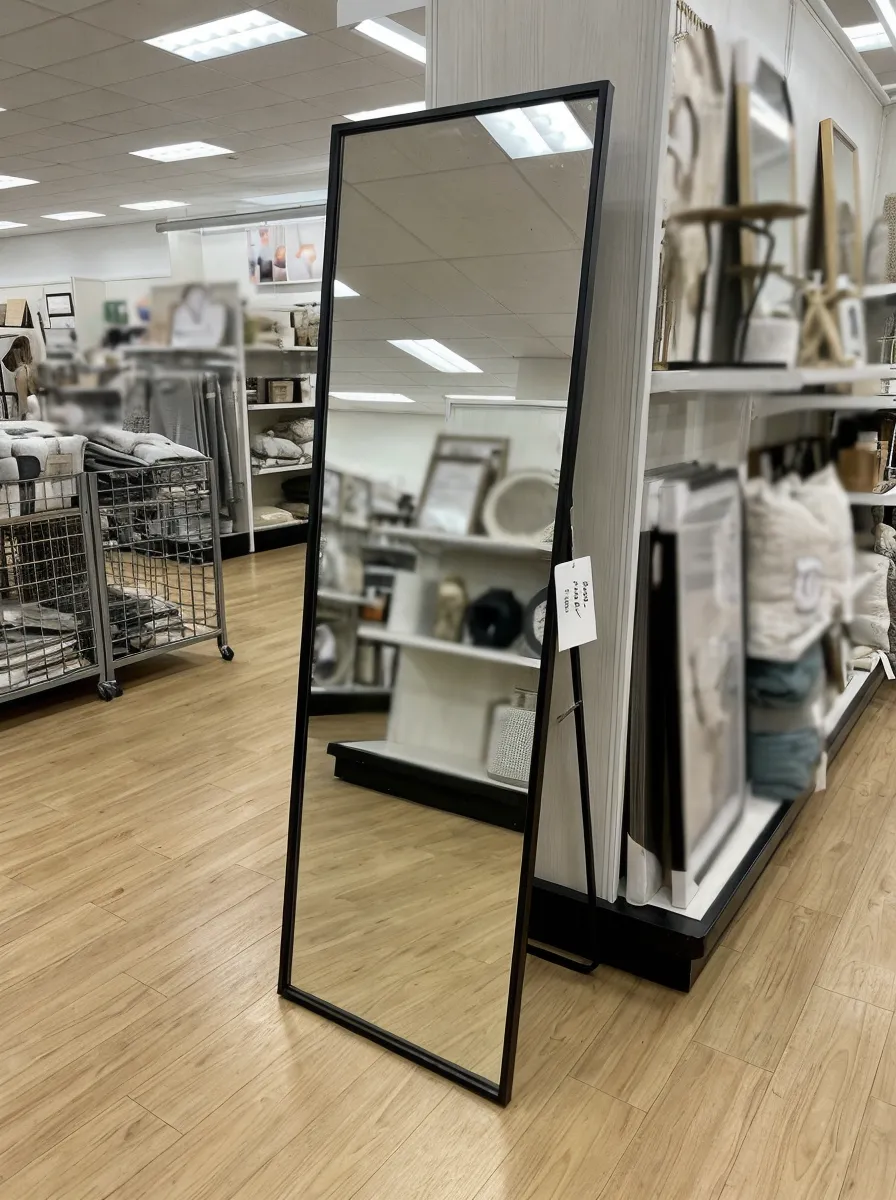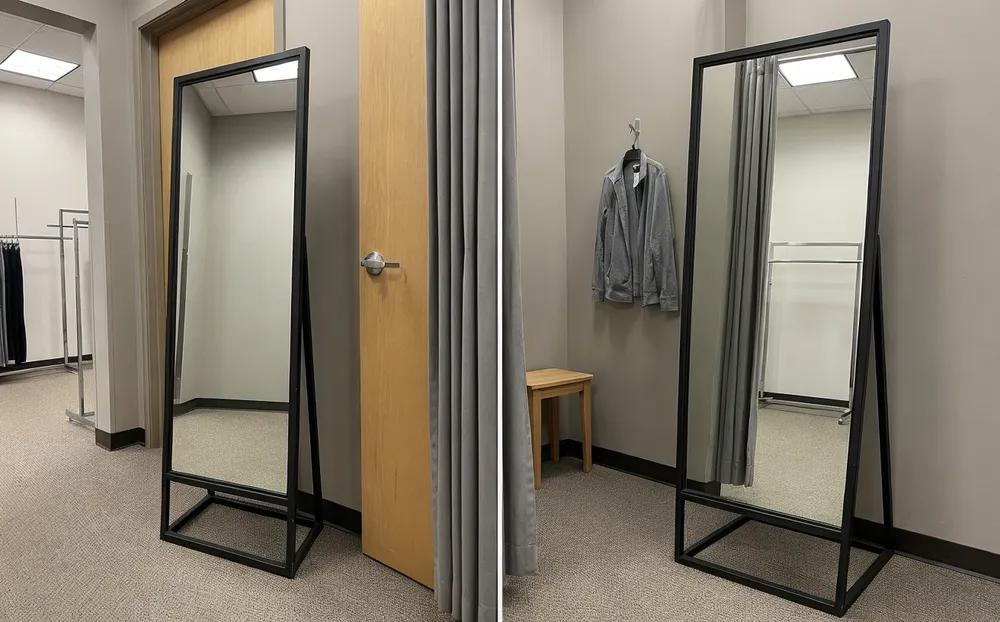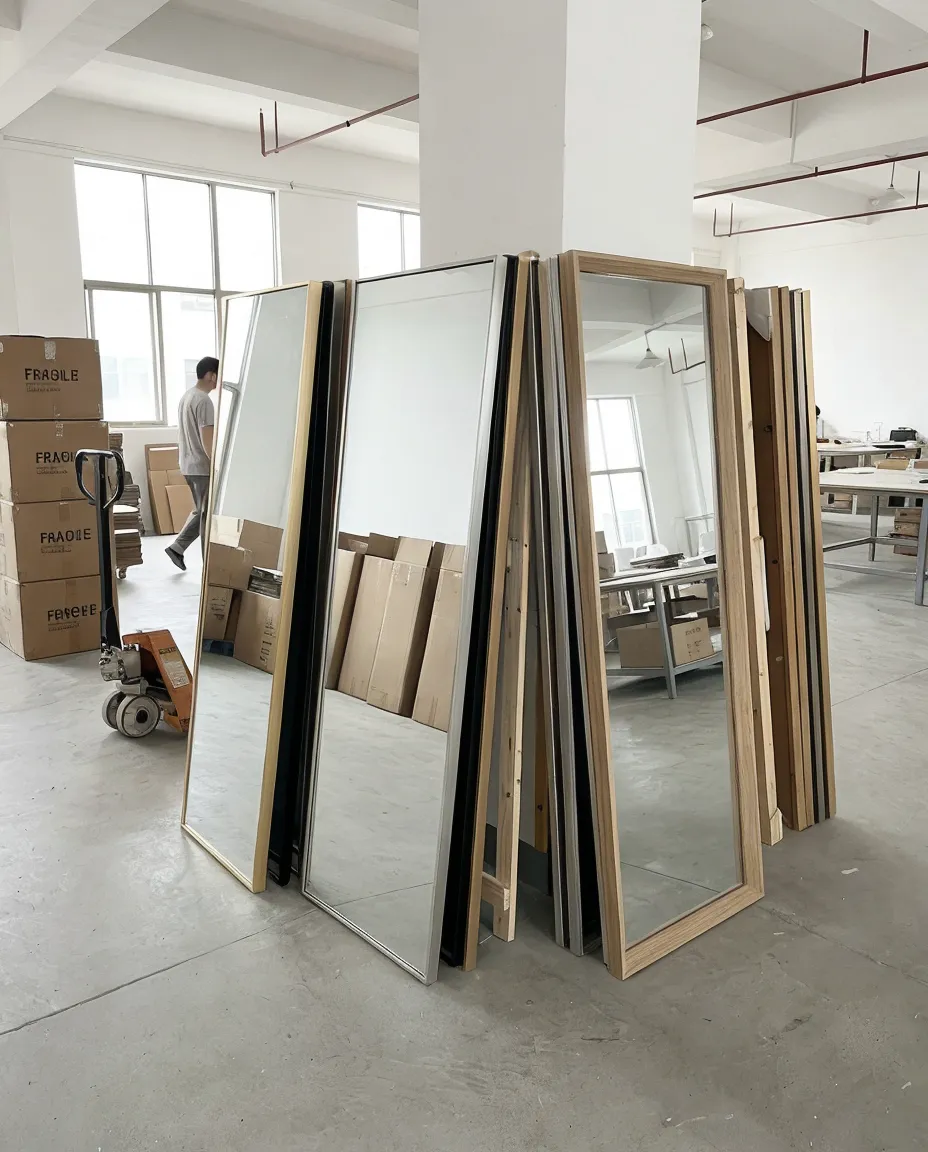
Full-length floor mirrors in metal, solid wood, and MDF frames with engineered anti-tip systems, built for furniture retail, hospitality procurement, and e-commerce channels.
Floor decor mirrors aren't oversized wall mirrors with a stand bolted on. They're a structurally distinct product — the glass is thicker, the frame carries load differently, the hardware has to prevent tipping, and the packaging must survive upright handling through an international freight chain. If you're adding floor mirrors to your product line or sourcing them for a hospitality project, the manufacturing details that matter are different from anything in the wall-mount range.
We produce floor decor mirrors from 150 cm to 180 cm in full-length formats. Metal, solid wood, and MDF frames, all with integrated stability systems — either leaning-frame geometry engineered for a controlled lean angle between 5° and 8°, or freestanding easel-back and base-plate designs for retail display environments. Every unit ships with anti-tip wall anchors included — not as an afterthought, but because floor mirrors that arrive without safety hardware create liability exposure for you and your downstream customers.
The parent category page covers our full shape and size range and category-wide specs. This page goes deeper into what makes floor decor mirrors a structurally and commercially distinct product line — the engineering that keeps them upright, the specs that affect your margin, and the market segments where they consistently move volume.
These are the exact parameters for our floor mirror line — not category ranges, but the values you'd put into a procurement comparison sheet.
| Parameter | Specification |
|---|---|
| Mirror height | 150 cm, 160 cm, 170 cm, 180 cm (standard); custom heights available |
| Mirror width | 40 cm – 60 cm (standard full-length proportions) |
| Glass thickness | 5 mm float glass (standard for all floor models) |
| Glass type | Copper-free silvered float glass |
| Mirror coating | Silver layer + two protective paint coats, copper-free process |
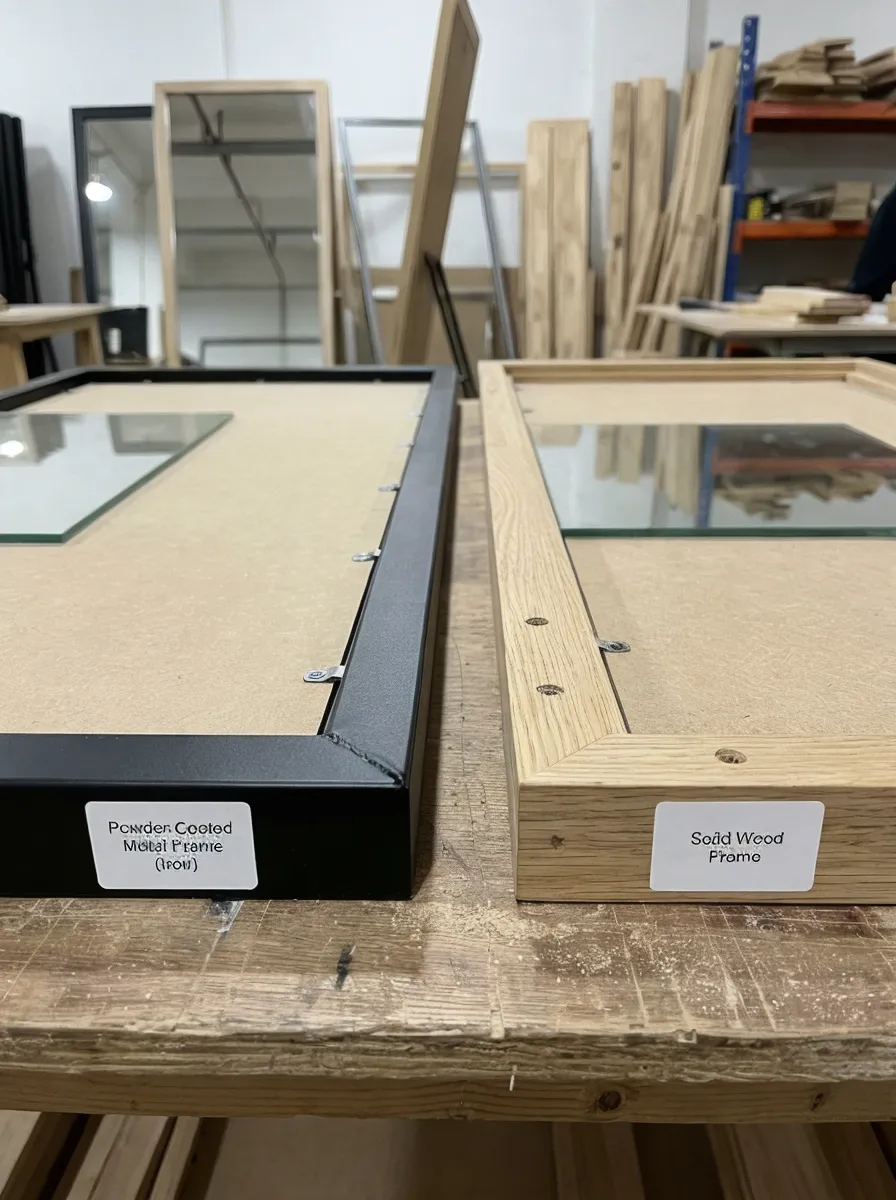
| Frame materials | Metal (iron), solid wood, MDF |
| Frame finishes | Powder-coated metal (any RAL/Pantone), natural or stained wood, painted MDF, gold/silver leaf |
| Frame profile width | 3 cm – 10 cm depending on material and design |
| Stability system | Leaning-frame (5°–8° engineered lean), easel-back, or weighted base plate |
| Anti-tip hardware | Wall-anchor strap kit included on every unit |
| Backing | 3 mm MDF backing board with dust cover |
| Unit weight | 12 kg (thin metal frame, 150 cm) – 25 kg (solid wood frame, 180 cm) |
| Hanging option | Optional wall-mount D-ring + French cleat for dual floor/wall use |
We use 5 mm glass on every floor mirror — no exceptions. Wall-mount mirrors can get away with 3 mm or 4 mm because the frame and wall carry the structural load. A floor mirror leans or stands on its own weight, and 4 mm glass at 170 cm flexes enough under temperature changes to stress the silvering at the edges.
The 5 mm standard adds roughly 1.2 kg per unit on a 50 × 170 cm panel, but it eliminates the flex-related coating failures that generate returns. We tested 4 mm floor mirrors early on — the return rate on units shipped to humid climates was three times higher than 5 mm. We stopped offering it.
The copper-free silvering process is the same one we run across all our mirror lines — silver deposition followed by two protective paint layers, applied in a temperature- and humidity-controlled environment.
For floor mirrors specifically, the edge seal matters more than on wall mirrors because floor units get moved, bumped, and repositioned by end users. We apply an additional edge sealant pass on floor models to prevent moisture ingress at the glass perimeter. Your buyers in coastal or high-humidity markets will see the difference in longevity.
Send us your size and frame requirements — we'll return a spec sheet and quote within 48 hours.
Floor mirrors have a problem that wall mirrors don't: they fall over. A tipped mirror is a broken mirror, a potential injury, and a guaranteed return or claim against your business. We engineer stability into the product at three levels, and the approach depends on which format you choose.
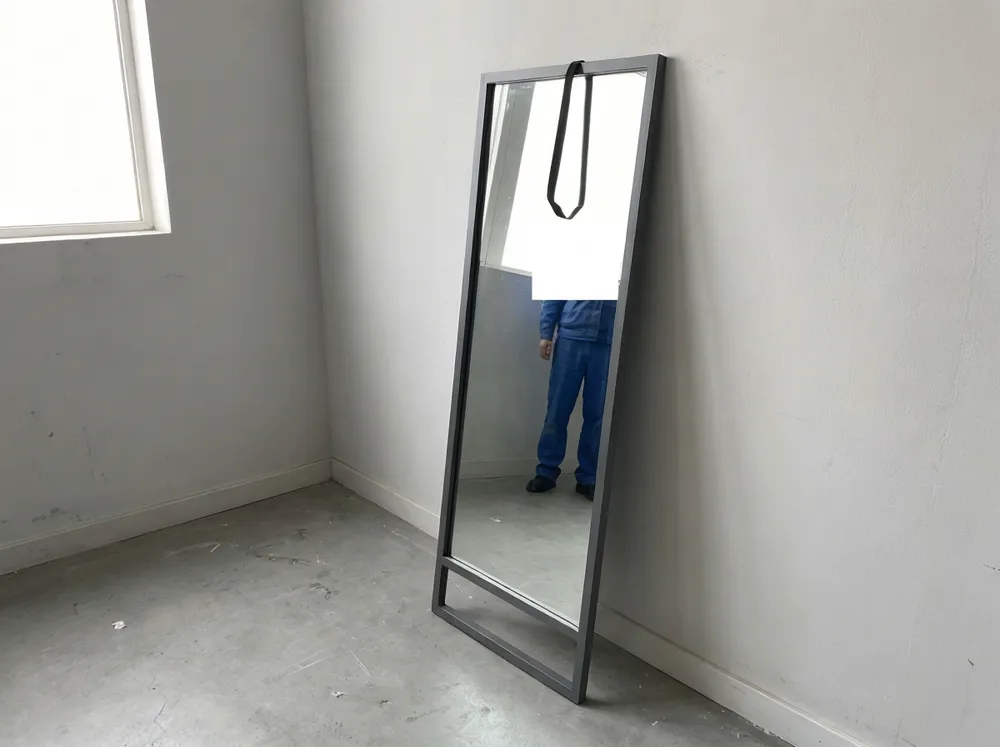
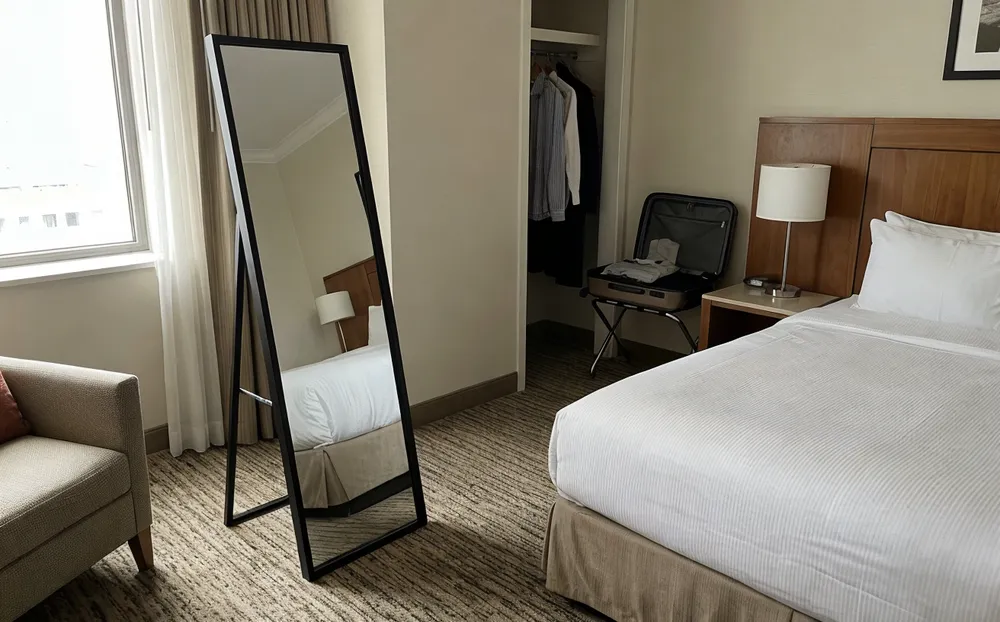
The highest-volume format we produce. Frame geometry is calculated for a lean angle between 5° and 8° against a wall — steep enough to show a full-length reflection from 1.5 meters away, shallow enough that the center of gravity stays well inside the base footprint.
Weight Distribution Engineering
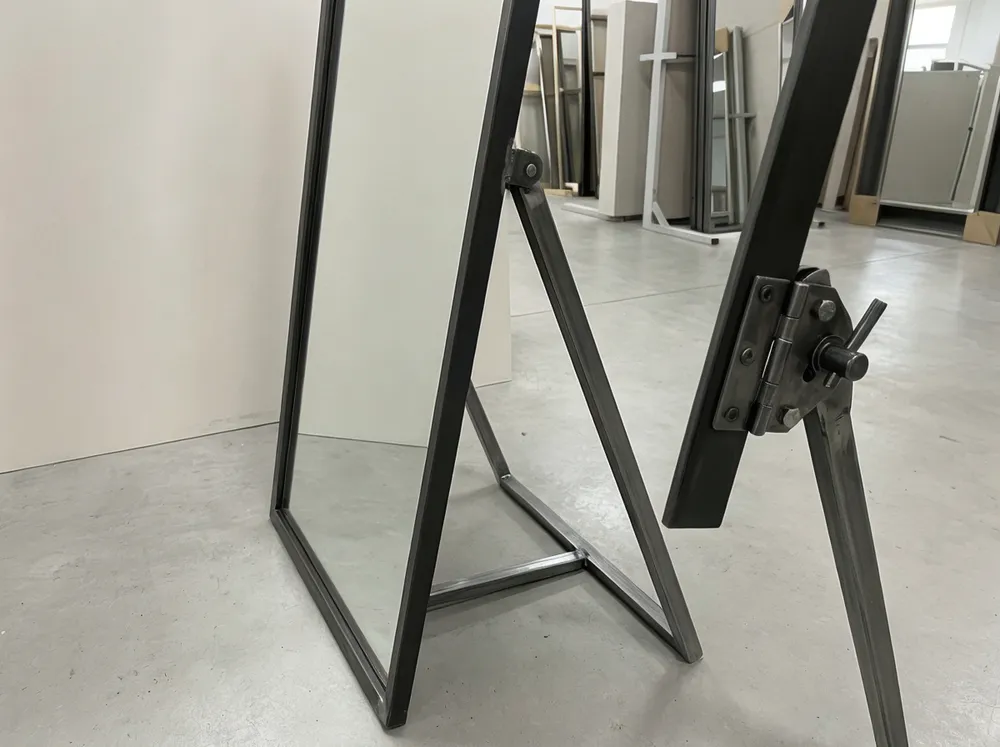
Uses a hinged rear strut, similar to a picture frame stand but scaled for full-length dimensions. The strut is steel on all models regardless of frame material — we tried wood struts early on and the hinge point wore out within a year of regular repositioning.
Steel Strut Advantages
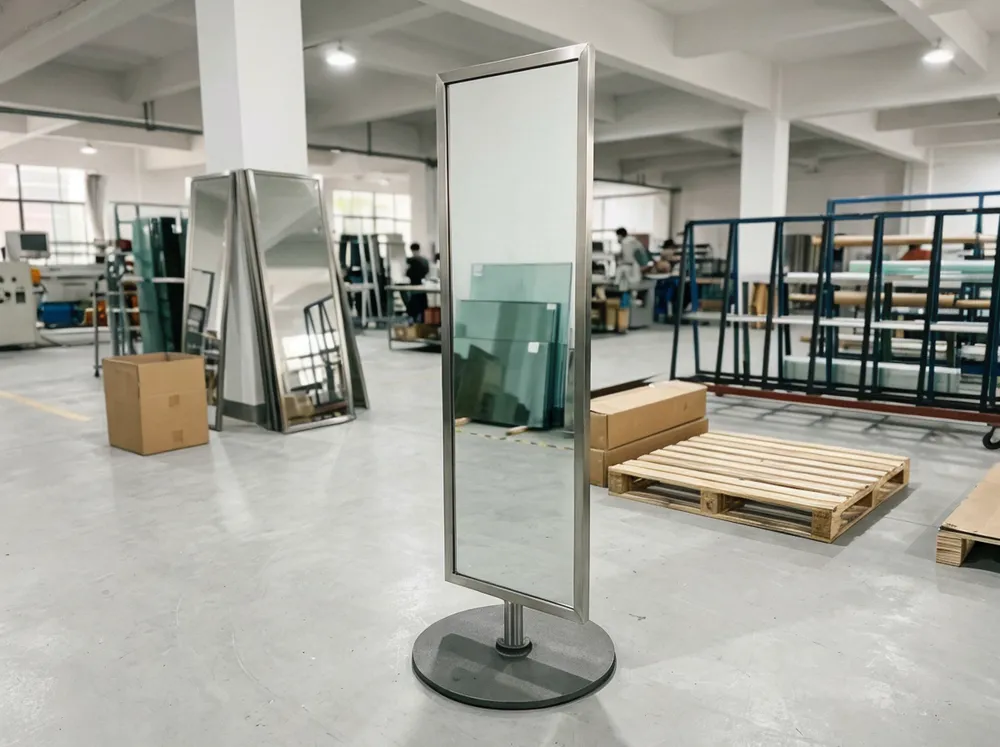
Sits on a weighted metal or wood base, typically used for retail display environments and fitting rooms. The base adds 3–5 kg of stability weight and keeps the mirror upright even on uneven flooring.
Base Options
All three formats include anti-tip hardware. This isn't optional and we don't charge extra for it. In the US, ASTM F2057 covers tip-over restraints for freestanding furniture, and while mirrors aren't explicitly named in that standard, the liability logic is identical. Including the hardware in every carton means you don't have to manage a separate accessory SKU or worry about compliance gaps in your product listing.
Floor decor mirrors sell into specific channels where the per-unit value and reorder pattern make them worth the dedicated logistics attention. Here's where we see consistent volume from our current distributor and project buyer base.
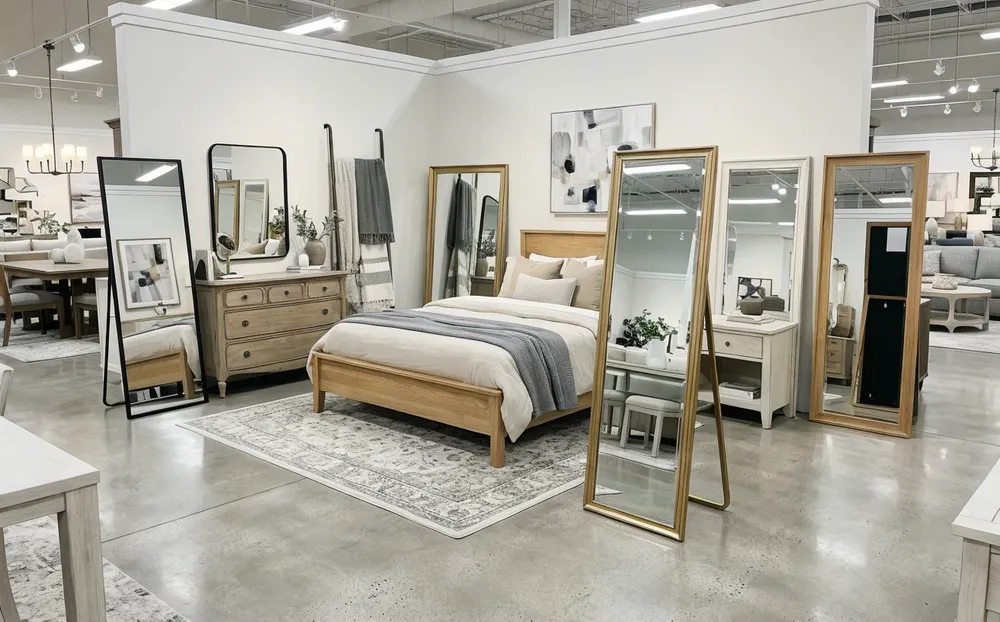
Full-length floor mirrors are anchor SKUs in the bedroom and dressing-room category at furniture retailers. They carry retail price points between $80 and $350 depending on frame material and finish, which puts them in the high-margin tier of any mirror program.
We produce floor mirrors in coordinated frame finishes — matte black, brushed gold, natural oak, antique white — so you can offer them as part of a bedroom collection rather than standalone pieces. Retailers who carry 3–4 floor mirror SKUs in different finishes report that the category sells through steadily year-round without the seasonal spikes and troughs that affect smaller decor items.
Hotels, serviced apartments, and commercial fitting rooms buy floor mirrors in project quantities — typically 50–500 units per property, with standardized specs across all rooms. The easel-back and base-plate formats are preferred here because they don't require wall mounting (which means no drilling into finished walls and no patching costs during room refreshes).
Color Consistency Across Large Runs
We've supplied floor mirrors for hotel projects where the spec called for a single frame finish across 200 rooms — our powder coating line holds color consistency across the full run, so room 1 and room 200 match. Hospitality buyers are particular about this. A visible color shift between floors of the same hotel generates complaints that cost more to resolve than the mirrors themselves.
Floor mirrors are one of the top-performing categories on Amazon, Wayfair, and independent home decor e-commerce stores. The challenge is shipping — a 170 cm mirror in a carton is fragile, heavy, and expensive to deliver via parcel carrier.
E-Commerce Packaging Engineering
Clothing retailers, bridal shops, and fitness studios use floor mirrors as functional equipment, not decor. They need mirrors that stand up to daily repositioning, resist fingerprints on the frame, and look presentable after years of use.
Powder-Coated Metal Frames
Our powder-coated metal frames handle this environment better than painted MDF — the coating is scratch-resistant and wipes clean without showing wear marks.
We'll recommend frame materials, finishes, and a starter SKU mix tailored to your channel requirements and buyer expectations.
Get Segment-Specific RecommendationsThe category page covers our general customization capabilities. Here's what applies specifically to floor mirrors and where the constraints differ from wall-mount models.
Height from 140 cm to 200 cm, width from 35 cm to 70 cm, in 1 cm increments. Below 140 cm, a floor mirror loses its full-length function and you're better served by our large decor mirrors with wall-mount hardware. Above 200 cm, the glass weight and shipping fragility create diminishing returns — we can produce them, but the damage rate in transit rises and we'll flag that in your quote so you can make an informed decision.
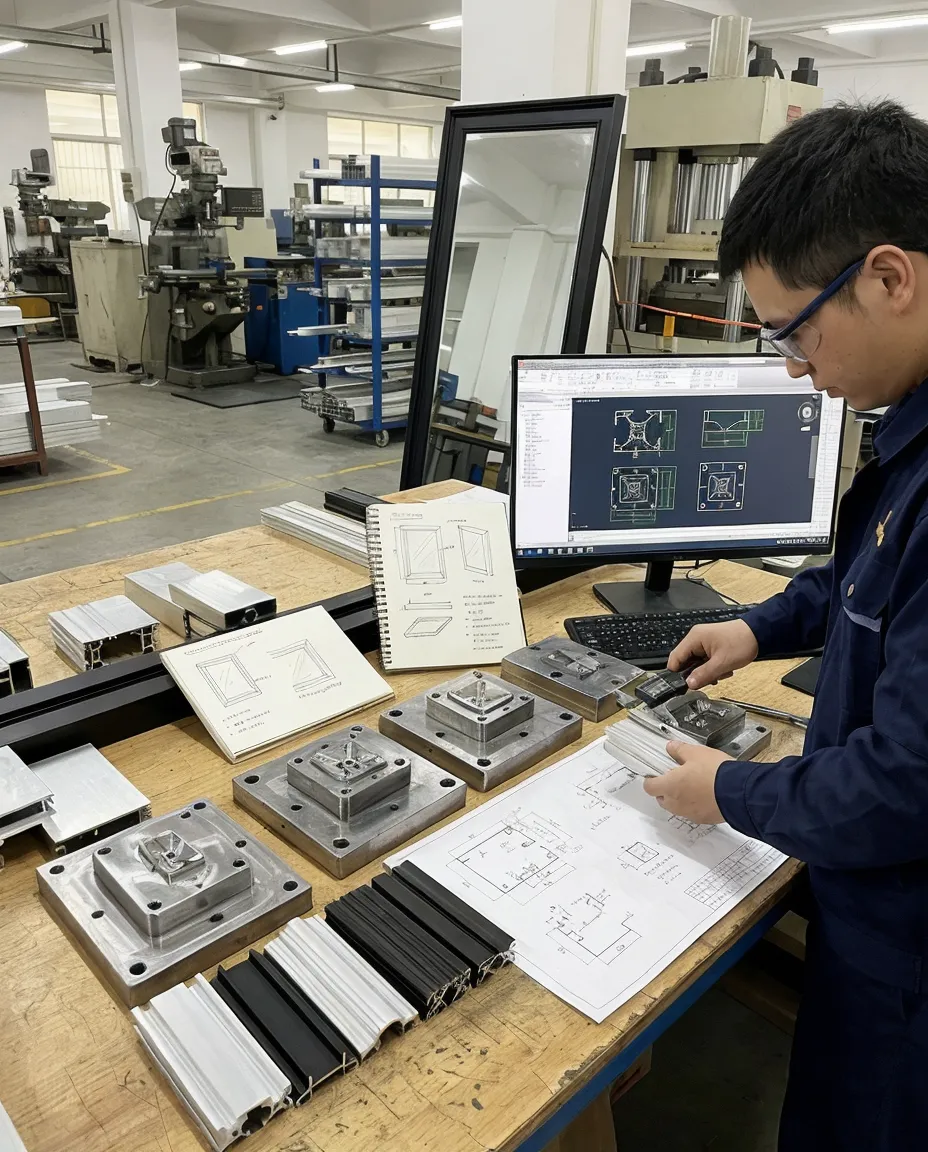
Our engineering team develops new frame molds in-house. Metal frame profiles take 10–15 days for tooling; wood and MDF profiles take 7–10 days. The tooling cost is a one-time charge, and we store your mold for reorders at no additional fee. For floor mirrors, frame profile design has a structural dimension that wall mirrors don't — the bottom rail needs to accommodate the stability system (ballast channel for leaning frames, strut mount for easel-backs, base attachment for freestanding). Our engineers factor this into the profile design from the start so you don't end up with a beautiful frame that tips over.
Any RAL or Pantone color on metal and MDF frames. Wood frames can be stained, lacquered, or painted. Gold and silver leaf is hand-applied for premium lines — expect a 5–7 day addition to lead time for leaf finishing. We produce finish samples before full production on custom colors, so you approve the exact shade before we run your order.
You choose leaning-frame, easel-back, or base-plate — or we can produce a dual-purpose design with both leaning geometry and a detachable easel strut, giving your end customer two display options from one SKU.
Your logo on the carton, custom inserts, UPC/EAN barcodes, and assembly instruction cards in your brand language. For e-commerce sellers, we configure FBA-ready packaging that meets Amazon's prep requirements so your units go straight to the warehouse without repackaging.
MOQ for standard floor mirror models on existing molds is 100 pieces. Custom dimensions or new frame profiles require 200 pieces per SKU — the higher minimum covers glass cutting setup and frame tooling amortization.
Send us a sketch or reference image| Customization | Range / Options | MOQ Impact | Lead Time Impact |
|---|---|---|---|
| Custom height/width | 140–200 cm × 35–70 cm | 200 pcs/SKU | No additional time |
| New frame profile (metal) | Any cross-section | 200 pcs/SKU | +10–15 days (tooling) |
| New frame profile (wood/MDF) | Any cross-section | 200 pcs/SKU | +7–10 days (tooling) |
| Custom RAL/Pantone color | Unlimited options | No change | +2–3 days (sample approval) |
| Gold/silver leaf finish | Hand-applied | 200 pcs/SKU | +5–7 days |
| Custom packaging/branding | Logo, barcodes, inserts | No change | +3–5 days (artwork approval) |
| Dual-purpose stability system | Leaning + easel | No change | No additional time |
Send us a sketch or reference image of your floor mirror concept — our engineering team will return a technical proposal with pricing within 48 hours.
Floor mirrors are the most packaging-sensitive product in our mirror range. A cracked floor mirror is a total loss — you can't repair a 170 cm silvered glass panel — so the packaging has to do its job from our loading dock to your warehouse or your customer's doorstep.
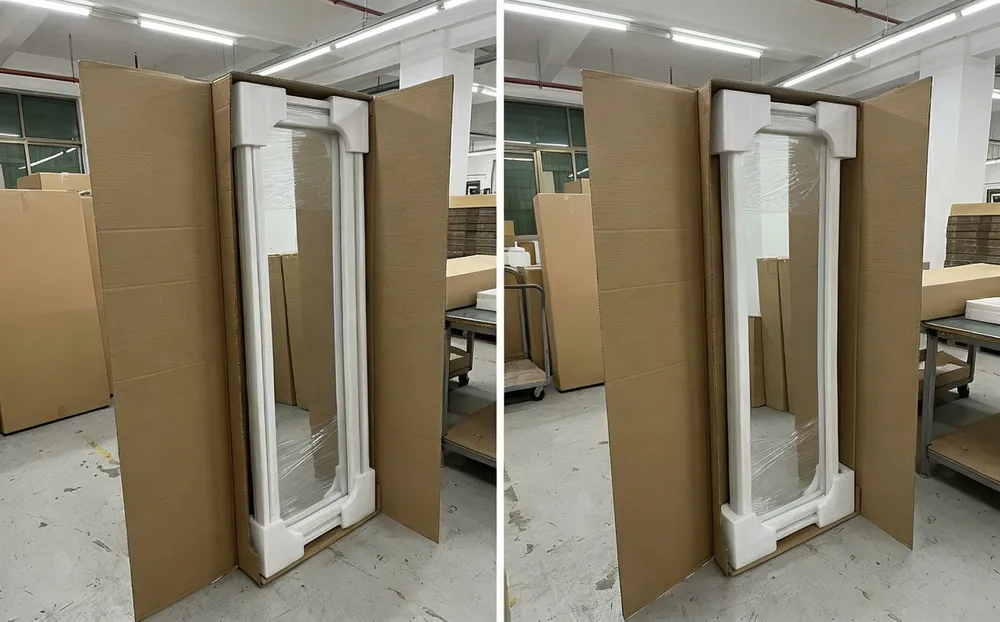
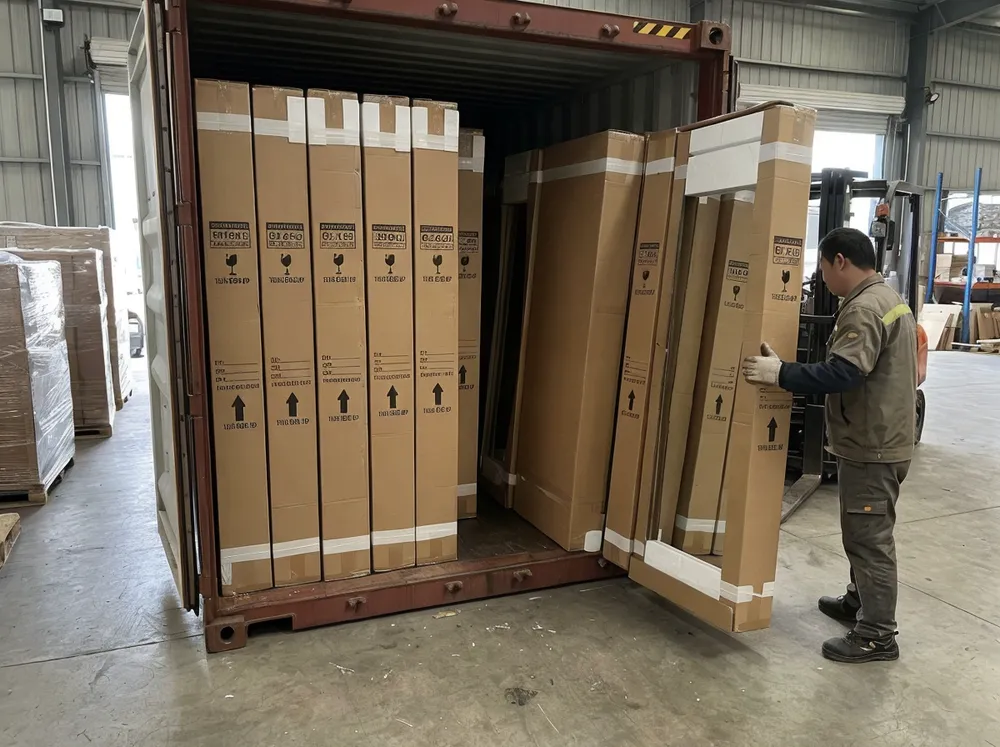
Each floor mirror is packed individually in a double-wall corrugated carton with high-density PE foam corner protectors and a foam-lined channel that suspends the mirror panel away from the carton walls.
For parcel-shipped floor mirrors, we add an inner poly bag, additional foam edge strips, and a reinforced carton with crush-test rating suitable for UPS/FedEx ground handling.
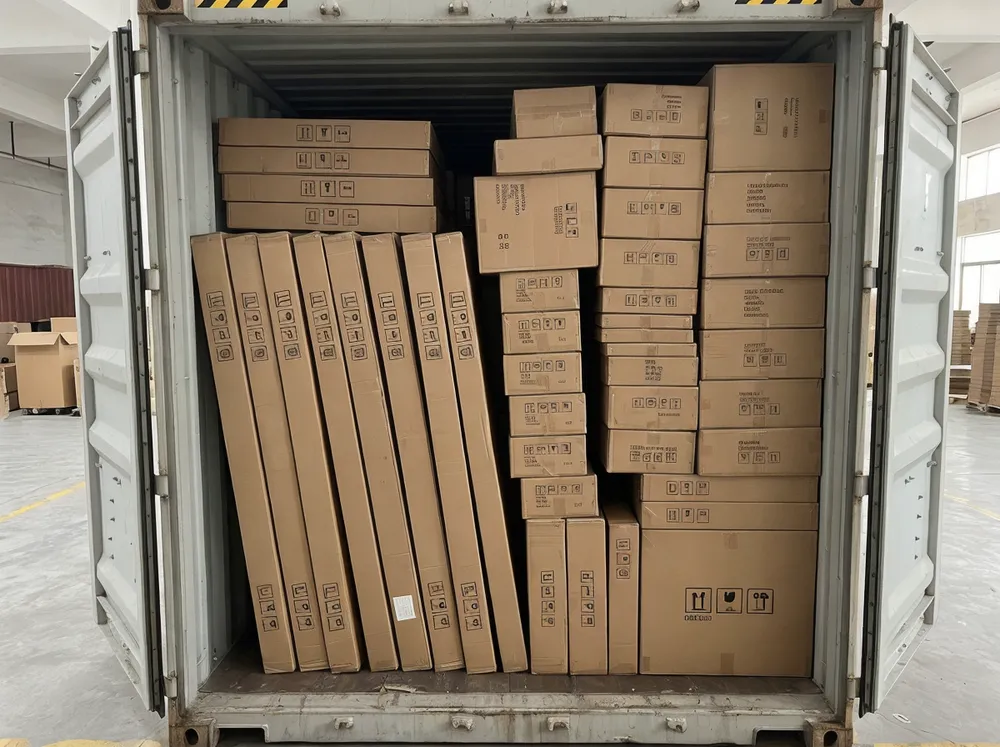
Floor mirrors load upright in a 40-foot container. Depending on frame type and mirror dimensions, you can fit approximately 200–350 units per 40HQ container. We plan the loading layout before production starts — carton dimensions and pallet configurations are set during the quoting stage so you know your per-unit freight cost before you commit.
Floor mirrors don't stack as efficiently as small wall mirrors (where you might fit 800–1,200 units per container), so your per-unit freight allocation is higher. We offset this by optimizing carton dimensions to minimize dead space — a 2 cm reduction in carton width across 300 units can mean an extra row in the container.
| Container Type | 150 cm, Metal Frame | 180 cm, Wood Frame |
|---|---|---|
| 40HQ | 300–350 units | 200–250 units |
| 20GP | 140–170 units | 90–120 units |
These are planning estimates — exact counts depend on your frame profile width and carton configuration. We confirm the loading plan with a diagram before you place the order.
We track damage reports from our repeat buyers and feed that data back into packaging improvements — the foam channel design we use now is the third iteration, developed after analyzing where breakage actually occurs in transit.
We've learned which carrier size thresholds trigger price jumps and we design carton dimensions around them — optimizing your landed cost without compromising protection.
We hold ISO 9001:2015, CE, SGS, and BSCI certifications at the factory level. For floor mirrors specifically, here's how these apply to your market entry:
Our glass and silvering process is tested to ASTM C1503 (Standard Specification for Silvered Flat Glass Mirror). Test reports are included with your shipment documentation.
The anti-tip wall anchor hardware we include meets the intent of ASTM F2057 tip-over restraint requirements — while that standard targets freestanding furniture rather than mirrors specifically, including the hardware pre-empts liability questions from your retail partners and gives your product listing a safety compliance point that many competing floor mirrors lack.
CE marking covers our mirrors for the EU market. BSCI certification satisfies social compliance requirements for European retail chains that audit their supply chain.
The copper-free silvering process meets EU environmental directives on heavy metals — no additional coating specification needed for EU-bound orders.
Our SGS testing covers the material safety and coating durability standards relevant to the Australian market. We provide Certificates of Analysis for glass composition and coating adhesion on request.
Every floor mirror undergoes 100% visual inspection and silver coating adhesion testing before it ships. We don't batch-sample on floor mirrors — the per-unit value is high enough that a single defective unit reaching your customer costs more in returns processing and reputation damage than the inspection time costs us.
Floor mirrors serve a different buyer need than wall-mount formats, but they often sell into the same channels and the same purchase orders. Here's how our floor mirror line relates to the sibling products under our shape and size range:
Many of our distributors carry floor mirrors alongside 2–3 wall-mount formats to cover the full price spectrum in a single container. We can mix floor mirrors with wall-mount models in the same order — MOQ applies per SKU, not per container, so a mixed load of 100 floor mirrors and 300 wall mirrors ships together without surcharges.
Direct answers to the technical and logistical questions that shape your floor mirror sourcing decisions.
The wall-anchor strap kit we include is rated for 30 kg of pull force, which exceeds the weight of our heaviest floor mirror (25 kg for a 180 cm solid wood frame model). The anchor uses a standard drywall toggle bolt.
If your market primarily uses masonry walls, let us know and we'll substitute a masonry anchor kit at no additional cost.
Yes. We produce dual-purpose floor mirrors with leaning-frame geometry plus D-ring and French cleat hardware pre-installed on the back. Your customer gets both options out of the box.
This is our most popular configuration for e-commerce sellers because it doubles the use-case appeal in the product listing without adding meaningful production cost.
We can produce up to 200 cm in height and 70 cm in width. Beyond 200 cm, the glass panel weight and shipping fragility create practical problems — damage rates increase and carrier surcharges escalate.
If your project requires mirrors taller than 200 cm, we recommend a two-panel design with a mid-frame rail, which we've done for hotel lobby installations.
Our powder coating line runs batch-calibrated — we spray test panels at the start of each batch and verify against your approved sample before running production units. For orders over 500 pieces, we pull mid-run samples to check for drift.
On wood stain finishes, we select boards from the same timber lot for each order to minimize natural grain variation. We send photos at the frame finishing stage so you can approve color before assembly.
The raw glass cost difference is roughly 15–20% per panel. But on a floor mirror, the 5 mm glass eliminates flex-related silvering failures that cause returns.
We've seen buyers switch to 4 mm to save on unit cost and then lose the savings (and more) on replacement shipments within the first year. We standardize on 5 mm for floor models and price accordingly — your landed cost per unit that actually stays sold is lower.
You know your channel, your price points, and your volume targets. Send us the details and we'll handle the rest — spec sheet, pricing, container loading plan, and a production timeline with milestone checkpoints.
If you're adding floor mirrors to an existing mirror program with us, we'll coordinate production timing so everything loads into the same container.