Incomplete Specs Are the Most Expensive Line Item on a Mirror PO
Half the dining room mirror purchase orders we receive are missing at least one spec that matters. Glass thickness left blank. Frame material listed as "wood" with no species or substrate call-out. Finish described as "gold." That last one is my favorite — there are at least eight production-distinct gold finishes we run regularly, and they don't price the same, weigh the same, or age the same.
When a spec is vague, someone on the production side has to guess. And guesses turn into containers that don't match your listing photos, your hospitality project's design package, or your retail buyer's expectations. The rework isn't free, and the lead time hit is worse.
This article covers the full dining room decor mirror specification framework — dimensions, glass thickness, frame material, silvering type, finish, and weight — so your next RFQ leaves nothing open to interpretation. If you're building a dining room decor mirror program for retail shelves, hospitality projects, or residential wholesale, these are the numbers you need on paper before you talk pricing.
What a Complete Dining Room Mirror Specification Actually Includes
A dining room mirror spec sheet that works for production needs six parameters locked down. Miss one and you're negotiating change orders mid-production.
- Overall dimensions (height × width, in mm or inches) — not just "large" or "medium"
- Glass thickness — 3 mm, 4 mm, 5 mm, or 6 mm float glass, each with different weight and cost implications
- Mirror coating type — standard silver with copper backing, or copper-free silvering
- Frame material — MDF, solid wood, metal, PS (polystyrene), or resin composite
- Frame finish — paint color (RAL or Pantone reference), foil wrap, veneer, lacquer, or metallic coating, with sheen level specified
- Hanging hardware — D-rings, French cleat, wire, or Z-bar, rated for the finished unit weight
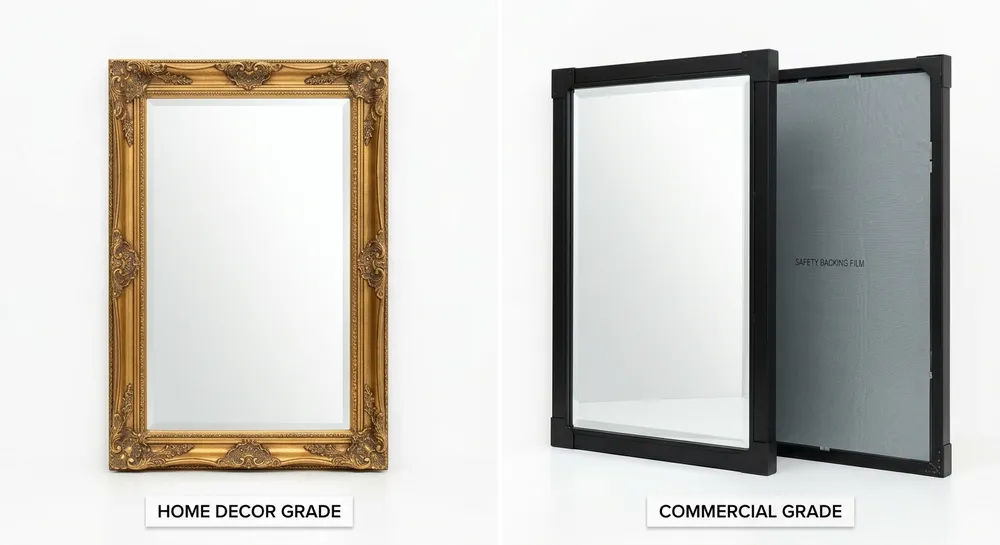
That's the minimum. For hospitality and commercial projects, you'll also want to specify safety backing (vinyl or film) and fire rating compliance if the destination market requires it.
Standard Dining Room Mirror Dimensions by Sales Channel
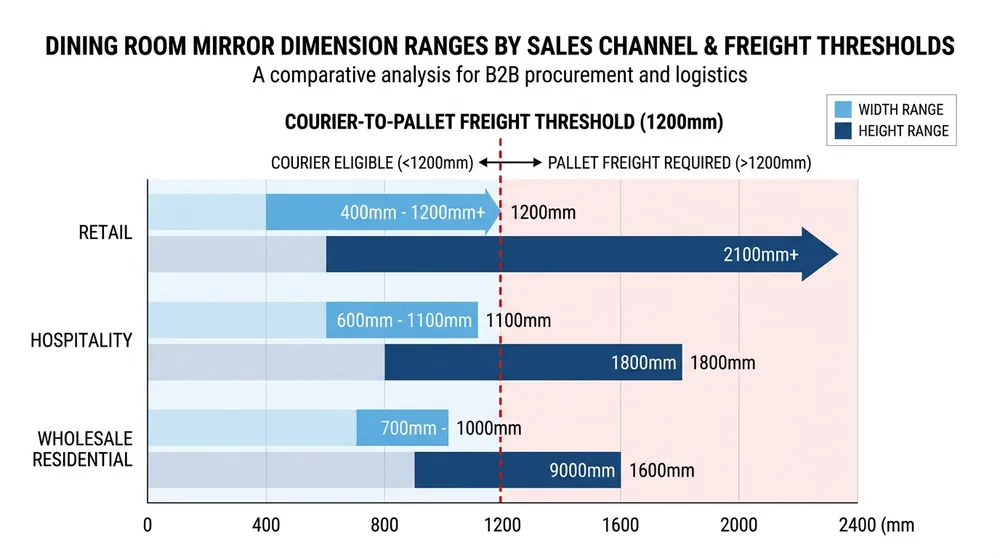
Dining room mirrors don't follow a single size standard. The dimensions that sell depend entirely on where the mirror ends up — and that means your channel dictates your spec range.
| Channel | Typical Height (mm) | Typical Width (mm) | Common Shapes | Notes |
|---|---|---|---|---|
| Retail / e-commerce | 800–1200 | 500–900 | Rectangle, arch, oval | Must fit standard shipping cartons; oversized = surcharge |
| Hospitality / commercial | 1000–1800 | 600–1200 | Rectangle, custom | Often specified by interior designer; exact dims required |
| Residential wholesale | 900–1500 | 600–1000 | Rectangle, round, arch | Mid-range sizing covers the broadest install base |
A few things worth noting. Retail channels push you toward dimensions that fit within courier-shippable carton limits — once a mirror exceeds roughly 1200 mm on the long side, freight costs jump because it moves to LTL or pallet shipping. Hospitality projects go the other direction: designers spec large statement pieces for dining rooms, and they expect exact dimensions, not "approximately 1200 mm."
(We ship a lot of 900 × 600 mm rectangles for the North American retail market. It's the sweet spot — big enough to look substantial over a sideboard, small enough to ship via standard parcel.)

If you're building a multi-SKU dining room mirror line for wholesale, three to four size options usually cover the market without creating inventory drag. We can help you map those sizes to your target price points during the quoting stage.
Glass Thickness: How 1 mm Changes Your Unit Weight, Freight Bill, and Breakage Rate
Glass thickness is the single spec that most directly affects three things you care about: per-unit weight, shipping cost, and breakage risk in transit.
| Glass Thickness | Weight per m² | Typical Use | Breakage Consideration |
|---|---|---|---|
| 3 mm | ~7.5 kg/m² | Small mirrors under 600 mm, budget retail | Higher breakage risk on larger sizes; needs robust packaging |
| 4 mm | ~10 kg/m² | Standard for most dining room mirrors 600–1200 mm | Good balance of weight and durability; our default recommendation |
| 5 mm | ~12.5 kg/m² | Large mirrors 1200 mm+, hospitality projects | Heavier but significantly more rigid; reduces flex-related cracking |
| 6 mm | ~15 kg/m² | Oversized or frameless statement mirrors | Adds real weight; usually only specified when the mirror is unframed or exceeds 1500 mm |
For a standard 900 × 600 mm dining room mirror, the difference between 3 mm and 5 mm glass is roughly 2.7 kg per unit. Multiply that across a 2,000-piece order and you're looking at 5,400 kg of additional container weight — enough to affect your freight rate and potentially your pallet configuration.
Our default for dining room mirrors in the 800–1200 mm range is 4 mm float glass. It handles normal shipping stress without the weight penalty of 5 mm, and the breakage rate in transit stays under 0.5% with our standard 5-layer packaging. If your project requires 5 mm or 6 mm, we adjust the carton engineering and pallet layout accordingly — but it's worth running the landed-cost math before you default to thicker glass just because it feels safer.
(A common over-spec we see: buyers requesting 6 mm glass for 800 mm mirrors. At that size, 4 mm performs identically in transit and on the wall. The extra 2 mm just costs you money.)
Frame Material Specs and Finish Durability Across Price Tiers
The frame is where most of the design differentiation happens — and where spec ambiguity causes the most production disputes. "Wood frame, gold finish" on a PO could mean five completely different products at five different price points.
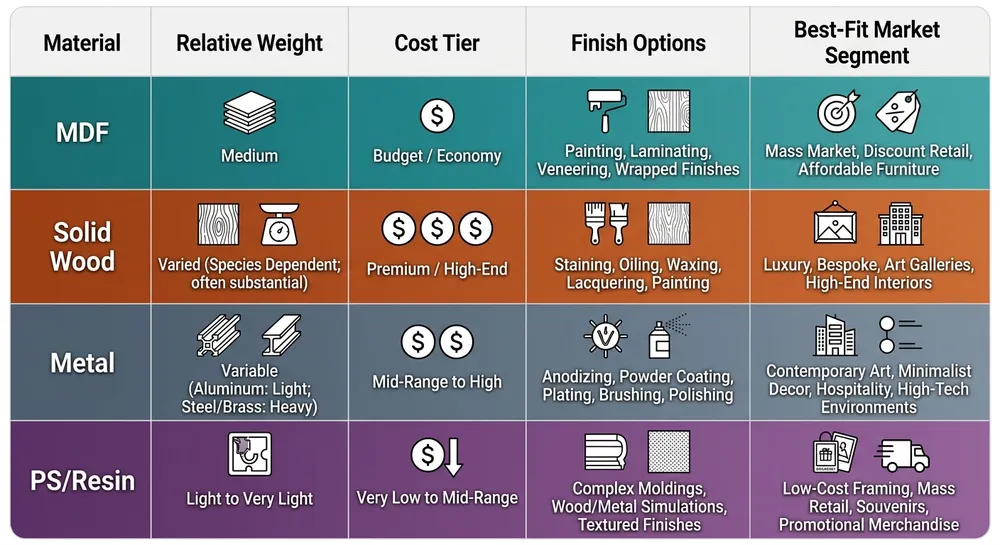
MDF (Medium-Density Fiberboard)
MDF is the workhorse frame substrate for mid-market dining room mirrors. It machines cleanly into detailed profiles, takes paint and foil wrap well, and costs less than solid wood. We use moisture-resistant MDF (green MDF) as standard for any mirror that might end up in a dining room adjacent to a kitchen — standard MDF swells if humidity stays above 70% for extended periods.
Typical finish options on MDF: spray lacquer, PU paint (any RAL/Pantone color), PVC foil wrap, or metallic leaf application. PU paint gives you the most consistent color match across large batches.
Solid Wood
Solid wood frames — paulownia, pine, rubberwood — command a higher price point and give you a margin advantage on retail shelves. The trade-off is weight and lead time. Solid wood frames need proper kiln-drying to 8–12% moisture content before finishing, or you'll see warping and finish cracking within six months of delivery.
We stock kiln-dried paulownia and pine for standard profiles. Custom wood species require longer lead times for material sourcing.
Metal
Steel and aluminum frames target the modern/industrial segment. Steel frames get powder-coated (60–80 μm thickness, passes 500-hour salt spray); aluminum frames can be anodized or powder-coated. Metal frames are heavier than MDF or wood at equivalent dimensions, so factor that into your per-unit weight and hanging hardware spec.
PS (Polystyrene) and Resin Composite
PS frames replicate ornate carved profiles at a fraction of the solid wood cost. They're lightweight, which helps your freight economics, and they take metallic finishes (antique gold, champagne silver, brushed bronze) convincingly. The limitation is impact resistance — PS frames can chip on sharp impacts, so packaging needs corner protection.
(PS frames account for about 40% of our dining room mirror output. The weight savings alone — sometimes 3–4 kg per unit versus solid wood — make a real difference when you're loading a 40-foot container.)
Finish Specification: Be Specific or Pay Twice
"Gold finish" is not a spec. Here's what we need on a PO to produce the right finish on the first run:
- Color reference: RAL number, Pantone code, or a physical sample
- Finish type: spray paint, powder coat, foil wrap, metallic leaf, or distressed/antiqued
- Sheen level: matte, satin, semi-gloss, or high-gloss
- Special effects: distressing, dry-brushing, patina, crackle
For hospitality projects where multiple rooms need to match, we recommend approving a pre-production sample with a signed color standard. Color drift between batches is manageable within ΔE ≤ 1.5 on our spray lines, but "close enough" doesn't work when 200 mirrors hang in the same hotel.
Copper-Free Silvering and Coating Performance in Dining Environments
The silvering layer is what makes a mirror a mirror, and the spec choice here affects long-term performance more than most buyers realize.
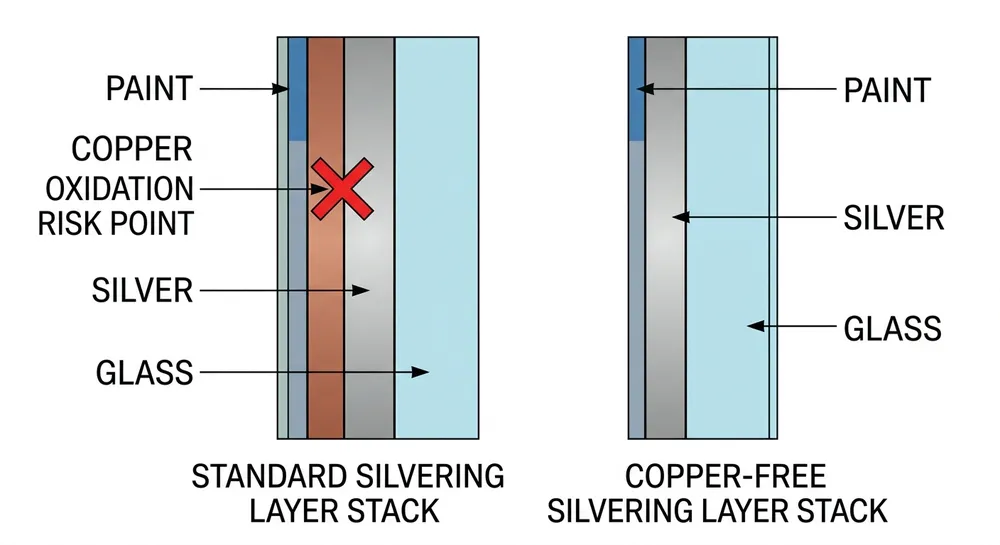
Standard silvering uses a copper layer between the silver coating and the protective paint backing. It works fine in dry environments. But dining rooms — especially in hospitality settings — sit adjacent to kitchens, experience temperature swings during service, and sometimes get cleaned with chemical agents that attack copper over time. The result: black edge spots that start appearing 18–24 months after installation.
We run copper-free silvering as our default process. The silver layer bonds directly to the glass through a proprietary activation step, then gets sealed with two layers of protective paint backing. No copper means no copper oxidation, which means no black-edge defect in humid or semi-humid environments.
The performance difference:
| Silvering Type | Salt Spray Resistance | Edge Blackening Risk | EU Environmental Compliance |
|---|---|---|---|
| Standard (copper-backed) | 48–72 hours | Moderate in humid environments | Requires additional compliance documentation |
| Copper-free | 120+ hours | Minimal | Meets EU REACH and RoHS by default |
For your sourcing decision, copper-free silvering adds a small per-unit cost — roughly 3–5% on the mirror component — but it eliminates the warranty exposure on dining room and hospitality placements. If you're selling into European markets, it also simplifies your compliance paperwork since there's no copper content to declare.
(We switched to copper-free as our standard line in 2019 after too many warranty claims came back from hotel projects in Southeast Asia. The humidity there is relentless, and standard silvering just couldn't hold up past the first year.)
Per-Unit Weight, Carton Engineering, and Container Loading Math
Specs don't exist in isolation — they roll up into weight, packaging, and freight numbers that directly affect your landed cost. Here's how the math works for a typical dining room mirror order.
Example unit: 900 × 600 mm, 4 mm glass, MDF frame, PU paint finish
- Mirror glass weight: ~2.2 kg
- Frame weight (MDF, 50 mm profile): ~1.8 kg
- Hardware and backing: ~0.3 kg
- Finished unit weight: ~4.3 kg
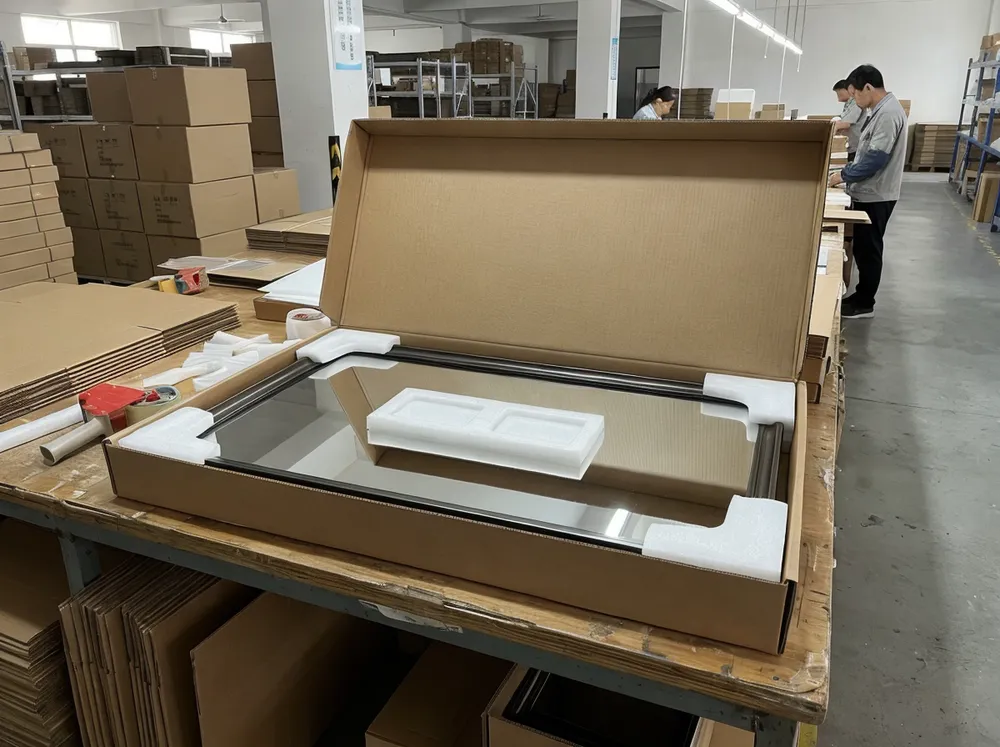
- Packaged weight (5-layer carton with foam corners): ~5.5 kg
- Carton dimensions: approximately 980 × 680 × 80 mm
At those carton dimensions, a standard 40-foot container holds roughly 800–900 units depending on pallet configuration. If you move to a larger mirror — say 1200 × 800 mm with 5 mm glass — the unit count per container drops to around 500–600, and your per-unit freight cost increases proportionally.
This is why glass thickness and frame material aren't just product specs — they're freight variables. A PS frame instead of MDF on that same 900 × 600 mm mirror drops the finished unit weight to roughly 3.1 kg, which means lighter cartons, more units per pallet, and better container utilization.
We provide detailed packing lists with carton dimensions, gross weights, and pallet configurations as part of every quotation. If you're comparing suppliers and one of them can't give you these numbers upfront, that's a red flag — it means they haven't engineered the packaging yet, and you'll likely see breakage or freight surprises.
Spec Errors That Turn Into Container-Level Problems
After ten-plus years of coordinating dining room mirror programs, the same spec mistakes keep showing up. Here are the ones that actually cost money.
Unspecified glass thickness on mixed-size orders. If your PO has three SKUs at different dimensions but doesn't specify glass thickness per SKU, the factory will default to whatever's standard on their line. You might get 3 mm on a 1200 mm mirror that really needs 4 mm. The mirror flexes during shipping, and you open the container to cracked units.
"Antique gold" without a sample or reference. Every factory interprets antique gold differently. Ours has a warm undertone with light distressing. Another factory's version might be cooler, heavier on the patina, or applied over a different base coat. Without a physical sample or at minimum a photo reference with a RAL base color, you're gambling.
Ignoring hanging hardware weight ratings. A 1200 × 900 mm mirror with a solid wood frame and 5 mm glass can weigh 9–10 kg. Standard D-ring hardware rated for 5 kg won't hold it. We spec hardware to the finished unit weight plus a 50% safety margin, but if you're sourcing hardware separately, match it to the actual weight — not the weight you assumed.
Skipping the safety backing spec for hospitality. Many commercial building codes require mirrors above a certain size to have a safety film or vinyl backing that holds glass fragments if the mirror breaks. If your project needs this and it's not on the PO, adding it after production means unpacking, applying film, repackaging, and a 2–3 week delay.
The simplest way to avoid these problems: send your full spec sheet — dimensions, glass thickness, frame material, finish reference, hardware, and any compliance requirements — at the RFQ stage. We'll flag anything that's missing or mismatched before production starts.
Matching Your Dining Room Mirror Specs to Your Market Segment
Different markets need different spec configurations. Here's how we typically see dining room mirror specs break down by buyer type.
Retail / e-commerce distributors prioritize dimensions that ship via standard parcel, lightweight frame materials (PS or MDF) to keep freight costs down, and finishes that photograph well for online listings. Glass thickness: 3–4 mm. Target price point drives the frame material choice — PS for opening price point, MDF for mid-range, solid wood for premium.
Hospitality and commercial project buyers need exact dimensions to match design packages, heavier glass (4–5 mm) for durability in high-traffic environments, copper-free silvering for moisture resistance, and safety backing for code compliance. Finish specs come from the interior designer and must be matched precisely — sample approval before production is non-negotiable.
Residential wholesale / distribution sits in between. Standard size ranges (900–1200 mm height), 4 mm glass, MDF or PS frames, and popular finish families (matte black, antique gold, natural wood, white) that cover broad consumer taste without excessive SKU proliferation.
If you're entering the decor mirrors by room category for the first time, start with the retail spec profile — it has the lowest MOQ risk and the fastest inventory turns. You can layer in hospitality-grade specs as project orders come in.
For custom dimensions, non-standard frame profiles, or finish development beyond our catalog range, our OEM/ODM engineering team works from your drawings or reference photos to develop production-ready specs. We typically turn around a technical proposal with pricing within 48 hours of receiving a complete spec package.
Frequently Asked Questions
What glass thickness should I specify for dining room mirrors under 1000 mm?
4 mm float glass is the standard for mirrors in the 600–1000 mm range. It provides enough rigidity to prevent flex during shipping and wall mounting without adding unnecessary weight. 3 mm works for mirrors under 600 mm, but at dining room scale, the weight savings don't justify the increased fragility.
Does copper-free silvering cost significantly more than standard?
The per-unit cost increase is roughly 3–5% on the mirror glass component — not on the total finished unit. On a mirror where the frame and finish represent 60–70% of the unit cost, the actual impact on your landed price is minimal. For dining room and hospitality applications, the warranty risk reduction more than offsets the cost difference.
Can I order mixed frame materials across SKUs in a single production run?
Yes, but each frame material runs on a different production sequence. Mixing MDF and PS frames in one order doesn't increase your per-unit cost, but mixing in solid wood or metal frames may affect lead time since those materials have different preparation cycles. Group your SKUs by frame material when planning your order timeline.
What finish documentation should I provide for a custom color match?
At minimum: a RAL or Pantone code, the desired sheen level (matte/satin/gloss), and whether you want any special effects (distressing, metallic leaf, patina). A physical sample or high-resolution photo under neutral lighting is even better. We produce a pre-production finish sample for approval before running the full batch — this step adds 5–7 days but prevents color disputes on delivery.
How do dining room mirror specs differ from bathroom mirror specs?
The main differences are in coating and hardware. Bathroom mirrors require higher moisture resistance — thicker protective paint backing, sealed edges, and often anti-fog film. Dining room mirrors prioritize decorative frame profiles and finish variety over moisture protection, though copper-free silvering is still recommended for dining rooms adjacent to kitchens. Hardware differs too: bathroom mirrors often use concealed mounting systems, while dining room mirrors typically use D-rings or French cleats rated for the frame weight. If you're building a multi-room mirror program, read our guide on how to select dining room mirror designs for a deeper look at the design selection side.

![Top 10 Room Decor Mirror Wholesalers in the UK for Import Buyers [2026]](https://www.livewellcraft.com/wp-pages/decor-mirrors-by-room/blog/room-mirror-wholesalers-uk/images/uk-room-decor-mirror-wholesale-supplier-landscape.webp)