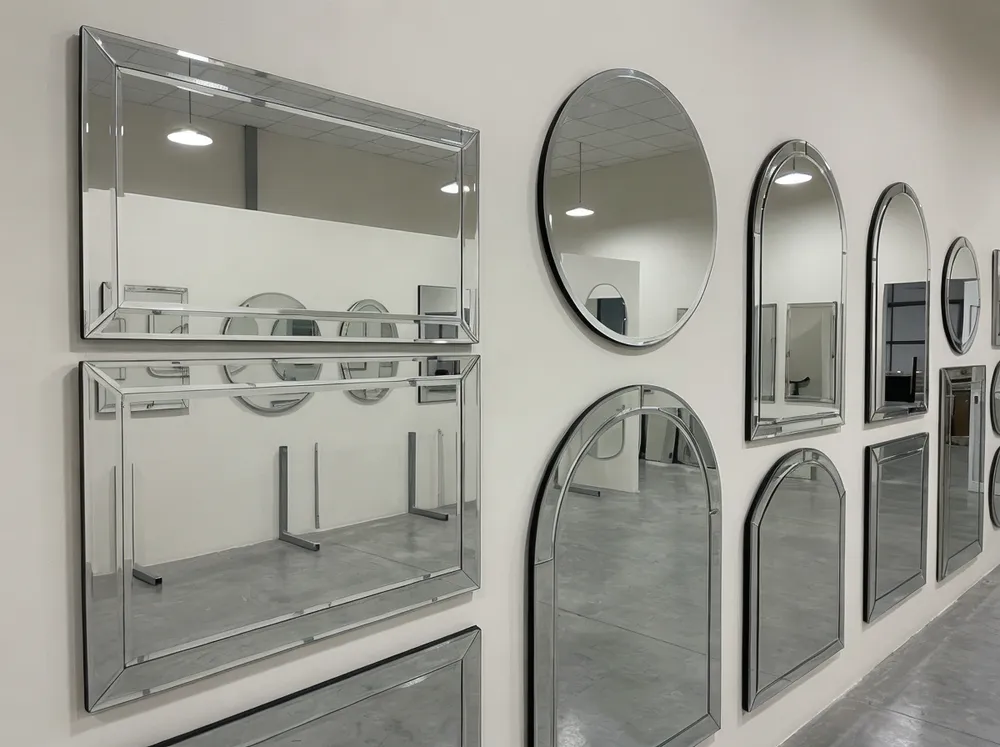
Most trend articles on mirror frames are written for homeowners deciding what to hang in their entryway. That's not useful if you're placing a 500-unit order and need to know which materials will actually sell through, which finishes survive the supply chain, and what your landed cost looks like per SKU.
We ship roughly 400,000 mirror pieces a year out of our Ho Chi Minh facility. We see which frame styles get reordered and which ones sit. This article is a sourcing-oriented read on what's moving in US retail right now — broken down by material, finish, cost tier, and channel fit.
What "frame material trends" actually means for a stocking decision
Consumer trend coverage talks about aesthetics: warm tones, organic shapes, mixed materials. That's useful context, but it's not a buying decision. For a wholesale buyer, a frame material trend only matters if it translates into:
- Sell-through velocity — does this style move at your retail price point?
- Reorder frequency — is this a one-season test or a repeatable SKU?
- Margin headroom — does the material cost leave room after freight and retail markup?
- Supply chain stability — can your supplier actually produce it at scale without quality variance?
The four frame materials driving the most activity in US retail right now are MDF/engineered wood, solid wood, metal (steel and aluminum), and resin. Each has a different cost profile, finish range, and channel fit. We'll go through each one.
MDF and engineered wood frames: the volume workhorse
MDF-core frames with wood veneer or multi-coat paint finishes are the backbone of mass retail mirror programs. Walmart, Target, and Amazon's mid-tier home goods category run heavily on this material — it's dimensionally stable, takes paint and foil wrap cleanly, and produces consistent profiles at high volume.
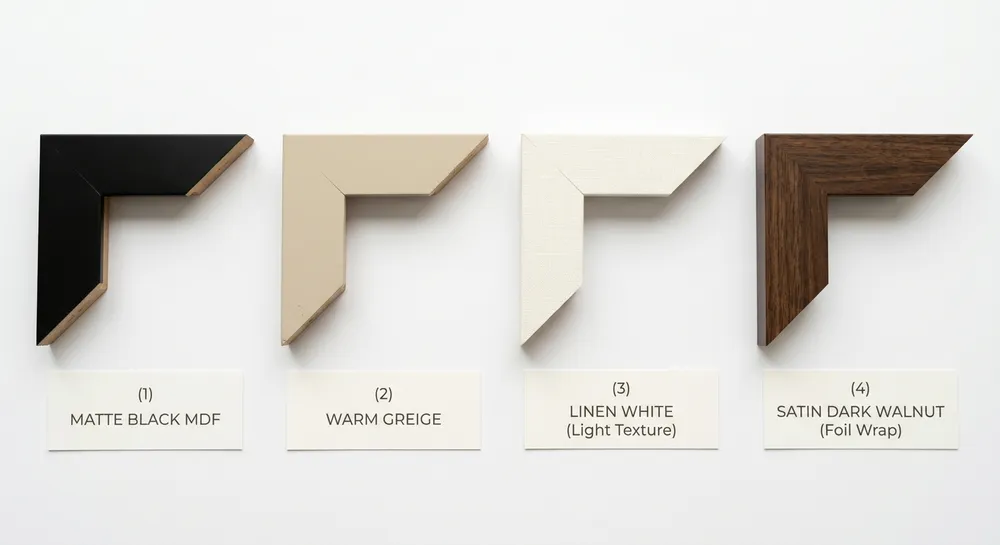
The finish trends on MDF right now are moving away from flat white and toward warmer neutrals: linen, greige, and warm off-white with a slight texture coat. We've also seen strong pull on black MDF frames with a matte or satin finish — that style has been reordering steadily for our North American accounts for the past two years.
From a production standpoint, MDF frames run efficiently on our lines. A standard 24×36" MDF profile with a two-coat paint finish and foil wrap edge can move through our facility at volume without the lead time variability you get with solid wood. MOQ on standard MDF profiles starts at 100 pieces; for custom profiles with new tooling, we typically ask for 300+ to justify the mold cost.
One thing worth knowing: MDF frame quality varies significantly by density and core composition. Low-density MDF (below 700 kg/m³) is common in cheap-end product and shows up as corner chipping and joint separation after transit. We run medium-high density core on all export frames — it's a spec detail worth asking your supplier about explicitly, because it's not visible in a product photo.

Solid wood frames: margin opportunity, but sourcing discipline required
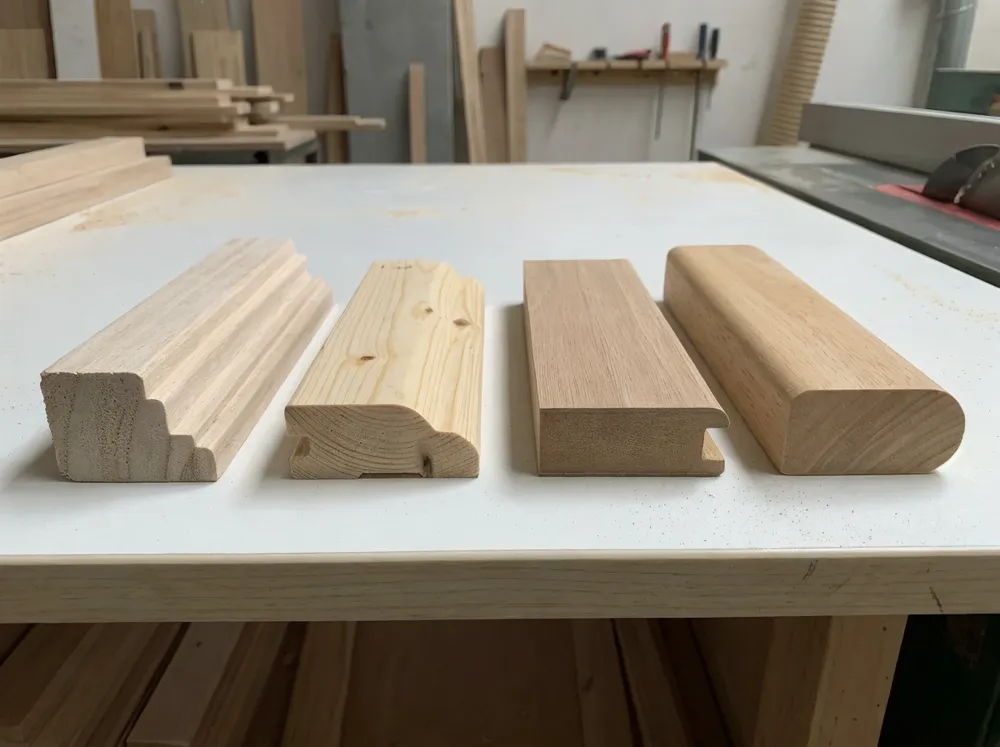
Solid wood frames — rubberwood, pine, and paulownia are the most common export-grade species — are trending upward in the boutique retail, specialty home goods, and Wayfair premium tier. The aesthetic driver is the "organic modern" look: visible grain, natural knots, light stain or clear lacquer finishes that let the wood read as wood rather than painted MDF.
The commercial case for stocking solid wood is real. A solid rubberwood frame in a 24×36" size retails comfortably at $80–$140 depending on finish and profile complexity, versus $45–$75 for a comparable MDF frame. That's meaningful margin headroom if your channel supports the price point.
The sourcing discipline part: solid wood frames have more production variables than MDF. Grain matching across a batch, moisture content control, and finish consistency across species lots all require tighter QC. We do 100% visual inspection on solid wood frames before packing — specifically checking for finish bleed at joints, grain color variance beyond acceptable tolerance, and any surface checking that developed during drying. Buyers who skip sample approval on solid wood orders tend to get surprises.
Lead times on solid wood run 3–5 days longer than MDF equivalents because of the additional drying and conditioning steps. For buyers building a new SKU around solid wood, we recommend a 50-unit sample run before committing to a full container. (We've had buyers skip this and end up with a grain tone that photographed differently than expected — not a defect, just a natural wood reality that's easier to manage with samples in hand.)
For channel fit, solid wood frames index well on Wayfair, boutique e-commerce, and specialty home retailers. They're harder to move at mass retail price points where the $99 ceiling compresses margin on the material cost.
Explore our wood decor mirrors category for current profiles and finish options.
Metal frames: the finish story is where the margin lives
Metal-framed mirrors — primarily steel and aluminum profiles — have been a consistent performer in US retail for several years, but the trend in 2025–2026 is less about the material itself and more about the finish direction.
The finishes gaining ground:
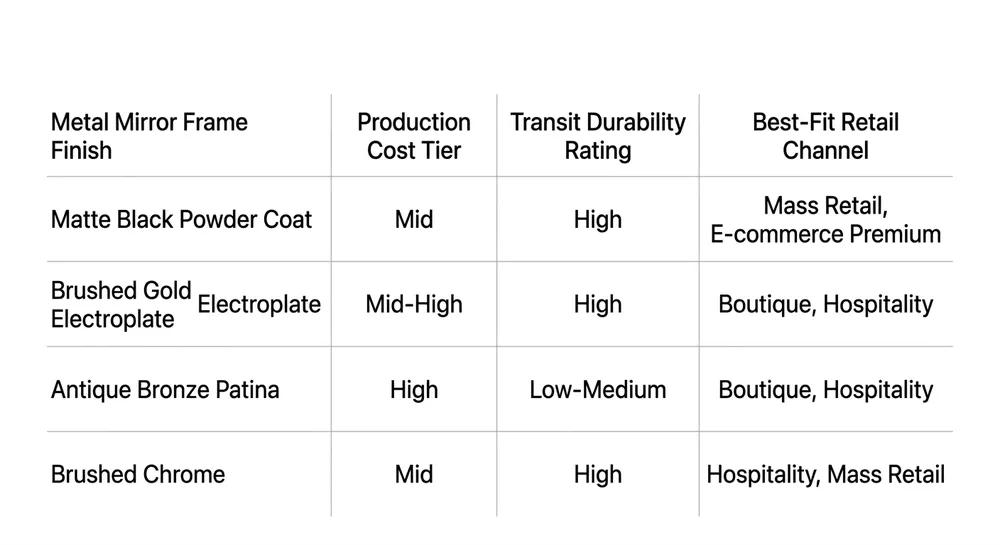
- Brushed gold and champagne gold — electroplated or PVD-coated steel, targeting the transitional and glam-adjacent retail segment. Strong on Wayfair and Amazon premium tier.
- Matte black powder coat — still the highest-volume metal finish we produce. Consistent demand across mass retail, e-commerce, and hospitality procurement.
- Antique bronze and aged brass — growing in boutique and specialty channels. These require a multi-step patina process (base coat, toner, protective clear) that adds cost but also adds the margin justification.
- Brushed nickel and chrome — bathroom mirror segment staple, steady but not growing.
The production reality on metal finishes: powder coat is the most durable and cost-efficient finish for steel frames. Our automated powder line runs at 60–80μm consistent thickness, which passes 500-hour salt spray — relevant for coastal retail accounts where humidity-related finish failure generates RMA claims. Electroplate finishes (gold, nickel, chrome) are more visually premium but require more handling care in transit and have a narrower tolerance for surface prep quality.
For buyers sourcing gold decor mirrors specifically, the finish spec matters more than the base material. A gold-toned frame can be electroplated steel, PVD aluminum, or gold-foil-wrapped MDF — each has a different price point, durability profile, and retail positioning. We can produce all three; the right choice depends on your target retail price and channel.
Resin frames: the ornate segment, with real sourcing trade-offs
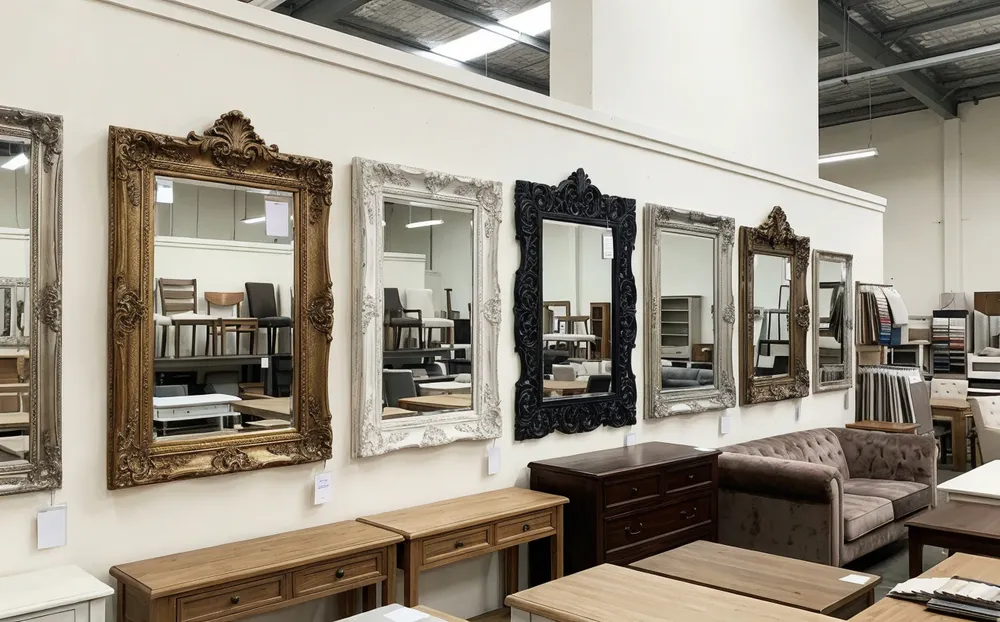
Resin frames cover the ornate, carved-look, and heavily decorative end of the mirror market — baroque profiles, floral motifs, layered molding details that would be cost-prohibitive in solid wood. The material allows complex shapes at a fraction of the tooling cost.
In US retail, resin frames are moving in two directions. The first is the traditional ornate gold or silver finish — still active in the hospitality procurement segment and in specialty home décor retail. The second is a newer direction: resin frames with a whitewash, distressed, or natural-tone finish that reads more "artisan" than "baroque." That second direction is growing faster.
The sourcing trade-offs with resin are worth understanding before you commit inventory:
- Resin frames are heavier than MDF or metal equivalents at the same profile size, which affects freight cost per unit.
- Finish adhesion on resin requires proper surface prep — we use a bonding primer before topcoat on all resin frames. Suppliers who skip this step produce frames where the finish peels at the relief edges within 6–12 months of retail shelf life.
- Resin is more susceptible to temperature stress in transit. Containers sitting on a port in summer heat can cause minor warping on thin-section resin profiles. We pack resin frames with foam corner protection and interior bracing as standard — not all suppliers do.
MOQ on resin frames is typically higher than MDF because the mold tooling cost needs to be amortized. Standard catalog resin profiles start at 100 pieces; custom mold development requires a tooling investment and a minimum run of 500+ pieces to make the per-unit cost work.
For buyers new to the resin segment, the safer entry is through catalog profiles rather than custom molds. Test sell-through on an existing ornate profile before investing in tooling for a proprietary shape.
Frame material vs. retail channel: a sourcing map
Different retail channels have different tolerance for price, finish complexity, and SKU depth. Here's how the trending materials map to channel requirements:
| Frame material | Best-fit US retail channels | Typical retail price range | Reorder pattern |
|---|---|---|---|
| MDF / engineered wood | Walmart, Target, Amazon mid-tier, TJX | $25–$75 | High frequency, stable SKUs |
| Solid wood | Wayfair premium, specialty home, boutique | $75–$180 | Moderate, seasonal variation |
| Metal (powder coat) | Amazon, Wayfair, mass retail, hospitality | $35–$120 | High frequency, finish-driven |
| Metal (electroplate/PVD) | Wayfair premium, boutique, specialty | $80–$200 | Moderate, trend-sensitive |
| Resin ornate | Specialty home, hospitality, boutique | $60–$250 | Lower frequency, longer cycles |
A few observations from our order patterns: MDF and powder-coat metal are the two materials with the most predictable reorder cycles — buyers in those segments tend to run 2–4 container orders per year on core SKUs. Solid wood and electroplate metal have more seasonal variation, with Q3 and Q4 orders typically 40–60% heavier than Q1–Q2. Resin ornate has the longest reorder cycle but also the highest per-unit margin for the buyer.
Finish trends that cut across all materials
Regardless of frame material, certain finish directions are showing up across multiple channels and price tiers right now:
Warm metallics over cool. Brushed gold, champagne, and warm bronze are outpacing silver, chrome, and cool nickel in new SKU introductions. This applies to both metal frames and metallic-finish MDF.
Matte and satin over gloss. Gloss finishes are declining in new retail programs. Matte black, satin white, and low-sheen wood tones are the dominant directions. (Gloss still has a place in bathroom mirrors and some hospitality specs, but it's not where new retail SKUs are being built.)
Textured surfaces over smooth. Linen-texture paint on MDF, hand-applied wax on wood, and hammered or brushed texture on metal are all gaining ground over smooth, uniform surfaces. These finishes photograph better for e-commerce and justify a higher retail price point.
Natural and organic tones. Warm off-whites, natural wood tones, and earthy neutrals are replacing the cool grey palette that dominated 2019–2022. This is the most durable trend direction we're seeing — it's been building for three years and shows no sign of reversing.
For a deeper look at how these finish directions translate into specific production specs, see our guide on custom frame finish specs.
Cost and lead time by material: what the numbers look like from the factory
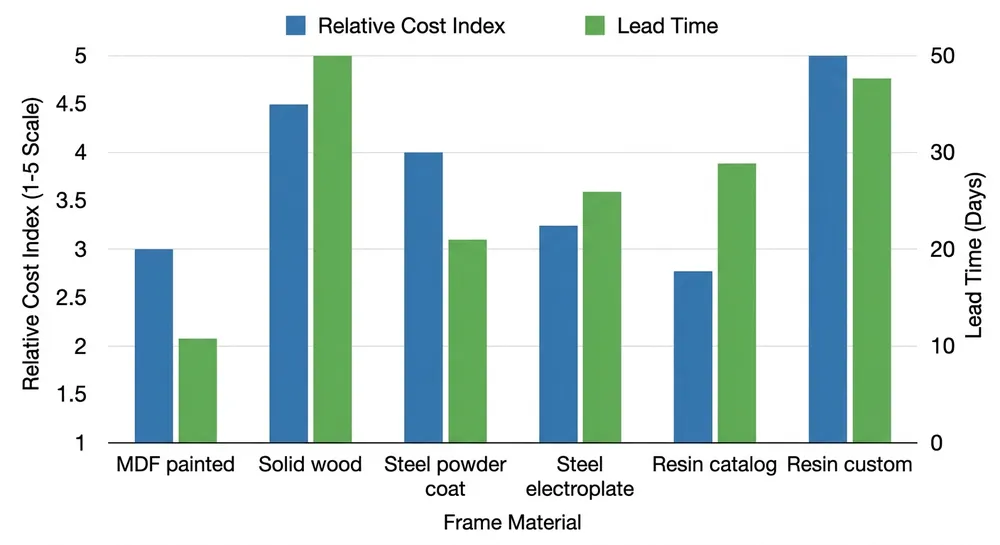
Trend articles don't usually include this, but it's what actually drives your stocking decision. Here's a realistic cost and lead time reference based on our production at 400,000 pieces/year capacity:
| Frame material | Relative FOB cost index | Standard lead time | MOQ (standard profiles) | MOQ (custom profiles) |
|---|---|---|---|---|
| MDF painted | Low (baseline) | 25–30 days | 100 pcs | 300 pcs |
| MDF foil wrap | Low–mid | 25–30 days | 100 pcs | 300 pcs |
| Solid wood (rubberwood/pine) | Mid | 30–35 days | 100 pcs | 300 pcs |
| Steel powder coat | Low–mid | 28–33 days | 100 pcs | 200 pcs |
| Steel electroplate/PVD | Mid–high | 33–40 days | 150 pcs | 300 pcs |
| Resin (catalog mold) | Mid | 30–35 days | 100 pcs | 500 pcs |
| Resin (custom mold) | Mid–high | 45–60 days (incl. tooling) | 500 pcs | N/A |
Lead times above are from order confirmation to container loading, not including ocean freight. For US West Coast ports, add 18–22 days; East Coast, add 25–30 days.
The cost index is relative — actual FOB pricing depends on profile complexity, glass spec, and finish detail. What this table is useful for is understanding the relative trade-offs when you're deciding which material to test first or how to structure a mixed-material container.
Building a starter SKU assortment without overcommitting inventory
The most common mistake buyers make when testing a new frame material trend is going too deep on a single SKU before validating sell-through. A 500-unit order in one finish and size is a significant inventory commitment if the style doesn't move at your retail price point.
A more defensible approach for testing trending frame materials:
Tier 1 — Core reorder SKUs (60–70% of your order volume) Stick with materials and finishes you've already validated: matte black powder coat metal, MDF in a neutral paint finish, or a solid wood profile that's already in your catalog. These are your margin floor — they ship reliably, reorder predictably, and don't require consumer education.
Tier 2 — Trend test SKUs (20–30% of order volume) Pick 2–3 trending directions to test: a brushed gold metal frame, a warm-tone solid wood profile, or a textured MDF in a new finish. Keep quantities at 100–150 pieces per SKU — enough to get real sell-through data without a warehouse problem if the style underperforms.
Tier 3 — Forward-position SKUs (5–10% of order volume) One or two SKUs in a direction you're watching but haven't validated yet. Resin ornate in a new finish, a custom profile you're developing, or a size/shape combination you're testing for a specific channel. Minimum viable quantity — 100 pieces if the MOQ allows.
This structure lets you run a mixed-material container that covers your core business while generating real market data on trend directions. We've helped buyers in the US market build this kind of assortment from a single factory source — one container, multiple materials, one QC standard.
For a detailed comparison of how wood, metal, and resin frames perform against each other on cost, durability, and margin, see wood vs metal vs resin frames.
Retail compliance and packaging: what Walmart and Wayfair actually require
Frame material trends don't exist in isolation from retail compliance requirements. If you're sourcing for Walmart, Wayfair, or Amazon, the frame spec has to work within their packaging, labeling, and product safety requirements — and not all suppliers are set up for this.
We've been a supplier to Walmart and Wayfair accounts since 2015. The compliance requirements that most often affect frame sourcing decisions:
Packaging durability. Wayfair's damage-in-transit claim rate is a real cost for suppliers. Mirrors need inner foam protection, corner guards, and outer carton compression strength that meets their drop-test requirements. Frame material affects packaging design — a heavy resin frame needs different inner support than a lightweight MDF frame.
Prop 65 compliance. California's Prop 65 requirements affect frame finishes — certain lead-based pigments and cadmium compounds in paint and electroplate finishes require labeling or reformulation. We use Prop 65-compliant finish formulations on all US-bound product as standard.
EDI and labeling. Walmart EDI compliance requires specific carton labeling, UPC placement, and ASN documentation. We have EDI capability and can produce retail-ready cartons with GS1 barcodes, inner pack labeling, and master carton marks to Walmart spec.
If you're building a program for a specific retail account, share their compliance requirements at the RFQ stage — it affects frame spec, packaging design, and sometimes material selection.
FAQ: frame material sourcing questions buyers actually ask
What's the most durable frame material for e-commerce shipping?
Steel powder coat is the most transit-durable frame material we produce. The frame itself won't dent, warp, or chip under normal container and last-mile handling. MDF is close behind if the density spec is correct and the corners are properly protected. Solid wood and resin require more careful inner packaging — not because the material is fragile, but because finish damage at corners and joints is the most common transit claim on those materials.
Can I mix frame materials in one container?
Yes, and most of our US buyers do. A standard 40' container can carry a mixed assortment of MDF, metal, and wood frames as long as the carton sizes are compatible for floor-loading or pallet configuration. We handle mixed-material containers regularly — the QC process runs by material type, not by container.
What's the minimum order to test a new frame finish?
For standard catalog finishes on existing profiles, 100 pieces. For a new custom finish on an existing profile (e.g., a new paint color or a new electroplate tone), we typically need 150–200 pieces to justify the line setup and color matching. For a completely new custom profile with new tooling, the minimum viable run is 300–500 pieces depending on the mold complexity.
How do I know if a trending finish will hold up in retail conditions?
Ask for a finish durability spec sheet. For powder coat, the relevant test is salt spray hours (500+ hours is the standard for export-grade product). For paint finishes on MDF, ask for adhesion test results (cross-cut adhesion per ASTM D3359). For electroplate, ask for plating thickness in microns and the base metal prep process. If a supplier can't provide these, that's a sourcing risk signal.
Does frame material affect lead time significantly?
Yes. MDF and standard powder-coat metal are our fastest materials — 25–33 days from order confirmation. Solid wood adds 5–7 days for conditioning. Custom resin with new tooling is the longest lead time category at 45–60 days. If you're working toward a specific in-store date, build your material selection around the lead time, not just the aesthetic.
Browse the full Decor Mirrors by Material & Frame category to see current profiles across all frame materials, or request a quote with your target materials, finish preferences, and order volume — our engineering team can develop custom frame profiles for trending styles you want to test before committing to a full run.