allenliu@livewellcraft.com +86 182 2840 2575 Mon–Sat: 9:00 AM – 6:00 PM (GMT+7)
Factory-Direct Manufacturing

Decor Mirrors by Material and Frame

Factory-direct decor mirrors organized by frame material and finish — sourced from the production floor, not a catalog.

Wood, acrylic, metal, resin, and finished-metal frames all produced in-house on dedicated lines. You pick the material that fits your price point and market — we handle the rest from glass cutting to packed carton.

  • 18+ years of mirror manufacturing
  • 400,000-piece annual capacity
  • Exported to 30+ countries
  • 5 continents served
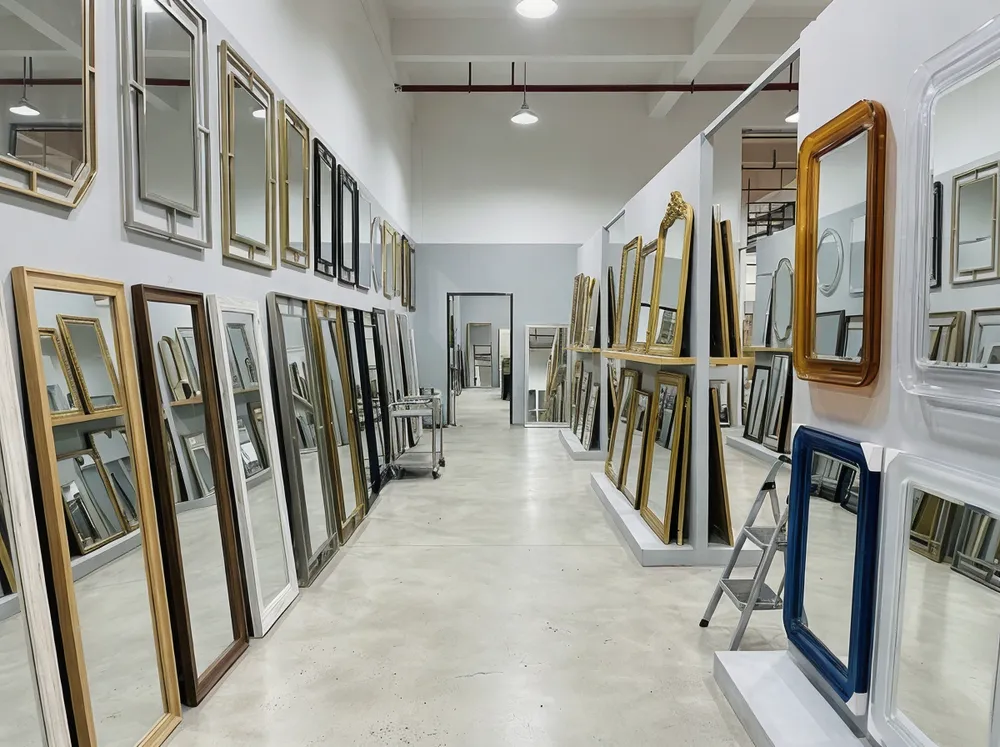
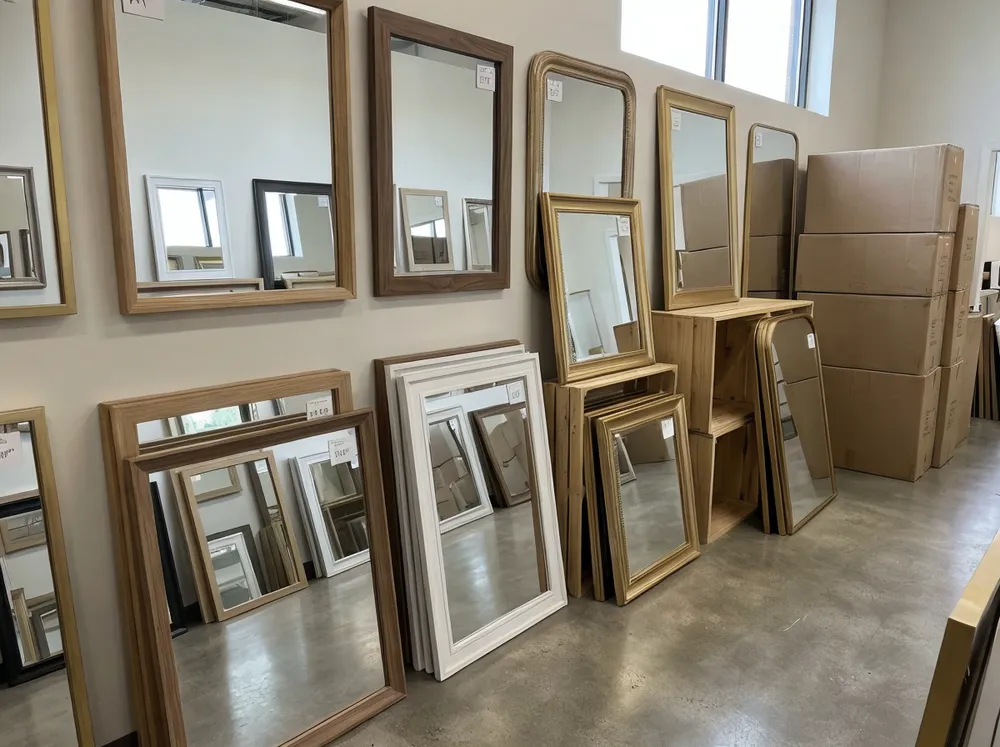
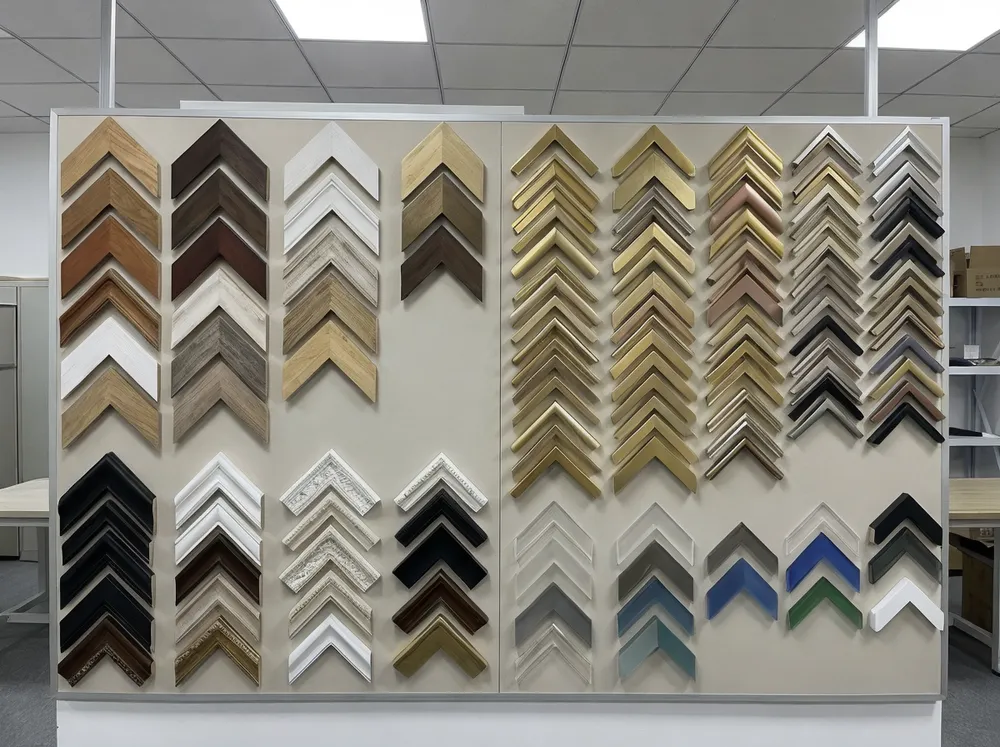
Variety of decor mirror frame materials including wood, metal, acrylic, and gold finishes displayed in factory showroom
Certified
ISO 9001:2015
Compliance
CE Certified
Social Audit
BSCI
Retail Partners
Walmart · Wayfair
Marketplace
Amazon Supplier

Why Frame Material Defines Your Mirror Margin

When you source decor mirrors by material and frame, the frame is where your margin lives. The glass panel is largely commoditized — 3mm or 4mm float, silver-coated, protective backing. What separates a $12 FOB mirror from a $45 one is the frame: its material, its finish, and the production process behind it.

This page walks you through every frame material category we manufacture, the spec ranges available, and how each one maps to a specific price tier and retail segment. We produce all frame types under one roof at our 12,000 m² facility in Dong Nai, Vietnam, so you can mix materials across a single PO without coordinating multiple suppliers.

Livewellcraft has been a dedicated decor mirrors manufacturer since 2008. Our 6 production lines and 150-person team ship roughly 400,000 mirrors a year to distributors, retailers, and hospitality project buyers across North America, Europe, Australia, Southeast Asia, and the Middle East. We hold ISO 9001:2015, CE, and BSCI certifications, and we've supplied programs for Walmart, Wayfair, and Amazon — so our systems already handle the compliance, labeling, and EDI requirements those channels demand.

18+
Years Manufacturing
400K
Annual Capacity
30+
Export Countries
150
Team Members

Six Frame Categories, One Facility

Every frame type below is produced on our own lines — no subcontracted frame work, no quality gaps between what you sample and what fills your container. Each category links to its dedicated product page with detailed specs, finish options, and MOQ information.

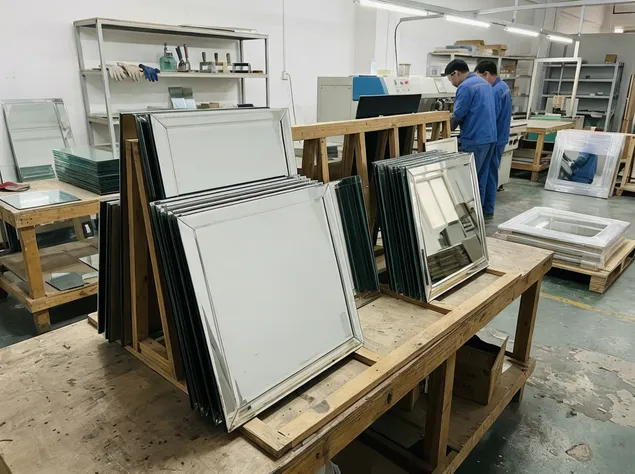
Frameless wall decor mirrors with beveled and polished edge treatments

Wall Decor Mirrors

Frameless and minimal-frame wall mirrors where the glass edge treatment — beveled, polished, or shaped — is the design element. These carry the lowest per-unit cost in the line and move well in volume retail and e-commerce channels where price sensitivity is high.

View Wall Decor Mirrors
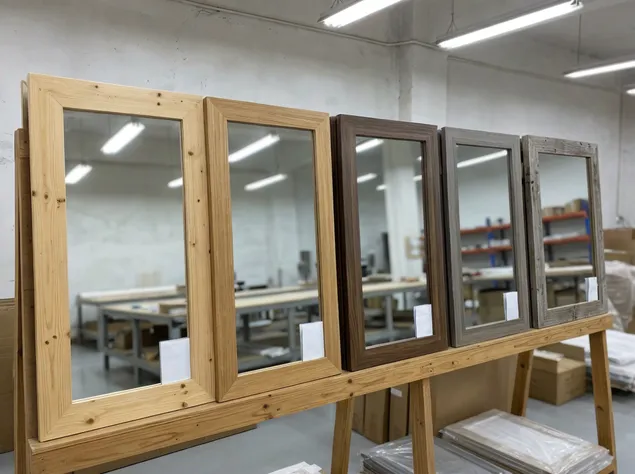
Wood frame decor mirrors in pine, paulownia, and MDF veneer finishes

Wood Decor Mirrors

Solid wood and engineered wood frames — pine, paulownia, MDF with veneer wrap, or reclaimed-look finishes. Wood frames hit the mid-to-premium price tier and perform strongly in home decor retail, boutique distribution, and farmhouse/rustic-themed hospitality projects. We sand, prime, and apply multi-coat finishes in-house, so the stain color and sheen level match your spec sheet, not our convenience. (Paulownia is worth considering if you're watching freight costs — it's roughly 40% lighter than pine at comparable strength, and that weight difference adds up across a full container.)

View Wood Decor Mirrors
Acrylic framed mirrors for lightweight shatter-resistant applications

Acrylic Decor Mirrors

Acrylic-framed and acrylic-panel mirrors for lightweight, shatter-resistant applications. These are the go-to for hospitality renovation projects, rental properties, and any channel where breakage during last-mile delivery eats into your returns budget. We cast and hand-finish acrylic frames on-site, controlling edge clarity and surface polish that cheaper injection-molded alternatives can't match.

View Acrylic Decor Mirrors
Composite and resin frame mirrors with ornate carved details

Frame Decor Mirrors

Composite, resin, and mixed-material frames — ornate profiles, carved details, and architectural moldings that would cost a fortune in solid wood. Resin casting lets us reproduce intricate designs at scale with consistent detail across thousands of units. This is the category where your product photography does the heavy lifting: the frames look high-end, the FOB price stays mid-range, and your retail markup holds.

View Frame Decor Mirrors
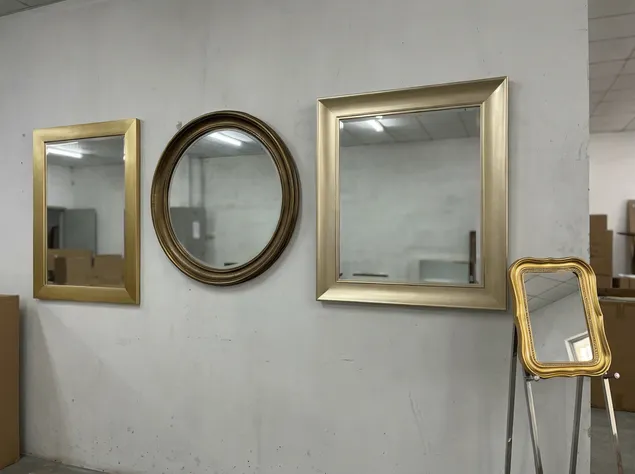
Gold finish frame mirrors in brushed, antique, and champagne gold
Fastest Growing

Gold Decor Mirrors

Gold-finish frames spanning brushed gold, antique gold, champagne gold, and bright gold electroplate. Gold-finish mirrors have been the single fastest-growing segment in our order book over the past three years — driven by interior design trends in both residential retail and boutique hospitality. We produce gold finishes through two processes: electroplating for bright, reflective gold and hand-applied metallic paint for matte and antiqued effects. Each process targets a different price point and visual result, so you choose based on your retail positioning.

View Gold Decor Mirrors
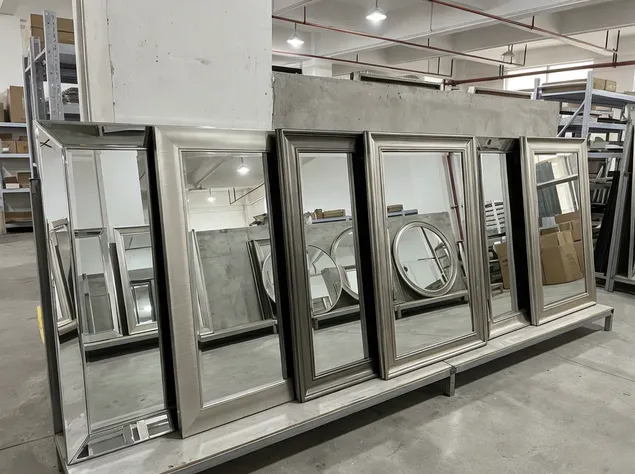
Silver finish frame mirrors in chrome, brushed nickel, and pewter tones
Year-Round Seller

Silver Decor Mirrors

Silver-finish frames in chrome, brushed nickel, antique silver, and pewter tones. Silver finishes pair naturally with modern and transitional interior styles and tend to have longer shelf life in retail — they don't cycle with trend seasons the way bold colors do. For distributors building a core catalog, silver-frame SKUs are reliable year-round sellers with low markdown risk.

View Silver Decor Mirrors

Not sure which frame material fits your market?

Jump to Selection Guide

How We Build Frames — and Why the Process Matters to Your Bottom Line

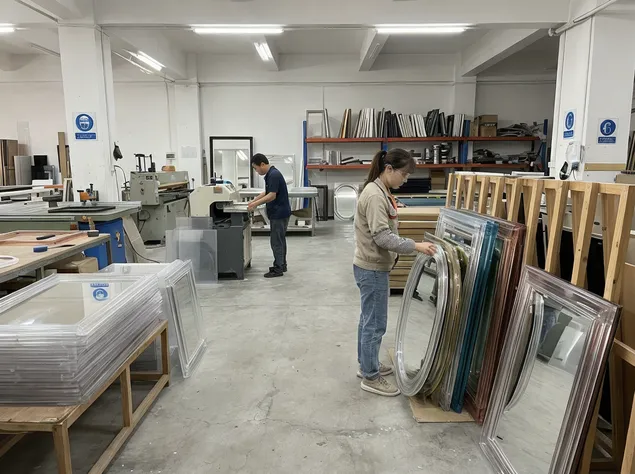
Frame production is where most mirror sourcing problems originate. A trading company can show you a beautiful sample, but if the factory behind it doesn't control its own frame line, your bulk order arrives with inconsistent finish, visible seams, or paint that chips during transit. We run dedicated frame production for each material type in-house, and that vertical control is what keeps your reorder quality identical to your first shipment.

Wood & MDF Frames

Wood and MDF frame production line with CNC routers and spray booth

Wood and MDF frames go through a five-stage sequence: rough cutting, profile shaping on CNC routers, sanding (120 through 320 grit progression), primer coat, and two-to-three finish coats depending on the spec.

We spray in a temperature-controlled booth — humidity above 65% causes adhesion problems with water-based finishes, and Dong Nai's climate will happily deliver 80% humidity if you let it. The booth keeps us at 50-60% year-round.

For distressed and antiqued looks, the aging effects are applied by hand between coat stages, which is why those finishes carry a slightly higher per-unit cost but also command significantly higher retail prices.

Margin insight: Buyers who add two or three distressed-finish SKUs to an otherwise standard wood-frame order see disproportionate margin improvement — the production cost delta is small, but the perceived value jump at retail is large.

Metal Frames

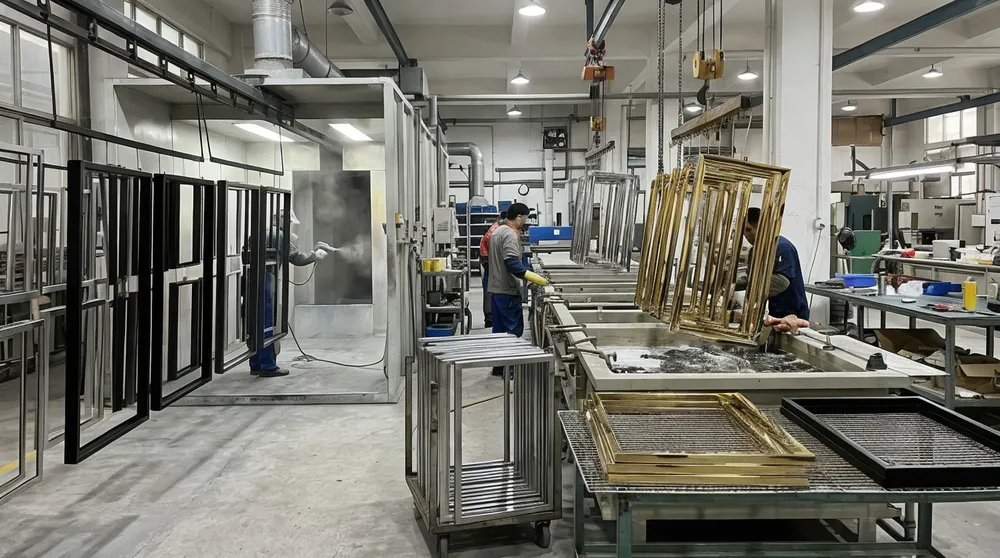
Steel and aluminum frame finishing with powder coating and electroplating

Metal frames — steel and aluminum — get cut, welded or bent to profile, then finished through either powder coating or electroplating.

Powder Coating

Durable matte or satin finish at lower cost

Electroplating

High-shine chrome, gold, and nickel looks

We run both lines, so a single order can mix powder-coated matte black frames with electroplated gold frames without splitting across suppliers.

Quality differentiator: Weld seams on metal frames are ground and polished before finishing — this is the step that cheap suppliers skip, and it's the reason their gold-plated frames show dark lines at the corners after six months on a retail shelf.

Resin & Composite Frames

Resin frame casting from silicone molds with hand-trimming and gilding

Resin and composite frames are cast from silicone molds, demolded, hand-trimmed, and then painted or gilded. The mold is the critical asset — we maintain over 200 active frame molds in-house and can develop a new custom profile mold in 12-15 days.

Resin gives you ornate, carved-look profiles at a fraction of solid wood cost, and the weight stays manageable for wall-mount applications.

Sourcing tip: If you're sourcing resin frames elsewhere and seeing bubbles or soft detail in the castings, the issue is almost always mold temperature control during pour — it's a small detail that separates clean production from scrap-heavy runs.

Category-Wide Technical Specifications

This table covers the general specification ranges across all frame materials in this category. For exact specs on individual products, visit the relevant sub-category page.

Parameter Range / Options
Mirror glass thickness 3mm, 4mm, 5mm (4mm standard for most retail)
Mirror type Silver mirror (copper-free), aluminum mirror, tinted (bronze, grey)
Frame materials Solid wood (pine, paulownia), MDF, metal (steel, aluminum), resin, acrylic, composite
Frame profile width 15mm – 120mm depending on material and design
Overall mirror sizes 200×300mm up to 1800×900mm; custom sizes available
Frame finishes Natural wood stain, painted (any RAL/Pantone), powder coat, electroplate (gold, silver, chrome, nickel, rose gold), hand-applied antique/distressed
Backing MDF backing board, cardboard, or open-back depending on design
Hanging hardware D-rings, sawtooth hangers, French cleat, wire — pre-installed
Certifications
ISO 9001:2015 SGS CE BSCI
MOQ 100 pieces per SKU (standard models), 300 pieces per SKU (custom)
Lead time 30-35 days (existing mold/profile), 45-50 days (new custom profile)

Matching Frame Material to Your Retail Price Tier

The frame material you choose determines your FOB cost, your freight economics, and ultimately the retail segment you can compete in. Here's how we see the lineup mapping to real market tiers — based on what our existing distributors across North America and Europe actually sell through, not theory.

Frame Material Typical FOB Range Best-Fit Retail Price Strongest Channels
Frameless / wall-mount Lowest $15–$35 retail E-commerce, mass retail, rental staging
MDF / engineered wood Low–mid $25–$60 retail Home decor chains, online marketplaces
Solid wood (pine, paulownia) Mid $40–$90 retail Boutique retail, specialty home stores
Metal (powder coat) Mid $35–$80 retail Modern/industrial retail, contract hospitality
Metal (electroplate gold/silver) Mid–high $50–$120 retail Premium home decor, design-forward retail
Resin / composite (ornate) Mid $45–$100 retail Traditional/classic retail, hospitality procurement
Acrylic Mid $30–$70 retail Hospitality, commercial interiors, safety-required

Catalog-Building Guidance

If you're building a catalog from scratch, most of our distributors start with three to four materials that span low-mid-high price tiers. That gives your sales team a mirror for every buyer conversation without overcomplicating your initial inventory. You can always add specialty SKUs — hand-gilded resin, reclaimed wood — once the core line is moving.

Market Segments Where Frame Selection Drives Reorder Volume

Decor mirrors by material and frame aren't just a product taxonomy — they map directly to buyer segments with different purchasing patterns, margin profiles, and reorder cycles.

Home Decor Retail and E-Commerce

This is the highest-volume segment. Retailers and Amazon/Wayfair sellers need a range of frame materials at competitive FOB prices with retail-ready packaging — UPC-labeled, photographable out of the box, and sturdy enough to survive last-mile delivery.

Wood and MDF frames dominate here by unit volume. Gold-finish metal frames are the margin play — they photograph well, trend strongly in social media-driven purchasing, and carry higher ASPs without proportionally higher COGS.

Retail-ready packaging UPC-labeled Highest volume
Home decor retail and e-commerce mirror display with wood and gold-finish frames
Hotel lobby with metal and acrylic frame mirrors for commercial interiors

Hospitality and Commercial Interiors

Hotels, restaurants, and commercial designers buy mirrors as part of a broader FF&E package. They care about durability, fire rating compliance for certain jurisdictions, and visual consistency across 50-200 identical units.

Metal and acrylic frames perform well here — metal for lobbies and public areas, acrylic where shatter resistance matters (gym facilities, pool areas, children's zones). Orders tend to be project-based with specific delivery windows, and reorders come when the property renovates or the management company rolls out a new design standard across multiple locations.

Fire rating compliance Shatter resistance 50-200 unit runs

Wholesale Distribution

Distributors buying for resale to independent retailers, interior designers, and small contractors. Your value to them is product line breadth — the more frame materials and finish options you carry, the more of their downstream demand you capture.

This is where having all six frame categories from a single supplier matters most: one PO, one quality standard, one logistics coordination point, consolidated freight.

Full line breadth Single PO Consolidated freight
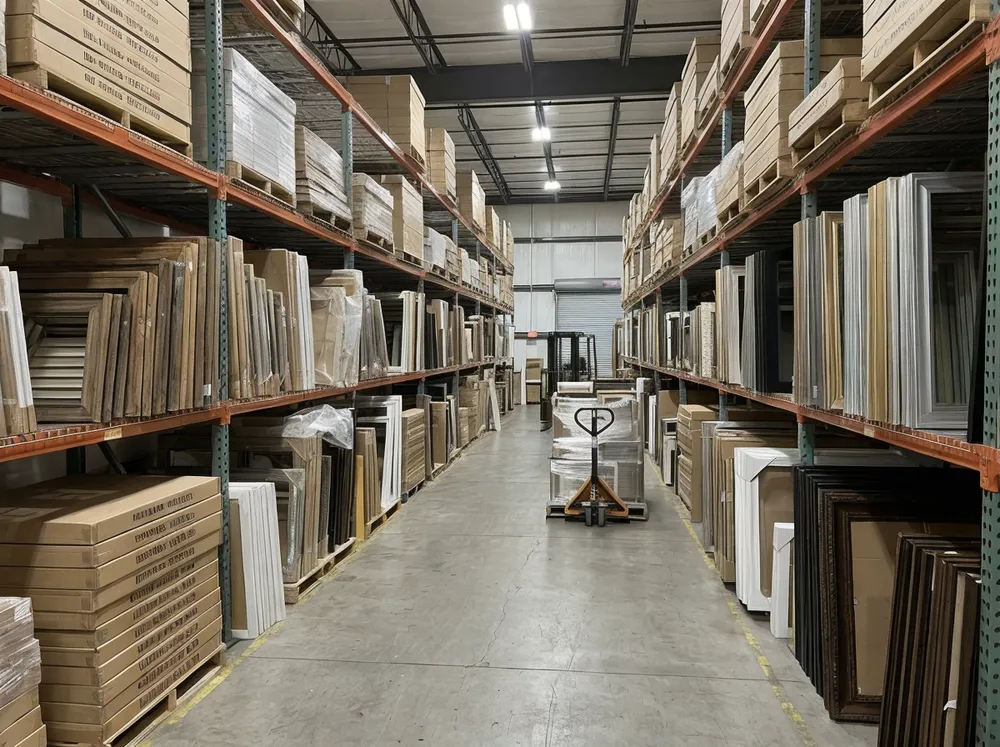
Wholesale distribution warehouse with diverse mirror frame inventory
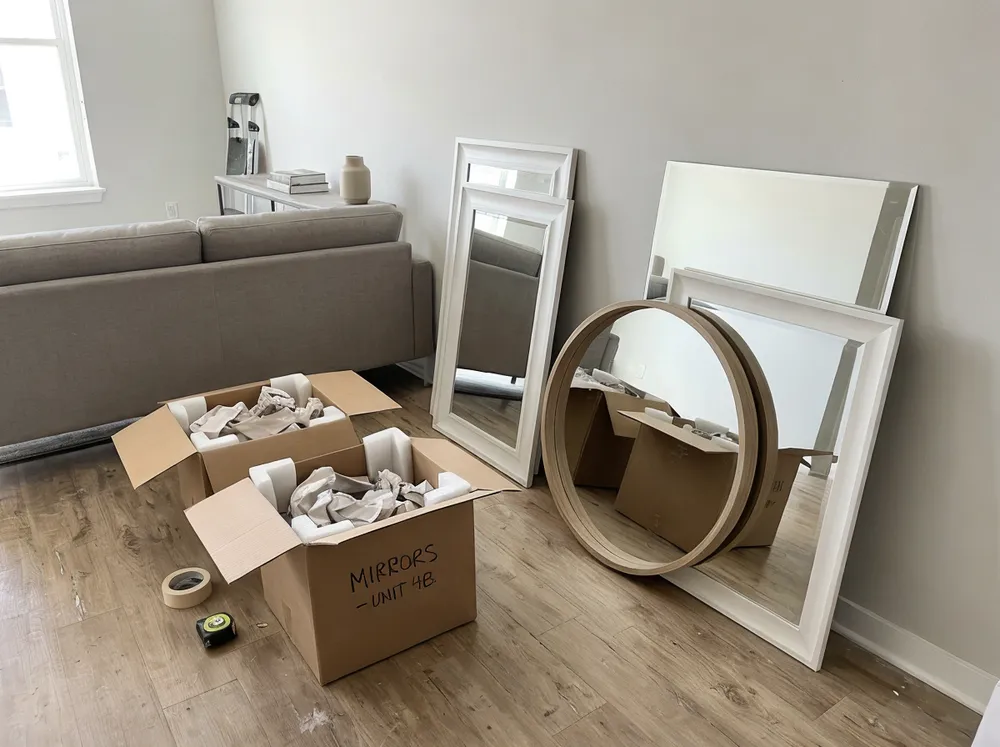
Property staging with lightweight MDF and frameless mirrors

Staging and Rental Property

Property staging companies and rental management firms buy mirrors in moderate quantities with fast reorder cycles. They prioritize low unit cost, lightweight frames for easy installation and removal, and neutral finishes that work across property styles.

MDF and frameless mirrors are the workhorses here. This segment is smaller per order but surprisingly consistent — staging companies reorder every 60-90 days as inventory gets damaged or rotated.

Lightweight frames 60-90 day reorders Neutral finishes

Which Segment Are You Targeting?

Tell us your market focus — we'll recommend a starter SKU mix based on what moves in your region.

Get Segment-Specific Recommendations

Custom Frame Profiles and Finishes at Production Scale

Our 12-engineer OEM/ODM team develops custom frame profiles, finishes, and mirror configurations in-house. This isn't a "send us a drawing and we'll try" operation — we maintain CAD/CAM capability, CNC routing for wood profiles, and our own mold shop for resin casting. A new wood or metal frame profile goes from your reference image to a production-ready sample in 10-15 days. A new resin mold takes 12-15 days.

In-House Engineering Capabilities
  • CAD/CAM design and prototyping
  • CNC routing for wood profiles
  • Dedicated mold shop for resin casting
10-15
Days for Wood/Metal Profile
12-15
Days for Resin Mold
OEM/ODM engineering team developing custom mirror frame profiles with CAD/CAM and CNC equipment

Customization Dimensions Available Across This Category

Frame Profile

Custom cross-section shapes, widths from 15mm to 120mm, corner detail options including mitered, rounded, and ornate finishes.

Finish

Any RAL or Pantone color match, custom stain colors, metallic finishes (gold, silver, rose gold, copper, brass), antiqued and distressed effects.

Mirror Configuration

Custom sizes, shaped glass (arch, oval, irregular), tinted mirror options including bronze, grey, and black.

Branding

Private label packaging, custom hang tags, branded backing labels for complete white-label programs.

Packaging

Retail shelf-ready with custom inserts, or bulk project packaging optimized for your distribution model.

MOQ Guidelines
  • 300 pcs per SKU for fully custom work
  • 100 pcs for finish changes on existing profiles

Custom Development Process

We've developed custom programs for buyers ranging from boutique home decor brands launching their first mirror line to large retailers rolling out seasonal collections across hundreds of stores. The process is the same either way:

1
Reference

You send reference images or sketches

2
Engineering

Our team produces technical drawing and material recommendation

3
Agreement

We agree on specs and pricing

4
Sample

Pre-production sample ships to you for approval

5
Production

Line runs after your approval

Mirror Packaging Engineered for Zero-Breakage Ocean Freight

Mirrors are fragile goods, and your packaging spec is a direct cost-of-goods decision — under-pack and you absorb breakage claims; over-pack and you waste container space and freight dollars. We've shipped mirrors across every major ocean route for 18 years, and our packaging configurations reflect that experience.

Standard Retail Packaging

Individual corrugated carton with molded foam corner protectors, PE bag over the mirror face, and a cardboard divider between the mirror and frame edges. Each carton is drop-tested to ISTA 2A standards.

  • UPC label included inside carton
  • Product insert included
  • Hanging hardware included

Default for retail-channel orders — this configuration is what Walmart and Wayfair programs require.

Bulk / Project Packaging

Mirrors are grouped 4-6 units per master carton with foam dividers between each unit, then palletized with stretch wrap and corner boards.

40HQ Container Capacity
800-1,200
Bulk packaging
500-700
Individual retail cartons

For project buyers who don't need retail packaging, this saves meaningful freight cost per unit.

Container Loading Optimization

We configure pallet dimensions to maximize your specific container type. For a 40HQ, we typically achieve 85-90% volume utilization on mirror shipments. Our logistics team provides a loading plan with your order confirmation so you can calculate landed cost accurately before committing.

Loading plan with order confirmation
Accurate landed cost calculation

Breakage Protection

<0.5%
Breakage rate on ocean freight

When damage does occur, we document it with photos at the packing stage so claims against the carrier are straightforward.

Documentation Standards

Commercial invoices and packing lists follow the format your freight forwarder and customs broker expect — no reformatting required on your end.

Common Questions About Sourcing Decor Mirrors by Material and Frame

Direct answers to the sourcing questions we hear most from distributors, retailers, and project buyers evaluating frame materials and finishes.

What is the MOQ for mixed-material mirror orders?

100 pieces per SKU on standard models, 300 per SKU on custom profiles. You can mix frame materials within a single PO — wood, metal, resin, acrylic — as long as each individual SKU meets its minimum.

Most first-time buyers order 3-5 SKUs across 2-3 materials to test market response before scaling.

How do I choose between powder-coated and electroplated metal frames?

Powder coating gives you a matte or satin finish with strong scratch and chip resistance — it's the better choice for hospitality and commercial projects where mirrors get handled frequently. Electroplating delivers the high-shine chrome, gold, and nickel finishes that retail buyers expect in premium home decor.

The cost difference is roughly 15-25% higher for electroplating, but the retail price premium you can charge typically exceeds that gap.

If you're unsure, order samples of both finishes on the same frame profile — the difference is immediately obvious in person and in product photography.

Will wood-frame mirrors warp or crack in humid climates?

Solid wood frames can move with humidity changes — that's the nature of the material. We mitigate this with kiln-dried stock (moisture content below 12% before cutting), sealed multi-coat finishes on all surfaces including the back, and engineered construction on wider profiles.

For markets with extreme humidity — Southeast Asia, coastal Middle East, tropical regions — we typically recommend MDF-core frames with wood veneer or painted finish. MDF is dimensionally stable regardless of humidity, and the visual difference from solid wood is negligible once finished.

We've shipped both configurations to the Gulf region for years and can advise based on your specific destination.

What silver coating process do you use, and does it affect mirror longevity?

We run copper-free silvering as our default process. The silver layer is deposited on float glass, then sealed with multiple protective paint coats. Copper-free silvering meets EU environmental requirements (no heavy metal content in the coating) and performs better in humid environments — the edge blackening that plagues cheap mirrors after 12-18 months is almost always a copper-layer oxidation issue.

We adhesion-test every batch before it moves to frame assembly. If you're selling into European markets, copper-free silvering also simplifies your REACH compliance documentation.

Can you match a specific gold finish from a reference sample or photo?

Yes. Send us a physical sample or high-resolution photos with lighting reference, and our finishing team will produce a color-match sample within 7-10 days. We maintain a library of over 30 gold-tone references — from bright polished gold to dark antique brass — so in most cases we can match from existing formulations without developing a new one.

For electroplated gold, we control the plating bath chemistry to maintain color consistency across production runs, which is the step where finish variation typically creeps in with less experienced suppliers.

How do resin frames compare to solid wood on durability and cost?

Resin frames are 30-40% lighter than equivalent solid wood profiles, resist moisture and temperature changes without warping, and reproduce fine carved detail that would require hand-carving in wood. FOB cost is typically comparable to mid-grade wood frames, but resin gives you ornate, high-perceived-value designs at that price point — which means better margin at retail.

The trade-off: resin doesn't have the natural grain texture of real wood, so for buyers targeting the organic/natural aesthetic, solid wood or wood-veneer MDF is the better fit. We produce both and can send comparison samples so you see the difference firsthand.

Start Your Order

Start With the Frame Materials That Fit Your Market

Not sure which combination of materials and finishes to lead with? Send us your target market, retail price range, and volume expectations. Our team will recommend a starter SKU mix based on what's actually selling for our existing distributors in your region — not a generic catalog dump.

Most new buyers begin with 3-5 SKUs across two or three frame materials, test sell-through for one season, then expand. We can ship samples of any frame material and finish combination within 10 days so you evaluate quality before committing to production.

  • Region-specific SKU recommendations
  • Samples shipped within 10 days
  • Mix materials in one PO
  • Test 3-5 SKUs before scaling
Sample display showing wood, metal, resin, and acrylic mirror frame materials with various finish options
30+
Gold-Tone Finishes
10 Days
Sample Delivery