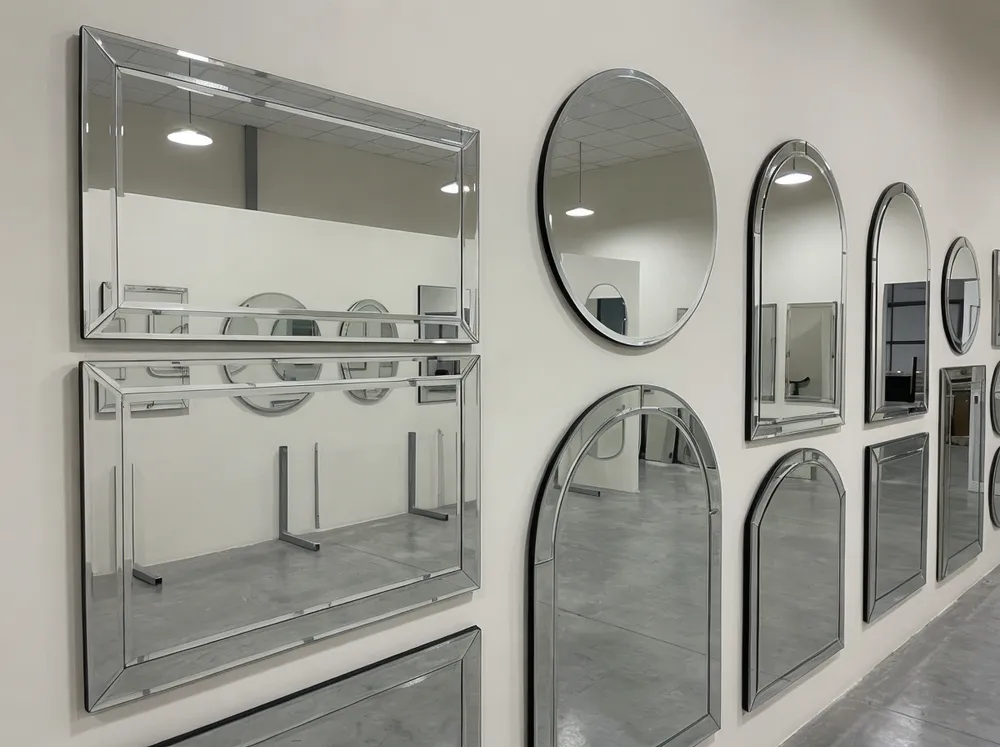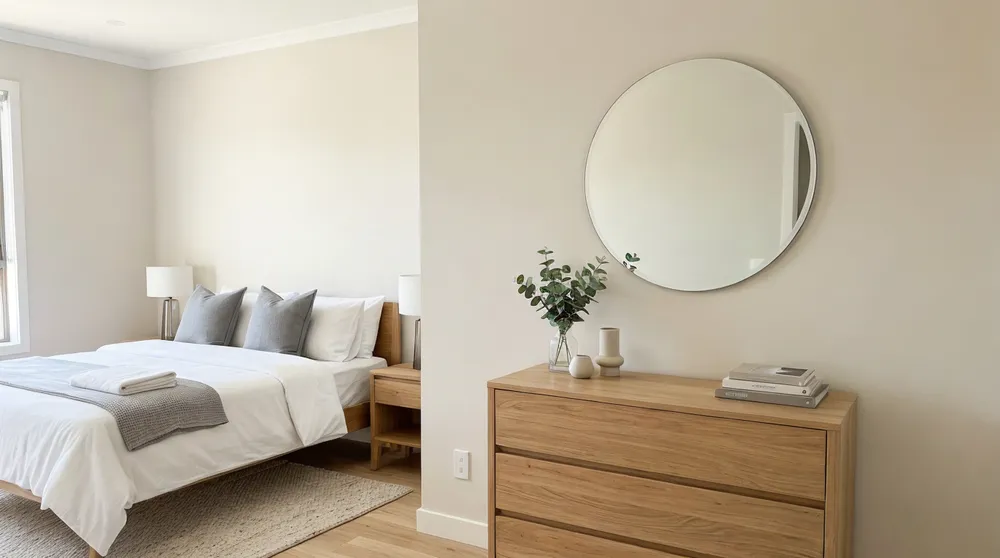
The highest-volume, lowest-FOB position in the decorative mirror line. No frame cost, no frame production lead time, and more units per container.
Wall decor mirrors are the frameless and minimal-frame segment of our decorative mirror line. The glass edge — beveled, polished, shaped, or flat-ground — does the visual work that a frame would do on other mirrors. That makes wall decor mirrors the lowest-FOB, highest-density product in our catalog: no frame material cost, no frame production step, and more units per container.
If your business model depends on competitive pricing and fast inventory turns, this is the product line that supports it.
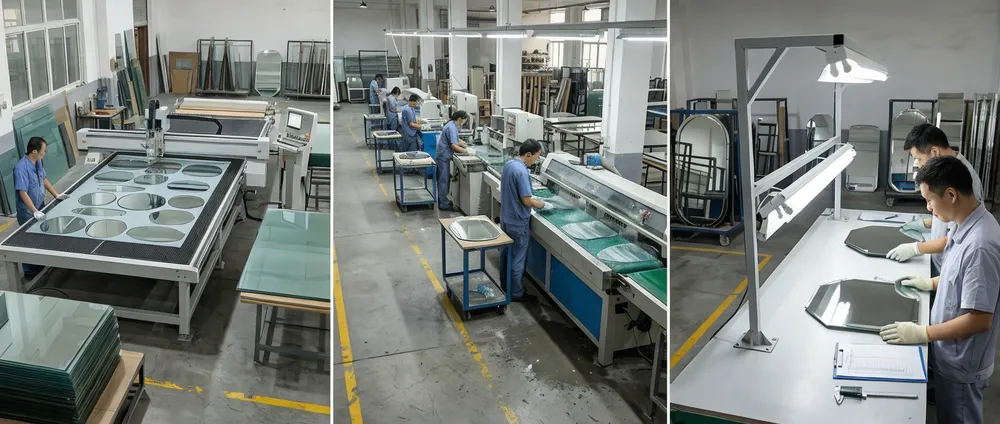
We produce wall decor mirrors on our dedicated glass processing and silvering lines at our 12,000 m² facility in Dong Nai, Vietnam. The production chain for this product is shorter than framed mirrors — glass cutting, edge treatment, copper-free silvering, protective coating, backing, hardware, and packaging — which means lead times run 25-30 days on standard models versus 30-35 for framed products. For the full picture on how our facility and frame categories are organized, see our decor mirrors by material and frame overview.
The positioning is straightforward: wall decor mirrors compete on glass quality and edge craftsmanship, not frame design. When you remove the frame, the mirror panel itself becomes the entire product — which means every flaw in the glass, every inconsistency in the edge finish, is visible. This is actually where a lot of suppliers lose buyers on reorders. The first shipment looks fine, the second batch arrives with uneven bevel widths or chipped polished edges, and your returns spike.
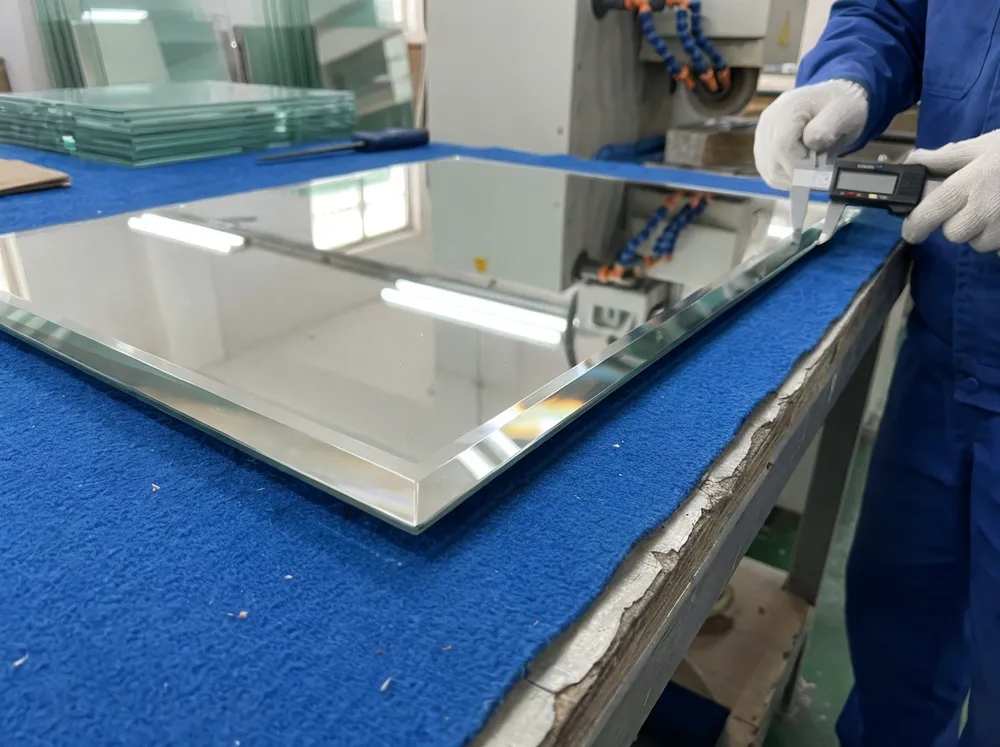
We hold edge tolerances tighter on wall decor mirrors than on framed products precisely because there's nothing to hide behind. Bevel width consistency runs within ±0.3mm across a production run, and polished edges go through a three-stage grinding sequence (rough, fine, polish) that eliminates micro-chips visible under retail lighting.
Our QC team inspects every unit's edge under angled light before it moves to silvering — a step we added after an early export order taught us that overhead warehouse lighting doesn't catch what a customer's wall sconce will. That one order cost us a full rework. We don't skip the angled-light check anymore.
Rough → Fine → Polish sequence eliminates micro-chips that become visible under retail lighting conditions.
Higher FOB due to frame material and labor. Same mirror panel quality.
Premium finish tier. Identical silvering process and glass grade.
Frame adds cost and design options. Core mirror panel unchanged.
"Entry-level" refers to FOB cost, not quality. The silvering process, glass grade, and protective coating are identical across the entire line. You're paying less because there's less material and less labor, not because we cut corners on the mirror panel itself.
These are exact values for this product line, not category-wide ranges. If you're building a comparison sheet, these are the numbers to use.
| Parameter | Specification |
|---|---|
| Mirror glass thickness | 3mm, 4mm, 5mm (4mm is our standard and what most retail buyers specify) |
| Mirror type | Silver mirror (copper-free silvering), aluminum mirror, tinted mirror (bronze, grey, black) |
| Edge treatments | Beveled (typically 20-25mm bevel width), polished, flat-ground, pencil-edge, ogee |
| Bevel angle | 3°–7° (standard 5°) |
| Standard shapes | Rectangle, square, round, oval, arch-top, hexagon, diamond |
| Size range | 200×300mm to 1500×900mm (custom sizes available up to 1800×1200mm) |
| Glass type | 2mm–5mm float glass, tempered option available for safety-rated applications |
| Backing | MDF backing board with moisture-resistant seal, or cardboard backing for lightweight models |
| Hanging hardware | D-rings, sawtooth hangers, or French cleat — pre-installed |
| Protective coating | 2-layer copper-free silver + 2-layer protective paint (moisture and oxidation resistant) |
| Weight range | 1.2 kg (small round, 3mm) to 12 kg (large rectangular, 5mm with MDF backing) |
| Certifications applicable | ISO 9001:2015, SGS, CE |
| MOQ | 100 pieces per SKU (standard models), 200 pieces per SKU (custom shape or size) |
| Lead time | 25–30 days (standard), 35–40 days (custom shape requiring new cutting template) |
3mm glass works for small decorative rounds, hexagon sets, gallery wall groupings
4mm recommended as minimum — our standard specification for most retail buyers
5mm keeps the mirror flat against the wall without bowing under its own weight
We'll flag size-thickness mismatches during quoting, but knowing this upfront helps your spec combinations make sense from the start.
We'll quote exact FOB pricing within 48 hours.
Each scenario below is a market segment where wall decor mirrors move consistently for our existing distributors and project buyers. We're not listing rooms in a house — we're showing you where the reorder cycles are.
This is the highest-unit-volume channel for wall decor mirrors. Amazon, Wayfair, and independent e-commerce sellers need SKUs that hit aggressive price points, photograph cleanly on white backgrounds, and survive parcel shipping. Frameless mirrors check all three: the FOB is the lowest in the decorative mirror line, the clean edge reads well in product photography without styling, and the flat profile packs efficiently into individual mailer cartons.
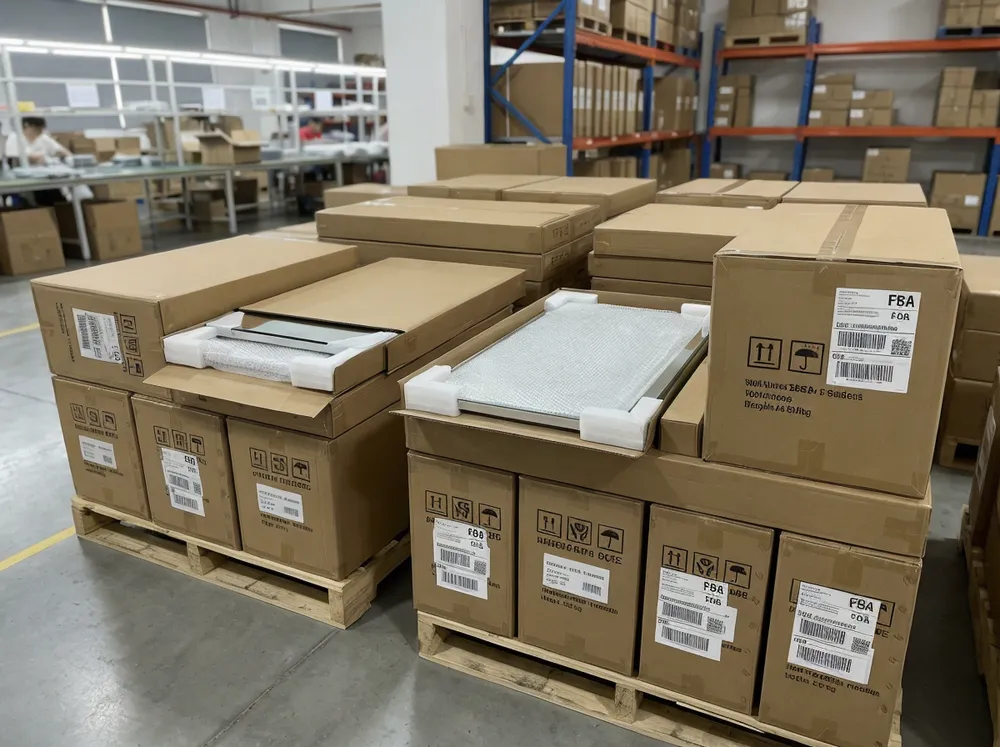
Sellers in this channel typically order 500–2,000 units per SKU per reorder cycle, with reorders every 60–90 days on top performers. We already package to Amazon FBA and Wayfair CastleGate specs, so your units go from our container to the fulfillment center without repackaging.
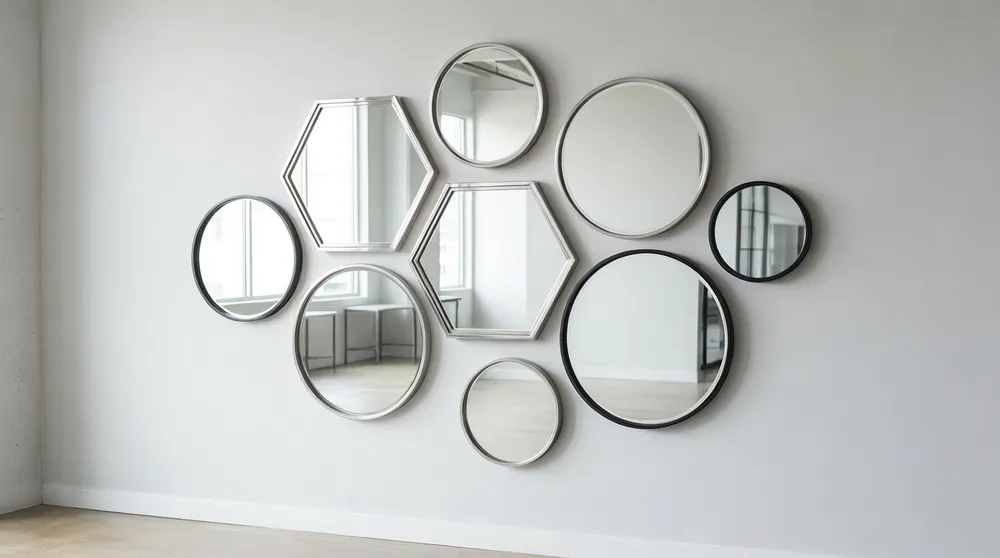
Selling mirrors as curated sets — three hexagons, a cluster of mixed rounds, a grid of small squares — is a margin multiplier. You take individual mirrors with a $3–5 FOB cost and bundle them into a set that retails for $40–80. The per-unit production cost barely changes, but the perceived value and the retail price jump significantly.
We produce gallery wall sets with matched edge quality across all pieces in the set and pack them together in a single retail carton with a layout template insert. (This is one of those categories where the packaging design matters almost as much as the product — a well-designed template card that shows the customer exactly how to arrange the set on their wall cuts your negative reviews in half.)
Margin insight: Template insert cards reduce negative reviews by up to 50% while adding minimal packaging cost.
Property staging companies and short-term rental operators buy frameless mirrors for a simple reason: low unit cost, neutral aesthetic that works across property styles, and easy replacement when units get damaged during tenant turnover.
Orders are typically 50–200 units, but the reorder frequency is high — every 60–90 days as inventory rotates. Round and oval frameless mirrors in the 400–600mm range are the workhorses here. Lightweight models with cardboard backing and sawtooth hangers keep installation time under two minutes per unit, which matters when your crew is staging a property in a single day.
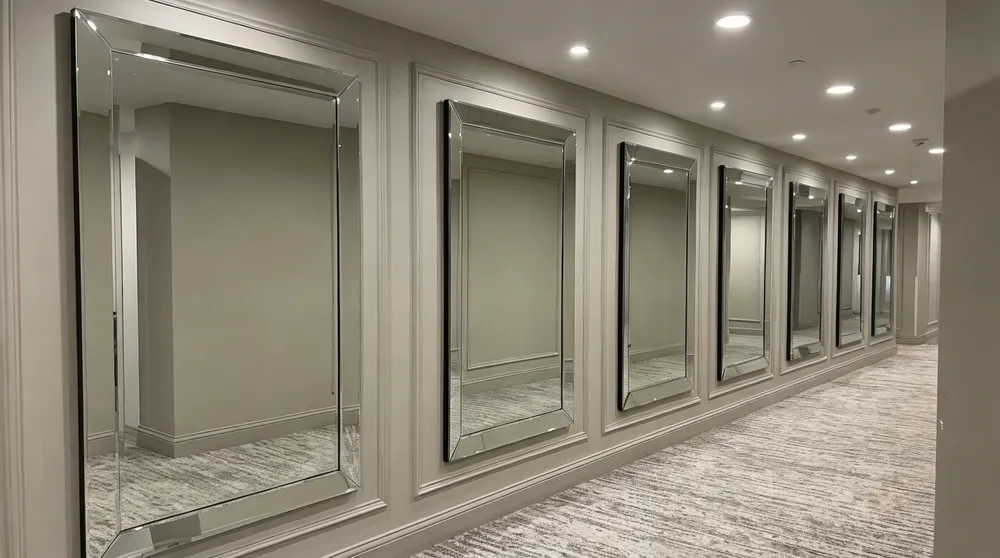
Hotels, restaurants, and commercial fit-out projects use frameless wall mirrors in lobbies, corridors, restrooms, and gym facilities. The appeal is clean-line aesthetics that don't compete with the interior design scheme, plus easy maintenance — no frame joints to collect dust, no finish to chip.
Hospitality orders tend to be project-based (200–500 units per property), with reorders tied to renovation cycles. For gym and pool-adjacent installations, we offer tempered glass options that meet safety glazing requirements. Beveled-edge rectangular mirrors in the 900×600mm to 1200×900mm range are the most common spec for this channel.
If you distribute to small home decor shops, gift stores, or furniture retailers, wall decor mirrors are a reliable catalog staple. They're impulse-friendly at the right price point, they don't require trend-specific merchandising, and they move year-round without seasonal markdown pressure.
Distributors typically carry 5–10 wall decor mirror SKUs spanning round, rectangular, and arch shapes in two or three sizes each. The low per-unit cost means your margin holds even at wholesale pricing to independents.
Typical Distributor SKU Mix
Round
2–3 sizes
Rectangular
2–3 sizes
Arch
2–3 sizes
Share your volume expectations and we'll recommend a starter SKU mix tailored to your market segment.
Get SKU RecommendationsWall decor mirrors have a shorter production chain than framed products, but the steps that remain are more exposed to quality variation. Here's what our process looks like and where we've learned to pay extra attention.
Starts with float glass sheets — we stock 3mm, 4mm, and 5mm in standard clear, plus bronze and grey tinted glass. Our automated cutting tables handle rectangular and square shapes with tight dimensional tolerance (±0.5mm).
For shaped glass — rounds, ovals, arches, hexagons — we use CNC waterjet cutting, which gives clean edges on curves without the micro-fractures that mechanical cutting can introduce on radius cuts.
Custom shapes require a cutting template, which our engineering team develops from your drawing or reference image in 3-5 days.
This is the step that defines the product. Beveling runs on dedicated grinding and polishing machines calibrated to hold consistent bevel width and angle across the full run.
We set bevel width at order start and verify every 50 units with a digital caliper check — bevel width drift is the most common quality issue in frameless mirror production, and it's invisible until you line up two mirrors side by side on a retail shelf.
Polished edges go through a three-stage sequence. Flat-ground and pencil edges are simpler processes but still get the same per-unit edge inspection.
Uses our copper-free process — silver deposition followed by two layers of protective paint, applied in a humidity-controlled environment. This is the same silvering line and process used for our framed mirrors; the parent category page covers the full silvering process details.
Key point for wall decor mirrors: Because there's no frame covering the mirror edges, the protective coating must extend fully to the glass perimeter. On framed mirrors, the frame overlaps the mirror edge by 5-10mm, which provides a secondary moisture seal. Frameless mirrors don't have that buffer, so our coating application extends to the absolute edge of the glass, and we run an adhesion pull test on edge samples from every batch.
The final production step. Standard models get an MDF backing board secured with clips, plus pre-installed hanging hardware.
The backing serves two purposes: it protects the silver coating from rear-side moisture and scratches during shipping, and it provides a solid mounting surface for the hanging hardware.
Lightweight models (small rounds, hexagon sets) use reinforced cardboard backing to keep the unit weight down — important for adhesive-mount gallery wall applications where your end customer doesn't want to drill into the wall.
Wall decor mirrors are the most customizable product in our line in terms of glass configuration, because there's no frame constraining the shape. Here's what you can specify and what the practical limits are.
Any shape that can be cut on our CNC waterjet table. Standard shapes (round, oval, rectangle, arch, hexagon, diamond) use existing templates at no additional tooling cost.
Irregular and custom shapes — a scalloped edge, a sunburst silhouette, an asymmetric organic form — require a new cutting template. Template development takes 3-5 days and costs are minimal; the template is reusable for all future orders of that shape.
Standard range: 200×300mm up to 1500×900mm.
We can produce up to 1800×1200mm, but mirrors above 1500mm in any dimension require 5mm glass minimum and reinforced packaging, which affects your freight cost per unit.
Below 200mm, we produce small-format mirrors for gallery wall sets and mosaic arrangements — these are typically sold in multi-piece packs.
Beveled, polished, flat-ground, pencil, and ogee edges are all available. Bevel width is adjustable from 10mm to 35mm.
You can also specify different edge treatments on different edges of the same mirror — for example, a beveled top and sides with a flat-ground bottom edge for a mirror designed to sit on a shelf or mantel.
Clear silver mirror is the default. Tinted options — bronze, grey, and black — are available at the same MOQ.
Bronze-tinted mirrors have been a strong seller for our hospitality buyers over the past two years; they add warmth to a space without requiring a frame, which keeps the FOB low while the perceived value stays high.
MDF or cardboard backing, with your choice of D-ring, sawtooth, French cleat, or wire hanging hardware.
For adhesive-mount applications (gallery wall sets, rental properties), we can include adhesive strips or omit hardware entirely.
Private label packaging, custom backing labels, branded hang tags, and custom carton printing are all available. Your brand, your unboxing experience — we stay invisible.
Buyer Insight
If you haven't tested tinted frameless mirrors in your market yet, a small trial order alongside your standard clear mirrors is worth considering — our distributors who added bronze tint saw a 15-20% ASP increase at retail with minimal additional COGS.
Send us a sketch or reference image of your custom shape — our engineering team will return a technical drawing and quote within 48 hours.
Wall decor mirrors are the most freight-efficient product in our decorative mirror line. No frame means a thinner packed profile per unit, which translates directly to more units per container and lower landed cost.
| Container | Retail Packaging | Bulk/Project |
|---|---|---|
| 20GP | 600–900 units | 900–1,300 units |
| 40HQ | 1,200–1,800 units | 1,800–2,600 units |
Unit counts vary by size mix within order
Framed mirrors typically load 800–1,200 units in a 40HQ with retail packaging. Wall decor mirrors load 50–80% more units in the same container — spreading the same ocean freight charge across significantly more product.
The difference is significant when calculating landed cost per unit.
ISTA 2A-tested configuration used across our full line:
Meets Walmart, Wayfair, and Amazon FBA receiving requirements
Configuration for project buyers, staging companies, and distributors who repack into their own branded packaging:
Ideal for distributors and white-label programs
Our logistics team provides a complete loading plan with your order confirmation — container type, pallet configuration, total carton count, and gross weight — so you can calculate your exact landed cost before committing to production.
Wall decor mirrors sold into North America and Europe need to meet specific safety and environmental standards. Here's what we cover and what you should be aware of for your target market.
Our copper-free silvering process meets EU REACH requirements for restricted substances. No lead, no copper in the reflective coating stack.
SGS test reports available for each production batch on request
Standard wall decor mirrors use annealed (non-tempered) float glass, appropriate for most decorative applications.
Tempered option available for installations where safety glazing is required by local building codes — gym facilities, commercial restrooms, areas accessible to children.
Tempered mirrors carry a slightly higher per-unit cost but eliminate liability exposure in regulated installations. CE marking available for EU markets.
Standard capabilities for major retail programs:
If you're placing wall decor mirrors into a retail program with specific compliance requirements, send us the vendor manual — we've onboarded with enough major retailers that the process is routine for our team.
For mirrors under 400mm in any dimension, 3mm glass is structurally sound and keeps your FOB and freight costs at their lowest. Between 400mm and 900mm, 4mm is the standard — it provides enough rigidity to hang flat without bowing and handles normal shipping stress. Above 900mm, go with 5mm.
The weight increase is modest (roughly 2.5 kg/m² per mm of thickness), but the rigidity difference is significant. We've seen buyers try to save on glass thickness for large-format mirrors, and the result is bowed panels that don't sit flat against the wall — a guaranteed return from any retail customer.
Traditional silvering uses a copper layer between the silver and the protective paint. Copper-free replaces that with a non-metallic protective layer.
The practical difference: copper-free holds up better in humid environments (bathrooms, coastal properties, pool areas), meets EU REACH environmental requirements without additional testing, and doesn't develop the dark-edge oxidation that copper-backed mirrors show after 2-3 years.
We run copper-free as our default process. For your business, it means fewer warranty claims on mirrors sold into moisture-prone applications and no compliance headaches for EU-bound shipments.
Wall decor mirrors carry the lowest FOB in the decorative mirror line, which gives you flexibility on retail pricing. In volume channels (Amazon, mass retail), they compete on price and move on velocity — high unit sales, moderate margin per unit, strong total margin on volume.
In curated channels (gallery wall sets, boutique retail), the margin story changes: a set of three frameless hexagonal mirrors with a $10-12 total FOB can retail for $50-70 as a packaged set.
Framed mirrors carry higher FOB but also command higher retail prices and tend to have lower velocity. Most of our distributors carry both — frameless for volume and entry-level positioning, framed for margin and premium positioning.
Yes. As long as each individual SKU meets the 100-piece MOQ (standard) or 200-piece MOQ (custom shape), you can combine as many SKUs as you need in a single order. We consolidate everything into one shipment.
A typical first order from a new distributor might include 3-5 SKUs: a round in two sizes, a rectangle, and an arch-top, totaling 500-1,000 units. That's enough to test your market across shapes without overcommitting on any single SKU.
Standard models using existing cutting templates and standard edge treatments ship in 25-30 days from order confirmation. Custom shapes requiring a new cutting template add 5-7 days for template development, bringing total lead time to 35-40 days.
Custom sizes on existing shapes (e.g., a non-standard dimension on a round mirror) don't require a new template and stay within the 25-30 day window. If you're working against a deadline, let us know upfront — we can often prioritize template development to compress the custom timeline.
Wall decor mirrors are the volume play — lowest FOB, highest container density, clean and minimal aesthetic. But if your market or project calls for something different, here's where to look within our line:
Need a frame for perceived value at retail? Wood decor mirrors hit the mid-tier with natural warmth and texture.
Ornate profiles at mid-range FOB for customers seeking decorative statement pieces.
Targeting the premium or design-forward segment? Higher ASPs and stronger margin per unit.
Premium positioning with classic metallic finish for design-conscious buyers.
Need shatter resistance for hospitality or commercial? Eliminates breakage risk entirely.
All sibling products ship from the same facility, so you can combine wall decor mirrors with any framed category in a single order and consolidate freight.
Most new buyers start with a sample order — 2-3 units across the shapes and edge treatments you're considering, shipped to your door so you can evaluate glass quality, edge finish, and packaging before committing to production quantities.
If you already know your specs, send us your size, shape, edge treatment, quantity, and target market. We'll return a detailed quote with FOB pricing, container loading plan, and production timeline.