Livewellcraft

DNOOO blank theme is active for local preview.

Top 10 Framed Decor Mirror Wholesalers in Canada Worth Contacting

Canada's framed mirror wholesale market is smaller than it looks from the outside. Most buyers searching for domestic suppliers quickly discover the same pattern: a handful of genuine stocking distributors, a larger number of importers reselling Asian-sourced product with a Canadian address, and a long tail of home decor wholesalers who carry mirrors as a secondary category alongside furniture and accessories. That's not a criticism — it's just the structure of the market, and understanding it changes how you evaluate each supplier on this list.

The ten companies below represent the realistic sourcing landscape for Canadian buyers looking for framed decorative mirrors in commercial quantities. Some are full-service distributors with warehouse stock. Some are category specialists. A few operate as trading intermediaries. Where a supplier's model affects your MOQ, lead time, or customization options, that's noted directly.

Before the list, a quick note on methodology: these companies were identified through Canadian wholesale directories, trade buyer forums, and direct website verification. Supplier descriptions stay conservative — we've noted what each company appears to offer based on publicly available information, not sales claims we can't verify.
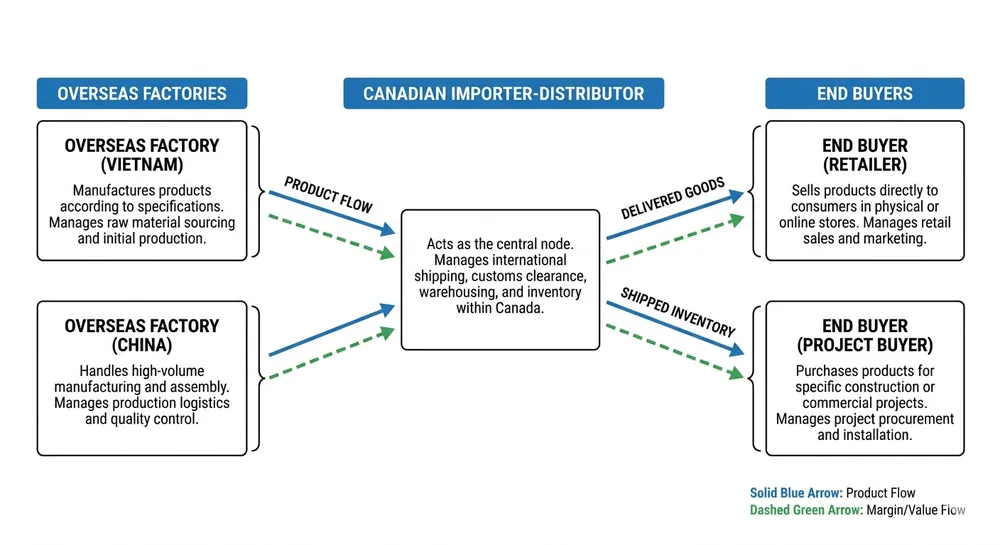
Diagram showing the Canadian framed mirror wholesale supply chain from factory to retailer and project buyer

What Serious Buyers Check Before Placing a Wholesale Mirror Order

MOQ and price are the first two questions, but they're rarely the deciding ones. The frame is where most wholesale mirror orders go wrong — not the glass. A cracked mirror is obvious at receiving. A frame with inconsistent finish, joint gaps that open after six months on a retail floor, or a powder coat that chalks under store lighting is a warranty problem that shows up after your customer has already paid.

When you're evaluating any supplier on this list, run through these criteria before committing to a trial order:

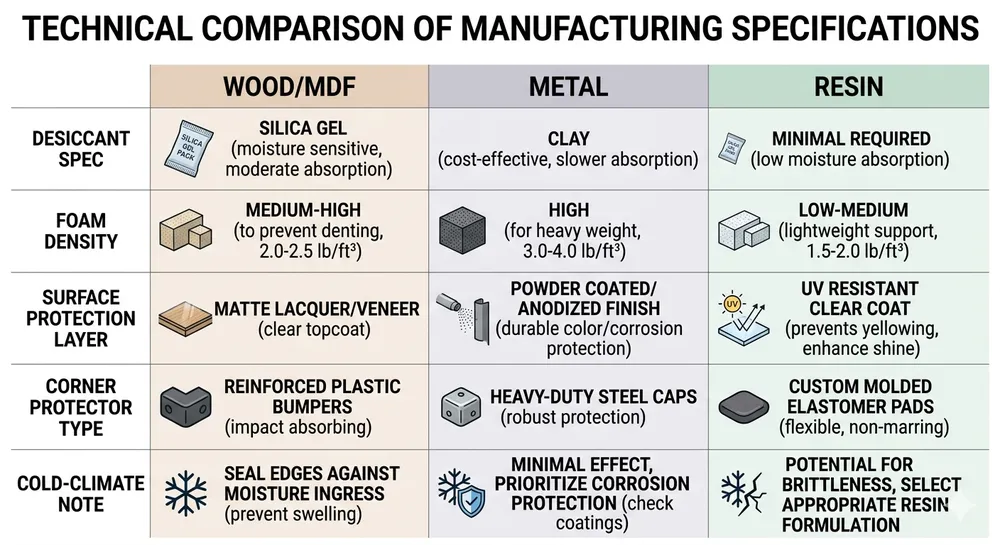
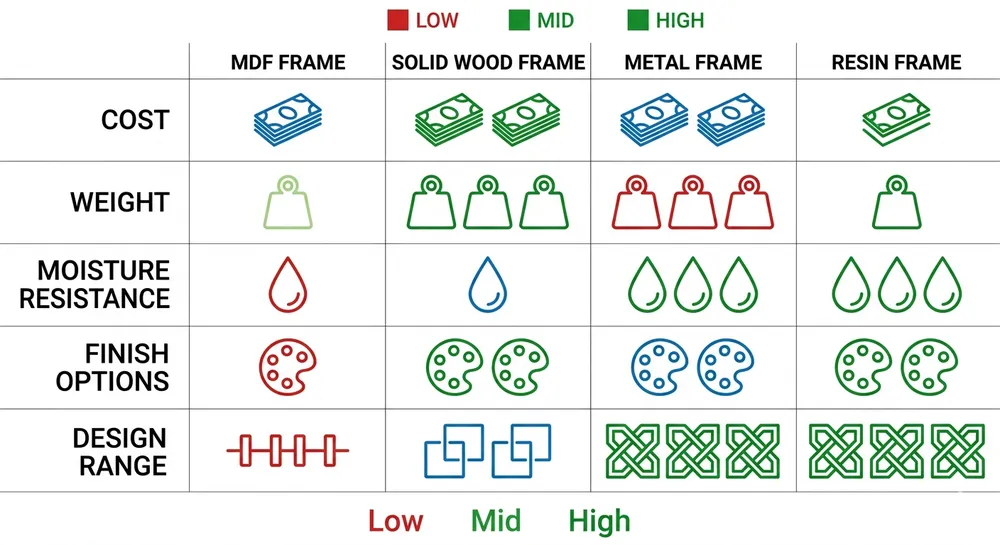
Frame material and construction method — Is the frame MDF-wrapped, solid wood, metal tube, or resin cast? Each has a different cost floor, weight profile, and failure mode. MDF frames are cost-efficient but moisture-sensitive; metal frames ship heavier but hold finish better in humid environments. Ask specifically, because "wood-look frame" often means MDF with a foil wrap, not solid wood.

Finish specification — For painted frames, ask for the coating thickness and whether they use a primer coat. For metal frames, ask whether it's powder coat or electroplate, and what the salt spray test result is. (We run our powder-coated frames to 500 hours minimum — below that, coastal retail accounts generate RMA claims.)

MOQ per SKU vs. MOQ per order — Some wholesalers quote a low per-order MOQ but require you to hit it across a narrow SKU range. If you're building a mixed assortment, the effective MOQ per style can be much higher than the headline number.

Packaging standard — Retail-ready packaging (individual box, corner protection, hang tag) versus bulk packing affects your receiving labor and your ability to drop-ship or floor-display without repackaging.

Lead time from order to dock — For stocking distributors, this is days. For importers placing orders against your PO, it's typically 45–75 days from Vietnam or China, plus ocean transit and customs clearance.
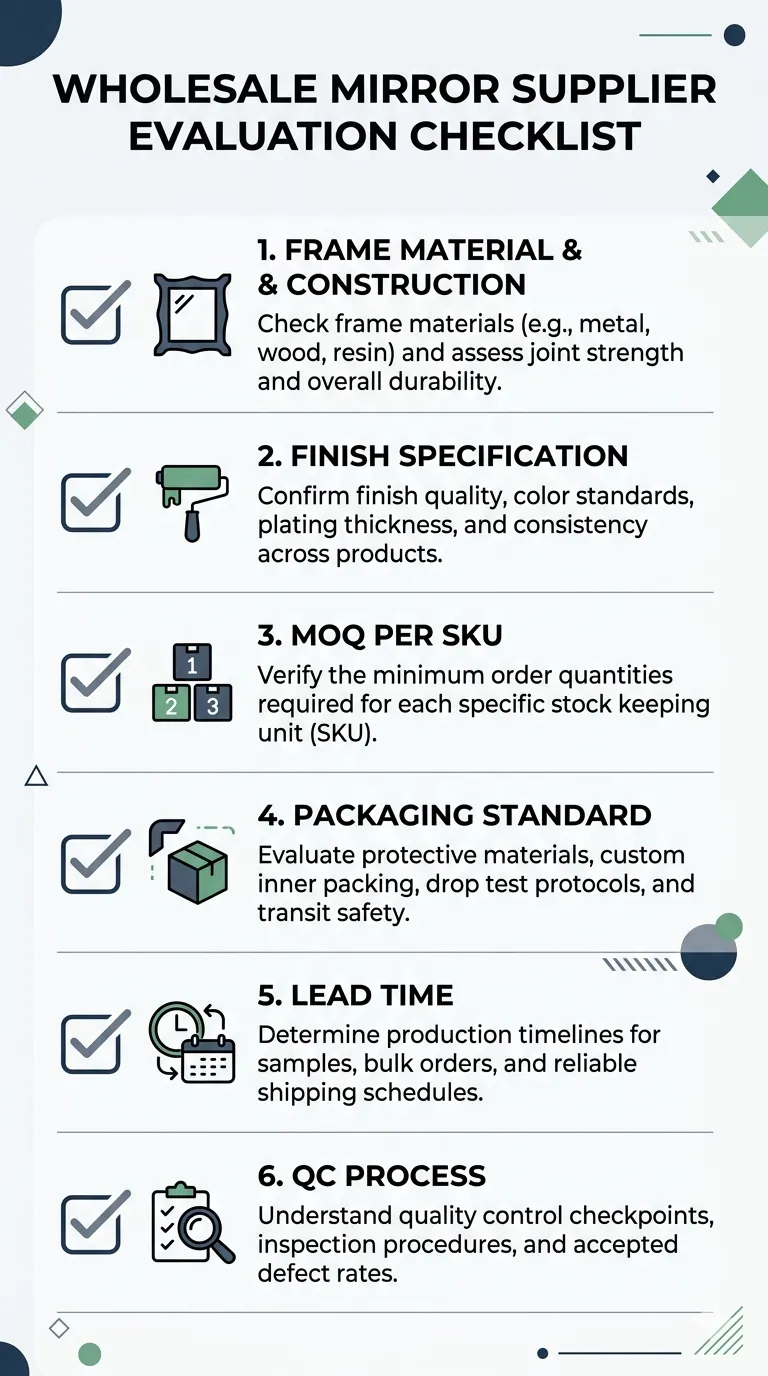
Supplier evaluation checklist for wholesale framed decorative mirrors covering MOQ, frame material, finish spec, packaging, and lead time

The 10 Canadian Framed Mirror Wholesalers Worth Evaluating

1. Umbra — Toronto, ON

Website: umbra.com

Umbra is one of the few Canadian companies that designs and develops its own mirror and home decor products rather than reselling imported stock under a generic label. Their framed mirror range skews contemporary and design-forward — thin metal frames, geometric shapes, multi-mirror wall arrangements. They wholesale to independent retailers and interior design trade accounts across Canada and the US. MOQ varies by product line; their trade program is accessible through their website. Lead times on stocked items are short. Custom or private-label work is not their model — they sell their own branded product.

Best fit for: Retailers who want design-differentiated product with brand recognition and reliable domestic stock.

2. Korhani Home — Mississauga, ON

Website: korhani.com

Korhani is primarily a rug and flooring wholesaler, but their home decor division carries framed wall mirrors as part of a broader accessories assortment. They distribute to independent furniture and home decor retailers across Canada. Their mirror range tends toward transitional and traditional styles — ornate resin frames, gold and silver finishes. Stock depth on mirrors is secondary to their core rug business, so availability can be inconsistent on specific SKUs. Worth contacting if you're already buying rugs or soft furnishings from them and want to consolidate suppliers.

Best fit for: Retailers consolidating home decor purchasing with an existing Korhani account.

3. Adairs Wholesale / Canadian Home Decor Distributors (via Canwel / regional reps)

Canada's mid-market home decor wholesale tier is served by a network of regional sales reps and small importers who don't always maintain a prominent web presence. Several operate through trade show channels — the Toronto Gift Fair and the Calgary Gift Show are the two main discovery points for this tier. These suppliers typically carry 20–60 mirror SKUs, stock in a single warehouse (usually Ontario or BC), and serve independent gift shops, boutique furniture stores, and interior design studios. MOQs in this tier are often low (6–12 pieces per style), but product consistency and reorder reliability vary significantly.

Best fit for: Independent retailers who need low-MOQ access to a mixed assortment and can absorb some SKU discontinuation risk.

4. Homeroots (Canadian distribution) — distributed via wholesale platforms

Website: homeroots.co

Homeroots is a US-based home furnishings wholesaler with distribution reach into Canada through their drop-ship and wholesale programs. Their framed mirror catalog is extensive — hundreds of SKUs across metal, wood, and resin frames in a wide finish range. They operate primarily as a drop-ship supplier for online retailers and marketplaces, but also offer bulk wholesale pricing for stocking orders. Canadian buyers should factor in cross-border shipping costs and potential duty on US-origin or US-warehoused product. Lead times on in-stock items are fast; out-of-stock items can have unpredictable replenishment timelines.

Best fit for: Canadian e-commerce retailers or marketplace sellers who want broad SKU access without holding inventory.

5. Privilege Furniture & Décor — Montréal, QC

Website: privilegefurniture.com

Privilege is a Montréal-based importer and wholesaler serving the Quebec and Eastern Canada retail market. Their catalog covers furniture and home accessories including framed mirrors, with a focus on traditional and transitional styles. They maintain warehouse stock in Quebec and serve independent furniture retailers and interior designers. French-language service is a practical advantage for Quebec-based buyers. Their mirror range is not their primary category, so frame material depth and finish options are limited compared to a mirror-specialist supplier.

Best fit for: Quebec-based retailers who want a local warehouse relationship and French-language account support.

6. Bouclair Home (wholesale/trade program)

Website: bouclair.com

Bouclair is a Quebec-founded home decor retailer that also operates a trade and wholesale program for interior designers and commercial buyers. Their framed mirror selection is curated and trend-driven — they refresh their assortment seasonally. This makes them useful for buyers who want current styling, but less reliable for buyers who need consistent reorder on the same SKU across multiple seasons. MOQ through their trade program is accessible. They're not a volume wholesale supplier in the traditional sense, but their product quality and styling are above the generic import tier.

Best fit for: Interior designers and boutique retailers who prioritize styling currency over SKU stability.

7. Canac / regional building material distributors (mirror category)

Several Canadian building material and hardware distributors — including regional players in Quebec and Ontario — carry framed bathroom and decorative mirrors as part of their home improvement category. These are not home decor specialists, but they stock framed mirrors in standard sizes (24×36, 30×40, 36×48 inches) suitable for residential and light commercial projects. Pricing is competitive on standard sizes. Frame options are limited — typically beveled wood or basic metal. Custom sizing or finish options are not available through this channel.

Best fit for: Contractors and project buyers who need standard-size framed mirrors in volume with fast local pickup.

8. Wholesale Club / Costco Business Centre (opportunistic bulk channel)

Not a traditional wholesale supplier, but worth noting for buyers who operate in the value tier. Both Costco Business Centre and Wholesale Club periodically carry framed decorative mirrors in bulk pack at aggressive price points. Selection is opportunistic — you buy what's available, not what you specify. No custom options, no reorder guarantee, no frame material transparency. Useful for filling out a low-price tier in a mixed assortment, not for building a reliable product program.

Best fit for: Value-tier retailers who can absorb SKU variability and don't require reorder consistency.

9. Décor-Rest Furniture / Canadian furniture wholesale network

Décor-Rest and similar Canadian furniture wholesalers occasionally include framed mirrors as accent pieces within their furniture collection programs. These are typically sold as part of a room grouping or collection package rather than as standalone mirror SKUs. If you're already buying furniture from a Canadian wholesaler, ask whether they carry mirrors as add-on items — the pricing is often favorable within an existing account relationship.

Best fit for: Furniture retailers who want to add mirrors as margin-enhancing accessories within an existing supplier relationship.

10. Direct import via Canadian mirror importers (Alibaba-sourced, Canadian address)

A significant portion of the Canadian framed mirror wholesale market is served by small importers who source directly from Chinese or Vietnamese factories, hold stock in a Canadian warehouse, and resell at wholesale prices. These companies often don't have a strong web presence — they operate through trade shows, word of mouth, and B2B platforms. Product quality varies widely. The advantage is domestic stock and low MOQ. The disadvantage is that you have no visibility into the factory behind the product, no ability to customize, and limited recourse if quality is inconsistent across shipments.

Best fit for: Buyers who need domestic stock access and are willing to accept product variability in exchange for low MOQ and fast delivery.
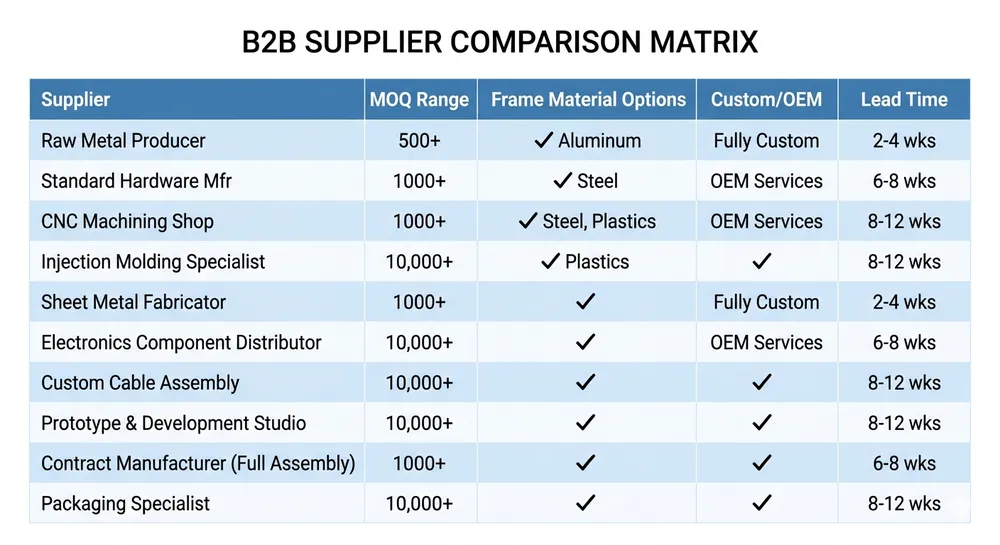
Comparison matrix of Canadian framed mirror wholesalers by MOQ, frame material range, customization, and lead time

Where Local Wholesale Adds Real Value — and Where It Compresses Your Margin

Local Canadian wholesalers solve specific problems well. If you need 12 pieces of a framed mirror for a client project that starts in three weeks, no factory in Vietnam can help you. If you're a new retailer testing a mirror category with limited capital, a domestic wholesaler's low MOQ and net-30 terms are genuinely useful. If you're buying across multiple home decor categories and want a single invoice, a broad-line distributor makes operational sense.

These are real advantages. The question is what you pay for them.

The typical Canadian wholesale markup on imported framed mirrors runs 40–70% above the landed factory cost. That margin covers warehousing, local logistics, account management, and the wholesaler's own import risk — all legitimate costs. But it means your cost of goods is structurally higher than a buyer who imports directly, and that gap compounds as your volume grows.

On a 500-unit order of a mid-range framed mirror — say a 24×36 inch MDF frame with a painted finish — the difference between buying from a Canadian wholesaler and importing factory-direct from Vietnam typically runs CAD $8–18 per unit depending on the frame spec and finish complexity. At 500 units, that's CAD $4,000–9,000 in margin that either stays in your pocket or gets passed to your customer as a lower retail price. At 2,000 units annually, the math becomes a sourcing strategy decision, not just a price comparison.

(The CAD $8–18 range is a representative estimate based on typical wholesale markup structures — your actual gap will depend on the specific product, your current supplier's pricing, and the landed cost of the factory-direct alternative including freight and duty.)

CBSA Tariff and Compliance Considerations for Mirror Imports

If you're evaluating factory-direct import as an alternative to domestic wholesale, the landed cost calculation needs to include Canadian customs duties and compliance requirements.

CBSA tariff classification: Decorative framed mirrors typically fall under HS code 7009.92 (glass mirrors, framed) or 7009.91 (unframed), with the framed category being most relevant here. The Most Favoured Nation (MFN) duty rate for mirrors from Vietnam is generally 0% under CPTPP (the Comprehensive and Progressive Agreement for Trans-Pacific Partnership), which Canada and Vietnam are both party to. This is a meaningful cost advantage — mirrors imported from Vietnam under CPTPP origin qualification enter Canada duty-free, while mirrors from non-CPTPP countries may attract duty.

Origin documentation: To claim CPTPP preferential tariff treatment, your supplier needs to provide a valid Certificate of Origin or origin declaration. Any factory you work with should be able to provide this routinely — if they can't, that's a red flag about their export compliance capability.

Canada Consumer Product Safety Act (CCPSA): Decorative mirrors sold in Canada must comply with CCPSA requirements. For framed wall mirrors, the primary compliance considerations are packaging safety (no sharp edges on retail packaging), and for mirrors with hanging hardware, the hardware must be rated for the mirror's weight. Most export-grade factories producing for North American markets build to these standards as a baseline — ask for their compliance documentation before your first order.

Anti-dumping: There are no current Canadian anti-dumping orders specifically targeting decorative framed mirrors from Vietnam or China as of this writing, but it's worth verifying current CBSA notices before placing a large first order.

Factory-Direct Framed Mirror Sourcing: What the Economics Actually Look Like

The wholesaler landscape above covers your domestic options honestly. Here's where the trade-off becomes a sourcing strategy question rather than a convenience decision.

We manufacture framed decorative mirrors at our 12,000 m² facility in Ho Chi Minh, Vietnam. Six production lines, 150 people, 400,000 pieces a year — the scale matters because it means your order doesn't queue behind a larger customer's run. We've been doing this since 2008, and the majority of our volume goes to North American buyers: retailers, distributors, and project buyers who started with a trial order and now run annual programs.

The frame is where we're different from a trading company reselling stock. We run our own frame production — MDF profiles, solid wood, metal tube, and resin casting are all done in-house. When a buyer asks for a 2-inch antique gold MDF frame with a specific profile radius, we're not calling a frame supplier and hoping for consistency across shipments. We're cutting and finishing that profile on our own line, which means the 500th unit matches the first. (Frame joint consistency is the most common complaint we hear from buyers who've switched from trading companies — the profile looks right in the sample but drifts in production. In-house frame control eliminates that.)

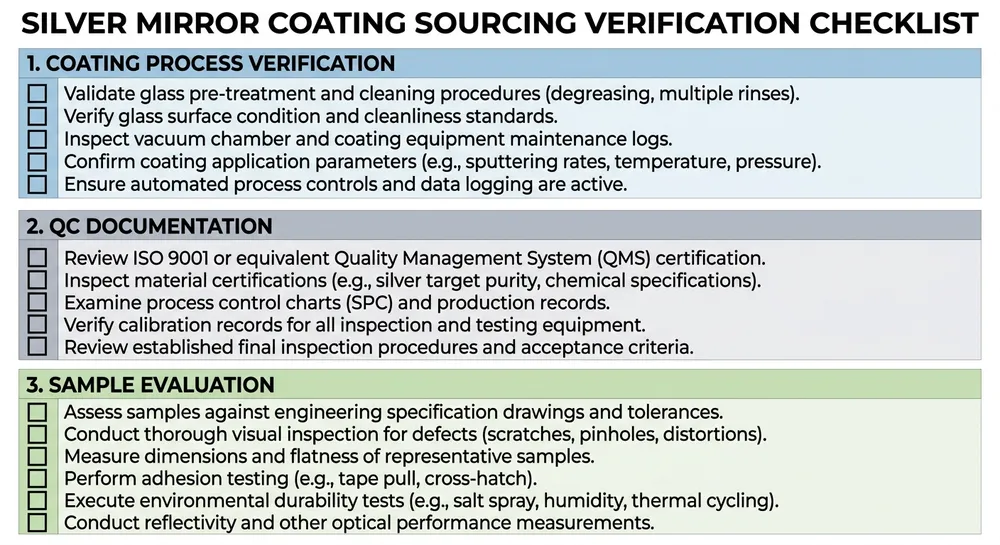
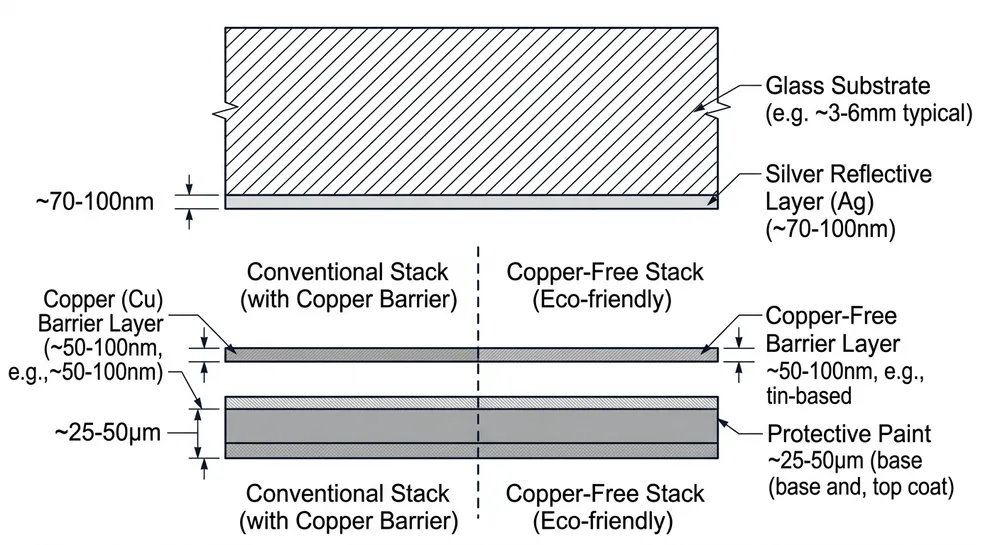
Our copper-free silvering process is worth mentioning specifically for Canadian buyers targeting coastal or humid-climate retail accounts. Standard silver mirrors use a copper backing layer that oxidizes at the edges over time — the black edge creep you see on older mirrors. Copper-free silvering eliminates that failure mode, which matters if your customers are in Vancouver, Halifax, or any coastal market where humidity accelerates the process. It's a spec detail that most wholesalers can't tell you about the product they're selling, because they don't know what's behind the glass.

On MOQ: we start at 100 pieces for standard models on existing molds. For custom frame profiles, the minimum is higher — typically 300–500 pieces depending on the tooling investment — but we absorb the mold cost on programs above 1,000 pieces annually. Most Canadian buyers we work with start with a 200-unit mixed trial order across 3–4 SKUs, then consolidate to a 2–3 container annual program once they've tested the product with their customers.

Lead time on existing molds runs 30–35 days production plus ocean transit — roughly 55–65 days door to Canadian port. That's longer than calling a domestic wholesaler, and we won't pretend otherwise. The trade-off is unit economics, customization control, and the ability to build a product program that your competitors can't easily replicate from the same wholesale catalog.

For buyers evaluating our Frame Decor Mirrors range, the Decor Mirrors by Material & Frame category page covers our full frame material and finish options in detail. If you're earlier in the sourcing decision and want to understand how frame material selection affects cost and durability, How to Choose Decor Mirror Frame Materials walks through the trade-offs we see most often from buyers in your market.

Bar chart comparing per-unit landed cost of factory-direct framed mirror import from Vietnam versus Canadian wholesale purchase at different order volumes

Which Sourcing Route Fits Your Situation

The honest answer is that both routes have a place depending on your order profile.

Local wholesale makes sense when:

  • You need product in under 4 weeks
  • Your order is under 100 pieces and you can't meet a factory MOQ
  • You're testing a new mirror category with no volume commitment
  • You need net-30 terms from a Canadian entity and can't manage import financing
  • You're filling a gap order between container shipments

Factory-direct import makes sense when:

  • You're ordering 300+ pieces per run and the per-unit cost gap is material to your margin
  • You want a frame profile, finish, or size that isn't available in the domestic wholesale catalog
  • You're building a private-label or OEM program that requires consistent production control
  • You're supplying a hospitality or commercial project where finish consistency across 200+ identical units is non-negotiable
  • You've been burned by inconsistent quality from a domestic wholesaler who can't tell you what factory made the product

The buyers who get the most value from factory-direct sourcing are typically those running a repeat annual program — not one-off orders. The economics improve with volume, and the relationship with the factory improves with repeat orders. We know which of our Canadian buyers are running seasonal programs, and we plan production capacity around them.

If you're currently buying from a Canadian wholesaler and want to understand whether the volume and margin math supports a direct import program, the Decor Mirror Frame Materials Sourcing Guide covers the cost structure in more detail. For buyers also evaluating the US market, Framed Mirror Suppliers in the USA covers the parallel landscape south of the border.

Frequently Asked Questions

What MOQ do Canadian framed mirror wholesalers typically require?

It varies significantly by supplier type. Stocking distributors serving independent retailers often go as low as 6–12 pieces per style with no order minimum. Mid-tier importers typically require 24–48 pieces per SKU or a minimum order value of CAD $500–1,500. For factory-direct import, the practical floor is 100 pieces per style for standard models — below that, the per-unit freight cost erodes the price advantage over domestic wholesale.

What frame materials are most commonly available through Canadian wholesale channels?

The majority of Canadian wholesale framed mirrors use MDF frames with a foil wrap or painted finish, or metal tube frames with powder coat. Solid wood frames are available but less common at the wholesale tier — they're heavier, more expensive to ship, and harder to produce consistently at volume. Resin frames (cast polyurethane) are available through some importers for ornate traditional styles. If you need a specific frame material or profile, domestic wholesale is unlikely to offer customization — that's where factory-direct sourcing becomes the only viable route.

Does importing framed mirrors from Vietnam to Canada attract customs duty?

Under CPTPP, decorative framed mirrors from Vietnam (HS 7009.92) generally qualify for 0% MFN duty when proper origin documentation is provided. Your supplier should furnish a Certificate of Origin or origin declaration with each shipment. Factor in the 5% GST on the CIF value, plus any applicable provincial taxes, when calculating your landed cost. Brokerage fees typically run CAD $150–300 per shipment through a licensed customs broker.

What's the difference between copper-free and standard silver mirrors for retail buyers?

Standard silver mirrors use a copper sulfate layer between the glass and the silver coating. Over time — especially in humid environments — that copper layer oxidizes and causes the characteristic black edge creep you see on aging mirrors. Copper-free silvering replaces the copper layer with a tin-based barrier, which is significantly more resistant to oxidation. For retail buyers supplying coastal markets (Vancouver, Halifax, Victoria), copper-free is worth specifying — it reduces warranty claims and extends the product's visible lifespan on the retail floor. Most Canadian wholesalers can't confirm which process their product uses; a factory-direct supplier can.

What packaging standard should I require for wholesale framed mirror orders?

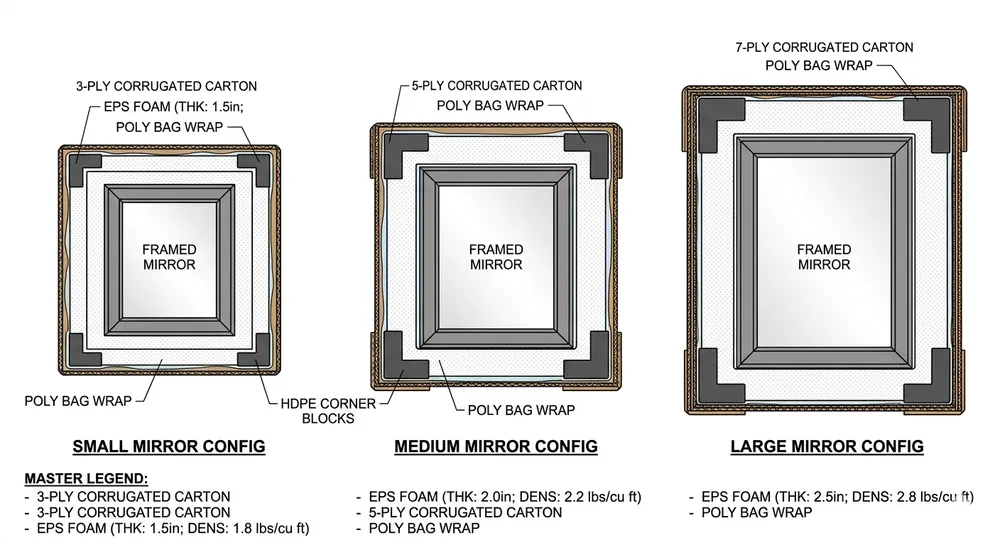
For retail floor display: individual RSC (regular slotted carton) box with foam corner inserts, a poly bag over the mirror face, and a hang tag or label slot. For project/contract delivery: master carton packing is acceptable if your receiving team can handle bulk unpacking. For drop-ship or e-commerce fulfillment: the individual box needs to survive a 1.2-meter drop test without glass breakage — ask your supplier specifically about their e-commerce packaging spec, because standard retail packaging often fails this test.
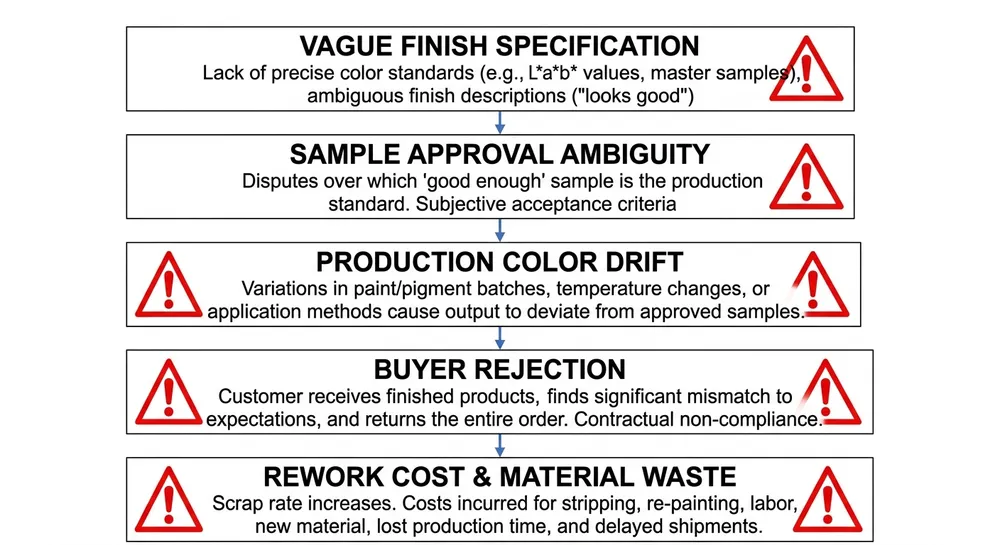
How to Specify Custom Mirror Frame Finishes for OEM Orders and Avoid Costly Rework

What a Vague Finish Spec Actually Costs You

Last year we received a 3,000-unit order with the finish spec written as "matte gold, similar to attached photo." The photo was a phone snapshot of a competitor's product taken under warm retail lighting. No Pantone reference, no gloss range, no substrate callout. We produced a golden-run sample, the buyer approved it over video call, and we ran the batch. When the container landed, the buyer's QC team rejected 40% of the units. The finish looked different under their warehouse fluorescents than it had on screen. That rework cost the buyer eleven weeks and roughly $8,500 in recoating, repacking, and air-freight for the replacement units.

The finish itself was fine. The spec was the problem.

This happens more often than it should. A frame finish that reads clear in your head can mean three different things on a production floor if the spec sheet doesn't pin down substrate, coating method, color reference, gloss window, and adhesion grade. Every gap in your spec is a decision your factory makes without you, and those decisions compound across a 5,000-piece run.

Flowchart showing how vague finish specs lead to sample mismatch, production drift, and rework costs in mirror frame OEM orders

Why the Mismatch Happens Between Sample and Production

A golden sample sitting on your desk went through a controlled process. One operator, one spray gun, one small panel, hand-finished and inspected under consistent light. Production is different. Your 3,000 frames run through an automated or semi-automated line over multiple shifts. Ambient temperature and humidity shift between morning and afternoon. Spray distance varies slightly between operators. Paint viscosity changes as a batch sits in the pot.

None of these variables are defects. They're normal production realities. The job of your finish spec is to define the acceptable window around your approved sample so the factory's QC team can measure conformance objectively, not guess whether a frame "looks close enough."

Without measurable tolerances, your factory is comparing production output to a memory of what the sample looked like. That's where color drift, gloss mismatch, and adhesion inconsistency creep in.

Four Finish Methods for Mirror Frames — and What Each Demands from Your Spec

Not every finish method needs the same spec detail. Here's what we run in-house and what your spec sheet needs to control for each one.

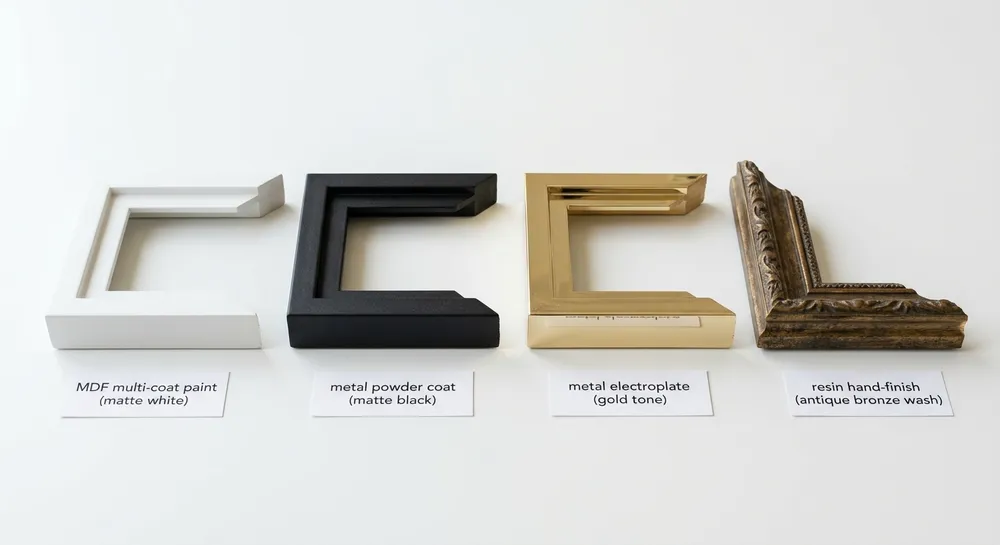
Finish Method Typical Substrates Key Spec Callouts Common Failure If Under-Specified
MDF/wood multi-coat paint MDF, engineered wood, solid wood Primer type, number of coats, color (Pantone/RAL), gloss units at 60°, adhesion grade Color drift between batches, orange peel texture, adhesion failure in humid markets
Metal powder coat Steel, aluminum profiles Powder chemistry (polyester, epoxy-polyester), film thickness (μm), color (RAL), gloss, salt spray hours Inconsistent film build, poor edge coverage on complex profiles, chalking in outdoor-adjacent use
Metal electroplate Steel, zamak, brass Plating layer sequence, target thickness per layer (μm), color tone reference, corrosion test standard Peeling at bends, color tone variation between racks, tarnishing in coastal/humid storage
Resin hand-finish Polyresin, polyurethane Base color, wash/antique technique reference, acceptable variation range, sealer coat spec Inconsistent hand-applied effects, color bleed between production batches, sealer adhesion failure

(We run all four methods on dedicated lines in our Ho Chi Minh facility. That matters because finish problems often start when a factory subcontracts coating to a third party and loses process control between stations.)

MDF/wood multi-coat is the most common finish method for decorative mirror frames in the mid-price segment. Your spec needs to call out the number of coats — typically a sealer, one or two color coats, and a topcoat. Each layer affects the final appearance. Skip the sealer on MDF and you get uneven absorption that shows as blotchy color, especially on darker finishes. We sand between coats on our line, which adds cost but eliminates the rough texture that causes QC rejections downstream.

Metal powder coat gives you the best durability-to-cost ratio for metal-framed decorative mirrors. Specify film thickness as a range — typically 60-80 μm for standard decorative frames. Below 50 μm you risk poor coverage on edges and corners. Above 100 μm you get sag and orange peel. Always call out the powder chemistry: polyester for anything near windows or humid environments, epoxy-polyester hybrid for interior-only applications where you want cost savings.

Electroplate is where specs get expensive to fix after the fact. A gold-finish mirror frame might involve a nickel base layer, a gold-tone top layer, and a clear lacquer seal. Each layer has a target thickness, and the color tone shifts with plating time and bath chemistry. If your spec just says "gold electroplate," you'll get whatever the operator's default settings produce — which may not match your approved sample by the second or third rack. Specify the layer sequence and reference a physical color standard, not a photo.

Resin hand-finish is inherently variable, and that's part of its appeal for antique and artisan-look frames. But "inherently variable" doesn't mean "no spec." Define the acceptable variation range with physical reference samples — a lightest-acceptable and darkest-acceptable pair. Without that bracket, your QC team has no objective basis for pass/fail decisions on the packing line.

Side-by-side comparison of MDF multi-coat, metal powder coat, electroplate, and resin hand-finish on mirror frame samples

How to Write a Finish Spec Sheet Your Factory Can Execute

A finish spec that prevents rework covers six fields. Miss any one and you're leaving a production decision to someone who hasn't seen your market or your end customer's expectations.

1. Substrate and prep

State the frame material and the surface preparation you expect before coating. For MDF: sanding grit sequence and sealer requirement. For metal: degreasing method and any pre-treatment (phosphating for powder coat, activation for electroplate). Substrate prep is where most adhesion failures originate. If your spec is silent on prep, the factory will use their default — which may or may not match what your sample went through.

2. Coating method and system

Name the coating method explicitly. Then specify the system: number of layers, type of each layer, and application method if it matters. "Spray-applied two-coat polyurethane with wet-on-wet application" is a spec. "Painted finish" is not.

3. Color reference

Use a physical standard: Pantone, RAL, or NCS code. If your target color doesn't match a standard chip exactly, send a physical sample and note the standard code that's closest, plus the direction of deviation ("RAL 1036 but 10% warmer / less green"). Photos are useful as supplementary references but unreliable as primary color specs — screen calibration, lighting, and camera white balance all distort color.

4. Gloss level

Specify gloss as a measurable range in gloss units (GU) at 60°. Common targets for decorative mirror frames:

  • High gloss: 80+ GU
  • Semi-gloss: 40-60 GU
  • Satin: 20-35 GU
  • Matte: 5-15 GU

A spec that says "matte" without a GU range is asking for trouble. One operator's matte is another's satin. Pin it down.

5. Adhesion standard

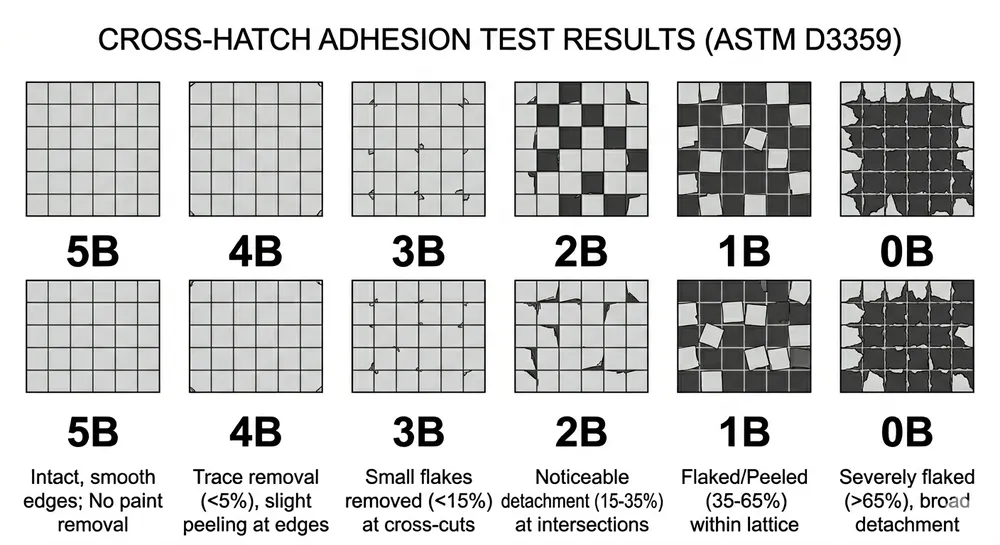
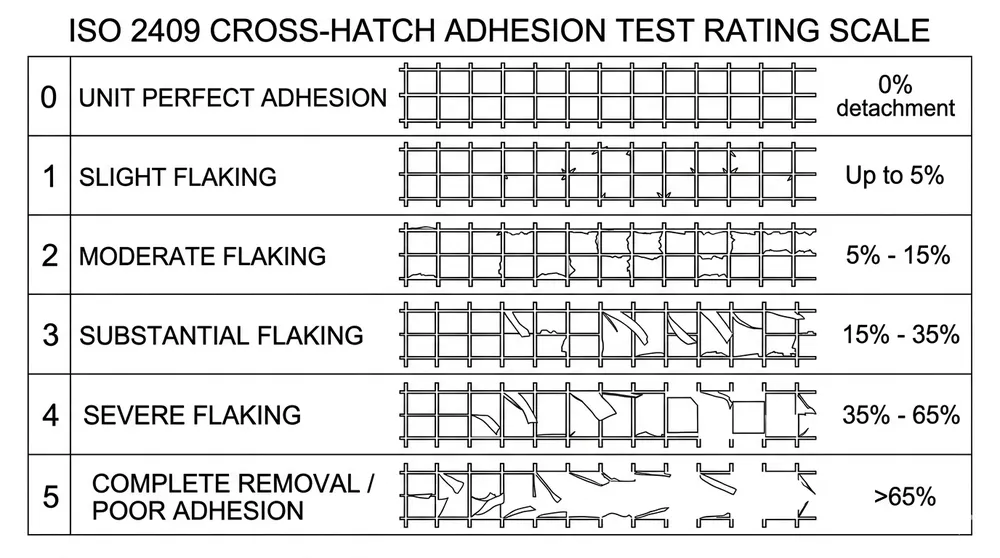
Call out the test method and minimum grade. ASTM D3359 cross-hatch adhesion test, Grade 4B minimum is a standard callout for painted and powder-coated mirror frames. For electroplate, specify a thermal cycling test or a bend test appropriate to the substrate. If you're shipping to humid markets — Southeast Asia, coastal US, Middle East — adhesion testing is where you catch failures before they become warranty claims.

6. Environmental and durability rating

If the frames will sit in bathrooms, near windows, or in humid retail environments, specify the relevant durability test: salt spray hours (ASTM B117) for metal finishes, humidity resistance hours for painted finishes, UV resistance if the product faces direct sunlight. Don't over-specify — a decorative bedroom mirror doesn't need 1,000-hour salt spray — but don't leave it blank either.

(We keep a one-page finish spec template that covers all six fields. When a buyer fills it out before we quote, the sample-to-production match rate jumps from roughly 85% to over 97%. Most of the rework we see traces back to specs that skipped fields 4, 5, or 6.)

Tolerance Callouts That Prevent Batch Rejection

Three measurements separate a spec that works from a spec that generates arguments at receiving.

Color variance: Delta-E (ΔE)

Delta-E measures the perceptible difference between two colors. For production mirror frames, specify ΔE ≤ 1.5 for solid colors and ΔE ≤ 2.0 for metallic or textured finishes. Below 1.0 is difficult to hold across a full production run without significant cost increase. Above 2.0 and your end customers will notice variation between units on the same retail shelf.

Your factory should measure delta-E with a spectrophotometer against the approved sample, not by visual comparison. If your supplier doesn't own a spectrophotometer, that's a red flag worth addressing before you place the order.

Gloss consistency: GU at 60°

Specify a range, not a single number. Target 10 GU ± 3 GU for matte, 50 GU ± 5 GU for semi-gloss. Gloss is affected by film thickness, cure temperature, and ambient humidity during application. A tight single-number target guarantees arguments. A defined range gives the factory room to operate while keeping your product consistent.

Adhesion grade: ASTM D3359

The cross-hatch test scores from 0B (complete removal) to 5B (no removal). Specify 4B minimum for standard decorative frames. For frames going into hospitality or commercial projects where cleaning chemicals contact the finish, specify 5B. Run the test on production units, not just the pre-production sample — adhesion can degrade if the factory changes cure time or skips a prep step mid-run.

ASTM D3359 cross-hatch adhesion test grade scale from 0B to 5B showing progressive coating retention on mirror frame finish samples

Five Spec Mistakes That Generate the Most Rework

After twelve years of running finish lines, these are the patterns I see repeat:

1. Color spec by photo only. Photos shift with every screen. Send a physical chip or call out a Pantone/RAL code. If you can't send a chip, at least specify the standard code closest to your target and describe the deviation in words.

2. No gloss range on "matte" or "satin" callouts. These words mean different things to different people. Always attach a GU number.

3. Skipping adhesion requirements for humid-market shipments. A finish that holds fine in a dry warehouse in Ohio can peel within months in a Bangkok retail store. If your distribution includes tropical or coastal markets, your adhesion spec needs to reflect that.

4. Approving a sample under different lighting than your receiving inspection. If you approve a sample under warm 3000K showroom light and your warehouse QC checks under 5000K fluorescents, the color will look different. Specify the light source for color evaluation — D65 daylight equivalent is the industry standard for a reason.

5. No spec for edge and corner coverage on powder-coated metal frames. Powder coat naturally thins at sharp edges due to the Faraday cage effect. If your frame profile has tight corners or decorative ridges, call out minimum edge coverage thickness or require the factory to radius sharp edges before coating. We radius all edges to a minimum 0.5 mm before powder application — it adds a step but eliminates the thin-spot failures that show up as rust spots six months after delivery.

Matching Your Finish Spec to the Market You're Selling Into

Your finish spec should reflect where the product ends up, not just what looks good on a sample board.

Hospitality and commercial projects need durability above all. Specify higher adhesion grades (5B), salt spray resistance for any metal components, and chemical resistance if the frames will be cleaned with commercial products. Gloss consistency matters less than longevity — a slight variation between rooms is invisible, but peeling finish in a hotel lobby is a callback.

Retail and e-commerce need visual consistency across units. Your customer might buy two silver-finish mirrors from the same listing and hang them side by side. Tight delta-E (≤ 1.5) and gloss consistency are worth the cost here. Packaging also matters — specify protective film or corner guards to prevent finish damage in transit.

Wholesale distribution needs a spec that balances cost and durability. You're likely stocking inventory across climate zones, so adhesion and humidity resistance should be specified even if the primary market seems dry. Your distributor in Arizona might redirect stock to a Florida account, and the finish needs to survive that.

(If you're building a frame material and finish program across multiple SKUs, standardizing your spec template across the line saves time on every reorder. We keep finish records for every SKU we produce, so your repeat orders match the original without re-sampling.)

How In-House Finishing Lines Close the Gap Between Spec and Production

The reason finish specs fail most often isn't that the spec was wrong — it's that the spec traveled through too many hands before reaching the coating operator. When your frame supplier subcontracts finishing to a separate coating shop, your spec gets interpreted twice: once by the frame factory and once by the coater. Each interpretation introduces drift.

We run MDF multi-coat, metal powder coat, electroplate, and resin hand-finish on dedicated lines inside our 12,000 m² facility in Ho Chi Minh. Your spec goes from our engineering team directly to the line supervisor who runs your job. One interpretation, one facility, one QC checkpoint before packing.

Our 12-engineer OEM team reviews your finish spec before we quote. If a callout is ambiguous or likely to cause production issues — say, a gloss target that's unrealistic for the substrate you've chosen, or an adhesion requirement that needs a different primer system — we flag it and propose an alternative before cutting a sample. That review catches problems at the spec stage, when changes cost nothing, instead of at the production stage, when they cost you a container.

We run spectrophotometer checks on color and gloss at line startup, mid-run, and end-of-run. Cross-hatch adhesion testing happens on the first production units and at random intervals through the batch. Every test result gets logged against your order number. If you want the test reports shipped with your documents, we include them.

If you're developing a new gold-tone finish or working through a frame material comparison for a new product line, send your finish requirements — substrate, color reference, gloss level, and target order quantity — through our quote request form. Our engineering team will come back with a coating recommendation and a realistic spec sheet you can use for this order and every reorder after it.

Wall Decor Mirror Mounting Specs and Weight Limits — What Importers Must Verify Before Ordering

Most mounting failures we see traced back to the same root cause: the hardware spec was decided after the mirror was already in production. By then, the frame profile is locked, the backing board is cut, and the carton dimensions are set. Changing the hardware at that stage means rework, repackaging, and in some cases a full re-run of the backing assembly. The importer pays for it either in cost or in delay.

Mounting specs aren't a finishing detail. They're a structural decision that touches glass thickness, frame material, backing board type, wall substrate compatibility, and how the carton gets built. Get them right at the RFQ stage and everything downstream — production, QC, packaging, freight — runs cleaner.

This guide covers what you need to verify before your order goes into production: how mirror weight actually breaks down, which hardware types apply to which weight ranges, what wall substrates your end market requires, and what to check on a pre-shipment sample before you approve a bulk run.

How Mirror Weight Actually Breaks Down — Glass, Frame, and Backing

The number that matters for hardware selection is total hung weight: glass panel + frame assembly + backing board + hardware itself. Each component contributes differently depending on the spec, and the combinations can surprise buyers who only think about mirror size.

Glass thickness is the dominant variable. For our Wall Decor Mirrors, we run three standard glass thicknesses:

Glass Thickness Weight per m² (approx.) Typical Application
3mm 7.5 kg/m² Small decorative mirrors, lightweight frames, retail price-point products
4mm 10 kg/m² Mid-size wall mirrors, standard residential and hospitality
6mm 15 kg/m² Large format mirrors, commercial installations, frameless or heavy-frame designs

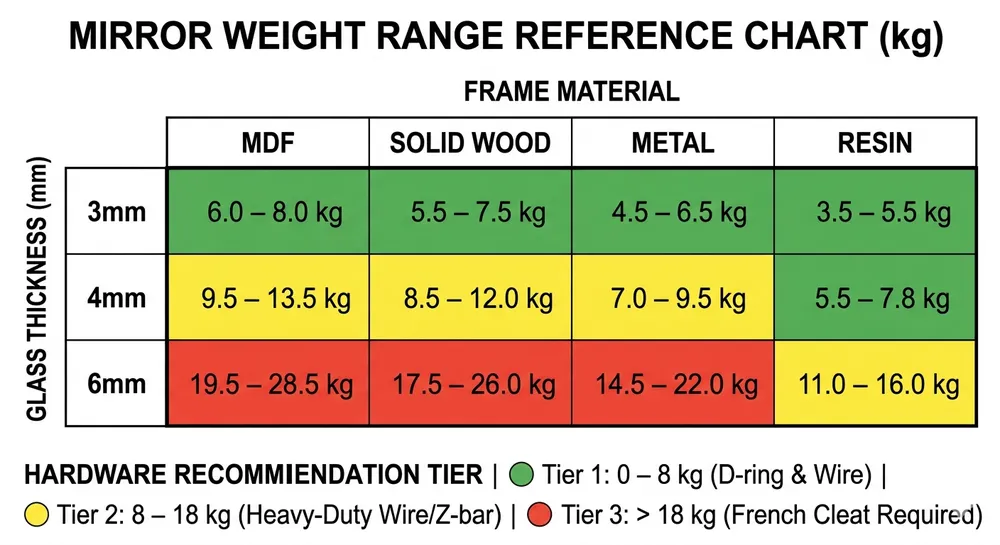
A 600×900mm mirror in 4mm glass carries roughly 5.4 kg of glass alone. Add an MDF frame and backing and you're at 7–9 kg total. Specify 6mm glass on the same footprint and total hung weight climbs to 11–14 kg depending on frame material. That's the difference between a D-ring wire setup and a French cleat — and it's a decision that needs to be made before the frame mold is cut.

Frame material adds weight in ways that aren't always obvious. Resin frames look light but dense casting compounds can run 1.8–2.2 kg/linear meter on a thick profile. Solid wood frames in hardwood species (oak, rubberwood) add more than MDF on equivalent profiles. Metal frames — typically 1.0–1.2mm cold-rolled steel or aluminum extrusion — are lighter per linear meter than solid wood but add rigidity that changes how the backing board needs to be attached.

Reference weight contributions by frame material for a standard 600×900mm mirror:

Frame Material Approx. Frame Weight Notes
MDF (18mm profile) 1.2–1.8 kg Most common for painted finishes; absorbs moisture in high-humidity environments
Solid wood (hardwood) 1.8–2.6 kg Higher weight, better screw retention for D-ring hardware
Metal (steel/aluminum) 0.8–1.4 kg Lightest frame option; requires welded or riveted hardware attachment points
Resin/polyresin 1.4–2.2 kg Weight varies significantly by casting density and profile thickness

(Note: these are production reference ranges from our Ho Chi Minh facility — actual weight depends on profile width, corner joint method, and finish system. We provide per-unit weight on every order confirmation so your freight team has accurate data.)

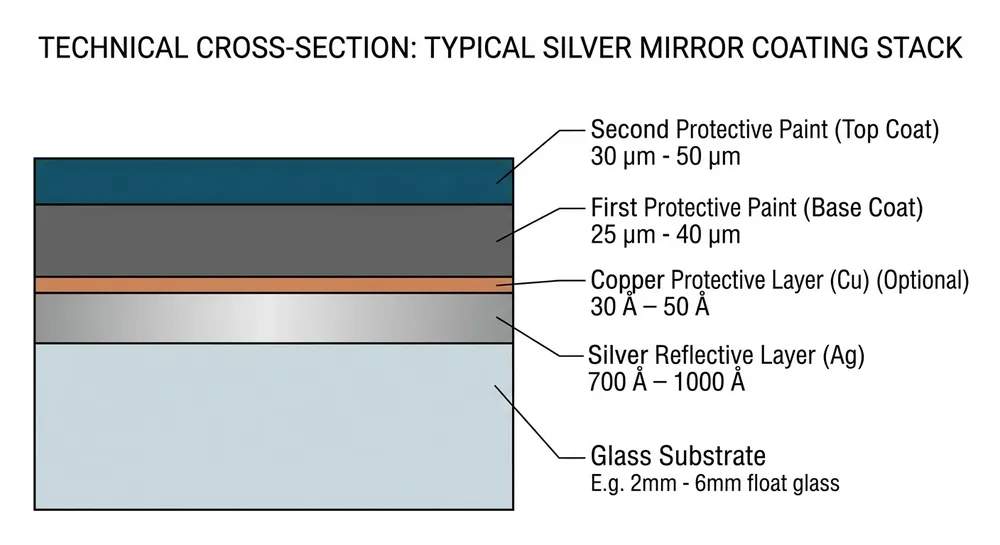
Backing board and silvering layers add less than most buyers expect, but they're not zero. A standard 3mm MDF backing with our copper-free silver coating system adds roughly 0.3–0.5 kg on a mid-size mirror. The multi-coat backing — silver layer, copper-free barrier coat, and two protective paint layers — is part of why our mirrors hold up in coastal and humid markets, but it does contribute to total weight. Worth noting when you're calculating freight cost per unit at scale.

Reference chart showing total hung weight ranges for wall decor mirrors by glass thickness (3mm, 4mm, 6mm) and frame material type

Hardware Types, Load Ratings, and When Each Applies

The five hardware types we install cover the full weight range of decorative wall mirrors. Each has a different load rating, wall substrate requirement, and installation profile — and the wrong choice for the weight class creates liability exposure for your downstream customer.

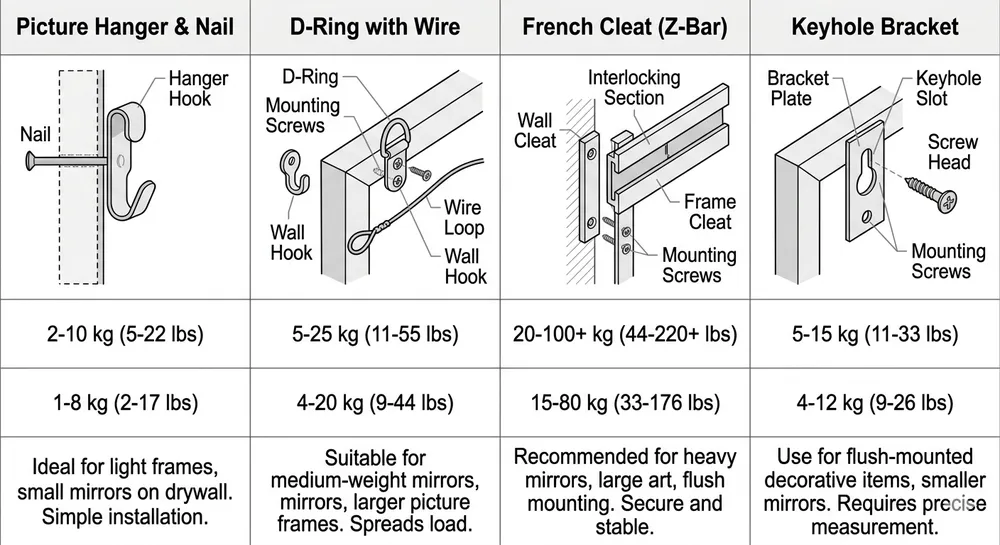
D-ring with braided wire is the default for mirrors up to approximately 10 kg total hung weight. Two D-rings mounted to the frame back, connected by 7-strand braided steel wire, hang on a single wall hook or picture rail. Load rating on a properly installed D-ring pair (M4 screws, 25mm penetration into solid wood or MDF) runs 12–15 kg before deformation. For drywall installations, the limiting factor is the wall anchor, not the hardware — standard drywall anchors rate 15–25 kg depending on type, but stud-mounted hooks handle 40+ kg.

We see buyers underspecify wire gauge on large mirrors. 0.8mm wire is fine for a 5 kg bathroom mirror. On a 9 kg piece, specify 1.2mm minimum — the thinner wire fatigues at the crimp point over time, especially in environments with vibration or temperature cycling.

French cleat (Z-bar) is the right call for mirrors above 10 kg, for commercial installations, and for any project where the mirror needs to be removable without tools. Two interlocking aluminum extrusions — one fixed to the wall, one to the mirror back — distribute load across the full cleat length rather than concentrating it at two screw points. A 600mm aluminum French cleat at 1.5mm wall thickness handles 30–40 kg comfortably. For mirrors above 25 kg, we specify 2.0mm cleat stock.

The trade-off: French cleat mirrors need a deeper carton. The cleat profile adds 18–25mm to the mirror's effective depth, which changes carton dimensions and affects how many units fit per pallet. We configure packaging per mounting type — a French cleat mirror ships in a different carton spec than the same mirror with wire hardware. See our notes on wall mirror packaging for safe shipping for how this flows through to freight cost.

Keyhole brackets work well for mid-weight mirrors (8–18 kg) where flush wall contact is a priority. Two keyhole slots routed or stamped into a metal backing plate accept wall-mounted screws. The mirror drops onto the screws and sits flush. Installation is clean and fast — relevant for hospitality projects where housekeeping staff need to remove and rehang mirrors for room maintenance. The limitation is that keyhole brackets require precise stud or anchor placement; the screw centers must match the bracket spacing exactly, which means your end customer needs accurate installation templates.

We include a printed installation template with every keyhole-mount mirror order. It's a small thing, but it eliminates the most common installation complaint we hear from hotel project buyers.

Adhesive mounting systems (mirror mastic, double-sided structural tape) are outside the scope of hardware we install at the factory. We don't recommend them for framed decorative mirrors above 5 kg — the peel strength degrades with temperature cycling and the failure mode is sudden rather than gradual. If your project spec calls for adhesive mounting, that's a conversation to have with your installation contractor, not something to specify at the mirror sourcing stage.

Comparison diagram of wall mirror mounting hardware types showing D-ring wire, French cleat, keyhole bracket, and Z-bar with load rating ranges

Mirror D-ring vs French Cleat Load Rating — The Decision Table

Buyers ask us this comparison constantly, so here it is as a direct reference:

Spec Factor D-ring + Wire French Cleat (Z-bar) Keyhole Bracket
Typical load rating 12–15 kg (hardware) 30–40 kg per 600mm cleat 15–25 kg per pair
Mirror weight range Up to 10 kg 10–40+ kg 8–18 kg
Wall substrate Drywall (anchored), stud, concrete Stud, concrete, masonry Stud, concrete (precise spacing required)
Installation complexity Low Medium Medium
Removable without tools No Yes Yes
Hospitality suitability Standard rooms Preferred for heavy pieces Good for maintenance access
Packaging depth impact Minimal +18–25mm carton depth Minimal
Factory installation Yes — standard Yes — standard Yes — with template

For Decor Mirrors by Material & Frame, the hardware decision should be locked before frame production starts. The frame back needs pre-drilled and reinforced attachment points for D-rings, routed channels for French cleat, or precision-stamped keyhole plates — none of these can be added cleanly after the frame is assembled.

Wall Substrate Compatibility — What Your End Market Requires

Hardware load ratings are only half the equation. The wall substrate determines whether those ratings are achievable in the field. This matters most for commercial and hospitality buyers, where installation conditions vary and liability for a fallen mirror is real.

Drywall (gypsum board) is the standard in North American residential and most hotel new-build construction. Drywall alone holds very little — the anchor or stud does the work. For mirrors up to 10 kg, a quality toggle bolt or snap anchor in drywall handles the load. For anything above 10 kg, stud mounting is the right spec. We recommend buyers in the North American market specify stud-mount installation for any mirror above 8 kg, with a 16" or 24" stud spacing note in the installation guide.

Concrete and masonry walls are standard in European, Middle Eastern, and Southeast Asian construction. Concrete anchors (M6 or M8 sleeve anchors) handle significantly higher loads than drywall anchors — a properly set M8 sleeve anchor in 150mm concrete holds 80+ kg in shear. For these markets, the hardware spec can be lighter relative to mirror weight, but the installation template needs to specify anchor type and minimum embedment depth.

Tile walls (bathrooms, spa installations) require diamond-drill installation and appropriate tile anchors. We don't specify tile installation hardware — that's the contractor's scope — but we do flag it on the installation guide when a buyer's project brief indicates bathroom or wet-area placement. The mirror backing spec matters here too: copper-free silvering and sealed edge treatment prevent silver oxidation from moisture ingress, which is a separate issue from mounting but affects the same installation environment.

Seismic and fire-rated requirements apply to commercial installations in California, Japan, New Zealand, and other seismic zones. For hospitality projects in these markets, mirrors above a certain size (typically 600×900mm or heavier than 10 kg) may require seismic clips or safety backing film in addition to standard mounting hardware. We can supply mirrors with safety backing film applied at the factory — it's a laminate layer on the glass face that holds fragments in place if the glass breaks. Specify this at the RFQ stage; it cannot be added after production.

(We've had buyers discover the seismic requirement after their container arrived in California. The retrofit cost — sourcing film, applying it unit by unit, repackaging — was significant. It's worth one line in your project spec to avoid it.)

Pre-Shipment QC Checklist for Mounting Hardware

This is where most importers lose money: they approve a sample, place a bulk order, and discover on arrival that the hardware installation quality didn't hold across the full run. Hardware QC on a pre-shipment inspection needs to be specific, not visual.

Here's what to verify on your pre-shipment sample before approving a bulk run:

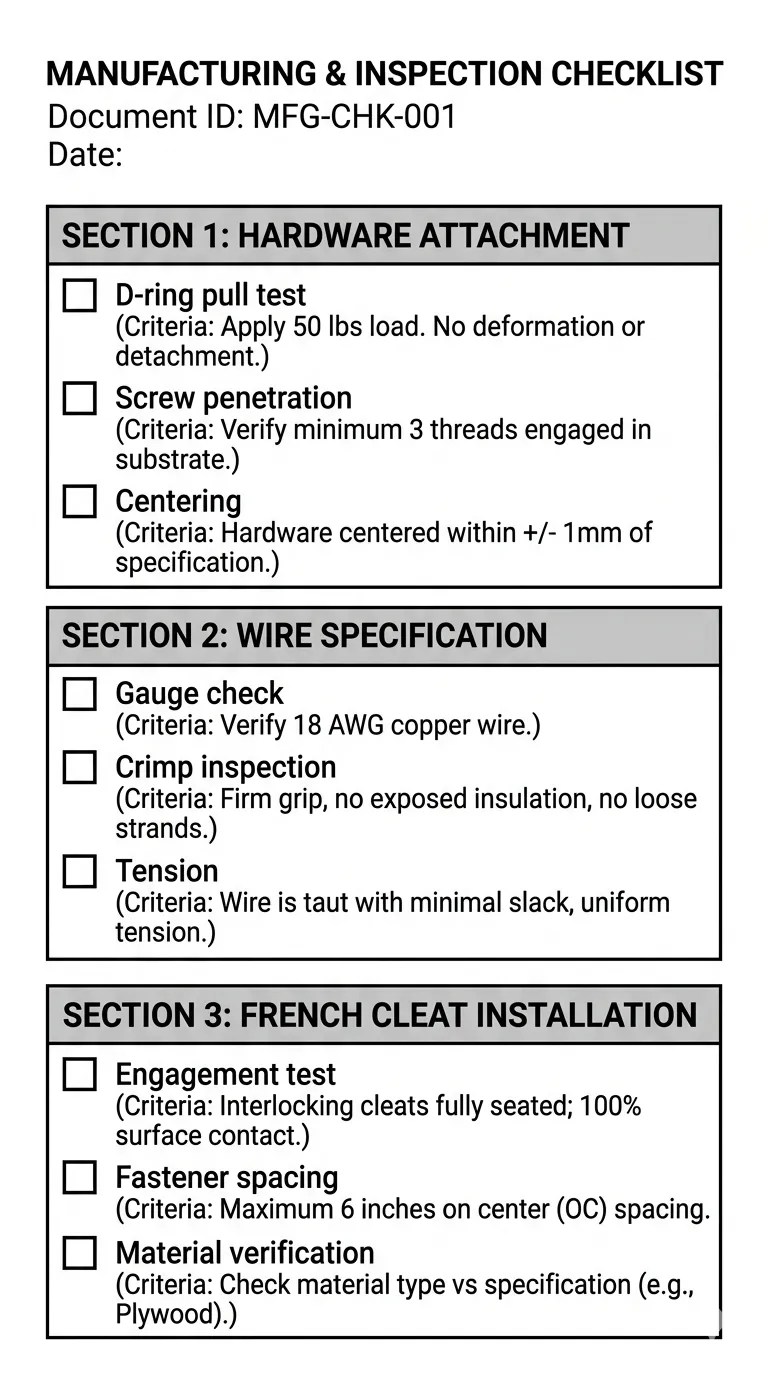
Hardware attachment integrity

  • Pull-test each D-ring or cleat attachment point. On a properly installed M4 screw into 18mm MDF, you should not be able to pull the hardware free by hand. If you can, the screw length is wrong or the MDF density is below spec.
  • Check screw penetration depth. We specify minimum 20mm penetration for D-rings on MDF frames, 25mm for solid wood. Shorter penetration is a common cost-cutting shortcut on lower-quality production runs.
  • Verify hardware is centered and level. Off-center D-rings cause the mirror to hang at an angle — a warranty claim waiting to happen.

Wire specification and termination

  • Check wire gauge against your spec. 0.8mm and 1.2mm wire look similar at a glance; measure with calipers.
  • Inspect crimp terminations. The wire should be doubled back through the crimp sleeve and compressed cleanly — no loose ends, no sharp wire protrusions that can cut hands during installation.
  • Check wire tension. The wire should have enough slack to hang on a hook but not so much that the mirror tilts forward more than 5° from vertical.

French cleat alignment and fit

  • Test the cleat engagement. The wall cleat and mirror cleat should interlock smoothly with no binding or rattle. Loose fit means the mirror can shift laterally on the wall.
  • Check cleat fastener spacing. We install cleats with fasteners at 150mm centers maximum — wider spacing allows the cleat to flex under load.
  • Verify cleat material. Aluminum extrusion is correct. Stamped steel is acceptable for lighter mirrors. Plastic cleat profiles are not acceptable for any mirror above 5 kg.

Documentation to request

  • Per-unit weight confirmation (glass + frame + hardware + backing)
  • Hardware specification sheet (type, material, load rating, screw spec)
  • Installation template (for keyhole and French cleat configurations)

We provide all three as standard on every Livewellcraft order. If your current supplier doesn't, that's worth noting before you approve production.

For a deeper look at how frame construction affects hardware attachment points, see our guide on frame mirror construction specs.

Pre-shipment QC inspection checklist for wall mirror mounting hardware covering D-ring pull test, wire gauge, French cleat fit, and documentation requirements

How Mounting Hardware Choice Affects Packaging and Freight Cost

This connection doesn't get enough attention in sourcing conversations. The hardware spec you choose at the RFQ stage directly determines carton dimensions, which determines pallet configuration, which determines how many units fit in a container.

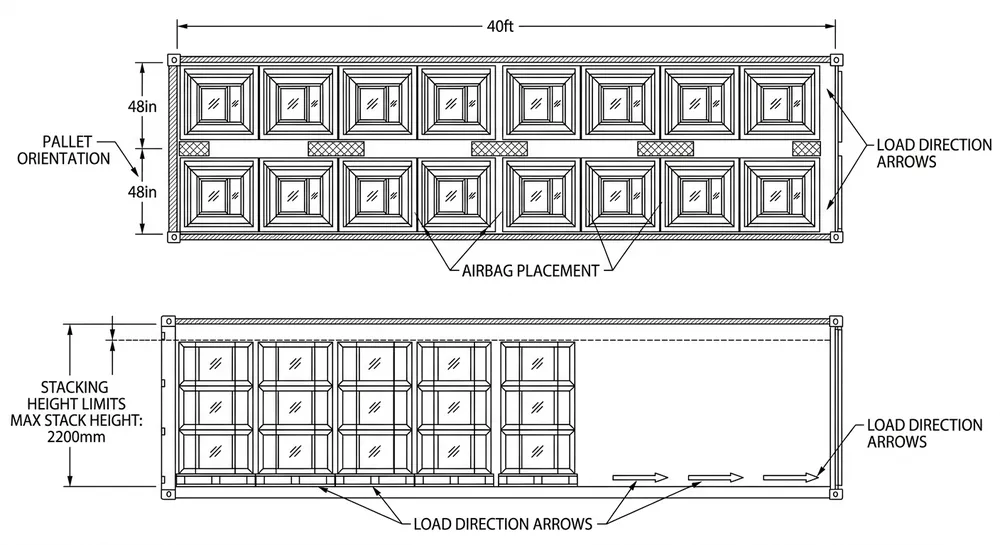
French cleat mirrors ship in deeper cartons. The cleat profile — typically 25–35mm tall when engaged — adds to the mirror's effective depth. A 600×900mm mirror with wire hardware ships in a carton roughly 650×950×60mm. The same mirror with French cleat hardware needs a carton approximately 650×950×90mm. That 30mm difference sounds small, but across a 40-foot container it can reduce unit count by 8–12% depending on stacking configuration.

Wire-hung mirrors can be stacked face-to-face with foam interleaving. French cleat mirrors typically need individual carton separation because the cleat profile creates an uneven back surface. This affects both carton cost and container loading efficiency.

Keyhole mirrors need installation templates packed inside the carton. The template adds negligible weight but requires a specific carton insert — a detail that needs to be confirmed with the packaging team before production starts.

We configure packaging per mounting type as a standard practice. When you submit your RFQ, specifying the mounting hardware type upfront means we can give you accurate per-unit carton dimensions and a realistic container loading count — which feeds directly into your landed cost calculation.

For buyers managing multiple SKUs with different mounting types, we recommend standardizing on one hardware system per size tier where possible. Mixed hardware specs across a single container order create complexity at the packing stage and increase the risk of mis-packed units.

Specifying Mounting Hardware in Your RFQ — What to Include

Vague hardware specs create problems at every stage. "Standard hanging hardware" means different things to different factories. Here's what a complete mounting spec looks like in an RFQ:

Mirror size: [W × H mm]
Glass thickness: [3mm / 4mm / 6mm]
Frame material: [MDF / solid wood / metal / resin]
Estimated total hung weight: [kg — or request factory confirmation]
Mounting hardware type: [D-ring + wire / French cleat / keyhole]
Wire gauge (if applicable): [0.8mm / 1.2mm / 1.5mm]
Cleat length (if French cleat): [mm]
Wall substrate in end market: [drywall / concrete / tile]
Safety backing film required: [yes / no]
Seismic clip required: [yes / no — specify market]
Installation template required: [yes / no]

The more specific your spec, the more accurate the quote — and the less room for substitution during production. We've seen buyers receive mirrors with 0.8mm wire on a 12 kg piece because the RFQ said "wire hanging" without specifying gauge. The factory wasn't cutting corners deliberately; they were filling a gap in the spec.

If you're not sure which hardware type fits your mirror spec, send us the mirror dimensions, glass thickness, frame material, and your target end market. We'll confirm the total hung weight from our production data and recommend the appropriate hardware — including any compliance requirements for your destination market.

Request Quote with your mirror spec and we'll come back with hardware recommendations and per-unit weight for your freight planning.

FAQ — Mounting Specs Buyers Ask Before Ordering

What is the weight limit for hanging a large decorative mirror on drywall?

The drywall itself isn't the limiting factor — the anchor or stud is. A stud-mounted hook handles 40+ kg. A quality toggle bolt in drywall handles 20–25 kg. For mirrors above 10 kg, we recommend specifying stud-mount installation in the installation guide. For commercial and hospitality projects, French cleat on stud or concrete anchor is the standard spec above 10 kg total hung weight.

Can I specify French cleat on a mirror with a resin frame?

Yes, but the cleat needs to be attached to a backing board, not directly to the resin frame. Resin doesn't hold screws reliably under sustained load. We attach French cleats to an MDF or plywood backing board that's bonded to the resin frame back — the cleat load transfers to the backing board, not the resin. This is standard practice in our production; just confirm it's specified in your order.

Does glass thickness affect which mounting hardware I need?

Directly, yes — because glass thickness is the main driver of total hung weight. A 600×900mm mirror in 3mm glass with an MDF frame typically runs 6–8 kg total, which is fine for D-ring wire. The same footprint in 6mm glass with a solid wood frame can reach 14–16 kg, which requires French cleat or heavy-duty keyhole. Always calculate total hung weight before specifying hardware, not just glass size.

What's the difference between a Z-bar and a French cleat?

They're the same principle — two interlocking profiles, one on the wall, one on the mirror — but Z-bar typically refers to a lighter-gauge stamped steel version used for smaller mirrors, while French cleat refers to the heavier aluminum extrusion used for larger and commercial applications. We use aluminum French cleat for mirrors above 10 kg and can supply Z-bar for lighter pieces where the buyer prefers it.

Do you supply installation hardware (wall anchors, screws) with the mirror?

We supply the mirror-side hardware — D-rings, wire, French cleat profile, keyhole plates — installed and tested at the factory. Wall-side hardware (anchors, hooks, screws) is typically not included because anchor type depends on the wall substrate at the installation site, which varies by project. We include an installation guide specifying the recommended anchor type and load rating for the mirror's weight class.

How do I verify mounting hardware quality on a pre-shipment inspection?

Pull-test the D-ring or cleat attachment by hand — it should not move. Check wire gauge with calipers. Test French cleat engagement for smooth fit without rattle. Verify screw penetration depth (minimum 20mm into MDF, 25mm into solid wood). Request the hardware specification sheet and per-unit weight confirmation as part of your pre-shipment documentation package.

For buyers sourcing Wall Decor Mirrors across multiple size tiers and frame materials, the mounting spec decision is worth getting right at the RFQ stage. It affects production, QC, packaging, and freight — and it's much cheaper to specify correctly upfront than to correct after the container ships.

If you're working through the frame material side of this decision, our guide on choosing frame materials covers the weight, durability, and cost trade-offs across MDF, solid wood, metal, and resin in more detail.

Gold vs Silver Decor Mirrors — Which Finish Sells Faster for US Retailers & Distributors

Here's the question we get from US distributors more than almost any other: Should I stock gold or silver? It sounds like an interior design question. It isn't. It's a margin and inventory risk question — and the answer depends on your channel, your price point, and how much trend exposure you're willing to carry.

The short verdict: gold moves faster in retail and hospitality right now, but silver carries lower sourcing risk and broader channel fit. Neither finish is universally better. The right answer is almost always a split assortment — and the ratio depends on where you're selling.

We've been finishing mirror frames in both gold and silver at our Ho Chi Minh facility since 2008. We run electroplating, powder coat, and multi-coat paint systems in-house, so the cost and durability differences between these two finishes aren't theoretical for us. This comparison is built on what we actually see coming off our lines and what our US buyers report back on sell-through.

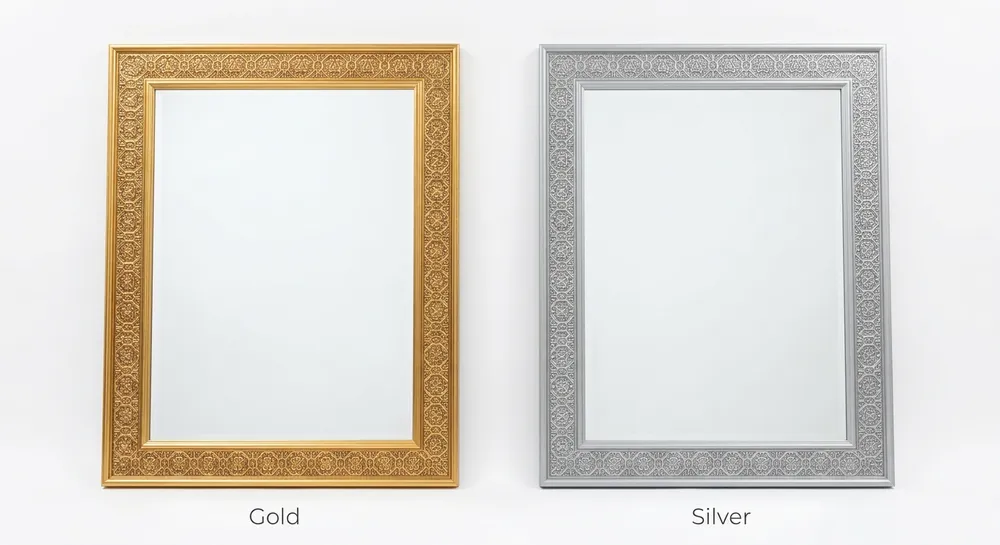
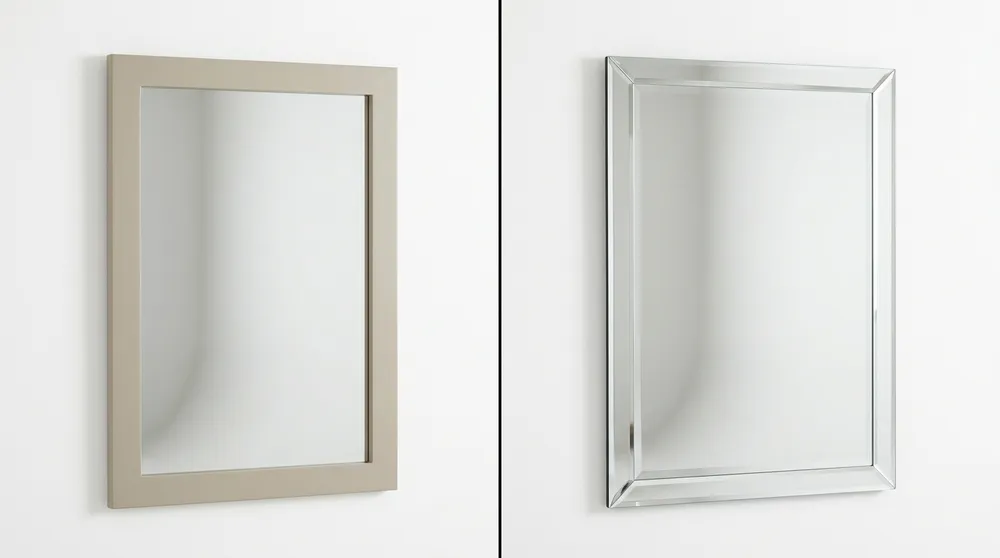
Side-by-side comparison of gold electroplated and silver powder-coated decorative mirror frames showing finish texture and color tone differences

How These Finishes Are Actually Made — and Why It Matters for Your Order

Gold and silver aren't just color choices. They're different production processes with different cost structures, different durability profiles, and different failure modes in transit.

Gold finishes on metal frames are typically electroplated — a zinc or iron base frame goes through a copper strike, then a brass or gold-tone plating bath. The result is a warm, slightly reflective surface with good depth. On MDF or resin frames, gold is applied as a multi-coat paint system: primer, base coat, metallic topcoat, and a UV-protective lacquer. We run both processes here. The electroplated route costs more per unit — the plating bath chemistry, the pre-treatment steps, and the longer line time add up. On a standard 24×36" metal frame, electroplating adds roughly 15–20% to frame production cost versus a powder-coated silver equivalent.

Silver finishes are more forgiving to produce. On metal frames, silver powder coat is our standard — automated line, 60–80μm consistent thickness, 500-hour salt spray rating. On MDF and resin, silver is a simpler paint system than gold because the metallic base coat requires less color-matching precision. (Gold tone is notoriously variable — warm gold, champagne gold, antique gold, brushed gold all read differently under different lighting, and buyers have strong opinions. Silver is more consistent across batches.) The result: silver frames typically cost less to produce, have more predictable batch-to-batch color consistency, and are easier to spec for repeat orders.

The practical implication for your sourcing: if you're building a high-volume, repeatable SKU program, silver is lower-risk. If you're chasing a trend-driven retail moment or a hospitality project spec, gold is worth the premium.

US Market Sell-Through: Which Finish Actually Moves

We ship to distributors and retailers across North America, and the feedback we get on sell-through is consistent enough to be useful.

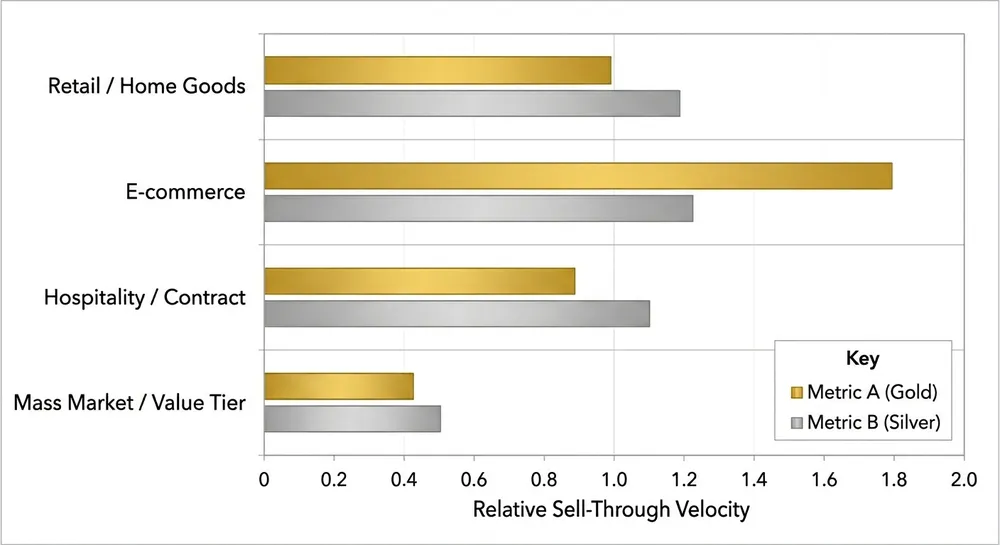
Gold has been the faster mover in retail and e-commerce since roughly 2021. The warm-tone interior trend — warm wood, terracotta, brass hardware — pulled gold mirrors into mainstream retail assortments. Wayfair, Amazon, and mid-tier home goods retailers have all expanded their gold mirror SKU counts. Our US retail buyers report gold frames turning faster than silver in the $49–$149 price band, particularly in oval, arch, and ornate rectangular profiles.

Silver holds its ground in three specific channels: contract/hospitality, coastal and contemporary residential, and the value-tier mass market. Hotel and multifamily project specifiers often default to silver or brushed nickel because it reads as neutral and coordinates with chrome fixtures. Contemporary coastal design — still a strong segment in California, Florida, and the Pacific Northwest — skews silver and white. And at the $29–$59 price point in mass-market retail, silver remains the dominant finish because it photographs cleanly and doesn't carry the "trendy" risk that gold does for buyers managing 18-month inventory cycles.

The honest picture: gold is hotter right now, but it's also more trend-dependent. Silver is slower but stickier — it doesn't spike, but it doesn't crater either. For a distributor building a catalog that needs to perform across two or three selling seasons, that stability has real value.

Bar chart comparing gold vs silver decorative mirror frame demand across US retail, e-commerce, hospitality, and mass-market channels

Head-to-Head: Finish Specs That Affect Your Landed Cost and Warranty Risk

This is the comparison most sourcing guides skip. The finish choice doesn't just affect aesthetics — it affects your freight cost, your return rate, and your reorder reliability.

Dimension Gold (Electroplated / Multi-coat) Silver (Powder Coat / Paint)
Production cost premium +15–20% vs silver equivalent Baseline
Color consistency batch-to-batch Moderate — gold tone varies by process High — silver powder coat is stable
Scratch resistance Moderate — electroplate can show micro-scratches Good — powder coat is harder surface
Tarnish / oxidation risk Low with UV lacquer topcoat Very low — powder coat is sealed
Transit damage visibility Higher — gold shows handling marks more readily Lower — silver hides minor scuffs
Packaging requirement Corner protection + foam wrap recommended Standard corner protection sufficient
Reorder color match Requires finish spec lock (Pantone or RAL reference) Easier — standard silver powder is consistent
Trend sensitivity High — warm-tone trend dependent Low — neutral, multi-cycle stable
Hospitality spec acceptance Growing, especially boutique hotel Strong, especially contract/multifamily

The packaging point is worth expanding. Gold frames — especially electroplated metal — show fingerprints and handling marks more than silver. We've had buyers come back after their first container asking why their gold mirrors had more transit claims than expected. The answer is almost always packaging: gold needs individual foam sleeve wrapping plus corner protectors, not just the standard carton. We build that into our export packing spec automatically now, but if you're sourcing gold frames elsewhere, ask specifically about their packing method. (We've seen competitors ship gold frames in the same carton spec as silver — the claim rate difference is significant.)

The Hidden Cost: Finish Durability in the Field

Your downstream customers — the end retailers or hospitality operators — will judge your product on how it looks six months after installation, not six minutes after unboxing. That's where finish durability becomes your warranty exposure.

Electroplated gold on metal frames is durable when the pre-treatment is done correctly. The failure mode we see most often — both on our own QC line and in field returns — is adhesion failure at weld seams and frame joints. If the frame isn't properly cleaned and pre-treated before plating, the plating lifts at stress points within 6–12 months. We grind and chemically treat every weld joint before the frame enters the plating line. Not every factory does this. When you're evaluating a gold mirror supplier, ask for their pre-treatment process spec — specifically whether they treat weld joints separately before plating.

Multi-coat gold paint on MDF frames has a different failure mode: topcoat yellowing under UV exposure. A gold frame in a south-facing retail display or a sunlit hotel corridor can shift noticeably in tone within a year if the UV lacquer isn't adequate. We use a two-layer UV topcoat on all our gold MDF frames — it adds cost, but it's the difference between a frame that holds its color for three years and one that generates warranty calls at month 14.

Silver powder coat on metal is the most durable finish we run. The automated line gives us consistent 60–80μm thickness, and the cured surface is harder than electroplate. Salt spray performance exceeds 500 hours, which covers coastal retail environments without issue. For silver MDF frames, the paint system is simpler and the failure modes are fewer — the main risk is edge chipping if the MDF substrate isn't properly sealed before painting, which is a substrate prep issue, not a finish issue.

The commercial implication: gold requires more QC diligence from your supplier, and more packaging investment from both sides. Silver is more forgiving. If you're sourcing from a factory you haven't audited, silver is the lower-risk starting point.

Assortment Strategy: When to Stock Both, When to Commit to One

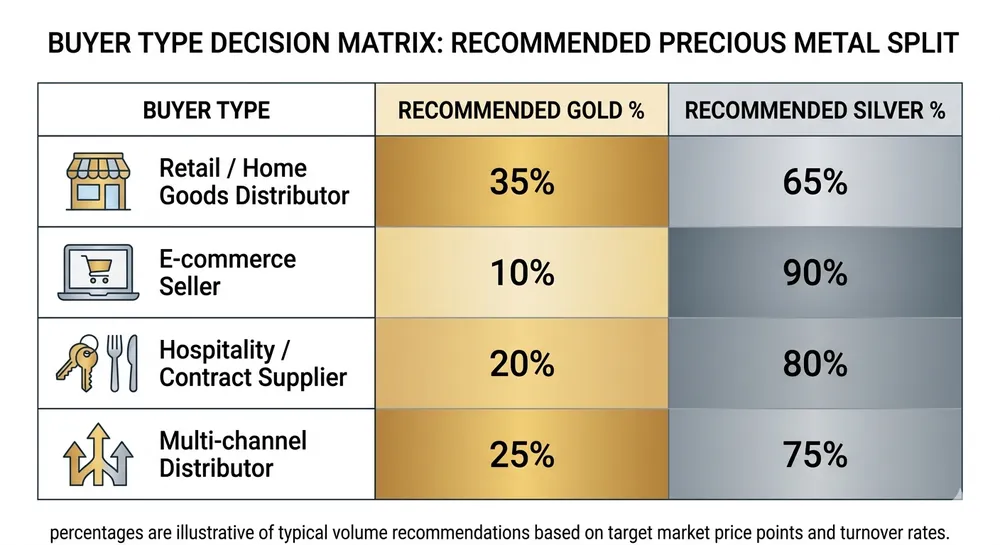
Most of our US distributor accounts run a split assortment. The ratio varies, but a common starting point is 60% gold / 40% silver for retail-focused buyers, and 40% gold / 60% silver for buyers with significant hospitality or contract exposure.

The case for committing to gold only: you're selling into a specific retail channel where warm-tone is dominant, your buyers are reordering the same SKUs, and you have enough volume to absorb the higher unit cost. Some of our West Coast retail accounts have gone gold-heavy and it's worked — but they're in markets where the trend has been consistent for several years.

The case for committing to silver only: you're primarily a contract/hospitality supplier, your buyers spec by finish code and need color consistency across large project quantities, and trend risk is a real concern for your inventory planning. Silver is the safer single-finish bet for contract-heavy distributors.

The case for a split assortment — which is what we recommend for most buyers entering or expanding in this category: you don't have to guess the trend. With MOQs starting at 100 pieces per SKU, you can run a trial order of both finishes on the same frame profile, test sell-through with your accounts, and reorder the winner at volume. We've had buyers start with 100 units each of gold and silver on the same 24×36" arch mirror, sell through the gold in six weeks and the silver in twelve, and use that data to set their container ratio. That's a much better decision than committing to 500 units of one finish based on a trend article.

Decision matrix showing recommended gold vs silver mirror assortment ratios by US sales channel and buyer type

Scenario Verdicts: Which Finish Wins for Your Specific Situation

Scenario 1: You're stocking a 200-unit opening order for a regional home goods chain. Gold wins. Retail buyers in this segment are actively looking for warm-tone mirrors in the $79–$129 retail price range. Gold arch and oval profiles are moving. The higher unit cost is absorbed by the retail markup, and the trend is established enough that you're not early-adopting risk. Specify electroplated gold on metal for the best margin-to-durability ratio, and confirm the supplier's packing spec includes individual foam wrapping.

Scenario 2: You're supplying a 150-room hotel renovation project. Silver wins. Hospitality specifiers default to neutral finishes that coordinate with chrome and brushed nickel fixtures. Silver powder coat on metal frames gives you the color consistency you need across a large project quantity, the durability to survive housekeeping cycles, and the finish stability for a property that won't renovate again for seven years. Gold is gaining ground in boutique hotel projects, but for a standard renovation spec, silver is the lower-risk choice.

Scenario 3: You're a new distributor building your first decorative mirror catalog. Split assortment wins. Start with 100 units each of gold and silver on two or three frame profiles — an arch, a rectangular, and an ornate style. Run them through your accounts for one quarter. The sell-through data you collect is worth more than any trend forecast. Gold Decor Mirrors and Silver Decor Mirrors are both available at 100-piece MOQ per SKU — you're not committing to a container to get the answer.

Scenario 4: You're an e-commerce seller managing a lean SKU count. Gold wins on velocity, silver wins on stability. If you can only stock one finish, gold will likely turn faster in the current market. If you need a finish that performs consistently across seasons without markdown risk, silver is safer. Most successful e-commerce mirror sellers in our network run both — gold as the primary SKU, silver as the secondary.

What to Verify When You Source Either Finish

The finish name on a spec sheet doesn't tell you much. Here's what actually matters when you're evaluating a supplier for gold or silver mirror frames:

For gold electroplated frames:

  • Ask for the pre-treatment process spec — specifically whether weld joints are treated before plating
  • Request a salt spray test result (minimum 200 hours for indoor decorative use)
  • Ask for a UV lacquer spec on MDF frames — confirm it's a two-layer system
  • Request a color reference (Pantone or RAL) and confirm batch-to-batch tolerance
  • Ask about their packing spec for gold frames specifically — individual foam sleeve is the standard

For silver powder-coated frames:

  • Request the powder coat thickness spec — 60–80μm is the standard for decorative frames
  • Ask for salt spray test results — 500 hours is achievable and should be the baseline
  • Confirm MDF substrate sealing process if ordering MDF frames
  • Ask about color consistency across production batches — silver powder is generally stable, but confirm the supplier uses a consistent powder supplier

For both finishes:

  • Request a pre-production sample before committing to a full order
  • Confirm the supplier's QC process includes 100% visual inspection — finish defects that pass QC are your problem, not theirs
  • Ask about their packaging spec for export — corner protection, foam wrapping, and carton compression strength all affect your claim rate

We hold ISO 9001:2015 certification and run 100% visual inspection on every unit before it loads. SGS and BSCI audit reports are available on request. For buyers who want to verify finish specs before ordering, we can provide pre-production samples with finish reference cards showing the exact color and surface treatment used on your order.

Frequently Asked Questions

What is the MOQ for gold and silver mirror frames at Livewellcraft? 100 pieces per SKU for standard frame profiles in both gold and silver finishes. This applies to both electroplated metal frames and multi-coat MDF frames. Custom frame profiles or non-standard sizes may require higher minimums — contact us with your specs for confirmation.

Does gold electroplating tarnish over time on decorative mirrors? With a proper UV lacquer topcoat, no — not under normal indoor conditions. The tarnish risk on gold-plated frames comes from inadequate sealing, not from the plating itself. Frames without a UV topcoat, or with a single thin lacquer layer, can show oxidation in humid environments within 12–18 months. Our gold frames use a two-layer UV topcoat specifically to prevent this. If you're sourcing from another supplier, ask for their topcoat spec and a humidity chamber test result.

Which finish is easier to reorder consistently — gold or silver? Silver is more consistent batch-to-batch. Silver powder coat uses a standardized powder chemistry that produces predictable color across production runs. Gold tone — especially warm gold and champagne gold — varies more between batches and between suppliers. For repeat-order programs where color consistency matters, lock in a Pantone or RAL reference on your first gold order and confirm the supplier can hold that spec on reorders.

How does finish choice affect container loading and freight cost? Gold frames require more protective packaging — individual foam sleeves plus corner protectors — which reduces carton density slightly compared to silver frames with standard corner-only protection. The difference is typically 5–8% fewer units per container for gold versus silver on the same frame profile. Factor this into your landed cost calculation when comparing the two finishes at volume.

Can I order both gold and silver finishes on the same frame profile? Yes. We run both finishes on most of our standard frame profiles. Ordering both finishes on the same profile is a common approach for buyers testing market response — same frame, same size, two finishes, 100 pieces each. It simplifies your product photography and makes sell-through comparison clean. Browse the full range at Decor Mirrors by Material & Frame or request a quote with your target profile and we'll confirm availability in both finishes.

Wall vs Tabletop Decor Mirrors — Space Requirements, Packaging Costs, and Retail Demand for Wholesale Buyers

You're building a mirror assortment and the question isn't which type looks better — it's which type loads better into a container, survives ocean freight with fewer claims, and clears your retail shelves faster. Wall-mounted decor mirrors and tabletop vanity mirrors share a silvering line and often the same glass thickness, but everything downstream — frame engineering, hardware, carton geometry, pallet density, and sell-through velocity — splits hard between the two formats.

Here's the short version: wall mirrors carry higher volume potential and stronger retail demand across most channels. Tabletop mirrors deliver better per-unit margin in vanity and gifting segments but eat more packaging cost per piece relative to their FOB price. If you're choosing one format to lead with, wall mirrors are the safer volume play. If you're optimizing a full assortment, sourcing both from the same factory collapses your landed cost gap and simplifies QC across the order.

How Construction Diverges After the Silvering Line

Both formats start the same way on our floor — float glass cut to spec, edges processed, then through the copper-free silvering line with multi-layer protective coating. The split happens at frame and backing.

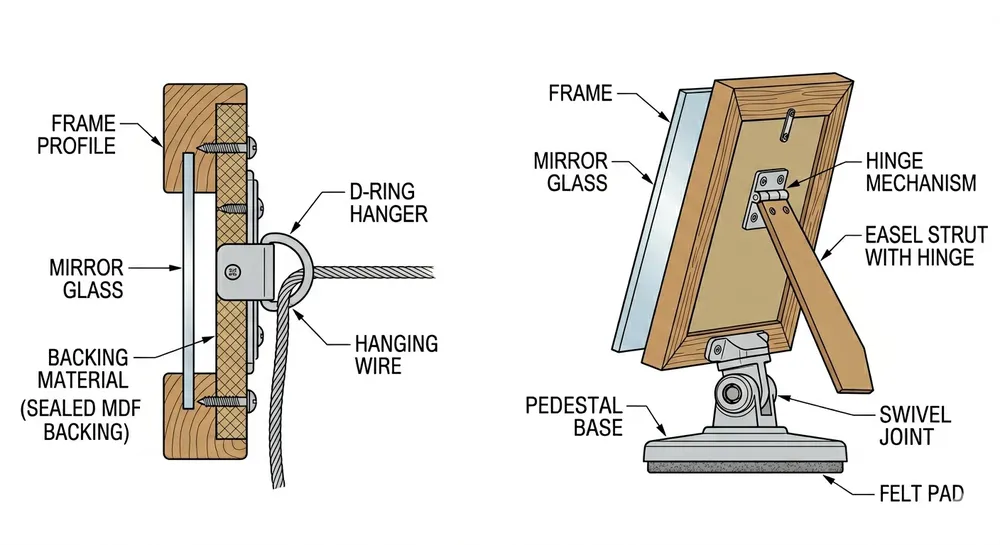
A wall decor mirror needs a frame engineered for vertical load. The frame carries the mirror's full weight against a wall, so joint strength and hanging hardware matter more than aesthetics. We use D-ring hangers, French cleats, or wire systems depending on mirror weight — anything over 5 kg gets a cleat or dual-point wire, not a single sawtooth. The backing is typically MDF or hardboard, sealed to protect the silver coating from moisture ingress. (We switched to sealed MDF backing as default in 2019 after tracking silver edge-blackening claims on unsealed units shipped to Florida and Gulf-state distributors.)

A tabletop mirror needs a freestanding support system — easel back, pedestal base, or swivel stand. That support structure adds components, assembly steps, and packaging complexity. An easel-back mirror with a strut hinge has 3–4 more parts than a comparable wall mirror. A pedestal vanity mirror with a swivel joint adds a metal or resin base, a pivot mechanism, and often a felt pad underneath. More parts means more assembly labor, more potential failure points in transit, and a wider carton footprint.

The frame material choice also shifts between formats. Wall mirrors sell well across the full material and frame range — MDF, wood, metal, resin. Tabletop mirrors skew heavily toward metal and resin because those materials handle the structural load of a stand or pedestal better than MDF at small scale. If you're sourcing tabletop mirrors in MDF frames, verify that the easel attachment point is reinforced — we've seen competitors' MDF easel-back mirrors fail at the hinge after a few months of use, which turns into your warranty problem.

Side-by-side diagram showing wall mirror with D-ring hanger and sealed backing versus tabletop mirror with easel strut and pedestal base

Head-to-Head Sourcing Comparison

Dimension Wall-Mounted Decor Mirror Tabletop / Vanity Mirror
Typical size range 40 × 60 cm to 90 × 120 cm 15 × 20 cm to 30 × 40 cm
Common frame materials MDF, wood, metal, resin Metal, resin, wood
Mounting / support D-ring, French cleat, wire Easel back, pedestal, swivel stand
Parts per unit 4–6 (glass, frame, backing, hardware) 7–10 (glass, frame, backing, stand, hinge, base, felt pad)
Average carton dimensions 65 × 95 × 12 cm (mid-size) 25 × 35 × 20 cm (mid-size)
Cartons per 40 ft container ~600–800 (flat-packed, vertical loading) ~1,200–1,800 (but smaller units)
Packaging cost as % of FOB ~8–12% ~12–18%
Ocean freight breakage rate 1.5–3% (properly packed) 2–4% (stand/hinge stress points)
Retail price range (US market) $25–$120 $15–$60
Typical wholesale margin 40–55% 45–65%

Wall mirrors win on container utilization because their flat profile stacks efficiently — vertical loading in custom cartons with corner protectors is a well-understood packing method. Tabletop mirrors have irregular carton shapes due to the stand or base, so you lose container volume to dead air space inside each carton. (This is one of those details that doesn't show up on your FOB quote but hits your landed cost hard when you're filling a 40-footer.)

Packaging Economics and Container Utilization — The Hidden Cost Gap

The FOB price difference between a wall mirror and a comparable tabletop mirror is often smaller than buyers expect. A 50 × 70 cm wall mirror in an MDF frame and a 20 × 30 cm tabletop mirror in a metal frame might sit within 15–20% of each other on unit cost. But the landed cost story is different.

Wall mirrors pack flat. A mid-size wall mirror carton runs about 12 cm deep, so you're stacking thin rectangles. We configure cartons for vertical loading in containers — mirrors standing upright with foam edge protectors and cardboard dividers between units. A 40-foot container holds 600–800 mid-size wall mirrors depending on frame depth. Your freight cost per unit drops as the container fills efficiently.

Tabletop mirrors pack thick. The stand, base, or easel adds depth to the carton — a 20 × 30 cm tabletop mirror often ships in a carton that's 18–22 cm deep because the pedestal or easel needs clearance. That extra depth per carton means fewer units per container layer, and the irregular shapes create gaps that can't be filled. You might fit 1,400 tabletop units in the same container, but each unit is a fraction of the size and retail value of a wall mirror. Revenue per container drops.

For more detail on how we engineer cartons for wall-format mirrors, see our guide on wall mirror packaging for safe container shipping.

The packaging material cost also diverges. A wall mirror needs corner protectors, a foam sheet over the glass face, and a fitted carton — straightforward. A tabletop mirror needs internal molded pulp or foam inserts to immobilize the stand, prevent the hinge from flexing during transit, and keep the base from shifting and cracking the glass. Those custom inserts add $0.30–$0.80 per unit depending on complexity. On a $6–$10 FOB item, that's a meaningful percentage.

Pallet loading diagram comparing flat-packed wall mirrors versus boxed tabletop mirrors showing container space utilization difference

Breakage Risk and Claims Exposure

Wall mirrors break in transit for one main reason: insufficient edge protection during container movement. The glass itself is well-supported by the frame and backing — the failure point is almost always the frame corner or the glass edge where it meets the frame. Proper corner protectors and vertical loading orientation solve this. We see 1.5–2% breakage on well-packed wall mirror shipments, and most of that traces to container handling at port, not the ocean crossing itself.

Tabletop mirrors have more failure modes. The stand hinge is a stress concentrator — every vibration during a 25-day ocean crossing works that joint. Pedestal bases can shift inside the carton and crack the glass from below. Swivel mechanisms can loosen and allow the mirror head to flop against the carton wall. We've reduced tabletop breakage to the 2–3% range by using molded pulp inserts that lock the base and mirror head separately, but it took us two years of iteration to get there. If your current supplier ships tabletop mirrors in generic foam-and-cardboard packaging, expect 4–6% breakage — and that's before your retailer's receiving team handles them.

The claims math matters. A 2% breakage rate on 800 wall mirrors at $12 FOB is $192 in lost product. A 4% breakage rate on 1,400 tabletop mirrors at $8 FOB is $448 — plus the customer service cost of handling more individual claims on lower-value items. Your operations team spends more time processing tabletop mirror claims for less revenue recovery.

Retail Sell-Through by Channel: Where Each Format Earns Its Shelf Space

Home decor retail (brick-and-mortar). Wall mirrors dominate floor space and sell-through in this channel. A single wall mirror displayed on a feature wall generates more visual impact per square foot of retail space than a shelf of tabletop mirrors. Retailers allocate 2–3× more linear footage to wall mirrors in the decor aisle. Sell-through rates for decorative wall mirrors in the $35–$80 range run 15–25% higher than tabletop mirrors in the same store, based on what our retail buyers report back during reorder conversations.

E-commerce. Both formats perform, but wall mirrors carry higher average order value. A wall mirror listing at $45–$90 generates more revenue per transaction than a tabletop mirror at $18–$40. However, tabletop mirrors have lower return rates online — the customer knows what they're getting, and the product is easier to photograph accurately. Wall mirrors suffer from "looked different on my wall" returns at 8–12% in some categories. If you're selling through Amazon or your own DTC site, factor return handling cost into your margin calculation for wall mirrors.

Hospitality and project supply. Wall mirrors win decisively. Hotel renovations, restaurant fit-outs, and multifamily residential projects order wall mirrors in quantities of 200–2,000 units per project. Tabletop mirrors appear in hospitality only as vanity accessories in upscale hotel bathrooms — a smaller, less predictable segment. If you're building a project supply business, wall mirrors are your anchor product.

Gifting and vanity retail. This is where tabletop mirrors earn their margin. Vanity mirrors with decorative frames sell well in beauty retail, department store gift sections, and seasonal gifting channels. Per-unit margins run 45–65% wholesale-to-retail, higher than most wall mirror categories. The trade-off is lower volume and more seasonal demand fluctuation. (Valentine's Day and Mother's Day drive 30–40% of annual tabletop vanity mirror volume for several of our North American distributors.)

Three Sourcing Scenarios, Three Clear Winners

Scenario 1: You're a home decor distributor building a core mirror catalog for independent retailers. Winner: wall mirrors. Your retailers need statement pieces that drive foot traffic and justify premium shelf space. A curated wall mirror line in 3–4 frame styles across 2–3 sizes gives you a tight, high-impact catalog. Start with framed vs frameless mirrors to narrow your frame strategy, then build your assortment around the styles that match your retail accounts' price points.

Scenario 2: You're sourcing mirrors for a hospitality purchasing group supplying hotel renovation projects. Winner: wall mirrors. Project buyers need consistent specs across hundreds of units, reliable mounting hardware, and packaging that survives job-site handling. Tabletop mirrors are an afterthought in this channel — maybe 5–10% of a hotel mirror order. Lead with wall-mounted formats and offer tabletop as an add-on for suite vanities.

Scenario 3: You're an e-commerce seller targeting the beauty and vanity accessories niche. Winner: tabletop mirrors. Your customer is searching for "vanity mirror with stand" or "decorative table mirror," and your margin on a $35 retail tabletop mirror with a $9 FOB cost is stronger than competing in the crowded wall mirror category where you're up against Wayfair's private label. Focus on distinctive frame finishes — gold electroplate, brushed brass, antique resin — that photograph well and justify premium pricing.

Decision matrix showing wall mirrors winning for home decor distribution and hospitality, tabletop mirrors winning for beauty e-commerce

Mixed-Order Consolidation: When Stocking Both Formats Pays Off

If your business touches more than one channel — say you distribute to both home decor retailers and beauty boutiques — sourcing wall and tabletop mirrors from separate factories doubles your supplier management, QC coordination, and shipping logistics. Two suppliers means two sets of production timelines, two quality standards, two container bookings.

We produce both formats on the same 6-line facility using the same silvering process, the same frame molding equipment, and the same QC protocol. A mixed order of 500 wall mirrors and 300 tabletop mirrors ships in one container, under one set of inspection reports, with one bill of lading. Your landed cost per unit drops because you're filling container volume that would otherwise ship as dead space — the tabletop mirror cartons fit into the gaps between wall mirror pallets.

The MOQ structure supports this. Our minimum is 100 pieces per SKU for standard models, so you can test 2–3 wall mirror styles and 1–2 tabletop styles in a single trial shipment without overcommitting. If the tabletop SKUs don't move, you've risked 100–200 units, not a full container.

Copper-free silvering runs as our default process across both formats, so your compliance documentation — CE, SGS test reports — covers the entire mixed order without separate certifications per mirror type. One factory audit qualifies both product lines.

What to Verify in Your RFQ for Each Format

When you're requesting quotes for wall-mounted decor mirrors, specify:

  • Mirror size and glass thickness — 4mm is standard for mirrors up to 60 × 90 cm; 5mm for anything larger
  • Frame material and finish — MDF with lacquer, solid wood with stain, metal with powder coat or electroplate
  • Hanging hardware type — D-ring, French cleat, or wire; confirm weight rating matches the finished mirror weight
  • Backing material — sealed MDF or hardboard; ask whether the backing is moisture-sealed if your market includes humid climates
  • Packaging configuration — vertical loading orientation, corner protectors, foam face sheet; confirm carton dimensions for your container loading plan

When you're requesting quotes for tabletop mirrors, specify:

  • Mirror size and stand type — easel back, pedestal base, or swivel; confirm the mechanism material (metal vs plastic hinges)
  • Base material and weight — a light resin base on a 30 cm mirror will tip over; ask for the base weight relative to the mirror head
  • Insert packaging — molded pulp or custom foam; generic bubble wrap is not sufficient for ocean freight on tabletop mirrors
  • Assembly state — shipped fully assembled or KD (knock-down); KD saves carton volume but adds your warehouse labor cost
  • Hinge/swivel durability spec — ask for cycle test data if available; a swivel that loosens after 500 rotations becomes a return

The difference between a clean import and a claims headache often comes down to these details being locked in before production starts, not discovered after your container arrives.

Silver Mirror Coating Specifications — What B2B Buyers Need to Verify Before Placing Orders

Most coating failures we see in returned shipments weren't caused by bad silver. They were caused by buyers who never asked the right questions before the order shipped. Edge blackening, oxidation spots appearing six months after delivery, delamination in humid environments — these are predictable failures when you know what to look for in the spec sheet. When you don't, they become warranty claims.

This article breaks down what silver mirror coating specs actually mean, which numbers matter for your end-use environments, and what to ask any supplier before you commit to a bulk order.

The Coating Stack: What's Actually Between the Glass and the Frame

A silver mirror isn't just glass with a reflective surface. The coating is a layered system, and each layer has a job. Understanding the stack tells you where failures originate.

The standard decorative mirror coating stack, from glass outward:

Layer Typical Thickness Function
Silver (Ag) layer 800–1,200 Å (angstroms) Primary reflective surface
Copper (Cu) layer 400–800 Å Adhesion bridge + oxidation barrier (copper-backed only)
First protective paint 15–20 µm Chemical barrier, seals silver from moisture
Second protective paint 15–20 µm Mechanical protection, UV resistance

The silver layer is where reflectivity lives. Thinner than 800 Å and you start seeing transmission — the mirror looks slightly transparent under strong backlight, which matters for retail display applications. Above 1,200 Å you're adding cost without meaningful reflectivity gain.

The protective paint layers are where most field failures actually start. A single paint layer at 15 µm is marginal for bathroom or coastal environments. Two full layers — properly cured, properly bonded — is the minimum spec we'd recommend for any mirror going into humidity-exposed settings.

Cross-section diagram of silver mirror coating layers showing silver, copper, and protective paint sequence on glass

Copper-Free vs Copper-Backed Silvering: The Compliance and Durability Trade-off

This is the spec decision that catches the most buyers off guard, especially those sourcing for European or North American markets.

Traditional copper-backed mirrors use a thin copper layer between the silver and the protective paint. Copper improves adhesion and acts as a secondary oxidation barrier — it's been the industry standard for decades. The problem is copper. Several EU member states have restricted or are phasing out copper in mirror coatings under environmental directives targeting heavy metal discharge in manufacturing wastewater. If your buyers are in Germany, the Netherlands, or Scandinavia, copper-backed mirrors can create compliance friction at the import or retail level.

Copper-free silvering replaces the copper adhesion function with a chemically modified silver deposition process and a reformulated first paint layer that bonds directly to silver without the copper bridge. Done correctly, the adhesion performance is comparable. Done poorly — with a supplier who switched to copper-free on paper but didn't reformulate the paint chemistry — you get delamination within 12 months.

We run copper-free silvering as our default process at Livewellcraft. The decision wasn't purely about compliance — we started seeing European buyers flag copper content in their supplier questionnaires around 2018, and we made the switch before it became a sourcing barrier. The reformulated paint system we use now actually performs better in our humidity cycling tests than the old copper-backed spec did.

Spec Copper-Backed Copper-Free
EU environmental compliance Restricted in some markets Compliant
Silver adhesion mechanism Copper bridge layer Modified Ag deposition + paint chemistry
Humidity resistance (typical) Good with intact copper layer Equal or better with correct paint system
Risk if paint system is wrong Copper oxidation at edges Delamination at silver-paint interface
Cost difference Marginally lower material cost Comparable at volume

If a supplier tells you their copper-free mirror uses the same paint system as their copper-backed product, that's a red flag. The paint chemistry has to change when you remove the copper layer.

For buyers sourcing Silver Decor Mirrors for EU distribution, ask for explicit confirmation of copper-free process and request the paint system datasheet — not just a product spec sheet.

How Production Environment Controls Affect Batch Consistency

Silver deposition is sensitive to ambient conditions in a way that most buyers don't realize until they see variation across a large batch.

The silvering reaction — silver nitrate reduced onto the glass surface — is temperature and humidity dependent. At our facility, we maintain the silvering room at 18–22°C with relative humidity controlled below 60% during deposition. That's not a marketing claim; it's a process requirement. When ambient humidity climbs above 65–70% during deposition, the silver layer develops micro-porosity that isn't visible to the naked eye but shows up as oxidation spots within 6–12 months in the field.

(We learned this the hard way in 2016 — a summer production run during an unusually humid week produced a batch where 8% of units developed edge spotting within the first year. We traced it back to three days when the HVAC system in the silvering room was underperforming. That's when we added continuous humidity logging to the production record for every batch.)

What this means for buyers: when you're evaluating a supplier, ask whether they log ambient conditions during silvering. A supplier who can hand you a production environment record for your batch has a process. A supplier who can't is relying on luck.

The coating-to-frame handoff is another consistency risk that's easy to overlook. At our 12,000 m² single-site facility, coated glass moves directly from the silvering line to frame assembly without leaving the building. Inter-factory transport — even short distances — exposes freshly coated glass to uncontrolled humidity and handling stress before the protective paint has fully cured. If your supplier sources coated glass from a separate facility, ask about transport conditions and curing time before assembly.

Adhesion Testing: What to Require and How to Read the Results

Adhesion testing is where spec sheets meet reality. There are two standard methods buyers should know.

Cross-hatch adhesion test (ISO 2409): A grid of cuts is made through the coating with a multi-blade tool, then a standardized tape is applied and pulled. The result is rated 0–5, where 0 means no detachment and 5 means more than 65% of the coating lifted. For decorative mirrors going into any humidity-exposed environment, you want a rating of 0 or 1. A rating of 2 or higher on a fresh sample means the paint system has an adhesion problem — don't wait to see what happens in the field.

Tape pull test: A simpler version of the above, often used for incoming inspection. Less standardized than ISO 2409 but useful as a quick pass/fail check on samples. If the silver layer lifts with the tape on a fresh mirror, the paint system is failing at the silver-paint interface — the most common failure mode in copper-free mirrors with incorrect paint chemistry.

We run cross-hatch adhesion testing on every production batch before assembly, not on finished mirrors after framing. Testing after framing can mask edge adhesion issues because the frame covers the perimeter — which is exactly where humidity-driven delamination starts. Batch-level testing on coated glass before assembly is the only way to catch a paint system problem before it's inside 500 frames.

Cross-hatch adhesion test diagram showing ISO 2409 rating scale from 0 to 5 for mirror silver coating

Real Failure Modes: What Bad Coating Specs Look Like in the Field

Knowing the failure modes helps you read sample quality before a batch ships. These are the three we see most often in returned product or supplier audit findings.

Edge blackening: Oxidation starting at the cut edge of the glass, spreading inward over time. Almost always caused by inadequate edge sealing — the protective paint layers don't extend fully to the glass edge, leaving the silver exposed. In bathroom mirrors or coastal hospitality installations, edge blackening can appear within 6 months. Ask suppliers specifically about edge seal coverage and request a cross-section sample showing paint coverage at the edge.

Oxidation spots (mid-surface): Random dark spots appearing across the mirror face, typically 6–18 months after installation. Usually caused by micro-porosity in the silver layer from humidity during deposition, or by pinholes in the protective paint. This failure mode is particularly damaging for retail buyers because it appears after the product is already in the customer's home.

Delamination under humidity: The protective paint separates from the silver layer, typically starting at edges or corners. In copper-free mirrors, this is the signature failure of an incorrect paint system. In copper-backed mirrors, it usually indicates the copper layer was too thin or the paint adhesion was marginal. Accelerated humidity cycling tests (typically 40°C / 95% RH for 240 hours) should be part of your incoming QC protocol for any new supplier.

For buyers sourcing mirrors for bathroom, coastal hospitality, or outdoor-adjacent retail environments, these aren't edge cases — they're the primary risk. The Silver Mirror Oxidation Prevention guide covers mitigation strategies in more detail if you're specifying for high-humidity end markets.

Coating Specs by End-Use Environment

Not every mirror needs the same coating grade. Over-specifying adds cost; under-specifying creates warranty exposure. Here's how we think about it:

End-Use Environment Minimum Coating Spec Key Risk
Dry interior (bedroom, living room, retail display) Single protective paint layer, standard silver thickness Low — standard spec is sufficient
Bathroom / powder room Dual protective paint layers, edge seal verified, copper-free preferred Humidity-driven edge blackening and delamination
Coastal hospitality (hotel, resort) Dual paint layers, salt spray tested (≥500 hours), copper-free required Salt air accelerates silver oxidation at any exposed edge
Commercial retail display Standard silver thickness (800–1,000 Å), dual paint layers Consistent reflectivity across batch; no visible transmission
Outdoor-adjacent (covered patio, entryway) Maximum paint thickness, full edge seal, humidity cycling tested Thermal cycling stress on paint adhesion

The bathroom and coastal hospitality segments are where coating spec shortcuts create the most downstream damage for your business. A mirror that fails in a hotel bathroom generates a warranty claim, a replacement shipment, and a conversation about whether you're the right supplier. The coating upgrade cost is a fraction of that exposure.

(For buyers building a product line across multiple segments, we'd suggest specifying the bathroom-grade coating as your standard — the cost delta is small at volume, and it eliminates the risk of a standard-spec mirror ending up in a humidity-exposed installation.)

The Sourcing Checklist: What to Ask Before You Place an Order

This is the practical output of everything above. Run through this list with any new supplier — or use it to audit your current one.

Coating Process Verification

  • [ ] Copper-free or copper-backed? If copper-free, what paint system change was made?
  • [ ] Silver layer thickness spec (target and tolerance range)?
  • [ ] Number of protective paint layers and individual thickness per layer?
  • [ ] Edge seal coverage — does paint extend fully to the glass edge?
  • [ ] Ambient temperature and humidity control during silver deposition — is it logged?

QC Documentation to Request

  • [ ] Cross-hatch adhesion test results (ISO 2409) — batch-level, not just product-level
  • [ ] Salt spray test report (hours to first failure, test standard used)
  • [ ] Humidity cycling test results (temperature, RH, duration, pass criteria)
  • [ ] Production environment log for your specific batch (temperature and humidity during silvering)
  • [ ] Paint system datasheet from the coating material supplier

Sample Evaluation Before Bulk Order

  • [ ] Request a cross-section sample showing paint layer coverage at the glass edge
  • [ ] Run a tape pull test on the sample — silver should not lift
  • [ ] Inspect under strong backlight for transmission (indicates silver layer too thin)
  • [ ] Check edges under magnification for paint coverage gaps
  • [ ] Store one sample in a bathroom environment for 30 days before approving bulk production

Red Flags During Supplier Evaluation

  • Supplier cannot provide batch-level adhesion test results (only product-spec claims)
  • Copper-free claim with no mention of paint system reformulation
  • No ambient condition logging during silvering
  • Coated glass sourced from a separate facility and transported before assembly
  • Salt spray test results below 500 hours for any humidity-exposed application
Silver mirror coating sourcing checklist showing verification steps for B2B buyers evaluating suppliers

What the Spec Sheet Doesn't Tell You

Spec sheets are supplier-authored documents. They describe what the product is supposed to be, not what your batch will actually be. The gap between the two is where sourcing risk lives.

Three things a spec sheet won't tell you:

Whether the paint system is actually copper-free compatible. A supplier can list "copper-free" on the spec sheet while still using a paint formulation designed for copper-backed glass. The adhesion failure won't show up for 12–18 months. Ask for the paint material datasheet, not just the mirror spec sheet.

Whether ambient conditions were controlled during your batch. A spec sheet describes the process design. It doesn't tell you whether the HVAC was underperforming on the day your glass was silvered. Batch-level production environment logs are the only documentation that covers this.

Whether adhesion testing was done before or after framing. "100% QC inspection" is a common claim. Ask specifically: is adhesion testing done on coated glass before frame assembly, or on finished mirrors? The answer tells you whether the QC process can actually catch a paint adhesion problem before it's inside your product.

We're happy to walk through our coating documentation with buyers who want to verify before committing to volume. The spec sheet is the starting point — the production records are what actually protect your order. Request Quote and mention coating documentation in your inquiry; we'll include the relevant test reports with the proposal.

Frequently Asked Questions

What silver mirror coating thickness is standard for decorative mirrors?

The silver layer in standard decorative mirrors runs 800–1,200 Å. Below 800 Å, you may see slight transmission under strong backlight — acceptable for some applications, problematic for retail display. Above 1,200 Å adds material cost without meaningful reflectivity improvement. For most decorative applications, 900–1,100 Å is the practical target range.

How do I verify copper-free silvering without a lab test?

Request the paint system material datasheet from the coating supplier — not the mirror manufacturer's own spec sheet. A genuine copper-free paint system will reference adhesion promoters or modified primer chemistry designed for direct silver bonding. If the datasheet is the same as what's used on copper-backed glass, the copper-free claim is likely nominal only. You can also request a cross-section sample and have it analyzed by a third-party lab for copper layer presence — a straightforward test that costs less than a warranty claim.

What salt spray test result should I require for bathroom mirrors?

500 hours to first failure is the practical minimum for bathroom applications. Coastal hospitality or high-humidity commercial environments warrant 720 hours or more. Ask for the test standard used (ASTM B117 or ISO 9227 are the common references) and the specific failure criteria — "no visible corrosion at edges" is the relevant pass condition for mirror coatings.

Can I use the same coating spec for all my SKUs?

You can, and for most buyers it simplifies procurement. Specifying bathroom-grade coating (dual paint layers, full edge seal, copper-free, 500-hour salt spray) as your standard across all SKUs eliminates the risk of a standard-spec mirror ending up in a humidity-exposed installation. The cost premium over basic spec is typically 3–6% at volume — less than one warranty replacement per hundred units.

What documents should I request before approving a new mirror supplier?

At minimum: cross-hatch adhesion test report (ISO 2409, batch-level), salt spray test report, humidity cycling test results, and the paint system datasheet. If the supplier can also provide production environment logs showing temperature and humidity during silvering for a recent batch, that's a strong signal of process maturity. See the Decor Mirrors by Material & Frame category for additional sourcing context across mirror types.

For buyers comparing silver and gold mirror coating approaches, Gold vs Silver Mirrors covers the coating chemistry differences and how they affect long-term finish stability across different frame and environment combinations.

How to Prevent Silver Decor Mirror Oxidation in Humid Warehouse Conditions

We've seen it happen to buyers who did everything else right. The container arrives, the mirrors look fine on the surface, and three months later the retail returns start coming in — black creeping edges, cloudy patches near the corners, coating that looks like it's dissolving from the inside out. The product wasn't damaged in transit. It oxidized in the warehouse.

Silver mirror oxidation is one of those failure modes that's almost entirely preventable, but only if you control the right variables at the right points in the chain. The problem doesn't start in your warehouse. It starts with the coating spec your supplier used, gets worse if the export packaging is wrong, and finishes the job if your storage environment runs too humid. Fix one layer and ignore the others, and you'll still get claims.

This guide walks through the full chain — from what's actually happening inside the coating stack, to what warehouse conditions you need to hold, to what you should be checking on every incoming shipment.

Cross-section diagram showing silver mirror coating layers including glass, silver layer, copper or copper-free barrier, and protective paint backing
Figure 1. The silver mirror coating stack. The barrier layer between the silver and the protective paint is where most oxidation failures originate — copper-based barriers corrode under humidity; copper-free alternatives use tin-palladium chemistry that holds significantly longer.

Why silver mirrors oxidize — the mechanism your supplier won't explain

The silver layer in a decorative mirror is thin. Typically 800–1,000 Å (angstroms) of electroless-deposited silver, sitting directly on the glass. That layer is chemically reactive — it doesn't corrode on its own under normal conditions, but expose it to moisture, sulfur compounds, or chloride ions and the degradation starts fast.

What protects the silver is the barrier layer applied on top of it before the paint backing goes on. This is where most coating failures originate, and it's where supplier specs diverge significantly.

The traditional approach uses a copper barrier — a thin electroless copper deposit over the silver, then one or two coats of protective paint. Copper does provide some galvanic protection, but it has a problem: copper itself corrodes under sustained humidity, and when it does, it creates copper sulfate and copper chloride compounds that migrate laterally under the paint layer and attack the silver from the edges inward. That's the black-edge pattern you see on failed mirrors. It almost always starts at the cut edge, where the copper layer is exposed, and works its way toward the center.

Copper-free silvering replaces the copper barrier with a tin-palladium or organic inhibitor chemistry. There's no copper to corrode, so the lateral migration pathway doesn't exist. The silver layer is still vulnerable at the raw cut edge, but the failure mechanism is slower and more controllable. (We switched our standard production to copper-free silvering several years ago — the difference in long-term adhesion test results was significant enough that we stopped offering copper-backed mirrors as a default option.)

The paint backing matters too. Single-coat paint over copper is the cheapest spec and the most common source of field failures. Two-coat systems — a primer layer plus a topcoat — add meaningful protection, particularly at the edges. For export orders going to humid climates or long-term warehouse storage, two-coat is the minimum we'd recommend specifying.

Warehouse environment: the numbers that actually matter

Once the mirrors are in your facility, the coating is fixed — you can't change what your supplier applied. What you can control is the environment those mirrors sit in.

Silver mirror coatings are sensitive to two variables above everything else: relative humidity (RH) and temperature cycling. High RH accelerates the electrochemical reactions that degrade the silver layer. Temperature cycling — warm days, cool nights — causes condensation to form on mirror surfaces and inside packaging, which delivers moisture directly to the coating.

Practical benchmarks for silver mirror storage:

Parameter Target range Hard limit
Relative humidity 45–60% RH Do not exceed 70% RH
Temperature 15–28°C Avoid sustained temps above 35°C
Temperature swing (daily) < 8°C > 12°C swing risks condensation
Air circulation Moderate — no stagnant zones Avoid direct airflow onto mirror faces

A few things worth noting from experience:

Humidity above 70% RH sustained for more than two weeks is where we start seeing measurable coating degradation on standard copper-backed mirrors in accelerated testing. Copper-free mirrors hold longer, but they're not immune — at 85% RH, even well-specified copper-free coatings show edge effects after 4–6 weeks.

Temperature cycling is underestimated. A warehouse that runs 32°C during the day and drops to 20°C at night creates condensation inside the corrugated packaging. That moisture has nowhere to go. It sits against the mirror backing for hours. Over weeks, it works through the paint layer. We've traced several field failure clusters back to seasonal temperature swings in uninsulated warehouses, not to coating defects.

Direct floor storage is a common mistake. Concrete floors in humid climates wick moisture upward. Mirrors stored flat on pallets directly on concrete will show edge blackening faster than mirrors on racking, even in the same RH environment. Minimum 10 cm clearance from the floor, on racking or pallets with airflow underneath.

Warehouse racking diagram showing correct silver mirror storage orientation, pallet clearance from floor, and humidity monitoring placement
Figure 2. Correct warehouse storage setup for silver decor mirrors. Vertical orientation on padded racking, minimum 10 cm floor clearance, humidity monitors placed at mid-rack height away from loading doors.

Packaging specs that protect coating during ocean freight

The coating damage that shows up in your warehouse often started on the water. A 30-day ocean transit in a container that heats up to 55°C during the day and cools overnight is a condensation cycle running on repeat. If the packaging doesn't manage that moisture, the mirrors arrive already compromised — you just won't see it for another few weeks.

What to specify from your supplier:

Individual mirror wrapping: PE foam or EPE foam wrap, minimum 3 mm thickness, covering the full mirror face and backing. The foam acts as a moisture buffer and prevents the mirror surface from direct contact with corrugated board, which can transfer moisture and sulfur compounds from the cardboard itself. (Cardboard off-gassing is a real issue — sulfur compounds in recycled corrugated board are a documented cause of silver tarnishing in enclosed packaging.)

Silica gel desiccant: Each carton should contain desiccant rated for the carton volume. For a standard 60×80 cm mirror in a single-unit carton, 2×50g silica gel packets is a working minimum. For double-wall cartons with multiple units, scale accordingly. Specify indicating silica gel (color-change type) so you can check saturation status on arrival without opening every carton.

Edge protection: Cut edges are the most vulnerable point on any silver mirror. Foam corner guards or U-channel edge protectors on all four sides reduce mechanical impact risk and, more importantly, seal the exposed silver edge from direct humidity exposure during transit.

Carton sealing: All carton seams should be taped, not just the top flap. An unsealed bottom seam on a carton sitting in a humid container is an open moisture pathway.

For Silver Decor Mirrors going to high-humidity markets — Southeast Asia, the Gulf, coastal US distribution centers — we add a PE moisture barrier bag around the foam-wrapped mirror before it goes into the carton. It adds cost, but it eliminates the condensation cycle problem almost entirely.

Incoming QC checks for every silver mirror shipment

Don't wait for retail returns to find out your coating spec wasn't met. These checks take under five minutes per unit and will catch the most common failure patterns before the product goes into your inventory.

Visual edge inspection (100% of units, spot-check basis): Look at all four cut edges under good lighting. Healthy silver coating shows a clean, uniform silver-white edge. Early oxidation shows as gray or brown discoloration at the edge, sometimes with a slightly matte texture. Black edges are advanced oxidation — that product should not go to retail.

Tape adhesion test (sample 3–5% of units per shipment): Apply a 5 cm strip of standard 3M 610 tape (or equivalent) to the paint backing, press firmly, and pull at 90°. The paint and silver layer should remain fully adhered to the glass. Any lifting, flaking, or delamination indicates adhesion failure — either the paint spec is wrong, the surface prep was inadequate, or the coating was applied over contaminated glass. Reject the shipment lot and request factory QC documentation.

Humidity indicator check: If you specified indicating silica gel in the cartons, check the color on arrival. Saturated (pink/blue depending on type) desiccant in a sealed carton means the packaging was compromised during transit — either the carton was breached or the desiccant quantity was insufficient. Flag those units for priority inspection.

Corner and edge seal audit: Check that foam corner guards are intact and that the edge protection hasn't shifted during transit. Displaced corner guards mean the cut edge was exposed. Those units need closer visual inspection.

Incoming QC checklist for silver mirror shipments showing edge inspection, tape adhesion test, and desiccant check steps
Figure 3. Four-point incoming inspection protocol for silver mirror shipments. The tape adhesion test catches coating adhesion failures before product enters inventory; edge visual inspection identifies oxidation that started during transit.

What to specify when sourcing — the coating questions that matter

Most buyers ask about price and lead time. The buyers who avoid oxidation claims ask about coating specs. These are the questions worth putting in your sourcing inquiry or supplier audit:

1. Copper-free or copper-backed silvering? This is the single most important spec question. Copper-free silvering costs slightly more but eliminates the primary lateral oxidation pathway. For any order going into humid storage or high-humidity markets, specify copper-free. If a supplier can't confirm their silvering process type, that's a red flag.

2. How many paint coats on the backing? Single-coat is the minimum viable spec for dry, climate-controlled environments. Two-coat (primer + topcoat) is the correct spec for export. Ask for the paint system brand and DFT (dry film thickness) — a properly applied two-coat system should measure 80–120 μm total.

3. What accelerated corrosion testing do they run? EN 1036 (the European standard for silver mirrors) includes a damp heat test at 40°C / 95% RH for 168 hours. A supplier running this test on production batches and keeping records is a different category of supplier from one who doesn't. Ask for the test reports. (We run this test on every production batch at Livewellcraft — if a batch fails, it doesn't ship.)

4. What's the edge sealing process? Some manufacturers apply an additional edge sealant — typically a UV-cured or solvent-based lacquer — to the cut edges before packaging. This is particularly important for copper-free mirrors, where the cut edge is the main vulnerability. Ask whether edge sealing is standard or optional, and specify it for export orders.

5. Can they provide SGS or third-party coating test reports? Factory self-testing is useful. Third-party verification is better. For large orders or new supplier relationships, request SGS or equivalent lab reports on silver adhesion and corrosion resistance.

Our copper-free silvering process is standard on all Livewellcraft export orders, with two-coat paint backing and optional edge lacquer sealing for high-humidity destinations. We keep EN 1036 damp heat test records by production batch — available on request for any order.

The full prevention chain, summarized

Oxidation prevention isn't one fix. It's four control points working together:

  1. Factory coating spec — copper-free silvering, two-coat paint backing, edge sealing for humid markets
  2. Export packaging — PE foam wrap, adequate desiccant, edge protection, sealed cartons
  3. Transit conditions — moisture barrier bags for high-humidity routes, proper container loading to minimize temperature cycling
  4. Warehouse environment — RH held below 60%, temperature swings under 8°C daily, mirrors on racking with floor clearance, no direct floor storage

Miss any one of these and the others can't fully compensate. A well-coated mirror in bad packaging will still fail. A well-packaged mirror in a 75% RH warehouse will still fail. The chain has to hold end to end.

If you're sourcing decorative mirrors by material and frame type and want to verify your current supplier's coating spec, the incoming QC checks above are a practical starting point. If you're evaluating new suppliers, the five specification questions in the previous section will tell you quickly whether a factory understands their own coating process.

For orders where oxidation risk is a real concern — coastal markets, humid distribution environments, long shelf-life retail programs — share your warehouse conditions and target market with us. We'll recommend the right coating configuration and packaging spec for your situation. Request a quote and our engineering team will follow up with specifics.

FAQ

Does copper-free silvering affect reflectivity or visual quality? No. The copper layer in traditional silvering is a barrier coat, not part of the reflective surface. The silver layer itself provides the reflection, and copper-free chemistry doesn't change the silver deposition process. Reflectivity, clarity, and color rendering are identical between copper-backed and copper-free mirrors. The difference is entirely in long-term corrosion resistance.

What RH level is safe for long-term silver mirror storage? Below 60% RH is the practical target for standard copper-free mirrors with two-coat backing. Below 50% RH is better if you're storing product for more than six months before retail. Above 70% RH sustained, even well-specified mirrors will show edge effects within weeks to months depending on packaging quality. If your warehouse runs above 65% RH regularly, invest in dehumidification before the product arrives — retrofitting storage conditions after you have a claim is more expensive.

How do I tell if edge blackening is a coating defect or a storage problem? Coating defects typically appear within the first 30–60 days and affect multiple units from the same production batch in a consistent pattern — same location, same progression. Storage-related oxidation tends to appear later (3–6 months), affects units unevenly based on their position in the warehouse (units near loading doors or on lower shelves fail first), and correlates with seasonal humidity changes. If you're seeing early, batch-consistent failures, push back on the supplier's coating QC. If you're seeing late, position-dependent failures, look at your warehouse environment first.

Is EN 1036 the right standard to reference when specifying silver mirrors? EN 1036 is the European standard for float glass mirrors and includes the damp heat corrosion test most relevant to silver coating durability. It's a reasonable reference standard for any export market. For North American buyers, ASTM C1503 covers silvered flat glass mirrors. Both standards include accelerated corrosion testing — either is a valid basis for supplier qualification. Specifying one of these in your purchase order gives you a documented basis for rejection if the product fails on arrival.

How to Package Wall Decor Mirrors for Safe Container Shipping — Breakage Prevention for Bulk Orders

A container of 2,000 framed mirrors lands at your warehouse. Your receiving team opens the first pallet and finds corner chips, cracked glass, and frame joints that separated somewhere in the Pacific. The claim process takes six weeks. Your customer's launch date has passed. The replacement order costs you the margin on the original.

We've been shipping mirrors since 2008 — roughly 400,000 pieces a year to North America, Europe, Australia, and the Middle East. Early on, we had breakage rates that would make any buyer nervous. We've since brought that number below 0.5% on standard ocean freight runs, and the fix wasn't one thing. It was a packaging system built around how mirrors actually fail in transit.

This guide covers that system: the materials, the specs, the frame-specific adjustments, and the container loading logic. If you're qualifying a mirror supplier or reviewing your current packaging spec, this is what to check.

The Three Ways Mirrors Break in Transit — and Why Generic Fragile-Item Guides Miss Them

Most shipping guides treat glass as glass. Framed decorative mirrors have three distinct failure modes, and each one requires a different packaging response.

Impact shock is the obvious one — a carton dropped during port handling or forklift transfer. The glass fractures, or the frame corner takes a direct hit and the joint cracks. This is what corner protectors and foam density are designed to absorb.

Vibration fatigue is less obvious but accounts for a significant share of the damage we see on long-haul ocean routes. A 40-foot container on a vessel vibrates continuously for 20–30 days. If the mirror isn't immobilized inside the carton — meaning it can shift even 2–3mm — the frame corners work against the carton walls repeatedly. Wood frame joints loosen. Resin corners develop hairline cracks. The glass doesn't shatter; it arrives with edge chips that only show up under inspection lighting.

Moisture and condensation is the failure mode almost no packaging guide addresses for mirrors specifically. A sealed container moving from a humid port (Ho Chi Minh City, Guangzhou) to a cold destination (Rotterdam in January, Chicago in February) experiences significant internal temperature swings. Condensation forms on glass surfaces and inside carton walls. For mirrors, this matters beyond the obvious rust risk on metal frames — moisture that reaches the silver coating causes edge blackening and delamination. We've seen containers arrive with structurally intact mirrors that failed QC because the silver had started lifting at the edges. (This is one reason we switched to copper-free silvering — it's more resistant to moisture-driven edge oxidation, which reduces coating claims independent of physical breakage.)

Diagram showing three mirror transit failure modes — impact shock, vibration fatigue, and moisture condensation — with packaging response for each

Packaging Bill of Materials by Mirror Size Bracket

The right spec depends on mirror size. We use three brackets internally, and the material requirements step up meaningfully between them.

Under 60cm (smallest dimension)

These are your accent mirrors, small decorative rounds, and compact rectangular frames. They're light enough that impact shock is the primary risk — vibration fatigue is less of a concern because the mass is low.

Component Spec
Inner foam 20–25 kg/m³ EPE, 20mm each side
Corner protectors Molded EPE or cardboard tri-corner, 50mm leg
Carton B-flute double wall, 3-ply minimum
Poly bag 0.05mm PE, sealed
Desiccant 1× silica gel sachet (5g) per carton

At this size, we typically pack 2–4 units per master carton depending on frame depth, with a cardboard divider between units. The divider matters — without it, units shift against each other and the frame corners do the damage.

60–100cm (longest dimension)

This is the highest-volume bracket for most of our wholesale buyers — standard rectangular wall mirrors, arched frames, and mid-size decorative pieces. Both impact and vibration are real risks here.

Component Spec
Inner foam 25–30 kg/m³ EPE, 30mm each side
Corner protectors Molded EPE corner cap, 80mm leg minimum
Carton BC-flute double wall, 5-ply
Frame face protection 3mm foam sheet over mirror face, taped
Poly bag 0.06mm PE, heat-sealed
Desiccant 2× silica gel sachets (10g each) per carton

Individual cartons at this size. No multi-pack. The carton wall needs to be strong enough to take a stacking load of 6–8 cartons without compressing the foam insert — BC-flute handles this; B-flute alone doesn't.

Over 100cm (longest dimension)

Large format mirrors — full-length floor mirrors, oversized decorative pieces, large arch frames. These are the highest-risk units in any container. The glass area is large, the frame is heavy, and the leverage on corner joints during vibration is significant.

Component Spec
Inner foam 30–35 kg/m³ EPE or PE foam, 40mm each side
Corner protectors Rigid EPE or expanded polystyrene (EPS) corner block, 100mm leg
Carton BC-flute or EB-flute double wall, 5-ply, reinforced with H-tape on all edges
Frame face protection 5mm foam sheet + cardboard overlay on mirror face
Poly bag 0.08mm PE, heat-sealed
Desiccant 4× silica gel sachets (10g each) per carton
Strapping PP strap, 2 bands per carton

At this size, we also add a foam plug between the mirror back and the carton rear wall. Large mirrors flex slightly under vibration — the rear plug prevents the back of the frame from repeatedly contacting the carton wall and wearing through.

Cross-section diagram of wall mirror packaging layers for three size brackets — under 60cm, 60-100cm, and over 100cm — showing foam thickness, corner protector placement, and carton grade

Step-by-Step Packing Sequence from Assembly Line to Sealed Carton

The sequence matters as much as the materials. We've seen buyers source the right foam and the right carton and still get damage because the assembly order was wrong — foam inserted after the mirror instead of the mirror placed into pre-cut foam, for example, which leaves gaps at the corners.

1. Pre-cut foam inserts to mirror dimensions Foam should be cut to fit the specific mirror SKU, not trimmed on the line. A 5mm gap between the foam edge and the mirror frame is the maximum tolerance. More than that and the mirror can shift under vibration.

2. Poly bag first Wrap the mirror in the poly bag before it goes into foam. The bag is a moisture barrier, not a scratch protector — it needs to be sealed before the mirror contacts any foam surface. Foam is slightly hygroscopic; an unsealed bag lets moisture wick through.

3. Place mirror face-down into bottom foam half Face down means the mirror glass is against the foam, not the frame back. The glass surface is the most vulnerable to contact damage. The foam face layer should be the higher-density piece.

4. Add face foam sheet For the 60–100cm and over-100cm brackets, lay the foam sheet over the mirror back before placing the top foam half. This prevents the frame hardware (D-rings, wire, wall brackets) from pressing into the carton top under stacking load.

5. Set corner protectors Corner protectors go on after the foam halves are in place, not before. They should grip the foam corners firmly — if they're loose, they'll migrate during transit and leave the actual frame corners unprotected.

6. Close and tape carton H-tape pattern on top and bottom flaps. Single-line center tape is not sufficient for mirrors over 60cm — the flap gap is a weak point under drop impact. For large-format mirrors, add edge tape on all four vertical seams.

7. Place desiccant sachets Inside the carton, not inside the poly bag. The sachets absorb moisture from the carton interior air space. Placing them inside the sealed poly bag does nothing.

8. Label and orient arrow "This Side Up" and fragile arrows on all four vertical faces. This sounds obvious, but we've seen containers where cartons were loaded on their sides because the loading crew couldn't read the label language. Use pictogram arrows, not text-only labels.

Frame-Specific Packaging Adjustments

The frame material changes the failure risk profile, which changes the packaging priority. This is the section most generic shipping guides skip entirely.

Wood and MDF frames

Wood frames are the most forgiving under impact but the most vulnerable to moisture. MDF in particular absorbs humidity and swells — a frame that fits perfectly in the carton at origin can be tight enough to stress the glass by the time it reaches a humid port.

Adjustments:

  • Increase desiccant load by 50% vs. the standard spec for the size bracket
  • Ensure the poly bag seal is heat-sealed, not just folded — MDF moisture absorption happens through the carton wall and the bag is the last line of defense
  • For painted wood frames, add a thin tissue paper layer between the foam face and the frame surface — foam can leave pressure marks on soft paint finishes over 30-day voyages

If you're sourcing wood-frame mirrors and your supplier isn't specifying desiccant quantity by frame material, that's a gap worth flagging. See our notes on choosing decor mirror frame materials for more on how wood species and MDF grade affect moisture sensitivity.

Metal frames (powder coat and electroplate)

Metal frames are the most impact-resistant but the most vulnerable to surface contact damage. Powder coat scratches against foam under vibration if the foam density is too low — the foam surface abrades the coating rather than cushioning it.

Adjustments:

  • Minimum 25 kg/m³ foam on all contact surfaces — softer foam compresses and allows micro-movement
  • For electroplated finishes (chrome, gold, antique brass), add a non-woven fabric layer between the foam and the frame surface — electroplate is thinner than powder coat and scratches more easily
  • Corner protectors must be rigid enough that they don't compress under stacking load — for metal frames, EPS blocks outperform molded EPE at the corners

Resin and composite frames

Resin frames are brittle at low temperatures. A container moving through northern European ports in winter can see internal temperatures drop below 5°C, and resin becomes significantly more impact-sensitive at that range.

Adjustments:

  • Increase corner protector leg length by 20mm vs. standard spec — the extra standoff distance absorbs more of the impact energy before it reaches the frame corner
  • For intricate resin profiles (carved details, ornate moldings), wrap the frame perimeter in bubble wrap before the poly bag — the carved details are stress concentration points under vibration
  • Note the destination climate in your packaging spec. A resin mirror going to Dubai in August has a different risk profile than the same mirror going to Oslo in December.

(We've had buyers ask why we specify different packaging for the same SKU going to different markets. This is why — the frame material and the destination climate together determine the real risk, not just the mirror size.)

Table comparing packaging adjustments for wood, metal, and resin mirror frames — showing desiccant, foam density, and surface protection differences

Container Loading Plan: Pallet Configuration and Stacking Limits

Getting the carton spec right and then loading the container wrong is a common failure point. We've seen well-packaged mirrors arrive damaged because the loading pattern put too much stacking weight on bottom cartons, or because cartons were loaded horizontally when the foam insert was designed for vertical orientation.

Pallet configuration

Standard export pallet: 1,100mm × 1,100mm (EUR pallet) or 1,200mm × 1,000mm depending on destination market. We use 4-way entry pallets for all mirror shipments — 2-way entry limits forklift access at destination warehouses and increases the risk of carton damage during unloading.

Carton orientation on pallet: always vertical, with the "This Side Up" face matching the pallet top. Mirrors should never be palletized on their face or back — the foam insert is designed to support the mirror in vertical orientation, and horizontal loading transfers the stacking load to the glass surface rather than the frame perimeter.

Pallet wrap: stretch film, minimum 4 passes, with a cardboard top cap before wrapping. The top cap distributes the stretch film tension evenly — without it, the film pulls the top cartons inward and can compress corner protectors.

Stacking limits by size bracket

Mirror size Max cartons per pallet column Max pallet height Notes
Under 60cm 8 cartons 1,600mm 2 columns per pallet typical
60–100cm 5 cartons 1,400mm 1 column per pallet for large frames
Over 100cm 3 cartons 1,200mm Single column, no cross-stacking

These limits account for the carton compression strength at the bottom of the stack. BC-flute cartons have a box compression test (BCT) rating of approximately 800–1,200N depending on carton dimensions — at 5 cartons high for the 60–100cm bracket, the bottom carton is carrying roughly 60–80% of its BCT rating, which is the safe working range. Stack higher and you're compressing the foam insert, which defeats the cushioning.

20ft vs. 40ft container loading

For a 20ft container (internal volume approximately 33 CBM usable), a typical load of 60–100cm framed mirrors on standard pallets runs 400–600 units depending on frame depth. For a 40ft container (approximately 67 CBM usable), 900–1,400 units in the same size bracket.

Dunnage placement: airbags between pallet rows, not between individual cartons. Airbags at 80–90% inflation — over-inflated airbags exert lateral pressure on cartons and can compress corner protectors. Leave 50–80mm between pallet rows for airbag placement; tighter than that and the airbags can't do their job.

For mixed-SKU containers (multiple mirror sizes in one load), load heaviest/largest pallets against the container walls and lighter pallets in the center. Never stack a large-format mirror pallet on top of a small-mirror pallet — the weight distribution is wrong and the large cartons overhang the small ones.

Container loading diagram for framed wall mirrors showing pallet orientation, stacking rows, and airbag dunnage placement in a 40ft container

Humidity and Condensation Control for Long-Haul Ocean Freight

This section is worth reading carefully if your mirrors are moving on routes with significant temperature differentials — Asia to Northern Europe, Asia to the US East Coast in winter, or any route that passes through the tropics.

A sealed 40ft container is not a stable environment. The steel walls conduct temperature changes rapidly, and the air inside cycles through condensation and evaporation as the container moves through different climate zones. This is sometimes called "container rain" — moisture that condenses on the container ceiling and drips onto cargo. It's more common than most buyers realize, and it's not covered by standard marine insurance unless you can prove the container was defective.

Desiccant sizing for ocean freight

The standard silica gel sachets we specify per carton handle moisture at the individual unit level. For full-container loads on long-haul routes (over 20 days), you also need container-level desiccant.

Container desiccant strips (calcium chloride, 1kg absorption capacity per strip) should be hung from the container ceiling rails — typically 4–6 strips for a 40ft container on a 25–30 day route. These absorb the bulk moisture before it can condense on carton surfaces. The per-carton silica gel handles residual moisture that gets through.

For routes under 15 days, container-level desiccant is optional. For routes over 20 days, it's not optional — it's the difference between a clean container and a container with water-stained cartons and silver edge damage.

Vapor barrier liner

For high-value mirror shipments or routes with extreme temperature differentials, a container liner (polyethylene vapor barrier, 0.1mm minimum) inside the container walls adds another layer of protection. This is more common on electronics shipments but we've used it on large-format mirror orders going to Scandinavian markets in winter. The liner cost is roughly $80–120 per 40ft container — on a 1,000-unit order of large mirrors, that's under $0.15 per unit.

Ventilation vs. sealing

Standard shipping containers have ventilation plugs. For mirror shipments, seal them. Ventilation that makes sense for dry goods (it prevents moisture buildup from the cargo itself) works against you for mirrors — it lets humid port air in during loading and unloading at intermediate stops. Sealed containers with proper desiccant loading outperform ventilated containers on mirror shipments consistently.

For more on how moisture affects specific frame materials in transit, see our guide on wood mirror moisture protection.

Packaging Cost Structure: What the Spec Actually Costs Per Unit

Most buyers don't get a packaging cost breakdown from their supplier — it's buried in the unit price. Here's what the materials actually cost at different order volumes, so you can evaluate whether your current supplier is speccing the right materials or cutting corners to hit a price point.

These are approximate material costs at the factory level (Vietnam sourcing, 2024–2025 pricing):

Under 60cm mirrors

Order volume Packaging cost per unit Notes
1,000 pcs $0.85–$1.10 Standard B-flute, EPE foam, basic corner caps
5,000 pcs $0.65–$0.85 Volume discount on carton and foam
20,000 pcs $0.45–$0.60 Custom-cut foam inserts, optimized carton sizing

60–100cm mirrors

Order volume Packaging cost per unit Notes
1,000 pcs $1.40–$1.80 BC-flute, 30mm EPE, molded corner caps
5,000 pcs $1.10–$1.40 Volume pricing on foam and carton
20,000 pcs $0.80–$1.05 Custom tooled foam inserts, optimized carton

Over 100cm mirrors

Order volume Packaging cost per unit Notes
1,000 pcs $2.20–$2.80 BC/EB-flute, 40mm EPE, EPS corner blocks, PP strap
5,000 pcs $1.70–$2.20 Volume pricing, custom foam
20,000 pcs $1.30–$1.60 Full custom tooling, optimized for container density

If your supplier is quoting packaging costs significantly below these ranges, ask specifically what foam density they're using and what carton flute grade. The two most common cost-cutting moves are dropping from 25 kg/m³ foam to 15 kg/m³ (which looks identical but compresses under vibration) and switching from BC-flute to B-flute on medium-size mirrors. Both save $0.20–$0.40 per unit and both show up as damage claims.

(We've had buyers come to us after a bad container from another supplier. In most cases, the packaging looked fine on paper — the problem was foam density that wasn't specified in the PO and wasn't tested before shipment.)

Retail-Ready vs. Bulk-Pallet Packaging Configurations

If your mirrors are going into a retail program — Walmart, Wayfair, Amazon, or a regional chain — the packaging spec has requirements beyond breakage prevention. Retail compliance adds cost and complexity, and it's worth understanding the difference before you finalize your PO.

Bulk-pallet configuration

Standard export packaging as described above. Cartons are plain brown with product labels. No retail barcode placement requirements. No specific carton dimension constraints beyond container optimization. This is the right configuration for distribution centers that repack for retail, for hospitality project buyers, and for wholesale buyers who sell to their own retail customers.

Retail-ready configuration

Retail programs add several requirements on top of the base packaging spec:

Carton dimensions: Walmart and major retailers specify carton dimensions that fit their shelf and pallet systems. This sometimes means a less container-efficient carton size — you may lose 5–8% container utilization compared to a dimension-optimized bulk carton.

Barcode placement: GS1-128 shipping label placement is specified to the millimeter on some programs. The label must be scannable from the pallet without breaking the stretch wrap — which means it goes on the carton face that will be outward-facing on the pallet, and the pallet loading pattern has to be consistent.

Master carton weight limits: Most retail programs cap master carton weight at 20–25kg for ergonomic handling. For large mirrors, this sometimes means one unit per carton even when two would fit — which increases packaging cost per unit.

Inner pack requirements: Some programs require inner packaging that allows the end consumer to open the carton without tools and find the product in retail-ready condition. For mirrors, this typically means a foam insert that doubles as display packaging, which adds $0.30–$0.60 per unit.

We've been supplying Walmart, Wayfair, and Amazon programs since 2015, and the compliance requirements have gotten more specific over time, not less. If you're entering a new retail program, share the routing guide with your supplier before finalizing the packaging spec — retrofitting compliance requirements after the first container is expensive.

For a broader look at our Wall Decor Mirrors range and how different frame types perform in retail programs, that page covers the product specs in detail.

Common Packaging Failures and How to Catch Them Before Shipment

These are the failures we see most often when buyers come to us after a bad container from another supplier. Most of them are detectable before the container loads — if you know what to check.

Wrong foam density, correct foam thickness The carton looks right. The foam is the right thickness. But the density is 15 kg/m³ instead of 25 kg/m³. You can't tell by looking. The test: press your thumb firmly into the foam. At 15 kg/m³, it compresses easily and slowly recovers. At 25 kg/m³, it resists and recovers quickly. Ask your supplier for the foam density spec in writing and request a material certificate from the foam supplier.

Corner protectors that don't reach the frame corner Molded EPE corner caps that are sized for a smaller mirror get used on a larger one because the supplier ran out of the right size. The cap sits on the carton corner but doesn't actually contact the frame corner — it's decorative, not protective. Check by pulling the corner cap slightly outward after the carton is packed. It should be snug against the frame corner, not loose.

Unsealed poly bags The bag is there but the seal is folded, not heat-sealed. Moisture gets in during the voyage. Check the seal on a sample carton before the container loads — a heat seal has a visible weld line; a folded seal doesn't.

Insufficient desiccant for route length A 5g silica gel sachet is appropriate for a 7-day regional shipment. It's not appropriate for a 28-day trans-Pacific voyage. Ask your supplier what desiccant spec they're using and match it to your actual route length.

Cartons loaded horizontally Happens at the container loading stage, not the packing stage. The foam insert is designed for vertical orientation. A carton loaded on its side puts the stacking load on the foam face layer instead of the carton walls — the foam compresses and the mirror shifts. Specify vertical loading in your packing instructions and confirm with loading photos before the container seals.

For a full overview of how frame material affects both packaging requirements and long-term durability, the Decor Mirrors by Material & Frame category page covers the material comparison in detail.

Packaging Qualification Checklist for Supplier Evaluation

When you're qualifying a new mirror supplier, these are the packaging questions worth asking before you place a trial order. A supplier who can answer these specifically is running a real packaging program; one who gives vague answers is probably using whatever materials are cheapest that week.

  • What foam density (kg/m³) do you use for mirrors in the 60–100cm bracket?
  • What carton flute grade do you use for individual mirror cartons?
  • How do you size foam inserts — custom-cut per SKU or standard sizes?
  • What desiccant quantity do you include per carton, and how do you adjust for route length?
  • Do you use container-level desiccant on long-haul ocean routes?
  • What is your current breakage rate on ocean freight shipments?
  • Can you provide a packaging spec sheet with material certifications?
  • Do you have retail compliance packaging capability (Walmart, Wayfair, Amazon)?

A supplier who packages 400,000 mirrors a year has answers to all of these. A supplier who doesn't package at scale is figuring it out on your order.

If you're ready to review packaging specs for a specific order, send your mirror dimensions, frame material, destination market, and order volume to Request Quote — we'll return a packaging spec sheet with per-unit cost and a container loading plan.

Framed vs Frameless Decor Mirrors — Which Option Fits Your Retail Program

The question lands in my inbox every week: "Should we go framed or frameless?" Usually it comes from a buyer who's already seen both options at a trade show, has a rough price target, and needs to commit to a container. The answer isn't about aesthetics — it's about what each mirror type costs you across the full supply chain, and which one your end market will actually pay for.

Here's the short version: framed mirrors give you more retail margin headroom and stronger visual differentiation, but they cost more to ship and carry higher breakage risk in transit. Frameless beveled mirrors are leaner on freight and simpler to produce, but they compete on price and leave you less room to move on margin. The right call depends on your price tier, your freight lane, and how much SKU complexity you can manage.

The rest of this article breaks down exactly why — with the production and logistics numbers behind each option.

Side-by-side comparison of a framed decorative wall mirror with MDF frame and a frameless beveled edge mirror

What You're Actually Buying: Construction Differences That Drive Cost

A framed mirror is a glass panel — cut, silvered, and backed — mounted inside or behind a frame profile. The frame is a separate manufactured component: MDF, solid wood, metal tube, or cast resin, finished with paint, foil wrap, powder coat, or electroplate. Assembly adds a step. Packaging adds volume. The frame is where most of the cost variation lives.

A frameless mirror is the glass itself, edge-treated and ready to hang. The standard finish is a beveled edge — typically a 1-inch bevel ground and polished around the perimeter. Some frameless mirrors use a flat polished edge or a seamed edge for lower price points. No frame component, no assembly step, no frame finishing line.

From a production standpoint, frameless mirrors are simpler. We run glass cutting, silvering, and edge processing on a single flow. Framed mirrors require frame fabrication, finishing, and assembly as separate operations — which is why lead times on custom framed profiles run longer than standard frameless SKUs. (On our standard frameless beveled range, we can typically confirm production within 3–5 business days of order. Custom frame profiles need 7–10 days just for frame tooling sign-off before glass production starts.)

The cost difference isn't just the frame material. It's the labor, the finishing line time, the assembly station, and the additional packaging required to protect the frame in transit.

Unit Cost Drivers: Where the Money Goes in Each Option

Cost Component Framed Mirror Frameless Beveled Mirror
Glass processing Same Same
Frame material MDF / wood / metal / resin None
Frame finishing Paint, foil, powder coat, electroplate None
Assembly labor Required None
Edge treatment Basic seam or none Bevel grinding + polishing
Packaging complexity Higher (frame protection) Lower
Carton volume per unit Higher Lower

The bevel on a frameless mirror isn't free — grinding and polishing a clean 1-inch bevel on a 24×36-inch glass panel adds cost relative to a plain seamed edge. But it's still significantly less than sourcing, finishing, and assembling even a basic MDF frame.

Where framed mirrors earn back their cost premium is at retail. A well-finished frame — especially in metal or solid wood — supports a retail price point that a frameless mirror simply can't reach. We've shipped framed mirrors to North American retailers at FOB prices that support $79–$149 retail, while comparable-size frameless beveled mirrors typically land in the $29–$59 retail range. The margin math works differently at each tier.

Freight and Packaging: The Hidden Cost Most Buyers Underestimate

This is where framed mirrors quietly eat into your landed cost, and where a lot of buyers get surprised on their first container.

A framed mirror in an MDF frame is heavier than the equivalent frameless mirror — sometimes significantly. A 24×36-inch mirror with a 2.5-inch MDF frame profile can weigh 8–10 kg packaged. The same glass in frameless format runs 4–5 kg. On a 40-foot container, that weight difference compounds across hundreds of units.

Carton dimensions matter just as much as weight. Framed mirrors require corner protection, foam inserts around the frame profile, and often a larger carton footprint to prevent frame-to-glass pressure in transit. Frameless mirrors pack tighter — flat glass with edge protection, smaller carton, better cube utilization in the container.

Bar chart comparing average packaged weight and carton volume per unit for framed vs frameless decorative mirrors

Breakage risk is the other freight variable. Frame profiles — especially MDF with painted or foil-wrapped finishes — are vulnerable to corner impact damage. A corner hit that would leave a frameless mirror intact (glass protected by foam, no protruding frame) can crack an MDF corner joint and delaminate the finish. We've seen damage claims on framed mirrors run 2–3× higher than frameless on the same freight lane when packaging specs aren't tight.

We address this with reinforced corner inserts and double-wall cartons on all framed mirror shipments, but it adds packaging cost. Buyers sourcing framed mirrors from factories that cut corners on packaging — and some do — absorb that damage rate as claims or markdowns. (Ask your supplier specifically how they protect frame corners in transit. If the answer is "foam wrap," push for corner molded inserts. The difference in damage rate is real.)

For buyers shipping to Australia or the Middle East — longer ocean transit, more port handling — the packaging spec on framed mirrors matters even more. We adjust our carton specs by destination lane for this reason.

Retail Positioning: Which Mirror Type Fits Which Price Tier

Frameless beveled mirrors are a commodity at the mid-to-low retail tier. They're clean, versatile, and easy to merchandise, but they don't give your buyer a reason to pay more. The bevel is the only design element, and every supplier offers it. If your retail program is competing on price in the $25–$60 range, frameless works — but your margin is thin and your differentiation is minimal.

Framed mirrors open up the retail price ladder. The frame is the design story: finish, profile shape, color, material texture. A black metal frame reads contemporary. A distressed wood frame reads farmhouse. A resin frame with antique gold finish reads traditional. Each of those positions a different SKU at a different price point, and each gives your retail buyer a reason to display it prominently rather than stack it on a bottom shelf.

For home goods retailers, specialty stores, and hospitality procurement, framed mirrors are the stronger program builder. You can develop a cohesive collection — same glass, different frame profiles — that covers multiple price points and design aesthetics from a single supplier relationship. We do this regularly for North American and European buyers: a core glass size in three or four frame options, each hitting a different retail tier.

For e-commerce programs where photography drives conversion, framed mirrors also photograph better. The frame gives the product visual weight and context. Frameless mirrors can look thin and undifferentiated in product shots unless the photography is very deliberate.

Frame Material Sub-Decision: MDF, Wood, Metal, and Resin

If you've decided framed is the right direction, the frame material is the next decision — and it affects cost, weight, finish options, and durability in ways that matter for your program.

MDF frames are the most common and the most cost-efficient. MDF machines cleanly, accepts paint and foil wrap well, and produces consistent profiles at volume. The limitation is moisture sensitivity — MDF frames in high-humidity environments (bathrooms, coastal markets) can swell and delaminate over time. For dry retail environments and standard home use, MDF is the right call on cost. We run MDF on the majority of our framed mirror volume.

Solid wood frames cost more and weigh more, but they carry a quality signal that MDF can't replicate — especially for buyers targeting the premium or artisan retail segment. Solid wood also takes stain and natural finishes that MDF can't. The trade-off is less dimensional consistency across a large run; wood moves with humidity, and tight mitered corners require more careful QC. (We use finger-jointed solid wood on most of our wood-frame SKUs — it's more stable than single-piece wood and still reads as solid wood to the end buyer.)

Metal frames — typically steel or aluminum tube profiles — are the right choice for contemporary and industrial aesthetics, and they're the most durable option for high-traffic or commercial environments. Metal frames add weight but are essentially immune to moisture and impact damage that would crack MDF. Powder coat finish on metal passes 500-hour salt spray, which matters for coastal retail accounts. The cost premium over MDF is real but supportable at the right retail price point.

Resin frames give you the most design flexibility at a mid-range cost. Resin can be cast into ornate profiles — carved-look, antique, baroque — that would be prohibitively expensive in solid wood. Finish options include antique gold, silver leaf effect, and multi-tone paint. Resin is heavier than MDF but lighter than metal, and it holds detail well. For traditional and transitional retail programs, resin frames are often the best cost-to-design-value option.

Decision matrix comparing MDF, wood, metal, and resin mirror frames across cost, weight, moisture resistance, and finish options

Head-to-Head Sourcing Matrix

Dimension Framed Mirror Frameless Beveled Mirror
Typical FOB price range Higher — frame material + labor Lower — glass + edge processing only
Retail price potential $49–$199+ depending on frame $25–$69 typical range
Packaged weight Higher (frame adds 30–60%) Lower
Container cube efficiency Lower Higher
Breakage risk in transit Higher (frame corners vulnerable) Lower
MOQ at Livewellcraft 100 pcs standard models; custom frame profiles negotiable 100 pcs
Lead time (standard SKUs) 25–35 days 20–28 days
Lead time (custom frame) 35–45 days (includes frame tooling) 28–35 days (custom size/edge)
Design differentiation High — frame profile, finish, color Low — bevel is the only variable
Retail segment fit Home goods, specialty, hospitality Value retail, e-commerce basics, commercial
OEM/ODM complexity Higher — frame profile development required Lower — size and edge spec only

Application Scenarios: Which Option Wins

Scenario 1: Mid-Market Home Goods Retailer, $49–$99 Price Tier

Winner: Framed mirror, MDF or resin frame.

At this price tier, the frame is what justifies the retail price. A frameless mirror at $49–$99 retail is overpriced for what it is — buyers will find the same glass cheaper elsewhere. An MDF or resin frame in a current finish (matte black, brushed gold, natural wood tone) gives your retail buyer a product with a clear design story and a defensible price point. The freight premium over frameless is real but absorbed comfortably in the margin at this tier.

Scenario 2: E-Commerce Value Program, $25–$45 Price Tier

Winner: Frameless beveled mirror.

At this price point, margin is tight and freight cost per unit matters. Frameless mirrors pack more efficiently, weigh less, and have lower damage rates — all of which protect your landed cost. The bevel gives the product a clean, finished look that photographs well enough for e-commerce. You're not building a design story here; you're building a price-competitive SKU that moves volume. Frameless is the right call.

Scenario 3: Hospitality or Contract Project, 500+ Units

Winner: Depends on specification — but framed metal or solid wood for premium properties, frameless for budget properties.

Hospitality buyers care about durability and installation consistency more than retail price positioning. For premium hotel or resort projects, a metal-framed mirror with powder coat finish is the right spec — it survives housekeeping, humidity, and years of use without the finish failures you'd see on MDF in a bathroom environment. For budget hospitality (motels, student housing), frameless mirrors with a clean polished edge are cost-efficient and easy to install. We've supplied both configurations to hospitality projects across Southeast Asia and the Middle East — the spec decision usually comes down to the property's star rating and the designer's finish schedule.

Scenario 4: Specialty Retail or Boutique Home Store, $79–$149+ Price Tier

Winner: Framed mirror, solid wood or metal frame.

At this tier, the frame material itself is part of the product story. Solid wood with a hand-applied stain or metal with a brushed finish signals quality in a way that MDF can't. Your retail buyer is selling to a customer who is paying attention to materials, and the frame needs to hold up to that scrutiny. The higher FOB cost is justified by the retail price point, and the margin structure works. This is also the segment where OEM frame profile development pays off — a proprietary frame profile gives your buyer exclusivity that commodity frameless mirrors can never offer.

What to Verify Before You Place Your Order

Whether you go framed or frameless, the sourcing questions are different — and the risks are different.

For framed mirrors, verify:

  • Frame material spec (MDF density, wood species, metal gauge) — not just "MDF frame" or "metal frame"
  • Finish adhesion testing — ask for cross-hatch adhesion test results on painted or foil-wrapped MDF frames
  • Corner joint construction — mitered and glued vs. stapled; stapled corners fail in transit
  • Packaging spec — corner insert type, carton wall thickness, and whether the spec is adjusted for your destination port
  • Sample approval process for custom frame profiles — confirm who owns the tooling and what the minimum run is

For frameless mirrors, verify:

  • Bevel width and angle consistency across the batch — 1-inch bevel should be uniform; variation shows up badly in retail display
  • Silver coating adhesion — ask for silver adhesion test protocol; poor silvering delaminates from the edges first on frameless mirrors
  • Edge seaming quality on non-beveled options — a rough seam edge is a safety and aesthetic issue
  • Packaging — frameless glass needs full-perimeter edge protection, not just corner pads

We run 100% visual inspection on every unit before it loads, and silver coating adhesion testing is part of our standard QC protocol on all mirror types. On framed mirrors, we inspect frame-to-glass fit, corner joint integrity, and finish consistency at the assembly station — not just at final pack. (We added the assembly-station check after a run of MDF frames where corner joint gaps weren't visible until the frame was under load in the carton. Caught it before shipment, but it was a close call.)

Choosing Based on Your Program: A Decision Framework

If you're still deciding, run through these three questions:

1. What retail price tier are you targeting? Below $45: frameless. Above $60: framed. Between $45–$60: framed with MDF is viable if your freight lane is short; frameless if you're shipping long-haul.

2. How much SKU complexity can you manage? Frameless is simpler — one variable (size), one finish (bevel). Framed requires frame material, finish, and profile decisions per SKU. If you're building a 3–5 SKU starter program, framed gives you more range. If you're adding a single fill-in SKU to an existing program, frameless is faster to execute.

3. What's your freight lane and damage tolerance? Short ocean transit (Vietnam to Southeast Asia, Vietnam to Australia direct): framed is manageable with proper packaging. Long transit with multiple port transfers (Vietnam to US East Coast via transshipment): frameless has a meaningful advantage in damage rate. If your claims budget is tight, that matters.

For buyers building a full decorative mirror program — not just a single SKU — the answer is usually both. We supply framed and frameless mirrors to the same buyers regularly; they use frameless for their value tier and framed for their mid and premium tiers. That's a cleaner program structure than trying to stretch one mirror type across all price points.

Explore our Frame Decor Mirrors range for current framed SKUs and custom frame profile options, or browse the full Decor Mirrors by Material & Frame category to see how framed and frameless options fit into a complete mirror program. If you're sourcing for a specific retail format or hospitality project, our Wall Decor Mirrors section covers installation and specification considerations in more detail.

Ready to compare actual pricing on both options for your program? Send your target quantities, preferred sizes, and retail price points to our team — we'll return a side-by-side FOB quote on framed and frameless configurations within 48 hours. Request Quote

Acrylic Decor Mirrors Durability and Impact Resistance — What B2B Buyers Need to Know

Why Acrylic Mirror Durability Specs Belong on Your Purchase Order

Most claims we see on acrylic decor mirrors trace back to the same root cause: the PO said "acrylic mirror" and nothing else. No thickness spec, no hard-coat requirement, no UV stabilizer grade. The supplier shipped the cheapest sheet that technically qualified, and six months into a hospitality rollout the mirrors were hazed, scratched, or warped off the wall.

Acrylic (PMMA) is genuinely tough material for decorative mirrors. It absorbs impact far better than float glass, weighs roughly half as much, and won't shatter into dangerous fragments. But "acrylic" covers a wide range of sheet grades, thicknesses, and surface treatments, and the differences between them land directly on your return rate, your installed lifespan, and your margin. This article breaks down the specs that matter for sourcing acrylic decor mirrors in volume, so you can write a purchase order that protects your business.

PMMA vs Glass vs Polycarbonate: What the Numbers Mean for Your Product Line

When you're choosing a mirror substrate for a decor product, three materials come up: cast PMMA (acrylic), float glass, and polycarbonate. Each has trade-offs that affect your landed cost, warranty exposure, and target market fit.

Property PMMA (Acrylic) Float Glass Polycarbonate
Izod Impact Strength (ASTM D256) ~16 kJ/m² ~2 kJ/m² ~60–80 kJ/m²
Weight (per m² at 3mm) ~3.6 kg ~7.5 kg ~3.6 kg
Scratch Resistance Moderate (improvable with hard coat) High Low
UV Stability Good with stabilizer; yellows without Excellent Poor; yellows faster
Optical Clarity (ASTM D1003 haze) <1% haze (cast sheet) <0.5% haze 1–3% haze
Shatter Behavior Breaks into dull chunks, low injury risk Sharp shards Doesn't shatter
Relative Sheet Cost Medium Low High

A few things jump out of this table. PMMA gives you roughly 8x the impact resistance of glass at half the weight. That combination is why shatterproof acrylic mirrors dominate hospitality, children's spaces, and retail display. Polycarbonate is tougher still, but it scratches easily, yellows faster under UV, and costs more per sheet. For decorative wall mirrors where optical clarity and surface finish matter, PMMA hits the practical sweet spot.

(We've tested polycarbonate mirrors for a gym chain project. The impact resistance was overkill for wall-mounted decor, and the surface scratched during installation. We steered them back to hard-coated PMMA and the complaint rate dropped to near zero.)

Comparison chart of PMMA acrylic, float glass, and polycarbonate mirror properties for B2B decor sourcing

How Thickness Drives Impact Performance and Landed Cost

Acrylic mirror sheets for decor applications typically range from 1mm to 5mm. The thickness you spec affects impact resistance, rigidity, weight, and freight cost per unit. Getting this wrong in either direction costs you money.

1mm PMMA: Flexible, lightweight, lowest material cost. Works for adhesive-mounted decorative tiles and flat accent panels where the mirror bonds directly to a rigid substrate. Not self-supporting at sizes above roughly 300mm. If your product relies on the acrylic sheet to hold its own shape, 1mm will bow.

2mm PMMA: The standard for most wall-mounted decorative mirrors in the 300–600mm range. Enough rigidity to stay flat in a frame, light enough to keep shipping costs reasonable. This is where the bulk of our acrylic decor mirror production sits. (About 60% of our acrylic mirror orders spec 2mm, which tells you where the market has settled.)

3mm PMMA: Noticeably more rigid. Appropriate for larger format mirrors (600mm+), frameless designs that need structural integrity, and installations in high-traffic commercial environments where someone might bump the wall. The Izod impact values scale roughly linearly with thickness, so 3mm gives you about 50% more impact absorption than 2mm.

4–5mm PMMA: Specified for safety-critical applications: children's facilities, behavioral health environments, correctional settings. The material cost per unit climbs, but these channels accept the price premium because the alternative is tempered glass at even higher cost and weight.

Thickness Typical Application Self-Supporting Size Relative Material Cost
1mm Adhesive-mount tiles, substrate-backed accents Up to ~300mm Baseline
2mm Standard framed wall mirrors, retail displays Up to ~600mm ~1.6x
3mm Large-format, frameless, hospitality lobbies Up to ~900mm ~2.2x
4–5mm Children's spaces, safety-rated environments 900mm+ ~3–4x

The sourcing decision here is straightforward: spec the thinnest sheet that meets your application's rigidity and impact requirements. Over-specifying thickness inflates your unit cost and container weight without adding value your end customer will notice.

Three Failure Modes That Drive Returns on Acrylic Mirrors

Acrylic decor mirrors durability is strong on impact, but the material has specific vulnerabilities. If you understand these failure modes, you can spec around them and keep your return rate low.

Surface Scratching

PMMA has a Rockwell hardness around M90–M100. That's softer than glass (which sits around Mohs 5.5). In practice, this means acrylic mirrors scratch more easily during handling, installation, and cleaning. For a product that's meant to be looked at, visible scratches are a warranty issue.

The fix is a hard-coat treatment applied during or after sheet production. A good hard coat (typically silicone-based, applied at 3–5 microns) brings the surface pencil hardness up to around 3H–4H and improves Taber abrasion resistance (ASTM D4060) by 5–10x over uncoated PMMA. We specify hard-coated sheet for any acrylic mirror order going into hospitality or retail, where cleaning staff will wipe the surface regularly. The cost adder is modest relative to the return cost of scratched units.

Thermal Warping

PMMA has a coefficient of thermal expansion roughly 7x higher than glass. A 1-meter acrylic panel exposed to a 30°C temperature swing can expand by about 2mm in length. In a rigid frame with no expansion allowance, that expansion has nowhere to go, and the mirror bows.

We account for this in frame design by leaving 1–2mm clearance per linear meter between the acrylic panel edge and the frame rabbet. If you're sourcing acrylic mirrors from a supplier who frames them the same way they frame glass, ask about expansion clearance. It's a small detail that prevents a visible defect.

UV Yellowing

Standard extruded PMMA without UV stabilizers will begin to yellow noticeably after 2–3 years of direct sunlight exposure. Cast PMMA with UV stabilizer additives extends that timeline to 8–10 years under typical indoor conditions, and longer if the mirror isn't in direct sun.

For indoor decor applications, UV-stabilized cast sheet is the right baseline spec. If your product goes into a sunroom, a south-facing lobby, or any space with significant UV exposure, confirm that the sheet supplier includes UV stabilizer in the formulation. This is a raw material spec, not something that can be added after the fact.

Diagram showing three common acrylic mirror failure modes: surface scratching, thermal warping, and UV yellowing with prevention methods

Hard Coats and UV Stabilizers: Protecting Margin on Long-Lifecycle Products

Two treatments separate a commodity acrylic mirror from a product you can confidently warranty for commercial use.

Hard coat is a surface treatment, usually silicone-based, applied at 3–5 microns. It raises scratch resistance from roughly H pencil hardness (bare PMMA) to 3H–4H. For any acrylic mirror that will be cleaned regularly or handled during installation, hard coat is worth the cost adder. We've seen the difference in return rates: uncoated acrylic mirrors in hotel bathrooms generated 3–4x the scratch complaints compared to hard-coated units in the same property.

UV stabilizer is a bulk additive mixed into the PMMA resin during sheet casting. It absorbs UV radiation before it can break polymer chains and cause yellowing. Cast PMMA sheets from reputable suppliers (Mitsubishi, Evonik, Chi Mei) typically include UV stabilizer as standard. Extruded sheet, which is cheaper, often does not. If your supplier quotes you acrylic mirror sheet at a price that seems unusually low, check whether it's extruded without UV stabilizer. The upfront savings disappear when the product yellows in the field.

(We switched our default acrylic sheet sourcing to UV-stabilized cast PMMA in 2019 after a batch of extruded sheet started showing haze in a Middle East hotel project within 18 months. The cost difference was about 8–12% on the sheet, but the warranty claim would have been far more expensive.)

What Happens When Acrylic Mirror Specs Stay Vague on the PO

This is the sourcing trap we see most often with acrylic decor mirrors. The purchase order says "acrylic mirror, 2mm, 400x600mm, qty 3,000" and nothing else. That leaves the supplier free to choose:

  • Extruded vs cast sheet (cost difference, UV stability difference)
  • With or without hard coat (scratch resistance difference)
  • With or without UV stabilizer (yellowing timeline difference)
  • Edge finishing method (laser cut, router cut, polished, raw)
  • Protective film grade (peel-off quality affects installed appearance)

Each of those choices affects your product's field performance and your return rate. When the spec is vague, the supplier optimizes for their margin, not yours.

What to specify on your PO or RFQ:

  • Sheet type: cast PMMA with UV stabilizer (not extruded)
  • Hard coat: yes/no, with pencil hardness target (3H minimum for commercial)
  • Thickness tolerance: ±0.1mm is standard for cast sheet
  • Haze: <1% per ASTM D1003
  • Edge finish: specify polished, beveled, or raw
  • Protective film: specify peel quality (no residue after 30 days)
  • Reflectivity: request sample for visual approval before production

If you're comparing quotes from multiple suppliers and one price is 20–30% below the others, the gap is almost certainly in sheet grade, coating, or both. Ask for the sheet supplier name and grade. A factory that knows its material will answer immediately. One that's brokering won't.

Our QC process runs 100% visual inspection on every acrylic mirror unit before packing, checking for haze, scratches, coating uniformity, and edge quality. That inspection gate catches the problems that vague specs create. But the better approach is to eliminate those problems at the spec stage, before production starts. If you need help writing a tight material spec for decor mirrors by material and frame type, our engineering team can review your requirements and recommend the right sheet grade and treatment combination.

Spec Recommendations by Sales Channel

Different channels have different durability requirements and different price sensitivity. Here's how we typically guide buyers through the thickness and treatment decision.

Hospitality (hotels, restaurants, lobbies): 2–3mm cast PMMA, hard-coated, UV-stabilized. These mirrors get cleaned daily and live in spaces with controlled climate but high foot traffic. Hard coat is non-negotiable. Frame design needs thermal expansion clearance if the mirror is near exterior walls or windows.

Retail display and visual merchandising: 2mm cast PMMA, hard-coated. Weight matters here because displays get reconfigured frequently. Scratch resistance matters because staff handle the mirrors during setup. UV stabilizer is less critical if the display is indoors under artificial light, but we include it as default because the cost difference is small.

Residential wholesale (distributed through home decor retailers): 1–2mm cast PMMA, UV-stabilized. Hard coat is optional depending on your price point. For adhesive-mount decorative tiles, 1mm on a rigid backing works well. For framed wall mirrors, 2mm is the standard. This channel is the most price-sensitive, so spec only what the application genuinely needs.

Children's spaces and safety-rated environments: 3–5mm cast PMMA, hard-coated, UV-stabilized, with rounded or polished edges. These applications often require documentation of impact test results. We can provide Izod impact test data per ASTM D256 on the specific sheet grade used in your order. (Some institutional buyers also ask for a flammability rating per UL 94; cast PMMA is typically HB-rated, which satisfies most building codes for wall-mounted decor.)

For a deeper comparison of acrylic vs glass decor mirrors across these channels, we've covered the full cost and performance trade-off in a separate guide.

Frequently Asked Questions

How durable are acrylic decor mirrors compared to glass in high-traffic commercial spaces?

PMMA acrylic is roughly 8x more impact-resistant than float glass by Izod impact testing (ASTM D256), and it won't shatter into sharp fragments. In high-traffic environments like hotel corridors or retail floors, that impact resistance translates directly to lower replacement costs and zero injury liability from broken glass. The trade-off is scratch susceptibility, which a hard-coat treatment effectively addresses for commercial cleaning cycles.

What ASTM standards should I reference when specifying acrylic mirrors for bulk orders?

Three standards cover the properties that matter most: ASTM D256 for Izod impact resistance, ASTM D1003 for haze and light transmittance (optical clarity), and ASTM D4060 for Taber abrasion resistance (scratch durability). Including these on your RFQ gives your supplier a clear performance target and gives you a measurable basis for acceptance testing.

Will acrylic mirrors yellow over time in indoor installations?

UV-stabilized cast PMMA holds its clarity for 8–10 years under typical indoor lighting conditions. Without UV stabilizer, yellowing can become visible in 2–3 years, especially near windows. Always confirm that your supplier uses UV-stabilized cast sheet, not unstabilized extruded sheet. This is the single most common cause of premature yellowing in acrylic decor mirrors.

What thickness of acrylic mirror do I need for wall-mounted decor products?

For framed mirrors in the 300–600mm range, 2mm is the industry standard. It provides enough rigidity to stay flat in the frame while keeping weight and material cost reasonable. Above 600mm, move to 3mm for structural integrity. Below 300mm or for adhesive-mount applications, 1mm on a rigid substrate works. Over-specifying thickness adds cost without visible benefit to your customer.

How do I prevent scratching on acrylic mirrors during shipping and installation?

Specify hard-coated PMMA sheet (3H pencil hardness minimum) and require protective peel film that leaves no residue after 30 days. For shipping, each mirror should have individual film protection and corner guards. Instruct your installation teams to remove the protective film only after all surrounding construction work is complete. Most field scratches happen during the last mile, not in the container.

Can acrylic mirrors be custom-shaped or beveled for OEM decor products?

Yes. PMMA machines cleanly with standard CNC routing and laser cutting equipment. We produce custom shapes, beveled edges, and radius corners on our acrylic decor mirrors line. Laser-cut edges come out polished and don't need secondary finishing for most decorative applications. If you need a non-standard profile or a backlit design, send your dimensions and we'll confirm feasibility and quote the project with your specific sheet grade and treatment specs.