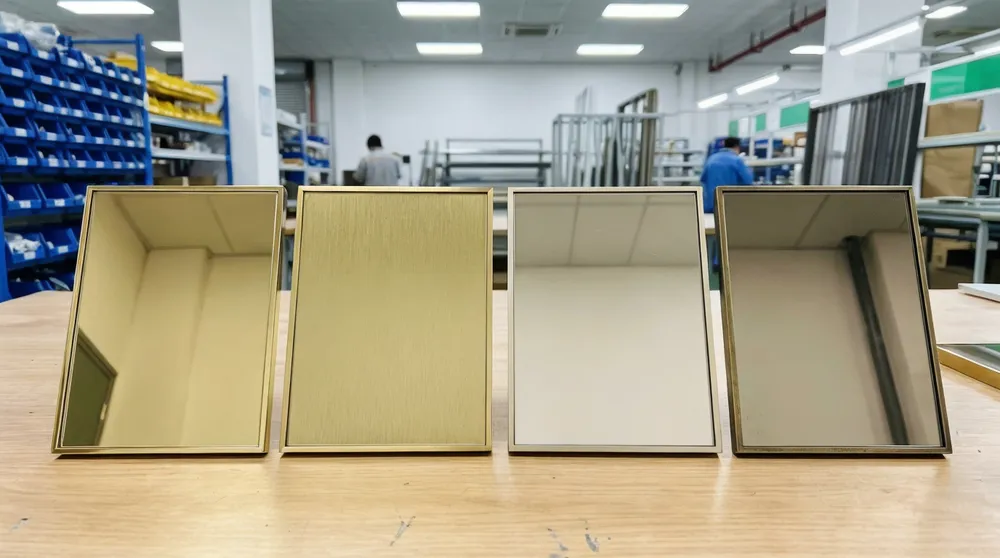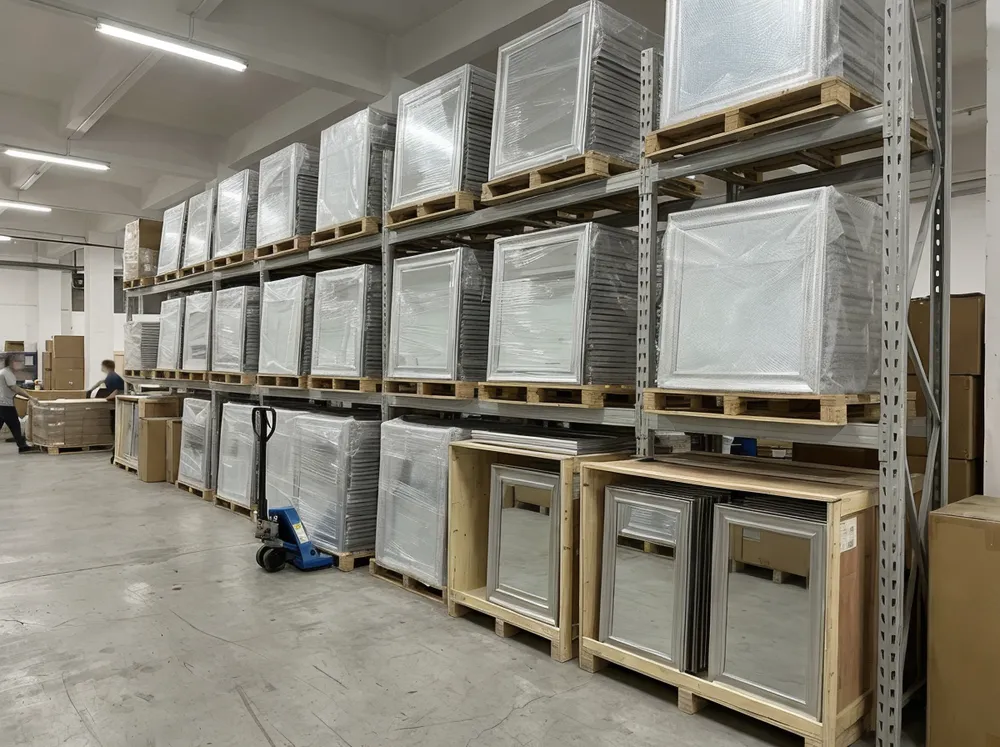
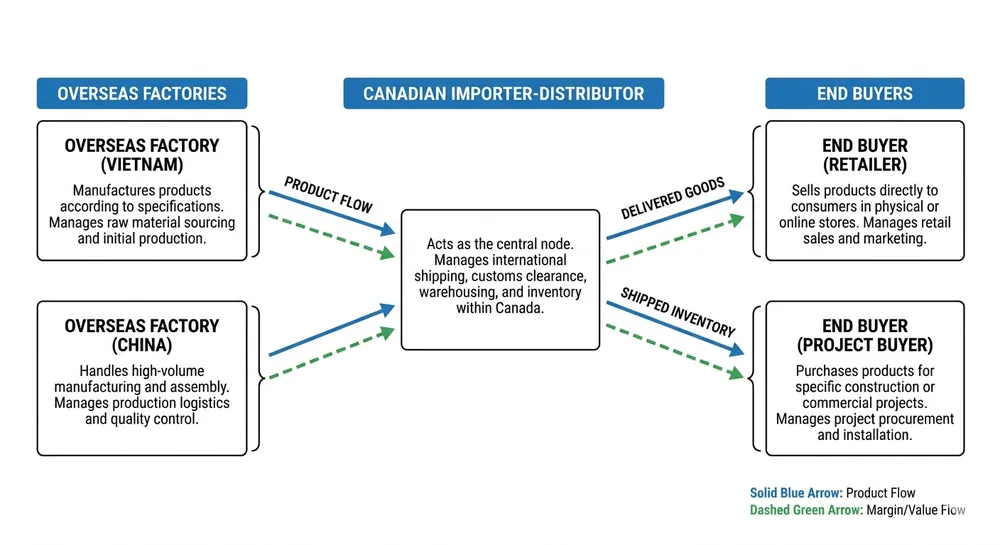
Canada's framed mirror wholesale market is smaller than it looks from the outside. Most buyers searching for domestic suppliers quickly discover the same pattern: a handful of genuine stocking distributors, a larger number of importers reselling Asian-sourced product with a Canadian address, and a long tail of home decor wholesalers who carry mirrors as a secondary category alongside furniture and accessories. That's not a criticism — it's just the structure of the market, and understanding it changes how you evaluate each supplier on this list.
The ten companies below represent the realistic sourcing landscape for Canadian buyers looking for framed decorative mirrors in commercial quantities. Some are full-service distributors with warehouse stock. Some are category specialists. A few operate as trading intermediaries. Where a supplier's model affects your MOQ, lead time, or customization options, that's noted directly.
Before the list, a quick note on methodology: these companies were identified through Canadian wholesale directories, trade buyer forums, and direct website verification. Supplier descriptions stay conservative — we've noted what each company appears to offer based on publicly available information, not sales claims we can't verify.

What Serious Buyers Check Before Placing a Wholesale Mirror Order
MOQ and price are the first two questions, but they're rarely the deciding ones. The frame is where most wholesale mirror orders go wrong — not the glass. A cracked mirror is obvious at receiving. A frame with inconsistent finish, joint gaps that open after six months on a retail floor, or a powder coat that chalks under store lighting is a warranty problem that shows up after your customer has already paid.
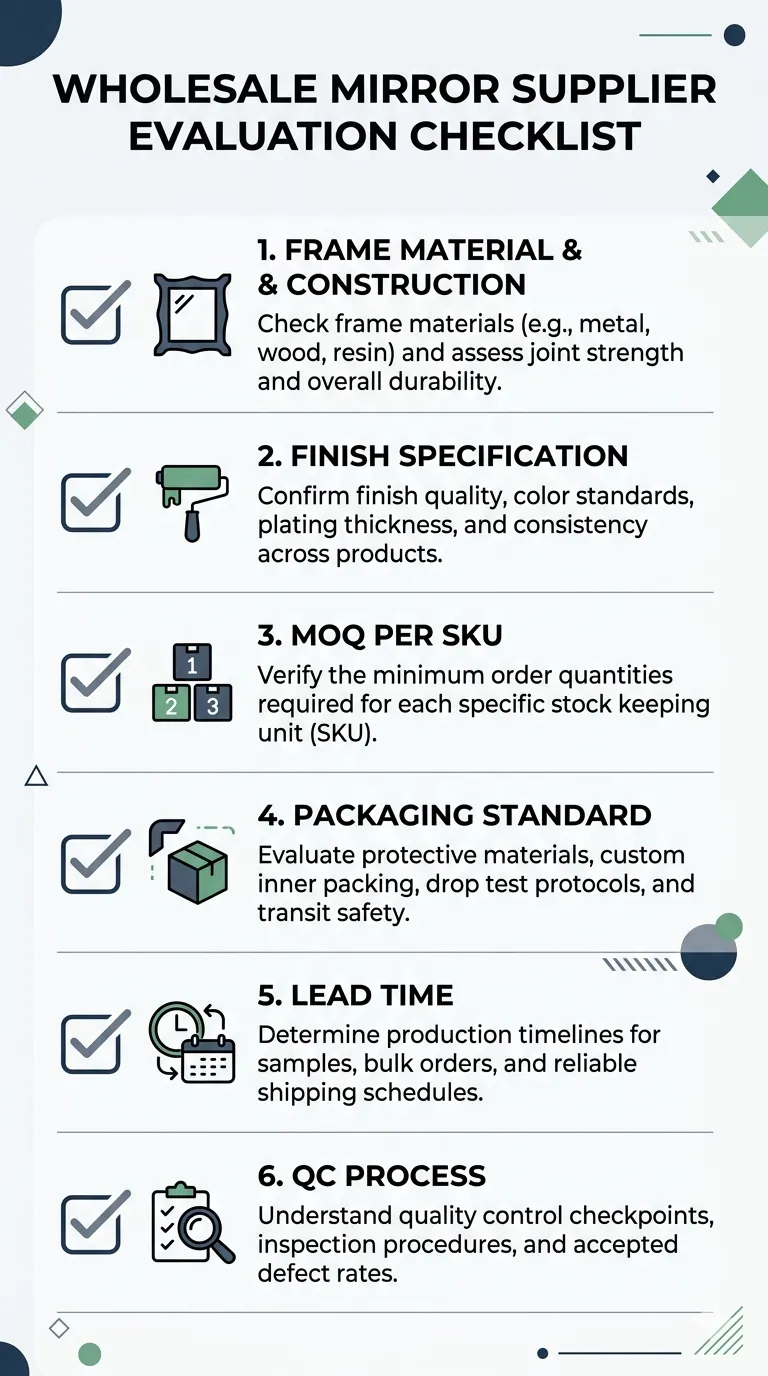
When you're evaluating any supplier on this list, run through these criteria before committing to a trial order:
Frame material and construction method — Is the frame MDF-wrapped, solid wood, metal tube, or resin cast? Each has a different cost floor, weight profile, and failure mode. MDF frames are cost-efficient but moisture-sensitive; metal frames ship heavier but hold finish better in humid environments. Ask specifically, because "wood-look frame" often means MDF with a foil wrap, not solid wood.
Finish specification — For painted frames, ask for the coating thickness and whether they use a primer coat. For metal frames, ask whether it's powder coat or electroplate, and what the salt spray test result is. (We run our powder-coated frames to 500 hours minimum — below that, coastal retail accounts generate RMA claims.)
MOQ per SKU vs. MOQ per order — Some wholesalers quote a low per-order MOQ but require you to hit it across a narrow SKU range. If you're building a mixed assortment, the effective MOQ per style can be much higher than the headline number.
Packaging standard — Retail-ready packaging (individual box, corner protection, hang tag) versus bulk packing affects your receiving labor and your ability to drop-ship or floor-display without repackaging.
Lead time from order to dock — For stocking distributors, this is days. For importers placing orders against your PO, it's typically 45–75 days from Vietnam or China, plus ocean transit and customs clearance.
The 10 Canadian Framed Mirror Wholesalers Worth Evaluating
1. Umbra — Toronto, ON
Website: umbra.com
Umbra is one of the few Canadian companies that designs and develops its own mirror and home decor products rather than reselling imported stock under a generic label. Their framed mirror range skews contemporary and design-forward — thin metal frames, geometric shapes, multi-mirror wall arrangements. They wholesale to independent retailers and interior design trade accounts across Canada and the US. MOQ varies by product line; their trade program is accessible through their website. Lead times on stocked items are short. Custom or private-label work is not their model — they sell their own branded product.
Best fit for: Retailers who want design-differentiated product with brand recognition and reliable domestic stock.
2. Korhani Home — Mississauga, ON
Website: korhani.com
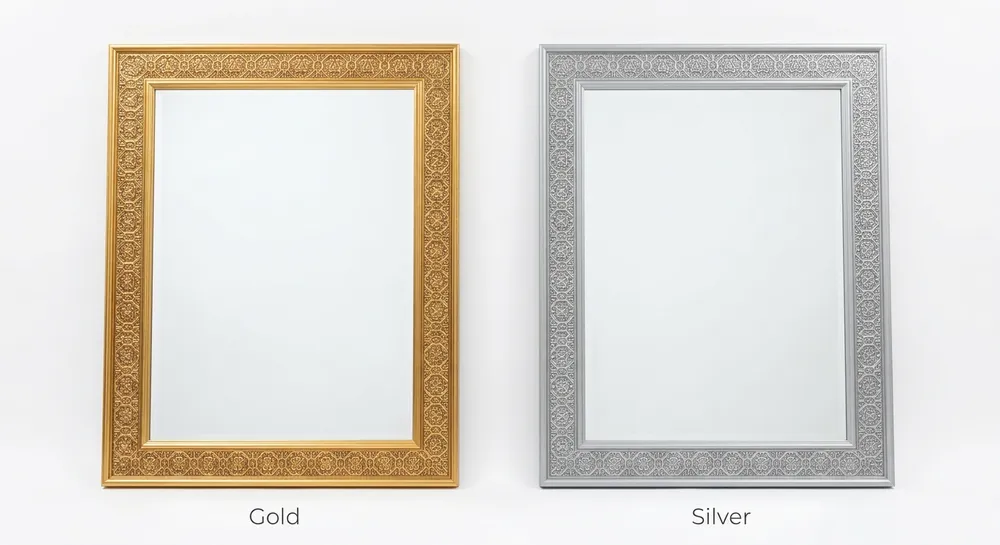
Korhani is primarily a rug and flooring wholesaler, but their home decor division carries framed wall mirrors as part of a broader accessories assortment. They distribute to independent furniture and home decor retailers across Canada. Their mirror range tends toward transitional and traditional styles — ornate resin frames, gold and silver finishes. Stock depth on mirrors is secondary to their core rug business, so availability can be inconsistent on specific SKUs. Worth contacting if you're already buying rugs or soft furnishings from them and want to consolidate suppliers.
Best fit for: Retailers consolidating home decor purchasing with an existing Korhani account.
3. Adairs Wholesale / Canadian Home Decor Distributors (via Canwel / regional reps)
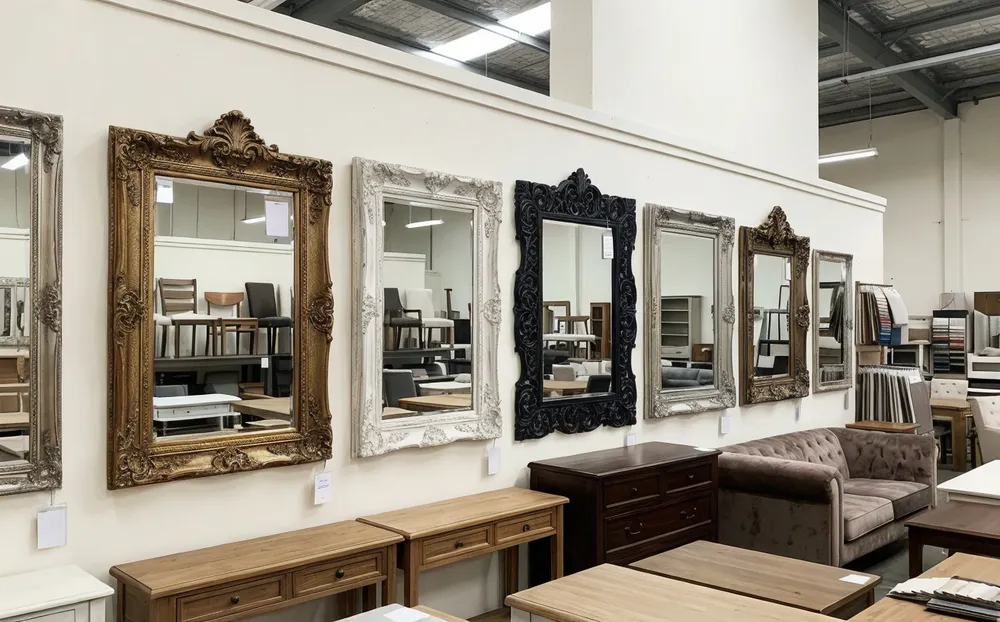
Canada's mid-market home decor wholesale tier is served by a network of regional sales reps and small importers who don't always maintain a prominent web presence. Several operate through trade show channels — the Toronto Gift Fair and the Calgary Gift Show are the two main discovery points for this tier. These suppliers typically carry 20–60 mirror SKUs, stock in a single warehouse (usually Ontario or BC), and serve independent gift shops, boutique furniture stores, and interior design studios. MOQs in this tier are often low (6–12 pieces per style), but product consistency and reorder reliability vary significantly.
Best fit for: Independent retailers who need low-MOQ access to a mixed assortment and can absorb some SKU discontinuation risk.
4. Homeroots (Canadian distribution) — distributed via wholesale platforms
Website: homeroots.co
Homeroots is a US-based home furnishings wholesaler with distribution reach into Canada through their drop-ship and wholesale programs. Their framed mirror catalog is extensive — hundreds of SKUs across metal, wood, and resin frames in a wide finish range. They operate primarily as a drop-ship supplier for online retailers and marketplaces, but also offer bulk wholesale pricing for stocking orders. Canadian buyers should factor in cross-border shipping costs and potential duty on US-origin or US-warehoused product. Lead times on in-stock items are fast; out-of-stock items can have unpredictable replenishment timelines.
Best fit for: Canadian e-commerce retailers or marketplace sellers who want broad SKU access without holding inventory.
5. Privilege Furniture & Décor — Montréal, QC
Website: privilegefurniture.com
Privilege is a Montréal-based importer and wholesaler serving the Quebec and Eastern Canada retail market. Their catalog covers furniture and home accessories including framed mirrors, with a focus on traditional and transitional styles. They maintain warehouse stock in Quebec and serve independent furniture retailers and interior designers. French-language service is a practical advantage for Quebec-based buyers. Their mirror range is not their primary category, so frame material depth and finish options are limited compared to a mirror-specialist supplier.
Best fit for: Quebec-based retailers who want a local warehouse relationship and French-language account support.
6. Bouclair Home (wholesale/trade program)
Website: bouclair.com
Bouclair is a Quebec-founded home decor retailer that also operates a trade and wholesale program for interior designers and commercial buyers. Their framed mirror selection is curated and trend-driven — they refresh their assortment seasonally. This makes them useful for buyers who want current styling, but less reliable for buyers who need consistent reorder on the same SKU across multiple seasons. MOQ through their trade program is accessible. They're not a volume wholesale supplier in the traditional sense, but their product quality and styling are above the generic import tier.
Best fit for: Interior designers and boutique retailers who prioritize styling currency over SKU stability.
7. Canac / regional building material distributors (mirror category)
Several Canadian building material and hardware distributors — including regional players in Quebec and Ontario — carry framed bathroom and decorative mirrors as part of their home improvement category. These are not home decor specialists, but they stock framed mirrors in standard sizes (24×36, 30×40, 36×48 inches) suitable for residential and light commercial projects. Pricing is competitive on standard sizes. Frame options are limited — typically beveled wood or basic metal. Custom sizing or finish options are not available through this channel.
Best fit for: Contractors and project buyers who need standard-size framed mirrors in volume with fast local pickup.
8. Wholesale Club / Costco Business Centre (opportunistic bulk channel)
Not a traditional wholesale supplier, but worth noting for buyers who operate in the value tier. Both Costco Business Centre and Wholesale Club periodically carry framed decorative mirrors in bulk pack at aggressive price points. Selection is opportunistic — you buy what's available, not what you specify. No custom options, no reorder guarantee, no frame material transparency. Useful for filling out a low-price tier in a mixed assortment, not for building a reliable product program.
Best fit for: Value-tier retailers who can absorb SKU variability and don't require reorder consistency.
9. Décor-Rest Furniture / Canadian furniture wholesale network
Décor-Rest and similar Canadian furniture wholesalers occasionally include framed mirrors as accent pieces within their furniture collection programs. These are typically sold as part of a room grouping or collection package rather than as standalone mirror SKUs. If you're already buying furniture from a Canadian wholesaler, ask whether they carry mirrors as add-on items — the pricing is often favorable within an existing account relationship.
Best fit for: Furniture retailers who want to add mirrors as margin-enhancing accessories within an existing supplier relationship.
10. Direct import via Canadian mirror importers (Alibaba-sourced, Canadian address)
A significant portion of the Canadian framed mirror wholesale market is served by small importers who source directly from Chinese or Vietnamese factories, hold stock in a Canadian warehouse, and resell at wholesale prices. These companies often don't have a strong web presence — they operate through trade shows, word of mouth, and B2B platforms. Product quality varies widely. The advantage is domestic stock and low MOQ. The disadvantage is that you have no visibility into the factory behind the product, no ability to customize, and limited recourse if quality is inconsistent across shipments.
Best fit for: Buyers who need domestic stock access and are willing to accept product variability in exchange for low MOQ and fast delivery.
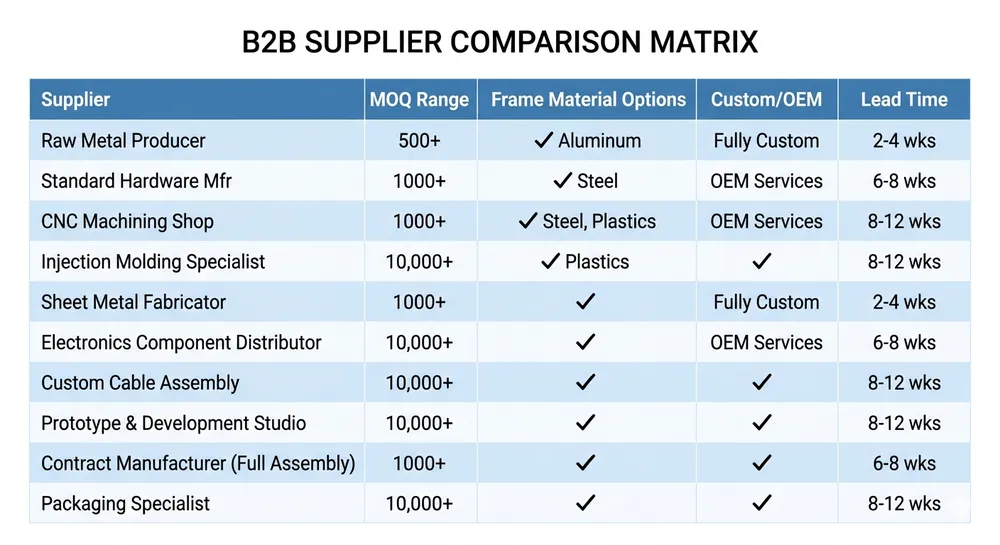
Where Local Wholesale Adds Real Value — and Where It Compresses Your Margin
Local Canadian wholesalers solve specific problems well. If you need 12 pieces of a framed mirror for a client project that starts in three weeks, no factory in Vietnam can help you. If you're a new retailer testing a mirror category with limited capital, a domestic wholesaler's low MOQ and net-30 terms are genuinely useful. If you're buying across multiple home decor categories and want a single invoice, a broad-line distributor makes operational sense.
These are real advantages. The question is what you pay for them.
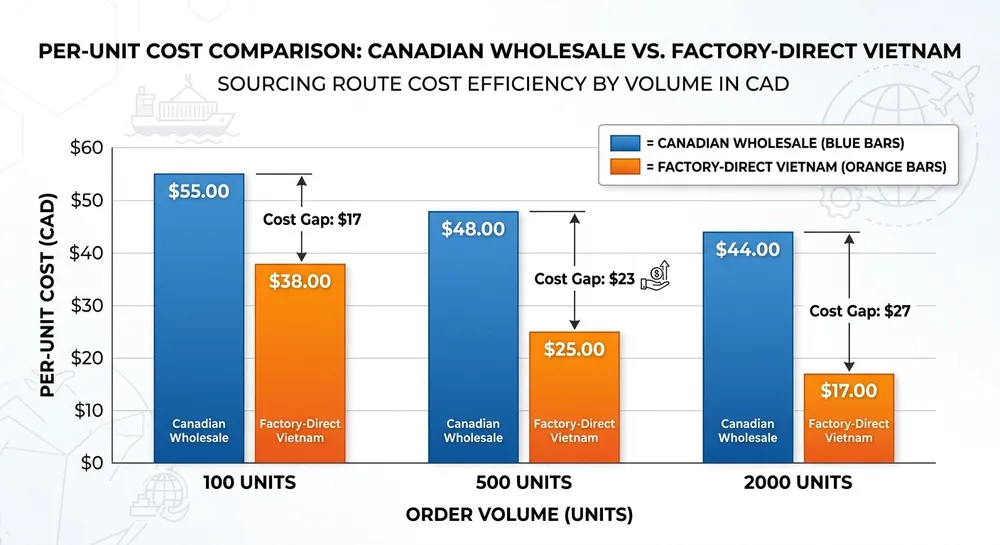
The typical Canadian wholesale markup on imported framed mirrors runs 40–70% above the landed factory cost. That margin covers warehousing, local logistics, account management, and the wholesaler's own import risk — all legitimate costs. But it means your cost of goods is structurally higher than a buyer who imports directly, and that gap compounds as your volume grows.
On a 500-unit order of a mid-range framed mirror — say a 24×36 inch MDF frame with a painted finish — the difference between buying from a Canadian wholesaler and importing factory-direct from Vietnam typically runs CAD $8–18 per unit depending on the frame spec and finish complexity. At 500 units, that's CAD $4,000–9,000 in margin that either stays in your pocket or gets passed to your customer as a lower retail price. At 2,000 units annually, the math becomes a sourcing strategy decision, not just a price comparison.
(The CAD $8–18 range is a representative estimate based on typical wholesale markup structures — your actual gap will depend on the specific product, your current supplier's pricing, and the landed cost of the factory-direct alternative including freight and duty.)
CBSA Tariff and Compliance Considerations for Mirror Imports
If you're evaluating factory-direct import as an alternative to domestic wholesale, the landed cost calculation needs to include Canadian customs duties and compliance requirements.
CBSA tariff classification: Decorative framed mirrors typically fall under HS code 7009.92 (glass mirrors, framed) or 7009.91 (unframed), with the framed category being most relevant here. The Most Favoured Nation (MFN) duty rate for mirrors from Vietnam is generally 0% under CPTPP (the Comprehensive and Progressive Agreement for Trans-Pacific Partnership), which Canada and Vietnam are both party to. This is a meaningful cost advantage — mirrors imported from Vietnam under CPTPP origin qualification enter Canada duty-free, while mirrors from non-CPTPP countries may attract duty.
Origin documentation: To claim CPTPP preferential tariff treatment, your supplier needs to provide a valid Certificate of Origin or origin declaration. Any factory you work with should be able to provide this routinely — if they can't, that's a red flag about their export compliance capability.
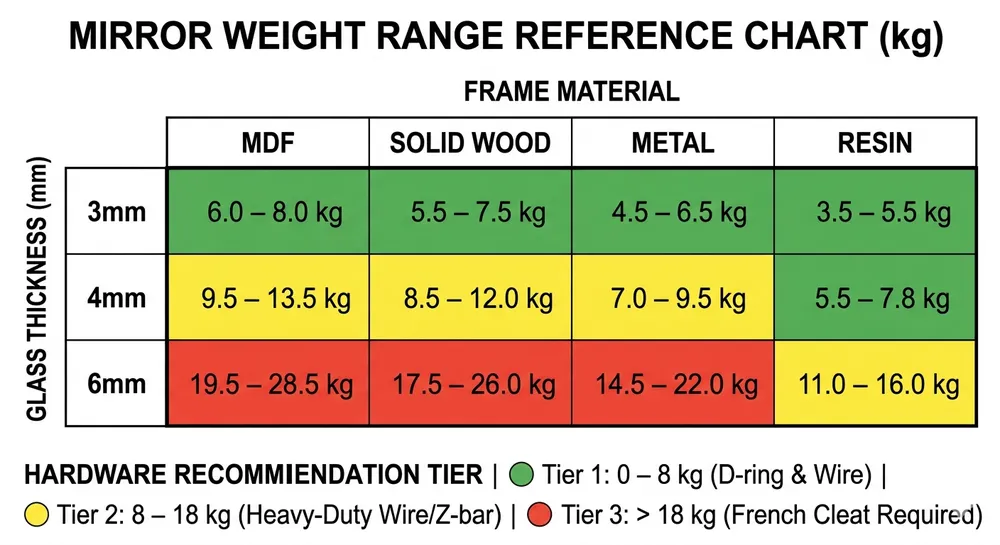
Canada Consumer Product Safety Act (CCPSA): Decorative mirrors sold in Canada must comply with CCPSA requirements. For framed wall mirrors, the primary compliance considerations are packaging safety (no sharp edges on retail packaging), and for mirrors with hanging hardware, the hardware must be rated for the mirror's weight. Most export-grade factories producing for North American markets build to these standards as a baseline — ask for their compliance documentation before your first order.
Anti-dumping: There are no current Canadian anti-dumping orders specifically targeting decorative framed mirrors from Vietnam or China as of this writing, but it's worth verifying current CBSA notices before placing a large first order.
Factory-Direct Framed Mirror Sourcing: What the Economics Actually Look Like
The wholesaler landscape above covers your domestic options honestly. Here's where the trade-off becomes a sourcing strategy question rather than a convenience decision.
We manufacture framed decorative mirrors at our 12,000 m² facility in Ho Chi Minh, Vietnam. Six production lines, 150 people, 400,000 pieces a year — the scale matters because it means your order doesn't queue behind a larger customer's run. We've been doing this since 2008, and the majority of our volume goes to North American buyers: retailers, distributors, and project buyers who started with a trial order and now run annual programs.
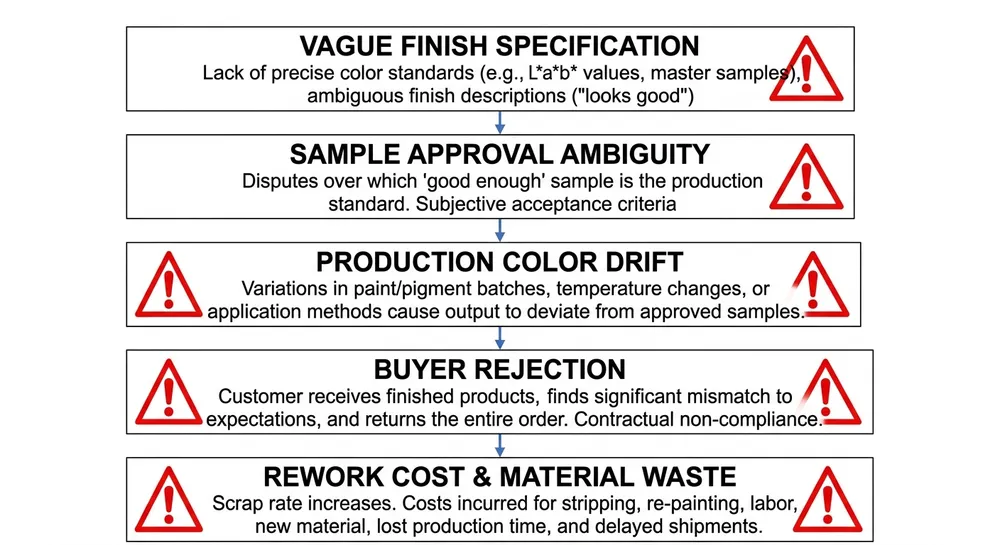
The frame is where we're different from a trading company reselling stock. We run our own frame production — MDF profiles, solid wood, metal tube, and resin casting are all done in-house. When a buyer asks for a 2-inch antique gold MDF frame with a specific profile radius, we're not calling a frame supplier and hoping for consistency across shipments. We're cutting and finishing that profile on our own line, which means the 500th unit matches the first. (Frame joint consistency is the most common complaint we hear from buyers who've switched from trading companies — the profile looks right in the sample but drifts in production. In-house frame control eliminates that.)
Our copper-free silvering process is worth mentioning specifically for Canadian buyers targeting coastal or humid-climate retail accounts. Standard silver mirrors use a copper backing layer that oxidizes at the edges over time — the black edge creep you see on older mirrors. Copper-free silvering eliminates that failure mode, which matters if your customers are in Vancouver, Halifax, or any coastal market where humidity accelerates the process. It's a spec detail that most wholesalers can't tell you about the product they're selling, because they don't know what's behind the glass.
On MOQ: we start at 100 pieces for standard models on existing molds. For custom frame profiles, the minimum is higher — typically 300–500 pieces depending on the tooling investment — but we absorb the mold cost on programs above 1,000 pieces annually. Most Canadian buyers we work with start with a 200-unit mixed trial order across 3–4 SKUs, then consolidate to a 2–3 container annual program once they've tested the product with their customers.
Lead time on existing molds runs 30–35 days production plus ocean transit — roughly 55–65 days door to Canadian port. That's longer than calling a domestic wholesaler, and we won't pretend otherwise. The trade-off is unit economics, customization control, and the ability to build a product program that your competitors can't easily replicate from the same wholesale catalog.
For buyers evaluating our Frame Decor Mirrors range, the Decor Mirrors by Material & Frame category page covers our full frame material and finish options in detail. If you're earlier in the sourcing decision and want to understand how frame material selection affects cost and durability, How to Choose Decor Mirror Frame Materials walks through the trade-offs we see most often from buyers in your market.
Which Sourcing Route Fits Your Situation
The honest answer is that both routes have a place depending on your order profile.
Local wholesale makes sense when:
- You need product in under 4 weeks
- Your order is under 100 pieces and you can't meet a factory MOQ
- You're testing a new mirror category with no volume commitment
- You need net-30 terms from a Canadian entity and can't manage import financing
- You're filling a gap order between container shipments
Factory-direct import makes sense when:
- You're ordering 300+ pieces per run and the per-unit cost gap is material to your margin
- You want a frame profile, finish, or size that isn't available in the domestic wholesale catalog
- You're building a private-label or OEM program that requires consistent production control
- You're supplying a hospitality or commercial project where finish consistency across 200+ identical units is non-negotiable
- You've been burned by inconsistent quality from a domestic wholesaler who can't tell you what factory made the product
The buyers who get the most value from factory-direct sourcing are typically those running a repeat annual program — not one-off orders. The economics improve with volume, and the relationship with the factory improves with repeat orders. We know which of our Canadian buyers are running seasonal programs, and we plan production capacity around them.
If you're currently buying from a Canadian wholesaler and want to understand whether the volume and margin math supports a direct import program, the Decor Mirror Frame Materials Sourcing Guide covers the cost structure in more detail. For buyers also evaluating the US market, Framed Mirror Suppliers in the USA covers the parallel landscape south of the border.
Frequently Asked Questions
What MOQ do Canadian framed mirror wholesalers typically require?
It varies significantly by supplier type. Stocking distributors serving independent retailers often go as low as 6–12 pieces per style with no order minimum. Mid-tier importers typically require 24–48 pieces per SKU or a minimum order value of CAD $500–1,500. For factory-direct import, the practical floor is 100 pieces per style for standard models — below that, the per-unit freight cost erodes the price advantage over domestic wholesale.
What frame materials are most commonly available through Canadian wholesale channels?
The majority of Canadian wholesale framed mirrors use MDF frames with a foil wrap or painted finish, or metal tube frames with powder coat. Solid wood frames are available but less common at the wholesale tier — they're heavier, more expensive to ship, and harder to produce consistently at volume. Resin frames (cast polyurethane) are available through some importers for ornate traditional styles. If you need a specific frame material or profile, domestic wholesale is unlikely to offer customization — that's where factory-direct sourcing becomes the only viable route.
Does importing framed mirrors from Vietnam to Canada attract customs duty?
Under CPTPP, decorative framed mirrors from Vietnam (HS 7009.92) generally qualify for 0% MFN duty when proper origin documentation is provided. Your supplier should furnish a Certificate of Origin or origin declaration with each shipment. Factor in the 5% GST on the CIF value, plus any applicable provincial taxes, when calculating your landed cost. Brokerage fees typically run CAD $150–300 per shipment through a licensed customs broker.
What's the difference between copper-free and standard silver mirrors for retail buyers?
Standard silver mirrors use a copper sulfate layer between the glass and the silver coating. Over time — especially in humid environments — that copper layer oxidizes and causes the characteristic black edge creep you see on aging mirrors. Copper-free silvering replaces the copper layer with a tin-based barrier, which is significantly more resistant to oxidation. For retail buyers supplying coastal markets (Vancouver, Halifax, Victoria), copper-free is worth specifying — it reduces warranty claims and extends the product's visible lifespan on the retail floor. Most Canadian wholesalers can't confirm which process their product uses; a factory-direct supplier can.
What packaging standard should I require for wholesale framed mirror orders?
For retail floor display: individual RSC (regular slotted carton) box with foam corner inserts, a poly bag over the mirror face, and a hang tag or label slot. For project/contract delivery: master carton packing is acceptable if your receiving team can handle bulk unpacking. For drop-ship or e-commerce fulfillment: the individual box needs to survive a 1.2-meter drop test without glass breakage — ask your supplier specifically about their e-commerce packaging spec, because standard retail packaging often fails this test.