Most mounting failures we see traced back to the same root cause: the hardware spec was decided after the mirror was already in production. By then, the frame profile is locked, the backing board is cut, and the carton dimensions are set. Changing the hardware at that stage means rework, repackaging, and in some cases a full re-run of the backing assembly. The importer pays for it either in cost or in delay.
Mounting specs aren't a finishing detail. They're a structural decision that touches glass thickness, frame material, backing board type, wall substrate compatibility, and how the carton gets built. Get them right at the RFQ stage and everything downstream — production, QC, packaging, freight — runs cleaner.
This guide covers what you need to verify before your order goes into production: how mirror weight actually breaks down, which hardware types apply to which weight ranges, what wall substrates your end market requires, and what to check on a pre-shipment sample before you approve a bulk run.
How Mirror Weight Actually Breaks Down — Glass, Frame, and Backing
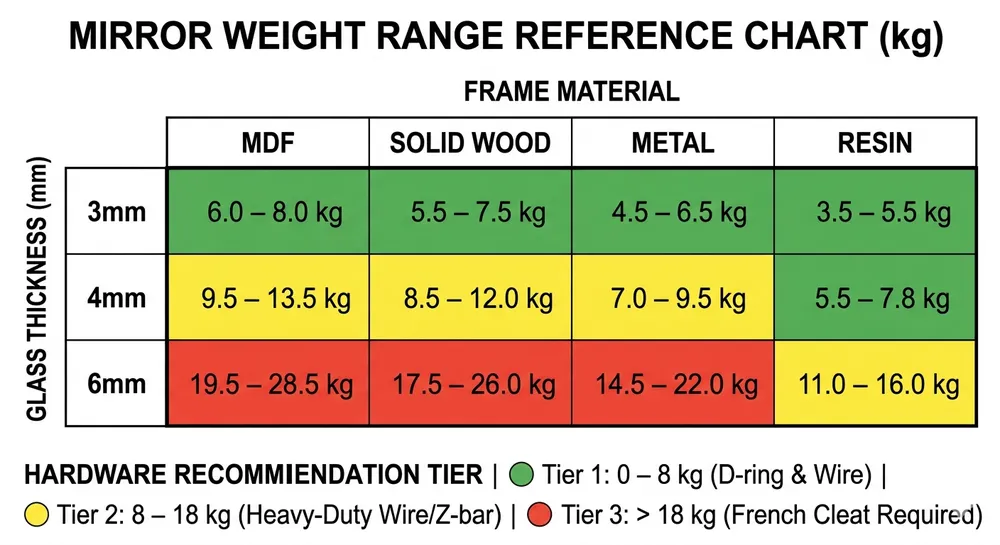
The number that matters for hardware selection is total hung weight: glass panel + frame assembly + backing board + hardware itself. Each component contributes differently depending on the spec, and the combinations can surprise buyers who only think about mirror size.
Glass thickness is the dominant variable. For our Wall Decor Mirrors, we run three standard glass thicknesses:
| Glass Thickness | Weight per m² (approx.) | Typical Application |
|---|---|---|
| 3mm | 7.5 kg/m² | Small decorative mirrors, lightweight frames, retail price-point products |
| 4mm | 10 kg/m² | Mid-size wall mirrors, standard residential and hospitality |
| 6mm | 15 kg/m² | Large format mirrors, commercial installations, frameless or heavy-frame designs |
A 600×900mm mirror in 4mm glass carries roughly 5.4 kg of glass alone. Add an MDF frame and backing and you're at 7–9 kg total. Specify 6mm glass on the same footprint and total hung weight climbs to 11–14 kg depending on frame material. That's the difference between a D-ring wire setup and a French cleat — and it's a decision that needs to be made before the frame mold is cut.
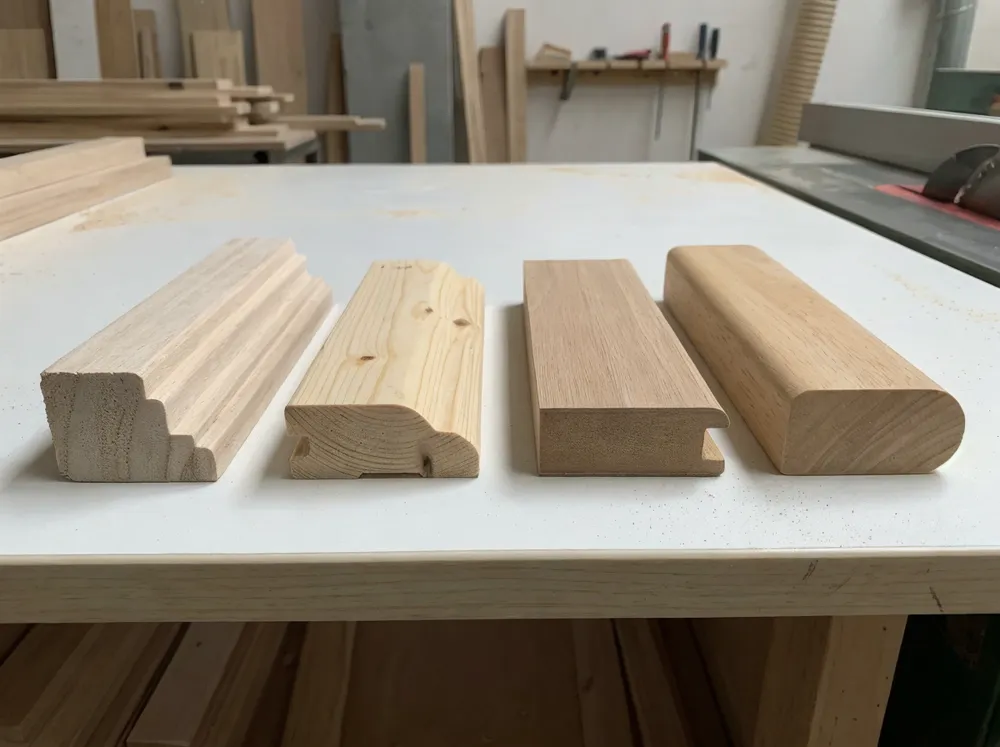
Frame material adds weight in ways that aren't always obvious. Resin frames look light but dense casting compounds can run 1.8–2.2 kg/linear meter on a thick profile. Solid wood frames in hardwood species (oak, rubberwood) add more than MDF on equivalent profiles. Metal frames — typically 1.0–1.2mm cold-rolled steel or aluminum extrusion — are lighter per linear meter than solid wood but add rigidity that changes how the backing board needs to be attached.
Reference weight contributions by frame material for a standard 600×900mm mirror:
| Frame Material | Approx. Frame Weight | Notes |
|---|---|---|
| MDF (18mm profile) | 1.2–1.8 kg | Most common for painted finishes; absorbs moisture in high-humidity environments |
| Solid wood (hardwood) | 1.8–2.6 kg | Higher weight, better screw retention for D-ring hardware |
| Metal (steel/aluminum) | 0.8–1.4 kg | Lightest frame option; requires welded or riveted hardware attachment points |
| Resin/polyresin | 1.4–2.2 kg | Weight varies significantly by casting density and profile thickness |
(Note: these are production reference ranges from our Ho Chi Minh facility — actual weight depends on profile width, corner joint method, and finish system. We provide per-unit weight on every order confirmation so your freight team has accurate data.)
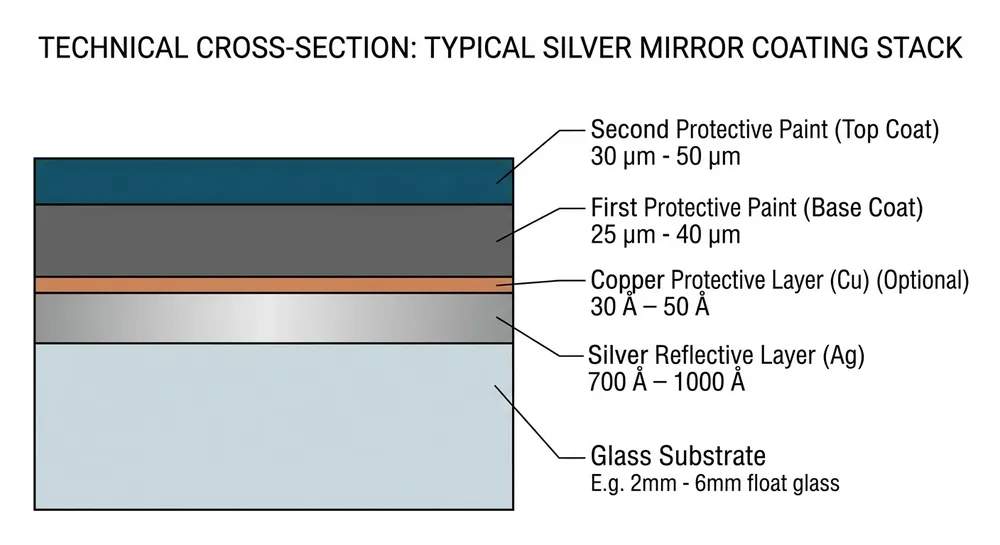
Backing board and silvering layers add less than most buyers expect, but they're not zero. A standard 3mm MDF backing with our copper-free silver coating system adds roughly 0.3–0.5 kg on a mid-size mirror. The multi-coat backing — silver layer, copper-free barrier coat, and two protective paint layers — is part of why our mirrors hold up in coastal and humid markets, but it does contribute to total weight. Worth noting when you're calculating freight cost per unit at scale.

Hardware Types, Load Ratings, and When Each Applies
The five hardware types we install cover the full weight range of decorative wall mirrors. Each has a different load rating, wall substrate requirement, and installation profile — and the wrong choice for the weight class creates liability exposure for your downstream customer.
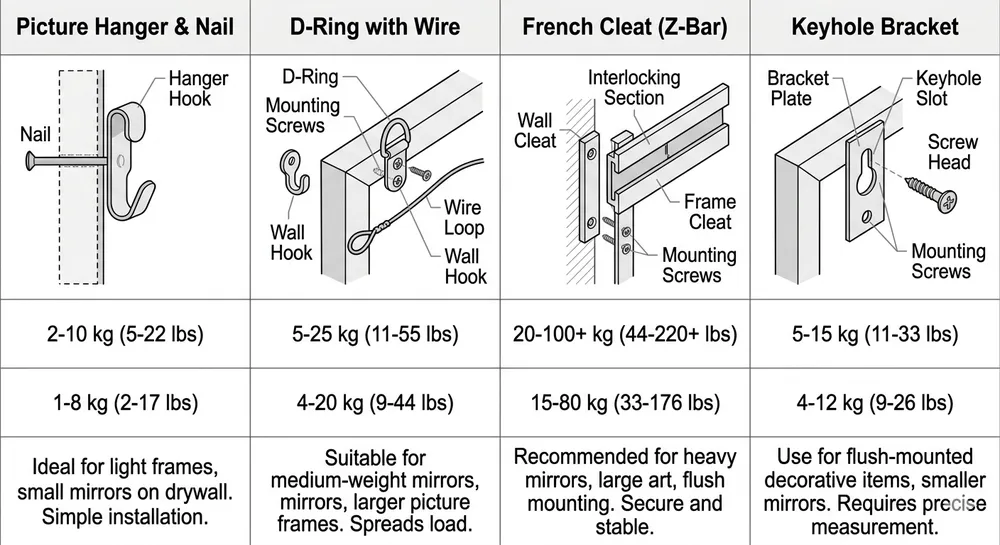
D-ring with braided wire is the default for mirrors up to approximately 10 kg total hung weight. Two D-rings mounted to the frame back, connected by 7-strand braided steel wire, hang on a single wall hook or picture rail. Load rating on a properly installed D-ring pair (M4 screws, 25mm penetration into solid wood or MDF) runs 12–15 kg before deformation. For drywall installations, the limiting factor is the wall anchor, not the hardware — standard drywall anchors rate 15–25 kg depending on type, but stud-mounted hooks handle 40+ kg.
We see buyers underspecify wire gauge on large mirrors. 0.8mm wire is fine for a 5 kg bathroom mirror. On a 9 kg piece, specify 1.2mm minimum — the thinner wire fatigues at the crimp point over time, especially in environments with vibration or temperature cycling.
French cleat (Z-bar) is the right call for mirrors above 10 kg, for commercial installations, and for any project where the mirror needs to be removable without tools. Two interlocking aluminum extrusions — one fixed to the wall, one to the mirror back — distribute load across the full cleat length rather than concentrating it at two screw points. A 600mm aluminum French cleat at 1.5mm wall thickness handles 30–40 kg comfortably. For mirrors above 25 kg, we specify 2.0mm cleat stock.
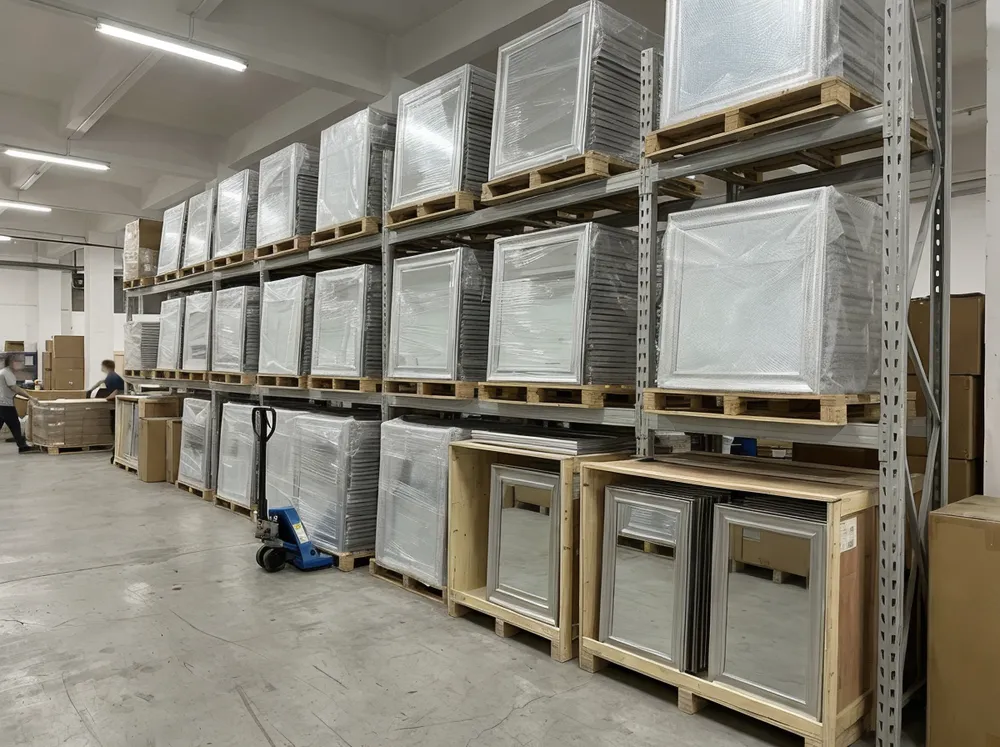
The trade-off: French cleat mirrors need a deeper carton. The cleat profile adds 18–25mm to the mirror's effective depth, which changes carton dimensions and affects how many units fit per pallet. We configure packaging per mounting type — a French cleat mirror ships in a different carton spec than the same mirror with wire hardware. See our notes on wall mirror packaging for safe shipping for how this flows through to freight cost.
Keyhole brackets work well for mid-weight mirrors (8–18 kg) where flush wall contact is a priority. Two keyhole slots routed or stamped into a metal backing plate accept wall-mounted screws. The mirror drops onto the screws and sits flush. Installation is clean and fast — relevant for hospitality projects where housekeeping staff need to remove and rehang mirrors for room maintenance. The limitation is that keyhole brackets require precise stud or anchor placement; the screw centers must match the bracket spacing exactly, which means your end customer needs accurate installation templates.
We include a printed installation template with every keyhole-mount mirror order. It's a small thing, but it eliminates the most common installation complaint we hear from hotel project buyers.
Adhesive mounting systems (mirror mastic, double-sided structural tape) are outside the scope of hardware we install at the factory. We don't recommend them for framed decorative mirrors above 5 kg — the peel strength degrades with temperature cycling and the failure mode is sudden rather than gradual. If your project spec calls for adhesive mounting, that's a conversation to have with your installation contractor, not something to specify at the mirror sourcing stage.
Mirror D-ring vs French Cleat Load Rating — The Decision Table
Buyers ask us this comparison constantly, so here it is as a direct reference:
| Spec Factor | D-ring + Wire | French Cleat (Z-bar) | Keyhole Bracket |
|---|---|---|---|
| Typical load rating | 12–15 kg (hardware) | 30–40 kg per 600mm cleat | 15–25 kg per pair |
| Mirror weight range | Up to 10 kg | 10–40+ kg | 8–18 kg |
| Wall substrate | Drywall (anchored), stud, concrete | Stud, concrete, masonry | Stud, concrete (precise spacing required) |
| Installation complexity | Low | Medium | Medium |
| Removable without tools | No | Yes | Yes |
| Hospitality suitability | Standard rooms | Preferred for heavy pieces | Good for maintenance access |
| Packaging depth impact | Minimal | +18–25mm carton depth | Minimal |
| Factory installation | Yes — standard | Yes — standard | Yes — with template |
For Decor Mirrors by Material & Frame, the hardware decision should be locked before frame production starts. The frame back needs pre-drilled and reinforced attachment points for D-rings, routed channels for French cleat, or precision-stamped keyhole plates — none of these can be added cleanly after the frame is assembled.
Wall Substrate Compatibility — What Your End Market Requires
Hardware load ratings are only half the equation. The wall substrate determines whether those ratings are achievable in the field. This matters most for commercial and hospitality buyers, where installation conditions vary and liability for a fallen mirror is real.
Drywall (gypsum board) is the standard in North American residential and most hotel new-build construction. Drywall alone holds very little — the anchor or stud does the work. For mirrors up to 10 kg, a quality toggle bolt or snap anchor in drywall handles the load. For anything above 10 kg, stud mounting is the right spec. We recommend buyers in the North American market specify stud-mount installation for any mirror above 8 kg, with a 16" or 24" stud spacing note in the installation guide.
Concrete and masonry walls are standard in European, Middle Eastern, and Southeast Asian construction. Concrete anchors (M6 or M8 sleeve anchors) handle significantly higher loads than drywall anchors — a properly set M8 sleeve anchor in 150mm concrete holds 80+ kg in shear. For these markets, the hardware spec can be lighter relative to mirror weight, but the installation template needs to specify anchor type and minimum embedment depth.
Tile walls (bathrooms, spa installations) require diamond-drill installation and appropriate tile anchors. We don't specify tile installation hardware — that's the contractor's scope — but we do flag it on the installation guide when a buyer's project brief indicates bathroom or wet-area placement. The mirror backing spec matters here too: copper-free silvering and sealed edge treatment prevent silver oxidation from moisture ingress, which is a separate issue from mounting but affects the same installation environment.
Seismic and fire-rated requirements apply to commercial installations in California, Japan, New Zealand, and other seismic zones. For hospitality projects in these markets, mirrors above a certain size (typically 600×900mm or heavier than 10 kg) may require seismic clips or safety backing film in addition to standard mounting hardware. We can supply mirrors with safety backing film applied at the factory — it's a laminate layer on the glass face that holds fragments in place if the glass breaks. Specify this at the RFQ stage; it cannot be added after production.
(We've had buyers discover the seismic requirement after their container arrived in California. The retrofit cost — sourcing film, applying it unit by unit, repackaging — was significant. It's worth one line in your project spec to avoid it.)
Pre-Shipment QC Checklist for Mounting Hardware
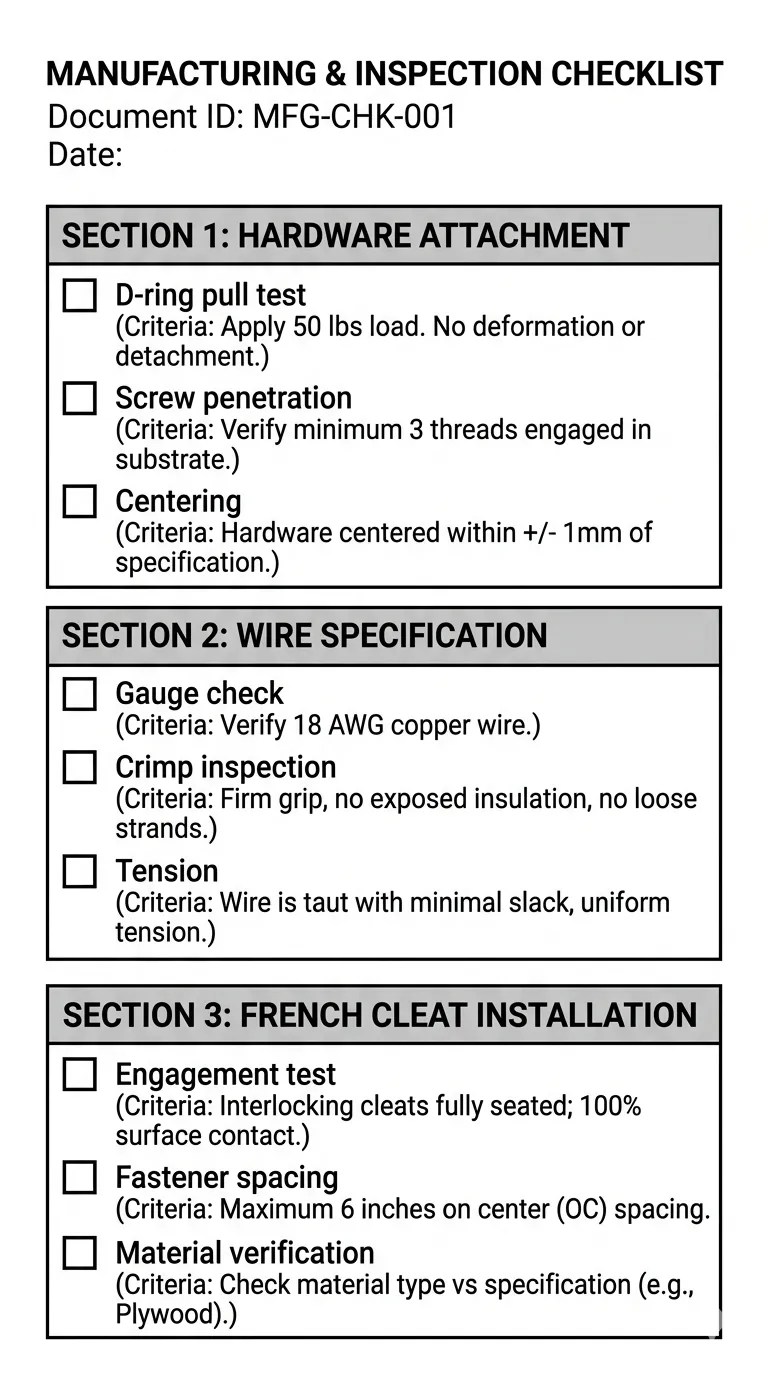
This is where most importers lose money: they approve a sample, place a bulk order, and discover on arrival that the hardware installation quality didn't hold across the full run. Hardware QC on a pre-shipment inspection needs to be specific, not visual.
Here's what to verify on your pre-shipment sample before approving a bulk run:
Hardware attachment integrity
- Pull-test each D-ring or cleat attachment point. On a properly installed M4 screw into 18mm MDF, you should not be able to pull the hardware free by hand. If you can, the screw length is wrong or the MDF density is below spec.
- Check screw penetration depth. We specify minimum 20mm penetration for D-rings on MDF frames, 25mm for solid wood. Shorter penetration is a common cost-cutting shortcut on lower-quality production runs.
- Verify hardware is centered and level. Off-center D-rings cause the mirror to hang at an angle — a warranty claim waiting to happen.
Wire specification and termination
- Check wire gauge against your spec. 0.8mm and 1.2mm wire look similar at a glance; measure with calipers.
- Inspect crimp terminations. The wire should be doubled back through the crimp sleeve and compressed cleanly — no loose ends, no sharp wire protrusions that can cut hands during installation.
- Check wire tension. The wire should have enough slack to hang on a hook but not so much that the mirror tilts forward more than 5° from vertical.
French cleat alignment and fit
- Test the cleat engagement. The wall cleat and mirror cleat should interlock smoothly with no binding or rattle. Loose fit means the mirror can shift laterally on the wall.
- Check cleat fastener spacing. We install cleats with fasteners at 150mm centers maximum — wider spacing allows the cleat to flex under load.
- Verify cleat material. Aluminum extrusion is correct. Stamped steel is acceptable for lighter mirrors. Plastic cleat profiles are not acceptable for any mirror above 5 kg.
Documentation to request
- Per-unit weight confirmation (glass + frame + hardware + backing)
- Hardware specification sheet (type, material, load rating, screw spec)
- Installation template (for keyhole and French cleat configurations)
We provide all three as standard on every Livewellcraft order. If your current supplier doesn't, that's worth noting before you approve production.
For a deeper look at how frame construction affects hardware attachment points, see our guide on frame mirror construction specs.
How Mounting Hardware Choice Affects Packaging and Freight Cost
This connection doesn't get enough attention in sourcing conversations. The hardware spec you choose at the RFQ stage directly determines carton dimensions, which determines pallet configuration, which determines how many units fit in a container.
French cleat mirrors ship in deeper cartons. The cleat profile — typically 25–35mm tall when engaged — adds to the mirror's effective depth. A 600×900mm mirror with wire hardware ships in a carton roughly 650×950×60mm. The same mirror with French cleat hardware needs a carton approximately 650×950×90mm. That 30mm difference sounds small, but across a 40-foot container it can reduce unit count by 8–12% depending on stacking configuration.
Wire-hung mirrors can be stacked face-to-face with foam interleaving. French cleat mirrors typically need individual carton separation because the cleat profile creates an uneven back surface. This affects both carton cost and container loading efficiency.
Keyhole mirrors need installation templates packed inside the carton. The template adds negligible weight but requires a specific carton insert — a detail that needs to be confirmed with the packaging team before production starts.
We configure packaging per mounting type as a standard practice. When you submit your RFQ, specifying the mounting hardware type upfront means we can give you accurate per-unit carton dimensions and a realistic container loading count — which feeds directly into your landed cost calculation.
For buyers managing multiple SKUs with different mounting types, we recommend standardizing on one hardware system per size tier where possible. Mixed hardware specs across a single container order create complexity at the packing stage and increase the risk of mis-packed units.
Specifying Mounting Hardware in Your RFQ — What to Include
Vague hardware specs create problems at every stage. "Standard hanging hardware" means different things to different factories. Here's what a complete mounting spec looks like in an RFQ:
Mirror size: [W × H mm]
Glass thickness: [3mm / 4mm / 6mm]
Frame material: [MDF / solid wood / metal / resin]
Estimated total hung weight: [kg — or request factory confirmation]
Mounting hardware type: [D-ring + wire / French cleat / keyhole]
Wire gauge (if applicable): [0.8mm / 1.2mm / 1.5mm]
Cleat length (if French cleat): [mm]
Wall substrate in end market: [drywall / concrete / tile]
Safety backing film required: [yes / no]
Seismic clip required: [yes / no — specify market]
Installation template required: [yes / no]
The more specific your spec, the more accurate the quote — and the less room for substitution during production. We've seen buyers receive mirrors with 0.8mm wire on a 12 kg piece because the RFQ said "wire hanging" without specifying gauge. The factory wasn't cutting corners deliberately; they were filling a gap in the spec.
If you're not sure which hardware type fits your mirror spec, send us the mirror dimensions, glass thickness, frame material, and your target end market. We'll confirm the total hung weight from our production data and recommend the appropriate hardware — including any compliance requirements for your destination market.
Request Quote with your mirror spec and we'll come back with hardware recommendations and per-unit weight for your freight planning.
FAQ — Mounting Specs Buyers Ask Before Ordering
What is the weight limit for hanging a large decorative mirror on drywall?
The drywall itself isn't the limiting factor — the anchor or stud is. A stud-mounted hook handles 40+ kg. A quality toggle bolt in drywall handles 20–25 kg. For mirrors above 10 kg, we recommend specifying stud-mount installation in the installation guide. For commercial and hospitality projects, French cleat on stud or concrete anchor is the standard spec above 10 kg total hung weight.
Can I specify French cleat on a mirror with a resin frame?
Yes, but the cleat needs to be attached to a backing board, not directly to the resin frame. Resin doesn't hold screws reliably under sustained load. We attach French cleats to an MDF or plywood backing board that's bonded to the resin frame back — the cleat load transfers to the backing board, not the resin. This is standard practice in our production; just confirm it's specified in your order.
Does glass thickness affect which mounting hardware I need?
Directly, yes — because glass thickness is the main driver of total hung weight. A 600×900mm mirror in 3mm glass with an MDF frame typically runs 6–8 kg total, which is fine for D-ring wire. The same footprint in 6mm glass with a solid wood frame can reach 14–16 kg, which requires French cleat or heavy-duty keyhole. Always calculate total hung weight before specifying hardware, not just glass size.
What's the difference between a Z-bar and a French cleat?
They're the same principle — two interlocking profiles, one on the wall, one on the mirror — but Z-bar typically refers to a lighter-gauge stamped steel version used for smaller mirrors, while French cleat refers to the heavier aluminum extrusion used for larger and commercial applications. We use aluminum French cleat for mirrors above 10 kg and can supply Z-bar for lighter pieces where the buyer prefers it.
Do you supply installation hardware (wall anchors, screws) with the mirror?
We supply the mirror-side hardware — D-rings, wire, French cleat profile, keyhole plates — installed and tested at the factory. Wall-side hardware (anchors, hooks, screws) is typically not included because anchor type depends on the wall substrate at the installation site, which varies by project. We include an installation guide specifying the recommended anchor type and load rating for the mirror's weight class.
How do I verify mounting hardware quality on a pre-shipment inspection?
Pull-test the D-ring or cleat attachment by hand — it should not move. Check wire gauge with calipers. Test French cleat engagement for smooth fit without rattle. Verify screw penetration depth (minimum 20mm into MDF, 25mm into solid wood). Request the hardware specification sheet and per-unit weight confirmation as part of your pre-shipment documentation package.
For buyers sourcing Wall Decor Mirrors across multiple size tiers and frame materials, the mounting spec decision is worth getting right at the RFQ stage. It affects production, QC, packaging, and freight — and it's much cheaper to specify correctly upfront than to correct after the container ships.
If you're working through the frame material side of this decision, our guide on choosing frame materials covers the weight, durability, and cost trade-offs across MDF, solid wood, metal, and resin in more detail.