You're building a mirror assortment and the question isn't which type looks better — it's which type loads better into a container, survives ocean freight with fewer claims, and clears your retail shelves faster. Wall-mounted decor mirrors and tabletop vanity mirrors share a silvering line and often the same glass thickness, but everything downstream — frame engineering, hardware, carton geometry, pallet density, and sell-through velocity — splits hard between the two formats.
Here's the short version: wall mirrors carry higher volume potential and stronger retail demand across most channels. Tabletop mirrors deliver better per-unit margin in vanity and gifting segments but eat more packaging cost per piece relative to their FOB price. If you're choosing one format to lead with, wall mirrors are the safer volume play. If you're optimizing a full assortment, sourcing both from the same factory collapses your landed cost gap and simplifies QC across the order.
How Construction Diverges After the Silvering Line
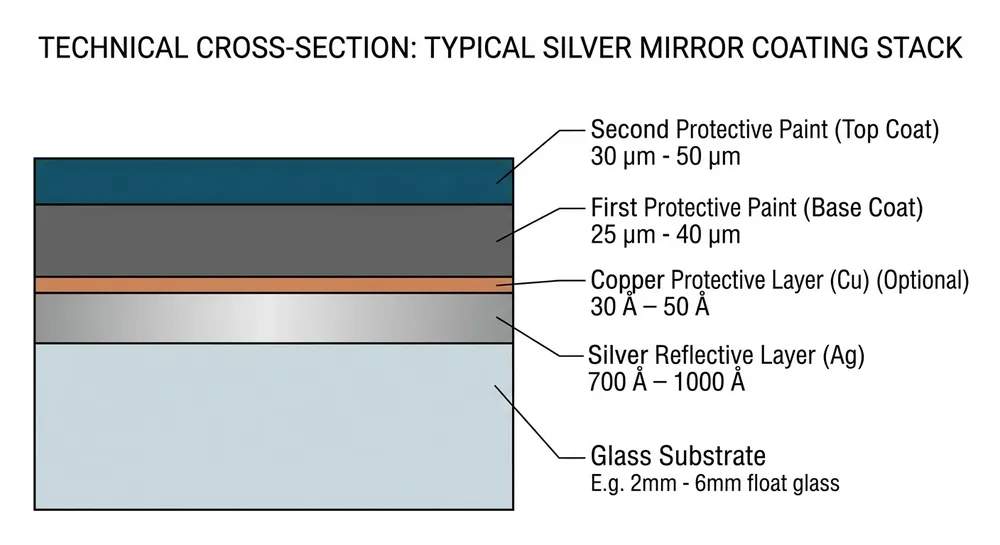
Both formats start the same way on our floor — float glass cut to spec, edges processed, then through the copper-free silvering line with multi-layer protective coating. The split happens at frame and backing.
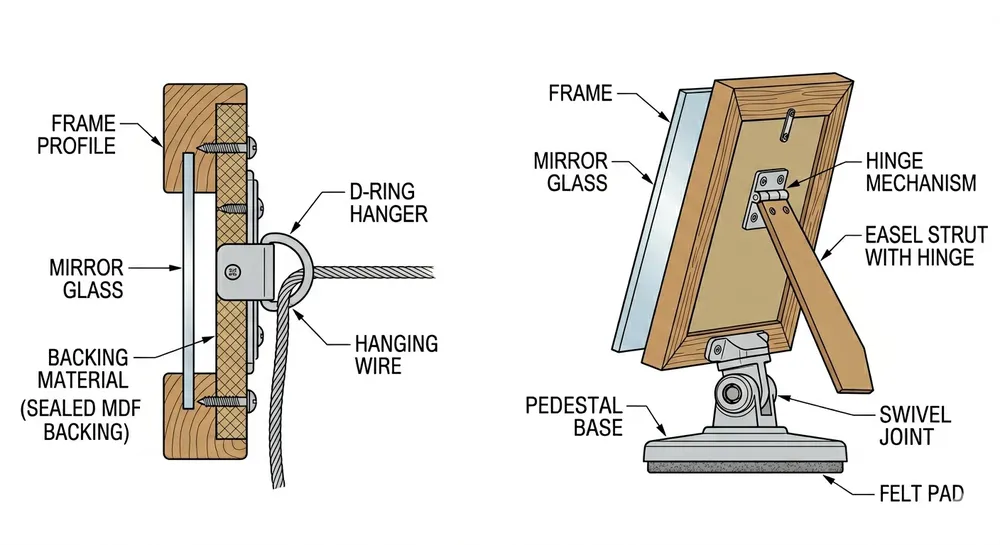
A wall decor mirror needs a frame engineered for vertical load. The frame carries the mirror's full weight against a wall, so joint strength and hanging hardware matter more than aesthetics. We use D-ring hangers, French cleats, or wire systems depending on mirror weight — anything over 5 kg gets a cleat or dual-point wire, not a single sawtooth. The backing is typically MDF or hardboard, sealed to protect the silver coating from moisture ingress. (We switched to sealed MDF backing as default in 2019 after tracking silver edge-blackening claims on unsealed units shipped to Florida and Gulf-state distributors.)
A tabletop mirror needs a freestanding support system — easel back, pedestal base, or swivel stand. That support structure adds components, assembly steps, and packaging complexity. An easel-back mirror with a strut hinge has 3–4 more parts than a comparable wall mirror. A pedestal vanity mirror with a swivel joint adds a metal or resin base, a pivot mechanism, and often a felt pad underneath. More parts means more assembly labor, more potential failure points in transit, and a wider carton footprint.
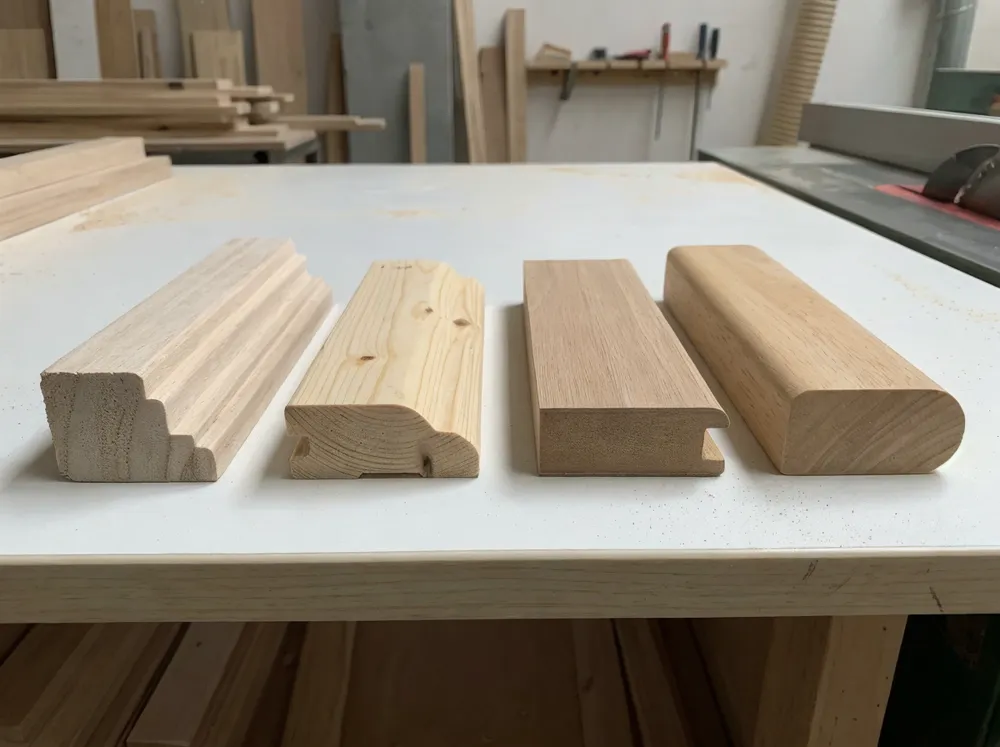
The frame material choice also shifts between formats. Wall mirrors sell well across the full material and frame range — MDF, wood, metal, resin. Tabletop mirrors skew heavily toward metal and resin because those materials handle the structural load of a stand or pedestal better than MDF at small scale. If you're sourcing tabletop mirrors in MDF frames, verify that the easel attachment point is reinforced — we've seen competitors' MDF easel-back mirrors fail at the hinge after a few months of use, which turns into your warranty problem.
Head-to-Head Sourcing Comparison
| Dimension | Wall-Mounted Decor Mirror | Tabletop / Vanity Mirror |
|---|---|---|
| Typical size range | 40 × 60 cm to 90 × 120 cm | 15 × 20 cm to 30 × 40 cm |
| Common frame materials | MDF, wood, metal, resin | Metal, resin, wood |
| Mounting / support | D-ring, French cleat, wire | Easel back, pedestal, swivel stand |
| Parts per unit | 4–6 (glass, frame, backing, hardware) | 7–10 (glass, frame, backing, stand, hinge, base, felt pad) |
| Average carton dimensions | 65 × 95 × 12 cm (mid-size) | 25 × 35 × 20 cm (mid-size) |
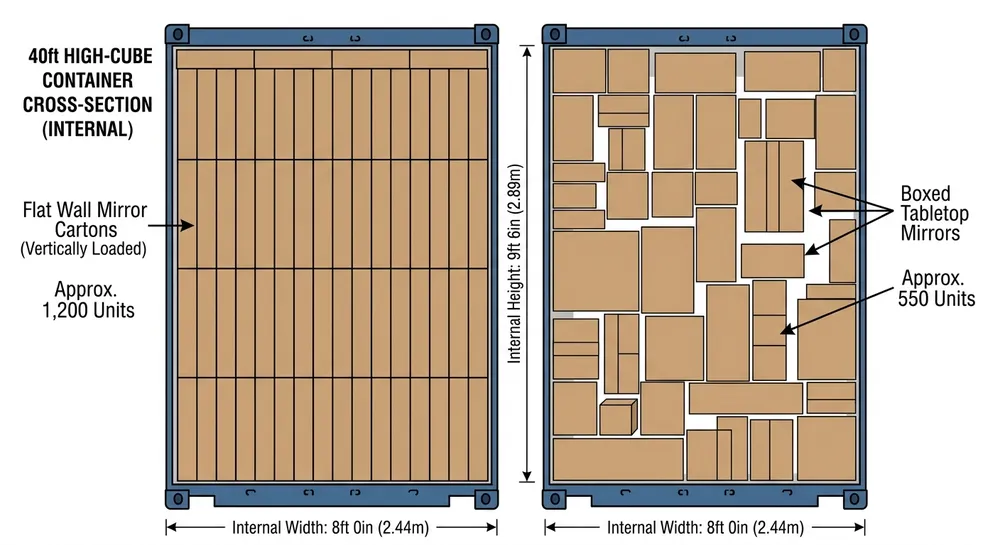
| Cartons per 40 ft container | ~600–800 (flat-packed, vertical loading) | ~1,200–1,800 (but smaller units) |
| Packaging cost as % of FOB | ~8–12% | ~12–18% |
| Ocean freight breakage rate | 1.5–3% (properly packed) | 2–4% (stand/hinge stress points) |
| Retail price range (US market) | $25–$120 | $15–$60 |
| Typical wholesale margin | 40–55% | 45–65% |
Wall mirrors win on container utilization because their flat profile stacks efficiently — vertical loading in custom cartons with corner protectors is a well-understood packing method. Tabletop mirrors have irregular carton shapes due to the stand or base, so you lose container volume to dead air space inside each carton. (This is one of those details that doesn't show up on your FOB quote but hits your landed cost hard when you're filling a 40-footer.)
Packaging Economics and Container Utilization — The Hidden Cost Gap
The FOB price difference between a wall mirror and a comparable tabletop mirror is often smaller than buyers expect. A 50 × 70 cm wall mirror in an MDF frame and a 20 × 30 cm tabletop mirror in a metal frame might sit within 15–20% of each other on unit cost. But the landed cost story is different.
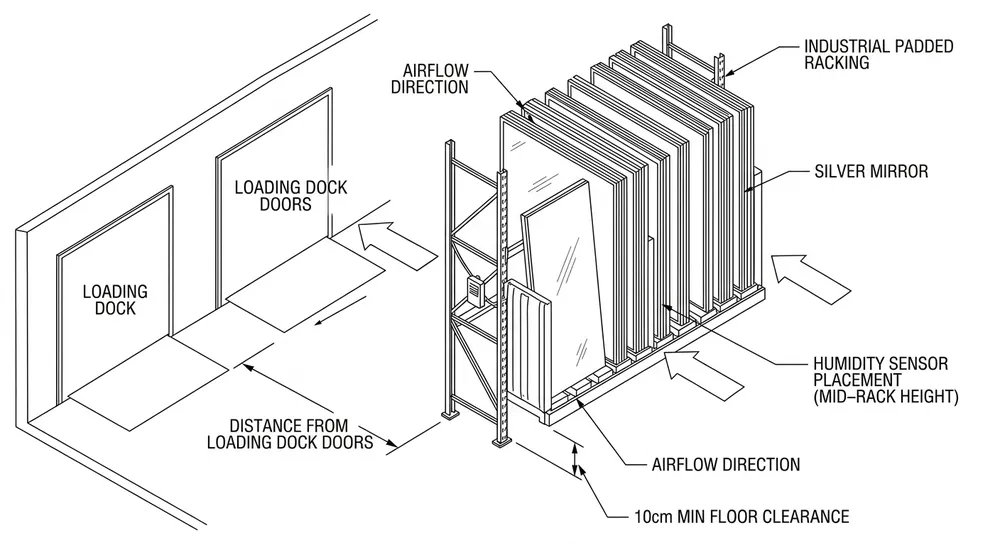
Wall mirrors pack flat. A mid-size wall mirror carton runs about 12 cm deep, so you're stacking thin rectangles. We configure cartons for vertical loading in containers — mirrors standing upright with foam edge protectors and cardboard dividers between units. A 40-foot container holds 600–800 mid-size wall mirrors depending on frame depth. Your freight cost per unit drops as the container fills efficiently.
Tabletop mirrors pack thick. The stand, base, or easel adds depth to the carton — a 20 × 30 cm tabletop mirror often ships in a carton that's 18–22 cm deep because the pedestal or easel needs clearance. That extra depth per carton means fewer units per container layer, and the irregular shapes create gaps that can't be filled. You might fit 1,400 tabletop units in the same container, but each unit is a fraction of the size and retail value of a wall mirror. Revenue per container drops.
For more detail on how we engineer cartons for wall-format mirrors, see our guide on wall mirror packaging for safe container shipping.
The packaging material cost also diverges. A wall mirror needs corner protectors, a foam sheet over the glass face, and a fitted carton — straightforward. A tabletop mirror needs internal molded pulp or foam inserts to immobilize the stand, prevent the hinge from flexing during transit, and keep the base from shifting and cracking the glass. Those custom inserts add $0.30–$0.80 per unit depending on complexity. On a $6–$10 FOB item, that's a meaningful percentage.
Breakage Risk and Claims Exposure
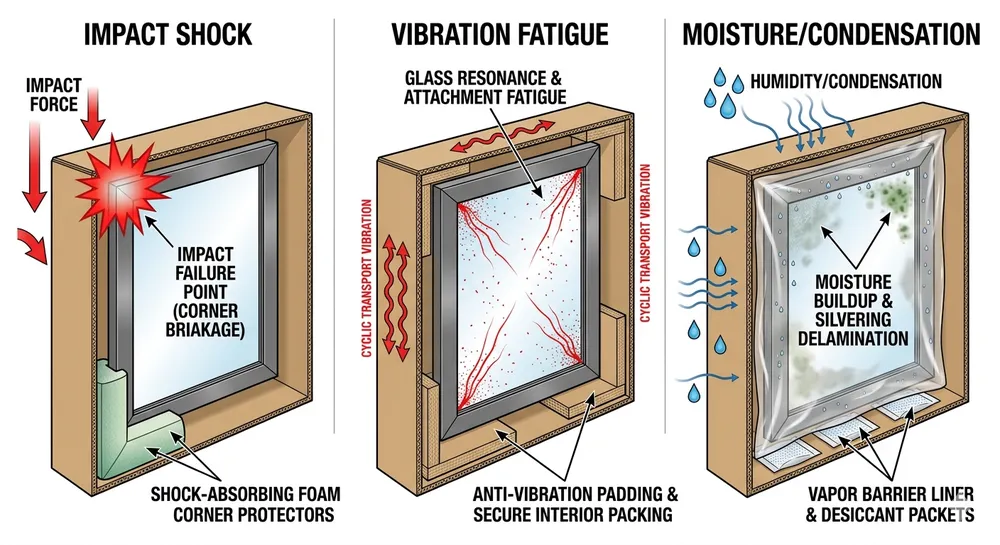
Wall mirrors break in transit for one main reason: insufficient edge protection during container movement. The glass itself is well-supported by the frame and backing — the failure point is almost always the frame corner or the glass edge where it meets the frame. Proper corner protectors and vertical loading orientation solve this. We see 1.5–2% breakage on well-packed wall mirror shipments, and most of that traces to container handling at port, not the ocean crossing itself.
Tabletop mirrors have more failure modes. The stand hinge is a stress concentrator — every vibration during a 25-day ocean crossing works that joint. Pedestal bases can shift inside the carton and crack the glass from below. Swivel mechanisms can loosen and allow the mirror head to flop against the carton wall. We've reduced tabletop breakage to the 2–3% range by using molded pulp inserts that lock the base and mirror head separately, but it took us two years of iteration to get there. If your current supplier ships tabletop mirrors in generic foam-and-cardboard packaging, expect 4–6% breakage — and that's before your retailer's receiving team handles them.
The claims math matters. A 2% breakage rate on 800 wall mirrors at $12 FOB is $192 in lost product. A 4% breakage rate on 1,400 tabletop mirrors at $8 FOB is $448 — plus the customer service cost of handling more individual claims on lower-value items. Your operations team spends more time processing tabletop mirror claims for less revenue recovery.
Retail Sell-Through by Channel: Where Each Format Earns Its Shelf Space
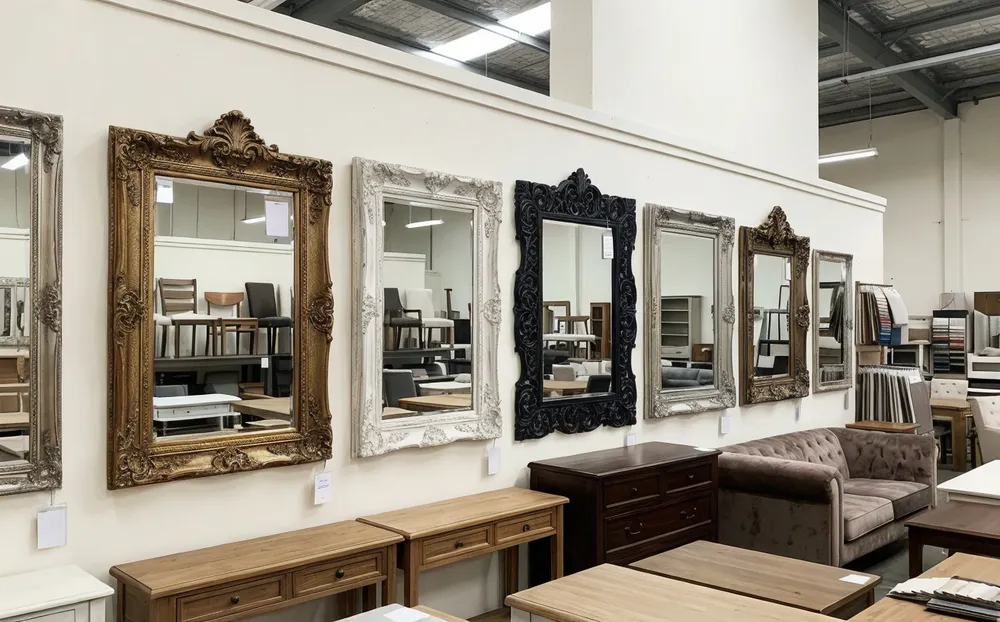
Home decor retail (brick-and-mortar). Wall mirrors dominate floor space and sell-through in this channel. A single wall mirror displayed on a feature wall generates more visual impact per square foot of retail space than a shelf of tabletop mirrors. Retailers allocate 2–3× more linear footage to wall mirrors in the decor aisle. Sell-through rates for decorative wall mirrors in the $35–$80 range run 15–25% higher than tabletop mirrors in the same store, based on what our retail buyers report back during reorder conversations.
E-commerce. Both formats perform, but wall mirrors carry higher average order value. A wall mirror listing at $45–$90 generates more revenue per transaction than a tabletop mirror at $18–$40. However, tabletop mirrors have lower return rates online — the customer knows what they're getting, and the product is easier to photograph accurately. Wall mirrors suffer from "looked different on my wall" returns at 8–12% in some categories. If you're selling through Amazon or your own DTC site, factor return handling cost into your margin calculation for wall mirrors.
Hospitality and project supply. Wall mirrors win decisively. Hotel renovations, restaurant fit-outs, and multifamily residential projects order wall mirrors in quantities of 200–2,000 units per project. Tabletop mirrors appear in hospitality only as vanity accessories in upscale hotel bathrooms — a smaller, less predictable segment. If you're building a project supply business, wall mirrors are your anchor product.
Gifting and vanity retail. This is where tabletop mirrors earn their margin. Vanity mirrors with decorative frames sell well in beauty retail, department store gift sections, and seasonal gifting channels. Per-unit margins run 45–65% wholesale-to-retail, higher than most wall mirror categories. The trade-off is lower volume and more seasonal demand fluctuation. (Valentine's Day and Mother's Day drive 30–40% of annual tabletop vanity mirror volume for several of our North American distributors.)
Three Sourcing Scenarios, Three Clear Winners
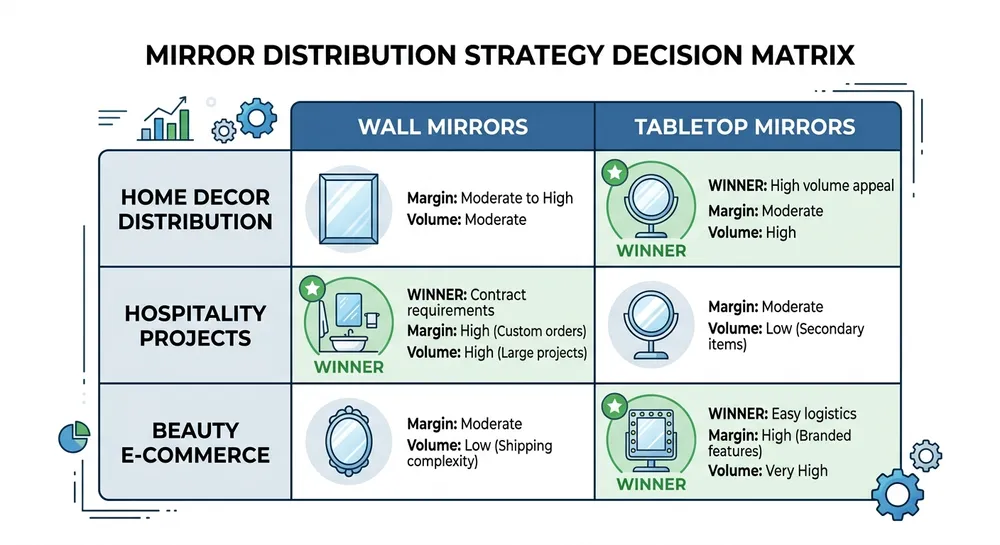
Scenario 1: You're a home decor distributor building a core mirror catalog for independent retailers. Winner: wall mirrors. Your retailers need statement pieces that drive foot traffic and justify premium shelf space. A curated wall mirror line in 3–4 frame styles across 2–3 sizes gives you a tight, high-impact catalog. Start with framed vs frameless mirrors to narrow your frame strategy, then build your assortment around the styles that match your retail accounts' price points.
Scenario 2: You're sourcing mirrors for a hospitality purchasing group supplying hotel renovation projects. Winner: wall mirrors. Project buyers need consistent specs across hundreds of units, reliable mounting hardware, and packaging that survives job-site handling. Tabletop mirrors are an afterthought in this channel — maybe 5–10% of a hotel mirror order. Lead with wall-mounted formats and offer tabletop as an add-on for suite vanities.
Scenario 3: You're an e-commerce seller targeting the beauty and vanity accessories niche. Winner: tabletop mirrors. Your customer is searching for "vanity mirror with stand" or "decorative table mirror," and your margin on a $35 retail tabletop mirror with a $9 FOB cost is stronger than competing in the crowded wall mirror category where you're up against Wayfair's private label. Focus on distinctive frame finishes — gold electroplate, brushed brass, antique resin — that photograph well and justify premium pricing.

Mixed-Order Consolidation: When Stocking Both Formats Pays Off
If your business touches more than one channel — say you distribute to both home decor retailers and beauty boutiques — sourcing wall and tabletop mirrors from separate factories doubles your supplier management, QC coordination, and shipping logistics. Two suppliers means two sets of production timelines, two quality standards, two container bookings.
We produce both formats on the same 6-line facility using the same silvering process, the same frame molding equipment, and the same QC protocol. A mixed order of 500 wall mirrors and 300 tabletop mirrors ships in one container, under one set of inspection reports, with one bill of lading. Your landed cost per unit drops because you're filling container volume that would otherwise ship as dead space — the tabletop mirror cartons fit into the gaps between wall mirror pallets.
The MOQ structure supports this. Our minimum is 100 pieces per SKU for standard models, so you can test 2–3 wall mirror styles and 1–2 tabletop styles in a single trial shipment without overcommitting. If the tabletop SKUs don't move, you've risked 100–200 units, not a full container.
Copper-free silvering runs as our default process across both formats, so your compliance documentation — CE, SGS test reports — covers the entire mixed order without separate certifications per mirror type. One factory audit qualifies both product lines.
What to Verify in Your RFQ for Each Format
When you're requesting quotes for wall-mounted decor mirrors, specify:
- Mirror size and glass thickness — 4mm is standard for mirrors up to 60 × 90 cm; 5mm for anything larger
- Frame material and finish — MDF with lacquer, solid wood with stain, metal with powder coat or electroplate
- Hanging hardware type — D-ring, French cleat, or wire; confirm weight rating matches the finished mirror weight
- Backing material — sealed MDF or hardboard; ask whether the backing is moisture-sealed if your market includes humid climates
- Packaging configuration — vertical loading orientation, corner protectors, foam face sheet; confirm carton dimensions for your container loading plan
When you're requesting quotes for tabletop mirrors, specify:
- Mirror size and stand type — easel back, pedestal base, or swivel; confirm the mechanism material (metal vs plastic hinges)
- Base material and weight — a light resin base on a 30 cm mirror will tip over; ask for the base weight relative to the mirror head
- Insert packaging — molded pulp or custom foam; generic bubble wrap is not sufficient for ocean freight on tabletop mirrors
- Assembly state — shipped fully assembled or KD (knock-down); KD saves carton volume but adds your warehouse labor cost
- Hinge/swivel durability spec — ask for cycle test data if available; a swivel that loosens after 500 rotations becomes a return
The difference between a clean import and a claims headache often comes down to these details being locked in before production starts, not discovered after your container arrives.