What a Vague Finish Spec Actually Costs You
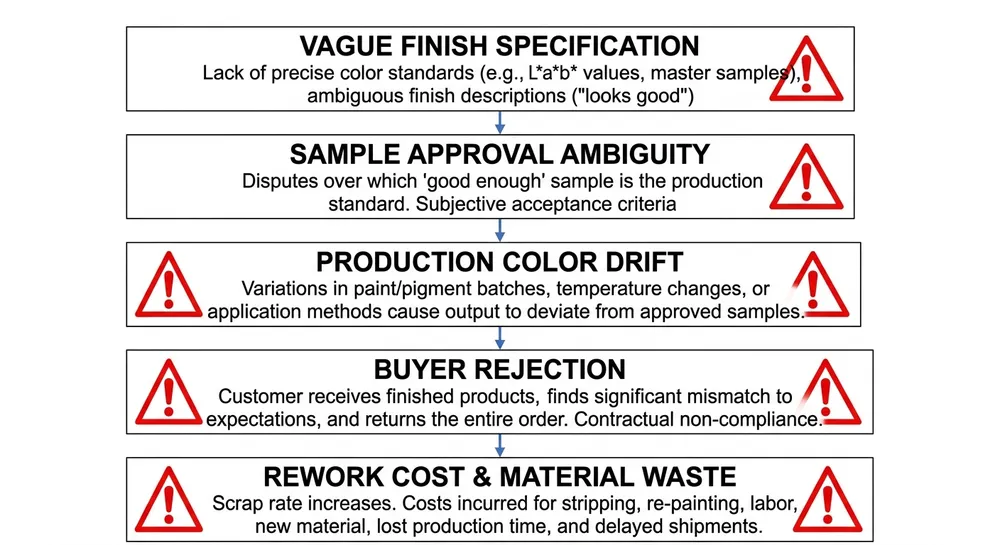
Last year we received a 3,000-unit order with the finish spec written as "matte gold, similar to attached photo." The photo was a phone snapshot of a competitor's product taken under warm retail lighting. No Pantone reference, no gloss range, no substrate callout. We produced a golden-run sample, the buyer approved it over video call, and we ran the batch. When the container landed, the buyer's QC team rejected 40% of the units. The finish looked different under their warehouse fluorescents than it had on screen. That rework cost the buyer eleven weeks and roughly $8,500 in recoating, repacking, and air-freight for the replacement units.
The finish itself was fine. The spec was the problem.
This happens more often than it should. A frame finish that reads clear in your head can mean three different things on a production floor if the spec sheet doesn't pin down substrate, coating method, color reference, gloss window, and adhesion grade. Every gap in your spec is a decision your factory makes without you, and those decisions compound across a 5,000-piece run.

Why the Mismatch Happens Between Sample and Production
A golden sample sitting on your desk went through a controlled process. One operator, one spray gun, one small panel, hand-finished and inspected under consistent light. Production is different. Your 3,000 frames run through an automated or semi-automated line over multiple shifts. Ambient temperature and humidity shift between morning and afternoon. Spray distance varies slightly between operators. Paint viscosity changes as a batch sits in the pot.
None of these variables are defects. They're normal production realities. The job of your finish spec is to define the acceptable window around your approved sample so the factory's QC team can measure conformance objectively, not guess whether a frame "looks close enough."
Without measurable tolerances, your factory is comparing production output to a memory of what the sample looked like. That's where color drift, gloss mismatch, and adhesion inconsistency creep in.
Four Finish Methods for Mirror Frames — and What Each Demands from Your Spec
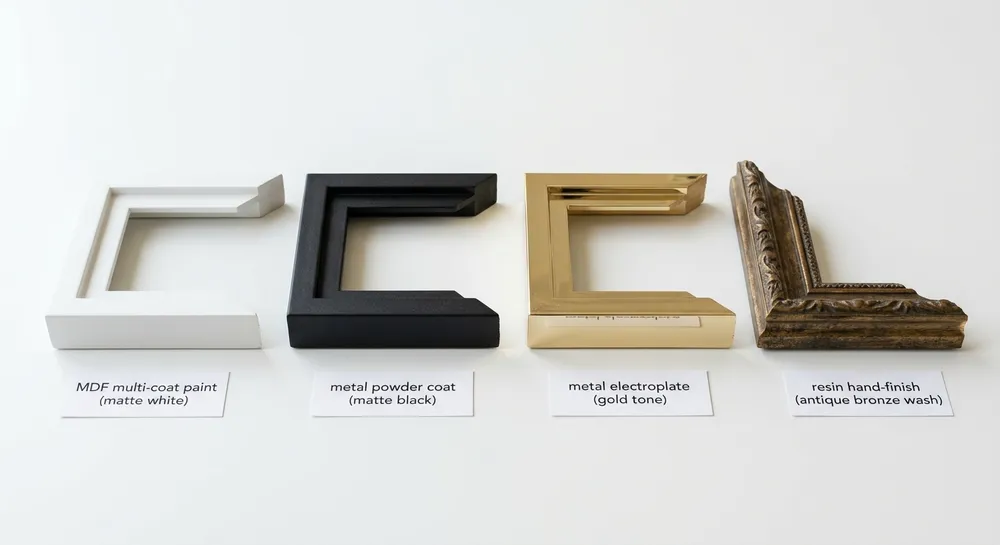
Not every finish method needs the same spec detail. Here's what we run in-house and what your spec sheet needs to control for each one.
| Finish Method | Typical Substrates | Key Spec Callouts | Common Failure If Under-Specified |
|---|---|---|---|
| MDF/wood multi-coat paint | MDF, engineered wood, solid wood | Primer type, number of coats, color (Pantone/RAL), gloss units at 60°, adhesion grade | Color drift between batches, orange peel texture, adhesion failure in humid markets |
| Metal powder coat | Steel, aluminum profiles | Powder chemistry (polyester, epoxy-polyester), film thickness (μm), color (RAL), gloss, salt spray hours | Inconsistent film build, poor edge coverage on complex profiles, chalking in outdoor-adjacent use |
| Metal electroplate | Steel, zamak, brass | Plating layer sequence, target thickness per layer (μm), color tone reference, corrosion test standard | Peeling at bends, color tone variation between racks, tarnishing in coastal/humid storage |
| Resin hand-finish | Polyresin, polyurethane | Base color, wash/antique technique reference, acceptable variation range, sealer coat spec | Inconsistent hand-applied effects, color bleed between production batches, sealer adhesion failure |
(We run all four methods on dedicated lines in our Ho Chi Minh facility. That matters because finish problems often start when a factory subcontracts coating to a third party and loses process control between stations.)
MDF/wood multi-coat is the most common finish method for decorative mirror frames in the mid-price segment. Your spec needs to call out the number of coats — typically a sealer, one or two color coats, and a topcoat. Each layer affects the final appearance. Skip the sealer on MDF and you get uneven absorption that shows as blotchy color, especially on darker finishes. We sand between coats on our line, which adds cost but eliminates the rough texture that causes QC rejections downstream.
Metal powder coat gives you the best durability-to-cost ratio for metal-framed decorative mirrors. Specify film thickness as a range — typically 60-80 μm for standard decorative frames. Below 50 μm you risk poor coverage on edges and corners. Above 100 μm you get sag and orange peel. Always call out the powder chemistry: polyester for anything near windows or humid environments, epoxy-polyester hybrid for interior-only applications where you want cost savings.
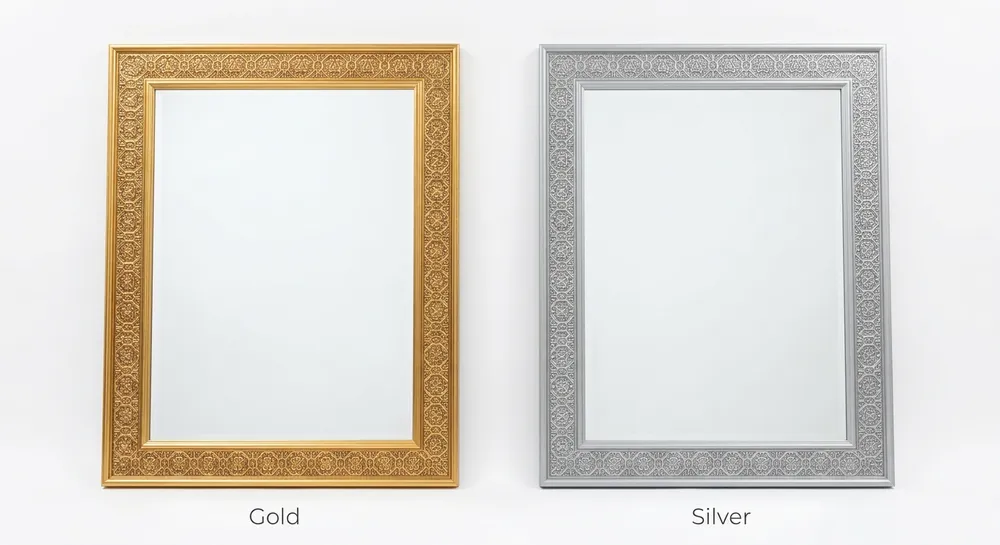
Electroplate is where specs get expensive to fix after the fact. A gold-finish mirror frame might involve a nickel base layer, a gold-tone top layer, and a clear lacquer seal. Each layer has a target thickness, and the color tone shifts with plating time and bath chemistry. If your spec just says "gold electroplate," you'll get whatever the operator's default settings produce — which may not match your approved sample by the second or third rack. Specify the layer sequence and reference a physical color standard, not a photo.
Resin hand-finish is inherently variable, and that's part of its appeal for antique and artisan-look frames. But "inherently variable" doesn't mean "no spec." Define the acceptable variation range with physical reference samples — a lightest-acceptable and darkest-acceptable pair. Without that bracket, your QC team has no objective basis for pass/fail decisions on the packing line.
How to Write a Finish Spec Sheet Your Factory Can Execute
A finish spec that prevents rework covers six fields. Miss any one and you're leaving a production decision to someone who hasn't seen your market or your end customer's expectations.
1. Substrate and prep
State the frame material and the surface preparation you expect before coating. For MDF: sanding grit sequence and sealer requirement. For metal: degreasing method and any pre-treatment (phosphating for powder coat, activation for electroplate). Substrate prep is where most adhesion failures originate. If your spec is silent on prep, the factory will use their default — which may or may not match what your sample went through.
2. Coating method and system
Name the coating method explicitly. Then specify the system: number of layers, type of each layer, and application method if it matters. "Spray-applied two-coat polyurethane with wet-on-wet application" is a spec. "Painted finish" is not.
3. Color reference
Use a physical standard: Pantone, RAL, or NCS code. If your target color doesn't match a standard chip exactly, send a physical sample and note the standard code that's closest, plus the direction of deviation ("RAL 1036 but 10% warmer / less green"). Photos are useful as supplementary references but unreliable as primary color specs — screen calibration, lighting, and camera white balance all distort color.
4. Gloss level
Specify gloss as a measurable range in gloss units (GU) at 60°. Common targets for decorative mirror frames:
- High gloss: 80+ GU
- Semi-gloss: 40-60 GU
- Satin: 20-35 GU
- Matte: 5-15 GU
A spec that says "matte" without a GU range is asking for trouble. One operator's matte is another's satin. Pin it down.
5. Adhesion standard
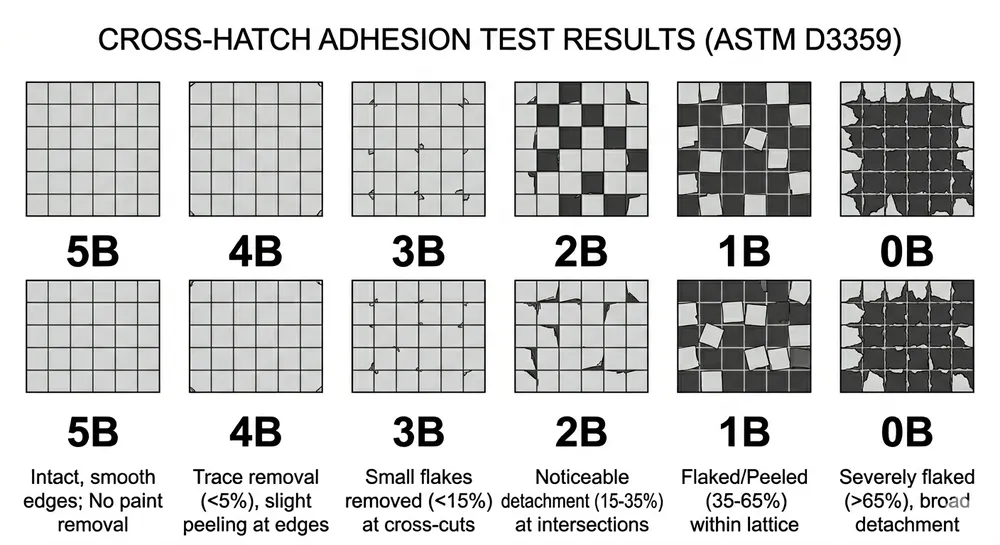
Call out the test method and minimum grade. ASTM D3359 cross-hatch adhesion test, Grade 4B minimum is a standard callout for painted and powder-coated mirror frames. For electroplate, specify a thermal cycling test or a bend test appropriate to the substrate. If you're shipping to humid markets — Southeast Asia, coastal US, Middle East — adhesion testing is where you catch failures before they become warranty claims.
6. Environmental and durability rating
If the frames will sit in bathrooms, near windows, or in humid retail environments, specify the relevant durability test: salt spray hours (ASTM B117) for metal finishes, humidity resistance hours for painted finishes, UV resistance if the product faces direct sunlight. Don't over-specify — a decorative bedroom mirror doesn't need 1,000-hour salt spray — but don't leave it blank either.
(We keep a one-page finish spec template that covers all six fields. When a buyer fills it out before we quote, the sample-to-production match rate jumps from roughly 85% to over 97%. Most of the rework we see traces back to specs that skipped fields 4, 5, or 6.)
Tolerance Callouts That Prevent Batch Rejection
Three measurements separate a spec that works from a spec that generates arguments at receiving.
Color variance: Delta-E (ΔE)
Delta-E measures the perceptible difference between two colors. For production mirror frames, specify ΔE ≤ 1.5 for solid colors and ΔE ≤ 2.0 for metallic or textured finishes. Below 1.0 is difficult to hold across a full production run without significant cost increase. Above 2.0 and your end customers will notice variation between units on the same retail shelf.
Your factory should measure delta-E with a spectrophotometer against the approved sample, not by visual comparison. If your supplier doesn't own a spectrophotometer, that's a red flag worth addressing before you place the order.
Gloss consistency: GU at 60°
Specify a range, not a single number. Target 10 GU ± 3 GU for matte, 50 GU ± 5 GU for semi-gloss. Gloss is affected by film thickness, cure temperature, and ambient humidity during application. A tight single-number target guarantees arguments. A defined range gives the factory room to operate while keeping your product consistent.
Adhesion grade: ASTM D3359
The cross-hatch test scores from 0B (complete removal) to 5B (no removal). Specify 4B minimum for standard decorative frames. For frames going into hospitality or commercial projects where cleaning chemicals contact the finish, specify 5B. Run the test on production units, not just the pre-production sample — adhesion can degrade if the factory changes cure time or skips a prep step mid-run.
Five Spec Mistakes That Generate the Most Rework
After twelve years of running finish lines, these are the patterns I see repeat:
1. Color spec by photo only. Photos shift with every screen. Send a physical chip or call out a Pantone/RAL code. If you can't send a chip, at least specify the standard code closest to your target and describe the deviation in words.
2. No gloss range on "matte" or "satin" callouts. These words mean different things to different people. Always attach a GU number.
3. Skipping adhesion requirements for humid-market shipments. A finish that holds fine in a dry warehouse in Ohio can peel within months in a Bangkok retail store. If your distribution includes tropical or coastal markets, your adhesion spec needs to reflect that.
4. Approving a sample under different lighting than your receiving inspection. If you approve a sample under warm 3000K showroom light and your warehouse QC checks under 5000K fluorescents, the color will look different. Specify the light source for color evaluation — D65 daylight equivalent is the industry standard for a reason.
5. No spec for edge and corner coverage on powder-coated metal frames. Powder coat naturally thins at sharp edges due to the Faraday cage effect. If your frame profile has tight corners or decorative ridges, call out minimum edge coverage thickness or require the factory to radius sharp edges before coating. We radius all edges to a minimum 0.5 mm before powder application — it adds a step but eliminates the thin-spot failures that show up as rust spots six months after delivery.
Matching Your Finish Spec to the Market You're Selling Into
Your finish spec should reflect where the product ends up, not just what looks good on a sample board.
Hospitality and commercial projects need durability above all. Specify higher adhesion grades (5B), salt spray resistance for any metal components, and chemical resistance if the frames will be cleaned with commercial products. Gloss consistency matters less than longevity — a slight variation between rooms is invisible, but peeling finish in a hotel lobby is a callback.
Retail and e-commerce need visual consistency across units. Your customer might buy two silver-finish mirrors from the same listing and hang them side by side. Tight delta-E (≤ 1.5) and gloss consistency are worth the cost here. Packaging also matters — specify protective film or corner guards to prevent finish damage in transit.
Wholesale distribution needs a spec that balances cost and durability. You're likely stocking inventory across climate zones, so adhesion and humidity resistance should be specified even if the primary market seems dry. Your distributor in Arizona might redirect stock to a Florida account, and the finish needs to survive that.
(If you're building a frame material and finish program across multiple SKUs, standardizing your spec template across the line saves time on every reorder. We keep finish records for every SKU we produce, so your repeat orders match the original without re-sampling.)
How In-House Finishing Lines Close the Gap Between Spec and Production
The reason finish specs fail most often isn't that the spec was wrong — it's that the spec traveled through too many hands before reaching the coating operator. When your frame supplier subcontracts finishing to a separate coating shop, your spec gets interpreted twice: once by the frame factory and once by the coater. Each interpretation introduces drift.
We run MDF multi-coat, metal powder coat, electroplate, and resin hand-finish on dedicated lines inside our 12,000 m² facility in Ho Chi Minh. Your spec goes from our engineering team directly to the line supervisor who runs your job. One interpretation, one facility, one QC checkpoint before packing.
Our 12-engineer OEM team reviews your finish spec before we quote. If a callout is ambiguous or likely to cause production issues — say, a gloss target that's unrealistic for the substrate you've chosen, or an adhesion requirement that needs a different primer system — we flag it and propose an alternative before cutting a sample. That review catches problems at the spec stage, when changes cost nothing, instead of at the production stage, when they cost you a container.
We run spectrophotometer checks on color and gloss at line startup, mid-run, and end-of-run. Cross-hatch adhesion testing happens on the first production units and at random intervals through the batch. Every test result gets logged against your order number. If you want the test reports shipped with your documents, we include them.
If you're developing a new gold-tone finish or working through a frame material comparison for a new product line, send your finish requirements — substrate, color reference, gloss level, and target order quantity — through our quote request form. Our engineering team will come back with a coating recommendation and a realistic spec sheet you can use for this order and every reorder after it.