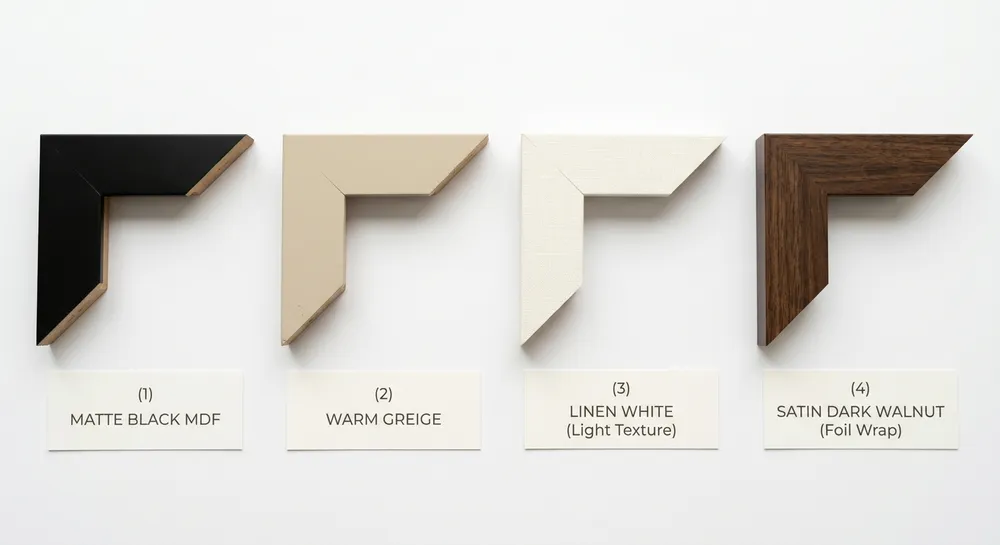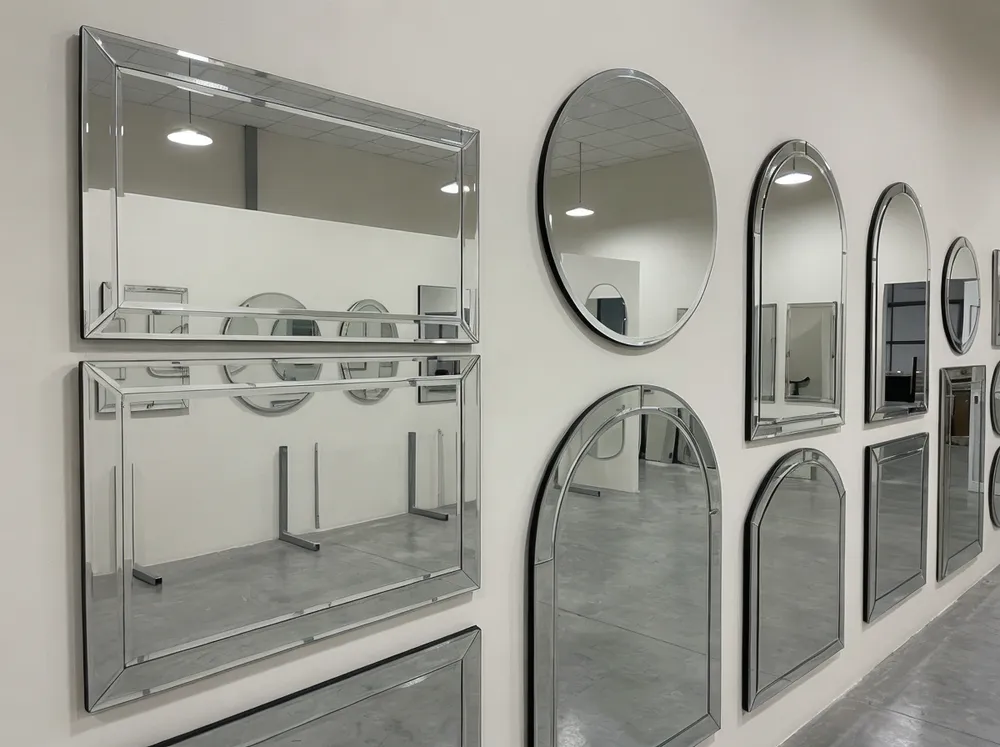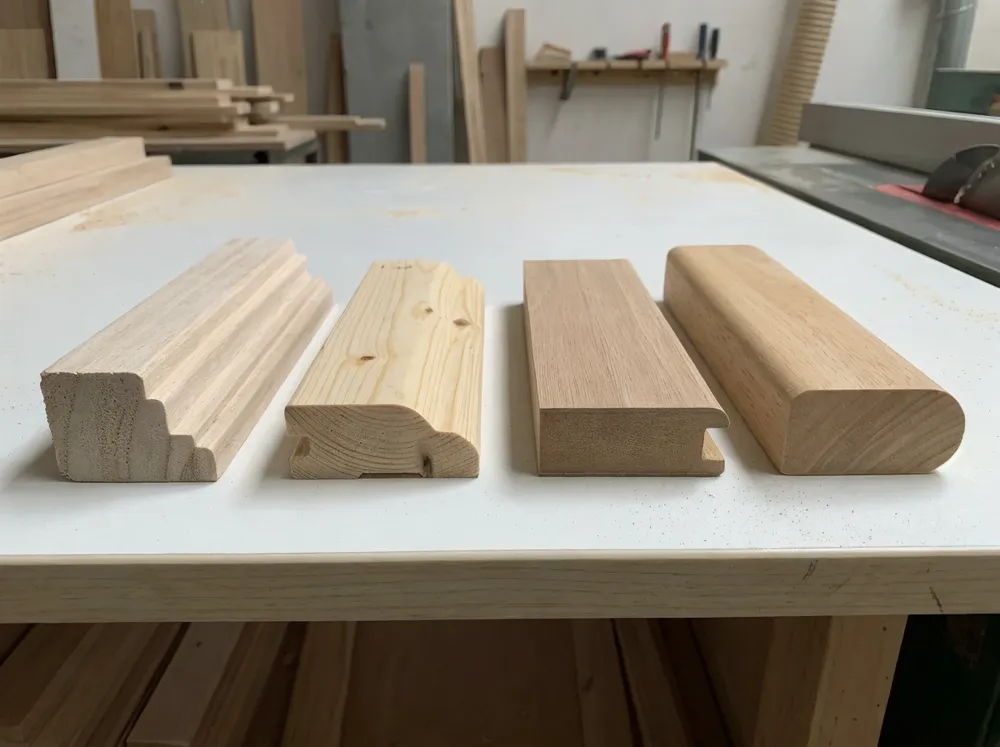
We shipped a 40-foot container of MDF-framed mirrors to a distributor in Houston two years ago. The frames looked perfect leaving our Ho Chi Minh facility. Six weeks later, 8% of the units had corner separation. The MDF had absorbed moisture during a monsoon-season port delay in Ho Chi Minh City, swelled just enough to crack the paint film at the miter joints, and by the time the container cleared customs in Texas, the damage was visible without a magnifying glass.
That order cost us a partial replacement shipment and cost the buyer a missed retail delivery window. The root cause wasn't a manufacturing defect. It was the wrong frame material for that shipping route and season.
Choosing decor mirror frame materials is a shipping and cost decision first, a design decision second. The frame you pick determines your breakage rate, your per-unit packaging cost, your container loading density, and your landed cost. Get it wrong and you absorb claims. Get it right and product moves without surprises.
What Container Transit Actually Does to Mirror Frames
A 20-foot ocean freight container can see internal temperatures swing from 15°C to 65°C in a single day on a tropical route. Humidity inside a sealed container regularly hits 85-95% when cargo crosses from a cool-water zone into a warm port. That cycle repeats for 20 to 35 days depending on your destination.
Your frame material has to survive that environment while also handling the mechanical stress of port crane lifts, truck transfers, and the constant low-frequency vibration of ocean transit. The mirror glass itself is relatively predictable to protect with proper corner pads and foam inserts. The frame is where the variables multiply, because each material responds differently to moisture, heat, and impact.
The failure modes are material-specific. MDF swells and delaminates. Solid wood warps and cracks at joints. Metal dents and, if the coating is compromised, starts oxidizing before the container is even unloaded. Resin can crack under sharp impact if wall thickness is too thin, but it shrugs off moisture entirely. Understanding these mechanisms is how you choose the right material for your route, your volume, and your margin target.
Breakage Risk, Weight, and Packaging Cost by Frame Material
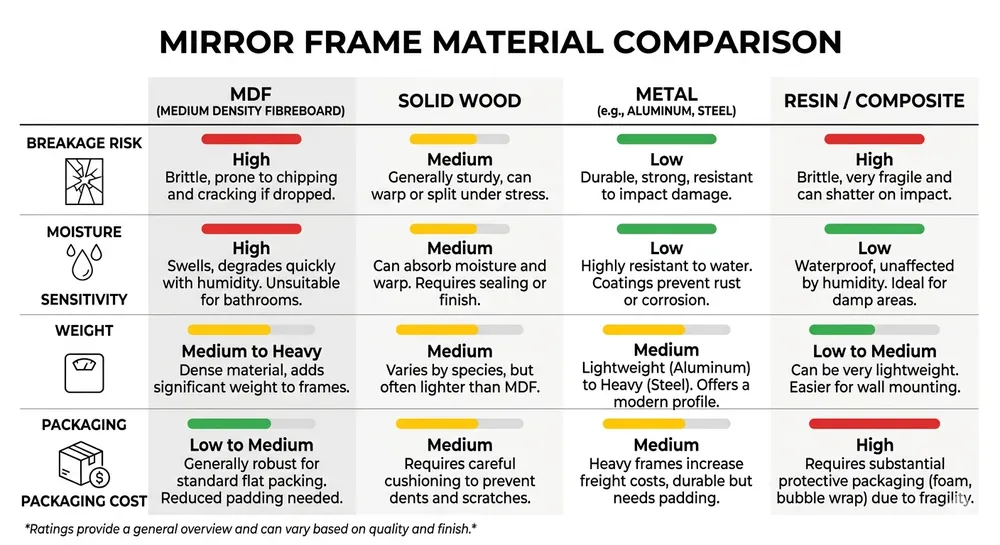
We produce all four major frame types on our own lines, so we see the damage data firsthand across thousands of shipments. Here's how they compare for a standard 60×90 cm decorative mirror frame:
| Factor | MDF | Solid Wood | Metal (Steel/Iron) | Resin (Polyurethane) |
|---|---|---|---|---|
| Frame weight (60×90 cm) | 1.8-2.5 kg | 2.0-3.5 kg | 1.5-3.0 kg | 1.0-1.8 kg |
| Typical damage rate (ocean freight) | 3-8% without moisture control | 2-5% | 1-3% | 1-2% |
| Primary failure mode | Swelling, corner separation | Warping, joint cracking | Denting, coating scratch | Impact cracking (thin walls only) |
| Moisture sensitivity | High | Medium-High | Low (coating-dependent) | Negligible |
| Heat sensitivity | Low | Medium | Low | Medium (softening above 60°C) |
| Packaging cost impact | Standard + desiccant packs | Standard + corner reinforcement | Foam wrap + edge guards | Standard |
| Container loading density | Good | Good | Good (stackable) | Excellent (lightest) |
(We switched to moisture-resistant MDF board for all Southeast Asian and Middle Eastern routes two years ago. Standard MDF is fine for direct-to-North-America shipments outside monsoon season, but if your container sits in a humid port for more than a week, the upgrade pays for itself in avoided claims.)

The numbers above are working ranges from our production and claims records, not lab-certified values. Your actual damage rate depends on packaging quality, container loading practice, and route conditions. But the relative ranking between materials is consistent: resin and metal outperform wood-based materials on shipping survival, while MDF and solid wood offer richer visual profiles that command higher retail price points.
That trade-off is the core of the decision. You're balancing margin potential against shipping risk.
How to Match Frame Material to Your Shipping Route and Volume
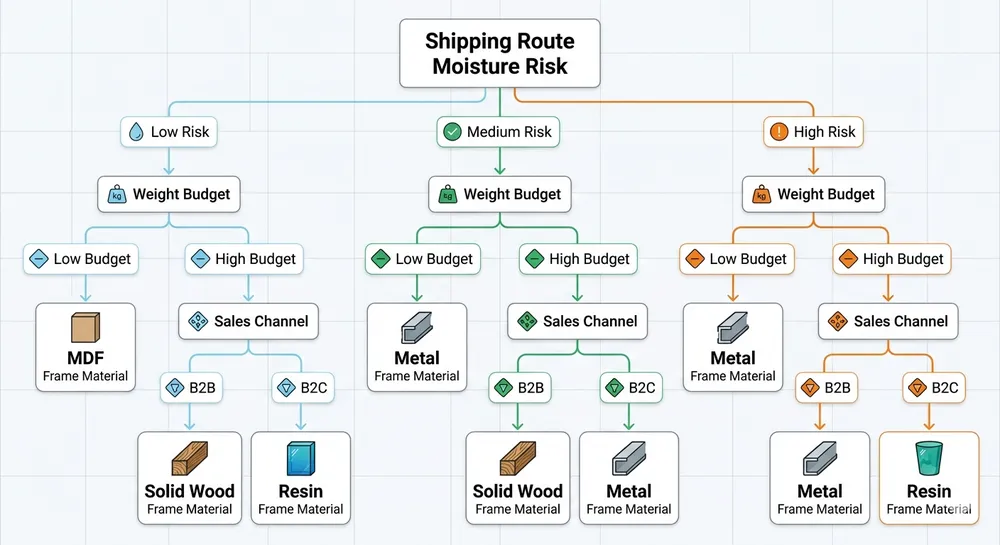
There's no single best frame material. The right choice depends on where the container is going, how many units you're ordering, and what channel you're selling into. Here's how to work through it:
Step 1: Identify your route's moisture exposure.
- Low risk: Direct shipments to North America or Northern Europe, loaded October through March. Container humidity stays manageable. MDF and solid wood are both viable.
- Medium risk: Shipments transiting through tropical ports (Singapore, Colombo, Jebel Ali) or loading during Southeast Asian monsoon season (May-October). Use moisture-resistant MDF or switch to metal/resin.
- High risk: Shipments to the Middle East, West Africa, or any route with expected port delays exceeding 10 days in humid conditions. Metal or resin frames are the safer call.
Step 2: Check your per-unit weight budget.
Freight cost is weight-sensitive. If you're shipping 2,000+ units and your freight quote is tight, resin frames can save you 30-40% on frame weight compared to solid wood. On a full container, that weight difference can shift your landed cost meaningfully. Run the numbers before you lock the material.
Step 3: Match material to your sales channel.
- Retail (big-box, e-commerce): MDF and resin dominate because they hold consistent finish quality across large batches and hit the price points that protect retail margin. If you're supplying to chains that run decor mirrors by material and frame as a category, MDF gives you the widest style range.
- Hospitality and project: Metal frames win here. They survive installation handling, resist damage in high-traffic environments, and the per-unit cost is easier to absorb in project pricing.
- Premium/boutique distribution: Solid wood frames justify their higher shipping risk because the retail markup covers the added packaging cost and the occasional claim.
Step 4: Factor in your reorder pattern.
If you reorder the same SKU quarterly, invest in dialing in the packaging spec for your chosen material on the first shipment. We typically run a packaging validation on the initial order, document what works, and replicate it on every reorder. That upfront effort drops your damage rate on subsequent shipments to near zero for any material type.
Mistakes That Quietly Inflate Your Claim Rate
We've seen these patterns repeat across hundreds of buyer accounts. Each one is avoidable if you catch it at the sourcing stage.
Specifying solid wood for humid-route shipments without kiln-dried stock. Green or air-dried wood with moisture content above 12% will move in a container. Joints open, frames twist, and the mirror glass can even crack from frame distortion pressure. If you want solid wood frames on a moisture-exposed route, confirm the supplier is using kiln-dried stock at 8-10% MC. We test every batch with a pin moisture meter before it enters the frame line.
Under-packaging resin frames with fine detail work. Resin is moisture-proof, but ornate resin profiles with thin raised elements (scrollwork, leaf patterns, carved textures) are brittle at the tips. Standard foam wrap isn't enough. These need individual cavity inserts or at minimum a rigid corner guard system. The packaging cost per unit goes up, but it's still cheaper than replacing 5% of a 3,000-piece order.
Ignoring the weight-to-freight-cost ratio on metal frames. Metal frames are durable shippers, but a heavy iron frame on a large mirror can push your per-unit freight cost past the point where your margin makes sense. Always calculate landed cost with the actual frame weight, not just the FOB price. (Powder-coated steel is more forgiving than electroplated finishes on this front. A small dent in powder coat can sometimes be touched up at destination, but a dent in chrome or nickel plate is always a reject.)
Treating all MDF as the same grade. Standard MDF and moisture-resistant MDF (often called MR-MDF or green MDF) behave very differently in transit. Standard MDF absorbs moisture fast and swells at cut edges and miter joints. MR-MDF costs roughly 10-15% more per board but cuts your moisture-related damage rate by more than half on humid routes. If your supplier doesn't specify which grade they're using, ask. This is one of the most common hidden cost traps in mirror frame sourcing.
Pre-Loading Checks That Prevent Container Surprises
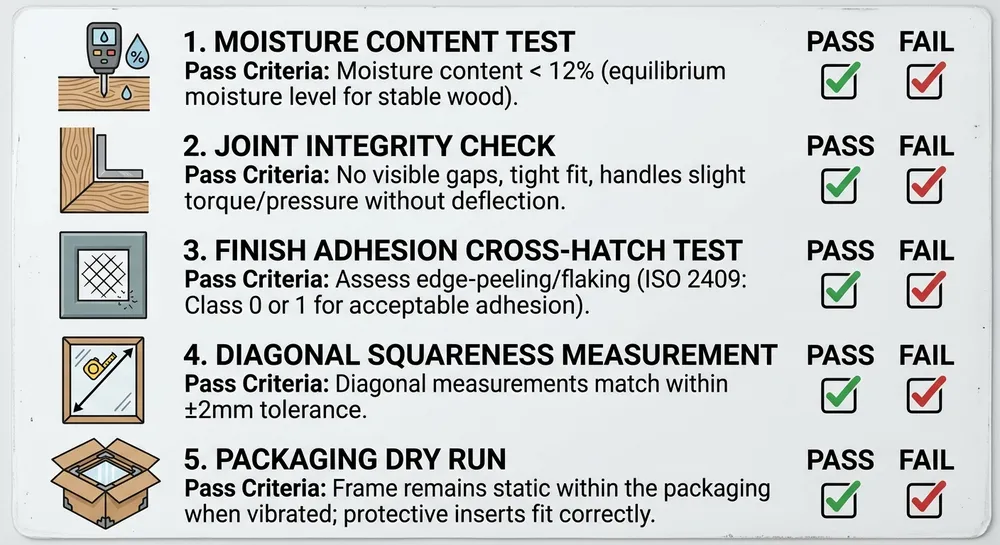
Inspection after assembly but before packing is where you catch most frame problems. Here's what we check on every order, and what you should verify your supplier is doing:
- Moisture content (wood and MDF frames): Pin meter reading at 3 points per frame. Reject anything above 12% MC for standard routes, above 10% for humid routes.
- Joint integrity: Apply moderate hand pressure at each miter joint and any mechanical fastening point. Separation or flex under hand pressure means the joint will fail in transit.
- Finish adhesion: Cross-hatch tape test on painted and powder-coated frames. If the coating lifts in the cross-hatch grid, the finish will flake during the vibration and temperature cycling of ocean freight.
- Dimensional check: Frame squareness measured diagonally. More than 2mm difference between diagonals means the frame is racked and will stress the mirror glass during transit.
- Packaging dry run: For the first shipment of any new SKU, we pack 10 units, simulate stacking load, and open them after 48 hours to check for pressure marks, foam compression, and corner contact.
If your supplier can't show you documentation or photos of these checks, that's a red flag. These aren't exotic QC procedures. They're basic frame production hygiene. For more on the packaging side specifically, we've written a separate guide on wall mirror packaging safety that covers cushioning specs and container loading patterns.
When the Problem Starts Before the Frame Reaches Packaging
Most frame shipping failures look like packaging problems, but they actually originate upstream in material sourcing or process control.
MDF board quality varies by supplier and batch. We've tested MDF from six different board mills in Vietnam and China. Density consistency, surface smoothness, and moisture resistance vary enough between suppliers that the same frame design can have a 2x difference in shipping damage rate depending on which board stock was used. We locked in two qualified board suppliers three years ago and test incoming density on every delivery. If you're sourcing from a factory that buys MDF on spot pricing from whoever is cheapest that month, your frame quality will be inconsistent.
Wood moisture content at the time of frame assembly determines transit behavior. A frame assembled from stock at 14% MC will shrink as it dries in a heated container, opening joints. A frame assembled from stock at 6% MC will absorb moisture and swell on a humid route. The target is 8-10% MC at assembly, matched to the expected transit conditions. This means the kiln-drying schedule and the factory's wood storage conditions matter as much as the frame design itself.
Metal frame coating thickness controls corrosion resistance in transit. We run our powder coat line at 60-80 μm and verify with a coating thickness gauge on every batch. Below 50 μm, salt air exposure during ocean transit can initiate corrosion at weld points and cut edges within the 25-35 day shipping window. If your metal-framed mirrors arrive with rust spots at the joints, the problem isn't the ocean. It's insufficient coating thickness at the factory.
(Resin frames have grown about 30% in our order mix over the past three years, mostly from buyers who got tired of wood-related claims on humid routes. The material cost is comparable to MDF, the tooling investment for a new profile is higher upfront, but the near-zero moisture sensitivity makes the total cost of ownership lower for high-humidity destinations.)
Running Mixed-Material Orders Without Multiplying Risk
Many of our buyers don't order a single frame material. They run a product line with MDF for their value tier, solid wood or resin for their mid-range, and metal for their contemporary collection. That means a single container might hold three or four different frame materials, each with different packaging requirements and different environmental sensitivities.
The mistake is treating a mixed container like four separate orders that happen to share a box. What actually works: group by moisture sensitivity within the container. Wood and MDF units go in the center of the container where temperature and humidity swings are smallest. Metal and resin units can handle positions closer to the container walls and doors. Desiccant packs are sized for the wood/MDF volume, not the total container volume.
We run all four frame materials on our own production lines across our 12,000 m² facility, so mixed-material orders don't require coordinating between multiple suppliers. Your MDF frames, wood frames, metal frames, and resin frames come from the same QC system, the same packaging team, and the same container loading crew. That eliminates the coordination risk that causes problems when you're sourcing frames from two or three different factories and trying to consolidate at a freight forwarder's warehouse.
If you're evaluating frame materials for a new product line or reconsidering your current material spec after shipping issues, send your order profile, destination market, and volume targets to our engineering team through the quote request page. We'll recommend the material and packaging configuration based on your specific route and channel, and send back a detailed comparison with landed cost estimates.
FAQ
Can I switch frame materials mid-production on a running order?
On a standard order, we can switch materials between production batches as long as the frame profile tooling is compatible. MDF-to-resin switches on the same profile shape are straightforward because both materials use similar molding approaches. Wood-to-metal switches require different tooling and typically add 5-7 days to the production schedule. Tell us at the quoting stage if you want to test two materials on the same design and we'll plan the line changeover into the timeline.
What's the real cost difference between standard MDF and moisture-resistant MDF frames?
The board stock itself runs about 10-15% higher for MR-MDF. On a finished framed mirror, that translates to roughly 3-6% increase in FOB unit cost depending on frame size and profile complexity. For shipments to humid destinations, that premium is almost always cheaper than the damage claims you'd absorb with standard MDF. We default to MR-MDF on any order shipping through tropical routes unless you specifically request standard grade.
How do I know if my current supplier is usingthe right MDF grade?
Ask for the board specification sheet from their MDF supplier. Moisture-resistant MDF is typically dyed green at the core (which is why it's called "green MDF" in the trade) and carries an MR or HMR rating on the mill certificate. If your supplier can't produce this documentation, request a sample cut in half so you can see the core color. Standard MDF has a uniform tan/brown core. We keep mill certificates on file for every board delivery and can share them on request.
Do resin frames look cheap compared to wood?
Five years ago, maybe. Current polyurethane casting technology reproduces wood grain texture, carved detail, and even distressed finishes at a level that's difficult to distinguish from real wood at arm's length. The giveaway is weight — resin frames are noticeably lighter. For retail display, that's actually an advantage because your wall-mount hardware requirements are simpler. We can send finish comparison samples of the same profile in wood and resin so you can evaluate side by side before committing to a material.
What desiccant quantity should I specify for wood or MDF mirror shipments?
The general rule is 150-200 grams of calcium chloride desiccant per cubic meter of container space occupied by wood or MDF products. For a full 40-foot container of MDF-framed mirrors, that typically means 8-12 kg of desiccant strips hung from the container ceiling and placed between carton rows. We include desiccant as standard on all wood and MDF shipments to tropical and humid-route destinations. If your supplier charges extra for desiccant or doesn't mention it at all, raise the question before your container loads.
Is there a minimum order quantity difference between frame materials?
Our MOQ starts at 100 pieces for standard models across all four materials. For custom profiles, MDF and resin have the lowest entry point because tooling costs are moderate. Custom metal frame tooling (welding jigs, bending dies) runs higher, so we typically recommend a minimum of 300-500 pieces on a custom metal design to amortize the tooling cost into a reasonable per-unit figure. Custom solid wood profiles fall somewhere in between. The OEM/ODM page has more detail on tooling and setup costs by material type.