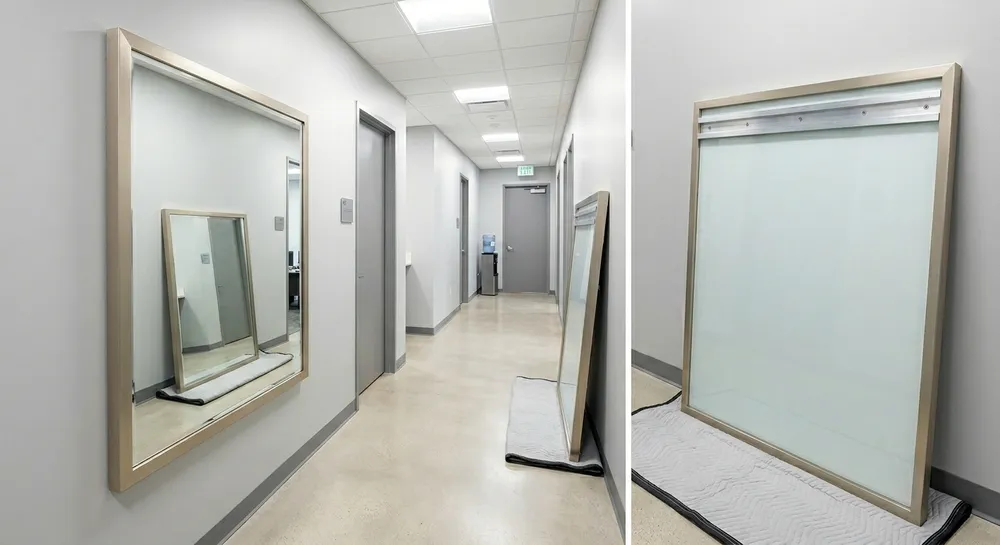
A mirror falls off a hotel corridor wall at 2 AM. Nobody is hurt, but the glass is across the floor, the frame is cracked, and the property manager is on the phone with their supplier before sunrise. The conversation is never pleasant. The mirror was specified correctly for the look — wrong for the load, the wall substrate, and the traffic volume.
We see this pattern more than we'd like. Buyers source mirrors based on dimensions and finish, then leave mounting hardware and backing specs to whoever is doing the installation. In a residential bedroom, that's usually fine. In a commercial hallway with 200 people walking past daily, it's a liability waiting to happen.
This guide covers what actually determines whether a hallway mirror stays on the wall safely — glass thickness, frame weight, backing film, hardware type, and wall substrate — and how to get those decisions made at the sourcing stage rather than on-site.
Why mounting failures happen — and where the decision actually gets made
Most hallway mirror mounting failures trace back to one of three mismatches: the hardware isn't rated for the mirror's actual weight, the anchor isn't matched to the wall substrate, or the glass has no safety backing so a minor impact becomes a shatter event.
None of these are installation errors in the traditional sense. They're specification errors — decisions that should have been made before the order was placed.
A 24×36 inch mirror in a 4mm float glass with a solid wood frame can weigh 18–22 kg depending on frame profile depth. A buyer who specifies "standard hanging hardware" without a weight rating is leaving the installer to guess. If the installer guesses wrong — or uses whatever D-rings came in the box — and the wall is drywall over metal studs rather than solid concrete, the mirror will eventually come down.
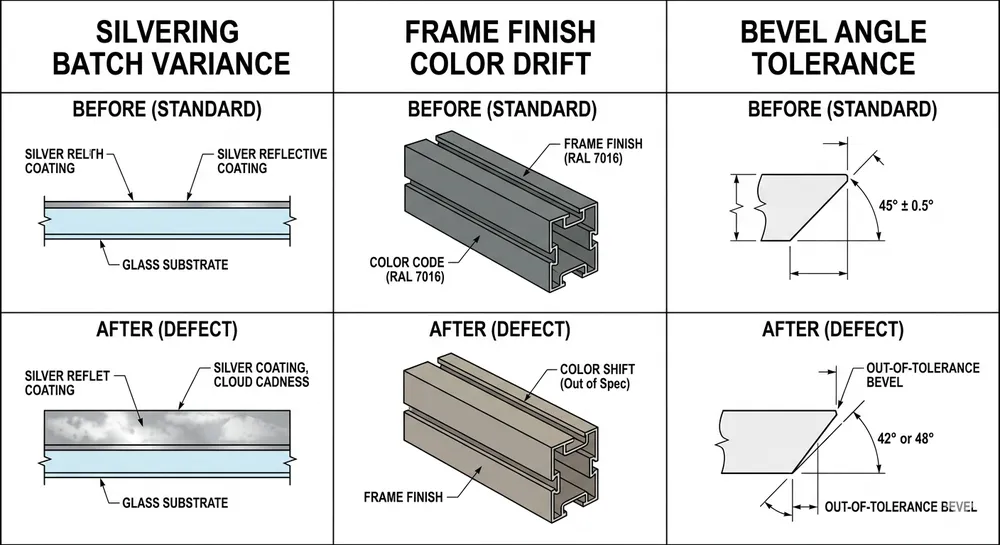
The other failure mode is subtler: mirrors that stay on the wall but develop backing delamination over 12–18 months in humid corridor environments. The silver coating lifts, the mirror looks degraded, and the buyer gets warranty calls. That's a sourcing problem too — copper-free silvering with a proper multi-layer protective coating handles corridor humidity; standard silvering doesn't.
(We've had buyers come to us after exactly this scenario — a hospitality chain that sourced 300 corridor mirrors from a different supplier, had 40% show delamination within a year, and needed a full replacement program. The fix was in the coating spec, not the installation.)
Glass thickness and frame weight: the numbers that drive every other decision
Before you can specify hardware, you need to know what the hardware has to hold. That starts with glass thickness and frame construction.
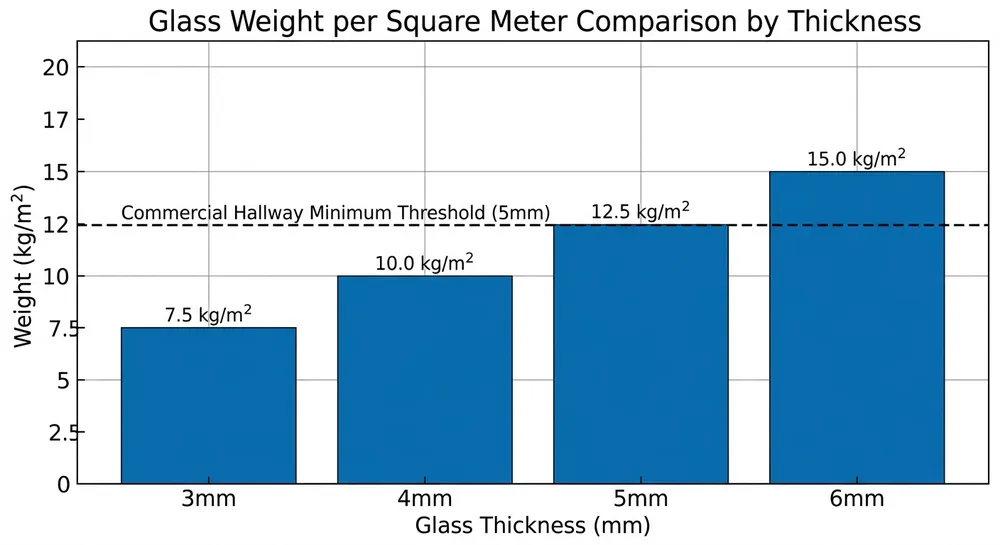
We offer 3mm, 4mm, 5mm, and 6mm float glass across our Hallway Decor Mirrors range. The thickness choice isn't just structural — it directly affects the mirror's total weight and therefore the hardware load rating you need to specify.
| Glass thickness | Approx. glass weight per m² | Typical use case |
|---|---|---|
| 3mm | ~7.5 kg/m² | Small accent mirrors, residential, low-traffic |
| 4mm | ~10 kg/m² | Standard residential and light commercial |
| 5mm | ~12.5 kg/m² | Commercial hallways, hospitality corridors |
| 6mm | ~15 kg/m² | High-traffic commercial, oversized formats |
For a 600×900mm mirror in 5mm glass, the glass alone is roughly 6.75 kg. Add a solid wood frame with a 45mm profile and you're at 10–13 kg total. Add a metal frame with cast corner joints and you could be at 15 kg or more. Hardware rated at 10 kg is already marginal before you account for dynamic load from a door slamming nearby or someone brushing against the frame.
Our standard recommendation for commercial hallway mirrors over 600mm in any dimension: specify 5mm glass minimum, confirm total assembled weight with us before finalizing hardware specs, and use hardware rated to at least 2× the confirmed weight.
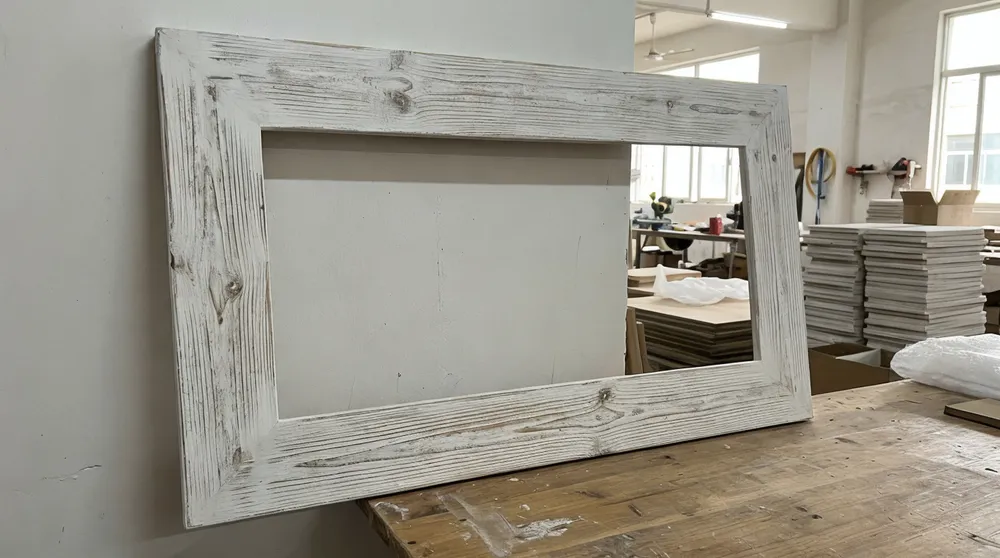
Frame material matters too. Solid wood frames add weight but distribute it evenly across the hanging system. Metal frames — particularly cast zinc alloy corner joints — concentrate weight at the corners, which affects how the hanging hardware needs to be positioned. We can provide assembled weight data for any SKU on request; if you're building an RFQ, ask for it upfront.

Mounting hardware options: what actually holds in high-traffic environments
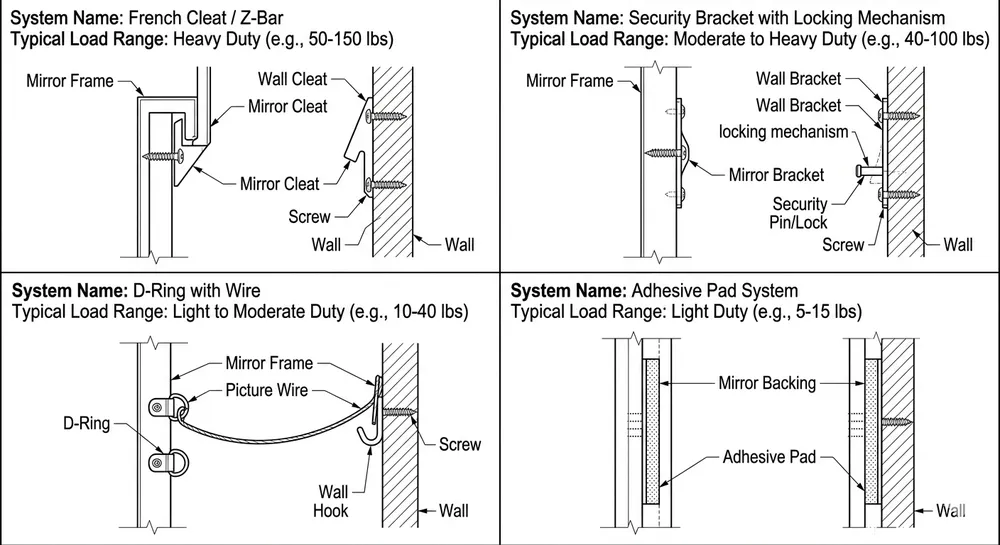
There are four hardware systems worth knowing for hallway mirror applications. Each has a real load ceiling and a real failure mode.
French cleats (Z-bars) The most reliable system for mirrors over 8 kg in commercial settings. A French cleat distributes weight across the full width of the mirror rather than concentrating it at two D-ring points. Properly installed into studs or masonry anchors, a 600mm cleat handles 30–50 kg without issue. The failure mode is installation error — if the wall-side cleat isn't level or isn't anchored into structural material, the whole system is compromised.
We can pre-install the mirror-side cleat at the factory. The buyer or installer sources and mounts the wall-side cleat on-site. This splits the labor cleanly and ensures the mirror-side hardware is correctly positioned relative to the frame's center of gravity.
Security brackets (anti-theft / anti-tip) Standard in hospitality and commercial retail. A security bracket uses a locking mechanism that requires a tool to remove — the mirror can't be lifted off the wall by hand. Load ratings vary by manufacturer, but 20–40 kg per bracket pair is typical for commercial-grade hardware. We integrate security bracket mounting points at the factory on request; the buyer specifies the bracket system they're standardizing on, and we position the receiver plates accordingly.
D-rings and wire systems Fine for residential mirrors under 8 kg. For anything heavier or in a commercial corridor, D-rings are the wrong tool. The wire concentrates load at two small points, the D-ring screws pull out of the frame over time under vibration, and there's no anti-tip protection. We still ship D-rings as standard on smaller residential SKUs, but for commercial orders we recommend upgrading to cleats or security brackets at the factory stage.
Adhesive mounting systems Command-strip style adhesives have a place in residential settings where wall damage is a concern. For commercial hallways, they're not appropriate for mirrors over 5 kg. Adhesive bond strength degrades with humidity and temperature cycling — exactly the conditions in a busy corridor near an entrance. We don't recommend adhesive-only systems for any commercial hallway mirror application.
Wall substrate matching: the variable most buyers ignore
Hardware load ratings are tested against ideal substrates. Real hallways are not ideal substrates.
The four substrates you'll encounter in commercial and residential hallway installations:
Concrete and masonry — the most forgiving. Expansion anchors or sleeve anchors rated for the mirror weight, installed at the correct embedment depth, will hold reliably for years. The main failure mode here is using drywall anchors by mistake when the wall looks like it might be concrete but isn't solid behind the surface layer.
Brick — similar to concrete but requires attention to mortar joint condition. Anchors into old, crumbling mortar will fail. Anchors into the brick face itself, with the correct drill bit and anchor type, are reliable.
Drywall over wood studs — reliable if the hardware hits the studs. A 600mm French cleat spanning two studs at 400mm centers is solid. A single D-ring between studs, relying on a drywall anchor, is not. For mirrors over 10 kg, stud-mounted hardware is non-negotiable.
Drywall over metal studs — the most problematic substrate for heavy mirrors. Metal studs are thinner than wood and have lower pull-out strength. For mirrors over 15 kg on metal stud walls, toggle bolts or specialized metal-stud anchors are required, and the hardware should span multiple studs where possible. This is common in commercial construction and catches buyers off guard when their standard residential hardware spec doesn't transfer.
When we're working with buyers on commercial hospitality projects, we ask for the wall substrate type upfront. It changes the hardware recommendation, and sometimes it changes the glass thickness recommendation too — a lighter mirror is easier to mount safely on a problematic substrate.
Factory-integrated safety features: what to specify before the order ships
This is where sourcing decisions have the most leverage. Once mirrors are on a truck, your options narrow considerably.
Safety backing film A polyester safety film laminated to the back of the glass holds shards in place if the mirror is broken. In a commercial hallway, this is the difference between a cleanup job and a liability event. We apply safety backing film as a factory option — it adds a small cost per unit but eliminates the risk of glass scatter on impact. For any commercial project with foot traffic, specify it.
Copper-free silvering with multi-layer protective coating Standard silvering uses copper as a barrier layer between the silver and the backing paint. Copper corrodes in humid environments, which is why you see black edge spots on mirrors in bathrooms and entrance corridors. Our copper-free silvering process eliminates that layer and replaces it with a more stable chemical barrier. Combined with a multi-layer protective backing coat, the result is a mirror that handles corridor humidity without delaminating over a 5–10 year service life. Specify this for any project in a climate-controlled but high-humidity environment — hotel corridors, gym lobbies, apartment building hallways.
Pre-installed hanging hardware We can install French cleats, security bracket receiver plates, or custom hanging systems at the factory before the mirror ships. This matters for two reasons: factory installation is more precise than on-site installation (the hardware is positioned relative to the frame's actual center of gravity, not estimated), and it reduces on-site labor cost for your installer. For large commercial orders — 50 units or more — factory-installed hardware is worth specifying in the RFQ. The per-unit cost is low; the on-site labor savings are real.
Shatter-resistant glass options For the highest-risk environments — children's facilities, psychiatric units, correctional facilities, high-abuse commercial spaces — we can source and process laminated safety glass or acrylic mirror alternatives. These aren't standard stock items, but they're available through our OEM/ODM Custom Mirror Development program. Lead times are longer; the safety profile is substantially better.
(The laminated glass option comes up more often than you'd expect for hospitality buyers — some hotel brands now specify it for all public-area mirrors as a standard safety requirement. Worth checking your end client's spec sheet before finalizing the order.)
Common mounting failures in commercial hallways — and the sourcing fix
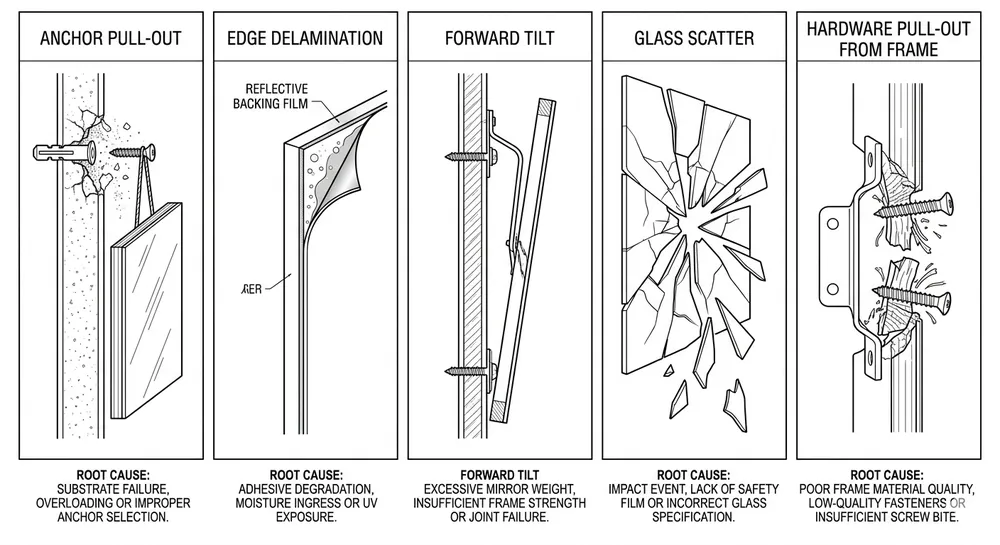
These are the failure patterns we hear about most often from buyers who've had problems:
Mirror drops within 6 months of installation Almost always a hardware-to-substrate mismatch. The anchor wasn't rated for the weight, or it wasn't installed into structural material. The sourcing fix: confirm assembled mirror weight before ordering hardware, and specify the wall substrate type so the hardware recommendation is substrate-specific.
Edge blackening within 12–18 months Silvering delamination from corridor humidity. The sourcing fix: specify copper-free silvering and multi-layer protective coating at the order stage. This is a factory-level decision — you can't retrofit it.
Mirror tilts forward over time Usually a single-point hanging system (one D-ring, one hook) that allows rotation. The sourcing fix: specify a two-point hanging system — either a French cleat or two security brackets — that prevents the mirror from pivoting on a single axis.
Glass shatters on minor impact, scatters across floor No safety backing film. The sourcing fix: specify safety backing film for all commercial hallway mirrors. It's a line item in the RFQ, not an afterthought.
Hardware pulls out of frame after repeated vibration D-ring screws installed into frame material that's too thin or too soft. The sourcing fix: for mirrors over 8 kg, specify hardware that's integrated into the frame's structural members, not just the backing board. We reinforce D-ring mounting points on heavier frames as standard practice — but it's worth confirming this is in the spec.
How to specify mounting-ready mirrors in your RFQ
If you're sourcing hallway mirrors for a commercial project or building a retail product line, these are the spec fields that prevent problems downstream.
Glass thickness: State the minimum acceptable thickness. For commercial hallways, 5mm is the floor. For oversized formats (over 900mm in any dimension), 6mm.
Assembled weight: Request confirmed assembled weight per SKU before finalizing hardware specs. Don't estimate from glass weight alone — frame material and profile depth add significantly.
Backing type: Specify copper-free silvering and multi-layer protective coating for any humid or high-traffic environment. Specify safety backing film for all commercial applications.
Hardware type and load rating: Specify the hanging system — French cleat, security bracket, or D-ring — and the minimum load rating. For commercial orders, specify that hardware must be rated to at least 2× the confirmed assembled weight.
Factory-installed hardware: If you want hardware pre-installed, state it in the RFQ. Include the wall-side hardware system you're standardizing on so we can match the mirror-side components.
Packaging for hardware protection: For commercial orders, specify that hanging hardware must be protected during transit — loose hardware that shifts in the box can damage the mirror backing or the frame finish.
A complete RFQ for a commercial hallway mirror program looks something like this:
> 600×900mm hallway mirror, 5mm float glass, copper-free silvering, multi-layer protective backing coat, safety backing film, solid wood frame with 40mm profile, French cleat pre-installed (mirror-side), confirmed assembled weight required before hardware finalization, retail-ready packaging with hardware protected separately.
That spec gives us everything we need to quote accurately and produce a mirror that installs safely without surprises on-site. Compare that to "600×900mm hallway mirror, wood frame, standard hanging hardware" — which leaves four critical safety decisions unresolved.
For buyers building a product line across multiple room categories, our Decor Mirrors by Room section covers how specs diverge by application — hallway mirrors have different requirements than bathroom or bedroom mirrors, and mixing specs across a single PO is a common source of problems.
Mounting height, placement, and clearance: the installation variables that affect safety
Hardware and glass specs handle the structural side. Placement handles the human side.
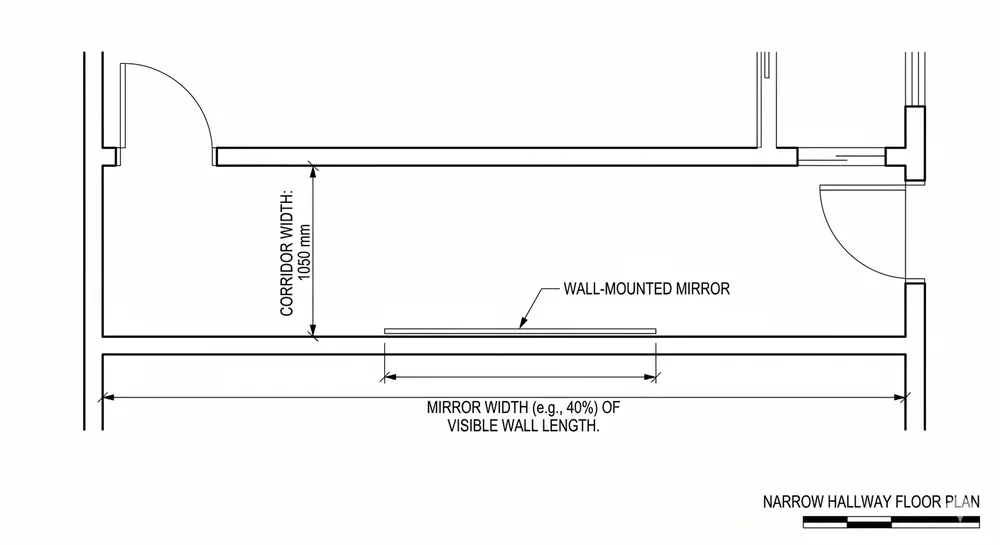
Mounting height for hallways: The standard range for a full-length or large decorative mirror in a hallway is 1500–1700mm to the mirror's vertical center, measured from finished floor level. This puts the reflective surface at eye level for most adults and keeps the bottom edge above typical impact height from luggage, carts, and children. For hospitality corridors with luggage traffic, bottom edge height of 900mm or above is worth specifying to your installer.
Clearance from doors and corners: A mirror mounted within 300mm of a door swing path is a problem waiting to happen. Door hardware, luggage handles, and cart edges will contact the mirror frame repeatedly. Minimum 400mm clearance from any door swing arc is a reasonable standard for commercial installations.
Multiple mirrors in a corridor: If you're specifying a series of mirrors along a corridor wall, consistent mounting height and equal spacing matter for both aesthetics and safety. Inconsistent heights mean some mirrors are mounted lower — closer to impact height — and inconsistent spacing can create crowding that makes individual mirrors harder to secure properly. We can supply mirrors with pre-marked mounting height references on the backing paper for large commercial orders.
Lighting interaction: Mirrors mounted directly opposite a light source create glare that can be disorienting in a narrow corridor. This is an installation consideration, not a product spec, but it's worth flagging to your end client or installer — a 15-degree angle offset from direct opposition eliminates most glare issues without affecting the mirror's visual function.
FAQ
What glass thickness should I specify for a commercial hallway mirror over 800mm wide?
6mm is the right call for any mirror over 800mm in width or height in a commercial hallway. At that size, 5mm glass is structurally adequate but the total assembled weight — typically 18–25 kg with frame — pushes into territory where 6mm's additional rigidity reduces flex under dynamic load. More practically, 6mm glass is less likely to crack from minor impacts in a high-traffic corridor, which reduces your warranty exposure.
Can safety backing film be added after the mirror is manufactured?
Technically yes, but it's not practical at scale. Aftermarket safety film application requires clean-room conditions to avoid bubbles and adhesion failures, and it voids most manufacturer warranties on the silvering. Specify it at the factory stage — it's a fraction of the per-unit cost compared to a field retrofit or a replacement program.
What's the difference between a French cleat and a Z-bar?
They're the same system with different names. A French cleat (also called a Z-bar or Z-clip) is an interlocking two-piece aluminum extrusion — one piece mounts to the wall, one to the mirror back, and they hook together at a 45-degree angle. The weight distributes across the full cleat length rather than concentrating at two points. For mirrors over 8 kg in commercial settings, it's the most reliable hanging system available.
Do your mirrors ship with hardware included, or does the buyer source hardware separately?
Standard residential SKUs ship with D-rings and wire. For commercial orders, we recommend specifying factory-installed hardware — French cleats or security bracket receiver plates — as part of the OEM/ODM development process. This ensures the hardware is correctly positioned and rated for the confirmed mirror weight. Buyers who source hardware separately sometimes find that off-the-shelf hardware doesn't match the frame's mounting point positions, which creates on-site problems.
What certifications are relevant for commercial hallway mirror safety?
Our mirrors carry ISO 9001:2015, SGS, CE, and BSCI certifications. For specific commercial building code compliance — particularly in North American markets — the relevant standards are ANSI Z97.1 (safety glazing) and CPSC 16 CFR Part 1201 for safety glazing materials. If your project requires certified safety glazing, specify this in your RFQ and we'll confirm whether the glass specification meets the applicable standard or whether laminated safety glass is required.