Most buyers who come to us with a mirror sourcing brief have already made one expensive mistake: they built their first assortment around what looked good in a catalog, not around what sells through at retail and reorders predictably. A bathroom mirror and a living room mirror share a factory floor — but almost nothing else in the spec sheet. Get the room-application logic wrong and you end up with overstock in one category and stockouts in another, plus a frame finish that fails in a humid environment because nobody flagged the coating spec at the RFQ stage.
This guide walks through how we think about Home Decor Mirrors product line planning from the factory side — the four axes that drive SKU selection, the specs that actually matter per room category, and the order structure that lets you test before you commit.
The Four Planning Axes: How SKU Decisions Actually Stack
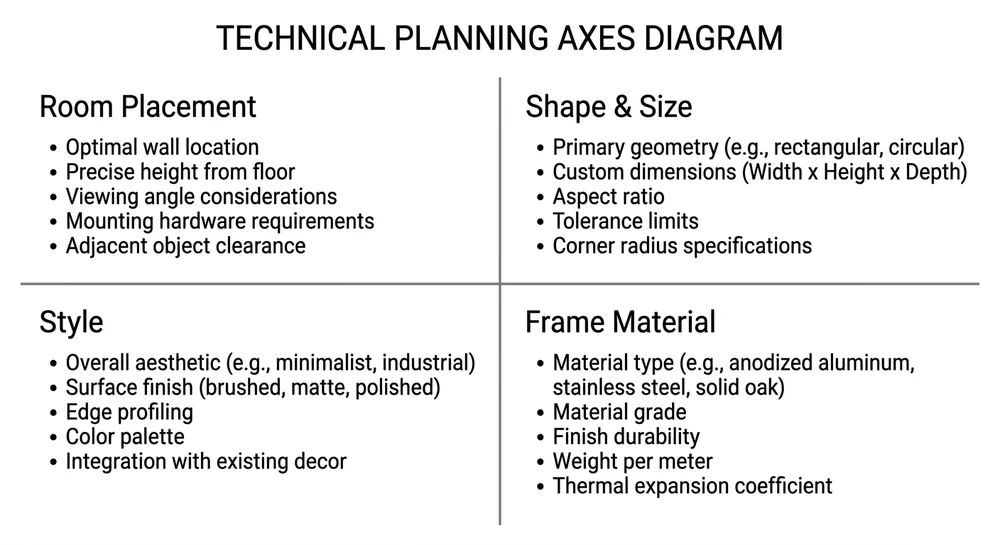
Before you write a single line item on an RFQ, you need a framework. We work with buyers across North America, Europe, and Australia, and the ones who build profitable lines consistently think about their assortment across four axes simultaneously — not sequentially.
Axis 1: Room placement. This is the load-bearing axis. Room determines moisture exposure, typical viewing distance, size expectations, and whether the frame material needs to survive a humid environment. A bathroom vanity mirror and a bedroom full-length mirror are different products in almost every spec dimension.
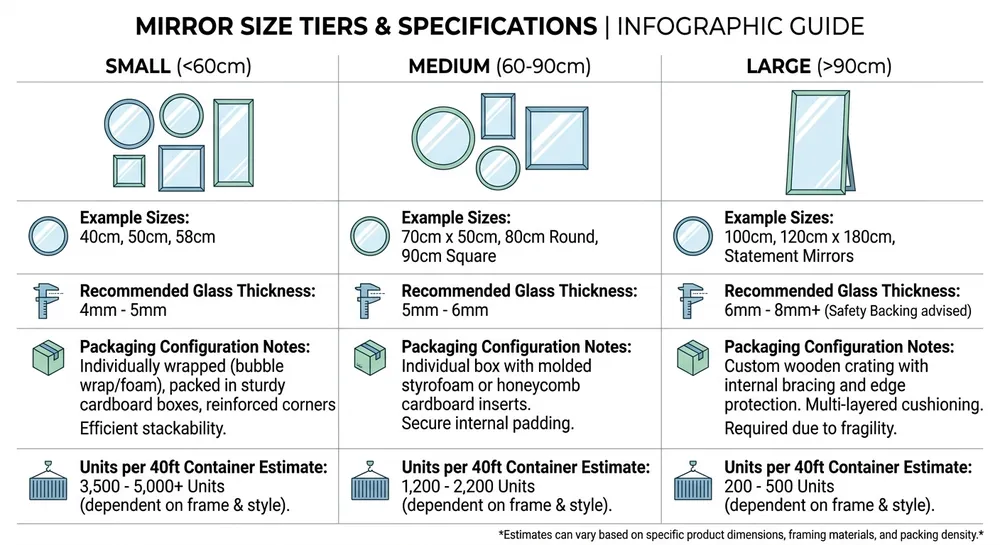
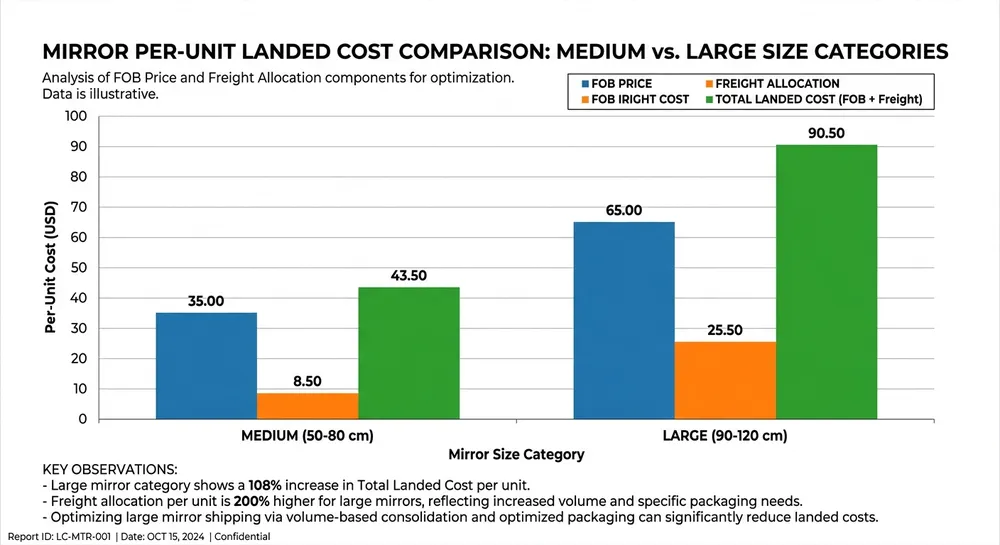
Axis 2: Shape and size. Round, rectangular, arch-top, irregular — shape drives frame complexity and therefore cost. Size drives glass weight, packaging spec, and container loading efficiency. A 24×36" rectangular mirror loads very differently from a 30" round, and that difference shows up in your landed cost per unit.
Axis 3: Style. Transitional, modern, rustic, glam — style determines frame profile depth, finish type, and which retail channels the SKU fits. Style is also where trend risk lives. We'll come back to this.
Axis 4: Frame material. Wood, MDF, metal, resin, frameless — each material has a different cost floor, lead-time profile, and moisture tolerance. This axis is where most first-time buyers under-specify, and where we catch the most problems before production starts.
The practical implication: a well-built starter assortment doesn't pick one option per axis. It picks a deliberate combination — for example, three room categories × two size tiers × two style directions × two frame materials — and maps those intersections to actual SKUs. That's how you get to a 10–14 SKU mix that covers your market without redundancy.
Room-Based Category Logic: Where Specs Diverge
The Decor Mirrors by Room category structure exists for a reason. Room placement isn't a merchandising label — it's a spec driver. Here's where the differences matter most for sourcing decisions.
Bathroom mirrors: moisture is the spec, not the style
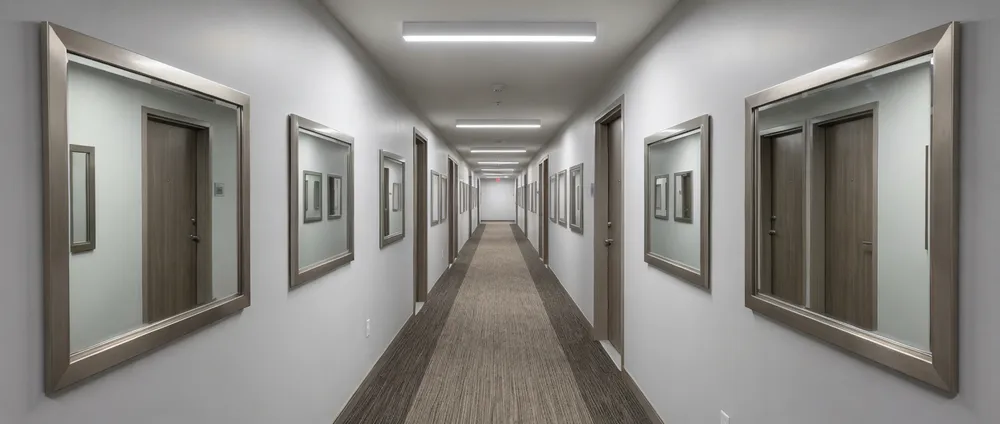
Bathroom mirrors are the highest-reorder category in our residential line. Vanity replacement, renovation projects, hospitality refits — the demand is steady and the order sizes are predictable. But the spec requirements are unforgiving.
The glass silvering spec is non-negotiable in this category. Standard copper-backed silvering degrades in sustained humidity — you'll see edge blackening within 12–18 months in a bathroom environment, and that generates warranty claims. We run copper-free silvering as our default across the entire line, which means our bathroom mirrors are EU-compliant on the lead and copper restriction side without a spec upgrade or upcharge. For buyers selling into European retail or hospitality, that's a compliance checkbox that's already handled. (We made the switch to copper-free across all production in 2021 — the material cost difference is marginal, and the warranty claim reduction was immediate.)
Frame material for bathroom applications: metal frames with a moisture-resistant powder coat, or frameless designs, are the safe choices. MDF frames need a sealed edge profile and a proper moisture barrier coating — we can do it, but buyers need to specify it explicitly, and the finish options narrow. Wood frames in bathrooms are a risk we flag every time; unless the buyer's end market is a dry climate and the mirror placement is away from direct splash zones, the delamination rate climbs.
Size range for Bathroom Decor Mirrors typically runs 24"–36" width for single-sink vanity, 48"–72" for double-sink. These are the sizes that move at retail and reorder. Going outside this range for a first order is a margin risk — you're betting on a niche before you've validated the core.
Living room mirrors: size and statement drive the margin
Living Room Decor Mirrors are where your margin lives, but also where your inventory risk concentrates. Large-format decorative mirrors — 36"×48" and above, arch-top designs, ornate frame profiles — carry higher retail price points and better gross margin per unit. They also have longer sell-through cycles and are more sensitive to style trends.
The frame profile is the product in this category. A living room mirror buyer is paying for the visual weight of the frame — the depth, the finish, the profile detail. We run frame profiles from 1.5" flat to 4"+ ornate molding, and the cost difference between a simple 2" flat metal frame and a 3.5" carved resin profile is significant. Buyers need to decide early whether they're building a value-accessible line or a premium statement line, because the frame spec drives the price floor.
Glass spec for living room applications: 5mm float glass is standard for mirrors up to 36" on the long dimension. Above that, we move to 6mm for structural integrity during shipping and wall mounting. The weight difference matters for packaging — heavier glass means more foam protection, which affects your carton cube and container loading count.
Style trend risk is real here. We've seen buyers over-index on a trending frame finish (brushed gold was the obvious one a few years back) and end up with 18 months of slow-moving inventory when the trend cycled. Our recommendation: anchor your living room assortment on 2–3 transitional or classic styles that have 3–5 year shelf life, then add 1–2 trend-forward SKUs at lower initial quantities. Test before you commit volume.
Bedroom mirrors: full-length drives the category
Full-length floor mirrors and leaner mirrors are the bedroom category's commercial core. The size range — typically 14"×48" to 24"×65" — means these are among the most container-efficient mirrors we ship. A 20"×60" leaner in a flat-pack carton loads well, and the retail price point relative to production cost gives buyers reasonable margin.
The hardware spec matters more in this category than buyers expect. A full-length mirror needs a wall-mount bracket rated for the glass weight, or a floor stand with a stable base geometry. We've seen returns driven entirely by inadequate hanging hardware — the mirror itself was fine, the bracket failed. We include weight-rated D-ring hardware as standard on wall-mount bedroom mirrors and test the bracket pull strength before shipment.
Frame material for bedroom mirrors: MDF with a foil wrap or paint finish is the cost-efficient choice for value-tier retail. Solid wood or metal frames move the price point up and suit mid-to-premium channels. The finish options on MDF are wide — we can match most RAL colors and wood-grain foils — so buyers building a coordinated bedroom furniture program can align the mirror finish to their case goods without going to solid wood cost.
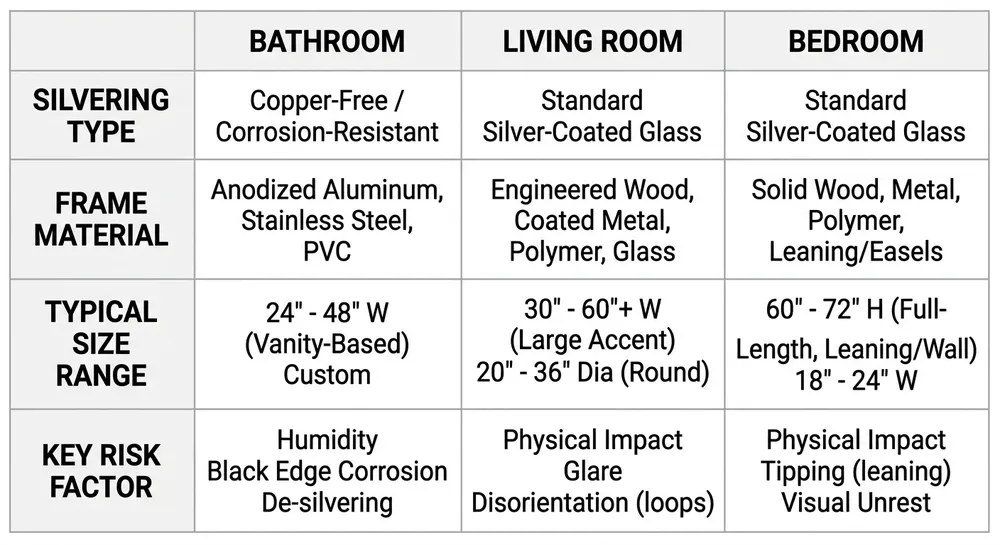
Frame Material Trade-offs: Cost Floor, Lead Time, and Moisture Tolerance
Frame material is the axis where sourcing decisions have the most downstream consequences — on cost, on lead time, and on warranty exposure. Here's how the main options stack up from a production standpoint.
| Frame Material | Cost Tier | Moisture Tolerance | Lead Time Impact | Best Application |
|---|---|---|---|---|
| Metal (powder coat) | Mid | High | Standard | Bathroom, modern living room |
| MDF (sealed/foil) | Low–Mid | Medium (sealed) | Standard | Bedroom value tier, transitional |
| Solid wood | Mid–High | Low–Medium | +5–7 days (drying) | Premium bedroom, rustic living room |
| Resin/PU | Mid | High | Standard | Ornate profiles, glam style |
| Frameless | Low | High | Standard | Bathroom, minimalist |
A few notes from production experience:
Metal frames are our most consistent lead-time category. The powder coat line runs at 60–80μm thickness, passes 500-hour salt spray, and the process is automated — batch-to-batch consistency is high. For buyers building a bathroom or modern-style line, metal is the low-risk frame choice.
MDF needs to be specified correctly for humid applications. Unsealed MDF edge profiles in a bathroom environment will swell. We seal the edges and apply a moisture-barrier primer before the finish coat on bathroom-spec MDF frames, but this has to be called out in the order spec — it's not assumed. (We've had buyers come back after their first season with edge-swelling complaints because the spec wasn't locked at RFQ. Now we flag it proactively on every bathroom MDF inquiry.)
Solid wood adds lead time because the timber needs to reach equilibrium moisture content before machining and finishing. We source kiln-dried timber, but the drying and conditioning step adds 5–7 days to the production schedule. For buyers on tight seasonal timelines, this matters.
Resin and PU profiles give you the ornate frame geometry of carved wood at lower cost and with better moisture tolerance. The trade-off is weight — a deep resin profile on a large mirror adds shipping weight. For buyers targeting the glam or maximalist segment, resin profiles are the practical choice for achieving the visual without the solid wood price.
Silvering Spec: The Detail That Determines Warranty Exposure
Most buyers don't ask about silvering until they have a warranty problem. We'd rather you ask before the order.
Standard mirror silvering uses a copper backing layer between the silver and the protective paint coat. Copper-backed mirrors are fine in dry environments. In humid environments — bathrooms, coastal climates, high-humidity retail storage — the copper layer oxidizes at the edges over time, producing the black edge creep that generates returns.
Copper-free silvering eliminates the copper layer and uses an alternative barrier chemistry. The result is better edge stability in humid environments and compliance with EU restrictions on copper and lead in decorative products. We run copper-free as our production default — it's not a premium option, it's just how we make mirrors. For buyers selling into EU retail or building a bathroom-heavy assortment, this is a meaningful compliance and warranty risk reduction that doesn't add cost.
The practical sourcing check: when you're evaluating mirror suppliers, ask specifically whether their silvering is copper-free or copper-backed, and ask for a humidity chamber test result. A supplier who can't answer that question clearly is running copper-backed silvering and probably hasn't tested it in humid conditions.
Order Economics: MOQ Tiers, Mixed-SKU Containers, and the Sample Workflow
This is where product line planning meets sourcing reality. The category logic above tells you what to buy — this section tells you how to structure the order.
MOQ tiers and what they mean for SKU testing
Our standard MOQ is 100 pieces per SKU for catalog models. That's low enough to test a new SKU at retail before committing to full-container volume. For custom frame profiles or non-catalog finishes, MOQ moves to 200–300 pieces depending on the frame complexity — the tooling and setup cost needs to be spread across enough units to make sense for both sides.
The practical implication for line planning: you don't have to commit to 500 units of a new style to find out if it sells. Start at 100, run it through one retail season, and reorder based on actual sell-through data. We see most new buyers in the residential mirror category start with a 3–5 SKU trial order across two room categories, then expand to a full assortment on the second PO.
Mixed-SKU container loading
Vertical integration matters here. Because we handle glass cutting, silvering, frame production, and assembly under one roof, we can run a mixed-SKU order without coordinating across multiple suppliers. A container with 200 units of bathroom vanity mirrors, 150 units of bedroom full-length mirrors, and 100 units of living room arch-top mirrors is a single production run, a single QC process, and a single shipment. You're not chasing three factories and three freight consolidations.
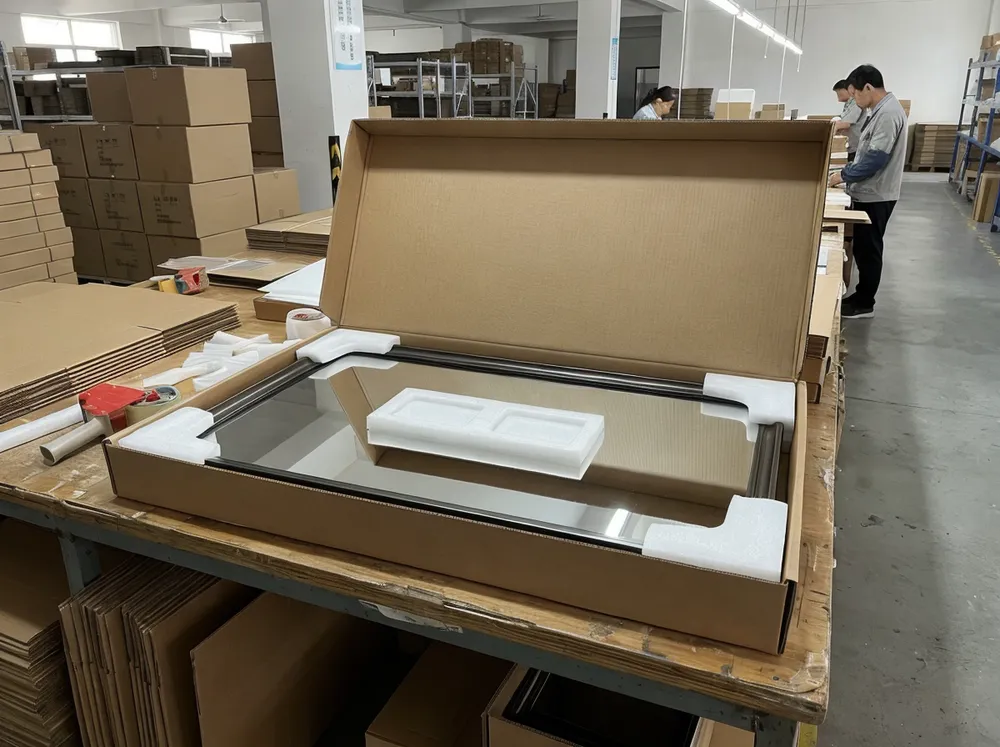
Container loading efficiency varies by mirror size and packaging spec. Flat-pack cartons for frameless and simple-frame mirrors load more efficiently than assembled mirrors in foam-lined boxes. For buyers optimizing landed cost, we can advise on packaging configuration per SKU to maximize container fill rate — it's worth a conversation before you finalize the order spec.
Sample-to-bulk workflow
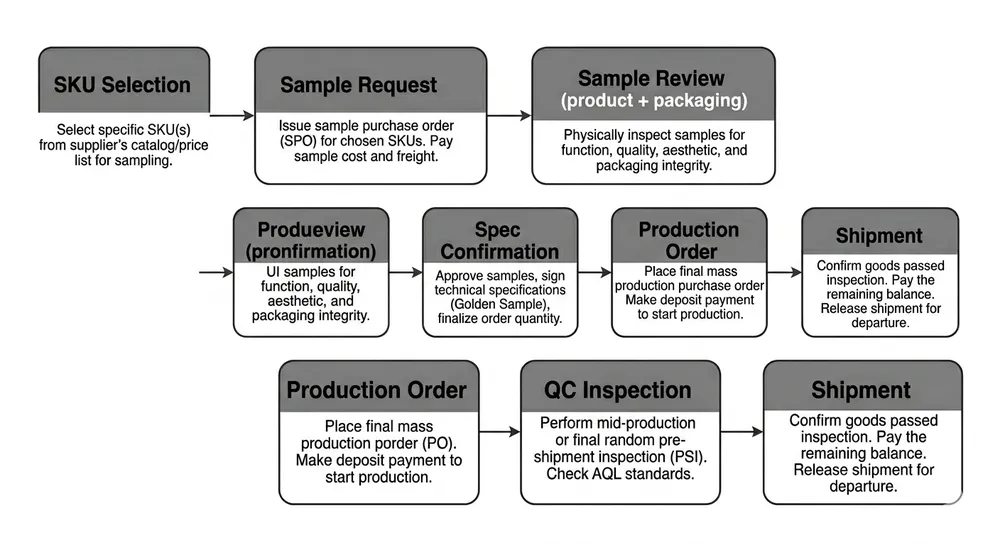
The standard path: request samples of 2–3 SKUs from our catalog, evaluate finish quality and packaging, confirm the spec, then place the production order. Sample lead time is typically 7–10 days for catalog models. For custom frame profiles, we produce a pre-production sample before committing to full tooling — that step adds time but prevents expensive surprises at bulk delivery.
One thing we've learned from working with retail buyers: sample approval needs to include packaging review, not just product review. The mirror that looks perfect out of the box can arrive at your customer's door with corner damage if the carton spec isn't right. We include packaging drop-test results with our sample documentation for buyers who need it.

Common Planning Mistakes That Cost Buyers Money
We see the same mistakes often enough that they're worth naming directly.
Over-indexing on trend styles at launch. A new buyer building their first mirror line wants to lead with what's visually exciting. That's understandable. The problem is that trend-forward styles — a specific frame finish, an unusual shape — have shorter sell-through windows and don't reorder as predictably as transitional or classic styles. Build your assortment base on styles with 3–5 year shelf life. Add trend SKUs at 20–30% of your initial volume, not 60%.
Ignoring reorder velocity when selecting SKUs. The mirrors that drive a distribution business aren't always the most visually striking — they're the ones that sell through in 60–90 days and reorder on a predictable cycle. Bathroom vanity mirrors in standard sizes are less exciting than a large ornate living room piece, but they reorder 3–4× per year. A line built around reorder velocity looks different from a line built around catalog appeal.
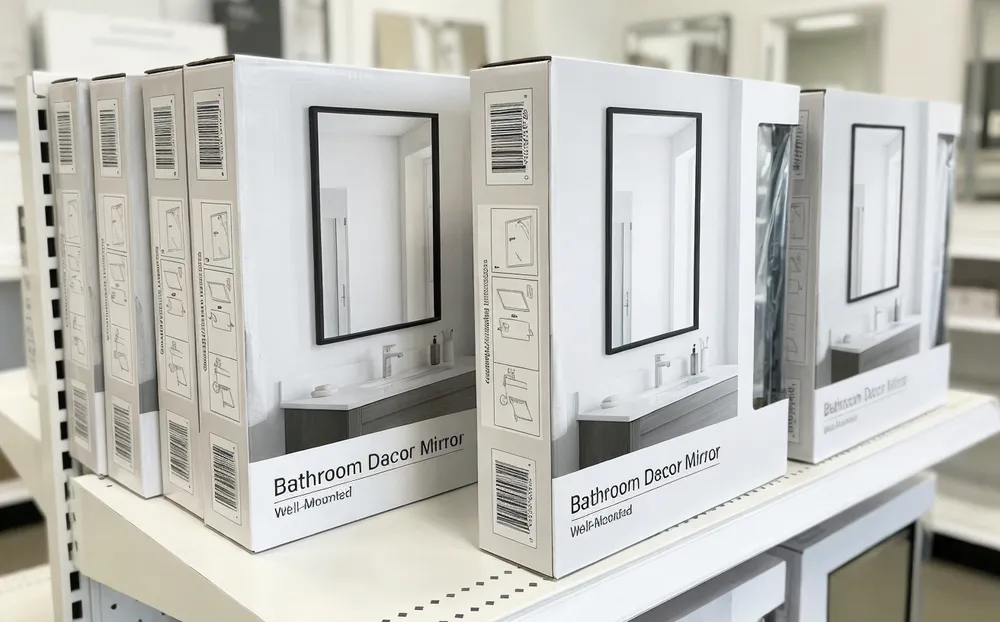
Under-specifying packaging for the sales channel. A mirror going into a retail store has different packaging requirements than one going into an e-commerce fulfillment center. Drop-test requirements, barcode placement, retail-ready packaging — these need to be specified at the order stage, not retrofitted after the first shipment. We have experience with Walmart, Wayfair, and Amazon compliance requirements; if your target channel has specific packaging standards, tell us at the RFQ stage.
Treating all frame materials as interchangeable. A buyer who specifies "wood frame" without locking the species, moisture content, and finish type is leaving the spec open to interpretation. We'll make a reasonable choice, but it may not be the choice that fits your market or your price point. The more specific your frame spec at RFQ, the fewer surprises at sample review.
Building a Starter Assortment: A Practical 10–12 SKU Framework
For buyers entering the home decor mirror category or expanding an existing line, here's a framework we've seen work across multiple markets.
Tier 1 — Core reorder SKUs (5–6 SKUs): These are your volume drivers. Bathroom vanity mirrors in 24" and 36" widths, copper-free silvering, metal or frameless frame, 2 finish options. Bedroom full-length mirror in one size, MDF or metal frame, 2 finish options. These SKUs should be in your catalog permanently — they reorder predictably and anchor your container economics.
Tier 2 — Margin SKUs (3–4 SKUs): Living room statement mirrors in larger formats — 36"×48" or arch-top designs — with a frame profile that justifies a higher retail price point. 2 style directions (transitional and one trend-adjacent). These carry better margin per unit but slower sell-through. Keep initial quantities conservative.
Tier 3 — Test SKUs (2 SKUs): One trend-forward style at minimum viable quantity (100–150 units). One custom or OEM frame profile if you're building a proprietary line. These are your market intelligence — run them for one season and let the sell-through data tell you whether to scale or rotate.
This structure gives you coverage across room categories, two price tiers, and a built-in mechanism for testing new directions without betting the container on them.
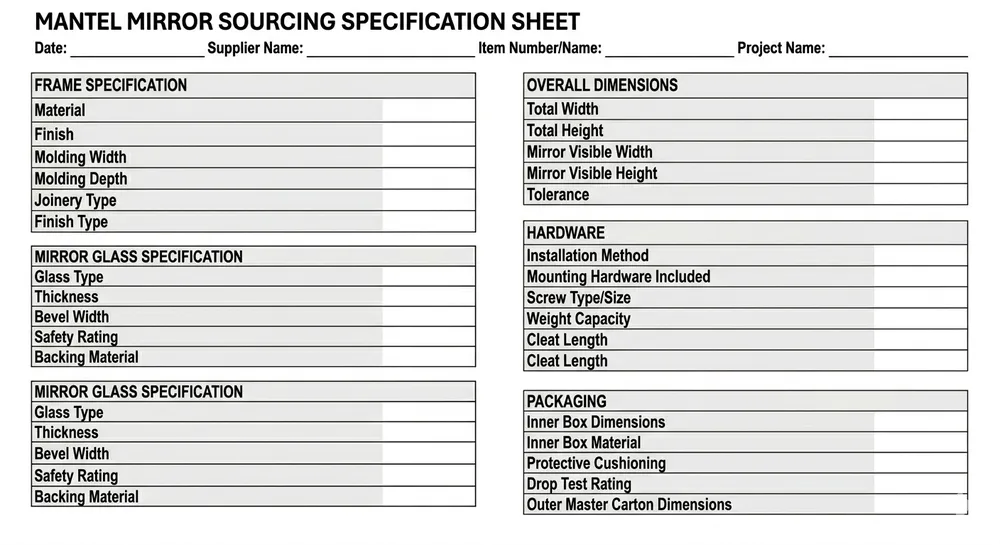
Spec Reference: What to Lock Before You Send an RFQ
When you're ready to move from category plan to actual sourcing inquiry, these are the spec dimensions that need to be confirmed per SKU — not left open.
| Spec Dimension | Why It Needs to Be Locked | Common Default If Unspecified |
|---|---|---|
| Glass thickness | Affects weight, packaging, and structural integrity | 5mm (may be wrong for large formats) |
| Silvering type | Copper-free vs. copper-backed — warranty exposure in humid environments | Copper-backed (lower cost, higher risk) |
| Frame material + species | Cost, moisture tolerance, and finish options vary significantly | Supplier's choice |
| Frame finish | Color, texture, and durability spec | Supplier's standard catalog finish |
| Hanging hardware | Weight rating, bracket type, included vs. separate | Minimal hardware, unrated |
| Packaging spec | Drop-test rating, retail-ready requirements, barcode placement | Standard export carton |
| MOQ per SKU | Determines whether custom options are viable | 100 pcs catalog / 200–300 pcs custom |
Locking these dimensions before the RFQ goes out means your quote comes back comparable across suppliers and your sample review has a clear pass/fail criteria. Leaving them open means you're comparing quotes that aren't actually quoting the same product.
For buyers building a multi-room assortment, the Request Quote process works best when you submit your target room categories, preferred frame materials, size ranges, and volume estimates together — we can return a tailored SKU proposal with pricing, MOQs, and lead times that reflects your actual line plan rather than a generic catalog price list.
FAQ: Home Decor Mirror Product Line Planning
What glass thickness should I specify for home decor mirrors?
For mirrors up to 36" on the long dimension, 5mm float glass is standard and sufficient. Above 36" — large living room pieces, full-length bedroom mirrors over 60" — specify 6mm. The weight increase is real (roughly 20% heavier per square foot), which affects your packaging spec and container loading count, but the structural integrity during shipping and wall mounting justifies it. Don't let a supplier talk you into 4mm on a large-format mirror to save cost — the breakage rate in transit goes up and the wall-mount stability goes down.
How do I know if a supplier's silvering will hold in a bathroom environment?
Ask for a humidity chamber test result — specifically, accelerated corrosion testing at 40°C and 95% relative humidity for 240 hours minimum. A mirror that passes this test without edge blackening is suitable for bathroom applications. If a supplier can't provide this data, assume they haven't tested it. Copper-free silvering consistently outperforms copper-backed in this test; it's the spec to request for any bathroom or high-humidity application.
What's the realistic MOQ for a custom frame profile?
For a fully custom frame profile — new tooling, non-catalog geometry — plan for 200–300 pieces minimum per SKU. Below that, the tooling amortization makes the unit cost uncompetitive. If you're testing a custom direction, the practical path is to start with a catalog frame that's close to your target, validate the market, then invest in custom tooling for the reorder. We've helped buyers do this transition on several programs — it's a lower-risk way to build a proprietary line.
Which mirror styles have the best reorder velocity for wholesale distribution?
Transitional styles — clean profiles, neutral finishes like matte black, brushed nickel, or natural wood tones — consistently outperform trend-specific styles on reorder velocity. They fit multiple retail environments, don't date quickly, and your retail customers can reorder them across seasons without a style refresh. In our experience, the top-reordering SKUs in a distributor's line are almost always transitional bathroom and bedroom mirrors, not the statement living room pieces that look best in a catalog.
Can I mix room categories in a single container order?
Yes, and it's often the right move for a first order. A mixed-SKU container across bathroom, bedroom, and living room categories lets you test multiple segments simultaneously without waiting for separate shipments. Because we run all production in-house, a mixed order is a single production schedule and a single QC process. The main constraint is minimum quantities per SKU — each line item still needs to meet its MOQ threshold. We can advise on container loading configuration to maximize fill rate across different carton sizes.