Most sourcing problems with modern wall art don't start on the production floor. They start when a supplier quotes against vague specs and a buyer accepts them. By the time the container arrives, the frame profiles are inconsistent, the print resolution doesn't hold at retail shelf distance, and the packaging fails the retailer's drop test. The order gets rejected or marked down, and everyone loses margin.
I've spent 12 years at Livewellcraft developing wall art styles and managing production runs for US retail programs. What I've seen repeatedly is that buyers who understand the actual standards their retail partners enforce — not just "good quality" — get far fewer surprises at the compliance stage. This article breaks those standards down by channel, material, and production parameter so you can spec them into your next purchase order before problems happen.
—
What "Modern Wall Art Design Standards" Actually Means in a Sourcing Context
"Modern wall art" covers a wide range of substrates, formats, and finishes — canvas prints, framed paper art, metal wall decor, mirror-based wall pieces, and mixed-media panels. The design standards that matter in a US retail context aren't aesthetic preferences. They're measurable production parameters that determine whether your product passes vendor compliance, survives the supply chain, and sells through without warranty claims.
The four categories that US retailers consistently enforce:
- Dimensional tolerances — acceptable variance in finished piece dimensions, frame profile width, and hanging hardware placement
- Finish and print standards — resolution, color consistency across a production run, coating durability, and surface defect thresholds
- Substrate and material specs — backing board density, frame material grade, canvas weight, and hardware load ratings
- Packaging and compliance — retail-ready packaging construction, UPC placement, drop-test performance, and vendor documentation
Each of these categories has different thresholds depending on which retail channel you're selling into. A spec that passes Wayfair's vendor program may not meet Walmart's planogram requirements. Getting this wrong costs you a chargeback, a return authorization, or a delisted SKU.
—
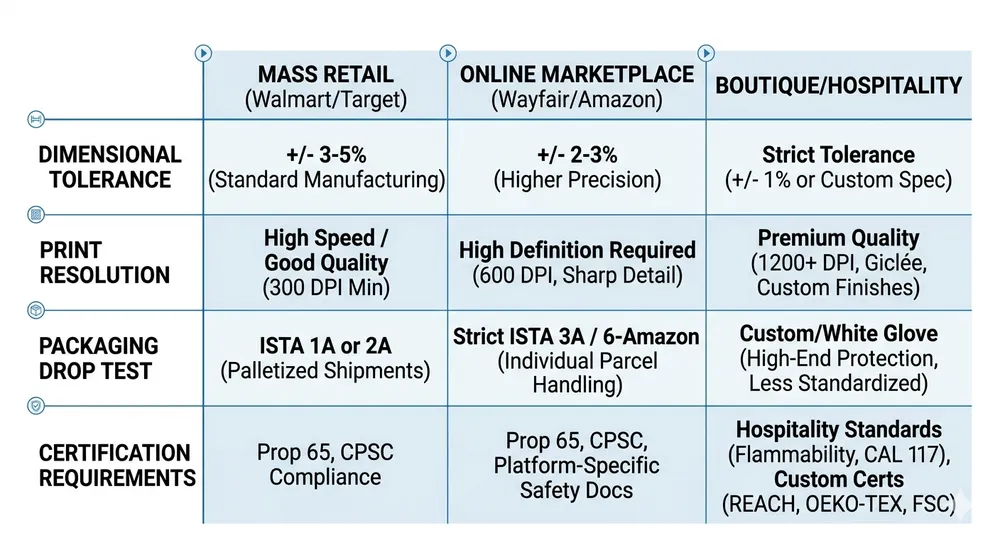
Channel-Specific Requirements: Mass Retail, Online Marketplace, and Boutique
The same piece of modern wall art faces different compliance gates depending on where it's sold. Here's how the standards diverge.
Mass retail (Walmart, Target)
Mass retail programs run on planogram compliance. Your finished dimensions need to land within ±3mm of the spec — not because the buyer is being difficult, but because shelf space is allocated by SKU footprint. A frame that runs 5mm wide throws off the planogram and triggers a chargeback.
Walmart's vendor standards also require retail-ready packaging that survives their distribution center handling. That means a minimum 32 ECT corrugated box, corner protection inserts, and a drop test at 30 inches from all six faces. We've had buyers come to us after a previous supplier's packaging failed the Walmart ISTA 2A test — the product was fine, but the box collapsed and the retailer rejected the shipment.
Color consistency is enforced through PO-level color standards. If your approved sample shows a warm grey frame, every unit in that PO needs to match within a ΔE of 2.0 or less. Mass retail buyers run spot checks on incoming shipments, and color drift above that threshold triggers a return authorization.
Online marketplace (Wayfair, Amazon)
Wayfair and Amazon have different pressure points. Dimensional accuracy still matters — product listing dimensions need to match the physical piece within ±5mm or you accumulate negative reviews that tank your ranking. But the bigger compliance risk is hanging hardware.
Both platforms see high return rates on wall art when the hanging system fails. Wayfair's vendor guidelines specify that hanging hardware must support at least 3x the product weight, and the mounting point must be centered within ±2mm of the piece's horizontal midpoint. Off-center hardware causes the piece to hang crooked, which generates returns and review complaints that are hard to recover from.
Amazon's FBA requirements add a packaging layer: poly-bagging or boxing that passes their IISC drop test, with suffocation warning labels on any poly bag over a certain size. If you're routing through FBA, your packaging spec needs to account for this before you finalize the carton design.
(We've supplied both Wayfair and Amazon vendor programs — the documentation requirements alone add about two weeks to the onboarding timeline if you're not prepared for them.)
Boutique retail and hospitality
Boutique buyers and hospitality procurement teams care less about planogram compliance and more about finish consistency and material authenticity. A hotel group ordering 200 units of a modern abstract piece for guest rooms needs every unit to look identical — same color temperature, same frame finish sheen, same canvas texture. They're not running drop tests, but they are doing visual inspections on delivery.
For hospitality, frame durability matters more than in retail. Pieces get handled during installation and occasionally during room refreshes. Frame joints need to be glued and pinned, not just glued, and the hanging hardware needs to be recessed or flush-mounted so it doesn't snag on walls during installation.
—
Material and Finish Standards That Production Actually Controls
This is where supplier capability separates from supplier claims. Any factory can say they meet "high quality" standards. The question is whether they control the production parameters that determine whether those standards hold across 500 or 5,000 units.
Print resolution and color consistency
For canvas and paper-based modern wall art, the minimum print resolution for retail is 150 DPI at final output size. At that resolution, the image holds at normal viewing distance (3–5 feet) without visible pixelation. Some boutique buyers specify 200 DPI for pieces larger than 24×36 inches, where viewing distance is closer.
Color consistency across a production run is controlled by ICC profile management and press calibration. A well-run print operation recalibrates between runs and maintains a ΔE tolerance of 2.0 or less against the approved color standard. Above ΔE 3.0, color shift becomes visible to the naked eye — that's the threshold where retail buyers start rejecting units.
We manage color consistency on our wall art runs by printing color control strips on every sheet and measuring them before the sheet goes to cutting. It adds a step, but it catches drift before it becomes a container-load problem.
Frame profile tolerances
For framed modern wall art, frame profile consistency is a production parameter that directly affects retail presentation. The profile width — the visible face of the frame — needs to hold within ±0.5mm across a production run. Wider variance shows up as inconsistency when units are displayed side by side on a retail shelf or hung in a gallery-style arrangement.
Frame corner joints are a common failure point. Miter joints need to be cut at exactly 45° and joined with both adhesive and mechanical fasteners (v-nails or corner brackets). A joint held only with adhesive will open under temperature cycling during shipping — we see this most often on containers that transit through high-humidity ports.
Frame finish — whether painted, foil-wrapped, or natural wood — needs to be applied after assembly, not before. Finishing individual frame components before assembly leaves raw edges at the miter joints that oxidize or show color mismatch over time.
Coating durability for surface finishes
For metal wall art and mirror-based wall decor, coating durability is measured by salt spray resistance. A standard commercial finish should pass 200 hours of salt spray testing without blistering or adhesion failure. Coastal retail accounts — Florida, California, Pacific Northwest — should specify 500-hour salt spray resistance, which requires a primer coat plus topcoat system rather than a single-coat finish.
Our copper-free silvering process on mirror-based wall art eliminates the oxidation risk that standard copper-backed mirrors develop over time. In humid environments, copper-backed mirrors show edge darkening within 18–24 months. Copper-free silver holds clean edges significantly longer — relevant if your buyers are placing product in bathrooms, coastal homes, or hospitality settings where humidity is a constant.

—
Compliance and Packaging Standards US Retailers Enforce at Vendor Onboarding
Getting the product right is half the job. Getting through vendor compliance is the other half. US retailers — especially mass retail and major online platforms — have formalized vendor onboarding programs with documentation requirements that catch unprepared suppliers before the first PO ships.
Retail-ready packaging construction
Retail-ready packaging for wall art needs to protect the product through the full distribution chain, not just direct shipping. The standard for mass retail is a double-wall corrugated box (32 ECT minimum) with foam corner inserts or molded pulp corners. Single-wall boxes fail at distribution center conveyor systems, which handle packages more aggressively than parcel carriers.
For pieces with glass or mirror components, an additional inner wrap — either foam sheet or bubble wrap — is required between the product surface and the box wall. The wrap needs to be secured so it doesn't shift during transit and abrade the surface finish.
UPC placement follows retailer-specific guidelines. Walmart requires the UPC on the bottom of the outer carton and on the product itself. Amazon requires the FNSKU label on the outside of the packaging in a scannable position. Getting label placement wrong triggers receiving delays and sometimes re-labeling fees.
Drop test and ISTA compliance
Most major US retailers require ISTA 2A or equivalent drop test compliance for packaged wall art. The test drops the packaged product from 30 inches onto each face, edge, and corner. The product must arrive undamaged and the packaging must remain structurally intact.
The failure modes we see most often: corner inserts that compress too much on the corner drops, and frame joints that open on the face drops when the piece isn't adequately cushioned. Both are fixable at the packaging design stage — they're expensive to fix after a compliance rejection.
(If you're entering a new retail program and haven't done ISTA testing on your current packaging, do it before you submit your first PO. The test itself is inexpensive. A compliance rejection on a 2,000-unit order is not.)
Vendor documentation
US retail vendor programs typically require:
| Document | Purpose | When Required |
|---|---|---|
| Factory audit report (BSCI or equivalent) | Social compliance verification | Walmart, Target, major chains |
| ISO 9001 certificate | Quality management system | Most major retailers |
| Product test report (ASTM or equivalent) | Safety and material compliance | All channels |
| SGS or third-party inspection report | Pre-shipment quality verification | Mass retail, large orders |
| CE marking documentation | Required for EU, sometimes requested by US buyers | Varies |
| Prop 65 compliance statement | California chemical safety | Any product sold in California |
Livewellcraft holds ISO 9001:2015, SGS, CE, and BSCI certifications — these cover the documentation requirements for Walmart, Wayfair, and Amazon vendor programs without additional third-party audits. For buyers entering these programs for the first time, having a supplier with existing certifications cuts the onboarding timeline significantly.
—
What to Verify During Supplier Evaluation
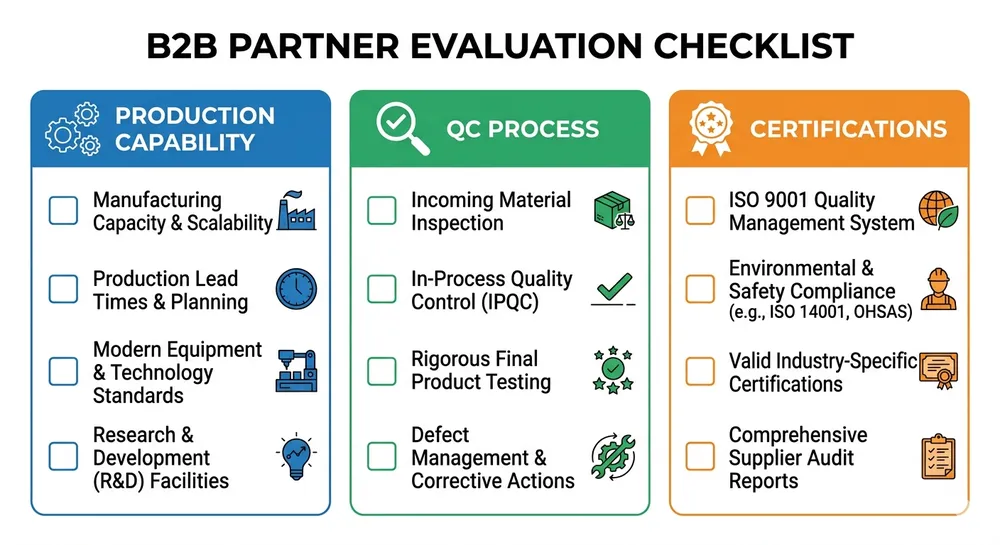
Knowing the standards is useful. Knowing how to verify that a supplier actually meets them is what protects your order. Here's what to check before you commit to a production run.
Production capability vs. claimed capability
Ask for a tolerance control record from a recent production run — not a spec sheet, but actual measurement data from finished units. A supplier who controls frame profile tolerances will have this data. A supplier who doesn't will offer you a spec sheet instead.
For print-based wall art, request a color consistency report showing ΔE measurements across a recent run. If the supplier can't produce this, their color consistency is managed by eye, which means it varies.
QC process at the unit level
100% visual inspection before shipment is the baseline for retail-grade wall art. Sampling inspection (AQL 2.5 or similar) is acceptable for commodity products but not for retail programs where a single defective unit on a shelf damages your brand with that retailer.
We run 100% visual inspection on all wall art orders — every unit is checked for surface defects, frame joint integrity, hardware placement, and packaging condition before it loads into the container. It's slower than sampling, but it's the only way to guarantee the defect rate your retail buyer expects.
Certifications and audit status
Verify that certifications are current, not expired. An ISO 9001 certificate from 2019 that hasn't been renewed tells you the supplier passed an audit once. A current certificate with a recent surveillance audit tells you the system is maintained.
For BSCI audits, check the audit grade. A "C" grade means corrective actions were required — ask what they were and whether they've been closed. A "B" or "A" grade means the factory passed without major findings.
You can review our Modern Wall Arts range to see how these standards translate into finished product specs, or browse the full Wall Arts by Style & Subject category for context on where modern wall art sits within the broader product range.

—
Speccing These Standards Into Your Purchase Order
Understanding the standards is the first step. Getting them into your PO in a way that's enforceable is where most buyers leave value on the table. Vague PO language like "high quality finish" gives a supplier no measurable target and gives you no grounds for rejection if the product doesn't meet your expectations.
Here's how to translate the standards above into PO language:
Dimensional tolerances: "Finished dimensions ±3mm from approved sample. Frame profile width ±0.5mm from approved sample."
Color consistency: "Color match to approved sample within ΔE 2.0 maximum. Supplier to provide color measurement report with shipment."
Packaging: "Double-wall corrugated, 32 ECT minimum. ISTA 2A drop test compliance required. UPC placement per [retailer] vendor guidelines."
Inspection: "100% visual inspection required. Pre-shipment inspection report (SGS or equivalent) required before container loading."
Certifications: "Supplier to provide current ISO 9001 certificate, BSCI audit report (grade B or above), and product test report with shipment documentation."
These aren't bureaucratic requirements — they're the language that makes your supplier accountable to the same standards your retail buyer will enforce when the container arrives.
If you're sourcing modern wall art for a specific retail program and want specs mapped to that channel's requirements, the most efficient path is to share your target retailer, design references, and volume with a supplier who already knows those programs. We've been through Walmart, Wayfair, and Amazon vendor onboarding multiple times — the compliance documentation, the packaging specs, the inspection requirements. If you're building a new program or switching suppliers, that experience shortens your timeline considerably.
For more on how we approach sourcing consistency, see our article on sourcing modern wall arts with clean finishes, or Request Quote with your channel requirements and we'll return a technical proposal with specs mapped to your retail partner's standards.
—
Frequently Asked Questions
What dimensional tolerance does Walmart require for framed wall art?
Walmart's planogram compliance requires finished dimensions within ±3mm of the approved spec. Frame profile width needs to hold within ±0.5mm when units are displayed side by side. Variance beyond these thresholds triggers planogram non-compliance chargebacks.
What print resolution is required for canvas wall art sold on Wayfair?
The practical minimum for retail-quality canvas prints is 150 DPI at final output size. For pieces larger than 24×36 inches, 200 DPI is recommended to maintain image quality at closer viewing distances. Wayfair's return data shows that image quality complaints spike on lower-resolution prints in larger formats.
Does modern wall art need BSCI certification to sell into US retail?
BSCI is required by Walmart and Target for factory social compliance verification. Amazon and Wayfair don't mandate BSCI specifically but may require equivalent social audit documentation during vendor onboarding. If you're targeting multiple retail channels, sourcing from a BSCI-certified factory covers the compliance requirement across all of them.
What's the difference between AQL sampling inspection and 100% visual inspection for wall art?
AQL 2.5 sampling means inspecting a statistically representative sample of units — typically 125 units from a 2,000-piece order. At AQL 2.5, you accept the lot if fewer than 8 defects are found in the sample. 100% inspection checks every unit. For retail programs where a single defective unit on a shelf creates a brand problem, 100% inspection is the appropriate standard. AQL sampling is acceptable for warehouse or project supply where individual unit presentation matters less.
How do I verify a supplier's color consistency claims before placing a bulk order?
Request a color measurement report from a recent production run showing ΔE values across the run. A supplier with real color control will have this data. Also request a production sample from the middle of a recent run — not just the first-off sample — to see whether color holds through the full production cycle. If the supplier can only provide a single approved sample with no run data, their color consistency is unverified.