The US home furnishing market doesn't move as one block. Bathroom mirror demand runs on renovation cycles and new construction. Living room mirrors track interior design trends and retail channel velocity. Bedroom mirrors follow housing turnover. If you're sourcing decorative mirrors for US distribution or retail placement, treating all room categories the same is how you end up with overstock in one SKU and backorders in another.
We ship to US distributors and retailers year-round. The reorder patterns we see across our room-specific lines tell a clearer story than most published market reports — because reorders reflect what's actually selling through, not what consumers say they want in a survey.
This breakdown covers where US demand is moving by room category in 2026, what's driving each shift, and what those signals mean for your inventory mix and sourcing decisions.

How US Housing and Renovation Cycles Drive Room-Specific Mirror Volume
Before getting into room-by-room numbers, it helps to understand what's actually moving the market at the macro level — because the same macro signal hits different room categories differently.
US housing starts have been running below historical averages since 2023, constrained by elevated mortgage rates. That suppresses new-construction-driven demand for full-room mirror packages. What it does instead is push spending into renovation: existing homeowners who aren't moving are upgrading in place. Bathroom remodels and living room refreshes are the two highest-frequency renovation categories, which is exactly why those two mirror segments are holding volume while some other home furnishing categories have softened.
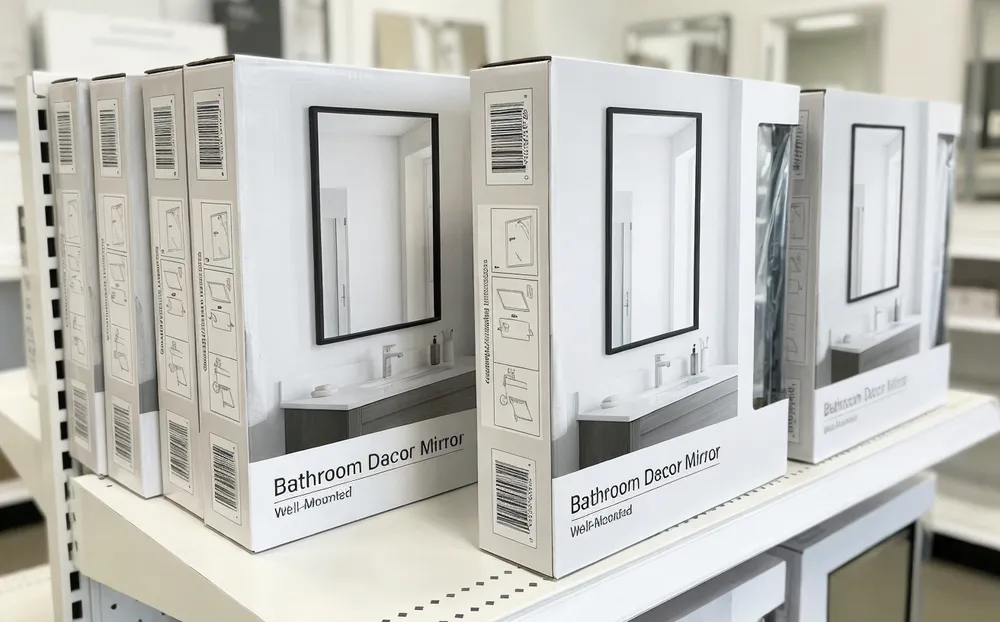
The other factor is the retail channel mix. Mass-market retailers (Walmart, Target) and online platforms (Wayfair, Amazon) now account for a larger share of decorative mirror sales than specialty home stores. That shift matters for sourcing because mass and online channels have different velocity profiles — faster turns, tighter margin tolerance, and stronger preference for SKUs that photograph well and ship flat. We've seen this directly in how our US buyers structure their POs: more emphasis on retail-ready packaging, more requests for KD (knock-down) configurations on larger frames, and more attention to carton drop-test compliance.
(We added a dedicated retail compliance review step to our QC process in 2022 specifically because of Wayfair and Amazon requirements — it's now standard on all North America-bound orders.)
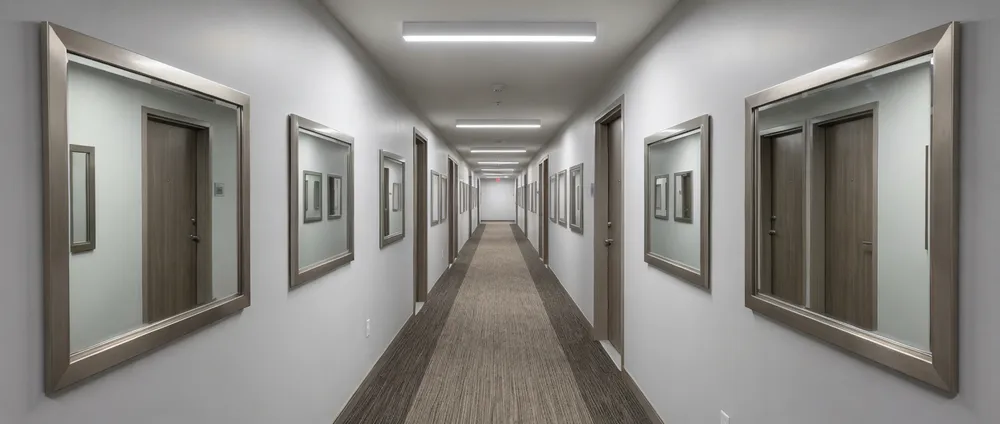
The third driver is the hospitality and multifamily sector. Hotel renovation cycles and apartment fit-out projects generate bulk mirror orders that don't show up in consumer trend surveys but are very real in wholesale volume. Bathroom and bedroom mirrors dominate this channel, with consistent spec requirements that make them ideal for repeat OEM programs.
Bathroom Mirrors: The Highest-Volume Room Category, Still Growing
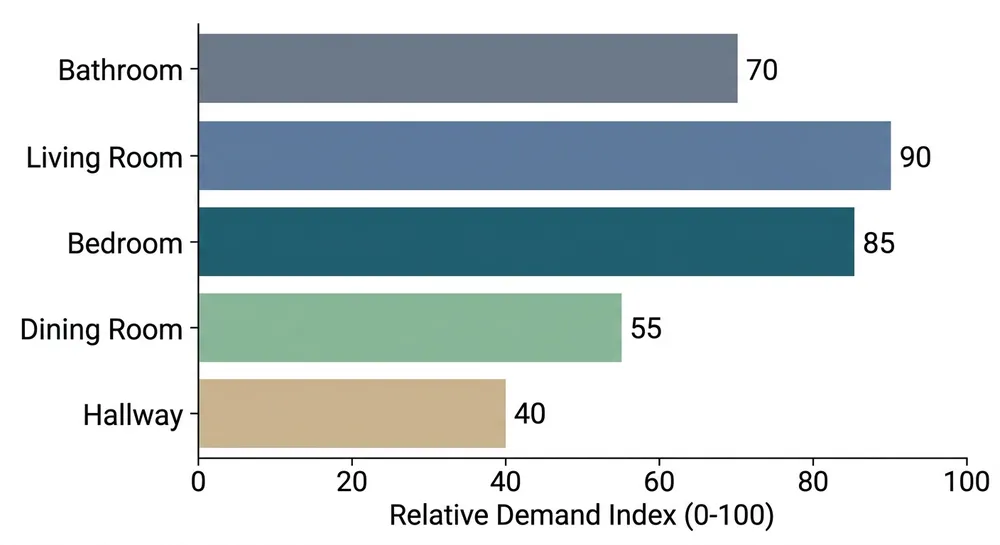
Bathroom mirrors are the single largest room category in US decorative mirror demand, and they've held that position for years. The reasons are structural: every bathroom needs at least one mirror, renovation frequency is high, and the category has expanded well beyond the basic frameless rectangle.
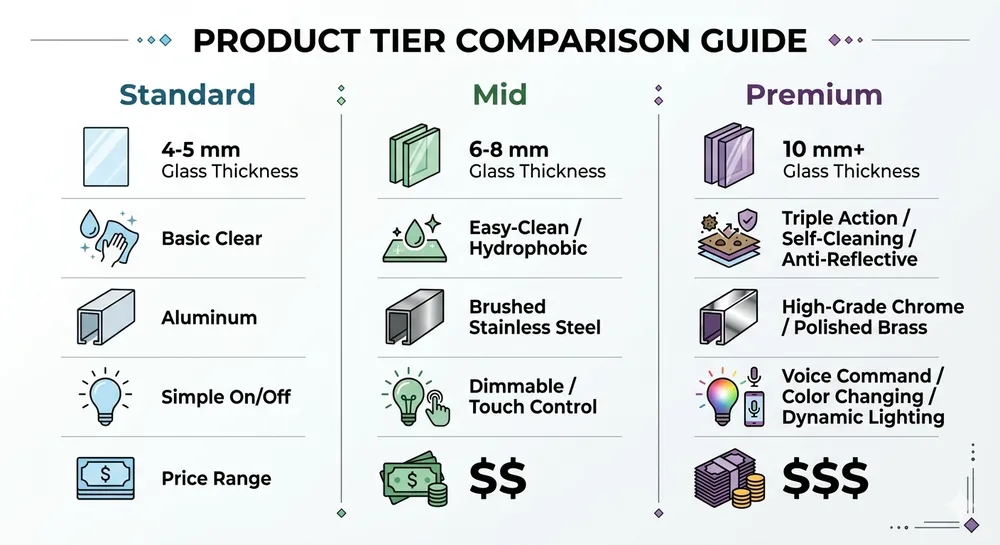
What's changed in 2026 is the spec profile of what's selling. Frameless LED backlit mirrors have moved from a premium niche to a mainstream SKU in the $80–$180 retail price band. Anti-fog coating is now a near-standard expectation in the mid-tier and above. Buyers who were sourcing plain silver-framed bathroom mirrors three years ago are now fielding customer demand for integrated lighting and moisture-resistant finishes.
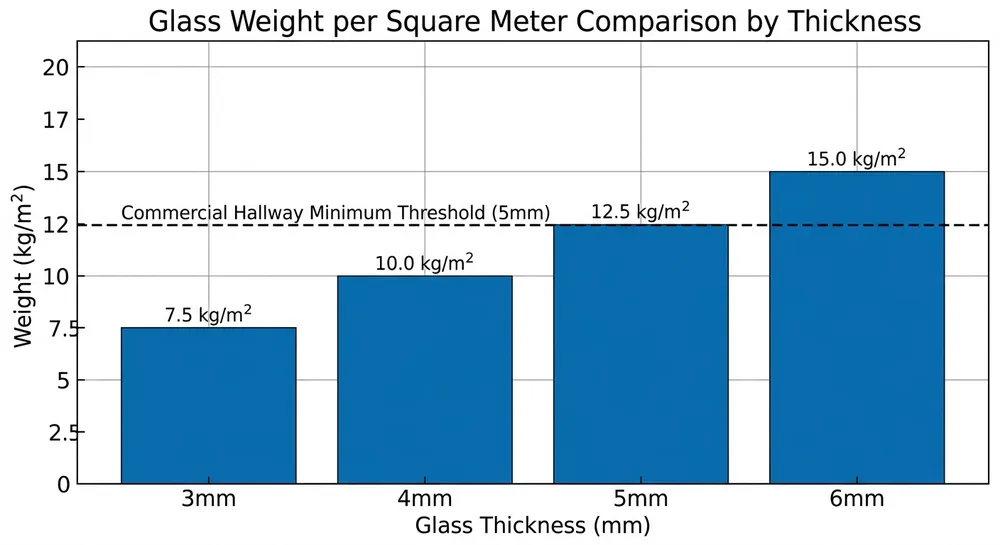
From a production standpoint, LED bathroom mirrors require a different supply chain than standard decorative mirrors — driver components, wiring harnesses, touch-switch integration. We run these on a dedicated line because mixing them with standard frame production creates scheduling conflicts. The glass spec also differs: bathroom mirrors typically use 5mm float glass with copper-free silver coating for moisture resistance, versus the 4mm glass common in living room decorative frames.
For wholesale buyers, the bathroom category offers strong reorder predictability. Renovation contractors and hospitality buyers tend to standardize on 2–3 SKUs and reorder consistently. The risk is over-speccing: buyers who chase every LED feature end up with a price point that doesn't move at retail. The sweet spot we see from US distributor reorders is a clean rectangular or arch-top mirror, 24"×36" or 30"×40", with anti-fog and basic LED backlight, retailing at $120–$160.
| Spec Parameter | Standard Tier | Mid Tier | Premium Tier |
|---|---|---|---|
| Glass thickness | 4mm | 5mm | 5mm |
| Silver coating | Standard | Copper-free | Copper-free |
| Frame | Aluminum or MDF | Aluminum | Frameless or metal |
| LED | None | Backlit | Backlit + dimmer + CCT |
| Anti-fog | No | Yes | Yes |
| Typical retail price | $40–$80 | $90–$160 | $180–$350 |
Explore our full bathroom decor mirrors range for current specs and MOQ options.
Living Room Mirrors: Design-Driven Demand with Strong Margin Potential
Living room mirrors are the second-largest category by volume and the highest-margin opportunity in the decorative mirror segment. The reason is simple: living room mirrors are bought for visual impact, not just function. That gives you room to work with frame design, finish, and size in ways that justify a higher price point.
The dominant trend in 2026 is oversized statement mirrors — arched, sunburst, and irregular organic shapes in the 40"–60" height range. These are driven by interior design content on social platforms, which has accelerated the adoption of design trends that previously took 3–5 years to move from editorial to mass retail. What was a boutique hotel lobby aesthetic in 2022 is now a mainstream Wayfair SKU in 2025.
Frame material preferences have shifted noticeably. Metal frames — brushed gold, matte black, antique brass — have taken share from painted MDF in the living room category. The shift reflects both aesthetic preference and a practical retail consideration: metal frames photograph better in online listings, which matters when 60%+ of decorative mirror sales happen through e-commerce channels.
We've seen this in our own order mix. Three years ago, roughly 70% of our living room mirror frames were MDF-based. Today it's closer to 50/50, and the metal frame orders tend to be larger because buyers are more confident in the sell-through. (The trade-off: metal frame tooling costs more upfront for custom profiles, so buyers who want proprietary designs need to plan for a higher NRE investment.)
For distributors building a living room mirror line, the SKU architecture that's working for our US buyers right now is: one entry-level rectangular metal frame in 24"×36", one arch-top statement piece in 30"×60" or 36"×60", and one decorative accent mirror (sunburst or organic shape) for the $80–$120 retail slot. That three-SKU structure covers the main price bands without over-fragmenting inventory.
See how living room decor mirrors are structured across our current product line, or read our deeper analysis of living room mirror trends for frame and finish specifics.
Bedroom Mirrors: Fastest-Growing Wholesale Reorder Category
Bedroom mirrors are where we've seen the sharpest increase in reorder frequency from US distributors over the past 18 months. The category was historically dominated by full-length floor mirrors and over-dresser styles, but the product mix has broadened considerably.
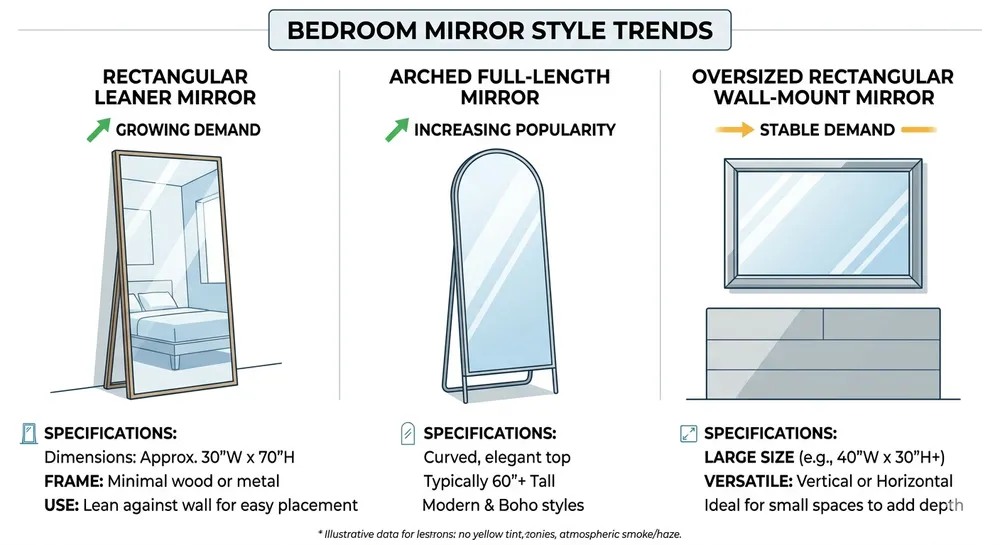
The growth is coming from two directions. First, the full-length leaner mirror has become a near-commodity SKU — every mass retailer carries one, and the price compression has been significant. That's pushed buyers toward differentiated bedroom mirror formats: arched full-length mirrors with decorative metal frames, wall-mounted full-length mirrors with integrated storage hooks, and oversized rectangular mirrors used as bedroom focal points rather than purely functional dressing mirrors.
Second, the multifamily and hospitality channel has increased bedroom mirror volume substantially. Apartment developers and hotel renovation projects specify bedroom mirrors in quantities of 50–500 units per project, with consistent specs and tight delivery windows. This is a different buyer profile than retail distribution — they care less about design trend and more about spec consistency, lead time reliability, and the ability to reorder the same SKU 12 months later without a spec change.
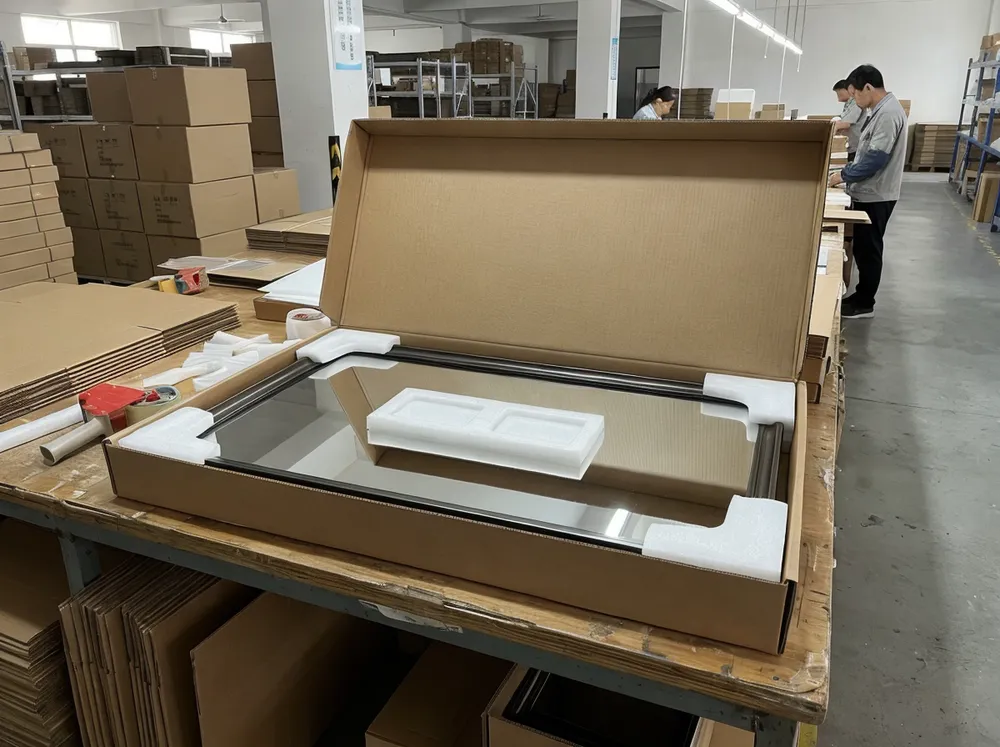
From a production standpoint, full-length bedroom mirrors (typically 16"×60" to 24"×72") require careful attention to glass handling and packaging. A 24"×72" mirror at 5mm glass weighs roughly 18–22 kg before framing — carton engineering matters a lot for damage rates in transit. We run a separate packaging validation for full-length mirrors because the failure mode (glass breakage in the last mile) is expensive for everyone.
The frame finish preferences in bedroom mirrors skew toward warmer tones than living room: natural wood, rattan-wrapped, and warm metal (gold, brass) outperform the matte black that dominates living room. This is worth noting if you're building a cross-room line — you can't always use the same frame finish across categories and expect consistent sell-through.
Explore bedroom decor mirrors for current sizing options and frame configurations.
Dining Room and Hallway Mirrors: Smaller Volume, Stronger Margin per Unit
Dining room and hallway mirrors don't move the same volume as bathroom or living room, but they punch above their weight on margin. These are typically statement pieces — large, decorative, often with ornate or architectural frames — where design differentiation justifies a higher price point and buyers aren't as price-sensitive as in the commodity bathroom segment.
Dining room mirrors in the US market tend to run large: 36"×48" and above is common, with rectangular and arched formats dominant. The frame aesthetic leans traditional to transitional — carved wood, antique gold, and aged silver finishes still sell well in this category, even as other room categories have moved toward contemporary metal. This is one area where MDF frame molding with decorative finish still has a clear commercial role, because the ornate profiles that work in dining rooms are difficult and expensive to execute in metal.
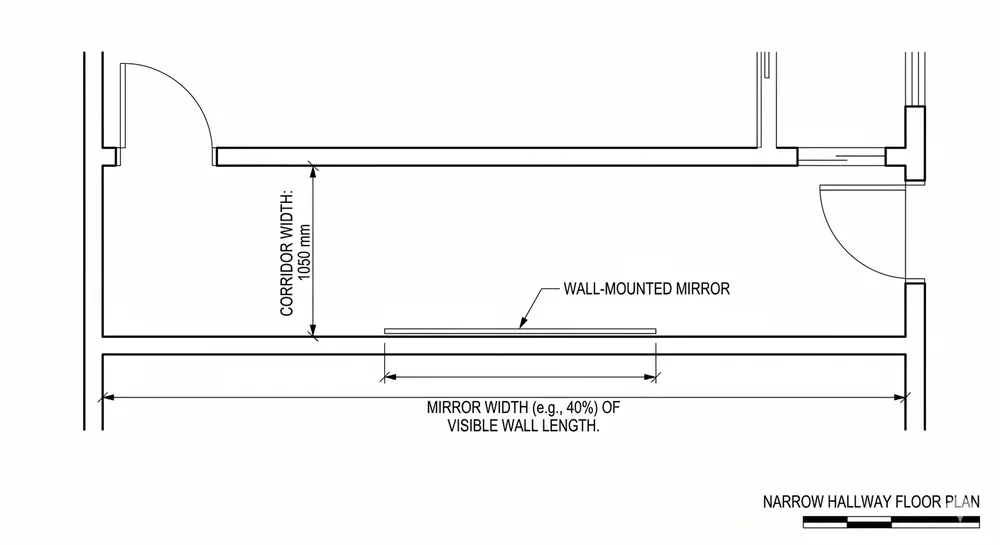
Hallway mirrors are a different use case. The primary format is tall and narrow — 14"×60" to 18"×72" — and the functional requirement (checking appearance before leaving the house) means full-length visibility matters. The design trend in hallway mirrors has moved toward entryway mirror-and-storage combinations, but pure decorative hallway mirrors with slim metal or wood frames remain a steady wholesale SKU.
For buyers building a multi-room mirror line, dining room and hallway SKUs are worth including not for volume but for average order value. A distributor who can offer a complete room-by-room mirror assortment to a hotel buyer or interior design trade account closes larger POs than one who only covers bathroom and bedroom.
Room-by-Room Demand Summary: Sourcing Signals for 2026
| Room Category | Demand Level | Growth Signal | Key Spec Shift | Primary Buyer Type |
|---|---|---|---|---|
| Bathroom | High | Steady | LED + anti-fog mainstream | Retail, hospitality, renovation |
| Living room | High | Growing | Metal frames, oversized formats | Retail, e-commerce |
| Bedroom | Medium-High | Fast growing | Arched/decorative full-length | Retail, multifamily, hospitality |
| Dining room | Medium | Stable | Large format, traditional frames | Trade, hospitality |
| Hallway | Medium | Stable | Slim full-length, entryway formats | Retail, trade |
The practical read for SKU planning: bathroom and living room justify deeper inventory and faster reorder cycles. Bedroom is worth expanding if you're not already covering the arched and decorative full-length formats. Dining room and hallway are margin contributors that round out a complete room-based assortment.
What Multi-Room Sourcing Actually Requires from a Supplier
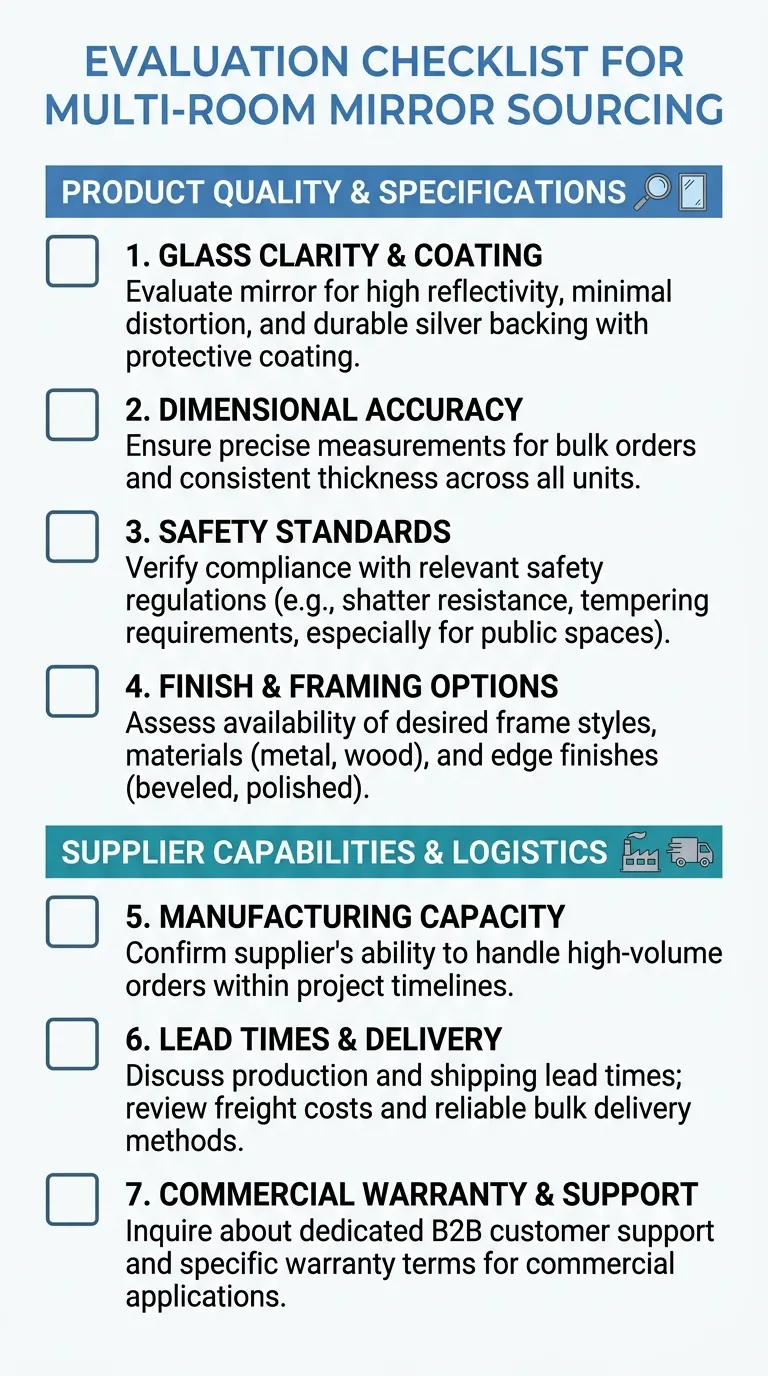
Sourcing mirrors across multiple room categories from a single supplier sounds straightforward. In practice, it requires a factory that can handle meaningfully different production specs under one roof — because a bathroom mirror and a living room mirror share almost nothing in the spec sheet beyond the glass itself.
Bathroom mirrors need moisture-resistant silver coating, often LED integration, and aluminum or frameless construction. Living room statement mirrors need decorative frame molding capability, metal fabrication for contemporary profiles, and packaging engineered for large-format pieces. Bedroom full-length mirrors need glass handling infrastructure for heavy panels and carton engineering for last-mile damage prevention. Dining room mirrors need ornate MDF molding capability and decorative finishing.
At Livewellcraft, we run 6 production lines across a 12,000 m² facility specifically because room-specific mirror programs require dedicated line capacity. We don't run bathroom LED mirrors on the same line as large decorative frames — the setup, materials, and QC checkpoints are different enough that mixing them creates quality risk. Our 12-person engineering team handles custom frame profile development across all room categories, so buyers building a multi-room line don't need to manage separate tooling conversations with separate suppliers.
Our 400,000-piece annual capacity means a buyer adding two or three new room categories to their existing program doesn't push us into allocation constraints. We've handled cross-room POs from US distributors that cover bathroom, living room, and bedroom SKUs in a single order — the logistics of coordinating specs, lead times, and container loading across categories is something we manage on our end, not something we hand back to the buyer to figure out.
(One thing we've learned from multi-room POs: the packaging spec review is where most problems surface. Different room categories have different carton requirements, and a buyer who approves specs category by category without a consolidated packaging review ends up with mixed carton sizes that complicate container loading. We now do a consolidated packaging review for any PO covering three or more room categories.)
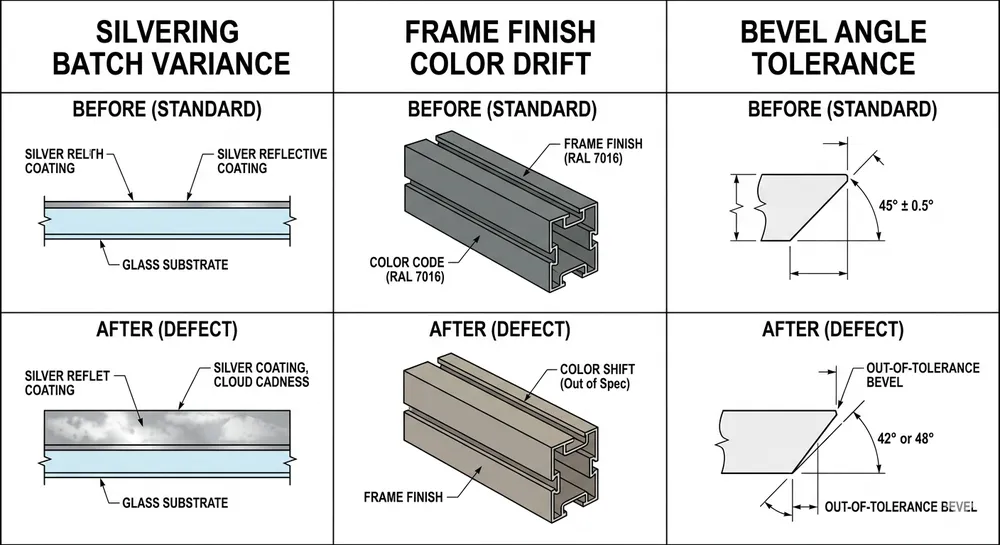
For buyers evaluating whether to consolidate room-specific mirror sourcing with a single factory, the questions worth asking are: Does the factory have dedicated line capacity for each room category, or does it run everything on shared lines? Does it have in-house glass processing (cutting, silvering, beveling) or does it outsource? Can it show you QC records by room category, not just aggregate pass rates?
We hold ISO 9001:2015 certification with SGS and BSCI audit records available on request — and we can provide room-category-specific QC data for buyers who want to verify consistency across their full assortment.
Translating Trend Data into SKU Decisions
Market trend data is only useful if it connects to a specific sourcing action. Here's how the 2026 demand signals translate into practical SKU planning decisions:
Bathroom: If your current bathroom mirror line is still anchored in plain aluminum-frame rectangles without LED or anti-fog, you're behind the mid-tier demand curve. Adding one LED anti-fog SKU in the 24"×36" or 30"×40" format is the minimum move. MOQ on standard LED bathroom mirrors starts at 100 pieces for our catalog specs; custom sizing or finish requires 200+ pieces.
Living room: The oversized arch trend has legs — it's moved from boutique to mass retail and is still growing. If you don't have an arch-top mirror in the 30"×60" or 36"×60" range with a metal frame option, that's a gap worth filling. Metal frame tooling for a custom profile runs 4–8 weeks for sample development; plan accordingly if you want a proprietary design rather than a catalog spec.
Bedroom: The arched full-length format is the clearest growth opportunity in this category. A 24"×60" or 28"×65" arched mirror with a brushed gold or natural wood frame covers the segment that's growing fastest. Full-length mirrors require a packaging review before finalizing the order — we flag this for every new buyer because it's where damage claims originate.
Dining room / hallway: These categories reward buyers who can offer something beyond the commodity rectangle. An ornate carved-frame dining mirror in the 36"×48" range, or a slim entryway mirror with a shelf or hook detail, gives you a differentiated SKU that holds margin better than a plain frame equivalent.
For a complete view of how sizing and spec requirements vary by room, the room mirror sizing guide covers the practical dimensions in detail.
Frequently Asked Questions
Which room mirror category has the highest reorder frequency from US wholesale buyers?
Bathroom mirrors reorder most frequently, driven by renovation project cycles and hospitality fit-outs. Living room mirrors have higher per-unit value but slightly longer reorder cycles because they're more design-trend-dependent. Bedroom full-length mirrors are the fastest-growing reorder category right now, particularly arched formats.
What minimum order quantities apply to room-specific mirror programs?
For standard catalog specs, MOQ starts at 100 pieces per SKU. Custom sizing, proprietary frame profiles, or private-label packaging typically requires 200–500 pieces depending on the complexity of the customization. Multi-room POs that combine bathroom, living room, and bedroom SKUs can often be structured to meet MOQ thresholds across categories without requiring 100+ pieces of every individual SKU — worth discussing during the RFQ stage.
How do frame material preferences differ across room categories?
Bathroom: aluminum and frameless dominate, with some brushed nickel and matte black metal. Living room: metal frames (brushed gold, matte black, antique brass) are growing fastest. Bedroom: warm tones — natural wood, rattan, warm metal — outperform the cooler finishes that work in living rooms. Dining room: MDF with decorative finish (carved, antique gold, aged silver) still holds a clear position. Hallway: slim metal or wood frames, minimal ornamentation.
What's the lead time for a multi-room mirror order covering three or more categories?
Standard catalog specs across multiple room categories: 35–45 days after sample approval and deposit. Custom frame profiles or finishes add 2–3 weeks for tooling and sample development before production begins. We recommend buyers planning a multi-room launch allow 60–75 days from PO to container loading for first-time custom orders.
How do I verify that a supplier's quality is consistent across room categories, not just in one product line?
Request QC records by product category, not just aggregate factory pass rates. Ask specifically for silver coating adhesion test results (relevant for bathroom mirrors) and carton drop-test records (relevant for full-length bedroom and living room mirrors). A factory that can provide category-specific QC data is one that actually runs category-specific inspection — not one that applies the same checklist to every product type.
—
Browse the full Decor Mirrors by Room range to see how our room-specific lines are structured, or Request Quote with your target room categories and volume estimates — we'll respond within 48 hours with pricing matched to current production schedules.