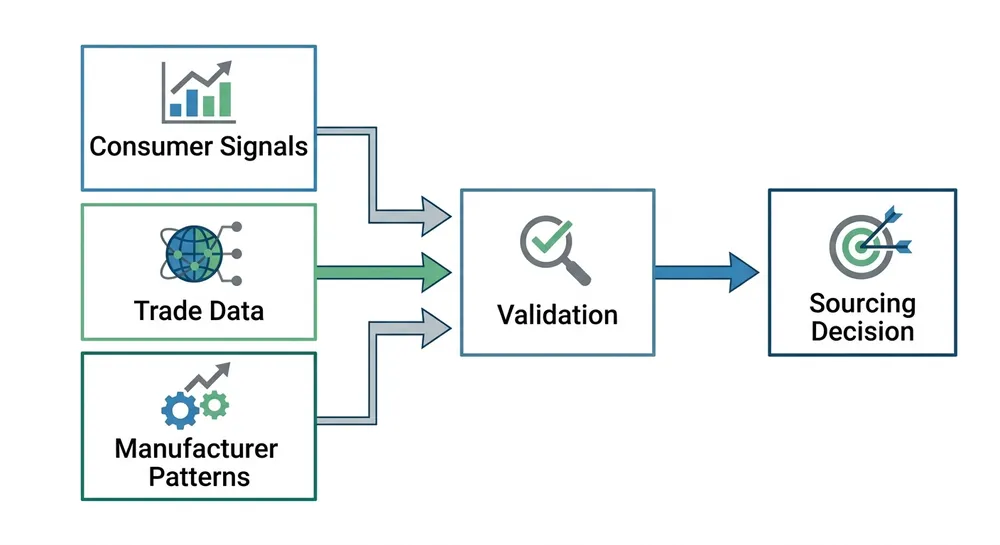
Most buyers I talk to discover a trending wall art subject about six months too late. By the time a subject shows up in a trade publication roundup or a competitor's catalog, the early-margin window is already closing. The buyers who consistently get there first aren't guessing — they're reading a specific set of signals, validating fast with small runs, and committing to volume only after the data confirms demand.
I've spent 12 years at Livewellcraft watching which subjects gain traction across US retail, European e-commerce, and hospitality procurement. Some of what I've seen is counterintuitive. A subject can go viral on Pinterest and completely stall at wholesale. Another subject barely registers on social platforms but moves 3,000 units a quarter for a mid-size distributor in the Midwest. The difference is almost always in how the buyer read the signal — and whether they tested before scaling.
This guide walks through the full process: where to find reliable trend signals, how to validate them before committing to a production run, and how to match a trending subject to production specs that actually hold up at volume.
Why late trend entry costs more than a missed sale
Entering a subject category six months after peak demand doesn't just mean lower sell-through. It means you've committed MOQ to a subject that's already being discounted by early movers, your retail buyer is negotiating harder because they've seen the category soften, and you're holding inventory that competes on price rather than novelty.
We see this pattern regularly with nature wall art. A subject like "botanical line drawings" will spike on Etsy, get picked up by a few fast-moving importers, and within two seasons it's a commodity subject with three factories undercutting each other on price. The buyers who entered at the signal stage — not the saturation stage — captured the margin. The late arrivals fought over what was left.
The cost of getting it wrong isn't just the unsold inventory. It's the opportunity cost of the production capacity you locked up on a declining subject instead of the next rising one.
The four signal layers worth monitoring
Not all trend signals carry equal weight for B2B sourcing decisions. Here's how I rank them by reliability and lead time.
Layer 1 — Consumer search volume (Google Trends)
Google Trends is free and underused by wholesale buyers. Search for the subject term plus "wall art" or "wall decor" — "botanical wall art," "abstract landscape wall art," "graffiti wall decor" — and look at the 12-month trajectory, not the current spike. A subject with a steady 6-month climb is more actionable than a single viral week.
Set up comparison views between subjects you're already carrying and subjects you're evaluating. If "nature wall art" is flat and "abstract wall art" is climbing at a consistent angle, that's a sourcing signal worth acting on. (I check this every quarter for the categories we produce — it's a 20-minute exercise that's saved us from overproducing the wrong subjects more than once.)
Layer 2 — Retailer bestseller and trending lists
Amazon's "Movers & Shakers" in the Home & Kitchen category, Wayfair's trending sections, and Target's online bestseller lists are real sell-through data, not aspirational forecasts. When a subject appears in multiple retailer trending lists simultaneously, it's already validated at consumer level — your job is to get ahead of the next reorder cycle.
Check these lists monthly. When you see a subject climbing across two or more major retailers at the same time, that's a 3-6 month window before wholesale demand peaks.
Layer 3 — Trade show order patterns
High Point Market, Las Vegas Market, and Ambiente Frankfurt are where retail buyers commit budgets. The subjects that get the most booth traffic and the most written orders at these shows are the ones that will drive wholesale reorders 6-12 months later. If you can't attend, the show recap reports from trade publications like Furniture Today and Home Accents Today are the next best thing.
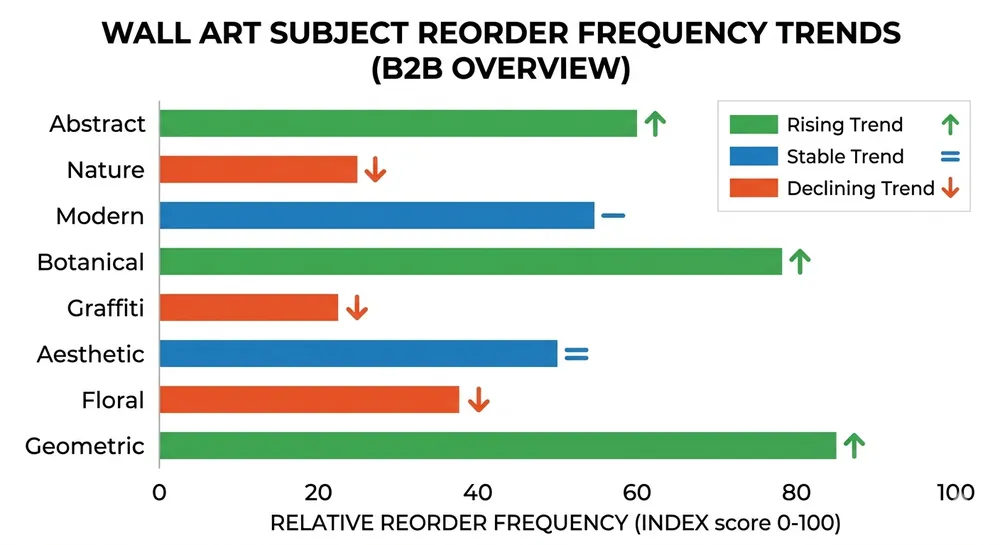
We track which subject categories generate the most sample requests at trade shows. Abstract and modern subjects have been consistently strong for three years running in North American shows. Nature subjects — particularly botanicals and organic forms — have been gaining ground in European markets.
Layer 4 — Manufacturer order data
This is the signal layer most buyers don't have direct access to, but it's the most reliable. When a factory starts seeing repeat reorders on a specific subject from multiple independent buyers across different markets, that's genuine demand confirmation — not a trend forecast.
At Livewellcraft, we produce across 9 subject categories: modern wall arts, abstract wall arts, nature wall arts, aesthetic wall arts, and five others including flower, tree, graffiti, creative, and unique styles. After 18 years of OEM/ODM orders across North America, Europe, Australia, and the Middle East, we have a clear picture of which subjects are gaining reorder frequency and which are plateauing. When you're evaluating a new subject, ask your manufacturer directly: "Are you seeing repeat orders on this subject from other buyers?" A factory that's honest with you about order patterns is worth more than a trend report.
From signal to sample: the validation process
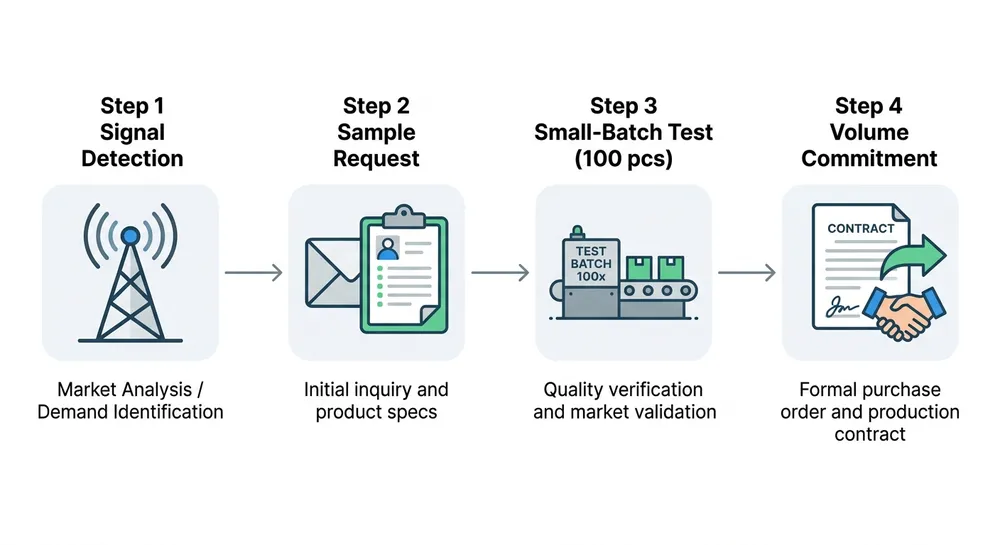
Spotting a trend signal is step one. The mistake most buyers make is jumping from signal directly to a volume order. The right sequence is: signal → sample → small batch → volume commitment.
Step 1 — Shortlist 2-3 subjects showing signals across at least two layers
Don't chase a subject that's only trending on one platform. If "graffiti wall art" is climbing on Google Trends but absent from retailer bestseller lists and trade show reports, it may be a niche aesthetic movement rather than a commercial opportunity. Wait for confirmation across layers.
Step 2 — Request samples across subject variations
Within a trending subject, there are usually 3-5 distinct visual treatments. "Abstract wall art" can mean geometric abstraction, fluid pour-style compositions, minimalist line work, or bold color-field pieces. Each treatment has a different buyer demographic and price point. Sample across the variations before deciding which to scale.
At Livewellcraft, standard sample lead time is 7-10 days for existing subject categories. For a new subject treatment that requires custom frame profiles or finish development, allow 2-3 weeks. (We can often run samples for multiple subject variations in parallel if you give us the full shortlist upfront — worth asking.)
Step 3 — Test with a 100-piece minimum order
Our standard MOQ starts at 100 pieces for most subject categories. That's a deliberate choice — it lets buyers test a trending subject with a real retail placement before committing to container quantities. A 100-piece run on a new subject costs you a fraction of a full order and gives you actual sell-through data within 60-90 days.
The buyers who use this approach consistently are the ones who build product lines rather than chase individual trends. They test 3 subjects at 100 pieces each, identify the one with the best sell-through, and scale that subject to 500-1,000 pieces on the next order.
Step 4 — Validate regional demand before scaling
A subject trending in US retail doesn't automatically translate to European or Middle Eastern markets. We've seen abstract geometric subjects perform strongly in Scandinavian retail while the same designs underperform in Gulf hospitality projects, where buyers prefer organic and nature-inspired subjects. Before scaling a subject to your full distribution network, confirm demand in each regional channel separately.

Matching a trending subject to production specs
A subject that trends commercially needs to be producible at scale without quality drift. This is where a lot of buyers run into problems — they identify a trending subject, place a volume order, and discover mid-production that the finish or frame profile doesn't hold consistency across 500+ units.
The subjects that scale cleanly share a few characteristics:
Frame profile compatibility. Some subject treatments work best in thin, minimal frames (common in modern and abstract categories). Others need deeper, more substantial frames to carry the visual weight (typical in nature and botanical subjects). If the frame profile you're ordering doesn't match the visual weight of the subject, the finished piece looks wrong — and your retail buyer notices. We develop custom frame profiles in-house with our 12-person engineering team, so we can match the profile to the subject treatment rather than forcing the subject into a standard frame.
Finish durability by subject category. High-contrast abstract subjects with bold color fields are more demanding on print consistency than softer nature subjects. A 5% color shift across a 500-piece run is invisible on a muted botanical print and obvious on a high-contrast geometric abstract. Specify your acceptable color tolerance upfront — we run 100% visual inspection before shipment, but knowing your tolerance threshold lets us set the right QC checkpoint during production rather than at final inspection.
Size range and container efficiency. Trending subjects often get requested in multiple sizes simultaneously. A subject that works at 24"×36" may not translate well to 12"×16" without redesigning the composition. Plan your size range before production, not after — it affects both the visual outcome and your container loading efficiency. We can advise on which size combinations load most efficiently for your target market's standard container configurations.
Common mistakes that cost buyers margin
These are the patterns I see repeatedly. They're all avoidable.
Chasing viral without checking wholesale velocity. A subject with 2 million Pinterest saves doesn't automatically have wholesale demand. Pinterest engagement skews toward aspiration, not purchase intent. Cross-reference with actual retailer sell-through data before ordering.
Over-ordering an unvalidated subject. The pressure to hit a lower per-unit price by ordering 500 pieces instead of 100 is real, but it's the wrong calculation when the subject is unvalidated. The per-unit savings disappear fast if sell-through is 40% instead of 80%. Start at 100 pieces, validate, then scale.
Ignoring regional demand differences. A subject trending in one export market may be flat or declining in another. If you distribute across multiple regions, validate each channel before committing to a single large production run that covers all markets.
Skipping the production feasibility check. Some trending subjects involve complex compositions, unusual aspect ratios, or finish requirements that add cost or reduce consistency at scale. Before you commit to a subject, ask your manufacturer: "What's the production complexity on this, and where does quality risk increase at volume?" A factory that answers that question honestly is telling you something useful.
Locking in volume before the sample is approved. We see this occasionally when buyers are under time pressure. The sample approval step exists to catch color drift, frame fit issues, and finish inconsistencies before they multiply across 500 units. Skipping it to save a week almost always costs more time in rework or reshipment.
How small-batch testing protects your sourcing position
The 100-piece MOQ isn't just a minimum — it's a risk management tool. Here's how the buyers who use it most effectively structure their testing:
- Test 2-3 subjects simultaneously rather than sequentially. If you test one subject at a time, you're 6 months behind by the time you've validated three. Run parallel small batches and let sell-through data pick the winner.
- Use the test run to qualify the supplier, not just the subject. A 100-piece order tells you about color consistency, packaging quality, lead time reliability, and communication responsiveness. All of that matters more at 1,000 pieces than at 100.
- Set a sell-through threshold before you order. Decide in advance: if this subject hits 70% sell-through in 60 days, we scale. If it doesn't, we don't. Having that threshold set before the order ships removes the emotional decision-making when the data comes in.
We've had buyers come back with reorders on subjects we both thought were marginal — the sell-through data surprised us. We've also had buyers wisely walk away from subjects that looked strong on trend signals but didn't convert at retail. The small-batch test is the only way to know which situation you're in.
Sourcing across multiple trending subjects from one facility
One practical advantage of working with a manufacturer that covers multiple subject categories is that you can test across subjects without managing multiple supplier relationships. When you're running parallel small-batch tests on abstract, nature, and graffiti subjects simultaneously, having all three produced at the same facility means consistent quality standards, a single point of contact for production updates, and simpler logistics.
Our Wall Arts by Style & Subject range covers 9 categories from one 12,000 m² facility in Vietnam. If you're testing three subjects at 100 pieces each, that's a single production order, a single QC process, and a single shipment. The alternative — sourcing each subject from a different factory — multiplies your coordination overhead and makes it harder to compare quality consistently across subjects.
This matters more than it sounds when you're trying to move fast on a trend window. Every additional supplier relationship adds lead time, communication overhead, and quality variability. Consolidating subject testing at one facility is a supply chain efficiency decision, not just a convenience.
FAQ
What's the fastest way to confirm whether a trending subject has real wholesale demand?
Check retailer bestseller lists (Amazon Movers & Shakers, Wayfair trending) and ask your manufacturer directly about reorder frequency on that subject. If a subject is trending on consumer platforms but your manufacturer isn't seeing repeat orders from multiple buyers, it may not have crossed into wholesale demand yet. Wait for both signals before committing to volume.
How do I know if a trending subject will hold quality consistency at scale?
Ask for a production sample at the exact size and finish you plan to order, then request a second sample from a different production batch. Color and finish consistency between two separate production runs tells you more about scale reliability than a single perfect sample. If the two samples match within your acceptable tolerance, the subject is producible at volume.
Can I test multiple trending subjects in one order?
Yes — and it's the most efficient way to validate. At Livewellcraft, you can combine multiple subject categories in a single order at 100 pieces per subject. One order, one shipment, parallel sell-through data across subjects. Most buyers who use this approach identify their strongest subject within one selling season and scale from there.
What wall art subjects are currently gaining traction in wholesale?
Abstract and modern subjects have shown consistent reorder growth in North American and European wholesale channels over the past two years. Nature subjects — particularly organic forms and botanical treatments — are gaining ground in European retail and hospitality. Graffiti and creative subjects are a smaller but growing segment in urban retail and specialty channels. These are patterns from our own order data, not forecasts — actual demand in your specific market and channel may differ, which is why the small-batch test matters.
What's the minimum order to test a new subject at Livewellcraft?
100 pieces for standard subject categories. For custom frame profiles or finish development on a new subject treatment, the MOQ may be higher depending on the tooling involved. Request a quote with your subject shortlist and target quantities and we'll confirm the MOQ and lead time for each.