Small-batch wall art orders go wrong in a predictable way. A buyer sends over a design, gets a quote for 100 pieces, and the per-unit price is nearly double what they expected. They push back, the factory explains "setup costs," and the conversation stalls. The buyer either overpays, over-orders to hit a lower price tier, or walks away and tries a different supplier — only to hit the same wall.
The problem isn't the factory. The problem is that most buyers don't know which cost components are fixed and which scale with volume. Once you understand that, you can structure your order to absorb fixed costs efficiently — and get to a viable per-unit price without committing to 500 pieces you don't need yet.
We've been running small-batch Unique Wall Arts orders since before "low MOQ" became a marketing phrase. Here's how the math actually works, and what to do about it.
What Actually Makes Small Orders Expensive Per Unit
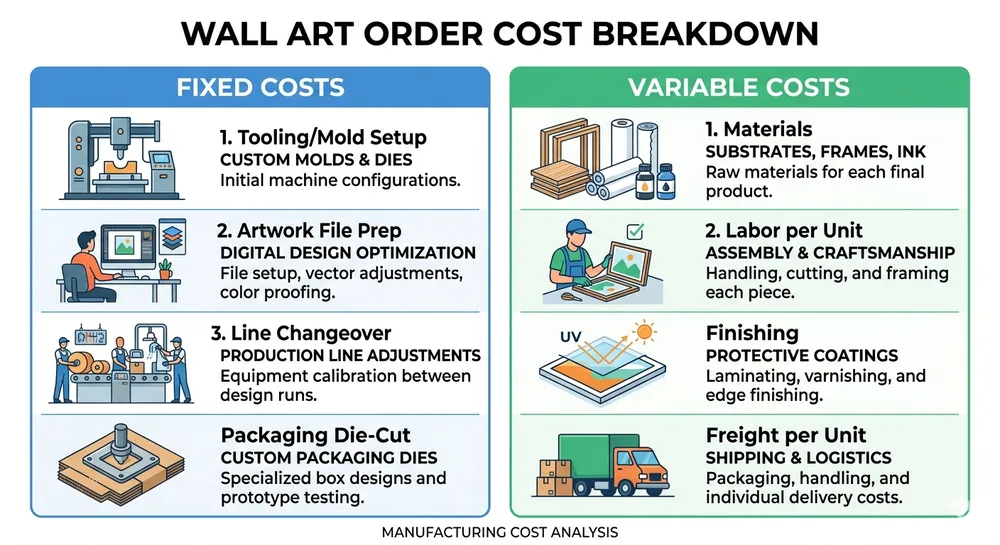
Three cost components don't move when your quantity drops. They sit on top of every order regardless of whether you're buying 50 pieces or 500.
Tooling and mold amortization. If your design requires a custom frame profile, resin cast shape, or die-cut mat, the mold or die costs the same to make whether it runs 50 units or 5,000. On a 500-piece order, that $800 mold adds $1.60 per unit. On a 50-piece order, it adds $16.00. That's the entire story behind "small orders cost more."
Line setup and changeover. Every time a production line switches to a new SKU — new frame profile, new finish color, new glass size — there's a setup window where the line isn't producing. That dead time gets priced into your order. At high volumes, it's a rounding error. At 100 pieces, it can add $3–6 per unit depending on the process.
Artwork and pre-production preparation. Digital print files need color profiling and test prints. Hand-finishing samples need approval rounds. Packaging artwork needs dieline setup. These are flat fees that don't scale. A $200 artwork prep charge on a 200-piece order is $1 per unit. On a 50-piece order, it's $4.
The variable costs — materials, labor, finishing consumables — do scale with quantity, but they're usually not where the gap is. When a buyer sees a 40% price difference between 100 and 500 pieces, the fixed costs are almost always the explanation.
Which Production Methods Scale Down Most Cost-Effectively
Not all wall art production methods behave the same at low volumes. The right method for your design can cut per-unit cost significantly at 100–200 pieces.
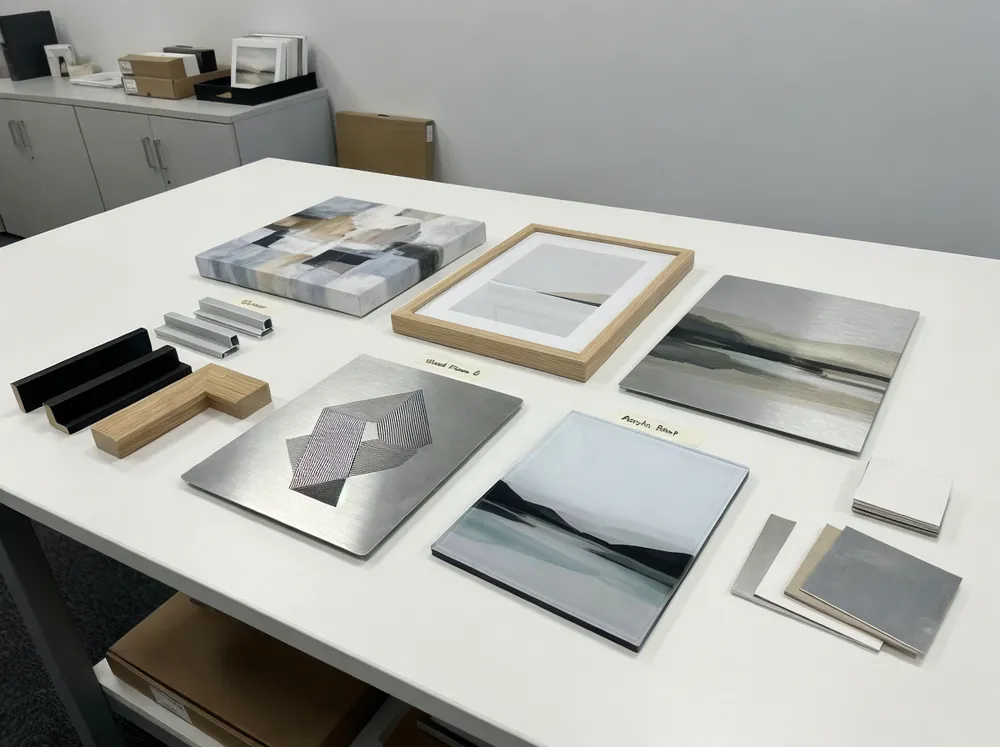
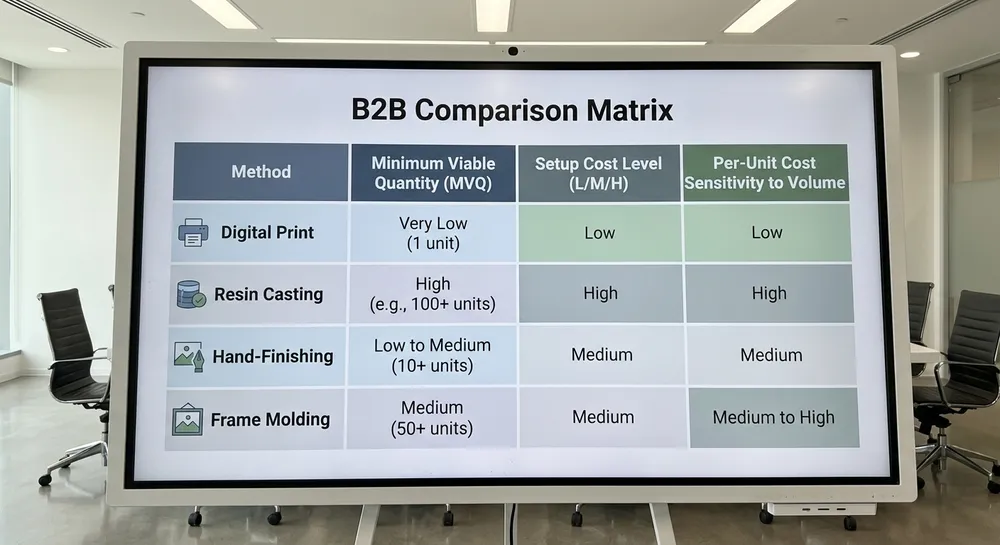
Digital printing on substrate is the most small-batch-friendly method. There's no plate, no screen, no mold. The setup cost is essentially the file prep and a test print. We can run 50 digitally printed canvas or aluminum panel pieces with the same per-unit economics as 300, minus a small color-calibration charge. If your design is graphic, photographic, or pattern-based, this is where to start.
Resin casting and 3D-textured finishes are the opposite. The mold is the cost. A resin-cast wall art piece with a custom relief texture requires a silicone or polyurethane mold that typically runs $400–900 depending on complexity. Below 150–200 pieces, that mold cost dominates the per-unit price. Above 300 pieces, it amortizes to a manageable level. If you want a resin-textured design at low volume, the practical move is to use an existing mold with a custom colorway — not a new mold.
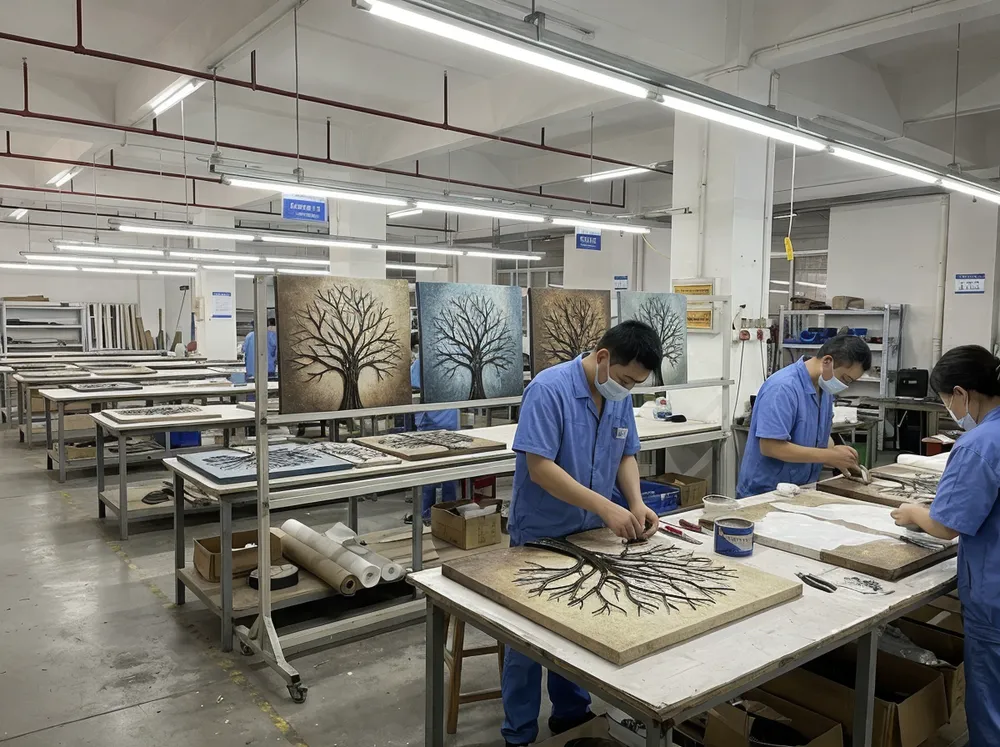
Hand-finishing and mixed-media (applied foil, hand-painted accents, fabric inlay) sits in the middle. Labor is the main cost, and labor does scale with quantity — but not as steeply as tooling. A 100-piece hand-finished order is viable; a 30-piece order usually isn't worth the production scheduling overhead for either side.
Frame molding is where in-house production makes a real difference. When a factory subcontracts frame molding, there's a minimum order from the molding supplier — often 200–300 linear meters — that gets passed to you as a hidden floor. We run our own frame molding line, so a 100-piece order doesn't trigger a subcontractor minimum. That's a cost that disappears when you source from a vertically integrated factory.

How to Structure Your Order to Absorb Fixed Costs
The buyers who get the best per-unit pricing on small batches aren't necessarily ordering more — they're ordering smarter. Three approaches consistently work.
Consolidate SKUs onto shared tooling. If you're planning three abstract wall art designs in the same frame profile and size, run them as one tooling setup. The mold gets made once, the line gets set up once, and each design runs sequentially. We do this regularly for buyers building out a style collection — four or five designs, same frame, different artwork. The setup cost spreads across the full combined quantity, and each individual SKU can be as low as 50–80 pieces.
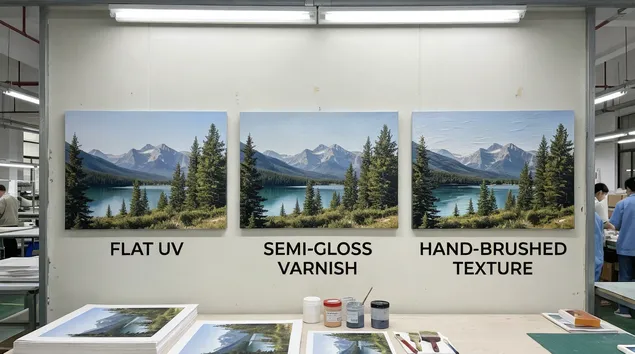
Use standard molds with custom finishes. We have existing molds for a range of frame profiles — arched tops, beveled edges, layered shadow-box frames. If your design can work within one of those profiles, you skip the tooling cost entirely. The customization comes through finish: paint color, metallic foil, distressed texture, antiqued patina. Finish changes cost a fraction of new tooling. (This is the approach most of our retail program buyers use when they're testing a new style before committing to a custom profile.)
Combine your small-batch order with a reorder of a proven SKU. If you already have a running product with us, adding a new small-batch design to the same production run shares the container, the QC inspection, and the freight. The new design's fixed costs stay the same, but your landed cost per unit drops because you're not paying solo freight on 100 pieces.
Step-by-Step: How to Place a Small-Batch Order with a Manufacturer
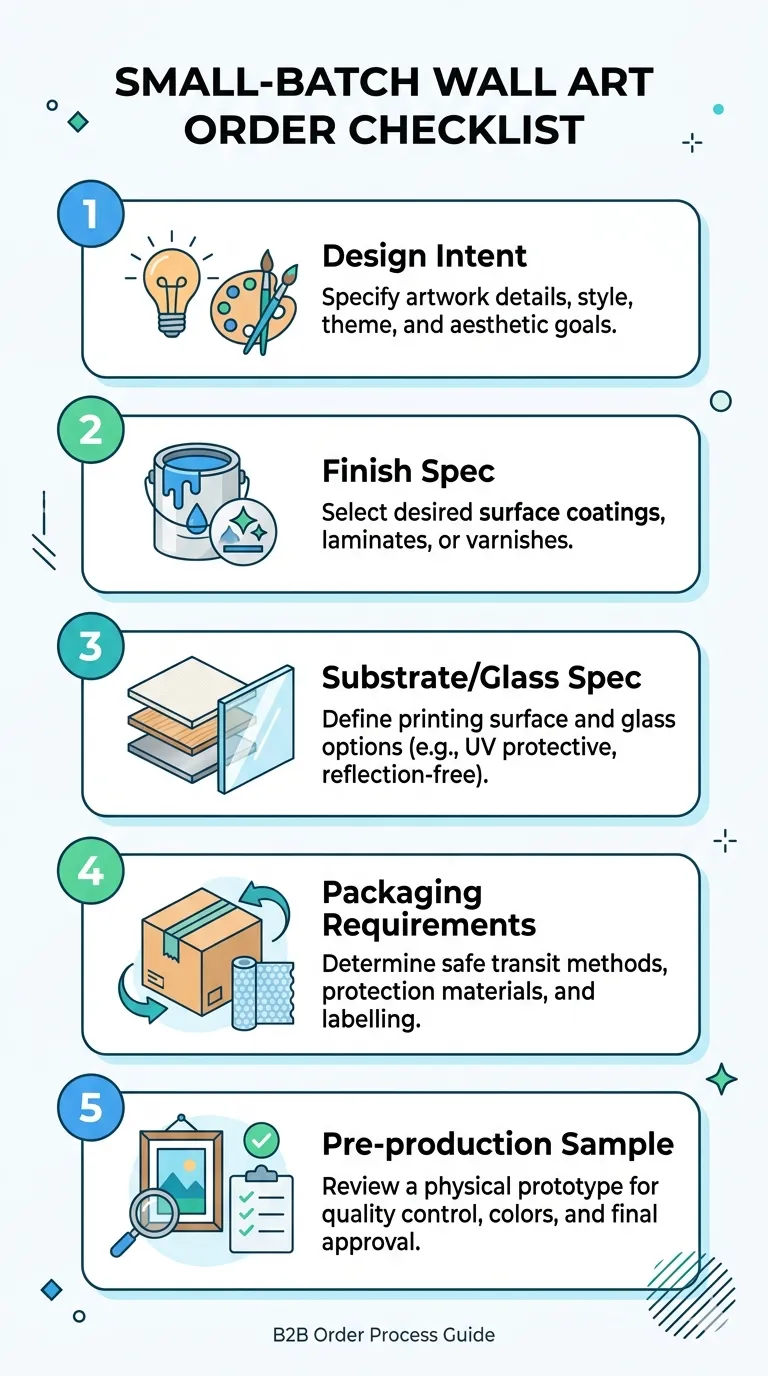
Underspecified orders are the single biggest source of cost surprises on small batches. When a factory has to chase down missing information, they quote with a buffer. Here's what to have ready before you send an inquiry.
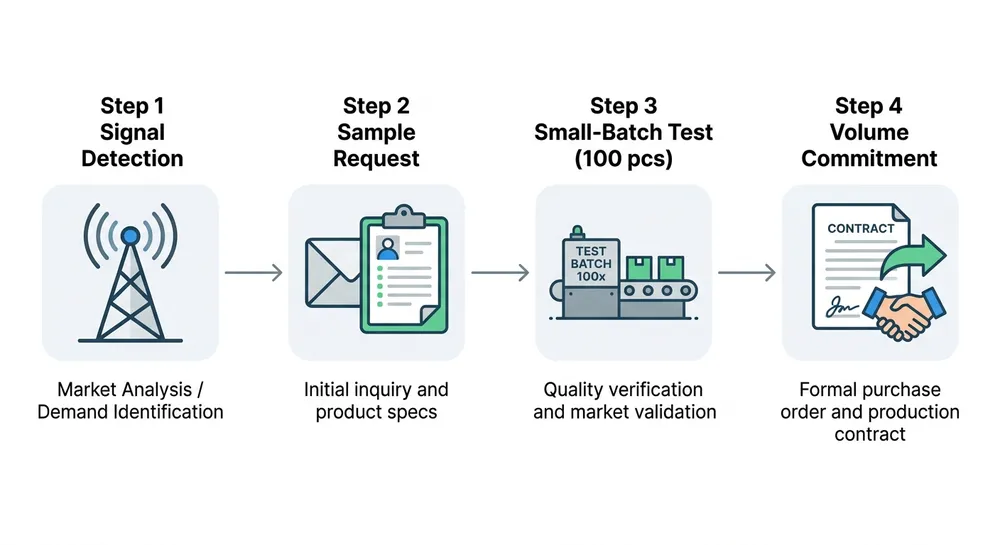
Step 1 — Define your design intent, not just your design. Send reference images, mood boards, or sketches. But also tell the factory what the design needs to do commercially: what retail price point you're targeting, what market segment it's for, whether it needs to coordinate with existing SKUs. That context lets an experienced OEM team suggest production methods and existing tooling that fit your budget — instead of quoting the most literal interpretation of your file.
Step 2 — Specify finish requirements completely. "Gold frame" is not a finish spec. Specify: base material (MDF, solid wood, metal), finish type (spray paint, powder coat, electroplating, foil wrap), sheen level (matte, satin, gloss), and any aging or distressing effect. Incomplete finish specs get quoted at the safest (most expensive) interpretation.
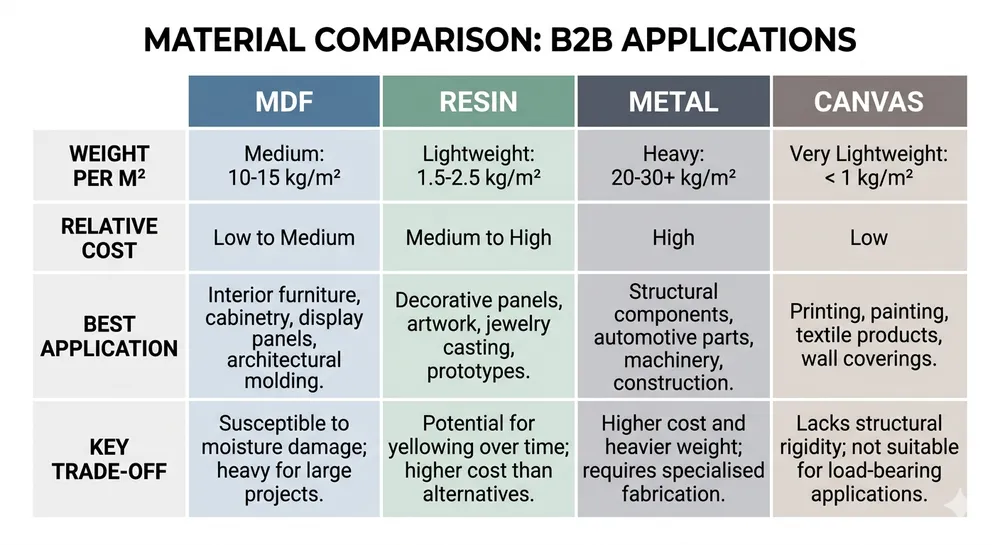
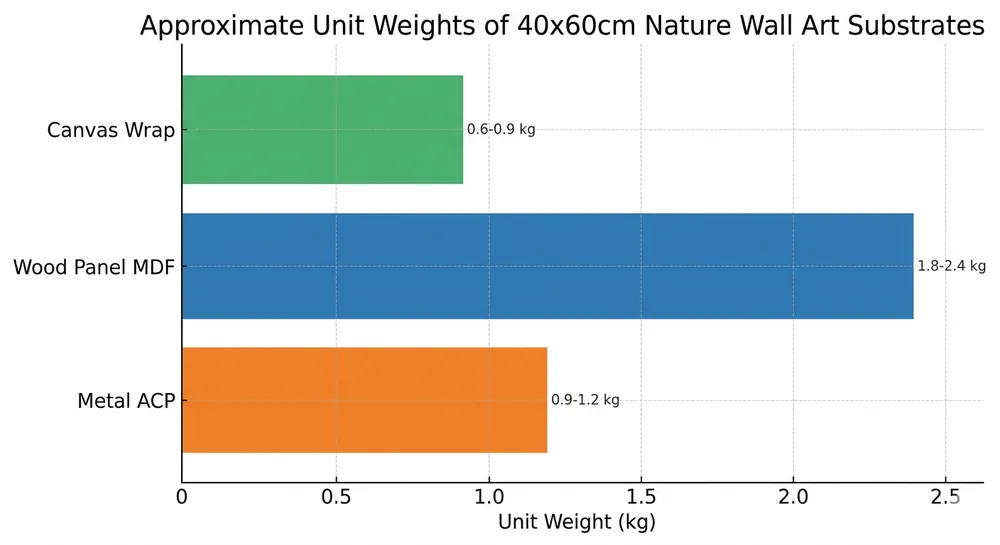
Step 3 — Confirm glass or substrate requirements. For mirror-based wall art, specify glass thickness (typically 3mm or 5mm for wall pieces), edge treatment (polished, beveled, seamed), and any coating (silver mirror, bronze tint, antique effect). For print-based pieces, specify substrate (canvas, aluminum composite, MDF with gesso). These choices affect both cost and shipping weight.
Step 4 — State your packaging requirements upfront. Retail-ready packaging — individual color boxes, insert foam, UPC labeling — adds cost that surprises buyers who don't ask about it early. On a 100-piece order, packaging can represent 15–25% of total cost. If you're selling to a retailer with specific packaging requirements, share those specs at the quote stage, not after samples are approved.
Step 5 — Request a pre-production sample before bulk. On small batches, a defect found at bulk inspection means scrapping a significant percentage of your order. A pre-production sample — one or two units built to your exact spec — costs $80–150 and eliminates that risk. Any factory that discourages pre-production samples on custom work is telling you something about how they handle problems.
Common Mistakes That Inflate Per-Unit Cost on Small Orders
These show up consistently. Most are avoidable.
Ignoring freight-per-unit math. A 100-piece order of wall art that ships in a single pallet costs nearly the same ocean freight as a 300-piece order in the same container space. The freight doesn't scale linearly with quantity — it scales with cubic volume and container utilization. At 100 pieces, you might be paying $4–7 per unit in ocean freight. At 300 pieces in the same container, that drops to $1.50–2.50. If your margin model was built on 300-piece freight rates, a 100-piece order will look unprofitable even if the factory price is fair.
Requesting fully custom tooling for a first order. New tooling on a first order with a new factory is a high-risk move. You haven't validated the factory's color accuracy, finish consistency, or QC process yet. If the bulk production doesn't match your sample, you're stuck with a mold you can't use elsewhere. Start with existing tooling and custom finishes. Commit to custom tooling on the second or third order, once you've seen how the factory handles production.
Underspecifying and then revising after samples. Every revision after the sample stage — change the frame color, adjust the glass edge, swap the packaging insert — triggers a re-quote and often a new sample charge. On a 100-piece order, two revision rounds can add $200–400 in pre-production cost. Get the spec right before the first sample.
Treating MOQ as a floor, not a starting point. Some buyers hit the factory's stated MOQ (say, 100 pieces) and assume that's the minimum for any configuration. It's often the minimum for standard models. Custom configurations — new frame profiles, new glass treatments, new packaging — typically have higher effective minimums because of tooling and setup. Ask specifically: "What is the minimum for this exact configuration?" before building your order plan around a number from the website.
When Standard Molds with Custom Finishes Beat Full Custom Tooling
This is the decision that separates buyers who get viable small-batch pricing from those who don't.
Full custom tooling — a new mold built to your exact frame profile or shape — makes sense when you're ordering at volume (typically 300+ pieces per run), when the design is a genuine differentiator that competitors can't replicate with standard profiles, and when you've already validated the style with a smaller test order.
Below that threshold, standard molds with custom finishes almost always produce better economics. Here's why: a standard mold has already been amortized across hundreds of previous runs. You're not paying for it. Your customization cost is limited to finish development — color matching, texture application, foil selection — which runs $50–150 per new colorway versus $400–900 for new tooling.
The commercial result is often indistinguishable to the end buyer. A standard arched-top frame in a custom antiqued bronze finish reads as a unique product on a retail shelf. The frame profile is the same as ten other SKUs in our catalog; the finish makes it yours.
We have buyers in the US home décor market who have built 15–20 SKU lines entirely on standard mold + custom finish combinations. Their per-unit cost is competitive at 100-piece runs, their tooling investment is zero, and they can introduce new colorways every season without retooling. (The tradeoff: if a competitor sources the same standard profile, the frame shape isn't proprietary. For most retail channels, that's an acceptable risk.)
How Livewellcraft's Production Setup Handles Small-Batch Economics
Our 100-piece MOQ on standard models isn't a marketing number — it reflects how our production lines are actually set up. Six lines running under one roof means we can schedule a 100-piece run of one SKU alongside a 2,000-piece run of another without the small order sitting in a queue waiting for a dedicated line slot.
The in-house frame molding line is the part that matters most for small-batch buyers. We don't go to an external molding supplier for frame stock. We run our own profiles, which means there's no subcontractor minimum sitting underneath your order. A 100-piece order gets the same frame stock access as a 1,000-piece order.
Our 12-engineer OEM/ODM team handles the design adaptation work that makes standard-mold + custom-finish orders viable. When a buyer sends a reference image and a target retail price, the team identifies which existing mold family fits the design intent, specifies the finish stack to match the reference, and returns a quote with a per-unit breakdown showing exactly where the cost sits. That process typically takes 48 hours. It's not a favor — it's how we qualify orders efficiently.
For buyers who need unique wall art custom specs beyond standard configurations, the same team handles full OEM development. The difference is we're honest about where the tooling cost threshold is, so you can decide whether the volume justifies it before committing.
Our certifications — ISO 9001:2015, SGS, CE, BSCI — matter for small-batch buyers specifically because retail compliance requirements don't scale down with order size. A 100-piece order going into a US retail chain needs the same documentation as a 1,000-piece order. Having those certifications in place means you're not paying a compliance premium on small runs.
Browse our full Wall Arts by Style & Subject range to see which standard mold families are available for custom finish development.
Practical FAQ: Small-Batch Unique Wall Art Ordering
What is the realistic minimum order for a custom finish on a standard frame profile? 100 pieces for most standard profiles in our catalog. Below 100, the line changeover cost makes the per-unit price unworkable for both sides. If you need fewer than 100 for a market test, consider ordering 100 and holding the excess as reorder stock — the per-unit savings usually justify the inventory carry.
How much does a pre-production sample cost, and is it credited against the bulk order? Sample cost depends on complexity: $80–150 for standard finish variations, $200–350 for new finish development with multiple colorway tests. We credit the sample cost against your bulk order once you confirm production. If you don't proceed, the sample cost covers our material and labor.
Can I split a 100-piece MOQ across two different designs? Yes, if both designs use the same frame profile and size. We treat it as one production run with two artwork variants. If the designs require different frame profiles, each variant needs to meet the MOQ independently because the line setup is separate.
What's the lead time on a 100-piece small-batch order? Standard finish on an existing mold: 18–25 days from sample approval. New finish development adds 7–10 days for the colorway approval round. Custom tooling adds 20–30 days for mold fabrication before production starts.
How do I keep freight cost from erasing my margin on small orders? Two options: consolidate with another order going to the same destination (we can hold your goods for up to 30 days to combine with a follow-up order), or ship by air for high-value, low-weight pieces where the freight premium is offset by faster inventory turn. For most wall art, ocean LCL is the baseline — budget $4–7 per unit at 100 pieces and model your margin from there.
—
If you have a design reference and a target quantity, send it through our Request Quote form with your finish requirements and target retail price. We'll return a per-unit cost breakdown at your exact volume within 48 hours — including a note on whether existing tooling fits your design or whether custom mold investment makes sense at your scale.