Why Acrylic Mirror Durability Specs Belong on Your Purchase Order
Most claims we see on acrylic decor mirrors trace back to the same root cause: the PO said "acrylic mirror" and nothing else. No thickness spec, no hard-coat requirement, no UV stabilizer grade. The supplier shipped the cheapest sheet that technically qualified, and six months into a hospitality rollout the mirrors were hazed, scratched, or warped off the wall.
Acrylic (PMMA) is genuinely tough material for decorative mirrors. It absorbs impact far better than float glass, weighs roughly half as much, and won't shatter into dangerous fragments. But "acrylic" covers a wide range of sheet grades, thicknesses, and surface treatments, and the differences between them land directly on your return rate, your installed lifespan, and your margin. This article breaks down the specs that matter for sourcing acrylic decor mirrors in volume, so you can write a purchase order that protects your business.
PMMA vs Glass vs Polycarbonate: What the Numbers Mean for Your Product Line
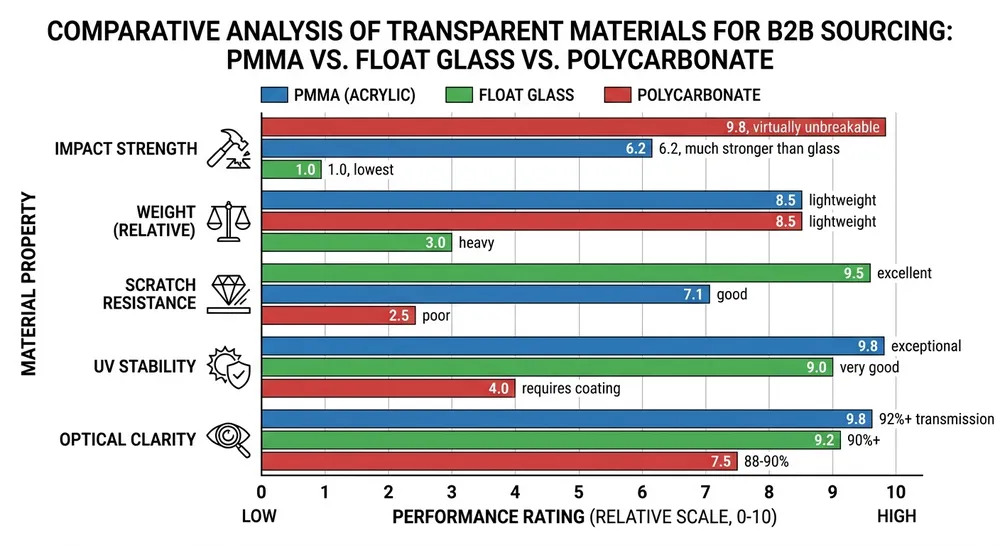
When you're choosing a mirror substrate for a decor product, three materials come up: cast PMMA (acrylic), float glass, and polycarbonate. Each has trade-offs that affect your landed cost, warranty exposure, and target market fit.
| Property | PMMA (Acrylic) | Float Glass | Polycarbonate |
|---|---|---|---|
| Izod Impact Strength (ASTM D256) | ~16 kJ/m² | ~2 kJ/m² | ~60–80 kJ/m² |
| Weight (per m² at 3mm) | ~3.6 kg | ~7.5 kg | ~3.6 kg |
| Scratch Resistance | Moderate (improvable with hard coat) | High | Low |
| UV Stability | Good with stabilizer; yellows without | Excellent | Poor; yellows faster |
| Optical Clarity (ASTM D1003 haze) | <1% haze (cast sheet) | <0.5% haze | 1–3% haze |
| Shatter Behavior | Breaks into dull chunks, low injury risk | Sharp shards | Doesn't shatter |
| Relative Sheet Cost | Medium | Low | High |
A few things jump out of this table. PMMA gives you roughly 8x the impact resistance of glass at half the weight. That combination is why shatterproof acrylic mirrors dominate hospitality, children's spaces, and retail display. Polycarbonate is tougher still, but it scratches easily, yellows faster under UV, and costs more per sheet. For decorative wall mirrors where optical clarity and surface finish matter, PMMA hits the practical sweet spot.
(We've tested polycarbonate mirrors for a gym chain project. The impact resistance was overkill for wall-mounted decor, and the surface scratched during installation. We steered them back to hard-coated PMMA and the complaint rate dropped to near zero.)

How Thickness Drives Impact Performance and Landed Cost
Acrylic mirror sheets for decor applications typically range from 1mm to 5mm. The thickness you spec affects impact resistance, rigidity, weight, and freight cost per unit. Getting this wrong in either direction costs you money.
1mm PMMA: Flexible, lightweight, lowest material cost. Works for adhesive-mounted decorative tiles and flat accent panels where the mirror bonds directly to a rigid substrate. Not self-supporting at sizes above roughly 300mm. If your product relies on the acrylic sheet to hold its own shape, 1mm will bow.
2mm PMMA: The standard for most wall-mounted decorative mirrors in the 300–600mm range. Enough rigidity to stay flat in a frame, light enough to keep shipping costs reasonable. This is where the bulk of our acrylic decor mirror production sits. (About 60% of our acrylic mirror orders spec 2mm, which tells you where the market has settled.)
3mm PMMA: Noticeably more rigid. Appropriate for larger format mirrors (600mm+), frameless designs that need structural integrity, and installations in high-traffic commercial environments where someone might bump the wall. The Izod impact values scale roughly linearly with thickness, so 3mm gives you about 50% more impact absorption than 2mm.
4–5mm PMMA: Specified for safety-critical applications: children's facilities, behavioral health environments, correctional settings. The material cost per unit climbs, but these channels accept the price premium because the alternative is tempered glass at even higher cost and weight.
| Thickness | Typical Application | Self-Supporting Size | Relative Material Cost |
|---|---|---|---|
| 1mm | Adhesive-mount tiles, substrate-backed accents | Up to ~300mm | Baseline |
| 2mm | Standard framed wall mirrors, retail displays | Up to ~600mm | ~1.6x |
| 3mm | Large-format, frameless, hospitality lobbies | Up to ~900mm | ~2.2x |
| 4–5mm | Children's spaces, safety-rated environments | 900mm+ | ~3–4x |
The sourcing decision here is straightforward: spec the thinnest sheet that meets your application's rigidity and impact requirements. Over-specifying thickness inflates your unit cost and container weight without adding value your end customer will notice.
Three Failure Modes That Drive Returns on Acrylic Mirrors
Acrylic decor mirrors durability is strong on impact, but the material has specific vulnerabilities. If you understand these failure modes, you can spec around them and keep your return rate low.
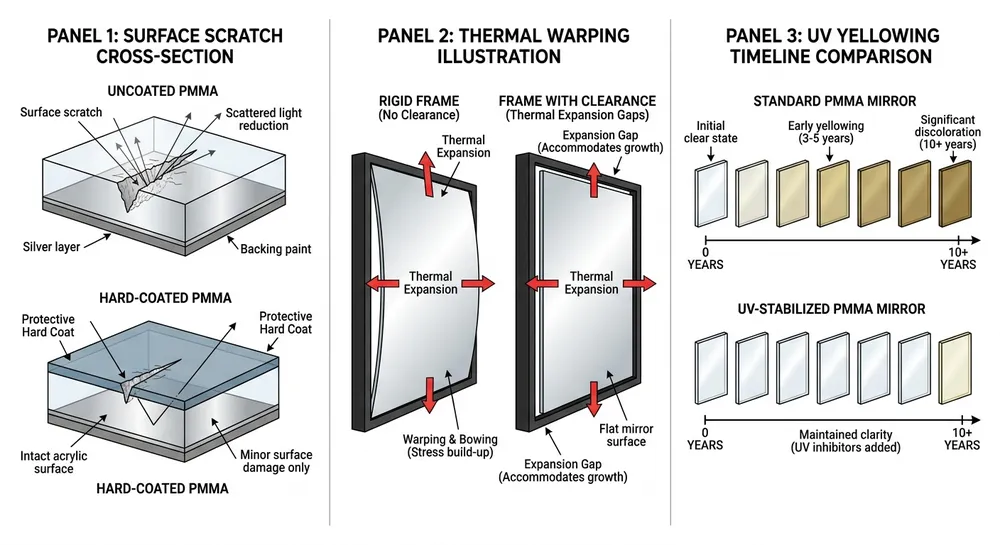
Surface Scratching
PMMA has a Rockwell hardness around M90–M100. That's softer than glass (which sits around Mohs 5.5). In practice, this means acrylic mirrors scratch more easily during handling, installation, and cleaning. For a product that's meant to be looked at, visible scratches are a warranty issue.
The fix is a hard-coat treatment applied during or after sheet production. A good hard coat (typically silicone-based, applied at 3–5 microns) brings the surface pencil hardness up to around 3H–4H and improves Taber abrasion resistance (ASTM D4060) by 5–10x over uncoated PMMA. We specify hard-coated sheet for any acrylic mirror order going into hospitality or retail, where cleaning staff will wipe the surface regularly. The cost adder is modest relative to the return cost of scratched units.
Thermal Warping
PMMA has a coefficient of thermal expansion roughly 7x higher than glass. A 1-meter acrylic panel exposed to a 30°C temperature swing can expand by about 2mm in length. In a rigid frame with no expansion allowance, that expansion has nowhere to go, and the mirror bows.
We account for this in frame design by leaving 1–2mm clearance per linear meter between the acrylic panel edge and the frame rabbet. If you're sourcing acrylic mirrors from a supplier who frames them the same way they frame glass, ask about expansion clearance. It's a small detail that prevents a visible defect.
UV Yellowing
Standard extruded PMMA without UV stabilizers will begin to yellow noticeably after 2–3 years of direct sunlight exposure. Cast PMMA with UV stabilizer additives extends that timeline to 8–10 years under typical indoor conditions, and longer if the mirror isn't in direct sun.
For indoor decor applications, UV-stabilized cast sheet is the right baseline spec. If your product goes into a sunroom, a south-facing lobby, or any space with significant UV exposure, confirm that the sheet supplier includes UV stabilizer in the formulation. This is a raw material spec, not something that can be added after the fact.
Hard Coats and UV Stabilizers: Protecting Margin on Long-Lifecycle Products
Two treatments separate a commodity acrylic mirror from a product you can confidently warranty for commercial use.
Hard coat is a surface treatment, usually silicone-based, applied at 3–5 microns. It raises scratch resistance from roughly H pencil hardness (bare PMMA) to 3H–4H. For any acrylic mirror that will be cleaned regularly or handled during installation, hard coat is worth the cost adder. We've seen the difference in return rates: uncoated acrylic mirrors in hotel bathrooms generated 3–4x the scratch complaints compared to hard-coated units in the same property.
UV stabilizer is a bulk additive mixed into the PMMA resin during sheet casting. It absorbs UV radiation before it can break polymer chains and cause yellowing. Cast PMMA sheets from reputable suppliers (Mitsubishi, Evonik, Chi Mei) typically include UV stabilizer as standard. Extruded sheet, which is cheaper, often does not. If your supplier quotes you acrylic mirror sheet at a price that seems unusually low, check whether it's extruded without UV stabilizer. The upfront savings disappear when the product yellows in the field.
(We switched our default acrylic sheet sourcing to UV-stabilized cast PMMA in 2019 after a batch of extruded sheet started showing haze in a Middle East hotel project within 18 months. The cost difference was about 8–12% on the sheet, but the warranty claim would have been far more expensive.)
What Happens When Acrylic Mirror Specs Stay Vague on the PO
This is the sourcing trap we see most often with acrylic decor mirrors. The purchase order says "acrylic mirror, 2mm, 400x600mm, qty 3,000" and nothing else. That leaves the supplier free to choose:
- Extruded vs cast sheet (cost difference, UV stability difference)
- With or without hard coat (scratch resistance difference)
- With or without UV stabilizer (yellowing timeline difference)
- Edge finishing method (laser cut, router cut, polished, raw)
- Protective film grade (peel-off quality affects installed appearance)
Each of those choices affects your product's field performance and your return rate. When the spec is vague, the supplier optimizes for their margin, not yours.
What to specify on your PO or RFQ:
- Sheet type: cast PMMA with UV stabilizer (not extruded)
- Hard coat: yes/no, with pencil hardness target (3H minimum for commercial)
- Thickness tolerance: ±0.1mm is standard for cast sheet
- Haze: <1% per ASTM D1003
- Edge finish: specify polished, beveled, or raw
- Protective film: specify peel quality (no residue after 30 days)
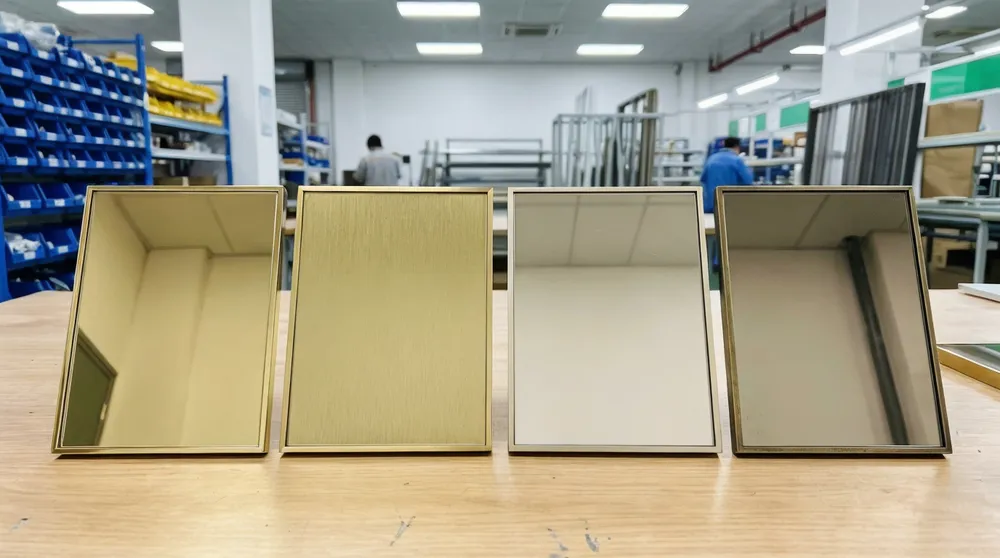
- Reflectivity: request sample for visual approval before production
If you're comparing quotes from multiple suppliers and one price is 20–30% below the others, the gap is almost certainly in sheet grade, coating, or both. Ask for the sheet supplier name and grade. A factory that knows its material will answer immediately. One that's brokering won't.
Our QC process runs 100% visual inspection on every acrylic mirror unit before packing, checking for haze, scratches, coating uniformity, and edge quality. That inspection gate catches the problems that vague specs create. But the better approach is to eliminate those problems at the spec stage, before production starts. If you need help writing a tight material spec for decor mirrors by material and frame type, our engineering team can review your requirements and recommend the right sheet grade and treatment combination.
Spec Recommendations by Sales Channel
Different channels have different durability requirements and different price sensitivity. Here's how we typically guide buyers through the thickness and treatment decision.
Hospitality (hotels, restaurants, lobbies): 2–3mm cast PMMA, hard-coated, UV-stabilized. These mirrors get cleaned daily and live in spaces with controlled climate but high foot traffic. Hard coat is non-negotiable. Frame design needs thermal expansion clearance if the mirror is near exterior walls or windows.
Retail display and visual merchandising: 2mm cast PMMA, hard-coated. Weight matters here because displays get reconfigured frequently. Scratch resistance matters because staff handle the mirrors during setup. UV stabilizer is less critical if the display is indoors under artificial light, but we include it as default because the cost difference is small.
Residential wholesale (distributed through home decor retailers): 1–2mm cast PMMA, UV-stabilized. Hard coat is optional depending on your price point. For adhesive-mount decorative tiles, 1mm on a rigid backing works well. For framed wall mirrors, 2mm is the standard. This channel is the most price-sensitive, so spec only what the application genuinely needs.
Children's spaces and safety-rated environments: 3–5mm cast PMMA, hard-coated, UV-stabilized, with rounded or polished edges. These applications often require documentation of impact test results. We can provide Izod impact test data per ASTM D256 on the specific sheet grade used in your order. (Some institutional buyers also ask for a flammability rating per UL 94; cast PMMA is typically HB-rated, which satisfies most building codes for wall-mounted decor.)
For a deeper comparison of acrylic vs glass decor mirrors across these channels, we've covered the full cost and performance trade-off in a separate guide.
Frequently Asked Questions
How durable are acrylic decor mirrors compared to glass in high-traffic commercial spaces?
PMMA acrylic is roughly 8x more impact-resistant than float glass by Izod impact testing (ASTM D256), and it won't shatter into sharp fragments. In high-traffic environments like hotel corridors or retail floors, that impact resistance translates directly to lower replacement costs and zero injury liability from broken glass. The trade-off is scratch susceptibility, which a hard-coat treatment effectively addresses for commercial cleaning cycles.
What ASTM standards should I reference when specifying acrylic mirrors for bulk orders?
Three standards cover the properties that matter most: ASTM D256 for Izod impact resistance, ASTM D1003 for haze and light transmittance (optical clarity), and ASTM D4060 for Taber abrasion resistance (scratch durability). Including these on your RFQ gives your supplier a clear performance target and gives you a measurable basis for acceptance testing.
Will acrylic mirrors yellow over time in indoor installations?
UV-stabilized cast PMMA holds its clarity for 8–10 years under typical indoor lighting conditions. Without UV stabilizer, yellowing can become visible in 2–3 years, especially near windows. Always confirm that your supplier uses UV-stabilized cast sheet, not unstabilized extruded sheet. This is the single most common cause of premature yellowing in acrylic decor mirrors.
What thickness of acrylic mirror do I need for wall-mounted decor products?
For framed mirrors in the 300–600mm range, 2mm is the industry standard. It provides enough rigidity to stay flat in the frame while keeping weight and material cost reasonable. Above 600mm, move to 3mm for structural integrity. Below 300mm or for adhesive-mount applications, 1mm on a rigid substrate works. Over-specifying thickness adds cost without visible benefit to your customer.
How do I prevent scratching on acrylic mirrors during shipping and installation?
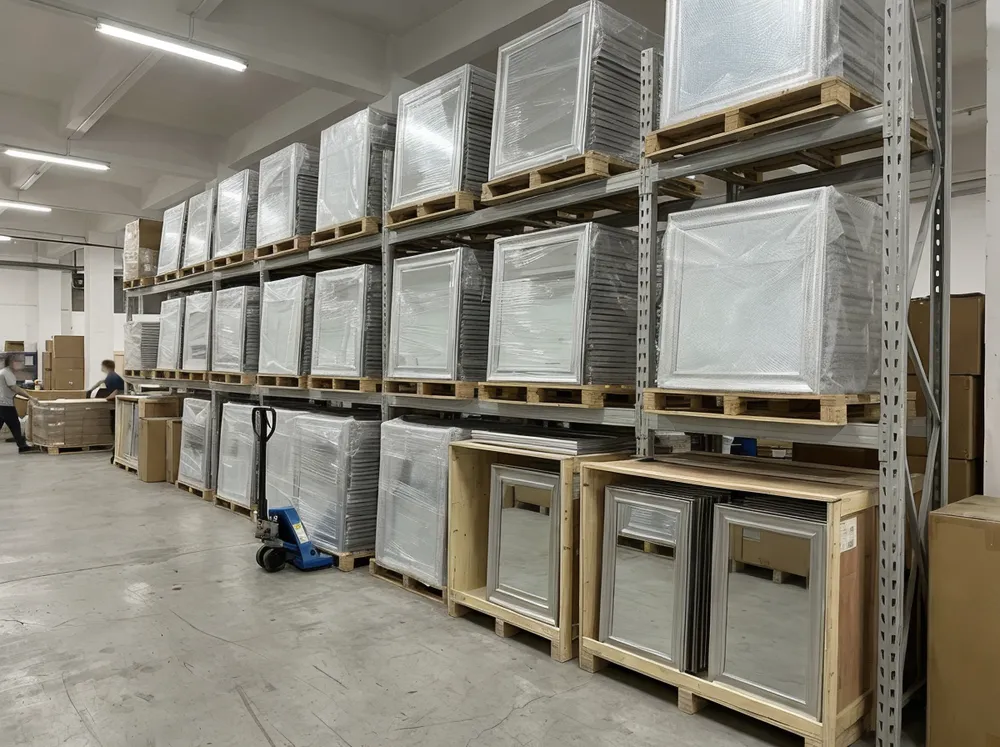
Specify hard-coated PMMA sheet (3H pencil hardness minimum) and require protective peel film that leaves no residue after 30 days. For shipping, each mirror should have individual film protection and corner guards. Instruct your installation teams to remove the protective film only after all surrounding construction work is complete. Most field scratches happen during the last mile, not in the container.
Can acrylic mirrors be custom-shaped or beveled for OEM decor products?
Yes. PMMA machines cleanly with standard CNC routing and laser cutting equipment. We produce custom shapes, beveled edges, and radius corners on our acrylic decor mirrors line. Laser-cut edges come out polished and don't need secondary finishing for most decorative applications. If you need a non-standard profile or a backlit design, send your dimensions and we'll confirm feasibility and quote the project with your specific sheet grade and treatment specs.