Mirrors fail in bathrooms for one reason: the coating system wasn't built for the environment. Not the glass, not the frame — the coating. A mirror that performs fine in a bedroom or hallway will start showing black edge spots within 18 months in a bathroom with daily shower use. By the time your downstream customer complains, the product is already in their home, and the return is yours to absorb.
The problem is that most supplier spec sheets don't distinguish between a general-purpose decorative mirror and a bathroom-grade one. They list "silver mirror" and move on. What you actually need to evaluate is the silvering process, the protective paint layer count and thickness, the edge seal method, and the backing material — and you need those specs in writing before you place the order.
This article breaks down each layer of a moisture-resistant mirror, the test standards that matter, and what to put in your RFQ so suppliers can't hand you a general-purpose product and call it bathroom-grade.

What "moisture resistance" actually means in mirror manufacturing
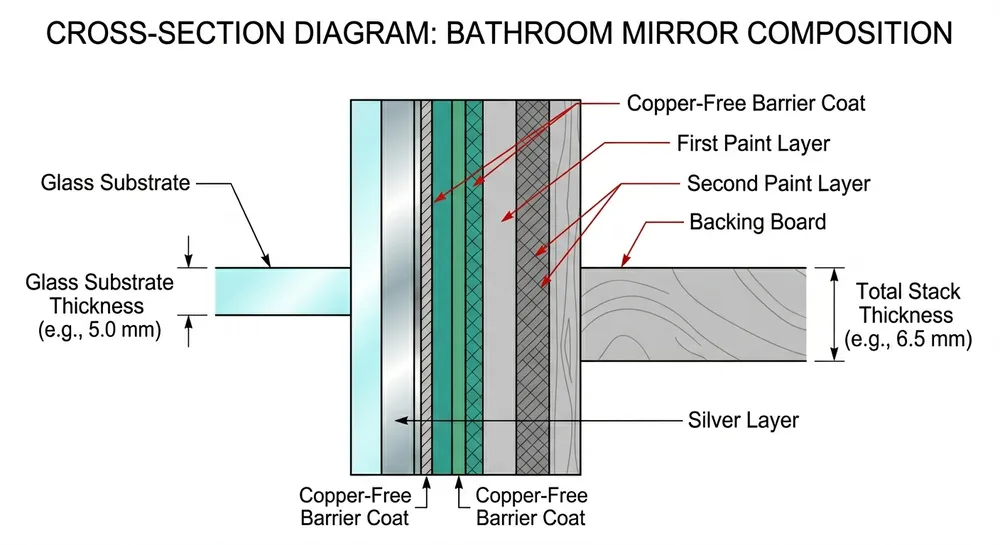
A mirror is a glass substrate with a silver layer deposited on the back surface, then sealed with protective coatings. The silver is what creates the reflection — and silver oxidizes. In a bathroom, you have daily humidity spikes, temperature cycling, and in coastal or tropical markets, ambient humidity that rarely drops below 70%. Every one of those conditions attacks the silver layer from the edges inward.
Moisture resistance in a mirror is not a single property. It's the combined performance of four things:
- The silvering process — whether the silver layer itself is copper-free or copper-backed
- The protective paint system — how many coats, what thickness, and what adhesion rating
- The edge seal — whether the perimeter is sealed against moisture ingress
- The backing material — whether the substrate behind the paint system is moisture-stable
A supplier who says "our mirrors are moisture resistant" without specifying these four elements is giving you a marketing claim, not a spec. The only way to verify bathroom suitability is to get numbers on each layer.
Copper-free vs copper-backed silvering: the spec that separates bathroom-grade from general-purpose
Traditional mirror silvering uses a copper layer deposited directly over the silver. The copper acts as a bonding layer for the paint coats that follow. The problem is that copper corrodes in humid environments — and when the copper layer corrodes, it lifts the paint above it and exposes the silver beneath. That's the black edge spotting you see on failed bathroom mirrors. It starts at the perimeter where moisture enters first, then works inward.
Copper-free silvering replaces the copper layer with a tin-based or proprietary barrier chemistry that bonds the silver to the paint system without introducing a corrosion-prone metal. The silver layer is still silver — the difference is what sits between the silver and the first paint coat.
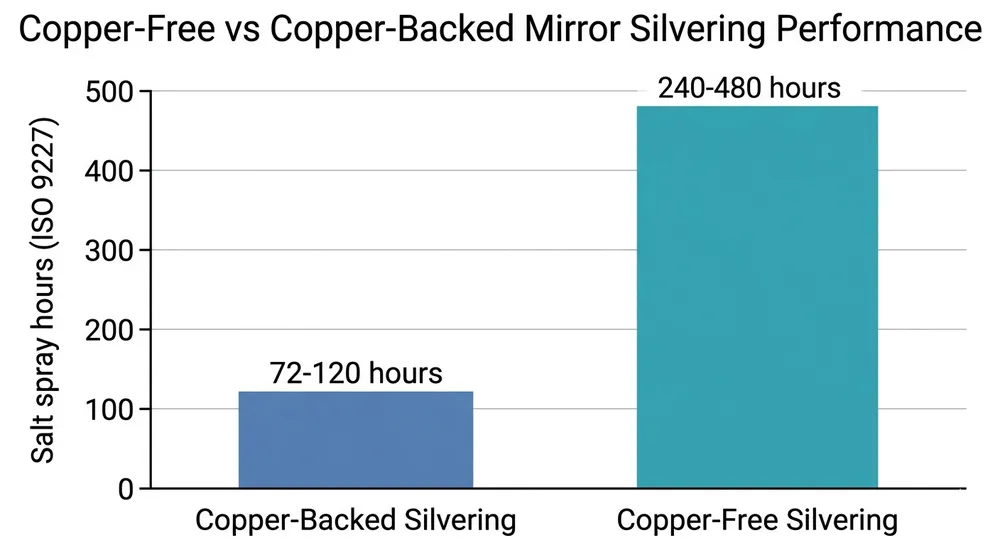
In real humidity exposure, the performance gap is significant:
| Silvering type | Typical salt spray performance | Edge blackening onset | Recommended application |
|---|---|---|---|
| Copper-backed | 72–120 hours (ISO 9227) | 12–24 months in daily-use bathrooms | Dry interior rooms only |
| Copper-free | 240–480 hours (ISO 9227) | 5+ years in standard bathroom conditions | Bathrooms, coastal hospitality, humid climates |
(These are typical industry ranges. Ask your supplier for their specific test data — a credible manufacturer will have batch-level salt spray records, not just a general claim.)
We run copper-free silvering as our default process at Livewellcraft. When we started supplying hospitality buyers in Southeast Asia and the Middle East, the feedback on copper-backed product in high-humidity hotel bathrooms was consistent enough that we made the switch across the line. The copper-free process costs slightly more in chemistry, but the warranty claim reduction makes it straightforward math for any buyer selling into bathroom applications.
The paint layer system: what thickness and count actually mean for your order
The paint coats over the silver layer are the primary moisture barrier. Most bathroom-grade mirrors use two paint coats — a base coat applied directly over the silver (or copper-free barrier), then a topcoat. Some manufacturers add a third coat for high-humidity or coastal specifications.
What matters in procurement is not just the number of coats but the dry film thickness (DFT) of each layer. A single coat applied at 20 microns gives you less protection than the same coat at 35 microns. Suppliers who don't specify DFT are leaving you with no way to verify what you're actually getting.
Spec ranges to require in your RFQ:
| Paint layer | Minimum DFT | Recommended DFT for bathroom grade |
|---|---|---|
| Base coat (over silver/barrier) | 20 μm | 28–35 μm |
| Topcoat | 20 μm | 28–35 μm |
| Total system (2-coat) | 40 μm | 56–70 μm |
The adhesion rating matters as much as thickness. The standard test is a cross-hatch adhesion test per ISO 2409 — the paint is scored in a grid pattern and tape-pulled. A rating of 0 (no detachment) or 1 (less than 5% detachment) is what you want for bathroom applications. A rating of 2 or higher means the paint system will fail under sustained humidity.
Ask for cross-hatch adhesion test results alongside salt spray data. If a supplier can only provide one, that's a gap worth noting.
Edge sealing: the entry point most buyers don't specify
The silver layer is most vulnerable at the cut edges of the glass. Even with a strong paint system on the back face, an unsealed edge gives moisture a direct path to the silver. In a bathroom mirror with daily condensation, an unsealed edge will show blackening within 12–18 months regardless of how good the back coating is.
Edge sealing options vary by manufacturer:
- No edge treatment — common on general-purpose mirrors, not acceptable for bathroom grade
- Paint edge seal — the back-coat paint is extended around the perimeter edge; adequate for moderate humidity
- Dedicated edge sealant — a separate moisture-barrier compound applied to the cut edge before or after framing; the correct spec for daily-use bathrooms and hospitality projects
In your RFQ, specify: "Mirror edges must be sealed with a dedicated moisture-barrier edge sealant applied to all four cut edges prior to frame assembly." If the supplier's standard process is paint-only edge coverage, ask whether they can add a dedicated edge seal step — most factories that run bathroom-grade product already have this in their process.
We apply edge sealant as a standard step on all bathroom-category mirrors. It adds roughly 3–4 minutes per unit in assembly time, but it's the single most effective thing you can do to extend edge integrity in humid environments. (We've seen mirrors with excellent back coatings fail at the edges within two years simply because the edge was left bare — the coating quality on the back face doesn't compensate for an open edge.)
Frame material and backing: the moisture durability of the assembled unit
The mirror glass and coating system don't exist in isolation — they're assembled into a frame with a backing board. Both affect the moisture durability of the finished product.
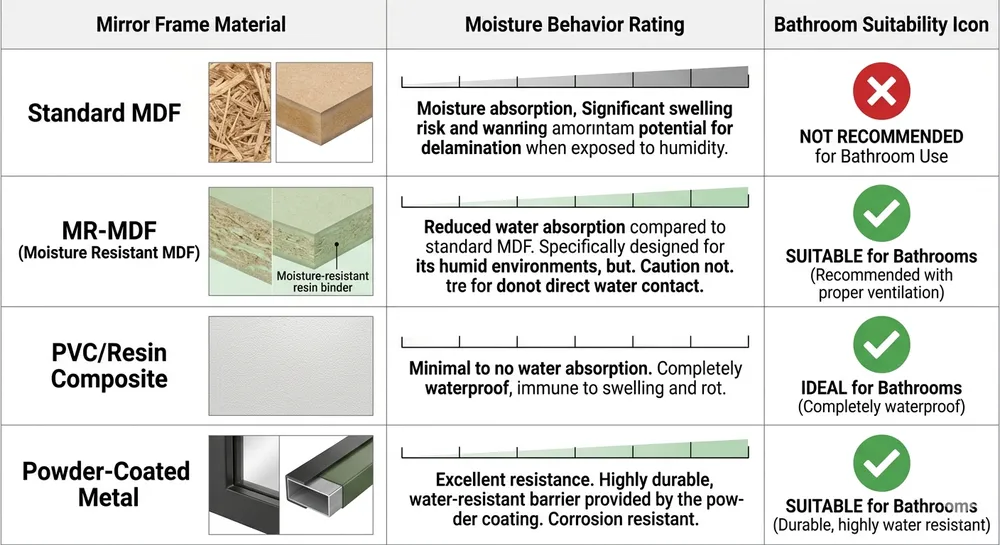
Frame material by moisture suitability:
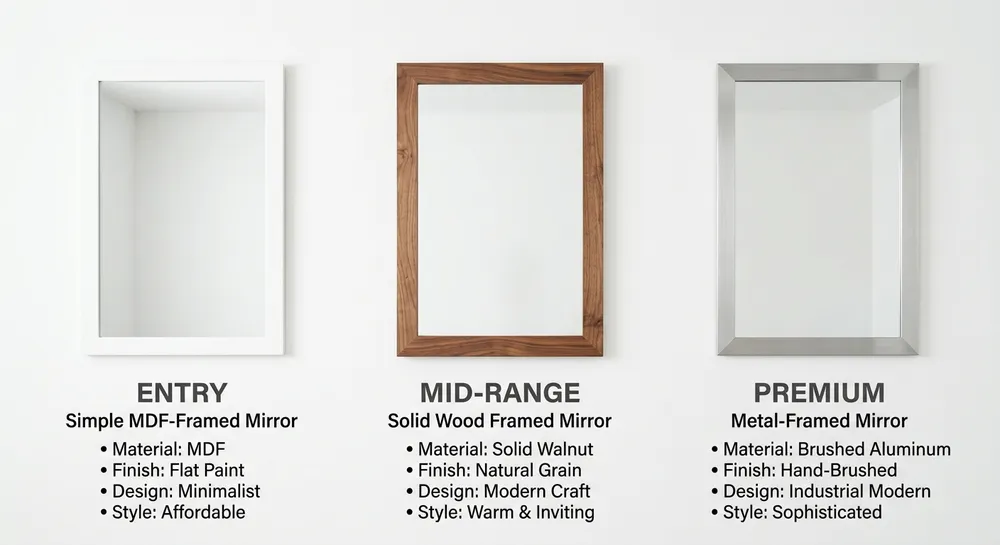
| Frame material | Moisture behavior | Bathroom suitability |
|---|---|---|
| Solid wood (untreated) | Swells, warps, can crack frame joints | Not recommended without sealing |
| MDF (standard) | High moisture absorption, swells and delaminates | Not recommended for direct bathroom use |
| MDF (moisture-resistant grade) | Reduced swelling, suitable for indirect humidity | Acceptable for most bathroom applications |
| PVC / resin composite | Dimensionally stable, no moisture absorption | Preferred for high-humidity and coastal applications |
| Metal (powder-coated) | Stable, no swelling; check coating adhesion at joints | Suitable; verify coating integrity at welds |
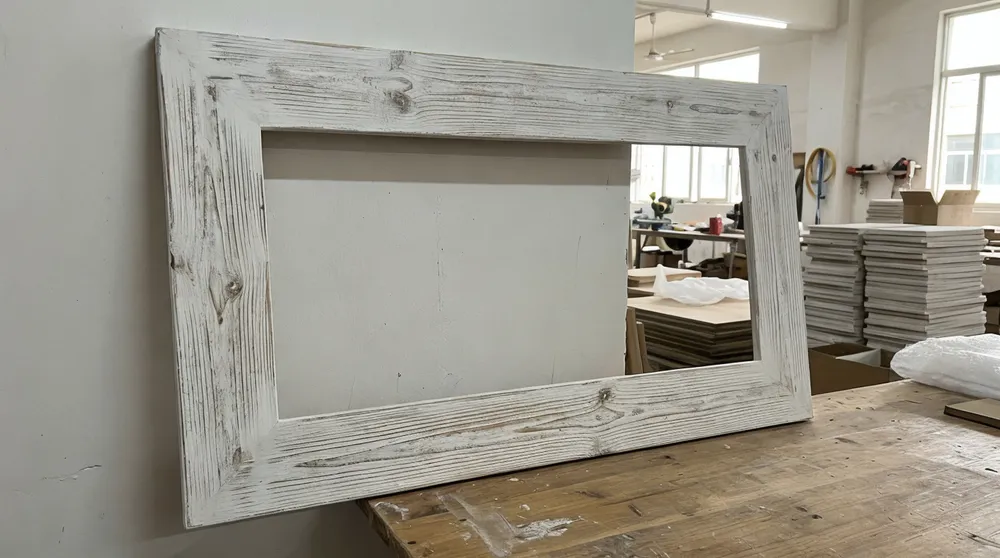
Standard MDF is the most common frame core material in decorative mirrors, and it's fine for living rooms and bedrooms. In a bathroom, standard MDF will absorb moisture through any unsealed cut edges or joint gaps, swell, and eventually crack the frame finish or push the mirror glass out of its rabbet. If your product line includes bathroom-specific SKUs, specify moisture-resistant MDF (sometimes called MR-MDF or green-core MDF) or a PVC/resin composite frame as a minimum.
The backing board behind the mirror glass has the same issue. A standard hardboard or cardboard backing will absorb moisture and degrade. Specify a moisture-resistant backing — either MR-MDF, PVC sheet, or a sealed hardboard — for any bathroom-category product.
Because we handle frame molding and assembly in-house, we can match the frame core and backing spec to the mirror's coating spec without coordinating across vendors. If you're sourcing the mirror glass from one supplier and the frame from another, you need to verify both independently — a bathroom-grade coating on a standard-MDF frame is still a product that will fail in a humid room.
The sourcing trap: what "bathroom mirror" on a spec sheet doesn't guarantee
The most common sourcing mistake we see is buyers assuming that a product listed as a "bathroom mirror" or "vanity mirror" in a supplier's catalog already meets bathroom-grade moisture specs. It often doesn't. The category label describes the intended use, not the coating system.
A supplier can list a mirror as a bathroom product while using:
- Copper-backed silvering (the cheaper, more common process)
- A single paint coat at 15–20 μm
- No edge sealant
- Standard MDF frame core
None of those choices are disclosed unless you ask. And if you don't ask in the RFQ, you won't find out until your downstream customers start reporting edge blackening.
The documents to request before finalizing a bathroom mirror order:
- Salt spray test report — ISO 9227, minimum 240 hours for bathroom grade; ask for the actual test report, not just a claim
- Cross-hatch adhesion test result — ISO 2409, rating 0 or 1
- Paint layer DFT measurement — per coat and total system
- Silvering process confirmation — copper-free or copper-backed, in writing
- Edge seal process description — what is applied, when, and to which surfaces
- Frame material spec — core material grade, moisture rating if applicable
If a supplier can't provide these on request, that's the answer. A factory running bathroom-grade product has this data because they test it. The absence of documentation is itself a sourcing signal.
For buyers sourcing Bathroom Decor Mirrors at volume, getting these specs confirmed before sampling saves you the cost of a failed trial order and the downstream warranty exposure that follows.
Sample RFQ spec clause for bathroom-grade decorative mirrors
Copy and adapt this clause for your next bathroom mirror RFQ. It covers the minimum spec requirements for a product intended for daily-use bathroom environments:
Bathroom Mirror Moisture Resistance Requirements
Silver layer: Copper-free silvering process required. Copper-backed silvering is not acceptable for this application.
Protective paint system: Minimum two-coat system. Base coat minimum 28 μm DFT; topcoat minimum 28 μm DFT; total system minimum 56 μm DFT. Cross-hatch adhesion per ISO 2409: rating 0 or 1 required.
Salt spray performance: Minimum 240 hours per ISO 9227 without edge blackening or paint delamination. Supplier to provide test report from current production batch.
Edge sealing: All four cut glass edges to be sealed with a dedicated moisture-barrier edge sealant prior to frame assembly. Paint-only edge coverage is not sufficient.
Frame core material: Moisture-resistant MDF (MR grade) or PVC/resin composite required. Standard MDF is not acceptable.
Backing board: Moisture-resistant backing required. Standard cardboard or untreated hardboard is not acceptable.
Documentation required with pre-production sample: Salt spray test report (ISO 9227), cross-hatch adhesion result (ISO 2409), paint DFT measurement record, silvering process confirmation in writing.
Adjust the salt spray threshold based on your target market's humidity profile. 240 hours is a reasonable floor for standard bathroom use. For coastal hospitality, high-humidity tropical markets, or spa environments, specify 360–480 hours and add a requirement for a third paint coat.
How Livewellcraft's production setup addresses these specs
We've been running copper-free silvering as our default since we started supplying hospitality buyers in humid-climate markets. The coating line operates at controlled temperature (±2°C) and humidity — not because it's a selling point, but because silver deposition quality is directly affected by ambient conditions during application. A coating line that isn't temperature-controlled produces inconsistent silver layer density, which shows up as uneven reflectivity and accelerated edge degradation in the field.
Our QC process includes silver adhesion testing on every production batch, not just on samples submitted for certification. We test cross-hatch adhesion and run salt spray verification on batch representatives before shipment. If a batch fails, it doesn't ship — we don't pass the problem downstream and wait for a warranty claim.
Because frame molding, glass cutting, silvering, and assembly all run under one roof, we can match the frame material spec to the mirror coating spec without coordinating across vendors. If you need MR-MDF frames with copper-free silvering and dedicated edge sealing, that's a single conversation with one production team, not a multi-vendor coordination problem.
Our ISO 9001:2015 certification covers the full production process, and SGS and CE documentation is available for buyers who need it for retail compliance or import requirements. For buyers building a bathroom mirror product line or sourcing for hospitality FF&E, we can provide a technical proposal that specifies each coating layer, the test data behind it, and the frame material options that match your target price point.
If you're evaluating suppliers for a bathroom mirror program and want to compare specs directly, our OEM/ODM custom mirror process starts with a technical brief — you tell us the application environment, the target market, and the volume, and we return a spec sheet with coating details and pricing.
Frequently asked questions
What salt spray hours should I require for a bathroom mirror?
240 hours per ISO 9227 is the practical minimum for a standard residential bathroom with daily shower use. For coastal markets, tropical climates, or hotel bathrooms with high daily humidity exposure, specify 360–480 hours. Below 240 hours, you're looking at a general-purpose mirror that will show edge degradation within 2–3 years in a bathroom environment.
Can I verify copper-free silvering without a lab test?
Not visually — copper-free and copper-backed mirrors look identical. The only reliable verification is a written process confirmation from the supplier plus a salt spray test report. Some buyers also request a cross-section sample under magnification, which will show the layer structure, but this requires lab preparation. For most sourcing decisions, a salt spray report from a current production batch plus a written process statement is sufficient.
Does the frame finish affect moisture resistance?
The frame surface finish (paint, foil wrap, lacquer) affects the frame's own moisture resistance but doesn't directly protect the mirror glass coating. A well-finished frame on a standard-MDF core will still absorb moisture through unsealed joints and back edges. The frame core material is what matters for structural moisture stability — the finish is secondary.
What's the minimum order quantity for bathroom-spec mirrors with copper-free silvering?
At Livewellcraft, copper-free silvering is our standard process across all production runs — there's no minimum uplift to access it. MOQ for standard bathroom mirror models starts at 100 pieces. Custom sizing, frame profiles, or packaging specifications are available through our OEM/ODM program with MOQs that vary by configuration.
How do I know if a supplier's salt spray test data is current?
Ask for the test report date and the production batch it corresponds to. A credible supplier will have test reports dated within the last 6–12 months tied to actual production batches. A report from 3 years ago on a "representative sample" tells you very little about what's coming off the line today. If the supplier can't provide a recent batch-level report, treat the spec claim as unverified.
Is there a difference between bathroom mirror specs for retail vs hospitality projects?
The coating specs are the same — copper-free silvering, 240+ hour salt spray, dedicated edge seal. The difference is usually in frame material and finish durability. Hospitality projects often specify metal or high-density resin frames for impact resistance, and may require additional finish durability testing (abrasion, chemical resistance) depending on the property's cleaning protocols. Retail bathroom mirrors can typically use MR-MDF frames with appropriate moisture sealing. If you're sourcing for both channels, it's worth building two SKU tiers rather than trying to hit both specs with one product.
For a broader view of how room-specific specs affect mirror product line planning, see our Decor Mirrors by Room category overview. If you're ready to send specs for a bathroom mirror program, our RFQ process is the fastest way to get a technical proposal with coating details and pricing.