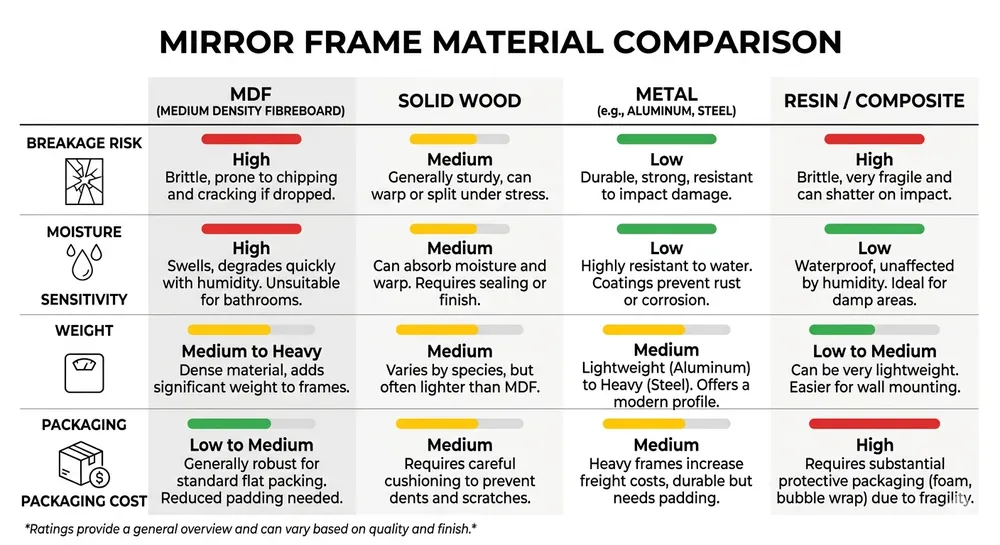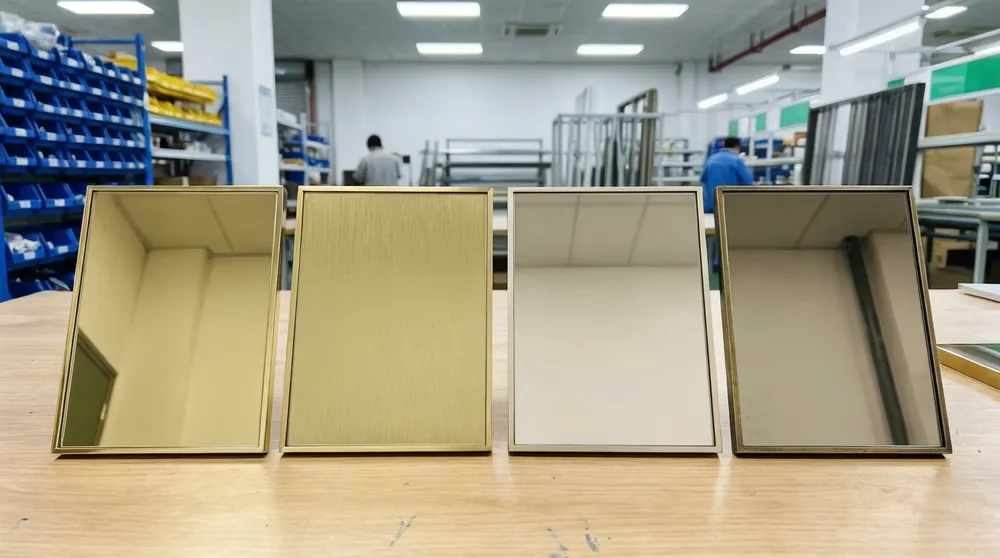
Finish inconsistency is the most common reason a bulk mirror order gets rejected at the receiving dock — and it's almost always preventable. Not at the packing stage. Not during final inspection. It's preventable at the spec stage, before production starts.
We've been running frame finishing lines at our Ho Chi Minh facility for over 12 years. MDF, solid wood, metal, resin — each substrate behaves differently under primer and topcoat, and each one has its own failure mode when the spec is vague or the process isn't controlled. What I see most often: buyers send a finish reference photo, a color name, and a target price. The factory interprets all three loosely. By the time 2,000 units are packed, the first and last pallets don't match.
This guide walks through exactly what to lock down before you place a custom frame mirror order — substrate prep requirements, coat count minimums, color reference standards, and the QC checkpoints that catch problems before they ship.

Why finish inconsistency happens — and where the spec breaks down
The short answer: finish inconsistency is a process control problem that starts with an underspecified order.
When a buyer sends a color reference without specifying gloss level, coat count, or primer type, the factory fills in the gaps with whatever is fastest or cheapest on their current line. That's not malice — it's how production scheduling works. If your spec doesn't constrain the process, the process will optimize for throughput.
The longer answer involves three compounding variables:
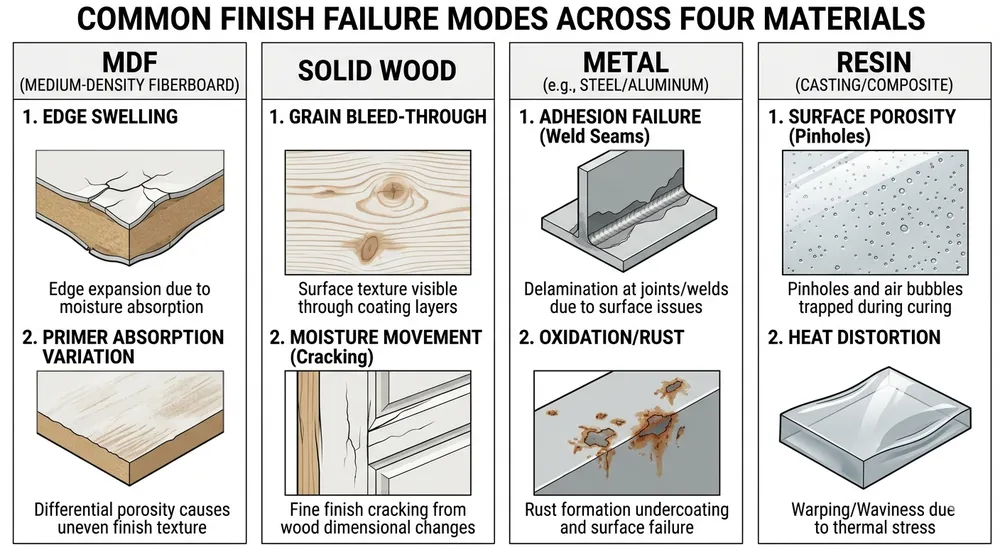
Substrate absorption variation. MDF and raw wood absorb primer unevenly, especially at cut edges and joints. Without a sealed primer coat applied at controlled thickness, the topcoat color reads differently across the same frame. We see this most on wide-profile MDF frames with routed decorative edges — the routed surface is more porous than the flat face, and if the primer schedule doesn't account for that, you get visible color banding.
Coat count shortcuts. A two-coat finish (primer + topcoat) is cheaper and faster than a three-coat system (primer + base + topcoat). On a smooth metal frame with a solid color, two coats may be fine. On a wood frame with a distressed or antiqued finish, skipping the base coat produces a flat, unconvincing result that looks nothing like the approved sample. If your spec doesn't call out minimum coat count, the factory will default to two.
Environmental variables during application. Coating adhesion is sensitive to ambient temperature and humidity at the time of application. In our facility, we maintain the finishing room at 20–28°C with humidity below 70% RH during coating and cure cycles. Factories without climate-controlled finishing areas see adhesion failures spike during monsoon season — the coating looks fine when it leaves the line, but peeling starts within weeks of the buyer receiving the goods. (This is one of the questions worth asking any new supplier directly: what are your finishing room conditions, and how do you monitor them?)
How to write a frame mirror spec that locks in finish consistency
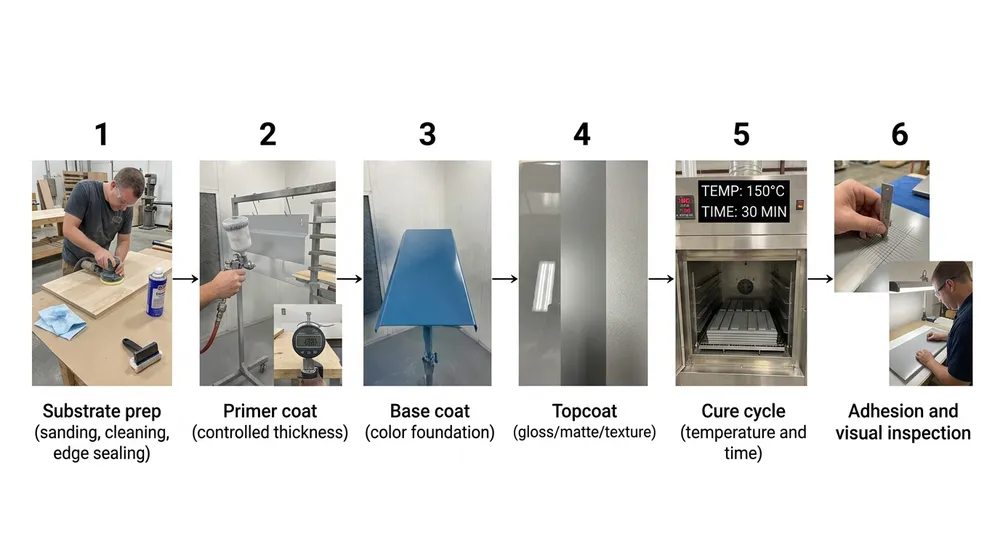
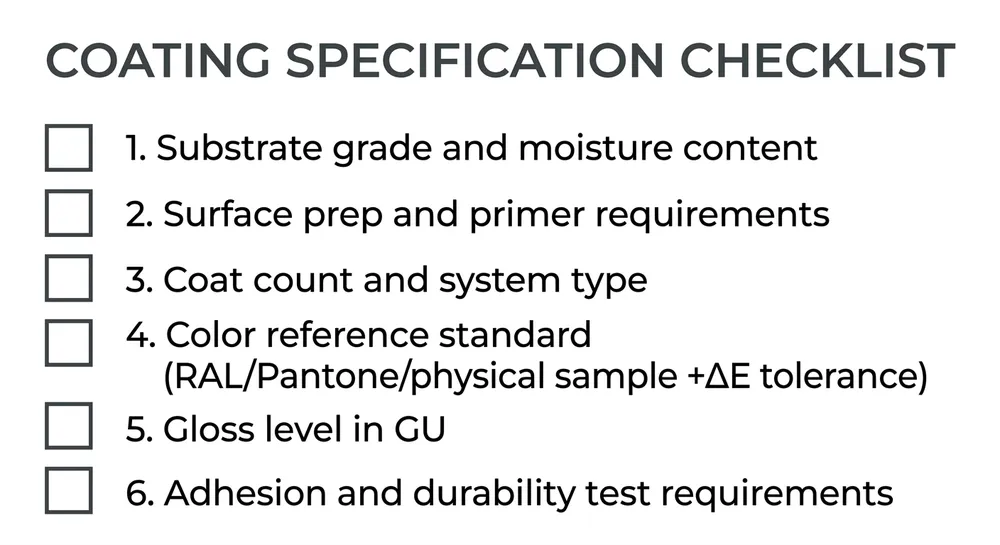
A finish spec that actually controls output has six components. Most buyer specs cover two or three. Here's what all six look like in practice:
1. Substrate and grade Don't just write "MDF frame" or "wood frame." Specify the substrate grade and moisture content requirement. For MDF, E1-grade (formaldehyde emission) is standard for export to Europe and North America. For solid wood, specify kiln-dried to 8–12% moisture content — frames built from wood above 12% MC will move after finishing, cracking the topcoat at joints.
2. Surface prep and primer requirements Specify sanding grit sequence (typically 120 → 180 → 240 for wood and MDF) and primer coat count. For porous substrates, require a sealing primer on all cut edges before the color primer coat. This single requirement eliminates most of the edge-absorption color variation we described above.
3. Coat count and system State the minimum number of coats and the system type. Example: "3-coat system: 1x sealing primer, 1x color base coat, 1x topcoat." For metal frames, specify whether the system is powder coat or liquid paint — they behave differently and have different adhesion requirements at weld seams.
4. Color reference standard A photo is not a color standard. Use one of:
- RAL or Pantone code for solid colors
- A physical approved sample retained by both parties
- A color tolerance callout: ΔE ≤ 2.0 under D65 illuminant is a workable standard for decorative mirror frames
If you're ordering a distressed, antiqued, or hand-applied finish, a physical sample is the only reliable reference. Specify that production batches must be compared against the retained sample under consistent lighting.
5. Gloss level Gloss level is measured in GU (gloss units) at 60°. Typical ranges:
- Matte: 5–15 GU
- Satin: 20–40 GU
- Semi-gloss: 50–70 GU
- High gloss: 80+ GU
Without a GU spec, "matte" to one factory is 8 GU and to another is 35 GU. The difference is visible across a product line.
6. Adhesion and durability requirement For export orders, specify cross-cut adhesion test per ISO 2409 (rating 0 or 1 acceptable) and minimum pencil hardness (typically 2H for topcoat on metal frames). For coastal or humid-climate markets, add a salt spray requirement — 48 hours minimum for standard decorative use, 96 hours for bathroom or outdoor-adjacent applications.
Material-specific finishing requirements and failure points
The spec framework above applies to all frame types, but each substrate has its own failure mode to watch for.
MDF frames
MDF is the most common frame substrate for mid-range decorative mirrors — it's dimensionally stable, takes paint well on flat surfaces, and machines cleanly for complex profiles. The failure points are at edges and joints.
Cut MDF edges are highly porous. Without edge sealing before primer, the topcoat color at the edge reads 10–15% darker than the face, which is visible on any frame wider than 30mm. We seal all MDF edges with a dedicated edge primer before the main primer coat — it adds one step but eliminates the color variation entirely.
Joint gaps are the other issue. MDF frames assembled with butt joints and no filler will show hairline cracks at the corners after finishing, especially if the frame goes through temperature cycling in transit. Require filled and sanded joints before any primer coat.
For buyers sourcing Frame Decor Mirrors in MDF with painted finishes, the spec should call out: E1-grade MDF, edge sealing primer, filled joints, minimum 3-coat paint system.
Solid wood frames
Wood moves. That's the fundamental challenge. A solid wood frame finished at 8% MC in a dry factory will absorb humidity in transit and expand slightly — enough to crack a rigid topcoat at mitered corners if the finish system isn't flexible enough.
Use a flexible topcoat formulation for solid wood frames, not the same rigid system used on MDF. Specify kiln-dried wood at 8–12% MC at time of finishing. For Wood Decor Mirrors with natural or stained finishes, also specify grain filler application before staining — without it, open-grain species like oak will show uneven stain absorption across the frame face.
The other wood-specific issue: knots and resin pockets in lower-grade timber bleed through paint finishes over time. Require A-grade or clear-grade timber for painted wood frames, or specify a shellac-based knot sealer in the prep sequence.
Metal frames
Metal frames — typically steel or aluminum — have a different failure profile. The substrate itself doesn't absorb coating, so the risk is adhesion failure rather than color variation.
The highest-risk points are weld seams and cut edges. Weld spatter and oxidation at seams prevent proper coating adhesion. We grind and chemically treat every weld before coating — without that step, you'll see peeling starting at the seam within months of delivery. Require weld grinding and phosphate or chromate pre-treatment in your spec for any welded metal frame.
For powder-coated metal frames, specify coating thickness: 60–80 microns is the standard range for decorative applications. Below 60 microns, coverage is thin at edges and corners. Above 100 microns, the coating can crack at bends. (We've seen buyers spec "thick powder coat" without a number — the factory interprets that as whatever comes off the gun, which varies by 30–40 microns batch to batch.)
For Gold Decor Mirrors and other electroplated finishes on metal frames, specify plating thickness in microns and require adhesion testing per ISO 2409 before shipment.
Resin frames
Resin frames are cast, not machined, so the surface quality depends on mold condition and release agent residue. Old or worn molds produce surface porosity — small pits that show through the topcoat as texture variation. Require mold inspection records or a pre-production sample from the specific mold that will be used for your order.
Resin also has lower heat resistance than metal or wood. In container transit through tropical ports, interior temperatures can reach 60–70°C. A resin frame finished with a standard topcoat not rated for that temperature range will show surface softening and gloss change on arrival. Specify a topcoat with heat resistance to at least 80°C for any resin frame going to Southeast Asia, Middle East, or similar markets.
QC checkpoints to require before shipment
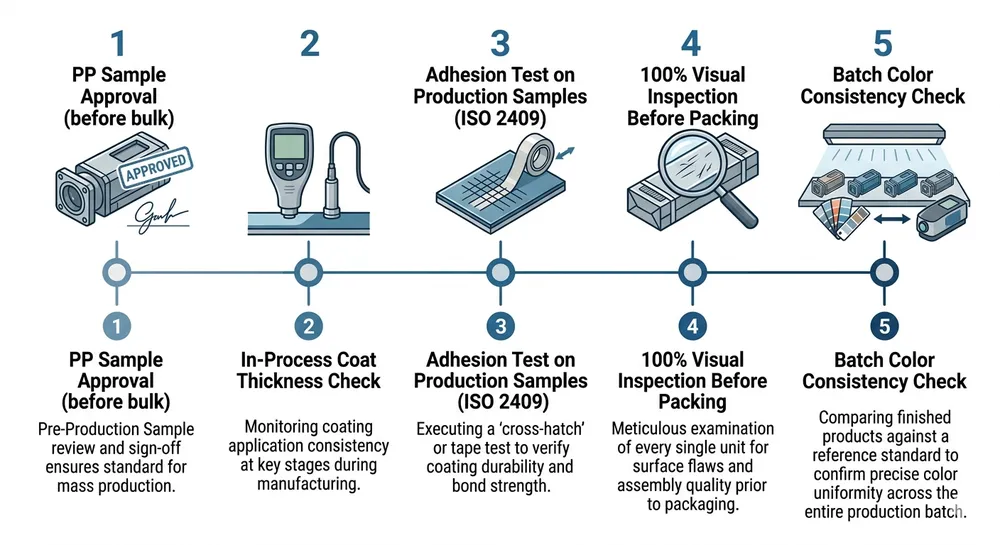
A finish spec controls what the factory is supposed to do. QC checkpoints confirm they actually did it. These are the checks worth requiring in your purchase order or quality agreement:
Pre-production sample approval Before bulk production starts, require a pre-production sample (PP sample) finished to your full spec. Evaluate it against your color reference under D65 lighting. Check gloss level with a gloss meter if you have one, or compare visually against a reference panel. Sign off in writing before production proceeds. This is the single most effective way to prevent batch-level finish surprises.
In-process coat thickness check For powder-coated metal frames, require wet film thickness checks during application. For liquid paint systems, require dry film thickness measurement on a sample of frames per batch. This catches coat count shortcuts before the full batch is committed.
Adhesion test on production samples Cross-cut adhesion test (ISO 2409) on 3–5 frames per production batch. Rating 0 (no flaking) or 1 (minor flaking at cut edges only) is acceptable. Rating 2 or above means the adhesion is failing and the batch needs investigation before packing.
100% visual inspection before packing Every frame should pass a visual inspection under consistent lighting before it goes into the carton. The inspection criteria should be written: acceptable color tolerance (ΔE ≤ 2.0), no visible brush marks or sags, no pinholes larger than 0.5mm, no joint gaps visible after finishing. At Livewellcraft, this is standard — every unit goes through visual inspection before packing, not a sample pull.
Batch color consistency check Pull 5–10 frames from different points in the production run (first, middle, last) and compare them side by side under D65 lighting. Color drift across a batch is the most common finish inconsistency complaint we hear from buyers who've had problems with other suppliers. If the factory can't show you this check was done, ask why.
Ordering mistakes that cause finish rejects — and how to prevent them at the RFQ stage
Most finish problems are locked in before production starts. These are the mistakes we see most often when buyers come to us after a bad experience with another supplier:
Sending a photo as the only color reference. Photos shift under different lighting and screens. A photo reference gives the factory a 10–15 ΔE interpretation window. Use RAL, Pantone, or a physical sample.
Not specifying gloss level. "Matte black" is not a spec. 10 GU matte black and 35 GU matte black look completely different on a mirror frame. Add the GU range.
Accepting a factory's standard finish without asking what it is. "Our standard finish" means whatever the factory runs most efficiently. Ask for the coat count, primer type, and topcoat system in writing before you confirm the order.
Skipping the PP sample to save time. The PP sample approval step is the cheapest insurance in the order process. Skipping it to move faster is how buyers end up with 2,000 units they can't sell.
Not specifying inspection criteria in the PO. If your purchase order doesn't state the acceptance criteria, the factory will use their own — which may be more lenient than yours. Write the criteria into the PO: color tolerance, gloss range, adhesion rating, visual defect limits.
Ordering across multiple production runs without a retained reference sample. If you reorder the same SKU six months later, the factory needs a physical reference to match against. Without a retained sample, color drift between runs is almost guaranteed.
When to request a pre-production sample run — and what to evaluate
The PP sample is your last checkpoint before bulk production commits. Here's what to actually evaluate when you receive it:
Color match under correct lighting. D65 (daylight) is the standard for decorative products. Don't evaluate under warm incandescent or fluorescent office lighting — both shift color perception significantly. If you don't have a D65 light box, a north-facing window on an overcast day is a reasonable substitute.
Gloss level. If you have a gloss meter, measure at 60°. If not, compare against a reference panel with a known GU value. The difference between 15 GU and 35 GU is visible to the naked eye on a flat frame surface.
Adhesion. Run a fingernail scratch test across the frame face and at a corner joint. This isn't a substitute for ISO 2409, but it catches obvious adhesion failures before you send the sample to a lab. If the coating lifts at the corner, reject the sample and ask for the primer schedule.
Joint quality. Check all four corners under good lighting. Hairline cracks at mitered joints on the PP sample will be worse in bulk production, not better. Require filled and re-finished joints before approving.
Edge finish on MDF frames. Run your finger along the inner and outer edges. If the edge feels rougher or looks darker than the face, the edge sealing step was skipped. Reject and require correction.
Packaging test. Ask the factory to pack the PP sample in the production carton and ship it to you. If the finish arrives damaged from a single-unit shipment, it won't survive a 40-foot container. Packaging problems are easier to fix before bulk than after.
For buyers working with our OEM frame mirror sourcing process, we send PP samples with a finish data sheet attached — coat count, primer system, topcoat type, measured gloss level, and adhesion test result. That documentation travels with the sample so you're evaluating the process, not just the piece.
Upstream prevention: what should be controlled before the order is placed
The QC steps above catch problems during production. But some finish inconsistencies are baked in before the first coat is applied — they come from material sourcing decisions the factory makes upstream of your order.
MDF batch variation. MDF density and surface smoothness vary between production batches and between mills. A factory sourcing MDF from multiple suppliers without incoming material inspection will see primer absorption vary batch to batch, which translates to color variation across your order. Ask your supplier whether they source MDF from a single approved mill or multiple sources, and whether they run incoming density checks.
Wood moisture content at intake. If the factory doesn't measure and record MC at timber intake, they're finishing wood at whatever moisture it arrived at. Frames built from high-MC timber will move after finishing. Require that your supplier documents MC at intake and holds timber in a conditioned storage area before frame assembly.
Metal pre-treatment consistency. Phosphate pre-treatment for powder coat adhesion degrades if the bath chemistry isn't monitored and refreshed. A factory running a depleted phosphate bath will produce frames that look fine on day one but fail adhesion within months. Ask whether they monitor bath chemistry and how often they refresh it.
Resin mold maintenance schedule. Worn molds produce surface defects that no amount of finishing can hide. Ask for the mold age and maintenance record for the specific mold used on your order.
These aren't questions most buyers think to ask at the RFQ stage. But they're the questions that separate a supplier who can hold finish consistency across 10,000 units from one who can hold it across 500.
We run dedicated frame lines per material type at our facility — the MDF line, the metal line, and the resin line each have their own prep and finishing sequences, not a shared process adapted on the fly. That separation is what makes it possible to hold consistent finish specs across large orders without the batch-to-batch drift that comes from running mixed materials through the same line. Browse our full range of Decor Mirrors by Material & Frame to see how the material-specific approach translates across product categories.
Practical FAQ
What's the minimum order quantity for a custom frame finish at Livewellcraft? MOQ starts at 100 pieces for standard frame profiles with custom color. For fully custom frame profiles (new tooling), the minimum is higher and depends on the profile complexity — our engineering team will confirm during the quote process.
Can I specify a custom RAL or Pantone color not in your standard range? Yes. We match custom colors using a spectrophotometer and produce a color standard panel for your approval before bulk. The color standard panel is retained at our facility for reorder matching.
How do you handle finish consistency on reorders placed months apart? We retain the approved color standard panel and the finish data sheet (coat count, primer system, topcoat batch reference) for each SKU. On reorder, production matches against the retained panel under D65 lighting before bulk approval. This is the only reliable way to hold color consistency across production runs separated by months.
What certifications cover your finishing processes? Our facility holds ISO 9001:2015, SGS, CE, and BSCI certifications. Adhesion testing follows ISO 2409. Salt spray testing follows ISO 9227 for orders requiring corrosion resistance documentation.
What if the finish on my bulk order doesn't match the approved PP sample? We don't ship product that fails the PP sample match. Our 100% visual inspection before packing includes comparison against the retained PP sample under D65 lighting. If a batch drifts outside the approved tolerance, it goes back through the finishing line before it reaches the packing stage.
If you're ready to place a custom frame mirror order — or want to send your current spec for a technical review — send us your requirements with frame material, finish reference, order quantity, and target market. We'll come back with a coating proposal, QC plan, and production timeline.