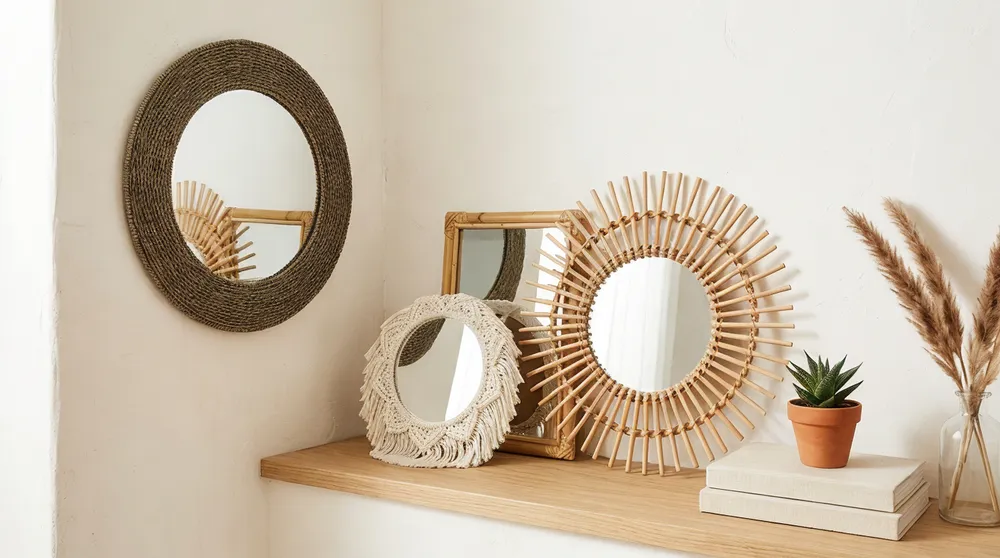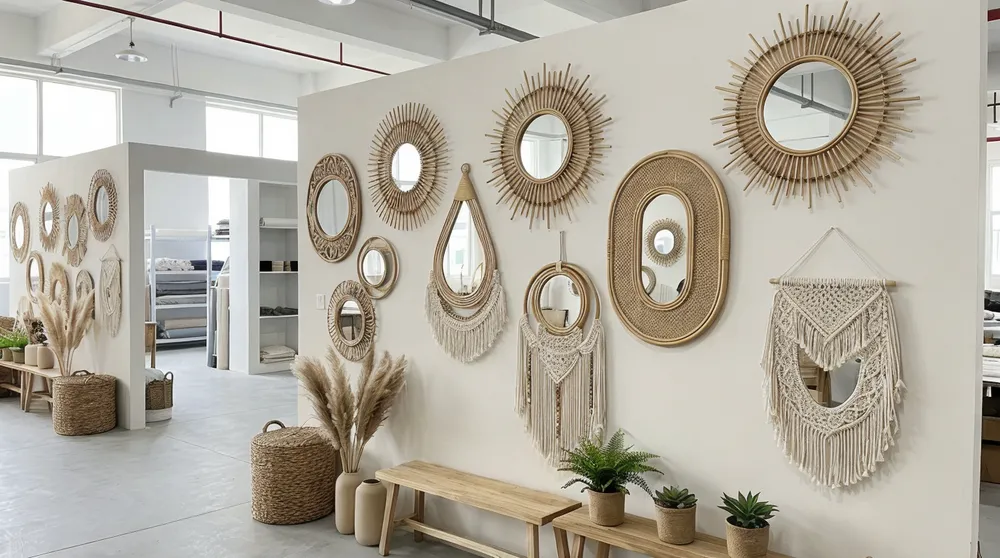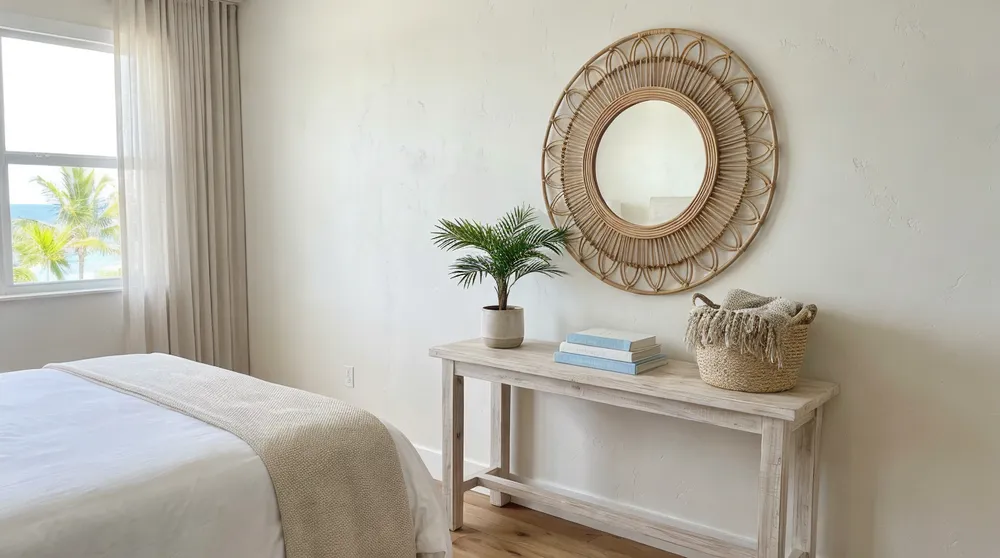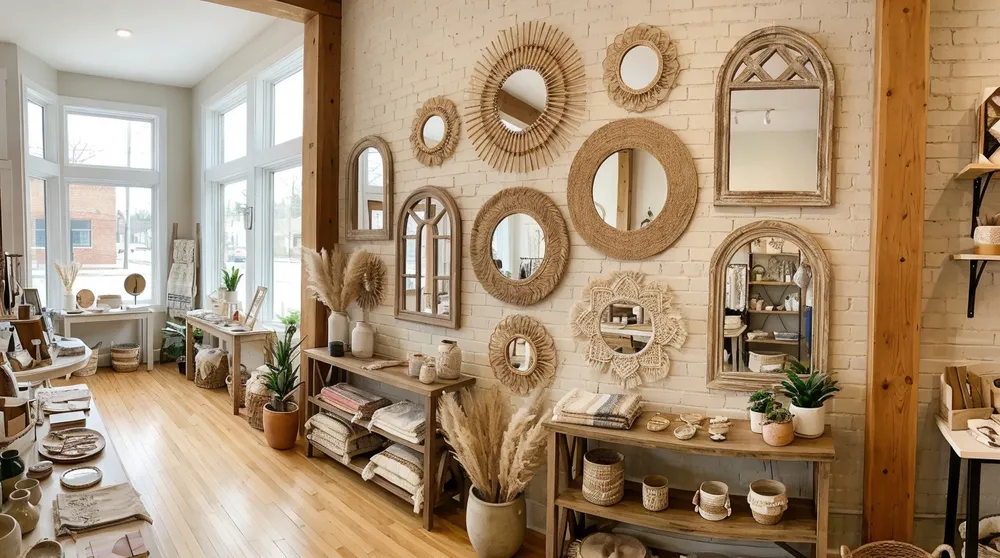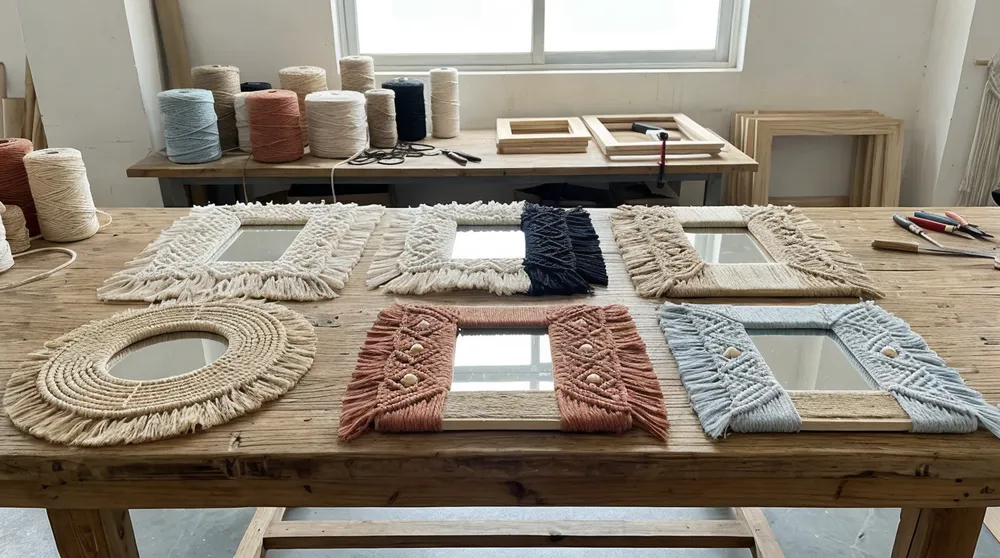
Bohemian decor mirrors manufactured with Vietnamese-sourced rattan, water hyacinth, and jute — your frame material cost stays low because our supply chain is short.
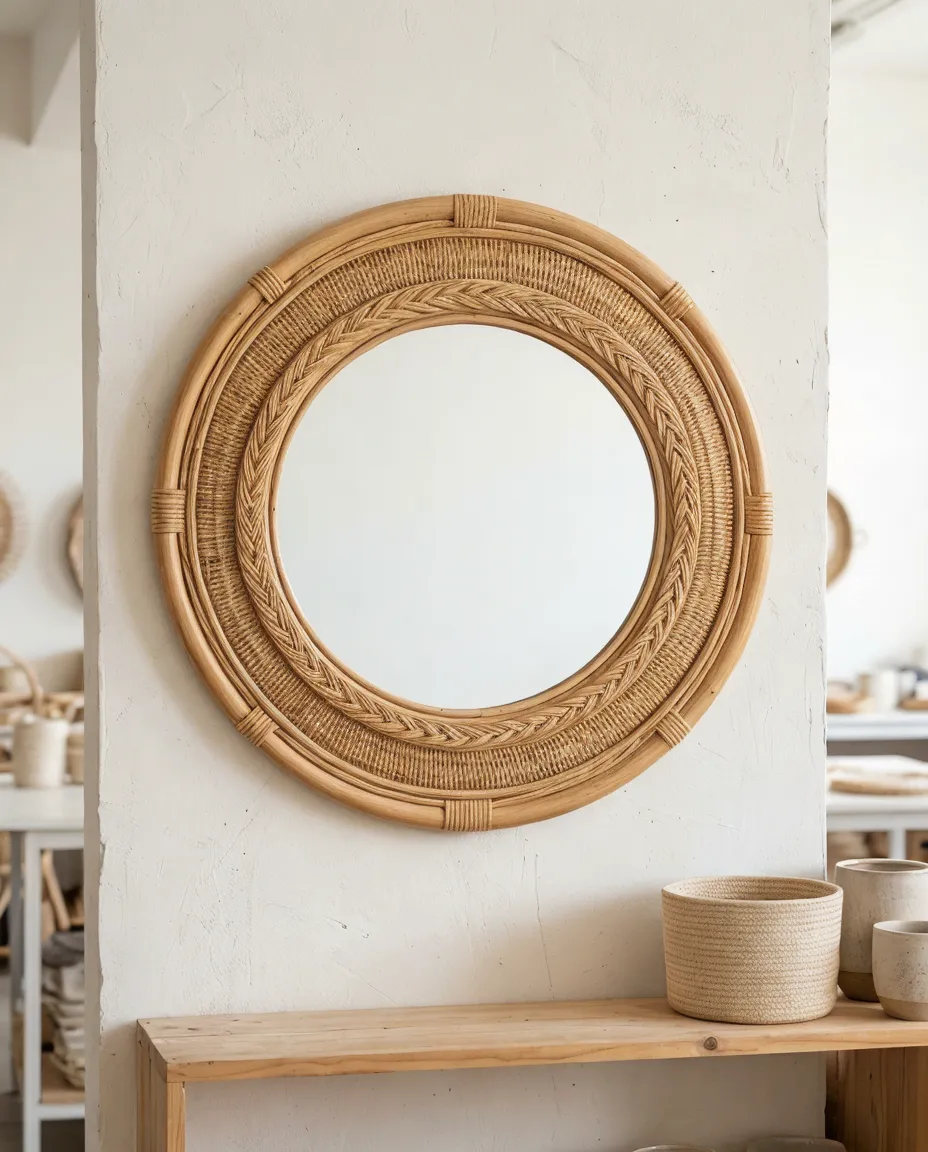
Livewellcraft produces bohemian decor mirrors that pair standard silvered glass panels with mixed-material natural fiber frames. We handle the frame weaving, mirror assembly, and retail-ready packaging in our 12,000 m² Dong Nai facility, so you source one SKU from one factory instead of coordinating a mirror supplier and a separate handicraft workshop.
Bohemian decor mirrors are mixed-material products. The mirror panel is the same copper-free silvered glass we use across all six style categories — same silvering line, same adhesion testing, same QC standard. The difference is entirely in the frame: natural fibers woven, wrapped, or assembled around a structural core, producing the organic, textured look that defines the bohemian aesthetic.
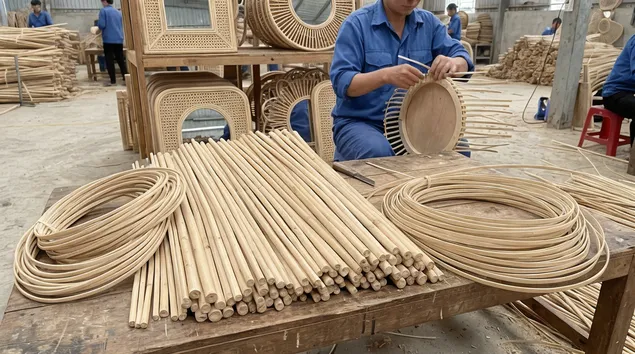
That frame construction is what makes boho mirrors a distinct sourcing category. Unlike our metal-framed modern mirrors or resin-cast vintage mirrors, bohemian frames involve handwork — rattan bending, jute wrapping, water hyacinth weaving. The labor content per unit is higher, but the raw material cost is lower than resin or metal. Your landed cost per piece sits between modern (lowest) and vintage (highest), while your retail price point can push closer to vintage territory because buyers perceive natural-material craftsmanship as premium. That spread is where your margin lives.
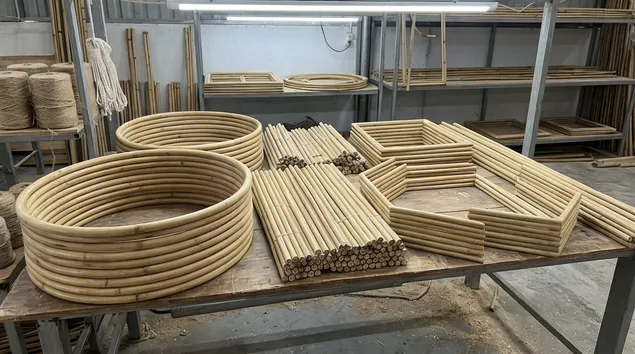
We produce bohemian decor mirrors on our mixed-material assembly station, which is set up specifically for frames that combine structural substrates (MDF ring, metal wire form, or bamboo hoop) with natural fiber finishing. The structural core gives the mirror hanging stability and long-term shape retention — pure rattan frames without internal reinforcement tend to warp in climate-controlled retail environments where humidity drops below 40%. We solved that early.
We lost a 600-piece order to warping complaints in 2016 before we standardized the internal core. Every boho frame since then ships with a rigid substrate.
Landed cost sits between modern (lowest) and vintage (highest) in our style range
Natural-material craftsmanship commands premium pricing closer to vintage territory
The spread between your cost and achievable retail price is where your margin lives
This is the commercial reason to source bohemian decor mirrors from a Vietnamese manufacturer rather than a Chinese or Indian one. Rattan, water hyacinth, seagrass, and jute are locally harvested materials here — our frame material suppliers are within Dong Nai and neighboring provinces, which means a 1-3 day material delivery cycle instead of cross-border import logistics.
Natural fiber frame materials account for roughly 20-30% of the bohemian mirror's total production cost. When a factory in another country imports these same materials, they absorb freight, customs duties, and longer lead times on material restocking. We don't. That cost difference flows directly into your FOB price.
Our primary bohemian frame material. We use whole rattan poles (8-15mm diameter) for structural hoops and split rattan peel for decorative weaving. Rattan frames get a clear lacquer seal after assembly to lock in moisture content and prevent cracking in dry climates.
Suppliers in Tay Ninh province — consistent diameter grading, kiln-dried to 10-12% moisture content before it reaches our floor.
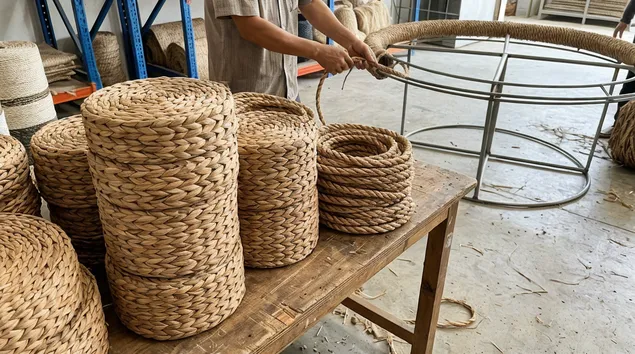
Woven into flat braids or twisted rope, then wrapped around a structural core. Water hyacinth gives a chunkier, more textured look than rattan. It's the material we recommend for oversized bohemian mirrors (800mm+ diameter) because the braid width fills the frame area without looking sparse.
Material cost is the lowest in our natural fiber range — water hyacinth is abundant and fast-growing in the Mekong Delta region.
Used for macramé-style bohemian mirrors — the frame is a knotted hanging structure rather than a rigid hoop. These are the lightest mirrors in our boho line, which improves your container loading density.
Jute and cotton rope frames are assembled by our macramé team on dedicated jigs that ensure consistent knot spacing and symmetry across a production run.
Structural hoops and geometric frame elements. Bamboo frames are the most rigid option in the bohemian range and work well for rectangular and arch-shaped mirrors where rattan's flexibility would require heavier internal reinforcement.
We source Tam Vong bamboo — dense wall thickness, minimal taper — and treat it with borax solution for insect resistance before finishing.
These are production-ready specifications on existing tooling. If your design falls within these ranges, there's no mold fee and no sampling delay — we pull from existing frame jigs and mirror cutting templates.
| Parameter | Standard Range | Notes |
|---|---|---|
| Mirror glass | 3mm or 4mm float glass, copper-free silvering | 4mm is default for mirrors over 600mm; 3mm for smaller accent sizes |
| Glass shape | Round, oval, arch, teardrop, irregular organic | Round is the highest-volume bohemian shape — roughly 70% of our boho orders |
| Mirror diameter/height | 200mm to 1200mm | Larger sizes available on custom order with reinforced hanging hardware |
| Frame materials | Rattan, water hyacinth, jute, cotton rope, bamboo, seagrass | Single-material or mixed-material combinations |
| Frame width | 30mm to 150mm from glass edge | Wider frames on macramé and water hyacinth styles |
| Structural core | MDF ring, metal wire form, or bamboo hoop | Selected based on frame material and mirror size |
| Finish | Clear lacquer, natural stain, whitewash, light walnut | Custom stain colors available at 200-piece MOQ per color |
| Hanging system | D-ring, jute loop, macramé cord hanger | Configured per your market's wall mounting preference |
| Unit weight | 0.8 kg (small accent) to 5.5 kg (1200mm with rattan frame) | Weight affects your shipping cost tier — we optimize frame design to stay under common carrier thresholds |
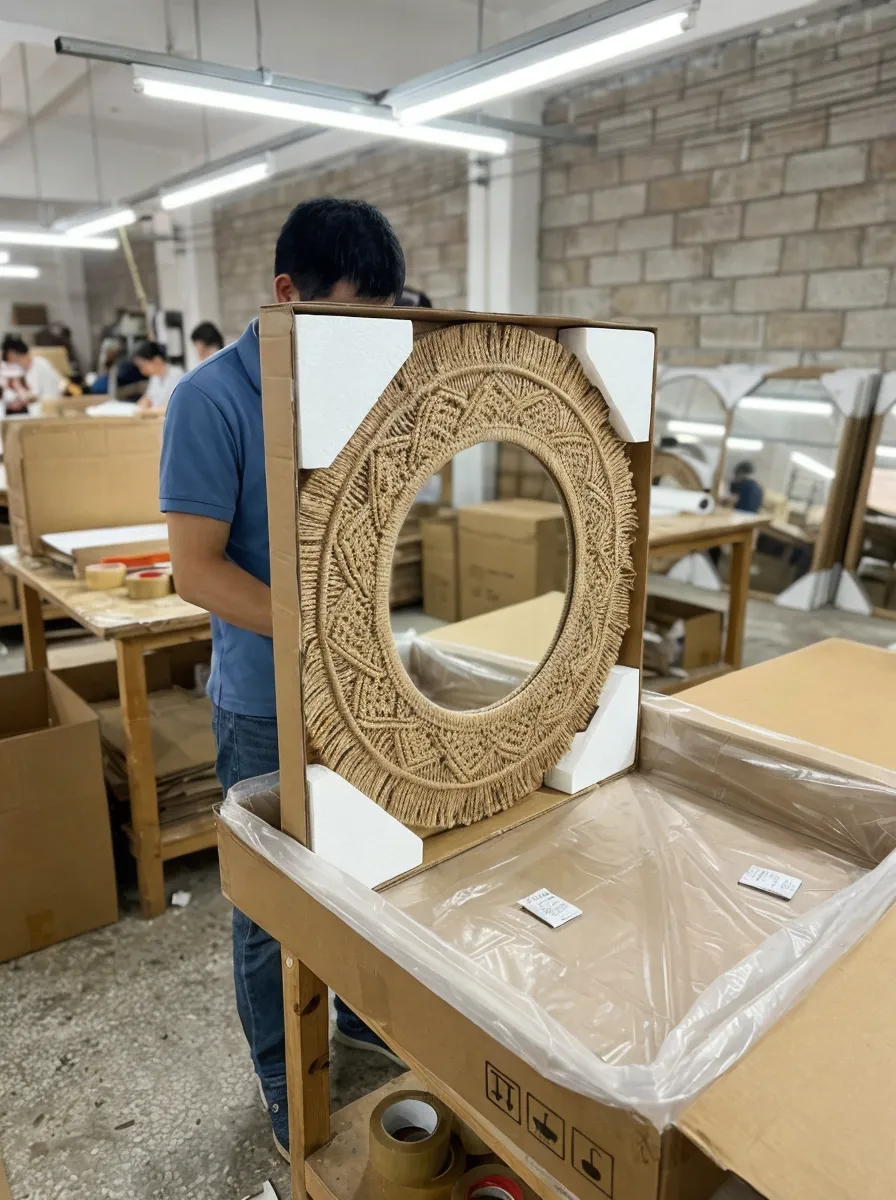
| Packaging | Individual poly bag + corrugated carton with foam corner protection | Retail-ready packaging with barcode and insert available |
Every mirror style maps to specific sales channels. Bohemian decor mirrors have a narrower but loyal buyer base compared to modern mirrors, and the margins are better. Here's where our wholesale bohemian decor mirrors buyers are placing them:
Online home decor brands — particularly those positioned around coastal, boho-chic, or natural living aesthetics — are the largest single channel for our bohemian mirrors. These buyers typically order 300-1,000 pieces per SKU, reorder quarterly, and need 3-5 SKU variations (different sizes or frame materials) to build a cohesive collection page.
The product photographs well against neutral backgrounds, which matters when your conversion rate depends on the listing image. We can supply lifestyle-ready product photos from our in-house photography setup if you need them for your initial listing.
Bohemian mirrors sell on a seasonal curve. Our order volume for boho SKUs peaks in Q1 and early Q2 as retailers stock for spring and summer floor sets.
If you're planning a seasonal collection, book your production slot by December to ship in February-March. We reserve mixed-material station capacity for boho orders during this window because demand is predictable.
(If you wait until March to place a spring order, you're competing for production time with everyone else who planned ahead.)
Hotels, vacation rentals, and resort properties in coastal markets use bohemian mirrors in guest rooms, spa areas, and lobby accent walls. These are project orders — typically 50-200 units of a single design, specified by an interior designer or procurement firm.
The natural fiber frames fit the coastal design brief without the premium price tag of custom artisan pieces. Your margin on hospitality projects is strong because the buyer is comparing your price against one-off artisan workshops, not against mass-market retail.
Independent home decor shops and gift stores order in smaller quantities — 20-50 pieces across 3-4 designs — but they reorder consistently and accept higher wholesale price points than chain retail.
If you distribute to this channel, our 100-piece MOQ per SKU on standard models lets you stock multiple designs without overcommitting inventory.
Bohemian mirrors are among the most customizable products in our style range because the frame construction is manual rather than mold-dependent. That flexibility has limits, though, and being upfront about them saves you sampling rounds.
Frame finish and weave pattern samples available during the quotation process
Ready to discuss your customization requirements?
Reference images, target sizes, finish preferences — send us the details and we'll return a technical proposal.
Packaging matters more for bohemian mirrors than for metal or resin-framed styles. Natural fiber frames are dimensionally bulkier and more susceptible to crushing during transit. We've refined our boho packaging over several years of ocean freight shipments, and the current damage rate on bohemian mirrors is under 0.8% — comparable to our hard-frame styles.
Each bohemian mirror ships in an individual corrugated carton with foam corner protectors around the mirror glass and a secondary cardboard sleeve supporting the frame perimeter. For macramé mirrors with hanging cords, we fold and secure the cord inside the carton with a paper tie to prevent tangling. Cartons are palletized with edge protectors and stretch-wrapped for container loading.
Container loading density depends on frame size and style. As a rough guide:
We provide exact loading plans with your quote so you can calculate your landed cost per unit before confirming the order.
If you're shipping to dry climates — Middle East, inland US, parts of Australia — ask us about our humidity-stabilized packaging option.
We include silica gel packs and a sealed poly liner inside the carton to prevent the natural fibers from drying out and becoming brittle during transit and warehouse storage.
Small cost addition, prevents customer complaints.
Bohemian mirrors serve a specific market segment. If your product mix needs a different aesthetic or your target channel doesn't align with the boho buyer profile, here are the sibling style categories we produce on the same factory floor:
Lowest landed cost per unit in our range. Slim metal or frameless designs for volume retail and e-commerce. If you need high container density and broad market appeal, start here.
Trend-driven shapes (wavy, asymmetric, tinted glass) that perform well on visual-first platforms. Sits between modern and bohemian in both price point and design complexity.
Ornate resin or carved wood frames with antiqued finishes. Higher frame cost, higher retail margin. Strong in specialty retail and interior design trade.
Geometric precision in metal or metallic-plated resin. Hospitality lobbies, commercial interiors, and high-end retail.
Oversized formats, premium finishes, semi-custom production. Project-driven orders with the highest per-unit margin.
You can mix styles within a single purchase order. Most of our distribution partners source 2-3 style categories from us to cover different price tiers in their catalog.
Browse all style categories100 pieces per SKU on standard catalog designs. Custom OEM bohemian mirrors — new frame patterns, custom sizes, or branded packaging — carry a 200-piece MOQ per SKU because of the jig setup and sampling involved. You can combine multiple boho SKUs in a single order to fill a container efficiently.
Depends on your price positioning. Rattan frames look more refined and hold tighter dimensional tolerances — they suit mid-to-premium retail where the product sits on a shelf next to $80-150 home decor. Water hyacinth frames have a chunkier, more rustic texture that reads well in photos and works for the $30-70 e-commerce price range.
Water hyacinth is also our lowest-cost natural fiber frame material, so your FOB price drops roughly 10-15% compared to equivalent rattan designs. We can send you samples of both to test with your buyers.
Natural fibers lose moisture in low-humidity environments, which can cause cracking or loosening over time. We mitigate this two ways: every natural fiber frame gets a clear lacquer seal that locks in moisture content, and the structural core (MDF or metal) maintains the frame's shape even if the outer fiber layer shifts slightly.
For markets with consistently low humidity — Middle East, desert Southwest US, heavily air-conditioned retail spaces — we recommend our humidity-stabilized packaging and advise your end customers to avoid placing the mirror in direct sunlight or next to heating vents. Our return rate on bohemian mirrors across all markets is under 1.2%.
Yes, and this is how most OEM orders start. Send us a photo or a competitor product link, and our engineering team will assess production feasibility, recommend the closest frame material and weave pattern, and produce a sample within 15-20 days. We'll flag any design elements that need modification for production efficiency or structural integrity — sometimes a reference design uses a weave pattern that looks good on a single artisan piece but doesn't scale to 500-unit production runs, and we'll suggest an alternative that achieves the same visual effect at consistent quality.
Standard catalog designs: 30-35 days from order confirmation to ready-for-shipment. Custom OEM designs with new frame patterns: add 15-20 days for sampling and approval before production begins. For seasonal orders (spring/summer retail), we recommend placing orders by December-January to ship in February-March. We send a detailed production schedule with your order confirmation so you can coordinate freight booking and warehouse receiving.
Our facility is ISO 9001:2015 certified, and we've passed SGS and BSCI audits. For EU markets, we provide CE documentation. For North American retail, our mirrors meet the labeling, packaging, and safety requirements of major retailers — we've supplied Walmart, Wayfair, and Amazon programs.
The mirror glass uses copper-free silvering, which meets EU environmental directives. All certification and audit reports are available on request. Send us your compliance checklist and we'll confirm coverage before you commit to an order.
Most new buyers in this category start with a 2-3 SKU sample order to test which frame materials and sizes resonate with their customers. We can ship samples within 7-10 days on standard designs, 15-20 days on custom patterns.
Tell us your target market, preferred frame materials, and quantity expectations — we'll come back with a technical proposal, FOB pricing, and a production timeline.