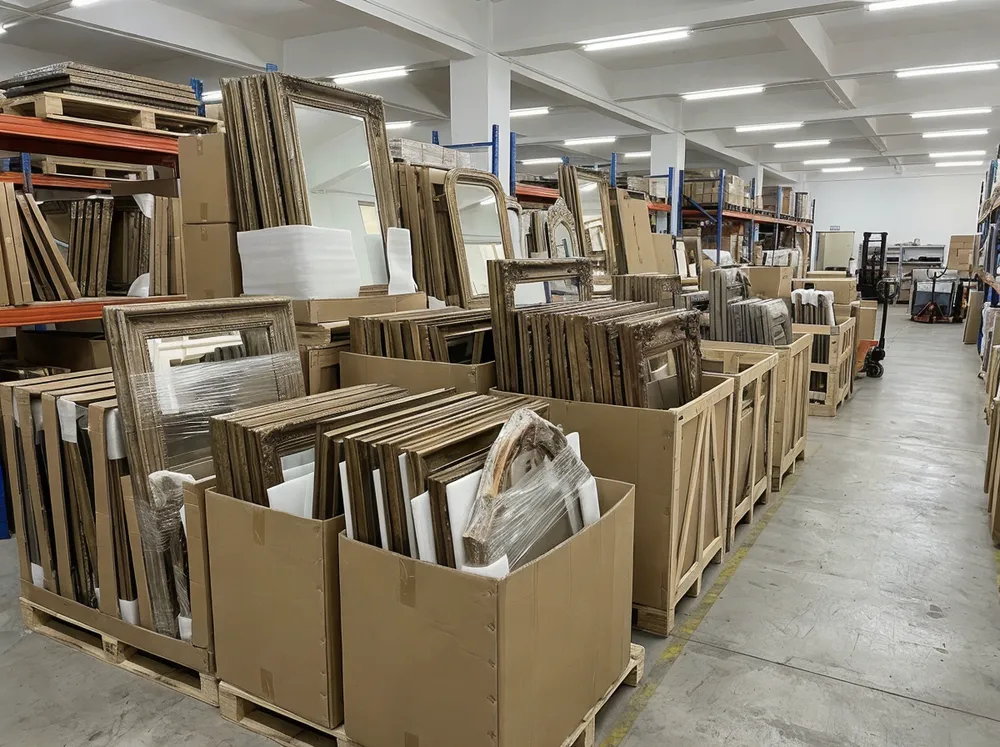
Deep-relief resin and carved wood frames, hand-finished in antiqued gold, silver, and distressed patina — manufactured at our Dong Nai facility for distributors, retailers, and hospitality buyers.
The frame work on vintage mirrors is the most labor-intensive in our style range. That complexity is exactly what drives your retail markup — your buyers pay for the craftsmanship, not the glass.
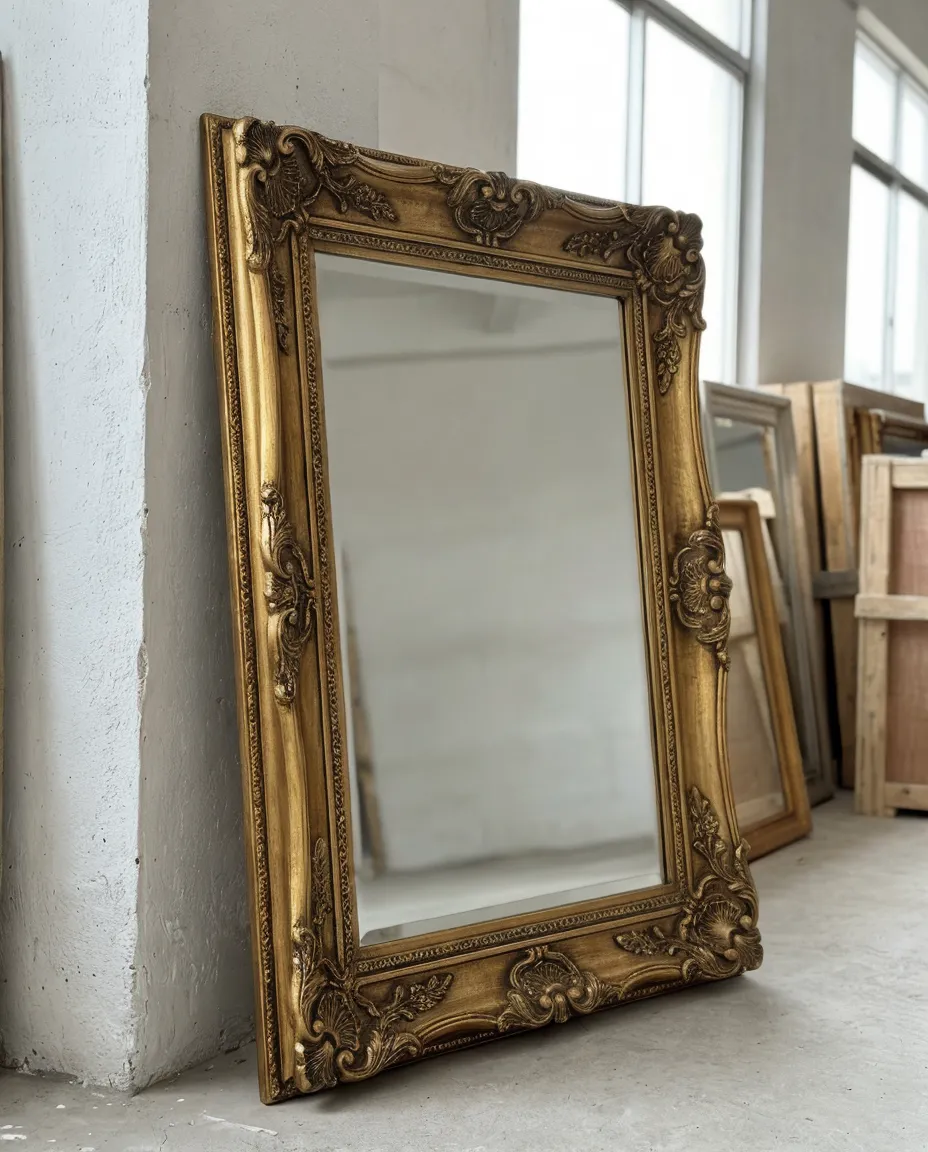
Vintage decor mirrors are defined by their frame work — ornate profiles with deep relief detail, multi-layer finishing, and aged patina effects that give each piece visual weight and perceived history. The glass panel uses the same copper-free silvering process and QC standard as every mirror we produce. The difference — and the reason vintage mirrors sit at a different price point than modern or aesthetic lines — is entirely in the frame.
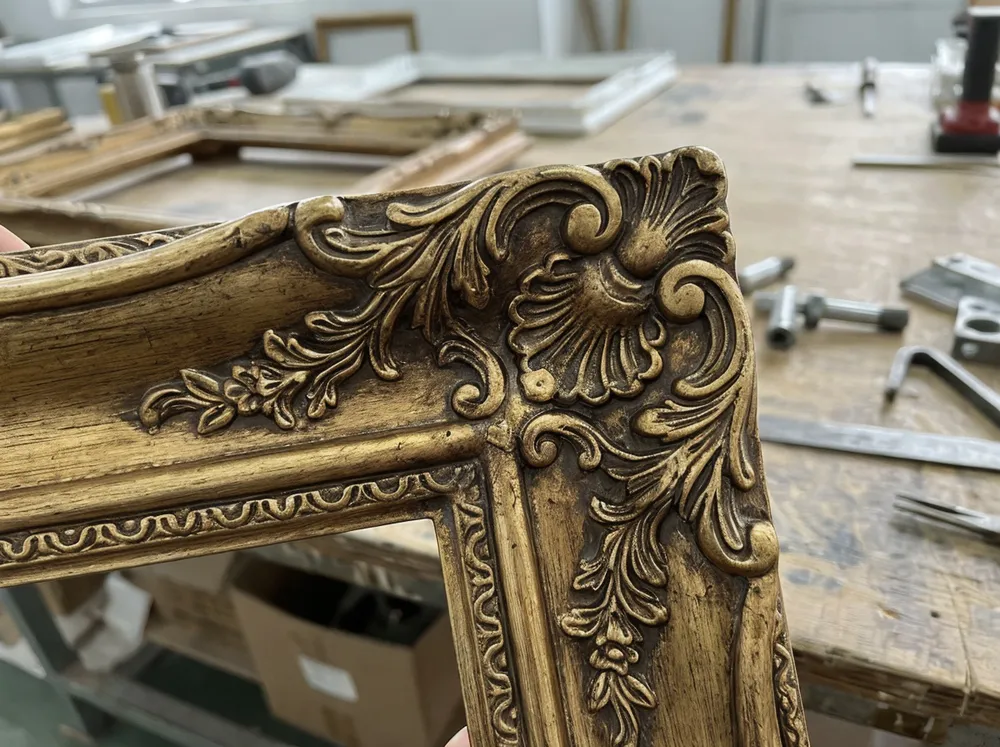
We manufacture vintage mirror frames primarily in cast resin and carved MDF, with solid wood available for premium programs. Resin casting allows the deep-relief ornamental detail (scrollwork, floral motifs, baroque profiles) that defines the vintage aesthetic. MDF frames take a different route — CNC-carved profiles with multi-coat finishing and hand-rubbed patina. Both paths produce frames that look and feel like antique pieces, but they're engineered for production consistency across thousands of units.
If you're sourcing mirrors where the frame carries the perceived value — and your downstream pricing reflects that — vintage is the category where your FOB-to-shelf markup is widest in our entire style range.
The parent category page covers how style drives frame engineering across all six lines — read the full breakdown here. This page focuses on what's specific to vintage: the frame construction, finishing process, and commercial positioning that make this line worth stocking.
Request vintage mirror samplesDeep-relief ornamental detail — scrollwork, floral motifs, baroque profiles. Fiberglass mesh core for structural integrity.
CNC-carved profiles with multi-coat finishing and hand-rubbed patina. Consistent grain-free surface.
Available for premium programs requiring natural material certification or specific wood species.
Complete specification reference for vintage decor mirrors. All parameters are configurable within stated ranges for custom programs.
| Mirror glass | 4mm float glass, copper-free silver coating with multi-layer protective backing |
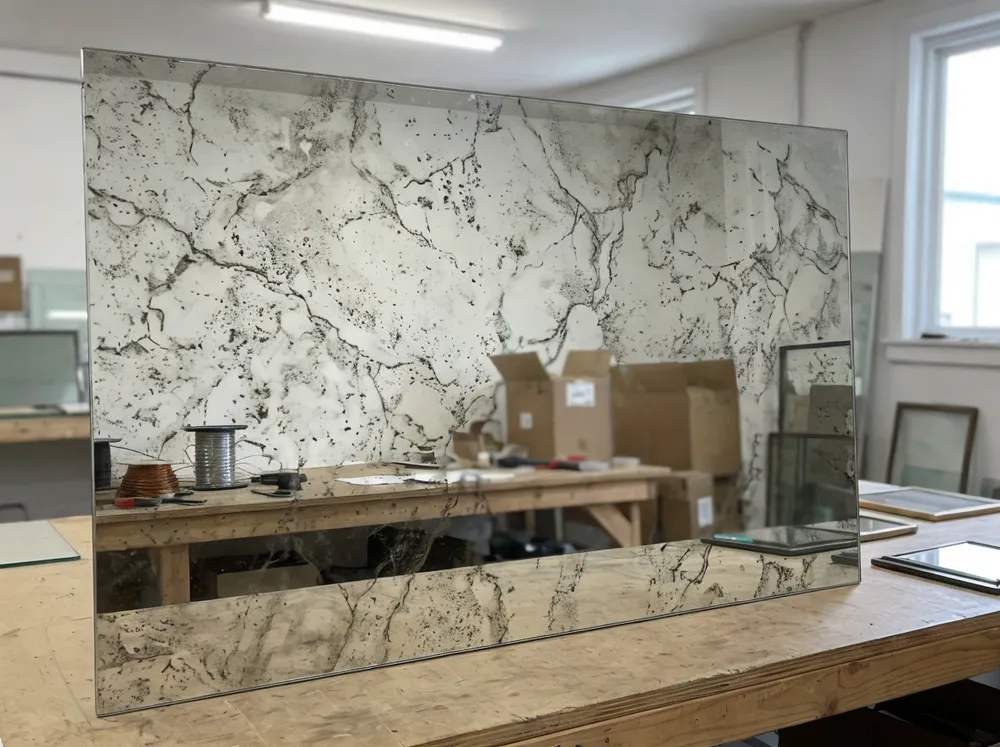
| Glass options | Clear silver mirror, antiqued mirror (distressed veining effect), beveled edge available |
| Frame materials | Cast resin (standard), carved MDF, solid wood (premium) |
| Frame profile depth | 30mm–80mm depending on design (deeper than modern/aesthetic lines) |
| Standard finishes | Antiqued gold, antiqued silver, distressed white, aged bronze, champagne, matte black with gold accent |
| Custom finishes | Any Pantone or RAL reference — matched and sampled before production |
| Size range | 300mm diameter (accent) to 1500mm height (statement/full-length) |
| Shapes | Round, oval, rectangular, arch-top, irregular ornate |
| Hanging hardware | French cleat (standard for pieces over 800mm), D-ring, wire, keyhole — configured per your market's wall type |
| Frame reinforcement | Fiberglass mesh core on all resin frames |
| Net weight range | 2.5 kg (small accent) to 18 kg (large statement piece) |
| Packaging | Individual poly bag + foam corner protection + corrugated carton; retail-ready or bulk options |
The distressed veining is applied during the silvering stage, not printed on afterward. Each piece has a slightly different pattern, which is actually a selling point for retail buyers who want one-of-a-kind character.
All parameters are configurable for orders meeting MOQ. Send your requirements for a detailed quote.
Send Spec Requirements
The vintage mirror frame goes through more production steps than any other style we make. A modern brushed-metal frame runs through three steps: deburring, powder coat, cure. A vintage resin frame runs through six: casting, demolding, sanding, base coat, hand-applied patina, and protective clear coat. Each step adds labor and material cost to your FOB price — but it also adds perceived value that your buyers can see and feel the moment they pick up the piece.
We cast resin frames using silicone molds that capture fine ornamental detail — scrollwork ridges, leaf veining, rope-twist borders. The mold quality determines whether those details read as crisp or muddy on the finished frame, so we replace molds on a defined cycle rather than running them until the detail degrades.
Careful extraction preserves the fine ornamental details captured during casting. Each frame is released from its silicone mold with precision to maintain the integrity of scrollwork and decorative elements.
After demolding, each frame gets hand-sanded to clean up parting lines and any flash. This step ensures a smooth foundation for the finishing layers that follow.
The base coat goes on by spray — typically a warm undertone (raw umber for gold finishes, cool gray for silver) that creates depth when the patina layer goes over it. This foundation color is critical to the final aged appearance.
The patina step is where vintage frames earn their margin. Our finishing team applies the aged effect by hand — dry-brushing metallic highlights onto raised surfaces, wiping back recessed areas to let the dark base coat show through, building up the layered look that makes a new frame read as a found antique.
This isn't a single-pass operation. The finisher works the piece, checks it against the approved sample, and adjusts until the aging pattern matches. We've trained this team specifically on vintage finishing techniques, and most of them have been doing this work for 5+ years.
The final clear coat locks the patina in place and adds scratch resistance for retail handling. We use a matte or satin clear depending on the finish spec — high-gloss clear coat on a vintage frame looks wrong, and we'll push back if a buyer requests it.
We learned early that gloss kills the antique illusion. Every buyer who tested gloss samples came back to matte.
The result is a hand-finished look that holds consistent across a 2,000-piece production run — close enough to match on a retail shelf, varied enough that each piece has individual character.
Pricing Power: This six-step process is why vintage mirrors cost more per unit than modern or aesthetic lines. It's also why your retail price point can sit 2–3× above a comparable modern mirror without resistance from end customers. The frame tells the story.
Vintage decor mirrors don't compete on price — they compete on perceived value. That positions them in segments where commodity mirrors don't get a second look.
Independent home decor stores, design-focused chains, and gift shops are the primary channel for vintage mirrors. These retailers curate their assortment — they want pieces that stop foot traffic and justify a premium shelf price.
Vintage mirrors with ornate gold or silver frames photograph well for in-store displays and social media, which drives sell-through without heavy discounting.
Typical Order Pattern
6–12 SKUs, 50–200 units per SKU, reorders on bestsellers every 60–90 days
Hotels, restaurants, upscale salons, and event venues use vintage mirrors as statement decor — lobby focal points, dining room accent walls, salon station mirrors.
Hospitality buyers order by project, typically 20–100 units in coordinated designs. The per-unit value is high, and these buyers often need custom sizing to fit specific wall dimensions.
Custom Capability
We handle project-specific modifications on existing vintage designs without requiring a full new mold — resizing within the frame's profile range is a tooling adjustment, not a redesign.
Designers specifying mirrors for residential projects source through trade showrooms and to-the-trade distributors. Vintage mirrors are a staple in traditional, transitional, and French country design schemes.
If you supply the design trade, vintage mirrors give you SKUs that designers actively seek out — and designers tend to reorder the same pieces across multiple projects once they find a source they trust.
Vintage mirrors perform well in the $80–$300+ retail price range on platforms like Wayfair, Amazon, and independent e-commerce stores. The ornate frame photographs distinctively — it stands out in search results against a sea of minimalist competitors.
Fulfillment Ready
We supply retail-ready packaging with UPC labels and FBA-compliant carton dimensions for Amazon sellers, so your fulfillment pipeline doesn't require repackaging at the warehouse.
Repackaging large mirrors at a 3PL is a damage event waiting to happen — we've seen enough claims to know it's worth getting the box right at the factory.
We'll suggest a starter SKU mix tailored to your channel and price positioning.
Vintage mirrors are our most-customized line. Buyers in this category rarely want a catalog piece exactly as-is — they want a specific finish tone, a size that fits their planogram, or a frame profile that matches their existing collection. Here's what you can modify and what the constraints are.
Profile selection and tooling options
40+ vintage frame profiles in our catalog — baroque, rococo, neoclassical, farmhouse distressed, Victorian, and transitional ornate. Selecting from existing molds eliminates tooling cost and cuts your sample lead time to 10–15 days.
New frame profiles require a silicone mold, which takes 20–25 days and carries a one-time tooling fee (refundable against your first production order above a set quantity). Send us a reference image or sketch — our design team will produce a 3D rendering for your approval before cutting the mold.
Adjusting width, depth, or corner detail on an existing profile is simpler than a full new mold. We can modify most catalog frames within ±15mm on profile dimensions without new tooling.
Patina, colorways, and aging intensity
Antiqued gold, antiqued silver, distressed white, aged bronze, champagne, matte black with gold rub — these are production-ready with no setup fee.
Any Pantone, RAL, or physical sample reference. We spray a sample panel and ship it for your approval before production. Custom colors require a 300-piece minimum per colorway to justify the line changeover.
You can specify the degree of aging — light wash (subtle, modern-vintage crossover), medium (our standard), or heavy distress (deep contrast, more rustic). We photograph the approved sample from three angles and use it as the QC reference standard on the production floor.
Standard catalog sizes range from 300mm to 1500mm on the longest dimension.
Custom sizing is available within the structural limits of each frame profile — resin frames can scale up to approximately 1800mm before weight and shipping fragility become concerns.
For oversized pieces, we recommend solid wood frames with reinforced backing. We'll advise on the practical limits when you send your size requirements.
Custom retail packaging — printed cartons, branded inserts, care cards, assembly instructions in your language — is available on all orders.
Minimum for custom print packaging is 500 units per SKU.
Below that, we apply your brand labels to our standard white-box packaging.
Send your customization requirements
We'll confirm feasibility and quote within 48 hours
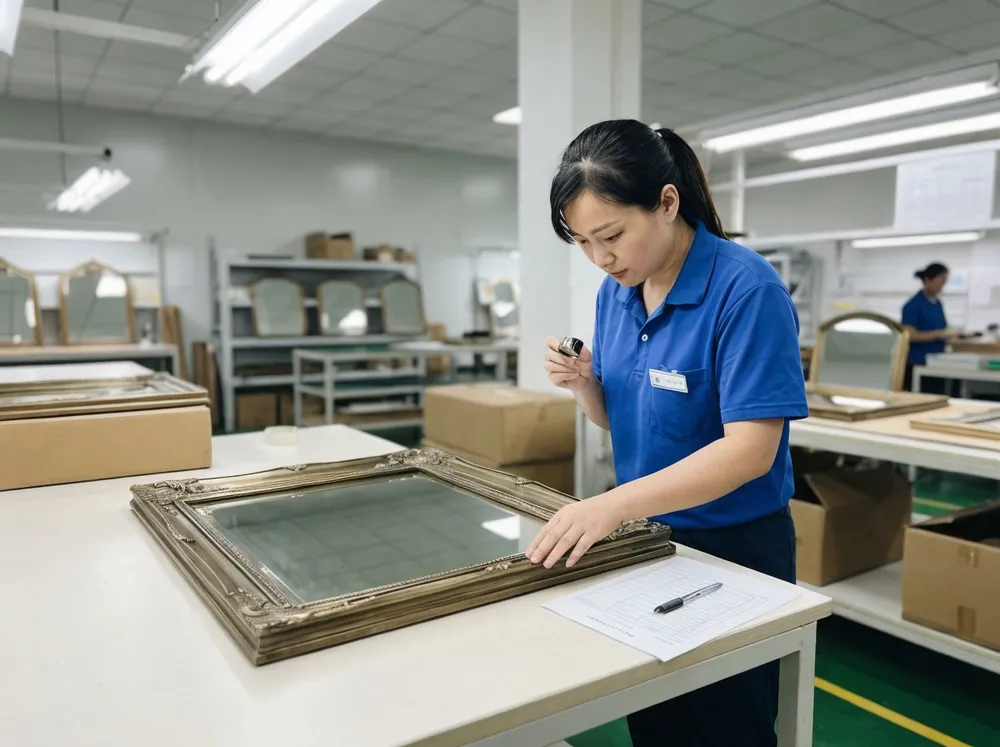
Every mirror we ship passes our standard QC protocol — 100% visual inspection and silver coating adhesion testing. Vintage mirrors add three additional checkpoints because the hand-finished frames introduce variability that automated lines don't.
After the finishing team completes each batch, our QC inspector compares a random sample against the approved reference piece under standardized lighting.
The acceptable range is defined during sample approval — we photograph the "lightest acceptable" and "darkest acceptable" versions and use those as boundary references. Pieces outside the range go back for touch-up or refinishing.
Why this matters: Hand-applied patina will never be identical unit-to-unit, and your retail buyers will place these side by side on a shelf. The variation should read as artisan character, not inconsistency.
Resin frames are checked for hairline cracks at stress points — corners, thin ornamental details, and the junction between frame and backing board. We flex-test a sample from each mold batch.
Technical note: Resin is strong in compression but brittle under impact. The fiberglass mesh core prevents catastrophic cracking, but surface hairlines can develop if the resin mix ratio drifts. We monitor the mix by weight, not volume.
Hanging hardware is load-tested at 3× the mirror's net weight.
For a 10 kg vintage mirror, the D-ring or French cleat assembly must hold 30 kg without deformation. We test a sample per batch and document the result.
If your market requires specific compliance documentation — California Prop 65, REACH, or retailer-specific testing protocols — we coordinate third-party testing through our existing lab relationships and include the reports with your shipment documents.
Vintage mirrors are the most packaging-sensitive product in our range. The ornate frame profiles have protruding details that are vulnerable to pressure damage, and the heavier weight of large vintage pieces increases the risk of carton crush during transit. We've refined the packaging spec over years of shipping these to North America and Europe — here's what your order looks like when it loads.
Each mirror is wrapped in a poly bag, then protected with molded foam corners that cradle the frame's widest ornamental points. The corrugated carton is sized to the mirror with 15mm clearance on each side — tight enough to prevent shifting, loose enough to absorb compression. For pieces over 800mm, we add a foam sheet across the mirror face inside the carton.
Vintage mirrors load vertically in A-frame configurations inside the container. Vertical loading reduces pressure on the glass face and keeps the ornate frame details away from contact surfaces.
These are estimates — actual quantities depend on frame depth and carton dimensions. We provide exact loading plans with your order confirmation so you can plan your container budget accurately.
| Mirror Size Range | 20GP Estimate | 40HQ Estimate |
|---|---|---|
| Small (300–500mm) | 800–1,200 pcs | 1,800–2,600 pcs |
| Medium (600–900mm) | 400–600 pcs | 900–1,400 pcs |
| Large (1000–1500mm) | 150–250 pcs | 350–550 pcs |
If you sell through Amazon FBA, Wayfair, or your own e-commerce store, we configure the carton to meet platform dimension and labeling requirements. The outer carton doubles as the shipping box — no repackaging needed at your warehouse. UPC barcodes, FNSKU labels, and suffocation warnings are printed or applied at our facility. For drop-ship programs, we can blind-ship with your brand identity on the packaging and packing slip.
Your breakage rate on well-packaged vintage mirrors should sit below 1% door-to-door. If it doesn't, something went wrong in the loading plan and we'll investigate with you.
Vintage is one of six style categories we manufacture. If your product line spans multiple aesthetics — or if you're testing which style resonates with your market — here's how the sibling lines compare.
| Style | Frame Character | Typical Buyer Segment | How It Differs from Vintage |
|---|---|---|---|
| Modern Decor Mirrors | Clean geometry, metal or minimal frames | Contemporary retail, office projects | Simpler frames, lower FOB, higher volume per SKU |
| Boho Decor Mirrors | Natural materials, macramé, rattan accents | Lifestyle retail, coastal/resort hospitality | Organic textures vs. vintage's ornate formality |
| Aesthetic Decor Mirrors | Irregular shapes, tinted glass, art-forward | Design-focused e-commerce, Gen-Z retail | Trend-driven vs. vintage's timeless positioning |
| Minimalist Decor Mirrors | Frameless or ultra-thin edge | Scandinavian retail, architectural projects | No frame presence — opposite end of the spectrum |
| Luxury Decor Mirrors | Premium materials, high-end finishing | High-end hospitality, designer showrooms | Overlaps with vintage on ornate detail but uses premium substrates and finishes |
Many of our distributors carry vintage alongside modern and one other style — that three-category mix covers the broadest retail floor without cannibalizing price points. If you're building a mirror assortment from scratch, we can suggest a SKU mix across styles based on your target market.
100 pieces per design for catalog models with standard finishes. Custom finishes or modified sizes start at 300 pieces per SKU. If you're testing the category, we can do a mixed-style sample order with no minimum — you pay per-unit sample pricing plus shipping.
Standard catalog models: 25–30 days from order confirmation to ready-for-shipment. Custom designs requiring new molds: add 20–25 days for tooling and sample approval before production starts. Rush production is possible on catalog models for an expedite fee — talk to us if you have a deadline.
We define the acceptable finish range during sample approval by photographing a "light boundary" and "dark boundary" reference piece. Every finisher on the line works against these references, and QC inspects random samples from each batch under standardized lighting. The result is controlled variation — each piece has individual character, but they look cohesive when displayed together. We've shipped 5,000-unit vintage mirror orders to retail chains using this method without consistency complaints.
Yes. Our standard e-commerce packaging for vintage mirrors is designed to pass ISTA 3A transit testing — the protocol Amazon and major carriers use. The molded foam corners protect the frame's protruding ornamental details, which are the most vulnerable points. We recommend requesting a packaging drop-test report if your platform or insurer requires documentation. (We run these tests in-house and can share video if needed.)
Standard silver mirror gives a clean, true reflection. Antiqued mirror glass has a deliberately distressed appearance — smoky veining, dark spots, and uneven silvering that mimics a centuries-old mirror. The effect is achieved chemically during the silvering process, not printed or filmed on afterward, so it's permanent and won't peel. Antiqued glass is popular for hospitality and high-end retail programs where the mirror itself — not just the frame — needs to carry the vintage aesthetic. It adds 10–15% to the glass component cost.
Resin captures finer ornamental detail than wood carving and costs less per unit at production volumes above 300 pieces. It's also more dimensionally stable — no warping or cracking from humidity changes during ocean freight. Solid wood frames have a different tactile quality and are preferred for premium programs where the buyer's end customer will handle the piece closely. We manufacture both and can send comparison samples so you can judge which fits your price point and market positioning.
Send us your requirements — target designs, quantities, finish preferences, and destination market. Our team will respond within 48 hours with a detailed quote, lead time, and container loading plan. If you're not sure which vintage designs fit your assortment, tell us your retail price target and market segment — we'll recommend SKUs based on what's moving for our current distributors.
Or reach us directly: