The question lands in my inbox every week: "Should we go framed or frameless?" Usually it comes from a buyer who's already seen both options at a trade show, has a rough price target, and needs to commit to a container. The answer isn't about aesthetics — it's about what each mirror type costs you across the full supply chain, and which one your end market will actually pay for.
Here's the short version: framed mirrors give you more retail margin headroom and stronger visual differentiation, but they cost more to ship and carry higher breakage risk in transit. Frameless beveled mirrors are leaner on freight and simpler to produce, but they compete on price and leave you less room to move on margin. The right call depends on your price tier, your freight lane, and how much SKU complexity you can manage.
The rest of this article breaks down exactly why — with the production and logistics numbers behind each option.
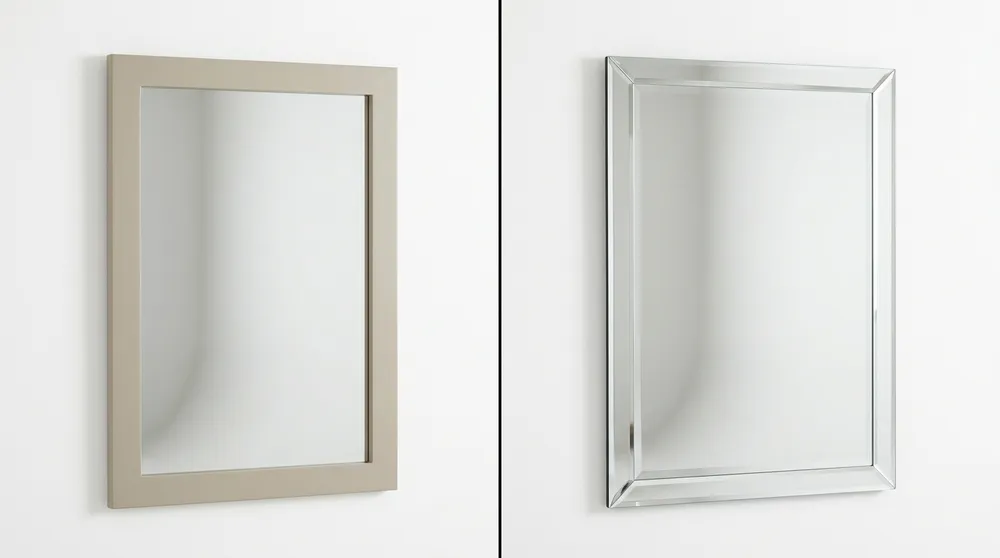
What You're Actually Buying: Construction Differences That Drive Cost
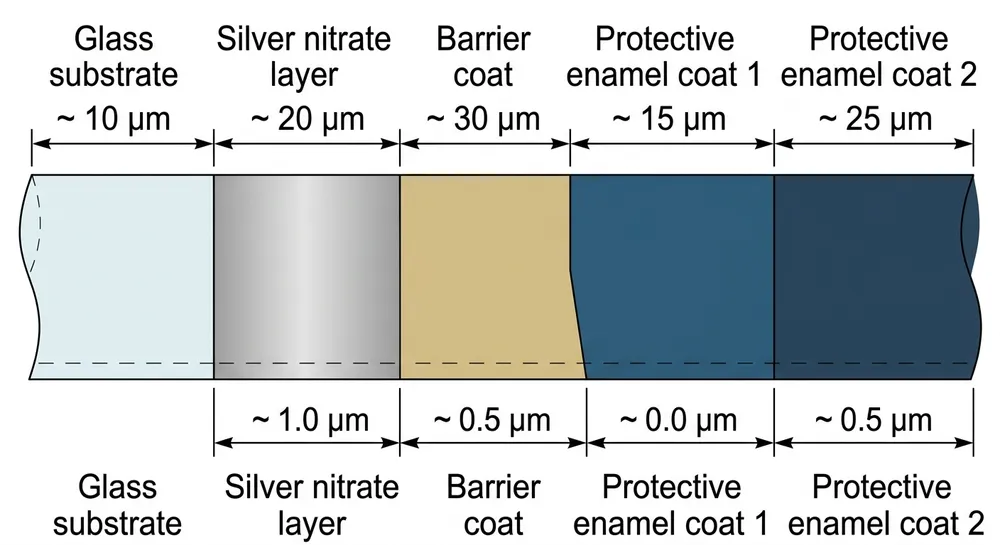
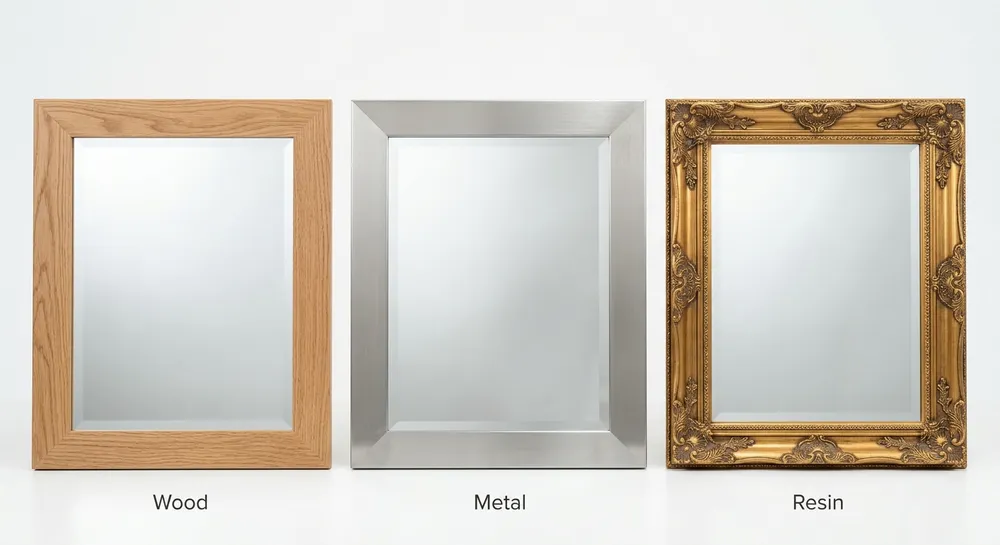
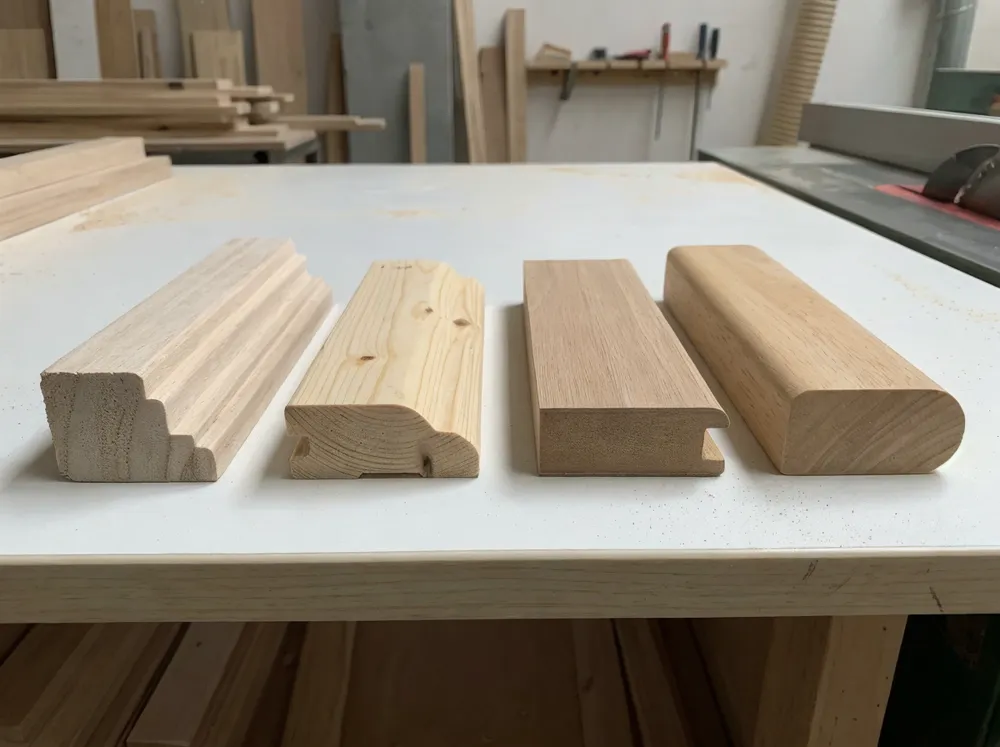
A framed mirror is a glass panel — cut, silvered, and backed — mounted inside or behind a frame profile. The frame is a separate manufactured component: MDF, solid wood, metal tube, or cast resin, finished with paint, foil wrap, powder coat, or electroplate. Assembly adds a step. Packaging adds volume. The frame is where most of the cost variation lives.
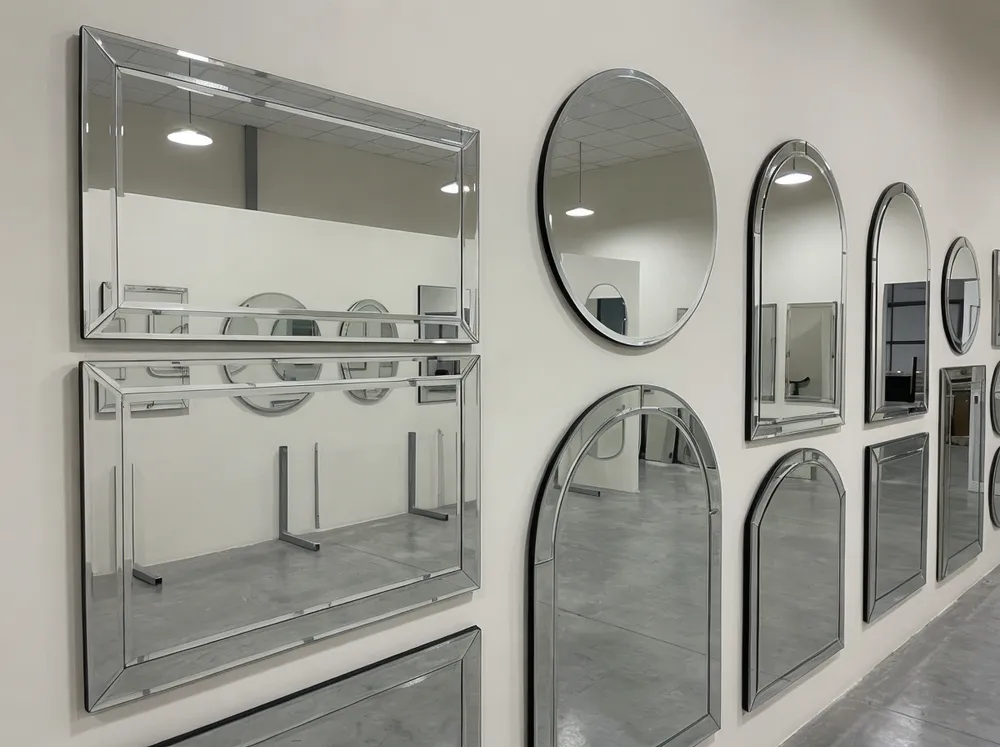
A frameless mirror is the glass itself, edge-treated and ready to hang. The standard finish is a beveled edge — typically a 1-inch bevel ground and polished around the perimeter. Some frameless mirrors use a flat polished edge or a seamed edge for lower price points. No frame component, no assembly step, no frame finishing line.
From a production standpoint, frameless mirrors are simpler. We run glass cutting, silvering, and edge processing on a single flow. Framed mirrors require frame fabrication, finishing, and assembly as separate operations — which is why lead times on custom framed profiles run longer than standard frameless SKUs. (On our standard frameless beveled range, we can typically confirm production within 3–5 business days of order. Custom frame profiles need 7–10 days just for frame tooling sign-off before glass production starts.)
The cost difference isn't just the frame material. It's the labor, the finishing line time, the assembly station, and the additional packaging required to protect the frame in transit.
Unit Cost Drivers: Where the Money Goes in Each Option
| Cost Component | Framed Mirror | Frameless Beveled Mirror |
|---|---|---|
| Glass processing | Same | Same |
| Frame material | MDF / wood / metal / resin | None |
| Frame finishing | Paint, foil, powder coat, electroplate | None |
| Assembly labor | Required | None |
| Edge treatment | Basic seam or none | Bevel grinding + polishing |
| Packaging complexity | Higher (frame protection) | Lower |
| Carton volume per unit | Higher | Lower |
The bevel on a frameless mirror isn't free — grinding and polishing a clean 1-inch bevel on a 24×36-inch glass panel adds cost relative to a plain seamed edge. But it's still significantly less than sourcing, finishing, and assembling even a basic MDF frame.
Where framed mirrors earn back their cost premium is at retail. A well-finished frame — especially in metal or solid wood — supports a retail price point that a frameless mirror simply can't reach. We've shipped framed mirrors to North American retailers at FOB prices that support $79–$149 retail, while comparable-size frameless beveled mirrors typically land in the $29–$59 retail range. The margin math works differently at each tier.
Freight and Packaging: The Hidden Cost Most Buyers Underestimate
This is where framed mirrors quietly eat into your landed cost, and where a lot of buyers get surprised on their first container.
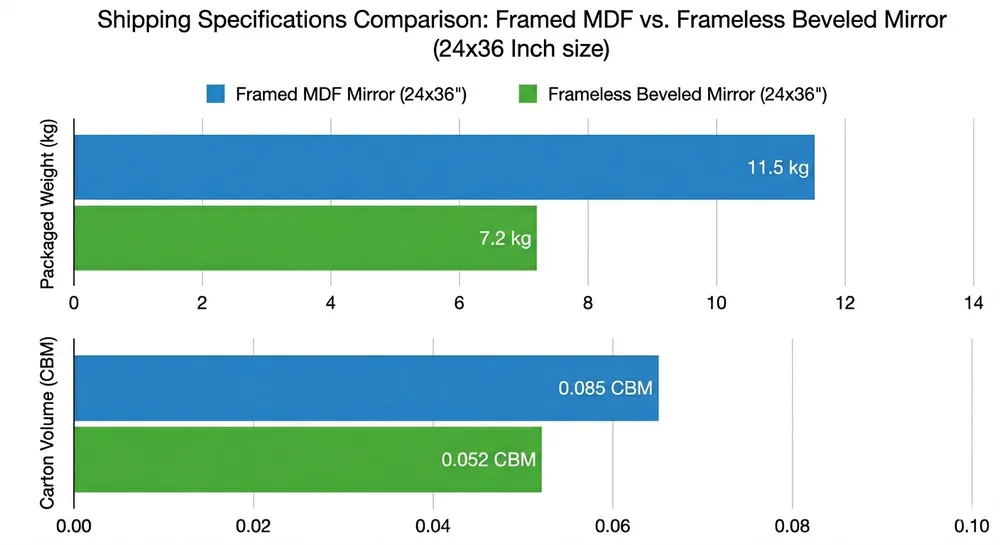
A framed mirror in an MDF frame is heavier than the equivalent frameless mirror — sometimes significantly. A 24×36-inch mirror with a 2.5-inch MDF frame profile can weigh 8–10 kg packaged. The same glass in frameless format runs 4–5 kg. On a 40-foot container, that weight difference compounds across hundreds of units.
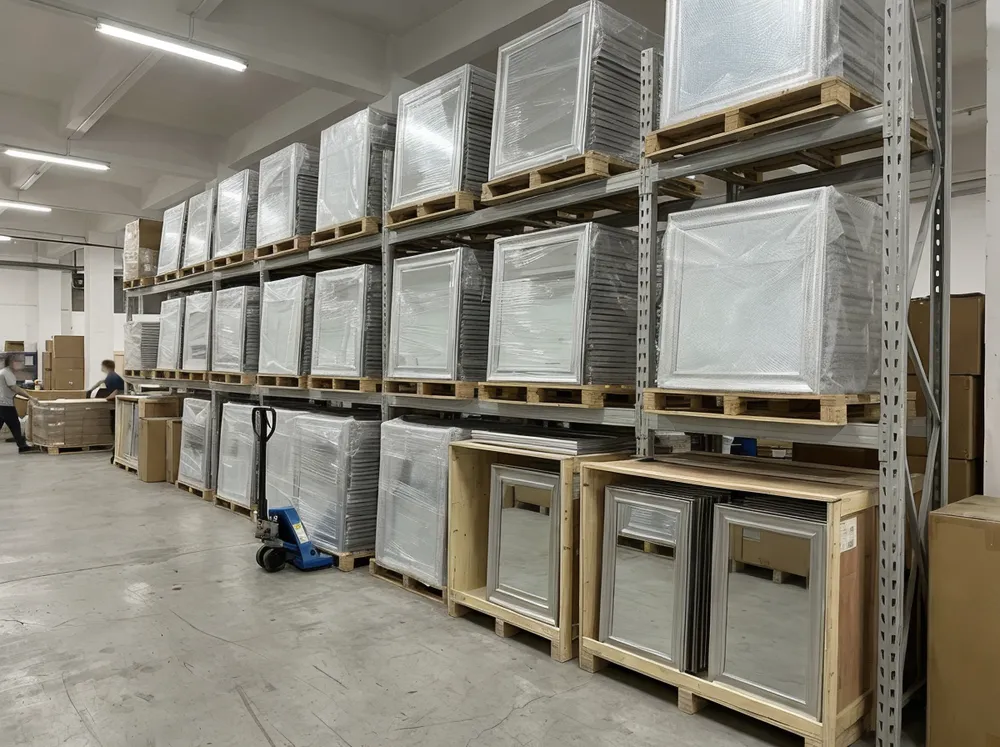
Carton dimensions matter just as much as weight. Framed mirrors require corner protection, foam inserts around the frame profile, and often a larger carton footprint to prevent frame-to-glass pressure in transit. Frameless mirrors pack tighter — flat glass with edge protection, smaller carton, better cube utilization in the container.

Breakage risk is the other freight variable. Frame profiles — especially MDF with painted or foil-wrapped finishes — are vulnerable to corner impact damage. A corner hit that would leave a frameless mirror intact (glass protected by foam, no protruding frame) can crack an MDF corner joint and delaminate the finish. We've seen damage claims on framed mirrors run 2–3× higher than frameless on the same freight lane when packaging specs aren't tight.
We address this with reinforced corner inserts and double-wall cartons on all framed mirror shipments, but it adds packaging cost. Buyers sourcing framed mirrors from factories that cut corners on packaging — and some do — absorb that damage rate as claims or markdowns. (Ask your supplier specifically how they protect frame corners in transit. If the answer is "foam wrap," push for corner molded inserts. The difference in damage rate is real.)
For buyers shipping to Australia or the Middle East — longer ocean transit, more port handling — the packaging spec on framed mirrors matters even more. We adjust our carton specs by destination lane for this reason.
Retail Positioning: Which Mirror Type Fits Which Price Tier
Frameless beveled mirrors are a commodity at the mid-to-low retail tier. They're clean, versatile, and easy to merchandise, but they don't give your buyer a reason to pay more. The bevel is the only design element, and every supplier offers it. If your retail program is competing on price in the $25–$60 range, frameless works — but your margin is thin and your differentiation is minimal.
Framed mirrors open up the retail price ladder. The frame is the design story: finish, profile shape, color, material texture. A black metal frame reads contemporary. A distressed wood frame reads farmhouse. A resin frame with antique gold finish reads traditional. Each of those positions a different SKU at a different price point, and each gives your retail buyer a reason to display it prominently rather than stack it on a bottom shelf.
For home goods retailers, specialty stores, and hospitality procurement, framed mirrors are the stronger program builder. You can develop a cohesive collection — same glass, different frame profiles — that covers multiple price points and design aesthetics from a single supplier relationship. We do this regularly for North American and European buyers: a core glass size in three or four frame options, each hitting a different retail tier.
For e-commerce programs where photography drives conversion, framed mirrors also photograph better. The frame gives the product visual weight and context. Frameless mirrors can look thin and undifferentiated in product shots unless the photography is very deliberate.
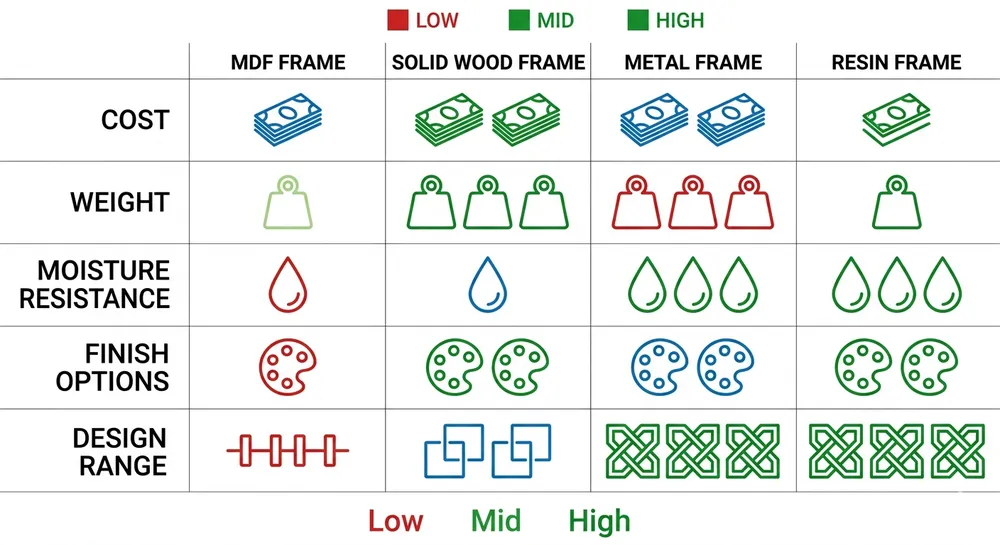
Frame Material Sub-Decision: MDF, Wood, Metal, and Resin
If you've decided framed is the right direction, the frame material is the next decision — and it affects cost, weight, finish options, and durability in ways that matter for your program.
MDF frames are the most common and the most cost-efficient. MDF machines cleanly, accepts paint and foil wrap well, and produces consistent profiles at volume. The limitation is moisture sensitivity — MDF frames in high-humidity environments (bathrooms, coastal markets) can swell and delaminate over time. For dry retail environments and standard home use, MDF is the right call on cost. We run MDF on the majority of our framed mirror volume.
Solid wood frames cost more and weigh more, but they carry a quality signal that MDF can't replicate — especially for buyers targeting the premium or artisan retail segment. Solid wood also takes stain and natural finishes that MDF can't. The trade-off is less dimensional consistency across a large run; wood moves with humidity, and tight mitered corners require more careful QC. (We use finger-jointed solid wood on most of our wood-frame SKUs — it's more stable than single-piece wood and still reads as solid wood to the end buyer.)
Metal frames — typically steel or aluminum tube profiles — are the right choice for contemporary and industrial aesthetics, and they're the most durable option for high-traffic or commercial environments. Metal frames add weight but are essentially immune to moisture and impact damage that would crack MDF. Powder coat finish on metal passes 500-hour salt spray, which matters for coastal retail accounts. The cost premium over MDF is real but supportable at the right retail price point.
Resin frames give you the most design flexibility at a mid-range cost. Resin can be cast into ornate profiles — carved-look, antique, baroque — that would be prohibitively expensive in solid wood. Finish options include antique gold, silver leaf effect, and multi-tone paint. Resin is heavier than MDF but lighter than metal, and it holds detail well. For traditional and transitional retail programs, resin frames are often the best cost-to-design-value option.
Head-to-Head Sourcing Matrix
| Dimension | Framed Mirror | Frameless Beveled Mirror |
|---|---|---|
| Typical FOB price range | Higher — frame material + labor | Lower — glass + edge processing only |
| Retail price potential | $49–$199+ depending on frame | $25–$69 typical range |
| Packaged weight | Higher (frame adds 30–60%) | Lower |
| Container cube efficiency | Lower | Higher |
| Breakage risk in transit | Higher (frame corners vulnerable) | Lower |
| MOQ at Livewellcraft | 100 pcs standard models; custom frame profiles negotiable | 100 pcs |
| Lead time (standard SKUs) | 25–35 days | 20–28 days |
| Lead time (custom frame) | 35–45 days (includes frame tooling) | 28–35 days (custom size/edge) |
| Design differentiation | High — frame profile, finish, color | Low — bevel is the only variable |
| Retail segment fit | Home goods, specialty, hospitality | Value retail, e-commerce basics, commercial |
| OEM/ODM complexity | Higher — frame profile development required | Lower — size and edge spec only |
Application Scenarios: Which Option Wins
Scenario 1: Mid-Market Home Goods Retailer, $49–$99 Price Tier
Winner: Framed mirror, MDF or resin frame.
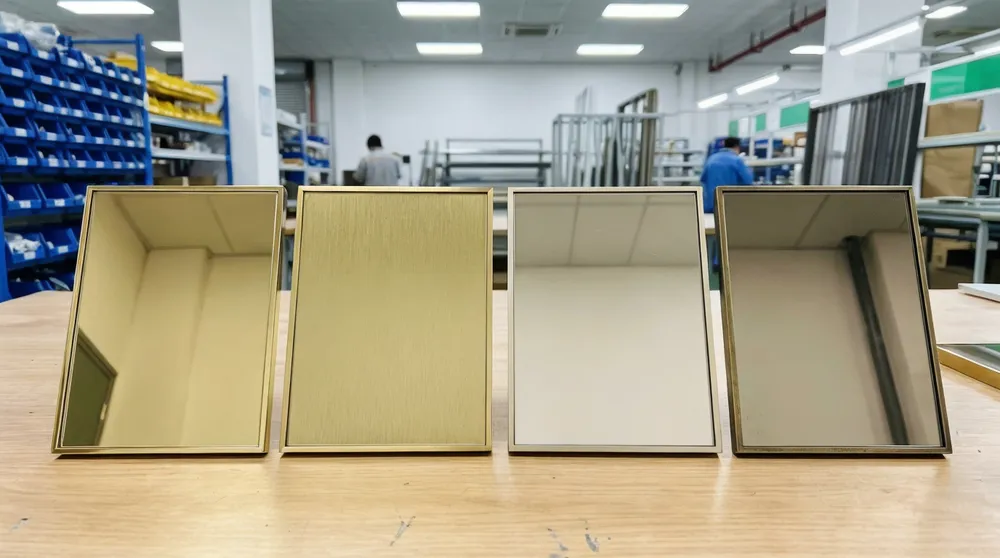
At this price tier, the frame is what justifies the retail price. A frameless mirror at $49–$99 retail is overpriced for what it is — buyers will find the same glass cheaper elsewhere. An MDF or resin frame in a current finish (matte black, brushed gold, natural wood tone) gives your retail buyer a product with a clear design story and a defensible price point. The freight premium over frameless is real but absorbed comfortably in the margin at this tier.
Scenario 2: E-Commerce Value Program, $25–$45 Price Tier
Winner: Frameless beveled mirror.
At this price point, margin is tight and freight cost per unit matters. Frameless mirrors pack more efficiently, weigh less, and have lower damage rates — all of which protect your landed cost. The bevel gives the product a clean, finished look that photographs well enough for e-commerce. You're not building a design story here; you're building a price-competitive SKU that moves volume. Frameless is the right call.
Scenario 3: Hospitality or Contract Project, 500+ Units
Winner: Depends on specification — but framed metal or solid wood for premium properties, frameless for budget properties.
Hospitality buyers care about durability and installation consistency more than retail price positioning. For premium hotel or resort projects, a metal-framed mirror with powder coat finish is the right spec — it survives housekeeping, humidity, and years of use without the finish failures you'd see on MDF in a bathroom environment. For budget hospitality (motels, student housing), frameless mirrors with a clean polished edge are cost-efficient and easy to install. We've supplied both configurations to hospitality projects across Southeast Asia and the Middle East — the spec decision usually comes down to the property's star rating and the designer's finish schedule.
Scenario 4: Specialty Retail or Boutique Home Store, $79–$149+ Price Tier
Winner: Framed mirror, solid wood or metal frame.
At this tier, the frame material itself is part of the product story. Solid wood with a hand-applied stain or metal with a brushed finish signals quality in a way that MDF can't. Your retail buyer is selling to a customer who is paying attention to materials, and the frame needs to hold up to that scrutiny. The higher FOB cost is justified by the retail price point, and the margin structure works. This is also the segment where OEM frame profile development pays off — a proprietary frame profile gives your buyer exclusivity that commodity frameless mirrors can never offer.
What to Verify Before You Place Your Order
Whether you go framed or frameless, the sourcing questions are different — and the risks are different.
For framed mirrors, verify:
- Frame material spec (MDF density, wood species, metal gauge) — not just "MDF frame" or "metal frame"
- Finish adhesion testing — ask for cross-hatch adhesion test results on painted or foil-wrapped MDF frames
- Corner joint construction — mitered and glued vs. stapled; stapled corners fail in transit
- Packaging spec — corner insert type, carton wall thickness, and whether the spec is adjusted for your destination port
- Sample approval process for custom frame profiles — confirm who owns the tooling and what the minimum run is
For frameless mirrors, verify:
- Bevel width and angle consistency across the batch — 1-inch bevel should be uniform; variation shows up badly in retail display
- Silver coating adhesion — ask for silver adhesion test protocol; poor silvering delaminates from the edges first on frameless mirrors
- Edge seaming quality on non-beveled options — a rough seam edge is a safety and aesthetic issue
- Packaging — frameless glass needs full-perimeter edge protection, not just corner pads
We run 100% visual inspection on every unit before it loads, and silver coating adhesion testing is part of our standard QC protocol on all mirror types. On framed mirrors, we inspect frame-to-glass fit, corner joint integrity, and finish consistency at the assembly station — not just at final pack. (We added the assembly-station check after a run of MDF frames where corner joint gaps weren't visible until the frame was under load in the carton. Caught it before shipment, but it was a close call.)
Choosing Based on Your Program: A Decision Framework
If you're still deciding, run through these three questions:
1. What retail price tier are you targeting? Below $45: frameless. Above $60: framed. Between $45–$60: framed with MDF is viable if your freight lane is short; frameless if you're shipping long-haul.
2. How much SKU complexity can you manage? Frameless is simpler — one variable (size), one finish (bevel). Framed requires frame material, finish, and profile decisions per SKU. If you're building a 3–5 SKU starter program, framed gives you more range. If you're adding a single fill-in SKU to an existing program, frameless is faster to execute.
3. What's your freight lane and damage tolerance? Short ocean transit (Vietnam to Southeast Asia, Vietnam to Australia direct): framed is manageable with proper packaging. Long transit with multiple port transfers (Vietnam to US East Coast via transshipment): frameless has a meaningful advantage in damage rate. If your claims budget is tight, that matters.
For buyers building a full decorative mirror program — not just a single SKU — the answer is usually both. We supply framed and frameless mirrors to the same buyers regularly; they use frameless for their value tier and framed for their mid and premium tiers. That's a cleaner program structure than trying to stretch one mirror type across all price points.
Explore our Frame Decor Mirrors range for current framed SKUs and custom frame profile options, or browse the full Decor Mirrors by Material & Frame category to see how framed and frameless options fit into a complete mirror program. If you're sourcing for a specific retail format or hospitality project, our Wall Decor Mirrors section covers installation and specification considerations in more detail.
Ready to compare actual pricing on both options for your program? Send your target quantities, preferred sizes, and retail price points to our team — we'll return a side-by-side FOB quote on framed and frameless configurations within 48 hours. Request Quote